
This week I wanted to begin a deep dive into the Declaration of Independence. To me it’s an important document whose message runs deep throughout this country. The ideas put forth by Jefferson of equality, natural rights, governments are created to protect rights, and we have the right to alter or complain about government are the heart of our democracy. But, Jefferson’s words, as great as they are, are far from our reality today and throughout history. I try to stress to the students that our history is a series of people trying to uphold the ideas of Jefferson – the American Revolution, abolitionist movement, Women’s Suffrage Movement, soldier’s fighting overseas, Civil Rights Movement, LGBTQ rights, Black Lives Matter, the Me Too movement. Whether you agree or disagree with their actions and statements – they are fighting for equality, they are fighting for a better life, they are pursuing happiness.
Before I got into the Declaration of Independence, I needed to begin with the Enlightenment. I focus heavily on 3 things for the Enlightenment: John Locke, natural rights, and Social Contract. There is no need to overcomplicate it – these are the basic understandings students need to comprehend Jefferson’s words in the Declaration of Independence.
Monday – Fast and Curious Quizizz, Vocabulary evaluation, Sketch and Tell
Tuesday – Fast and Curious, Cyber Sandwich, Vocabulary Evaluation
Wednesday – Number Mania
Thursday – Thin Slide, Begin Hyperdoc on the Declaration
Friday – Fast and Curious, 8pARTS
Monday
I began Monday with a Fast and Curious to introduce the Enlightenment period. As suspected, classes bombed the Enlightenment quiz because let’s face it – 8th graders don’t know much about the Enlightenment theories or government. This is such a weird, abstract concept to them. I have learned to take a different, hands on approach with government related topics, especially with middle schoolers.
The first run of Fast and Curious (12 questions) my class averages across the board hovered around 52%. This brought us into our next part of the lesson with vocabulary. I am trying a new literacy strategy with vocabulary that I like to pair with Frayer models and/or Sketch and Tells. I have been using an evaluative vocabulary strategy (click here for sample) where I have the students evaluate their knowledge of words based on 3 items: Know It, Not Sure, or Don’t Know It.
When I first do this, I stress to the students to be honest with themselves. If they truly KNOW a word, they should be able to define it within seconds, in their own words. Then I explain if they are not sure of a word that means they have seen it, but can’t define it. Finally I explain, if they don’t know a word that means they have never seen it before. Anything they are unsure about, or don’t know, then they Frayer the word. I like to have the students state, elaborate, exemplify, and illustrate the unknown words. I don’t spend more than 10 minute on the Vocabulary evaluation.
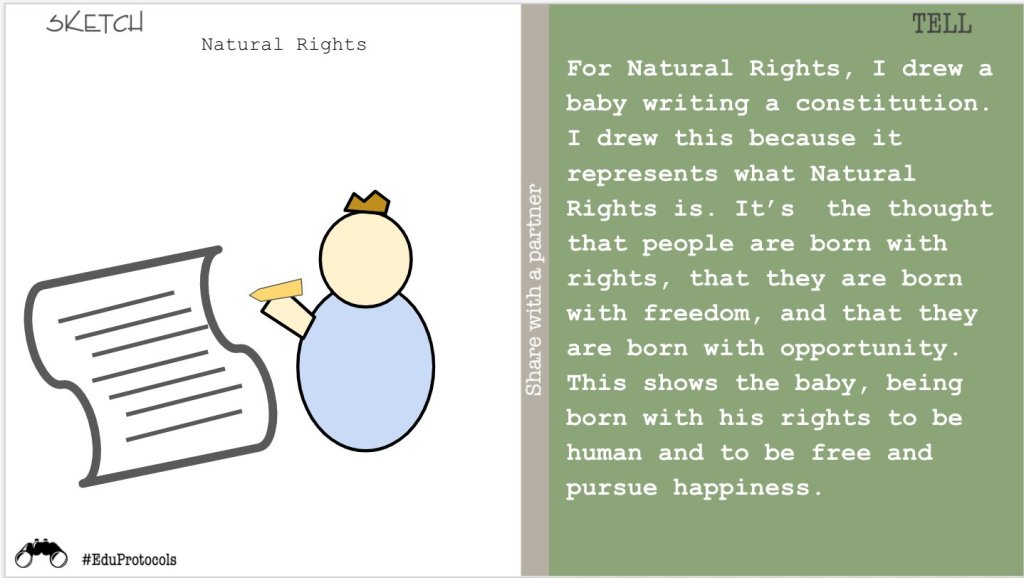
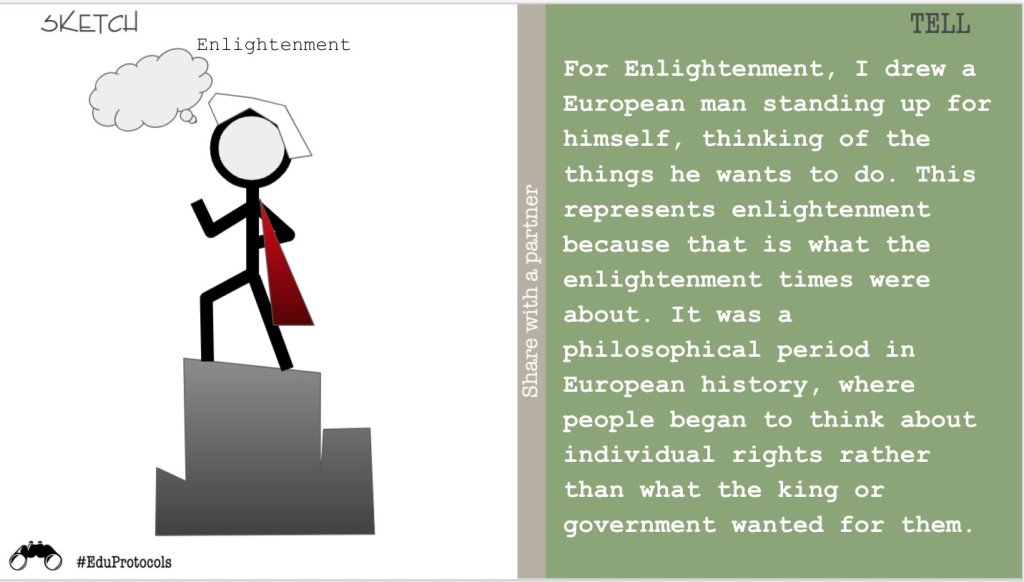
For the illustrate part of the Frayer, I had students do a Sketch and Tell (click here for file). They could use Google Shapes, Legos, or Playdoh for their creations. I really wanted to emphasize natural rights and social contract. Here are some examples:


Tuesday
Tuesday I started with a Cyber Sandwich (click here for the file). I try to do one of these a week. Occasionally, I will structure the note-taking portion, and other times I will leave it alone. For our Enlightenment Cyber Sandwich, I left the note-taking unstructured – Find 6 or more facts from the reading. The reading came from ICivics – a great, simple article on the Enlightenment which is great for middle schoolers.
I loaded up Monday with vocabulary to prepare students for reading on Tuesday. Students read for 10 minutes and took notes about the Enlightenment – natural rights, social contract, the influence on America. I like to share notes that I took after the 10 minute timer goes off. This was followed by a 5 minute discussion and note comparison. Finally, students summarized their learning with a 5+ sentence summary.

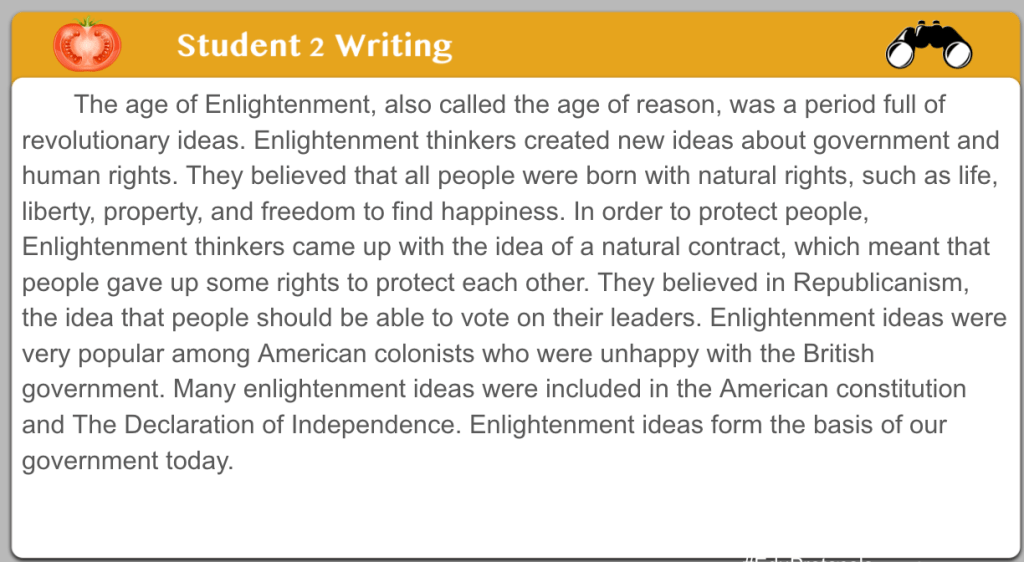
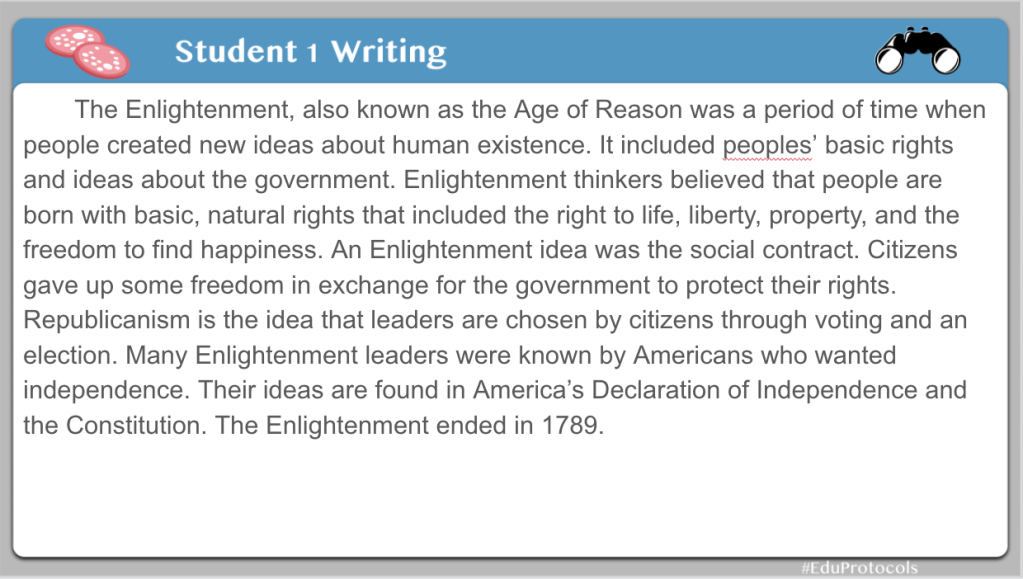

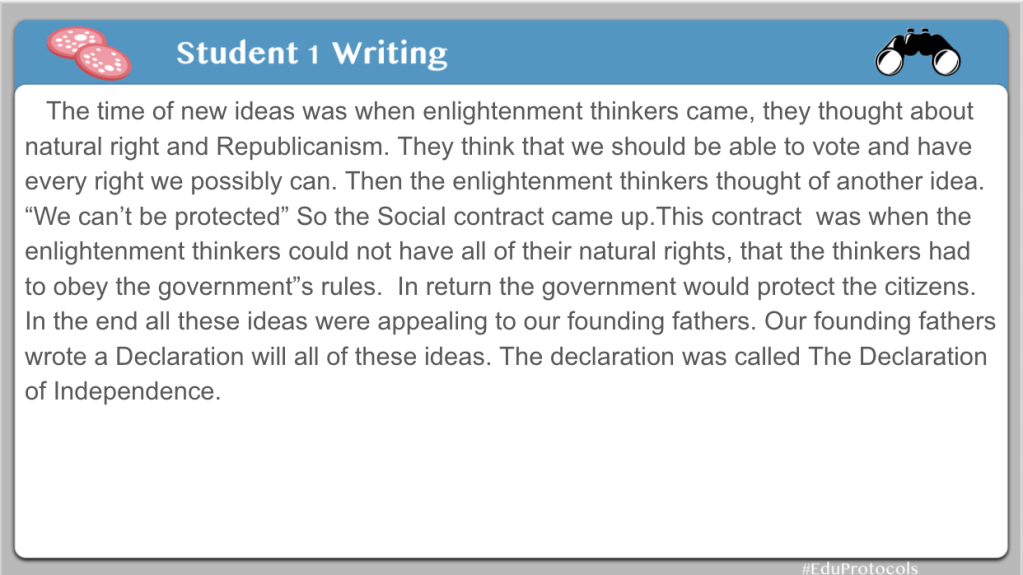
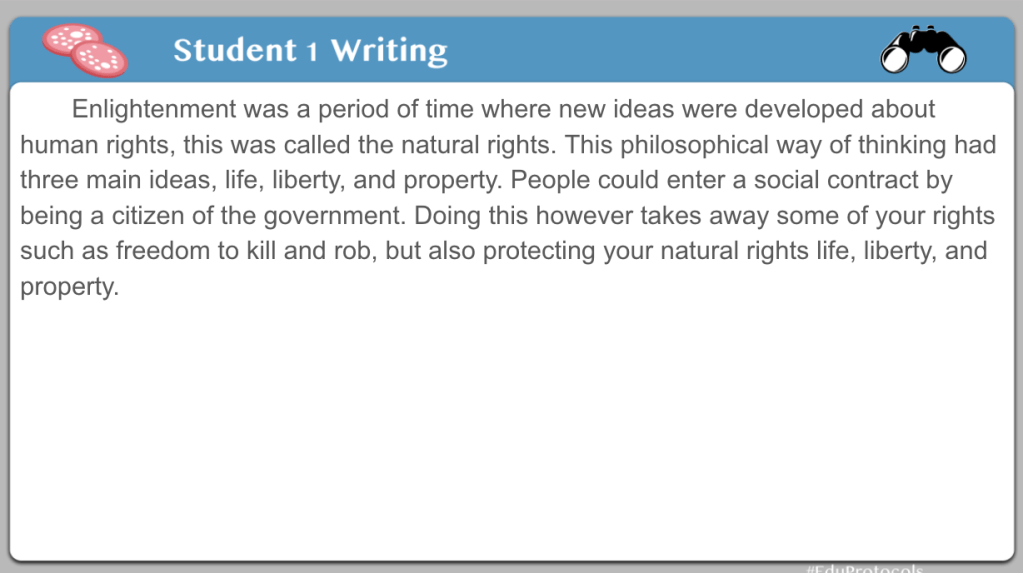
I like to do a fast and curious after a Cyber Sandwich to show the effectiveness of the vocabulary strategies and Cyber Sandwich notes, discussions, and summaries. All classes began with a 50-55% average and finished with: 82%, 87%, 90%, 94%, and 81% in 2 days. This is a huge confidence builder for students and helps create engagement and enthusiasm for the Cyber Sandwich.
Wednesday
Wednesday, I decided if I continued with the Enlightenment, it would not be good. The students demonstrated their knowledge of the key concepts of natural rights and social contract. I was ready to move onto the Declaration of Independence. They were ready to move on as well.
Here’s how I operate most days – I fly by the seat of my pants, go with the flow, and take it all in stride. I usually have a plan, but I’m always looking to change it to something better. With that being said, I had an introductory lesson for the Declaration of Independence, but a photo memory popped up in my phone. The photo memory was a Declaration of Independence Number Mania I put together 2 years ago.
Before I went into the Number Mania lesson, I began with a Thin Slide. I asked students, “What’s the importance of July 4th?” Students had 3 minutes to share 1 picture and 1 word about the importance of the 4th of July. I learned quickly to make one rule – the 1 word cannot be fireworks or anything to do with blowing stuff up. When the 3 minute timer went off, I went around the room and students presented for 10 seconds or less. Common responses:
- “The Declaration of Independence was signed.”
- ‘We won independence.”
- “We became a new country.”
I use these quotes to clear up misconceptions and this created a nice transition to the Number Mania lesson.
I saw the Number Mania picture in my photo memories and wanted to do this again. However, I remembered last time I did it, the lesson seemed unorganized and students were looking up random facts. It had no flow. It wasn’t that great. As a result, I searched for an article with numbers (dates and facts) about the Declaration. I found nothing. I did the next best thing – I typed my own article, added subheadings and loaded it up with numbers and related it back to the Enlightenment for some reinforcement of those ideas.
Here was the number mania lesson flow:
- Students read the article for 10 minutes.
- They submitted two or three numbers and facts through a Google Form.
- I shared the Google Sheet of facts with the class.
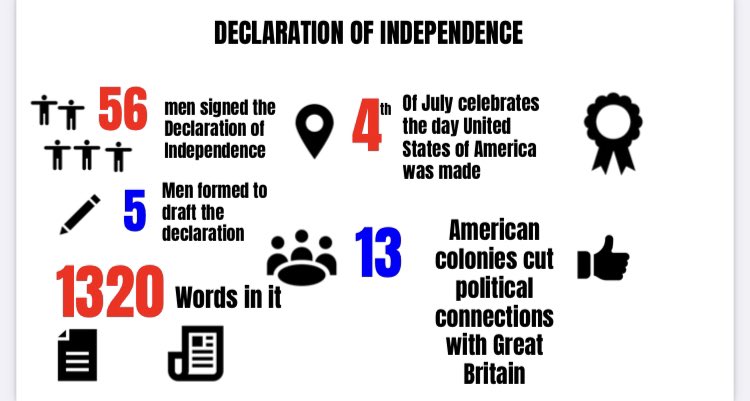
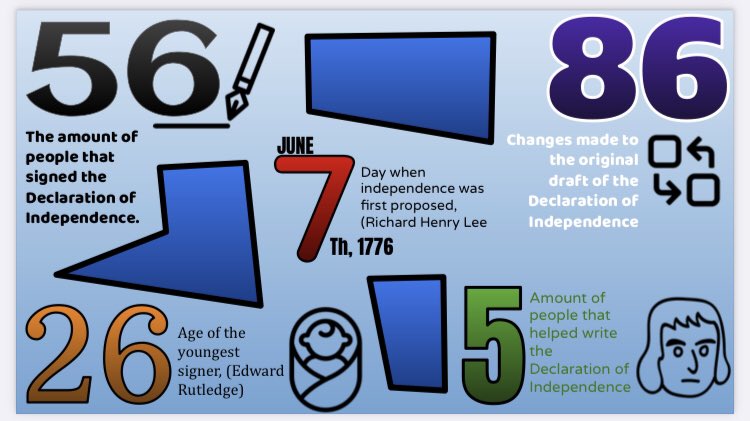
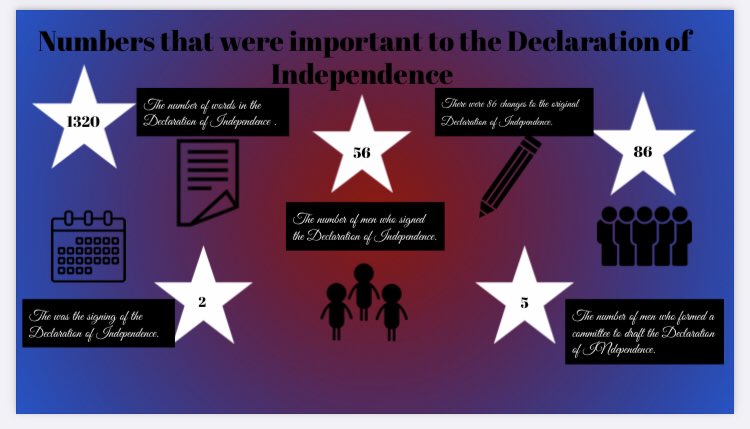
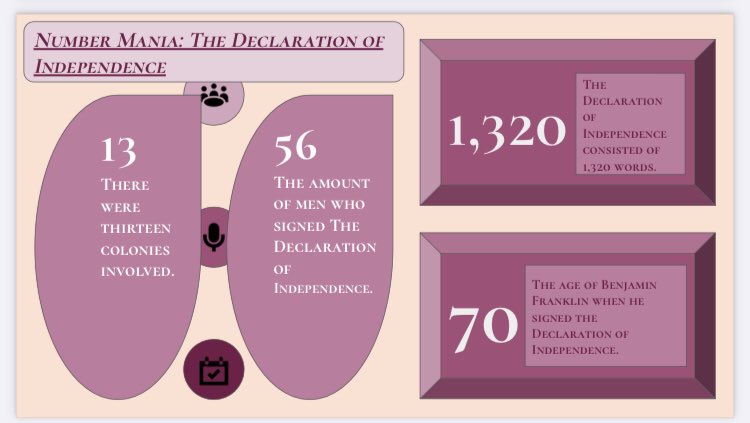
- Students created an infographic about the Declaration of Independence with 5-6 numbers. (The template was created by Stephanie Howell – @mrshowell24)
In 40 minutes, here are the results of our number mania:



Thursday
To begin class, I had students take 10 minutes to finish their Number Mania infographics. I asked them to answer these questions before submitting:
- Does it have a title?
- Is it easy to read or organized?
- Did you add color and change fonts?
- Do you have 5-6 facts?
When this was completed, I transitioned to a hyperdoc I created about the Declaration of Independence. The hyperdoc is located here. I designed my hyperdoc around 2 questions – What is the meaning of the American Revolution? and What is the meaning of the Declaration of Independence? Here are my sections on the hyperdoc:
Engage – Morgan Freeman’s stated, “True glory of the Declaration of Independence is our nation’s epic struggle to close the gap between the ideals of this beautiful document and the sometimes painful realities of our existence.” What have we done throughout history to close the gap?
Explore – Who was involved with creating the Declaration of Independence? Why did they write this document? Students answered these questions with an 8pARTS.
Explain – with this section, students are diving into the Declaration of Independence. I will begin this part of the lesson by reading a fake breakup letter or sharing a compilation of break up videos. This hooks the students in before we make meaning of the document.
Apply – I’m having students do some blackout poetry as a mix up. They will circle or box words that help explain the meaning of the Revolution and Declaration.
Share – students will share their blackout poems with me.
Reflect – students will take a Quizizz one more time.
Friday
I started class off with a fast and Curious about the Declaration of Independence. The Quizizz I created related to the Number Mania article and ideas from the Enlightenment. The class averages students received determined my next move. If classes reached an 80% or higher, we were going to try out an Iron Chef – Archetype lesson I learned from my friend Dr. Scott Petri. If classes got below an 80%, we were doing an 8pARTS summary lesson.
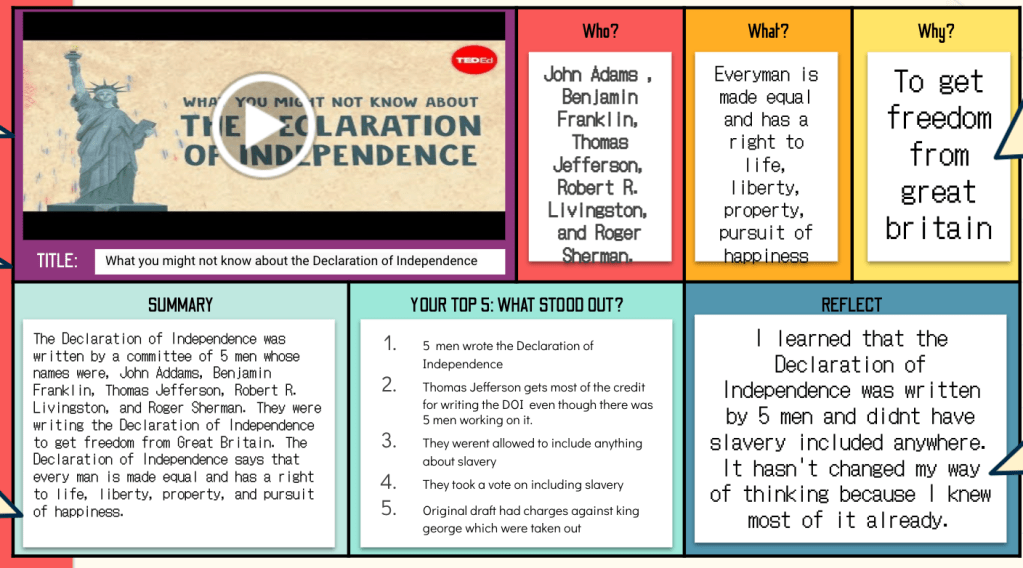
As a result, my 2nd, 4th, and 7th periods did the 8pARTS summary lesson (click here for the file). This lesson used a template from Amanda Sandoval (@historysandoval). Students watched a Ted Ed video about the Declaration of Independence and took notes about Who, What, and Why as they watched. I took notes as well and we had a debrief and discussion. I really like this Ted Ed video because it pairs really well with the Number Mania article I typed. After our debrief, students had 10 minutes to summarize, list 3 items that stood out the most, and reflect on new learning. Here are some examples:


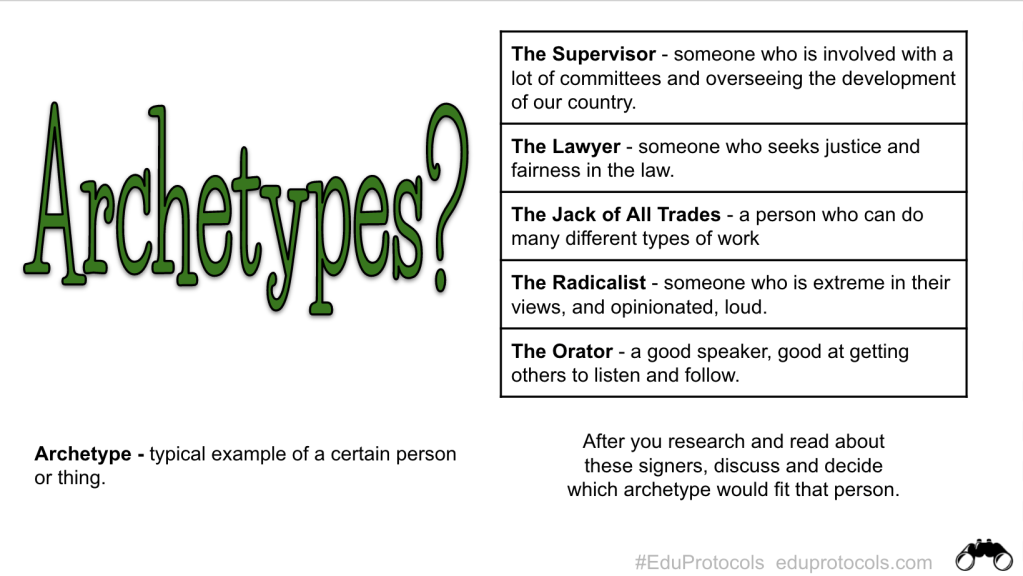
For my 5th and 6th periods, we tried out a new Iron Chef-Archetype lesson. An archetype is a title or persona you can connect to characters. Typical archetypes are: the hero, the jester, the lover, the caregiver, and so on…. You can learn more here. These archetypes, however, wouldn’t work with my lesson on the Declaration signers, so I created my own. Here are my archetypes:
- The Supervisor – someone who is involved with a lot of committees and overseeing the development of our country.
- The Lawyer – someone who seeks justice and fairness in the law.
- The Jack of All Trades – a person who can do many different types of work
- The Radicalist – someone who is extreme in their views, and opinionated, loud.
- The Orator – a good speaker, good at getting others to listen and follow.
I created this archetypes after reading the bios of selected Declaration signers. The list of Declaration signers included: Benjamin Franklin, Thomas Jefferson, John Adams, Benjamin Rush, Edward Rutledge, and Samuel Adams. I wanted to choose a list of familiar Founding Fathers we would be studying in the future.
I had students get into groups of 2 or 3. Then I had students choose one of the Declaration signers from my list. They had to visit this site: www.ushistory.org and read a brief bio about their chosen signer. Here are the rest of the steps:
- 20 minute timer.
- Read and List 5 facts about their signer.
- Decide and discuss which archetype to apply to their signer.
- Explain why they chose that archetype.
- Connect a modern day person to that archetype as well.
Here are some examples and a link to my template:
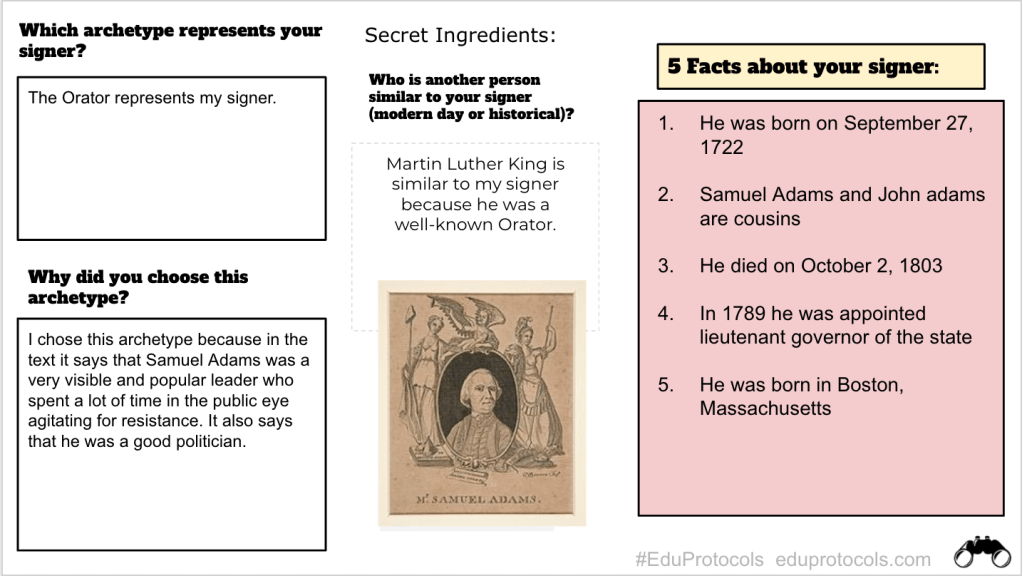
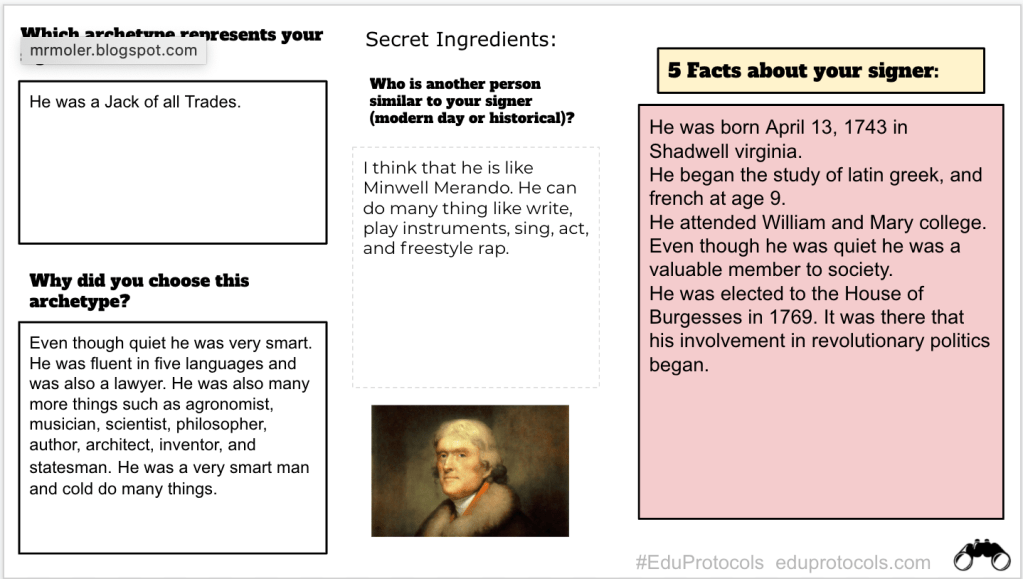


I really liked this lesson as it had students making connections between archetypes, historical figures, modern people, and using evidence. For a quick lesson on archetypes, and only 20 minutes, my students did a phenomenal job!
My Messages for the Week
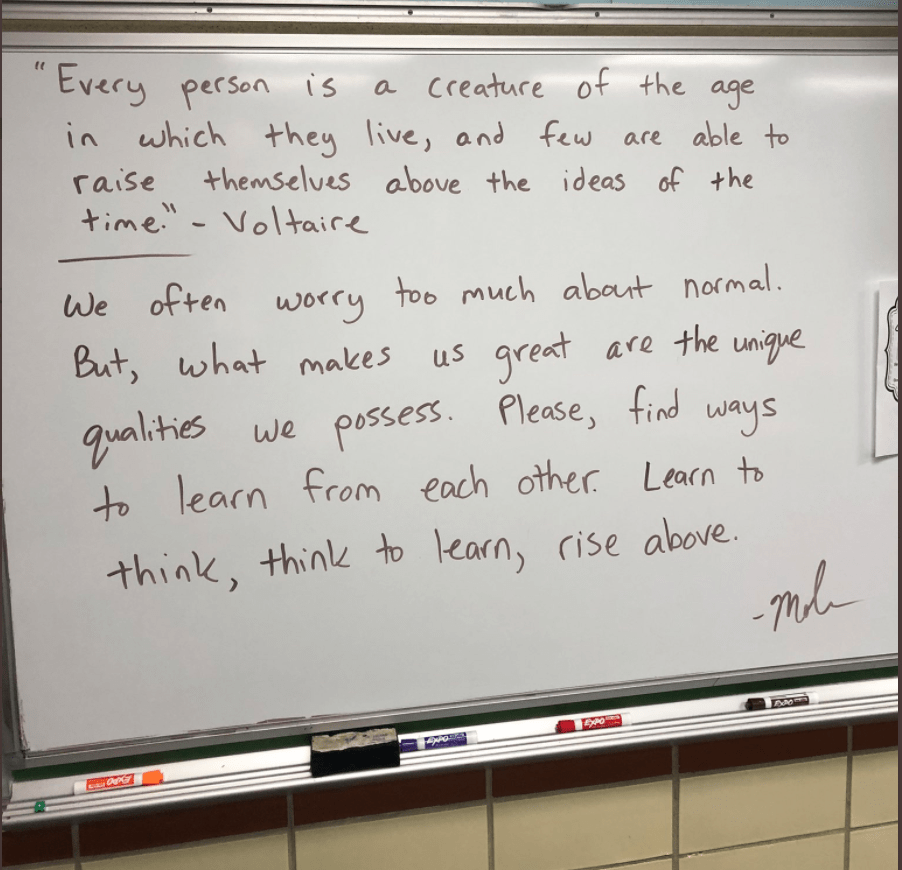
Everyday for the last 2 1/2 years, I write a new message on my board. I don’t bring attention to it. I don’t ask students to read it. It’s just simply there. Yet, students always tell me it’s the highlight of their day and they look forward to reading my message. I post them to my instagram account everyday (Follow me at @moler.adam). I never thought to post them on here, but I will now:



 Moler's Musings