This shortened week was a continuation from the effects of colonization. Last week, during our lesson on the effects of colonization I hinted at slavery and the Middle Passage knowing I was going to build off of that topic and conversation this week. This week turned out to be an EduProtocols free week, which is super rare for 505. My focus this week was to get students up and moving whether it was in the classroom or outside.
Tuesday – Middle Passage stations
Wednesday – Middle Passage stations, blackout poetry
Thursday – History Mystery Investigation – Roanoke
Friday – History Mystery Investigation – Roanoke
Middle Passage
When it comes to teaching about the Middle Passage and slavery, I don’t try to shock the students. I don’t show any videos that require a permission slip. I’ve even heard of having students lay side by side to create an experience – no, nope, not me. I thought and thought about a way to introduce the students to the Middle Passage. I really like the SHEG lesson about the Middle Passage, but it didn’t seem right for what I was trying to teach. A great idea hit me as I was looking at the SHEG lesson! The Middle Passage Slave Ship diagram listed the dimensions of the space set aside for enslaved adult males at 6′ x 1’4″ space. So, as students came in on Tuesday, I had a 6′ x 1’4″ space marked off with tape and the diagram on the board.
The taped off space with the picture created lots of questions. We used some questions to figure out that the diagram was a slave ship. It’s one thing to read about a 6′ x 1’4″ space, but it’s another to actually see it and make a connection.

After our introduction to the Middle Passage, I set up stations around my room. I’ve had people ask me to share the stations, but I cannot because I got them from Peacefield History. The stations begin with a quick Ted Ed video on the Middle Passage to build background information. The other stations included a primary source from Olaudah Equiano, a great video from Slate showing the amount of slave ships leaving Africa, some statistics, and a map. I love the mix up of sources for the stations. In an effort to mix things up, I had paper copies of the stations for students, I had the stations set up around the room in case students was to move around, I had the stations online, and I had QR codes for scanning. (This seems excessive, but I try to cater to every possible need.) The Middle Passage stations lasted 2 days. As students finished their station questions, they brought them to me and I gave some quick feedback and graded.
Through these stations students learned about Triangular Trade and applied it to past learning about European colonization. They also learned about misconceptions regarding the Middle Passage. Finally, they learned about the horrors of a slave ship on the Middle Passage from the Olaudah Equiano source.
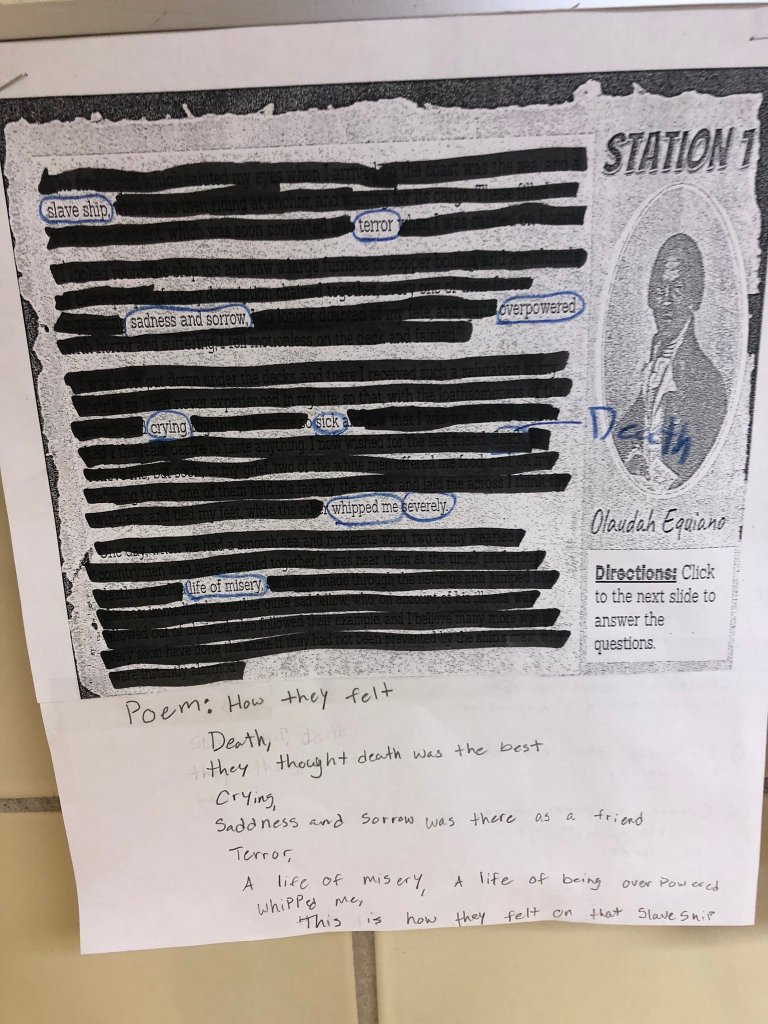
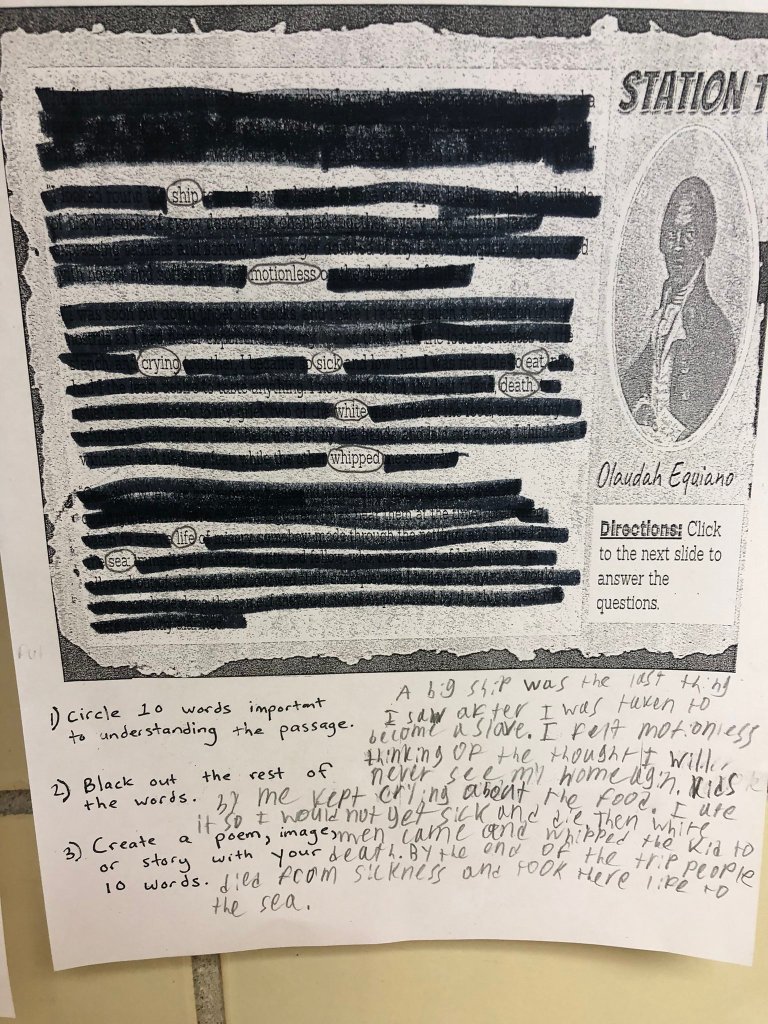
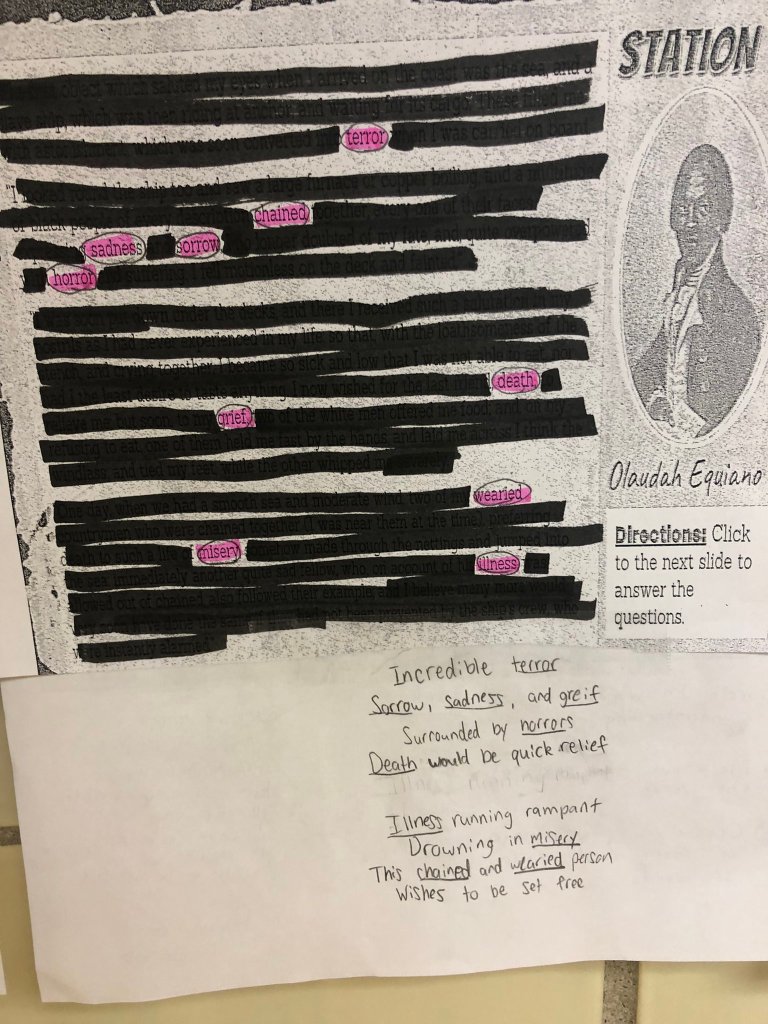
To wrap up the Middle Passage stations, I got a great idea from the Fully Engaged book from Michael Matera and John Meehan. I had students go back to the Olaudah Equiano primary source. Students selected 10 words important to understanding the source. They blacked out the remaining words. The final step was create a poem, story, or drawing related to the 10 chosen words. I phrased it as, “Unlock the a hidden meaning” within the source. With middle schoolers, it’s all in how your phrase things to create excitement and buy-in.
History Mystery – Roanoke
About 2 weeks ago as student asked me, “Do we study Roanoke in here?” I replied, “I haven’t done that in 5 years, but we can.” If a students inquires about a relevant topic, I should honor that question to build trust, rapport, and engagement for 505. I found my lesson from years ago, but I knew Mr. Roughton had something better. I went to Kevin Roughton’s site and found his History Mystery – Roanoke Lesson. I like this lesson for several reasons:
- It includes great primary and secondary sources.
- It works well with our historical thinking skills (sourcing, contextualizing, corroborating).
- It includes conflict between Spain and England which ties to Ohio’s standards of conflict over resources.
- It has students writing a claim with reasoning and evidence.
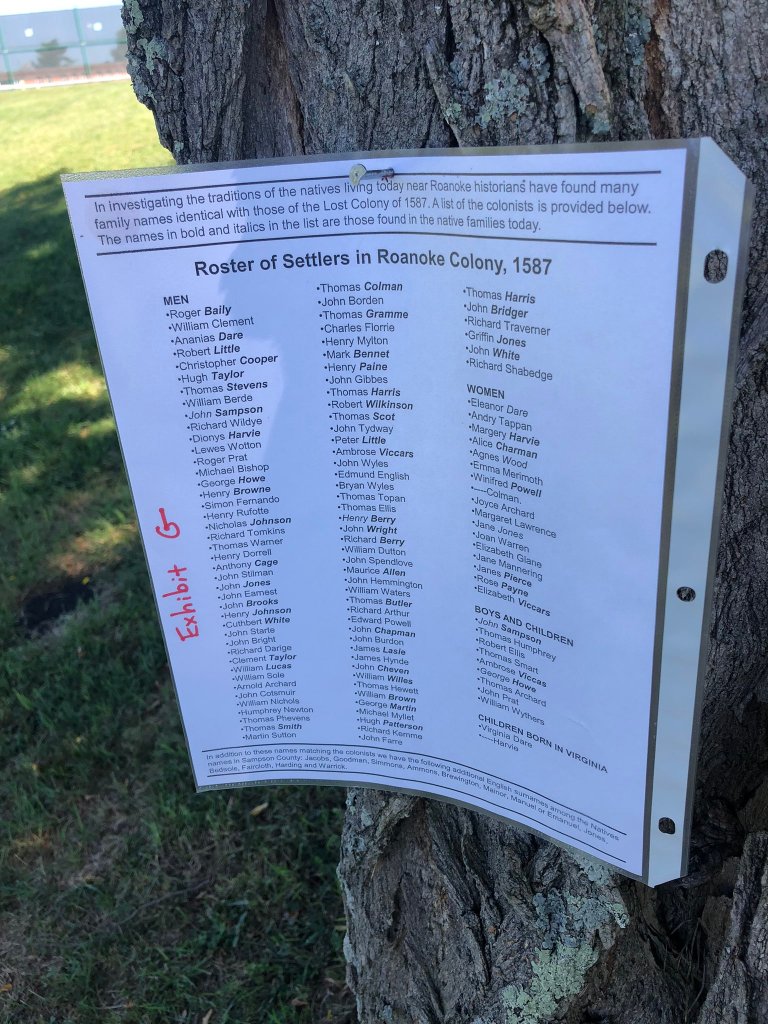
I printed off the lesson and I like to organize the exhibits (evidence) by writing the exhibit letter on the sources. To kick this lesson up a notch, I found out custodian and asked for a hammer and nails. I walked across our campus and nailed all of the exhibits to trees. The trees were located near the woods and my thinking was to create a “you just arrived in the New World with trees, grass, and nature” feel. I don’t know if it worked, but we got to go outside, move around, and students were engaged.
As the day progressed, I realized I had to do 3 things with this lesson:
- I had to place the Roanoke story in context by comparing the Roanoke to Jamestown and Plymouth with a map and a timeline.
- I had to model historical thinking skills with an exhibit – especially sourcing, and contextualizing. I thought out loud as I modeled the process.
- I had to explain the story of Simon Fernandez. If you don’t know who that is, it’s an interesting story so click here.
This lesson took 2 days to finish and once students knew about Jamestown, Simon Fernandez, and saw me modeling historical thinking skills – full student engagement. They worked well together, asked great questions, and enjoyed the story of Roanoke. Next time I run this lesson, I might provide context better with a quick Cyber Sandwich or Frayer some important words. In the end, this lesson was a great set up for our 13 colonies lesson next week.


 Moler's Musings