Each new school year I’m committed to trying new, creative teaching strategies while making old lessons better. One of my favorite strategies is smashing some EduProtocols together for lessons and/or larger units. The unit I’m featuring in this post is a historical thinking mini- unit where the students learn about primary sources, secondary sourcing, sourcing, contextualizing, corroborating, and close reading. These skills come directly from the Stanford History Education Group (SHEG) site.
In years past when teaching historical thinking skills, I felt like I spent way too much time on the topic. I would usually spend a week or more going over sourcing, corroborating, and contextualizing. During the unit we would practice these skills with topics the students probably didn’t know much about. It wasn’t the best way to begin the school year in social studies. Ultimately, my historical thinking skills unit wasn’t very engaging. The new mini-unit I put together lasted 3 days (I have 47 minute classes).
Wednesday – Fast and Curious, Sketch and Tell.
Thursday – Fast and Curious, Sketch and Tell, Number Mania
Friday – Fast and Curious, Number Mania, Digital Breakout
Fast and Curious
This year I began the historical thinking skills unit with a Fast and Curious on Quizizz. I asked basic vocabulary questions about historical thinking skills. Moreover, I asked questions about primary and secondary source examples. Once we finished the quiz, I saw the questions that were color coded yellow and red and gave some feedback. The average across the classes the first day was a 65%.
The 2nd class day we did the Fast and Curious on Quizizz again. I gave feedback as I discussed the yellow coded questions. The class averages were raised to a 73% for the 2nd day. The 3rd day of classes, we did the Fast and Curious one more time. All of the classes averaged together ended up being 84%.
I like Quizizz because it provides so much data to help with feedback. For example: yellow and red coded commonly missed questions, average time per question, and it keeps track of student data. I also like that Quizizz randomizes answer choices, questions, and students aren’t memorizing letter choices. Here is my Quizizz link.
Sketch and Tell
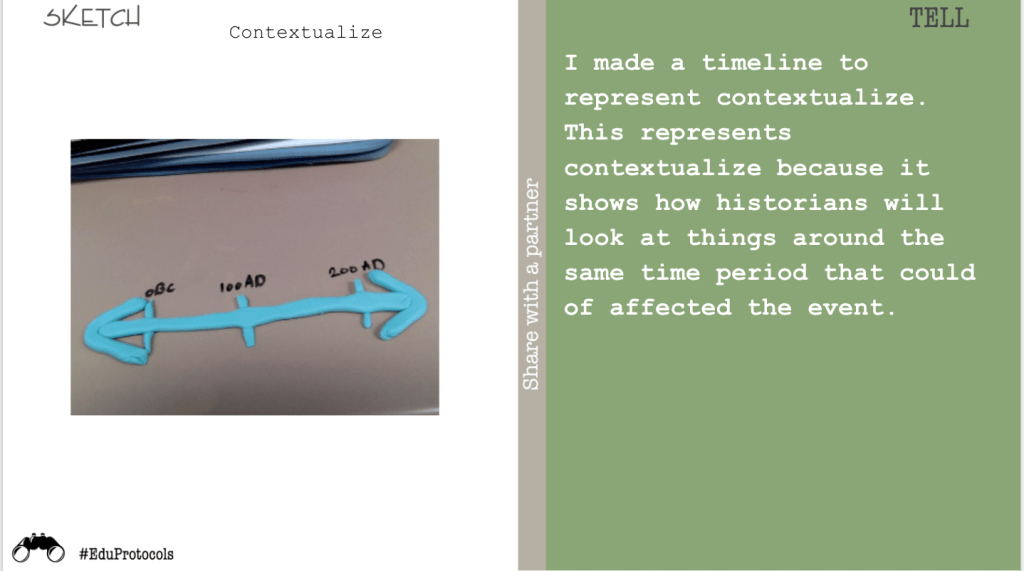
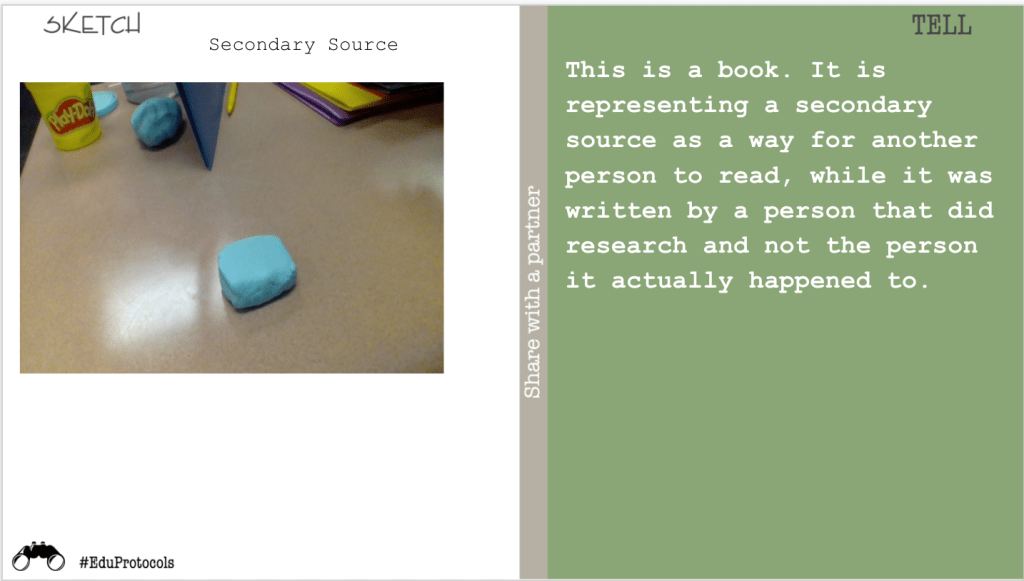
In past years I would have students write out definitions with examples as they worked in groups. I started to do this with my 1st period class, but as I was circulating around the room, I was bored. Next period, I switched it up to a Sketch and Tell Eduprotocol. Here is my template link.
I created a slide deck with directions and 5 sketch and tell slides for the words: primary source, secondary source, sourcing, contextualizing, and corroborating. When the next class came in, the slide deck was ready to go and we got out the Play Doh. Using the Play Doh, or Google shapes, students created abstract representations of each historical thinking word. For example, some created a question mark or magnifying glass for the word sourcing. Students then explain the meaning of their representation ultimately creating a definition for each word. This ended up being more engaging and more hands on for these basic vocabulary words.




Infographic/Number Mania
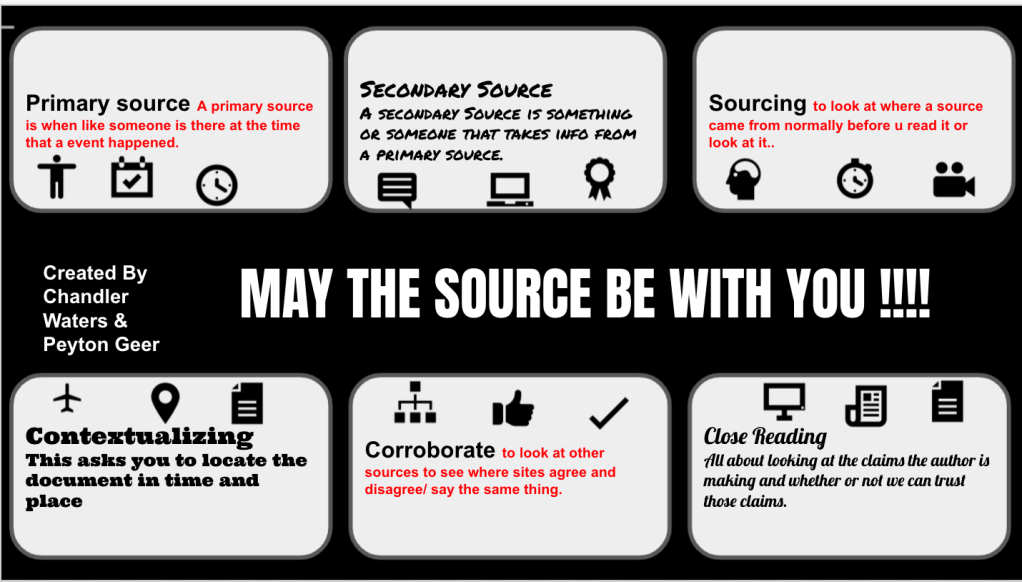
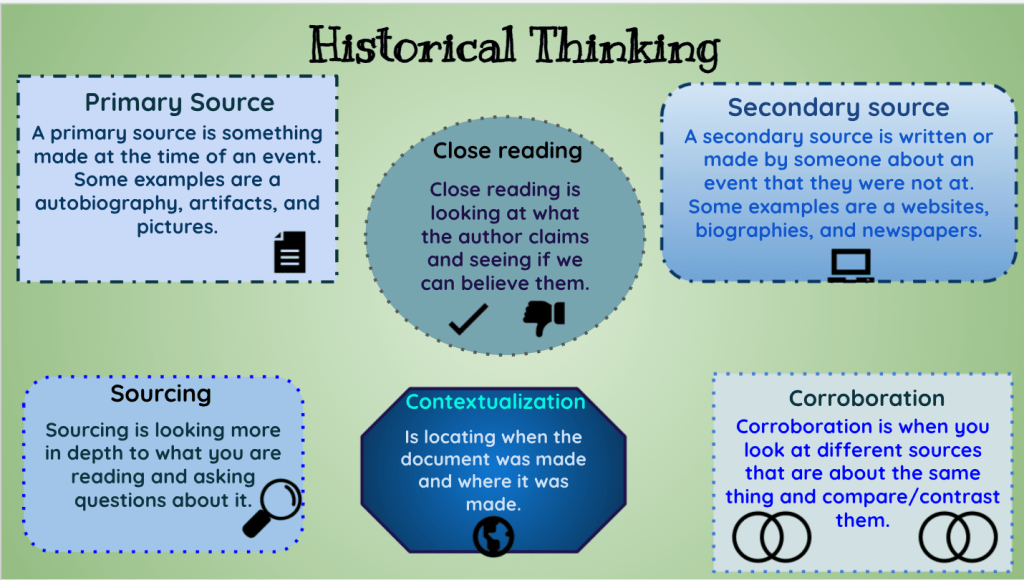
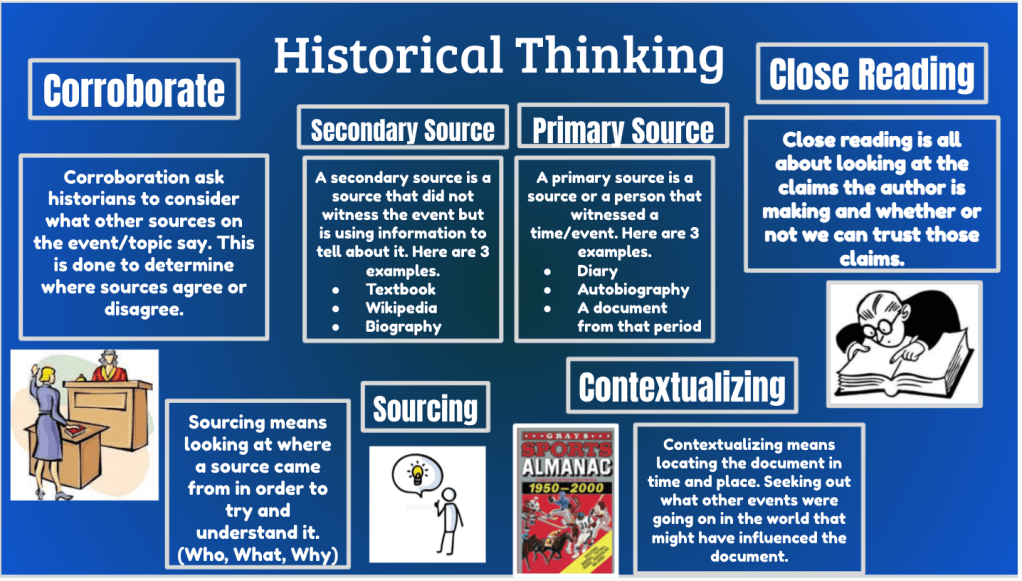
Once students finished their Sketch and Tell, they created groups of 2 or 3 and made a Historical Thinking Skills infographic using a Number Mania template (I love using this template I got from Stephanie Howell – @mrshowell24). I explained to students that infographics share large amounts of information in condensed, easy to understand formats. I also gave my classes 40 minutes of class time to complete the task. The success criteria I established was this:
- Simple definitions used for each historical thinking skill.
- 3 examples provided for primary sources 3 examples provided for secondary sources.
- Icons and images used relate to historical thinking skills.
- Information was organized and easy to understand (no large blank spaces)



Digital Breakout
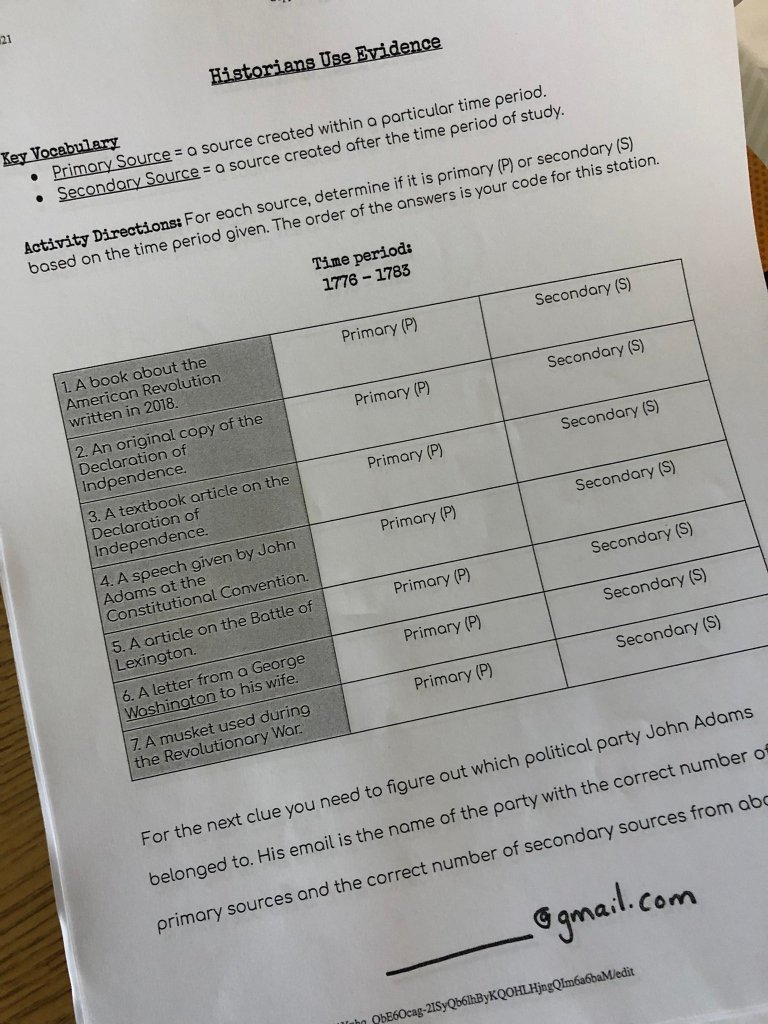
To end this unit, I put together a digital breakout. Instead of my typical breakouts where I use a Google Form for students to collect clues, I set up fake email accounts with vacation responses that sent their next puzzle. With each puzzle, students had to figure out the email address so they could send an email and get the next puzzle. There were 3 puzzles students had to complete:
- Determining if a source was primary or secondary.
- Determining which source would be the best to use to understand different historical events.
- Sourcing a painting and justifying if it would be useful with understanding the first Thanksgiving (a SHEG lesson).
The last sourcing puzzle had to be approved by me. When it was approved, I gave them a clue to help figure out the 3 digit code to open up the lockbox.
This digital breakout proved to be awesome because it was a crazy Friday for our first full week of school and super engaging. Plus, it wasn’t super hard and intimidating. I like for students to have a good first experience with digital breakouts so it keeps their interest throughout the year.


Final Thoughts
All in all this was a much more engaging lesson.
- The Fast and Curious was great for repetition and learning the material.
- The Sketch and Tell was great for hands on learning, dual-coding, and having students relate the abstract to more concrete examples they created.
- The infographic was a creative way for students to work together. Plus, this was a great way to see how students would/could work together. Alao a great way to see their creativity with a blank slide.
- Digital Breakouts are always fun and engaging – especially on a Friday.

 Moler's Musings