Introduction
This week we continued and finished our unit on the constitution. We incorporated some eduprotocols such as Frayer, Hero’s Journey, and Archetypes with limited government. For example, we used an iCivics article about Alberto Fujimori to illustrate concepts of limited versus unlimited government. Next, we followed this up with a lesson on federalism. For federalism, I brought in Oreos for a mystery box lesson. I used Thin Slides, sketch and tell, and a 3xPOV challenge. On Wednesday, we began part 1 of our 2-part constitution assessment. I shared a CyberSandwich and an article about how the constitution limits the power of government. On Thursday, we did part 2 of our assessment which was the citizenship test questions that I originally gave on January 4th. We began a new unit with a Geography challenge on Friday—the New Republic—where I focus on the decisions and the presidencies of the first 5 presidents.
Monday – Limited Government
Tuesday – Federalism
Wednesday – CyberSandwich, Reading
Thursday – Citizenship Test
Friday – Geography Challenge
Monday
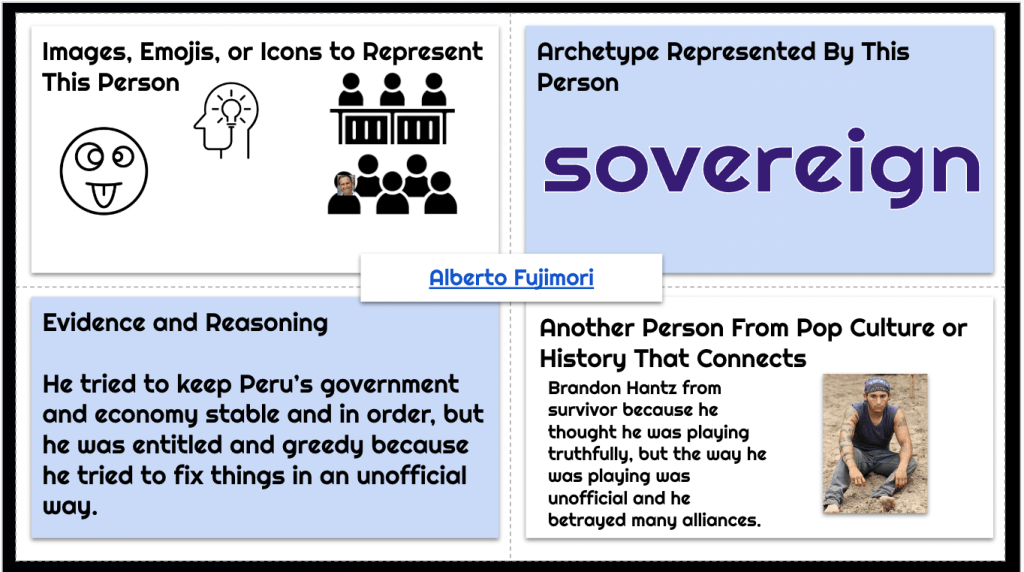
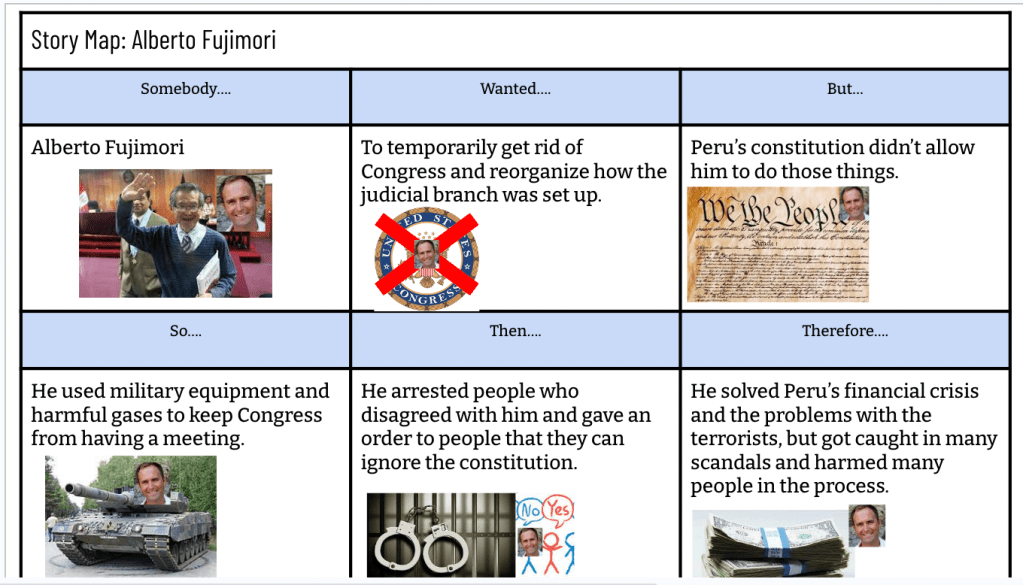
On Monday, we had a lesson on limited government. This was an extension from Friday’s class. For this lesson, I used an iCivics lesson about limited government. The first part of the reading involved words we already knew—such as separation of powers, rights, and popular sovereignty. I selected the word “rule of law” because the students had never heard that word before. So, students completed a Frayer model for that word and paraphrased the definition, found 3 connecting words, and found an image to represent it. Next, students read the article and sorted characteristics of limited and unlimited government. Next, students read an article on Alberto Fujimori who was elected President of Peru and eventually made himself a dictator. He got rid of separation of powers, removed people’s rights, abolished the Constitution in Peru. I took a Hero’s Journey template and changed it to a different format for comprehension—Somebody, Wanted, But, So, Then. I added a 6th element…..Therefore. Students read the article and mapped out the story. Students followed this up with a 4-square archetype about Alberto Fujimori. What’s interesting on the archetype is the number of students who read that Fujimori fixed Peru’s financial problems and terrorism problem and viewed him as a hero. Some even tried relating Rosa Parks and others to him. I intervened and said, “No, no—sorry that connection does not make sense.” I had to explain that Alberto Fujimori made himself a dictator, had opponents killed, and ended a democracy for his selfish interests. Maybe the students seeing him as a hero is a product of the world we live in now…..I do not know. With the archetypes, students chose images to represent Fujimori, chose an archetype, used evidence, and made a connection to another person in pop culture or history.


Tuesday
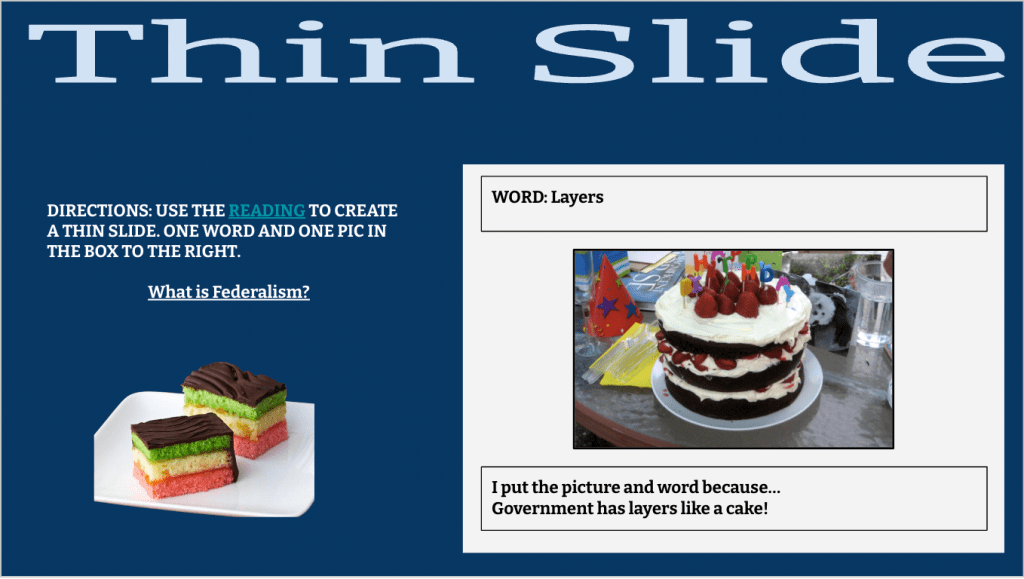
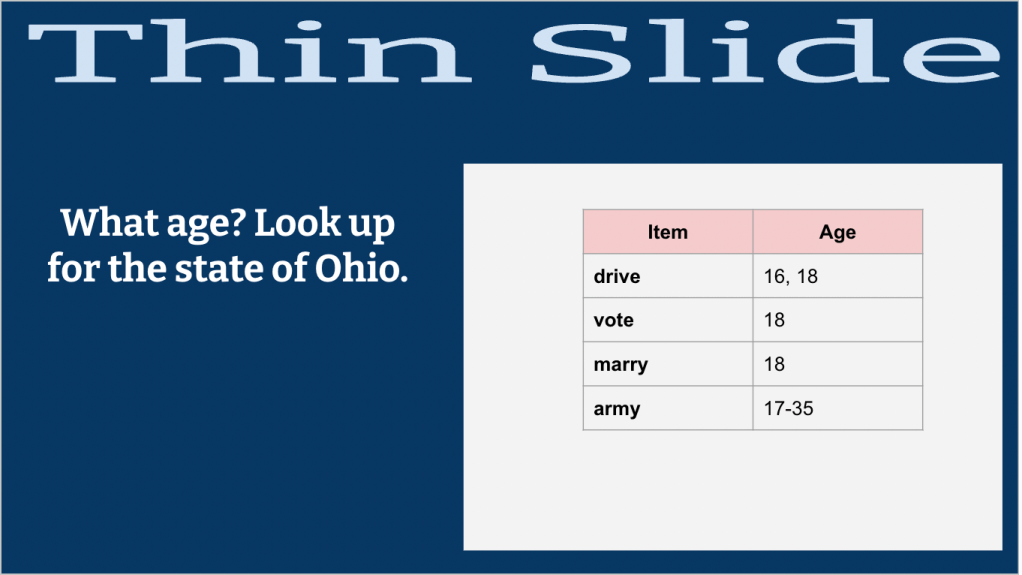
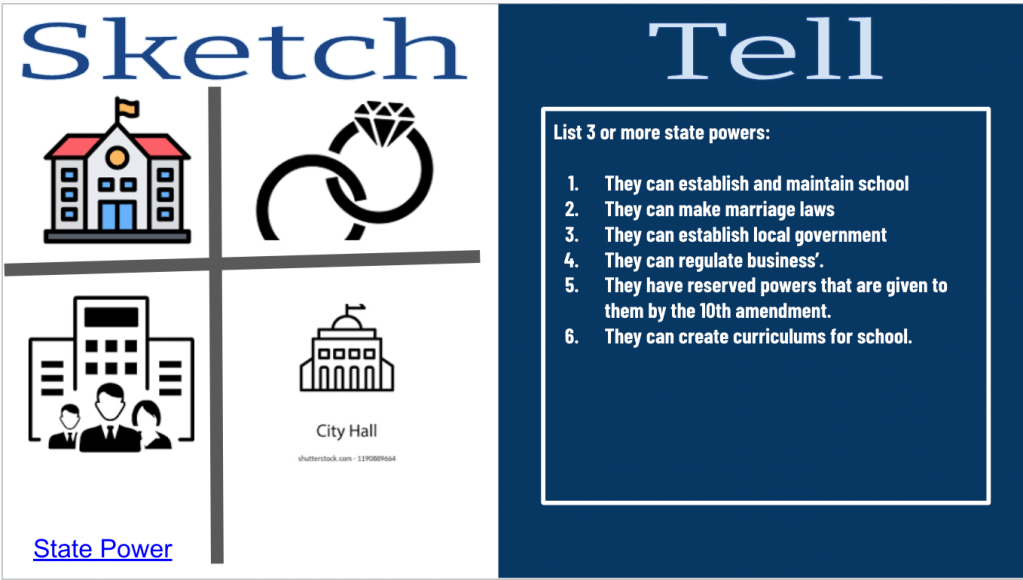
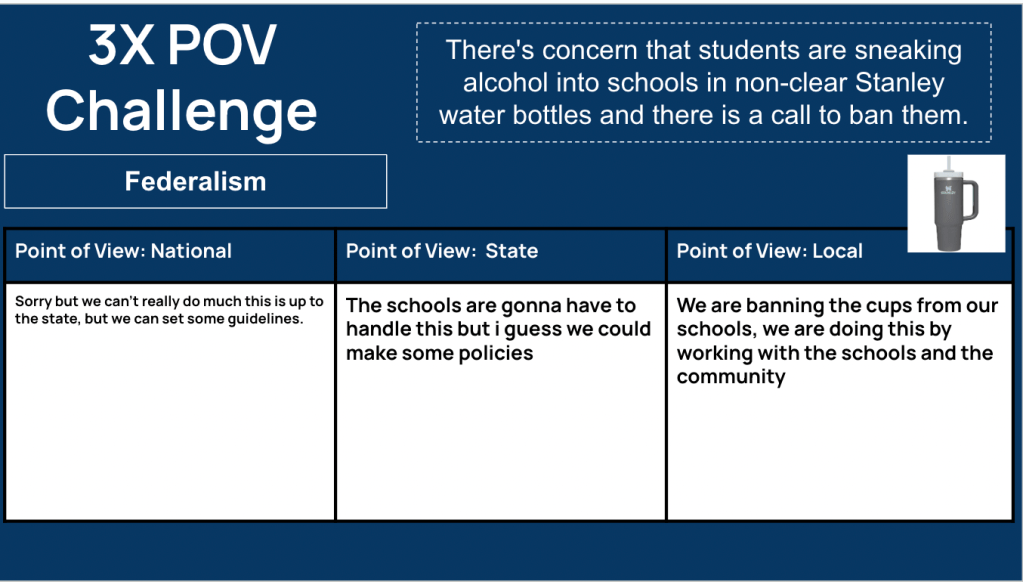
With my federalism lesson, I switched it up this year. I still did a mystery box lesson and I dropped hints about the Oreos in the mystery box. Without the lesson, I was still dropping hints about the Oreos inside the mystery box. However, this year I decided not to have the students use the Oreos in their sketch and tell. I began the lesson with a thin slide where I had the students read a brief description of federalism and they chose one word and one picture and then explained why they chose that word and picture to represent federalism. Next, we did a second thin slide where I had the students look up the ages in Ohio if they wanted to drive, vote, get married, and join the army. We then had a discussion on who sets these age limits—whether it is the state or national government. Next, I had the students use a sketch and tell template and they pulled information from an infographic I found on federalism. Students created pictures on the sketch and tell or found icons to represent expressed powers, state powers, or concurrent powers. Finally, I ended the lesson with a 3xPOV eduprotocol where I gave the students a scenario and asked them to consider the perspective of the national government, state government, and local government. I used a scenario involving the school wanting to ban Stanley tumblers, but as we started that activity, the students struggled to put themselves in the position of the different levels of government. I understand this difficulty because they are 8th graders. I also thought about what was missing from the lesson that could help them better grasp this concept. Ultimately, it is going to be tough for 8th graders to envision how national, state, and local governments would respond. Although I tried to guide them, they struggled, which is understandable at their age. However, I am reflecting on how to improve their perspective-taking ability on this topic.




Wednesday
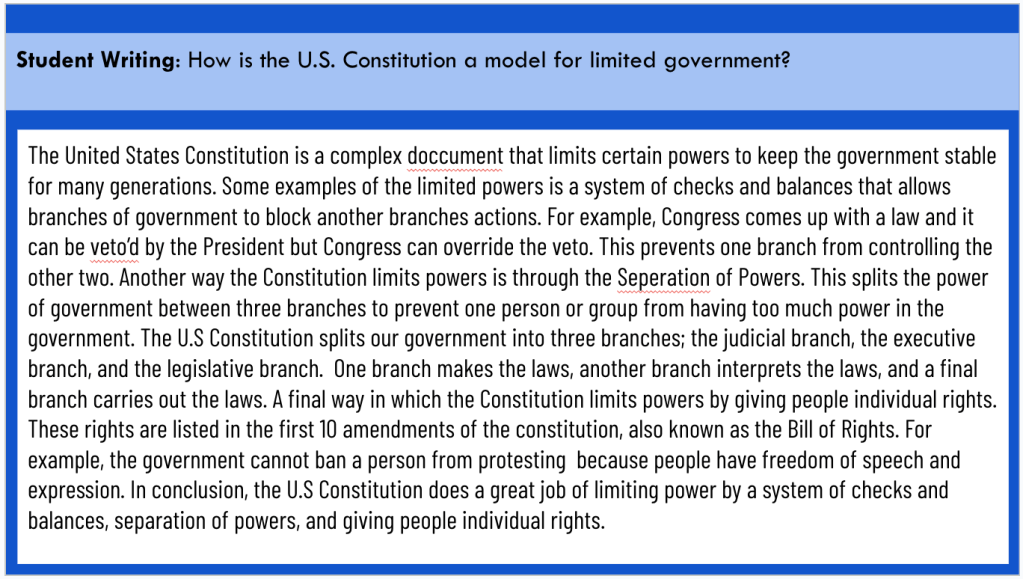
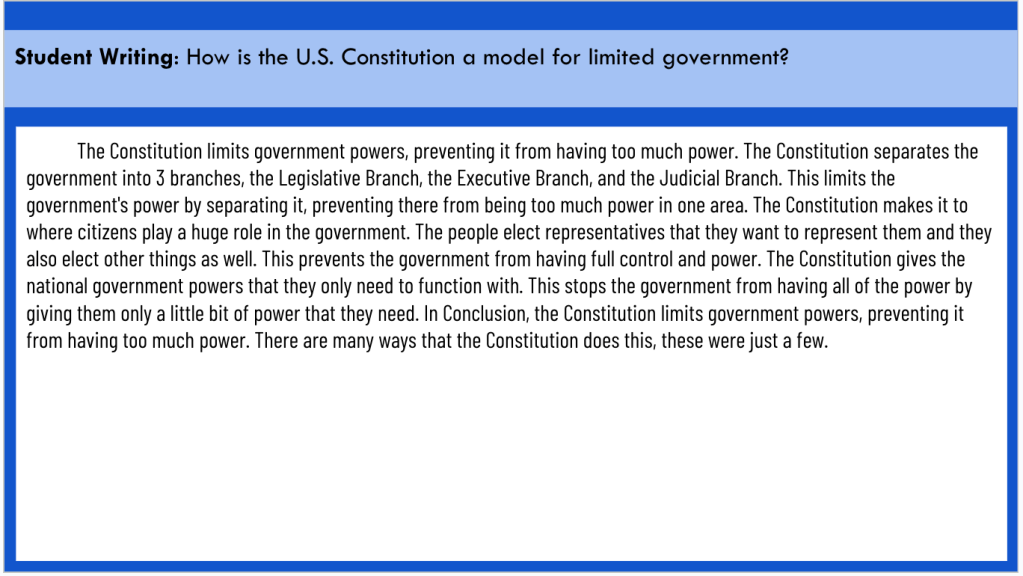
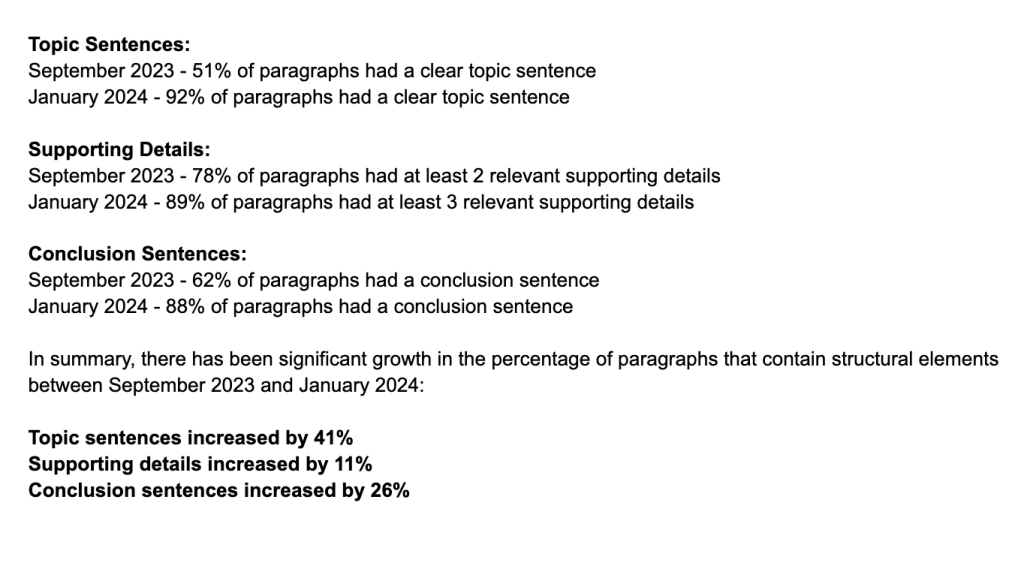
On Wednesday, we began our final assessment for the constitution unit. I like to do two-part assessments because some students enjoy creating projects to demonstrate understanding while others prefer taking quizzes. So my units always contain both types. Part one of our assessment was a cybersandwich where I asked “How is our constitution a model for limited government?” During the cybersandwich, I linked to a reading that I had AI generate because I believe AI allows personalized lessons. I copied and pasted our unit essential question into AI, mentioned what we learned about popular sovereignty, federalism, separation of powers, checks and balances, individual rights, and limited government. Then I asked AI to write an article for 8th graders incorporating details from our specific activities like the tug-of-war on separation of powers and the Oreos representing federalism. AI helps tailor content for students, so that’s why I used it here. Students read the article, took notes, discussed in groups, and then created a paragraph answering how the constitution exemplifies limited government, with a topic sentence, 3 supporting details, and conclusion. I had AI scan their paragraphs and compare them to our first cybersandwich paragraphs of the year because I want to track their paragraph writing progress in regards to using evidence. The results are in the image below. After finishing the cybersandwich, we did a Gimkit review in preparation for part 2 of the assessment on Thursday.


Thursday
On Thursday, we completed part 2 of our assessment using the same citizenship exam questions from January 4th. I read the questions aloud while students wrote down answers. After 10 questions, they input their scores into a Google Form. I analyzed the results with AI—their average improved from 3.1/10 to 7.5/10! We closed with retrieval practice games where their averages were in the low 70% range, which is decent.
Friday
On Friday, I introduced our new early republic unit with a geography challenge from TCI. I pondered using a MapWich EduProtocol but opted to keep the activity simple since it was Friday. However, I had AI modify TCI’s original questions because I did not like them. On Claude, I explained what content students were analyzing and asked for DOK 1, DOK 2, and DOK 3 questions. While I dislike premade maps, I know when students need a bit of a relaxed day. The challenge allowed them to label maps and answer basic questions on the population increase, which sufficed for a Friday. Additionally, I incorporated a claims-evidence-reasoning question asking them to evaluate expansion as positive or negative—so they still did higher-order thinking.
 Moler's Musings