The Week That Was In 505

This week was another testing week with the Ohio AIR math test. At the end of the week, our assistant principal sent out a weekly updated and asked the question, “What does AIR stand for in Ohio AIR Test?” I responded with, “AIR – Academically Inconvenient Requirement.” I don’t think I won the trivia contest.

This week we continued our unit on the causes of the Civil War. I asked the question, “What conflicts over slavery led to the Civil War?” This week we focused on the Missouri Compromise, Compromise of 1850, and the Kansas and Nebraska Act.

This semester I”ve been trying to build in more opportunities to have students empathize from multiple perspectives. I have been using some 2xPOV, empathy maps, and perspective summary writing at the end of different lessons.

Monday – Missouri Compromise

Tuesday – Compromise 1850/Fugitive Slave Act

Thursday – Kansas and Nebraska Act

Monday

On Monday, we began with the Missouri Compromise. I asked the question, “How did the Missouri Compromise attempt to balance free states and slave states between North and South?” I began the lesson with a Gimkit with 3 or 4 questions about the Missouri Compromise. I ran the Gimkit for 3 minutes, and then ran it again for 2 minutes.

Next in line, we switched Frayer model with the word, Compromise, in the center. Around the word Compromise, I had students create definition, use it in a sentence, share examples, and nonexamples. For the examples of Compromise, I urged everyone to think of examples we have learned about in class. They came up with, “3/5ths Compromise, the Treaty of Ghent, the Treaty of Paris 1783.” I thought these were great connections.

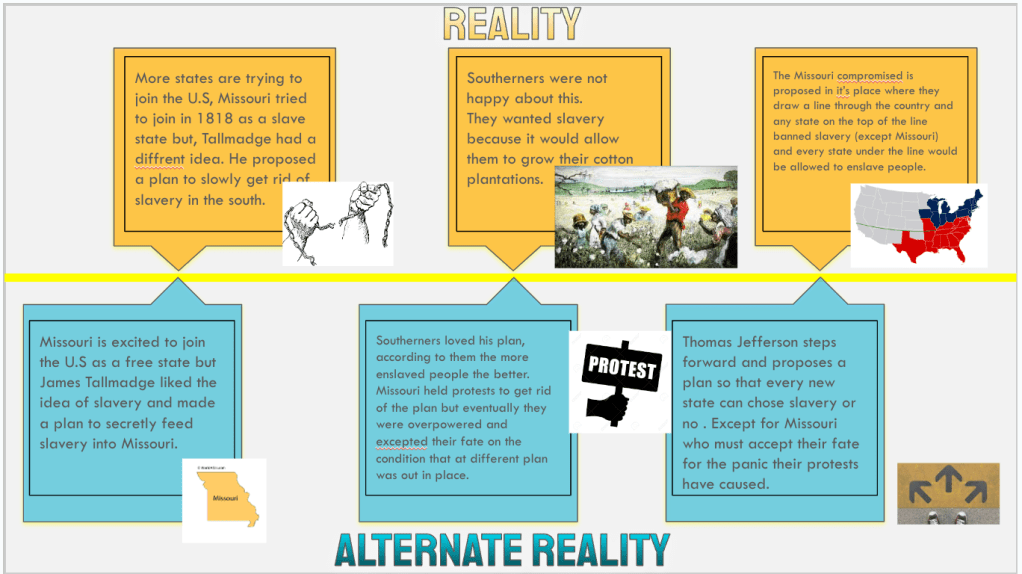
Following the Frayer, we switched to an EMC2learning penny pedagogy called Upside Down Learning. Students read a textbook section about the Missouri Compromise. On the top of the line with Upside Down Learning, students tell the true story of the Missouri Compromise. I had them think about the compromise, and retelling of the compromise in sequential order. Underneath of the true story, the students come up with alternate reality. They keep some of the details, but they twist them a bit.

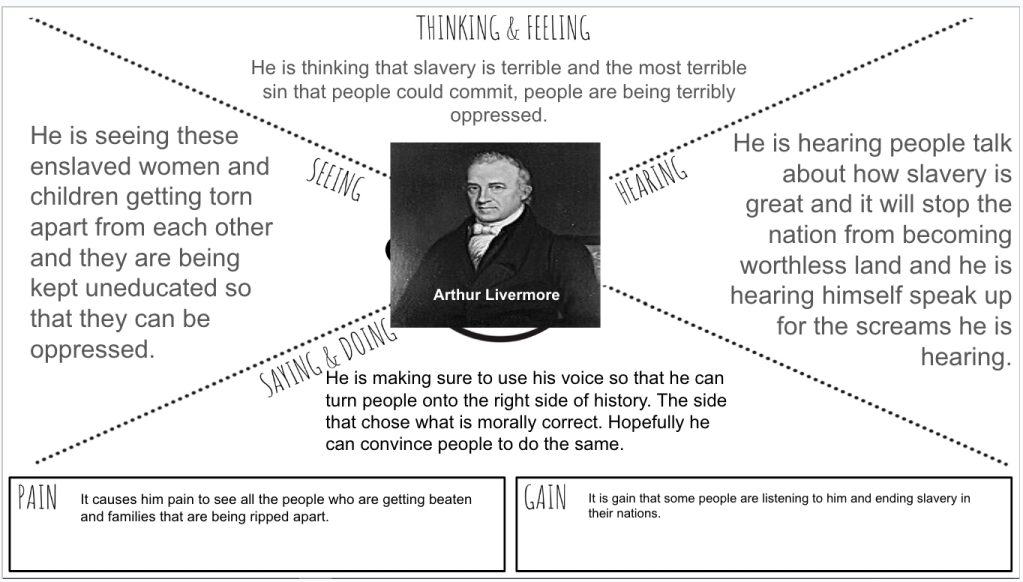
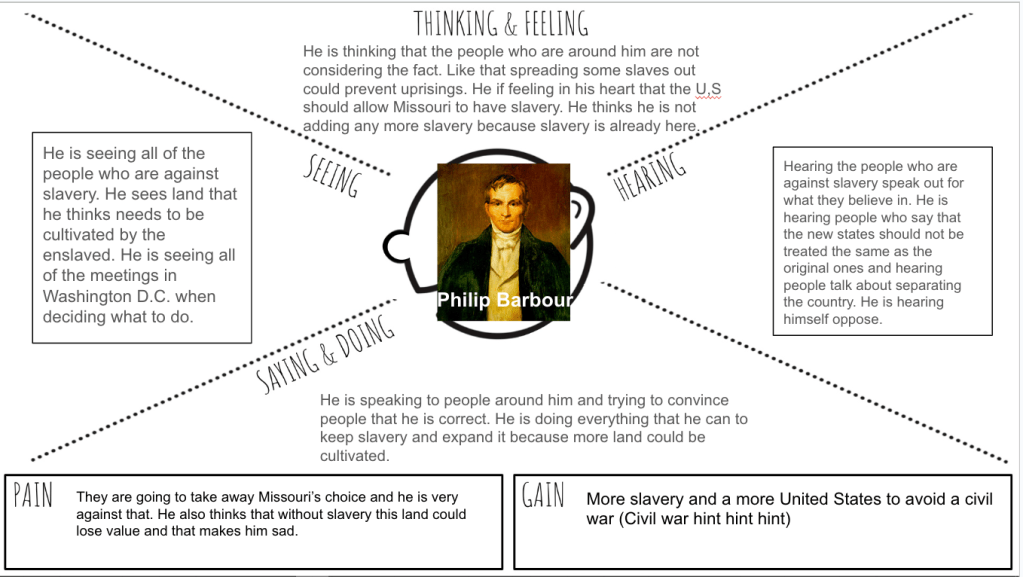
Next, I had students complete an empathy map with two primary sources. Students read a debate between two congressmen named Arthur Livermore and Philip Barbour over the Tallmadge Amendment and Missouri Compromise. Upon reading, students completed an empathy map. To end class, we ran one more Gimkit for 2 to 3 minutes and increased our class averages to over 90% across all classes.
Tuesday

On Tuesday, we switched over to the Compromise of 1850 and I asked the question, “What was the Compromise of 1850 and why did it make northerners angry?” I asked this question kowing we would focus on the Fugitive Slave Act. Before the lesson began, I wrote on the board, “Fugitive Slave – Freedom Seeker, Slave – Enslaved Person/People, Master – Enslaver.”

This lesson we began with a Number Mania and here were my instructions: “The Fugitive Slave Act of 1850 was a harsh and ineffective law that deepened the divide between the North and the South, ultimately contributing to the outbreak of the Civil War in 1861.”

  • Prove this quote true with 4 numbers and facts from the reading.
  • If you use my secret number, I’ve got a Jolly Rancher for you.
  • Add icons/images for all facts
  • Add a title.
  • In the speaker notes, explain why you selected these numbers.

I added the Secret Number to create some intrigue – it’s the end of the year! My secret number ended up being 11 – the Civil War began 11 years after the Compromise of 1850. I had these dates underlined and said to everyone, “I gave you a subtle hint.” Only a handful of student solved the secret number throughout the day.

The reading I paired with the Number Mania had a ton of numbers. I wanted to see if students could pick out the important numbers related to the quote.

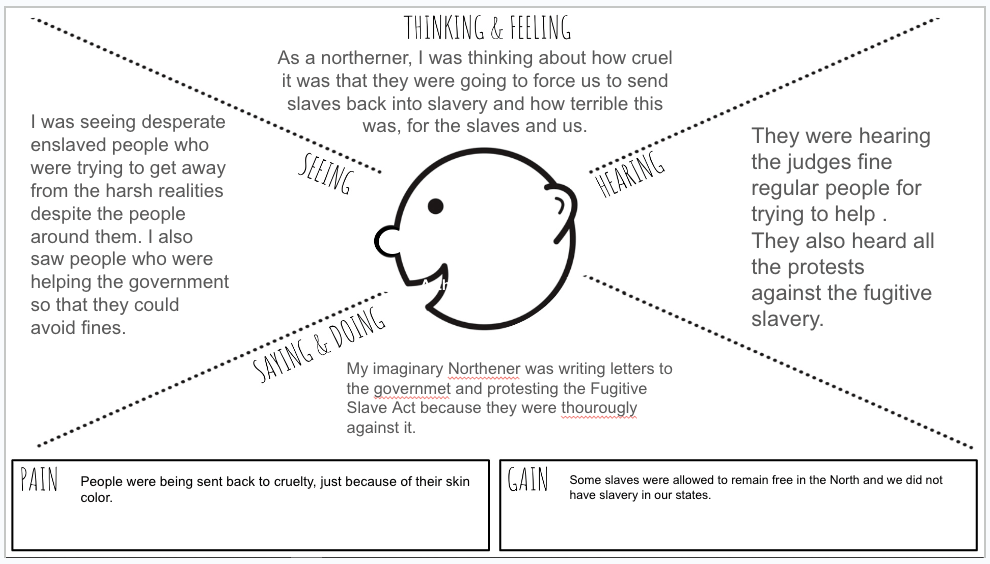
Following the Number Mania, students filled out an empathy map from a northerners perspective about the Fugitive Slave Act. I also related the Fugitive Slave Act to our community because Enslaved Person Trackers terrorized the abolitionists of New Richmond due to the Fugitive Slave Act. Students filled out an Empathy Map showing what a northerner might think, say, hear, and do about the Fugitive Slave Act. I encouraged them to use details from the Number Mania, which is essentially details from their reading.

At the end of class, I added a few more questions to the Gimkit about the Compromise of 1850. I ran the Gimkit for 3 to 4 minutes.

Wednesday

Wednesday was a shortened class period (30 minutes) due to math testing. I wanted students to reflect on their Number Mania from Tuesday. I put together a Google Form with success criteria at the top. The success criteria contained the numbers students could have used on their infographics. I asked the students these reflection questions:

  1. How many numbers from the provided list did you include in your infographic to support the quote “The Fugitive Slave Act of 1850 was a harsh and ineffective law that deepened the divide between the North and the South, ultimately contributing to the outbreak of the Civil War in 1861”?
  2. How well do you think the numbers you included in your infographic support the given quote?
  3. What did you learn about the Fugitive Slave Act of 1850 and its impact on the United States while creating your infographic?
  4. If you could improve one aspect of your infographic, what would it be and why? 
  5. If you graded yourself on the infographic, what score would you give yourself out of 4 points?

This was a day to finish the Number Mania and empathy maps. A pretty easy, light day.
Thursday

On Thursday we switched to the Kansas and Nebraska Act. I asked the question, “What did voting on slavery and the Kansas and nebraska act reveal about Sectionalism in the United States?” I knew the students would have trouble with the parts of this question – Kansas Nebraska Act and Sectionalism. I didn’t want to throw too much at the students, so we focused on sectionalism for the shortened class period.

One thing I’ve been trying to do more often is using a relevant preview Activity before learning something new. I took this idea from Gene Tavernetti’s book, Teach FAST. This book focuses on how to optimize learning through designing lessons around how students learn best.

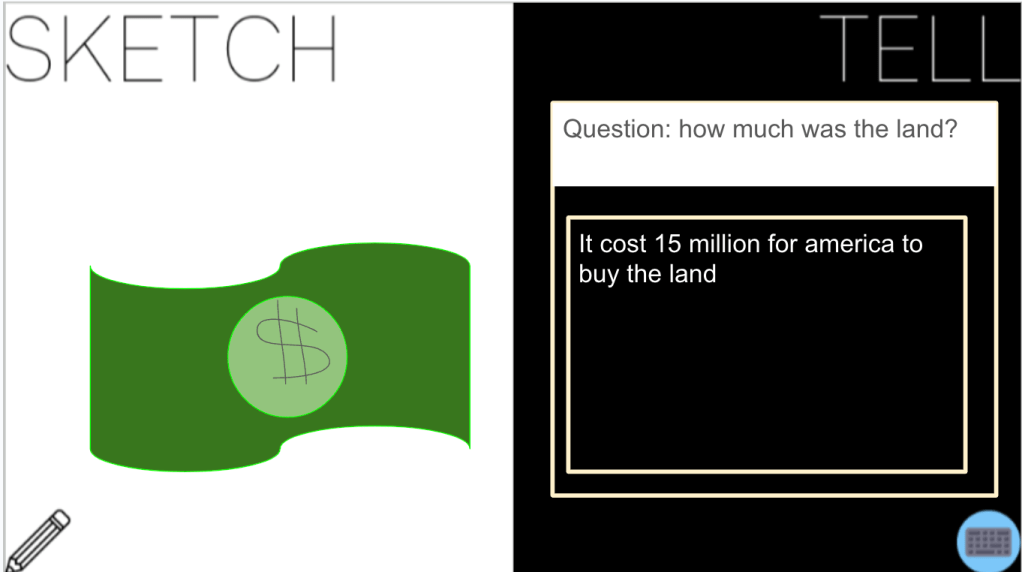
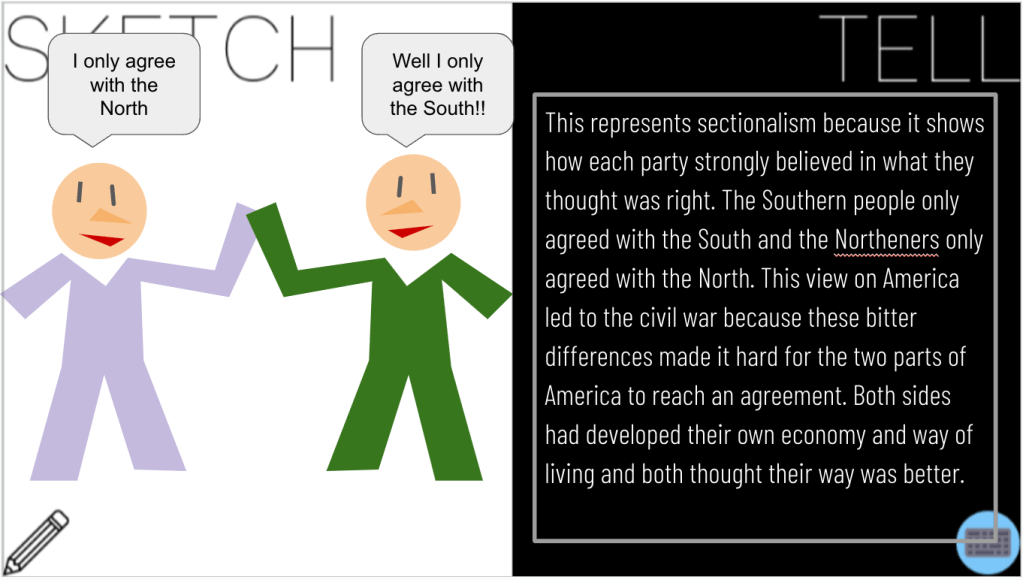
A preview activity is a quick activity where students reflect, discuss, or write out something they have experienced and eventually relate it the new content they will learn. In this case, I had students reflect, and create a Sketch and Tell, on a conflict they had with someone – a parent, sibling, teacher, or friend. They sketched about the two differing beliefs, or interests. Then they discussed the conflict with a partner. Finally, they wrote about it on the tell side.

Following the preview activity, I had students complete another Sketch and Tell. This one was about sectionalism. I had AI generate a 2 paragraph explanation of sectionalism. In my prompt, I asked AI to include Civil War and slavery context. Students created an image to represent sectionalism, they discussed their creation with a partner, and then they wrote about sectionalism. To end class, we ran another rep of the Gimmit. I added some more questions to the Gimkit about the Kansas Nebraska Act.
Friday

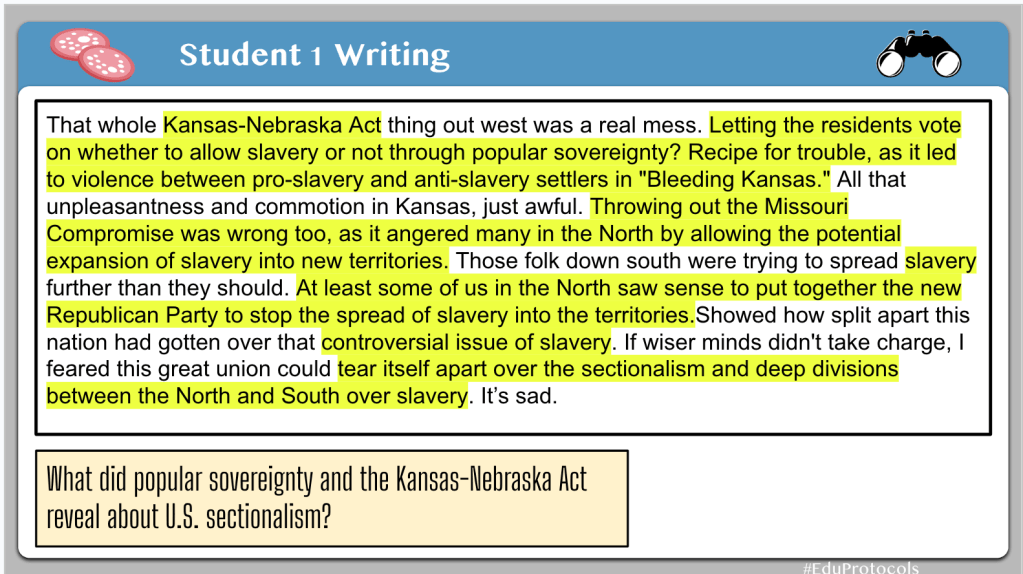
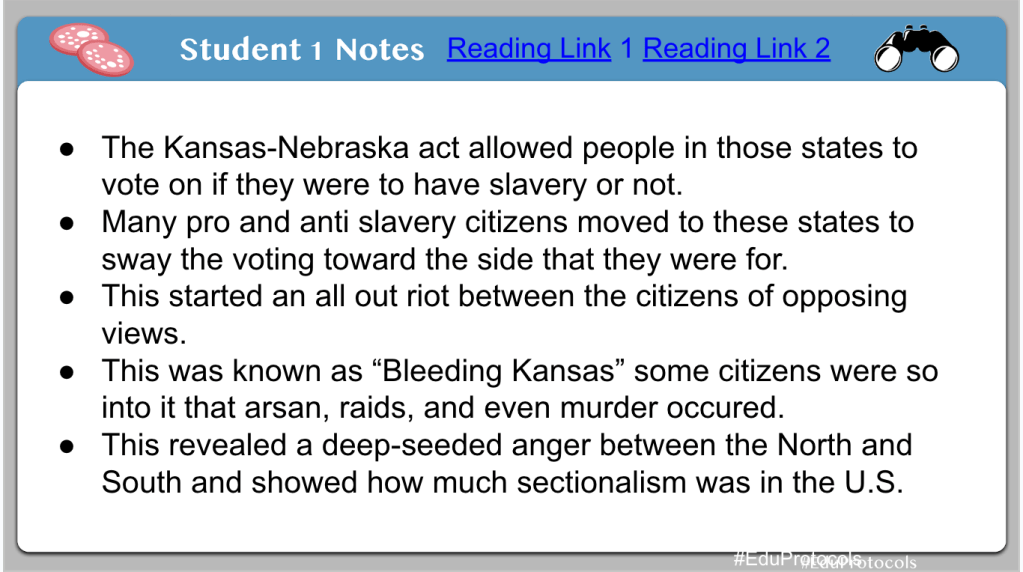
On Friday we addressed the second part to my question – the Kansas and Nebraska Act. I ran a CyberSandwich with this lesson. I had students read for 10 minutes about the Kansas and Nebraska Act. Their goal was to pull out 5 or more important facts that would help them answer the question, “What did voting on slavery and the Kansas and nebraska act reveal about Sectionalism in the United States?”

After 10 minutes, students discussed and compared their notes with a partner. Following this, students fixed a very vague northerner perspective on the Kansas Nebraska act.

I created another Google Form with reflection questions. I added success criteria at the top:

  1. Explain what “popular sovereignty” means and how it applied to the Kansas-Nebraska Act.
  2. Describe the violence that took place in Kansas between pro-slavery and anti-slavery settlers, known as “Bleeding Kansas”.
  3. Mention how the Kansas-Nebraska Act angered many in the North because it allowed the potential spread of slavery into new territories.
  4. Explain that the Act’s repeal of the Missouri Compromise was seen as wrong by those in the North.
  5. Note that the Republican Party was formed in response to the Kansas-Nebraska Act, with the goal of preventing the expansion of slavery.
  6. Conclude that the events surrounding Kansas revealed the deep divisions (sectionalism) between the North and South over the issue of slavery.

I also added these reflection questions:

  1. How many of the these details do you have?
  2. What score would you give yourself?
  3. Why would you give yourself that score?

To end class, I ran the Gimkit one more time – every class, except for one, got a 90% or higher class average.
The Week That Was In 505

This week we started state testing. We always begin with the ELA test. As a result, our schedule was a bit weird. Also, I don’t really do anything on class on ELA testing days. Staring at screen, reading, and writing for 2 1/2 hours is daunting. I’m not going to have students come into social studies only to do it all again.

This week we focused on social studies for Monday, Tuesday, and Friday. We began the week by finishing our lesson on abolitionists. Students could choose between 3 options to show their learning about abolitionists – Dinner Party (Amanda Sandoval template), Sketch and Tell, or an Instastory (Amanda Sandoval template).

Then we wrapped up our unit on Revolution and Reform with a Summative Assessment of creating a virtual museum exhibit sharing the things they learned. I gave students one class period to complete this museum exhibit.

To end the week, we began a new unit on the Civil War. I began with a Geography Challenge from TCI. WE have spent the last two weeks learning about slavery and abolitionism and this served as a nice transition to the cause of the Civil War – slavery. The geography challenge served as a nice transitioning piece from abolitionism to showing how the Union struggled over the issues of slavery and statehood.

Monday – Abolitionist Lesson, Assessment

Tuesday – Virtual Museum Exhibit

Friday – Geography Challenge, Class Companion

Monday

Last Thursday we began a lesson on abolitionism. I like this lesson because I can incorporate lots of local history with abolitionists like: James G. Birney, John Rankin, and Harriet Beecher Stowe. It helps students see how their community played an important role in the ending of slavery. Here is the layout of the lesson:

  1. Students choose an abolitionist and create a Thick Slide about their methods and motivations.
  2. Students share their Thick Slide through a Google Form. The Google Form collects the slide links into a Google Sheet. I share the sheet.
  3. Students choose 4 other abolitionists, read through the slides, and collect notes about them using a Frayer Model.
  4. Students use their information to create something – Dinner Party, Sketch and Tell, or Instastory.

Students like having the choice of to show what they know about abolitionism. I tried to pick choices that varied in complexity. To me the Dinner Party was the most complex because students had to think about where toplace the abolitionists at a dinner party and think about their conversations. It’s very outside of the box thinking.

The sketch and tell is an option that students are familiar with. I selected this because I wanted students to apply a visual to the methods and motivations for abolitionists.

The Instastory template is familiar to students because it looks like an Instagram posting. Even though I haven’t used this template all year, I wanted to throw it out there and see what would happen. Here are some student samples:

Tuesday

On Tuesday, I wanted to wrap up my unit on Revolution and Reform. I wanted students to be able to answer two questions:

  1. How was life different in the North from life in the South?
  2. What motivated abolitionists to risk their lives to end slavery?

I needed an assessment to tie those things together. Te perfect option was a virtual museum exhibit. A few years ago, I created a template for a virtual museum, but I have never used it……until now.

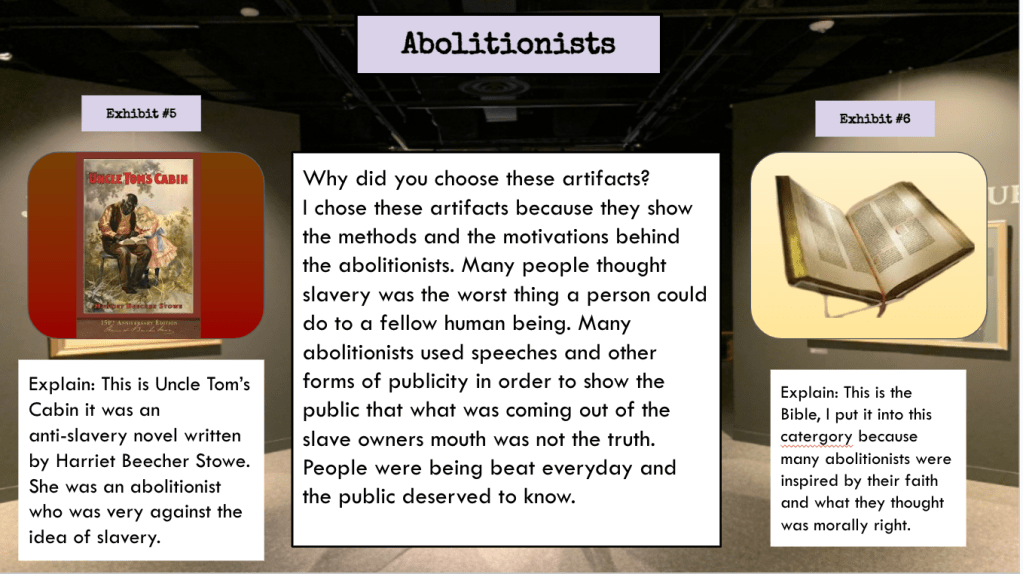
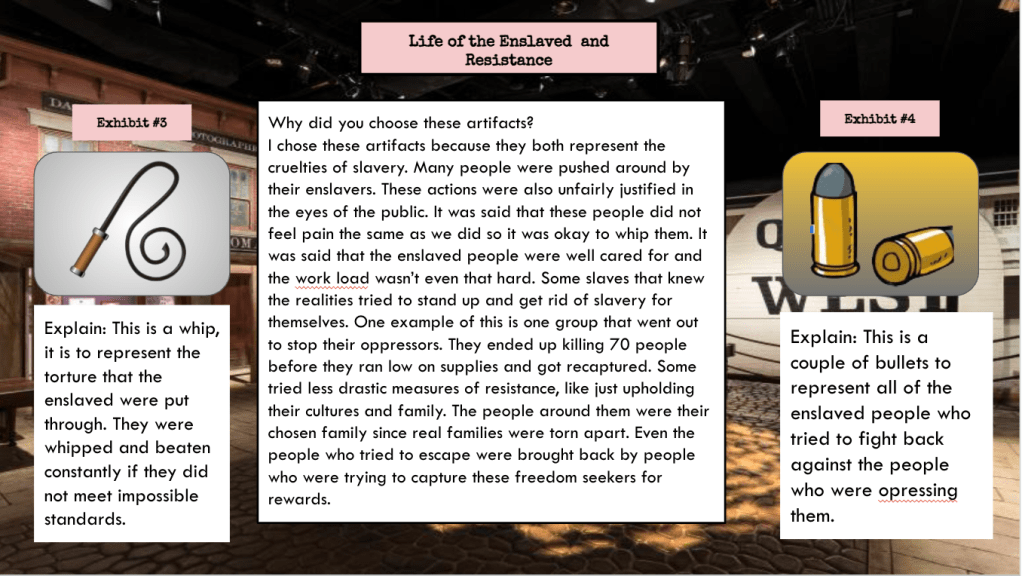
When I put together the assessment, I wanted students to create an exhibits showing differences between North and South, an exhibit on slavery and resistance, and an exhibit on abolitionism. Because this is a summative assessment, I gave students the entire class period to get it done. It had to be turned in by the end of class. No working on it at home. A one shot deal.

I was pretty impressed with the exhibits:

Friday

On Friday, I introduced a new unit question, “What were the conflicts over slavery that led to the Civil War?” I began with a Geography Challenge from TCI because it was a simple way to begin the lesson. Plus, it wasn’t a daunting task that involved much reading or writing considering students spent the last 2 days doing that with testing.

I introduced the lesson by reminding students we have been learning about slavery and abolitionists. Now it was time to see how al, of these ideas played into arguments over statehood and sectionalism between North and South. We were building on previous knowledge to set up new knowledge.

We began the lesson by reading some background knowledge paired with the maps. Next, I had the students go through the steps to complete the Geography Challenge map.

During this lesson, I tried Class Companion – an self-contained AI tool that offers immediate feedback with student writing responses. Here is a brief summary about it:

Class Companion is an innovative educational app that integrates artificial intelligence to provide personalized feedback on writing assignments for students. In subjects like AP World History, teachers can assign writing prompts for students to practice answering repeatedly until they achieve an acceptable response.

The AI acts as a virtual teacher, offering instant critiques on what students did well and areas for improvement, allowing them to learn from mistakes at their own pace outside the classroom. Teachers can customize assignments, rubrics, and the type of feedback given, making it versatile across subjects requiring written responses like social studies, English, science, and languages.

The app includes anti-cheating features like detecting pasted text, tracking response times, and enabling teachers to override the AI’s grading if disputed. Students appreciate the rigorous practice and autonomy Class Companion provides in mastering structured essay writing for classes like AP History.

In summary, Class Companion harnesses AI to deliver tailored writing guidance, practice opportunities, and engagement for students while giving teachers powerful customization and oversight capabilities. Its unique blend of technology and pedagogy enhances the learning experience.

The Week That Was In 505

This week, I wanted to focus on the second part of our Revolution and Reform unit, specifically on the topic of abolitionism. With only 28 or 29 days of school left, it’s crucial that I carefully select the most important content to cover. Although I would love to delve into all aspects of reform movements, time constraints simply won’t allow for it. Therefore, I chose to concentrate on abolitionism and slavery this week, as it provides a smooth transition into exploring the causes of the Civil War. To build a solid foundation, I began by discussing the impact of the cotton gin, the lives of enslaved people, and the resistance they exhibited. Finally, we concluded the week by examining abolitionist reformers, which ties in nicely with some local New Richmond history.

Monday – Cotton Gin Lesson

Tuesday – Life of Enslaved People

Wednesday – Resistance

Thursday – Abolitionists, Assessment

Friday – Citizens of Sardinia

Monday

On Monday, we wrapped up our lesson on the cotton gin, which we had started the previous Friday. The central question was, “What were the consequences of the cotton gin?” I utilized various activities such as “Annotate and Tell,” “Graph and Tell,” and a “2xPOV” (two points of view) activity. Initially, I had planned a “Sketch and Tell” where students would sketch different viewpoints on the consequences of the cotton gin, but I ultimately decided to switch to the “2xPOV” format to make the summative assessment clearer and more straightforward for the students. I allocated 20-25 minutes for them to complete their work on the consequences of the cotton gin. To reinforce their learning, we concluded with a “Fast and Curious” activity on Gimkit, where class averages ranged from 83% to 95%.

Tuesday

Tuesday marked the beginning of our exploration of the lives of enslaved people. To start, I explained the importance of using person-first language, such as “enslaved person,” “enslaver,” and “freedom seeker.” I then adapted a lesson from a textbook that my co-author, Dr. Scott Petri, contributed to – a resource written for schools in Texas that incorporates background information and primary sources to help students learn history. I was particularly impressed by the selection of primary sources and background information compiled for this lesson on the lives of enslaved people. The lesson included excerpts from Solomon Northup’s “12 Years a Slave,” Fanny Kemball’s diary, and a book written by Harriet Jacobs. These diverse perspectives provided valuable insights into the experiences of enslaved individuals.

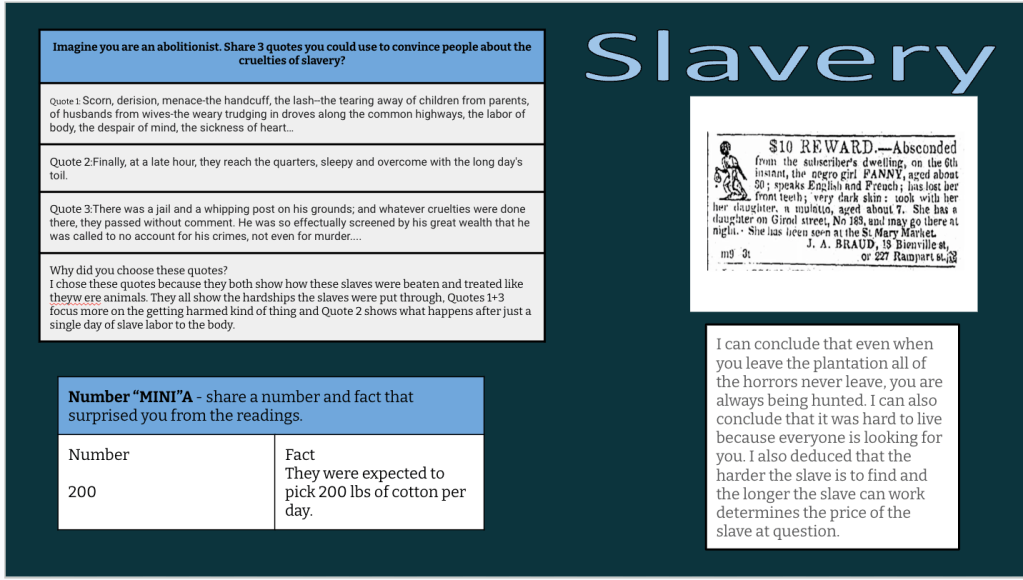
For the lesson, I used an “Annotate and Tell” activity where students read the excerpts and highlighted instances of cruelty. To conclude the activity and elevate the depth of knowledge, I incorporated a “Thick Slide” with questions such as, “Imagine you are an abolitionist. Find quotes you could use to show people about the cruelties of slavery.” I explained to the students that during this time period, people primarily obtained news and information through stories and hearsay. Additionally, I included a “Number Mania” activity, asking students to select one number from the excerpts that surprised them. To further engage with primary sources, students were tasked with finding a newspaper advertisement seeking a freedom seeker. In the image caption, they had to explain what they could learn or conclude about slavery from the advertisement. Finally, students were asked to give the slide a title. We ended the class with another “Fast and Curious” activity to reinforce their learning.

Wednesday

On Wednesday, I started class by presenting a quote from George Fitzhugh: “The slaves of the South are the happiest, and in some sense, the freest people in the world. The children and the aged and infirm work not at all, and yet have all the comforts and necessaries of life provided for them. They enjoy liberty, because they are oppressed neither by care or labor. The women do little hard work, and are protected from the despotism of their husbands by their masters.” The students were understandably confused by this quote, especially considering the previous day’s lesson on the harsh realities of enslaved life. They expressed their puzzlement and disagreed with the sentiment expressed in the quote, which I validated. However, I pointed out that this was how information was disseminated and often believed during that era, given the absence of modern media like TV, radio, and social media. I instructed the students to keep this quote in mind throughout our lesson on resistance to slavery, as we would revisit it at the end of the lesson.

For the resistance to slavery lesson, I adapted materials from the Zinn Education Project. The lesson categorized resistance into different forms, such as maintaining family, running away, revolting, or expressing resistance through culture, religion, and music. I cut out various stories of resistance and placed them in seven envelopes around the room, each representing a different category. Students were given a series of questions and had to move around the room, find the appropriate resistance category, and write down an example. This interactive portion of the lesson took approximately 25 minutes.

At the end of class, we revisited Fitzhugh’s quote for a “Thin Slide” activity, which I conducted using Padlet instead of Google Slides. On the Padlet, I displayed the original quote and asked students to share a form of resistance that contradicted the quote’s assertion. I encouraged them to do this from memory, without consulting their notes, and to include a relevant image with their example. One feature I appreciate about Padlet is the “I can’t draw” option, which uses an AI image generator to create images based on a prompt. The students did an excellent job with this portion of the lesson.

The assessment for the Resistance lesson was a Bento Box template created by Amanda Sandoval. Or the students could create blackout poetry using a biography about Harriet Jacobs I created with AI.

Thursday

Thursday marked the beginning of our lesson on abolitionism, which ties in nicely with local New Richmond history. New Richmond, Ohio, is a town situated along the Ohio River, directly across from Kentucky. The river served as a dividing line between free states and slave states. New Richmond has a rich history of abolitionism and involvement in the Underground Railroad. Having built up the context of slavery throughout the week and discussed the cruelties endured by enslaved people, I wanted students to examine abolitionists and consider the methods and motivations behind their efforts to end slavery.

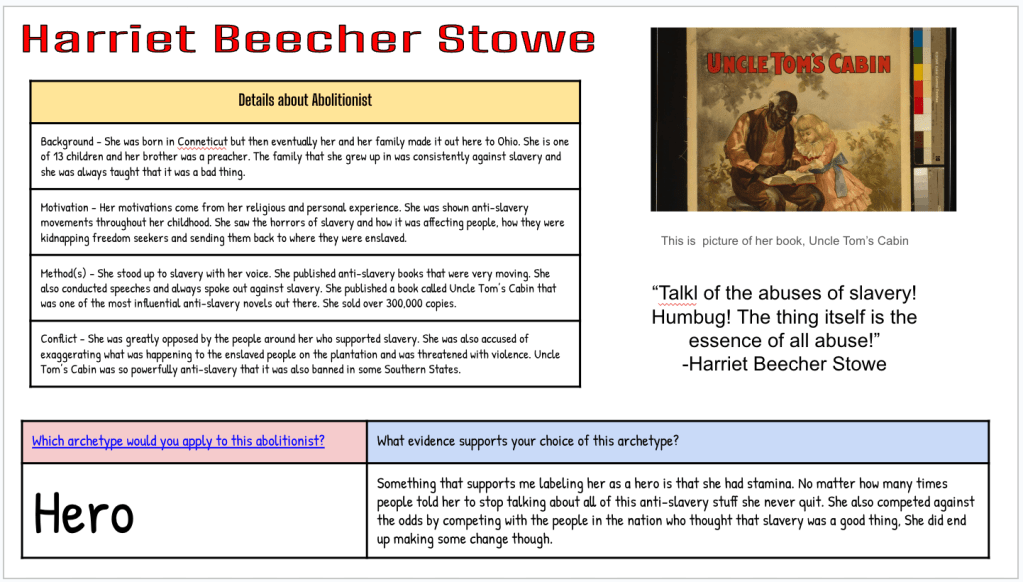
For this lesson, students chose an abolitionist to research, such as Frederick Douglass, Harriet Beecher Stowe, William Lloyd Garrison, Sarah Grimké, or local figures like John Rankin and James G. Birney. They read a one-page summary about their selected abolitionist and designed a “Thick Slide” detailing the methods, motivations, and conflicts faced by that individual. Students then shared their “Thick Slide” with all of my classes through a Google Form. Next, I had students use a Frayer Model to read and take notes on four other abolitionists, focusing on their methods, motivations, and conflicts.

To assess their understanding, students had a choice between three options:

  1. A “Dinner Party” activity, designed by Amanda Sandoval, where they arranged the abolitionists at a table and discussed the potential conversations they might have.
  2. Creating sketches depicting the abolitionists’ methods and motivations for wanting to end slavery.
  3. Designing an “Instastory Abolitionist” post. This lesson spanned two days, extending into Friday.

Friday

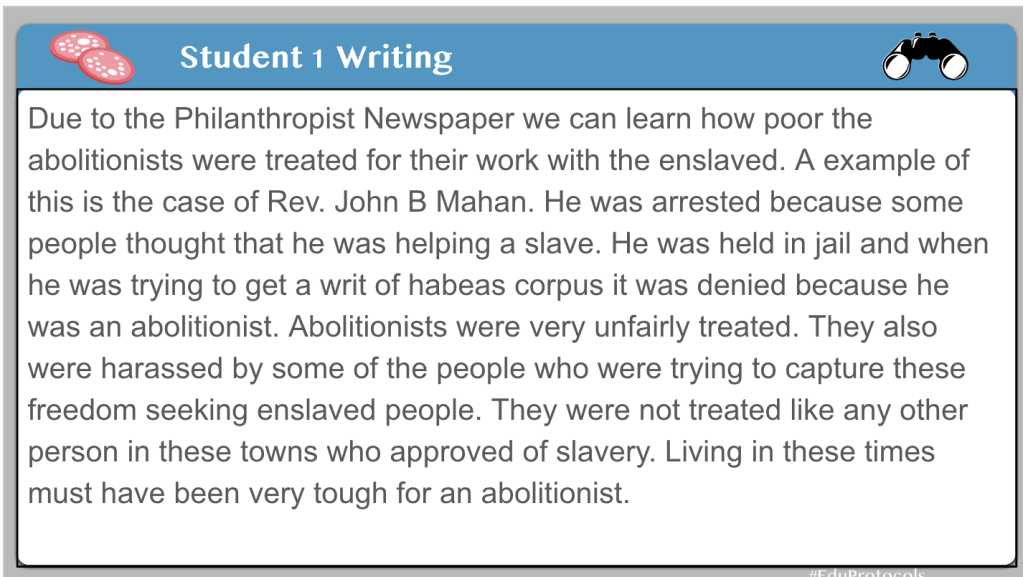
On Friday, most of my classes were working on the Frayer Model and taking notes on four different abolitionists. However, one class was ahead, so I used AI to create a tailored lesson. In our abolitionist lesson, we learned about James G. Birney, a local abolitionist who published an anti-slavery newspaper called “The Philanthropist.” I found a front page of that newspaper from December 18, 1838, and took a screenshot of a portion of it. I then input the image into the Claude AI and asked it to rewrite the article for me.

The AI-generated article discussed a community called Sardinia, Ohio, which most of the students were familiar with. It described an incident where a reverend was taken by slave catchers into Kentucky and put on trial for helping enslaved people. Using the AI, I generated a prompt: “What can we learn about the abolitionists from ‘The Philanthropist’ newspaper?” I turned this into a “Cybersandwich” lesson, with the following prompt for the notes section: “Read the article ‘Citizens of Sardinia’ carefully and identify at least three specific details or events that provide insight into the tensions and conflicts surrounding the issue of slavery in this community in 1838.”

The students were highly engaged with this lesson, as it incorporated local history that they could relate to and tied in with our study of abolitionism. This experience reinforced my appreciation for AI, as it enables me to bring more local history into the classroom using newspapers that might otherwise be challenging for students to read due to the print quality or archaic language.
The Week That Was In 505

This was our first week back from spring break, and just before spring break began, we finished up our unit on Westward expansion. I usually follow up Westward Expansion with some Industrial Revolution and reform movements. However, I am running out of days and just need to focus on what is important with these final days of school. So, I decided to cover the Industrial Revolution with some differences between north and south and how they developed differently in terms of geography, their economies, and transportation. The essential question was: How was life different in the North from life in the South? This blog post will be very short and to the point as we covered the differences between North and South for much of the week.

Monday

On Monday, our first day back from spring break, I began class with a Fast and Curious on Gimkit. I had 12 questions related to differences between North and South. The class averages ranged from 42% all the way to 52%. After the Gimkit and some feedback, I then switched gears to the Repuzzler EduProtocol. I used some vocabulary words such as agrarian, Industrial revolution, cotton gin, and etc. I gave students 2 minutes to share the Repuzzler with each other and 12 minutes to complete all of the slides together as a group.

Next, we moved on to the Sketch and Tell-O where students read about differences between North and South in terms of geography. Recently, I have been reading Gene Tavernetti’s book called Teach FAST. In this book, he discusses using preview activities to help students use things they already know and relate them to what they are getting ready to learn. I really like the examples he used in the book and it gave me some ideas to use in my current unit. For example, with the students getting ready to read and learn about the differences of geography in terms of northern and southern United States, I had them think about the geography in their community of New Richmond, Ohio. This way, when they got ready to read about northern and southern United States geography, they would have an idea of the importance of geography and how it impacts the way of life. I had students read and as they read, I had them complete a Sketch and Tell-O on paper. I really like this because they act as sketch notes. Students had until the end of class to read and complete their Sketch and Tell-O and explanations of their sketches.

Tuesday – Wednesday

Tuesday through Wednesday was a rinse and repeat type of lesson. I began class with a Gimkit Fast and Curious, we followed that up with a Repuzzler, and then students thought about the economy of New Richmond and then read about the different economies between North and South. They completed a Sketch and Tell-O. Then on Wednesday, it was the same style of lesson: the Fast and Curious, the Repuzzler, and then reading about transportation of north and south and completing a Sketch and Tell-O. Everything that I have students complete in my class I want it to serve a purpose. In this case, I wanted the students to be able to use their Sketch and Tell-O drawings to help them complete a map. On the map, I wanted students to cut out their Sketch and Tell-O circles, organize them in terms of North and South, add some labels, and then answer a few questions.

Thursday

On Thursday, I got to school and printed off 11×17 papers with blank outlines of the United States in the middle of each paper. On the back, I copied instructions for making an annotated map. Students were to cut out their Sketch and Tell-O circles and organize them on a map into North and South. I didn’t want them to label the circles, and then I had them answer three questions on the map which were:

  1. What is the purpose of this map?
  2. What similarities and differences do you see?
  3. Create a claim about why the North and South developed differently, and provide at least two pieces of evidence from the map to support your claim.

Students really had to think about organizing and planning as they cut out circles. They had to think about organizing the circles on their map to make them fit and where they should go. Some students just started gluing stuff down and then realized that they ran out of room and didn’t glue things correctly. Some students cut out circles and forgot which ones went with North and South. I’m only 50 total minutes over two classes. We also did a Fast and Curious, and this time the class averages all ranged from 83% to 95%.

Friday

Finally, on Friday, some students still needed to finish their map so I gave them 20 minutes to finish up. Then, we began a new lesson on the cotton gin which will then get us into a lesson on slavery, abolitionism, and resistance to slavery. I put together a lesson on the cotton gin and I asked the students: What were the consequences of the cotton gin? I put together a mini lesson where students started off thinking about an invention that had unintended consequences. Next, they read about Eli Whitney and background information on him and the cotton gin and completed an ArchType for Square. Then, I had students read two primary sources about Eli Whitney and the cotton gin and do an Annotate and Tell. Afterwards, I had the students do a Graph and Tell as they looked at statistics about slavery. Finally, we wrapped up with a Sketch and Tell where they retold the consequences of the cotton gin from two points of view. We only began this lesson in class and didn’t get all the way through it.

The Week That Was In 505

This was the last week before Spring Break and I needed to finish the westward expansion unit. The main focus of this unit was having students understand how we acquired territories, the implications of manifest destiny, and the motivations and legacies of groups that went west. A short and simple 3 week unit.

Monday – Explore Trail of Tears

Tuesday – Inspirations to Go West

Wednesday – Groups That Went West

Thursday – Dividing the Pie

Friday – Quizizz, Bento Box

Monday

Last Friday I left a lesson about the Trail of Tears while I was making my way to Madison, Wisconsin. The engagement level among all my classes was 85% – to me, this means 85% of students at least opened the assignment and attempted something with it. This does not mean they finished, and I didn’t expect them to finish everything.

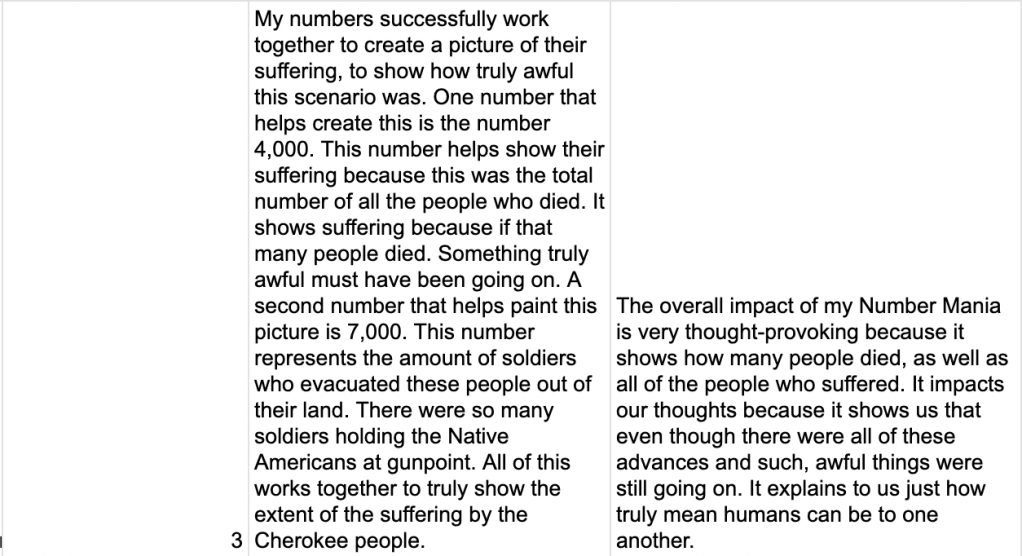
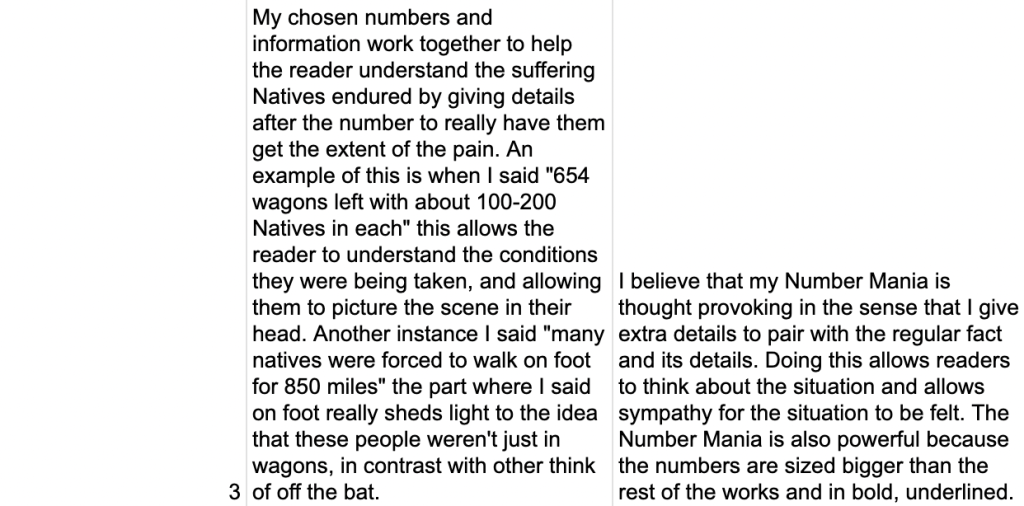
As a result, Monday was used to finish the Number Mania about the Trail of Tears. For this activity, I provided a quote to students, “…the sufferings of the Cherokees were awful. The trail of the exiles was a trail of death,” and students had to find 4 numbers from the article to prove that quote true. I love using Number Mania numbers and facts as textual evidence as it gives the students a purpose for the numbers they share.

On Monday, I used a Dr. Scott Petri trick and asked the students to analyze their Number Mania infographics. I extracted all the numbers that could prove the quote true and had the students share the amount of numbers they had correct. I also asked the students to reflect, “How do your chosen statistics and information work together to paint a picture of the suffering endured by Native Americans during this period? Is the overall impact of your infographic powerful and thought-provoking?” I didn’t want this Number Mania to be a one and done activity. I love this extension that Scott does with his students. Overall, the reflections were okay. Considering I’ve only done this a few times this year, I need to make reflecting a regular aspect of my class for the future.

Tuesday

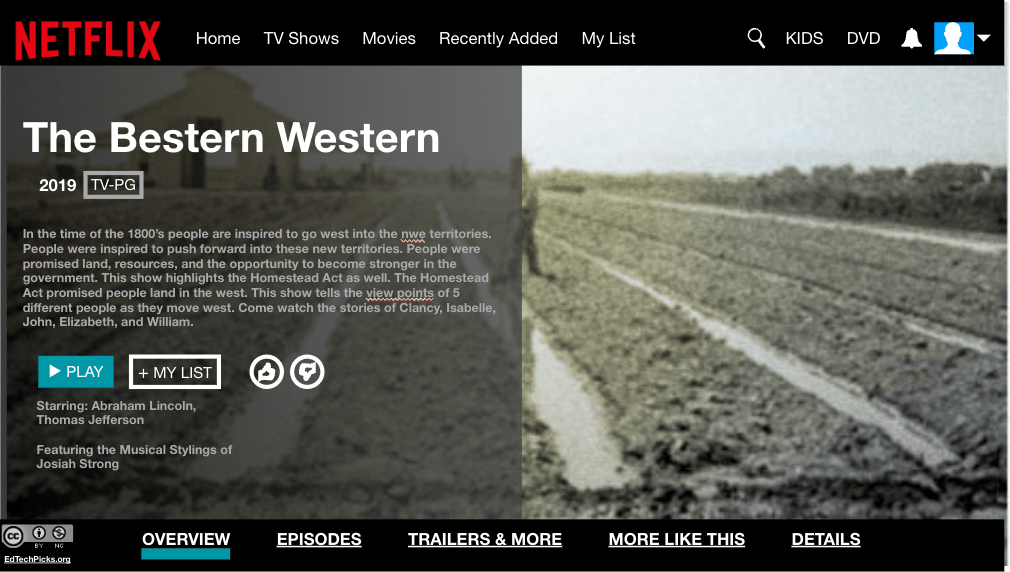
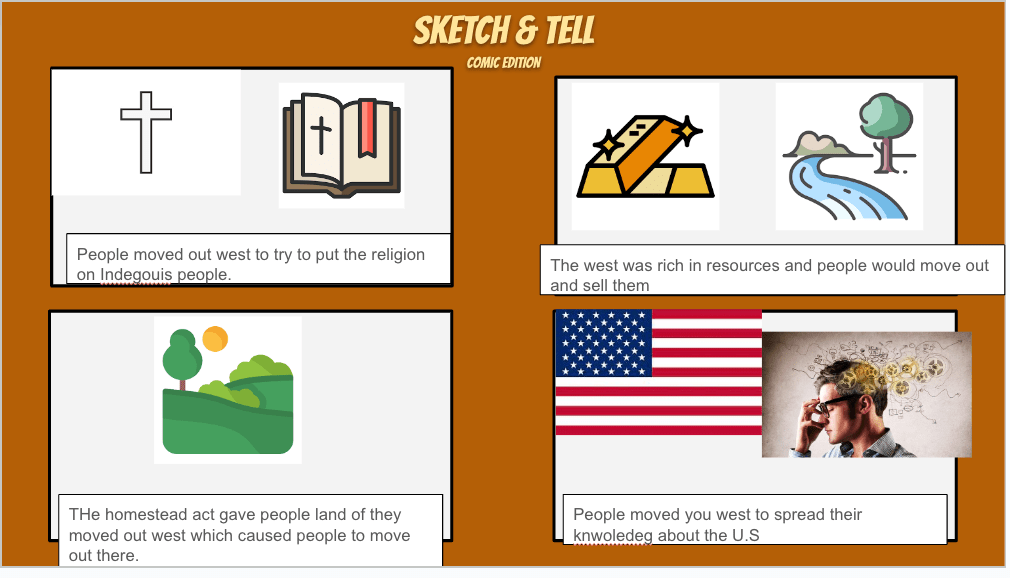
On Tuesday, I asked the question, “What inspired people to go west?” This is a lesson that I took from TCI and wrapped some Eduprotocols around it for more engagement. The materials for the lesson worked perfectly with a Frayer, 3xCER, and a Sketch and Tell comic or Netflix template.

This particular lesson has a combination of secondary source background information paired with primary sources. The sources include:

  1. Thomas Jefferson letter to Lewis and Clark to explore the Louisiana territory.
  2. Excerpts from Josiah Strong’s book, Our Country: Its Future and Its Present Crisis.
  3. An explanation of the Homestead Act and the song, I Will Go West, by JP Barrett.

I like the Thomas Jefferson source because it refers back to the Louisiana Purchase which we have discussed from the perspective of Federalists and Democratic Republicans. We also looked at it from the perspective of Lewis and Clark exploring from the Mr. Roughton Culture Shock lesson.

To begin this lesson, I had students Frayer the Homestead Act. I linked a brief reading that AI created and they had 4 minutes to define it, list 3 characteristics, use it in a sentence, and include a picture.

The next part of the lesson was the 3xCER. At first students struggled with pulling a claim from the Jefferson article and letter to Lewis and Clark. They struggles with this because it wasn’t directly stated – they had to process it themselves and figure it out. After noticing the struggles, we read the article and letter together and I mentioned that 4 possible claims could be pulled from the reading. We discussed as a class and this seemed to help with the other two readings.

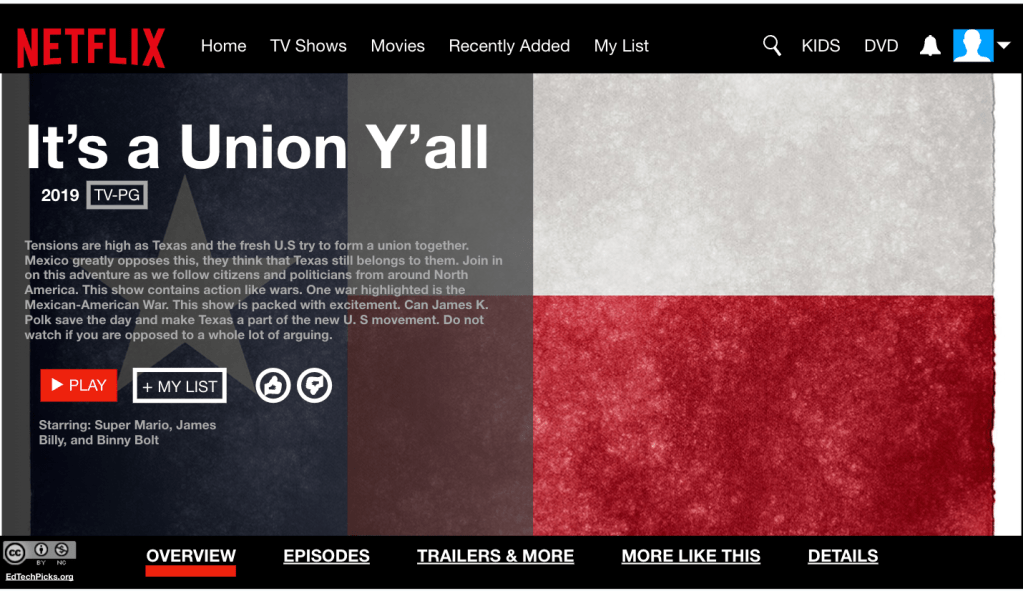
The last piece of the lesson was creating a Netflix show description based on an inspiration or creating a Sketch and Tell comic using a Justin Unruh template. For the Sketch and Tell comic students could identify 4 inspirations or create a story about what inspired someone to go west. This was an awesome one day lesson.

Wednesday

Wednesday we built off of Tuesday’s lesson and focused on the groups that went west:

  1. Explorers because it mentioned Lewis and Clark.
  2. Pioneer Women because I like to include women’s history whenever I can.
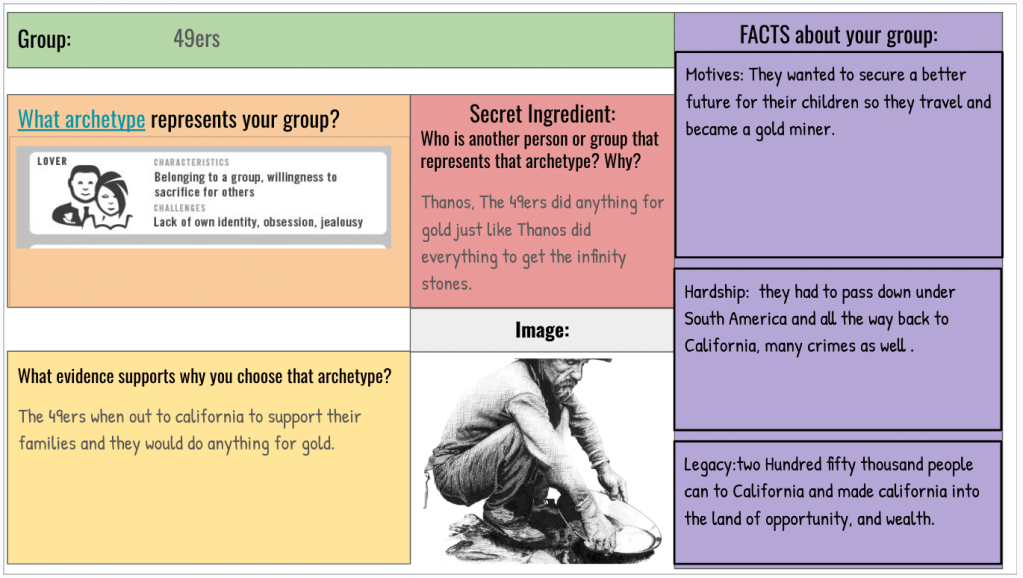
  3. 49er’s because most students understand gold and people trying to strike it rich.
  4. Mormons because it’s a fascinating story.
  5. Missionaries – because it ties to the idea of manifest destiny and expanding religion and forcing natives to convert to christianity.

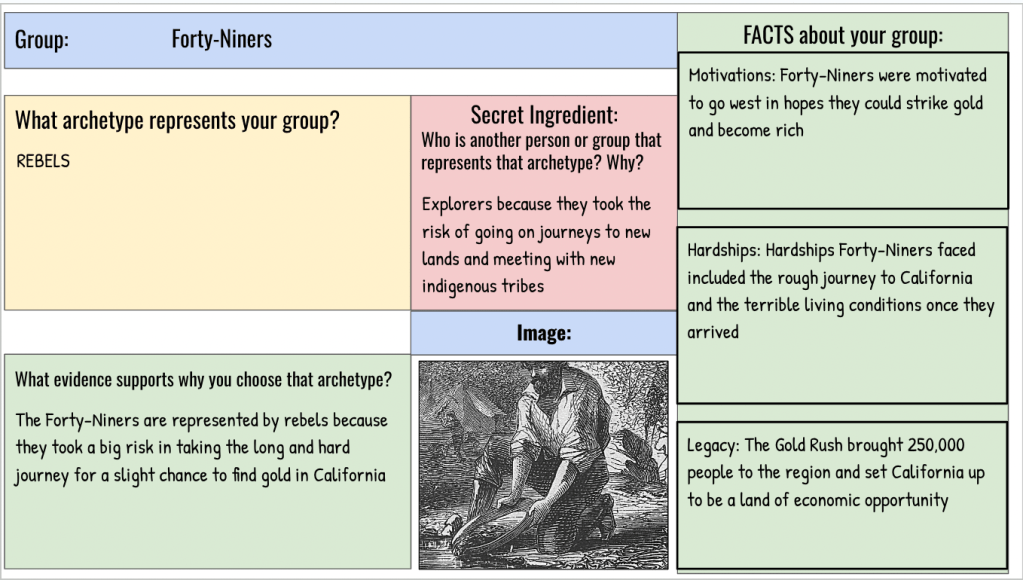
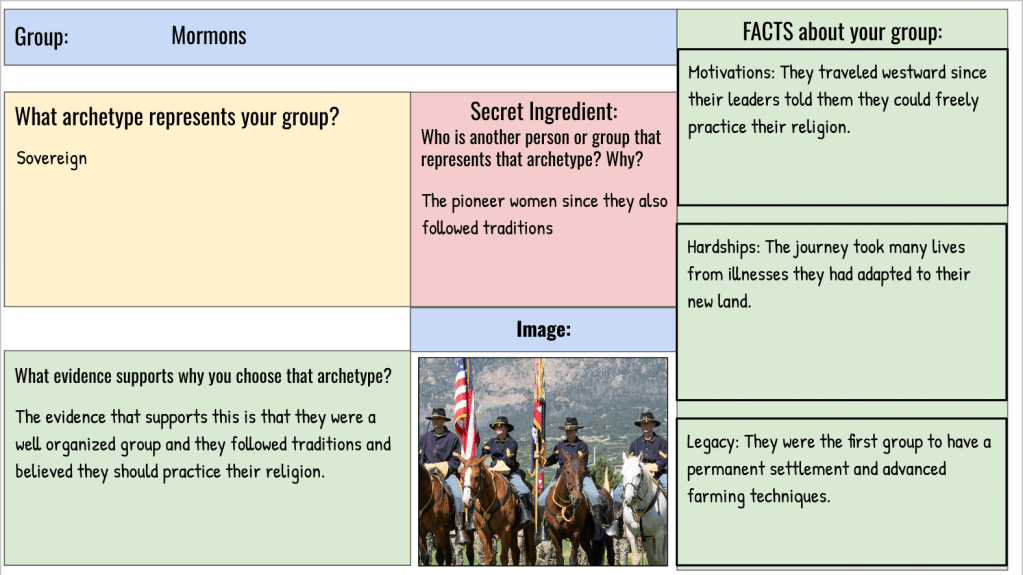
Students chose one group to read about and they used a Brianna Davis template for an Iron Chef – Archetype smash. Students had to list out the motivations, hardships, and legacies left by their chosen group. They had 20 minutes to read and make their slide – BUT there was a catch. I rolled 4 dice and that’s how many words they could use for their motivations, hardships, and legacies. I like this because it’s fun and the students end up paraphrasing the information. Some classes could use 24 words whereas other classes could only use 8 or 10.

After 20 minutes, students shared their slides through a Google Form. The next phase of the lesson was having the students read about the four other groups they didn’t make their slide about. The different word amounts ended up being a good thing because I mentioned to them, “When you are going through everyone’s slides, you need to be the judge and determine what’s good information versus not. A slide with 8 to 10 words might not be good so find a better source.” The different word amounts created this source analysis piece that I like.

Thursday

On Thursday, after the students read about the different groups, we finished up the lesson with an activity I saw on Twitter from Mr. Cline – Dividing the Pie. Lucas George did this activity for his westward expansion lesson as well.

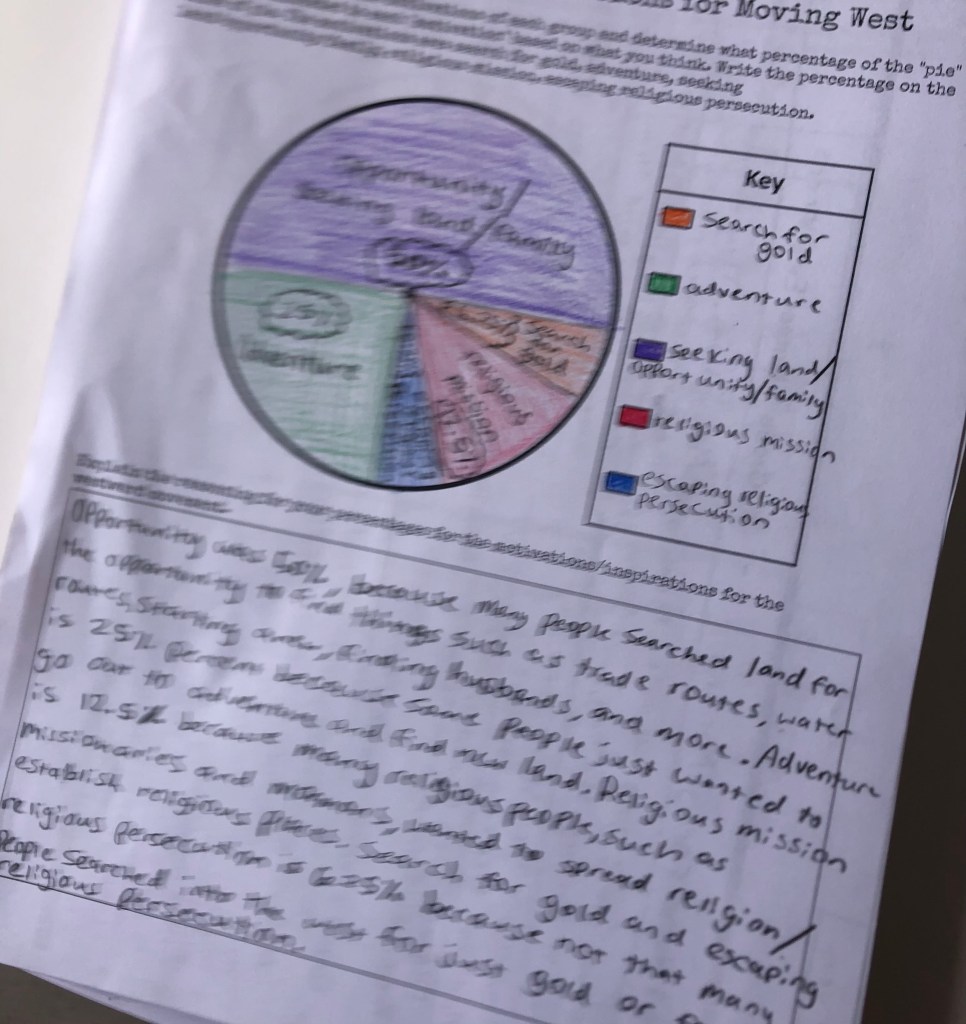
Students had a pie chart and had to divide the pie chart up into sections based on the different motivations and inspirations for what drove people west. The options were: gold, adventure, new opportunity, spreading christianity, and escaping religious persecution. Based on their percentages, students then had to justify why they divided up the pie for the different motivations. I timed this 25 minutes and collected it after the timer ended.

After the timer ended, it was time to wrap up the unit. I like to do two-part assessments. I asked students if they wanted to begin part one (Quizizz) or part two (Bento Box) of the end of unit assessment. They chose the Quizizz – 28 questions and the same quiz they have been doing off and on for the last three weeks. All class averages combined were 92%.

Friday

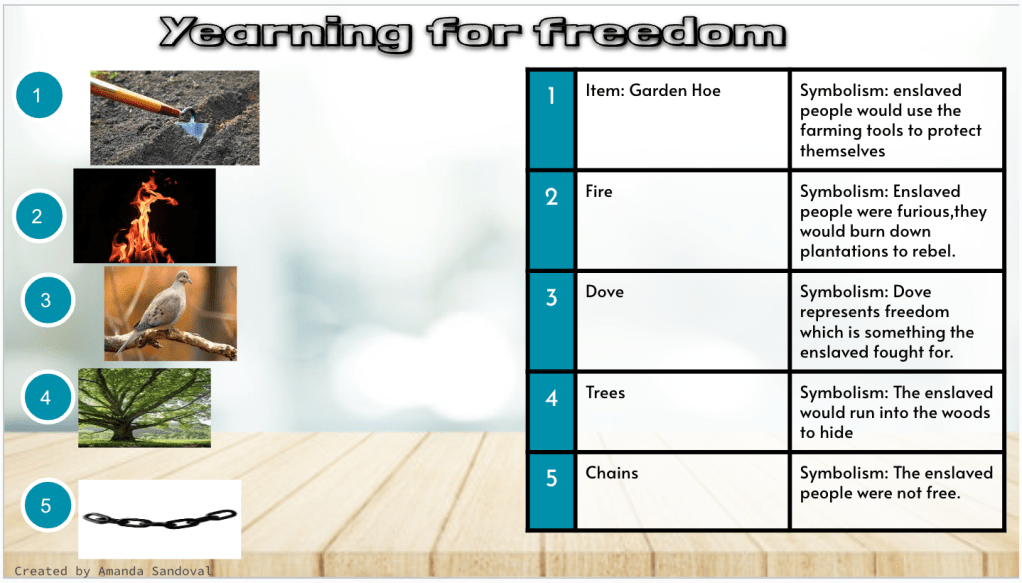
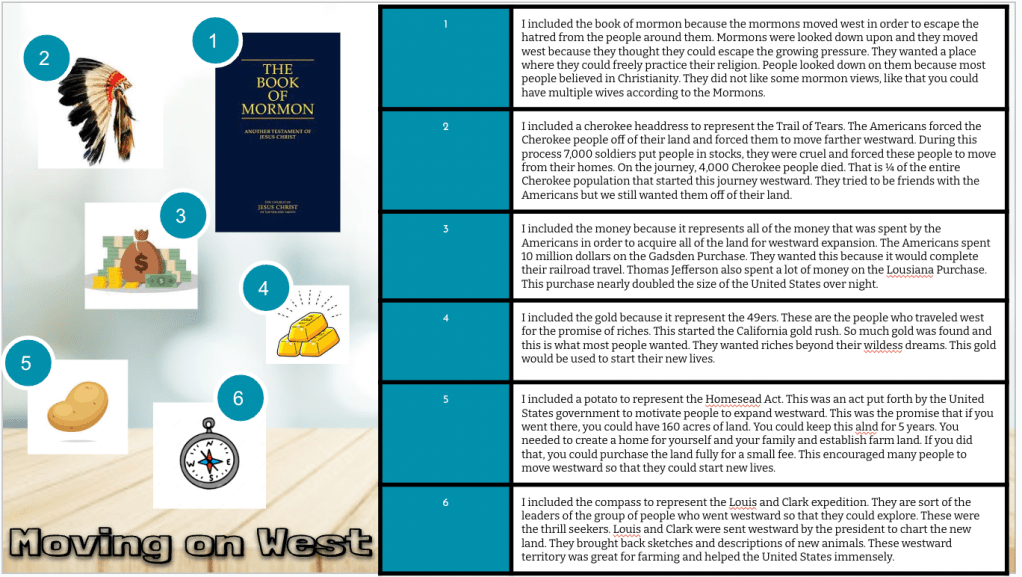
Heading into Spring Break I thought an Amanda Sandoval creation, the Bento Box, would be a great way to finish the unit. With the Bento Box students find pictures of icons, artifacts, images, etc and relate the symbolism to things they learned in the unit. It’s like a mini museum curation of items with explanations. I thought this would be great because it would allow the students to share multiple artifacts and open ended enough for students to share anything they learned from our westward expansion unit. I gave the students the entire class period to finish the Bento Box and submit. These turned out awesome…

The Week That Was In 505

I’m currently writing this from the O’Hare Airport in Chicago as I make my way to Madison, Wisconsin for the WCSS Conference. I’m looking forward to this conference as I will meet up with my friend, and co-author, Dr. Scott Petri. We are doing multiple sessions on EduProtocols and I’m doing an extra session on utilizing AI within the classroom. I was lucky enough to meet up with Jon Corippo in O’Hare! (Thanks for the popcorn, Jon!!)

This week we continued our unit on Westward Expansion. We began the week with having the students finish their Annotated maps from the previous week. I always underestimate how long it take to complete an annotated map. Then we followed up the maps with Manifest Destiny. I looked at last year’s lesson on this topic and I didn’t like it. I revamped my Manifest Destiny lesson to something I did 10 years ago when I first began teaching social studies.

Following the lesson on Manifest Destiny, I left a mini lesson on the Trail of Tears. I assigned this lesson because some of the readings about Manifest Destiny included references to the Trail of Tears. I assigned this lesson last year and really liked the outcomes of the lesson.

Monday – Mad Lib, Quizizz

Tuesday and Wednesday – Manifest Destiny – Part 1 and Part 2

Thursday – Dublin Details EMC2Learning

Friday – Trail of Tears

Monday

For Monday’s class I noticed many students needed to finish their annotated maps on westward expansion. Some needed 10 minutes while others needed 20 to 30 minutes. In times like this, I always have some supplemental things ready to go.

The best way to include supplemental activities when students finish at different times involve Quizizz, Gimkit, EMC2Learning Penny Pedagogies, EduProtocols, or utilizing AI. In this case, I had a Quizizz ready to go with questions from the previous week’s lesson. I also had a Mad Lib I created with AI.

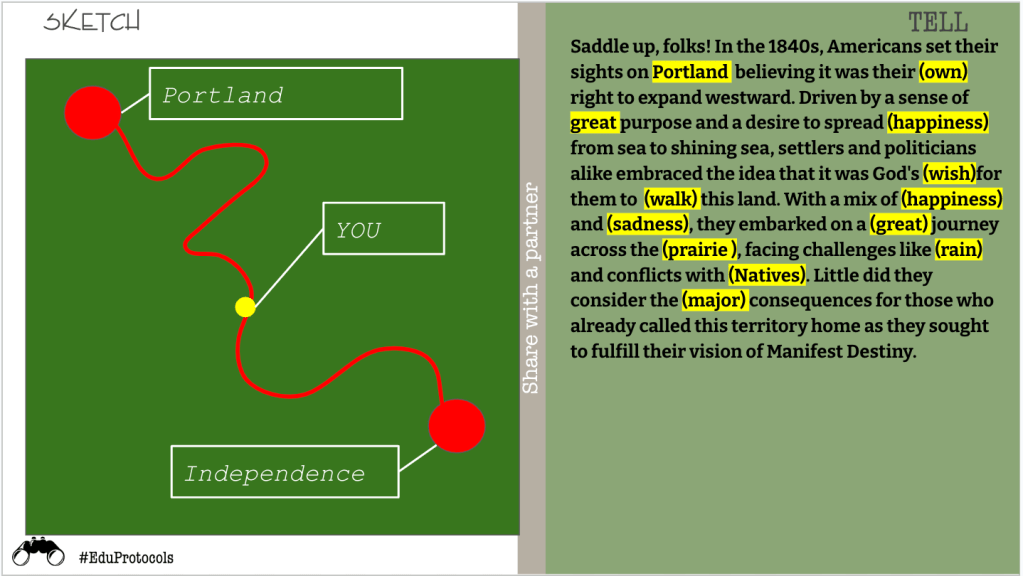
For the Mad Lib, I got on Claude AI and asked it to, “Write a one paragraph Mad Lib that blends westward expansion with the concept of manifest destiny.” It was a decent paragraph that I copied and pasted to a Sketch and Tell. The students that were able to do the Mad Lib seemed to enjoy it as it was something different. A nice mix up and change of pace. For those of you thinking, “How did they do with the noun, adjectives, and verbs??” The students did great with this because we have been practicing these skills recently with some 8pArts.

By the end of class, 90% of students completed their annotated map, some completed the Quizizz, and some completed the Mad Lib. Below are some examples.

Tuesday

On Tuesday we began the concept of Manifest Destiny. I looked at last year’s lesson and wanted to do something different. I began to think about a lesson I did with manifest destiny about 10 years ago…Below is my sequence…

Wicked Hydra

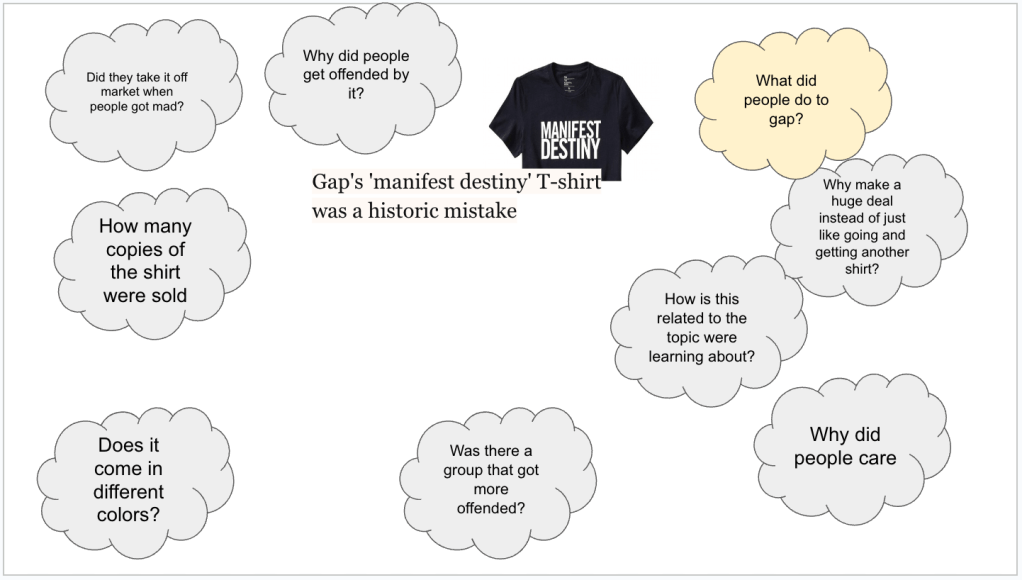
My lesson started off with a Wicked Hydra. In the middle of a Google Slide I typed a headline that read, “Gap’s ‘manifest destiny’ T-shirt was a historic mistake,” and placed this with a picture of the shirt. I had students working together asking questions about this headline. They have no background on manifest destiny or the Gap. Students were asking questions such as, “Why was it a mistake? What is the Gap? Why were people mad? What is manifest Destiny?” I wanted to see these types of questions. The Wicked Hydra immediately creates interest.

Thin Slide

Next in the lesson was a Thin Slide. I linked a short section of the textbook to thin slide and asked two questions, “According to the textbook what is Manifest Destiny? and If this is all people knew about Manifest Destiny, would they still be mad about the shirt?” Students read the textbook section to quickly gain some background information on manifest destiny. I set this lesson up to visit the textbook section again.

8pArts

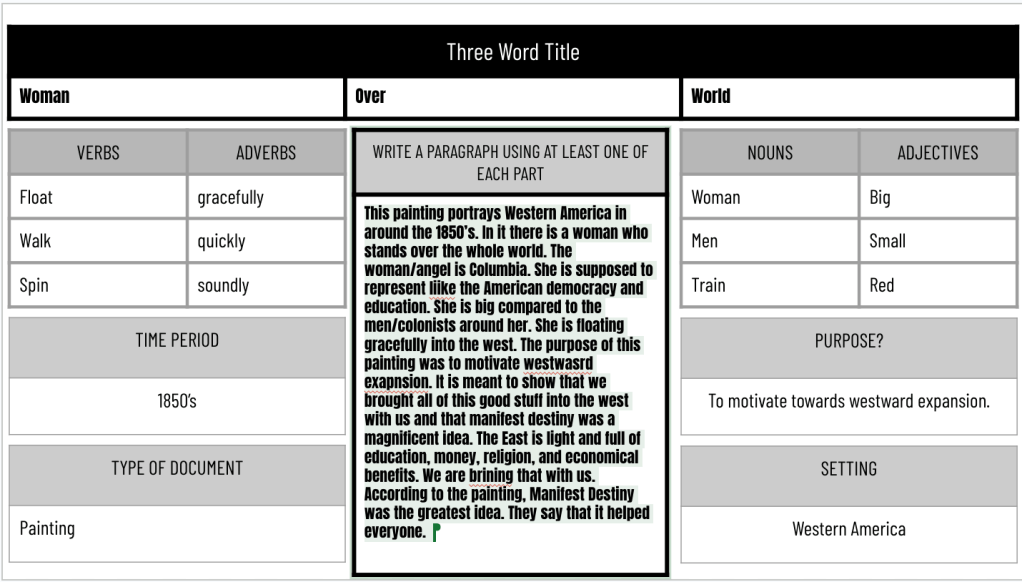
For the 8pArts I had students analyze the American Progress painting by John Gast. Students looked through image finding nouns, adjectives, guessing the time period, and the purpose. At the end of it all they wrote a brief summary of the image. We debriefed with a short discussion of the symbolism within the painting. I told the students, “If Manifest Destiny was an image, this is it.” Slowly I was building this idea of manifest destiny in their minds.

Wednesday

On Wednesday we continued our lesson on Manifest Destiny. I was hoping the Thick Slide would have been done on Tuesday, but we didn’t get that far.

Thick Slide

On the Thick Slide I shared a link to an article about manifest destiny. On the slide I included a table that asked students to list 3 reasons people might be offended by the Gap shirt. Students also had to share a quote from the article and explain its connection to manifest destiny. They had to include a picture that related to manifest destiny and they had to redefine manifest destiny from the Thin Slide. The article I included with Thick Slide was a combination of primary source quotes and analysis of Manifest Destiny.

Gap News Article and Compare

Next I had the students read the news article I grabbed the headline from. I paired this with a comparison slide from a CyberSandwich. Students read and compared the news article with the information from their Thick Slide.

Textbook Section

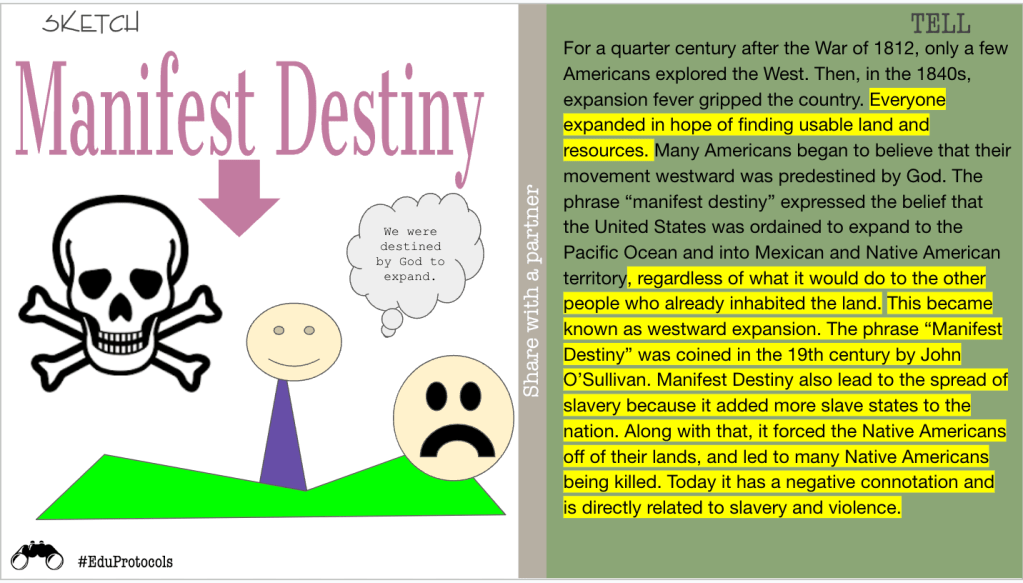
The last part of the lesson I had the students revisit the textbook section from the Thin Slide. I put this on a Sketch and Tell because I was out of town on Wednesday and wanted something to look familiar. I asked the students, “What else could you add to this textbook section to better inform people about Manifest Destiny? Highlight anything new you added.” They did an awesome job adding in more details. By the end of the lesson they had a better understanding of why the Gap t-shirt was offensive.

Thursday

Thursday’s class I began with giving the students an option – finish adding to the textbook section from Wednesday or take the Quizizz I had posted. At the end of 10 minutes we played a game from EMC2Learning called Dublin Details.

In this game I gave the students a topic and they had 2 minutes to write an 8 word sentence about that topic. No more, no less. When the timer went off, they found a partner. In the second round, they had two minutes and combined ideas with a partner to make a new 16 word sentence. For the final round, students created groups of four and had five minutes to combine their ideas into a 32 word mini-paragraph. At the end of of round 3, I had each group submit their mini-paragraph through Socrative. I chose the winning paragraph, explained why, and gave feedback.

This is my new favorite thing from EMC2Learning. We did a round on a random topic. Then we did a round on Manifest Destiny. This was truly an engaging activity.

Friday

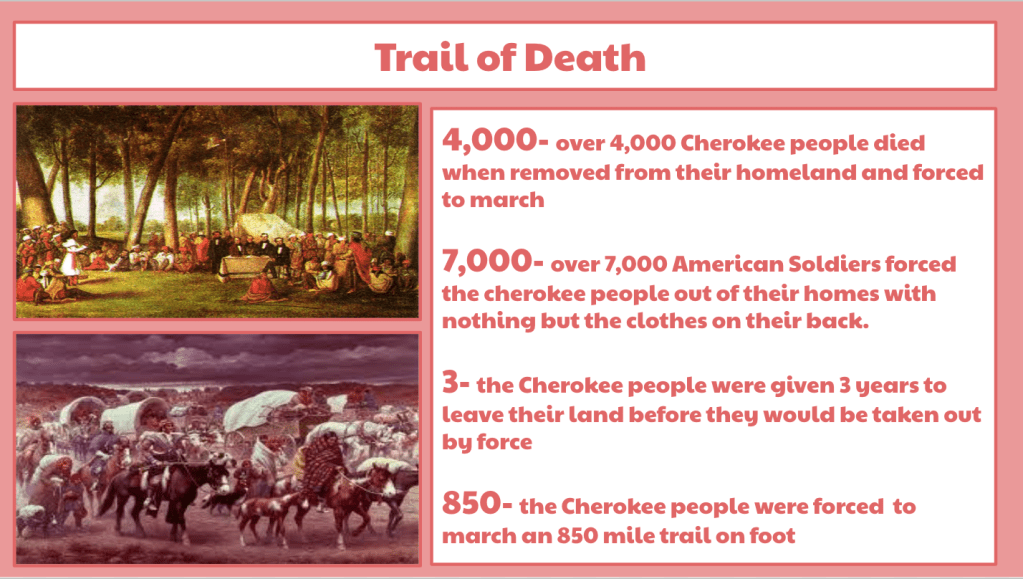
On Friday I wasn’t at school as I flew out to Madison, Wisconsin for the WCSS Conference. Again, I wanted to leave a familiar lesson – this is why EduProtocols rock!! The articles from manifest destiny mentioned the Trail of Tears and Indian Removal. So, I left a lesson on the Trail of Tears.

I adapted a lesson from TCI called, The Trail Where They Cried. I copied and pasted the article to a Google Doc and linked it to the lesson. I also provided a differentiated copy of the reading. Plus, I recorded myself reading the article and linked the recording to the Google Doc.

The first part of the lesson I had the students read and put the events from the reading into a sequential order. The second part of lesson students fill out thought bubble from John Ross and Andrew jackson. What were the Cherokees and the American government trying to achieve.

The familiar part of the lesson is a Number Mania. I like to set up Number Mania’s with a quote. I then have the students prove the quote true with number and facts from the article. For this particular lesson, students had to prove true this quote, “…the sufferings of the Cherokees were awful. The trail of the exiles was a trail of death.” This helps focus the students and the information. The students did an awesome job with their Number Manias and this lesson!

The Week That Was In 505

Introduction

This week, we started a new unit on Westward Expansion. Last year at this time, I was ahead of schedule and created a new unit on Andrew Jackson, but I decided not to do that unit this year because I am now three weeks behind schedule compared to where I was last year. To begin this new unit, I took the question directly from our textbook: “How justifiable was westward expansion?” I also added another question: “What role did Manifest Destiny play in westward expansion?” In Ohio, our standard suggests that students need to understand and be able to describe how the United States acquired territories such as Louisiana, Oregon, Florida, the Mexican Cession, and the Gadsden Purchase. My end goal with this unit was to have students continue to work on writing with claims, evidence, and reasoning, as well as be able to summarize and describe how we acquired different territories around the United States.

Monday – Quizizz, Geography Challenge

Tuesday – Sketch and Tell, Quizizz

Wednesday – Westward Expansion Territory Thick Slide

Thursday and Friday – Annotated Map

Monday

On Monday, I started off with a Quizizz featuring questions related to the entire unit we are going to study on Westward Expansion. This included topics such as the territories and the people that went out west. The quiz served as a pre-assessment to see where we were and what we knew and didn’t know. The average score across all classes was around 42%. Next, I took the geography challenge from TCI and used some AI to generate additional questions. The geography challenge was a nice way to introduce the students to Westward Expansion, allowing them to see a map and become familiar with the time and space in the context of the unit.

I took the questions from TCI, put them into a Google Doc, and then had AI generate two new questions, resulting in three different levels of the geography challenge for the multiple levels of students within my class. I was really impressed with AI and the questions it came up with for the geography challenge. I had it provide several different quotes from somebody who took a trail out west, and the students had to read the description and mark an X on the map where they thought the person was located. I thought this type of question was creative and pretty awesome. Here was one of the questions: “Read this quote and place a green X on your map at the location where you think it took place: ‘We followed the Oregon Trail along the Platte River for many miles. The landscape was flat and dusty, with few trees as far as the eye could see. The river guided us on, but provided little relief from the harsh prairie winds that parched our lips.'”
After 30 minutes, I collected the geography challenge. While the students were working on the geography challenge, I set up a Great American Race by writing different people, events, and topics on index cards and numbering them. At the end of the 30 minutes, I passed out an index card to each student and had them design a slide with three clues and a picture to set up the Great American Race for Tuesday’s class. This took less than 10 minutes.

Tuesday

On Tuesday, I handed back the geography challenge and told the students we were going to use these maps, so they had to hold on to them and be responsible for them. I also printed off all of the slides they designed for the Great American Race, stapled them together, and had the students get into groups of two to three people. I handed each group a packet of the slides they created, had them get out a piece of paper, and number it from one to 20.

This was a great way to introduce some of the events, people, and content associated with Westward Expansion that the students were getting ready to learn about. It was also a nice extension after the geography challenge. I gave the students 25 minutes to look up and find the answers for the 20 slides they created. Most groups got this done, but some groups did not. It’s always funny to me how they always assume this is easy because they feel like all they have to do is just type something into Google and they’ll get the answer; however, this is not the case. They have to know exactly the important words to type in to find the answer for what they want.

After the Great American Race, I looked at the results of the quizzes from the previous day and noticed that students were having trouble coming up with the answer for the Great American Race slides for annexation and cession. I anticipated this and had Sketch and Tell slides ready to go for these two words. We ended class with a Sketch and Tell on annexation and cession.

Wednesday

On Wednesday, now that we had the geography challenge and the Great American Race complete, it was time to dive a little deeper into the territories associated with Westward Expansion. I reminded the students of our essential question: “How justifiable was westward expansion?” To begin class, we looked up and completed a Frayer model for the word “justifiable.” I gave students three to four minutes to look it up, write a definition, find examples and non-examples, and use it in a sentence.

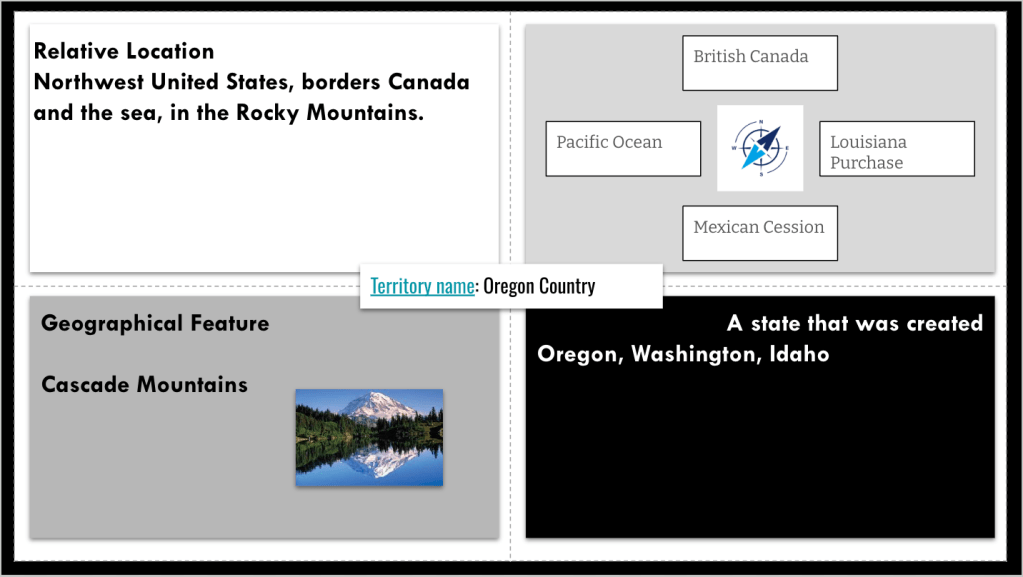
Next, I used an idea that I saw on the EduProtocols+ Hot Shot Show with Drew Skeeler. I used a geography template that I applied to a Frayer model. I had the students pick a territory from Westward Expansion, and they had to describe its relative location, use a compass to identify what was north, south, east, and west of the territory, find a geographical feature, and list a state that was created from the territory. I had the students use their geography challenge maps to help them with some of this, and I told them we were going to use that map again. This was a great way to help the students become familiar with their territory in a geographical context.

I then stated that the territory they chose was the territory they were going to create a Thick Slide about and share with the class. I had AI generate readings for all six territories and asked AI to provide context and details on how we got these territories and the consequences of each. I also mentioned our essential question in my prompt so AI could generate the readings to help students answer the question of how justifiable Westward Expansion was.

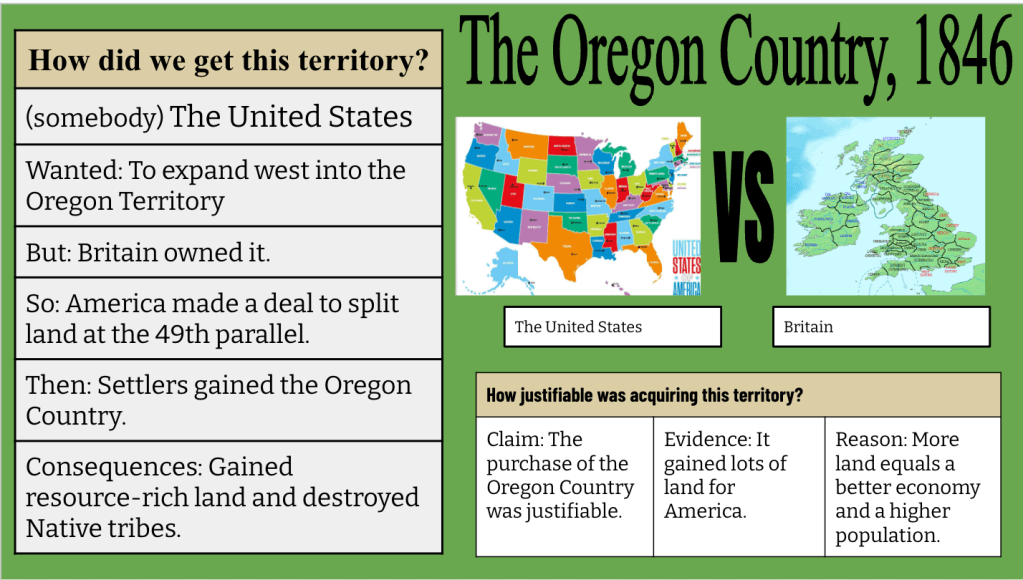
Students read about their territory and created a Thick Slide using the “Somebody Wanted But So Then” framework to retell how we got that territory. They provided two pictures and used some claim, evidence, and reasoning to answer the essential question. Reading and creating the slide took about 20 minutes. Once students were done, they shared a link to their slide through a Google Form, and I compiled all the slide links from the form into a Google Sheet and shared it with all of the classes. The last thing I had students do was take their territory and create a title and show description related to their claim, evidence, and reasoning from their Thick Slide. This was a simple way to end class for the last 10 to 15 minutes and a great way to incorporate some Depth of Knowledge Level 3 with the learning.

Thursday and Friday

On Thursday and Friday, I began class with a Quizizz because I ran out of time from the previous day. We were then going to start an annotated map, which I like to do with this unit because it fits with the standard and learning expectation of being able to summarize and describe how we got the territories during Westward Expansion. With an annotated map, you can either have the students hand draw a map or use a pre-made map and label it and cut it out. In this case, I had the students get out their map from the geography challenge, and I had them finish labeling the map with all six territories. Then, I had them glue the map to the center of a big piece of paper, and around the map, they were going to have to summarize and describe how we got the territories along with the consequences of it. Also, at the top, I had them write, “How justifiable was westward expansion?”

The idea of the annotated map is that you begin with the essential question in mind, work through the lesson, and then circle back to the original question at the very end, using evidence from all of your summaries to answer the essential question. To get their information, the students were going to use the slides that their classmates shared. I like doing this activity as it connects all my classes, and we are learning from each other. Plus, I like this lesson as I tell the students they must evaluate the sources that their classmates have created for them and ask themselves, “Is this a reliable, valid source which is going to give me the information that I need?” If not, then they should move on and find another source that they think is better.

I was hoping the annotated map would take two days, but we’re going to have to use a little bit of class time on Monday to finish them up. On these two days, we also did a little Fast and Curious with Quizizz, and the scores of the classes were really good. Based on the scores that I have seen, I really like this sequence of the geography challenge and EduProtocols for student learning.

The Week That Was In 505

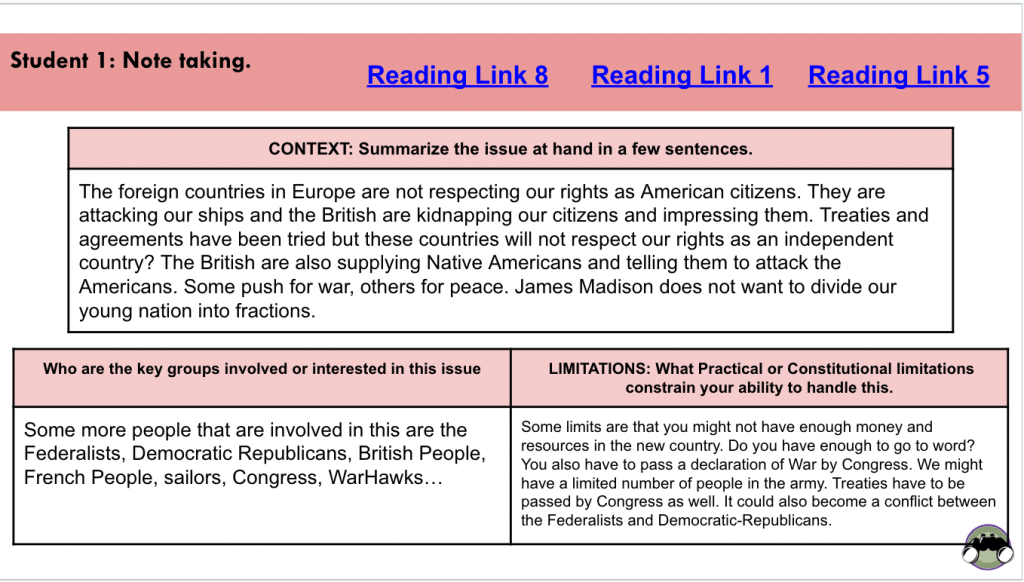
This week we continued with the War of 1812. I used a great lesson from Mr. Roughton called “Weigh the Evidence.” I thought this would be a great follow-up from Friday’s lesson about the War of 1812 and how James Madison responded to British impressment. I like this particular lesson because it was a refresher of the War of 1812 and it had students practicing writing a claim, using evidence, and reasoning.

We followed up this lesson with a lesson on the Monroe Doctrine. However, I had to leave town and needed to leave a self-sufficient lesson. I was also out of town Wednesday and needed to leave a familiar lesson. The goal was to end this unit this week so I can move on to something new. Since I was out, I left some hexagonal learning. This is something we have done at least 5 times this year. Each time my focus is getting the students to add more, be more descriptive rather than just restating the concepts in the hexagons. We also finished up the lesson with a Quizizz.

On Friday we wrapped up with a game. I didn’t feel like starting a new unit and then immediately go into the weekend.

Monday – Weigh the Evidence

Tuesday – Monroe Doctrine

Wednesday and Thursday – Hexagonal Learning, Quizizz

Monday

On Monday I wanted to keep the War of 1812 lesson going and I found a lesson from Mr Roughton’s website called “Weigh the Evidence.” In this particular lesson, there was a series of slides where I presented six artifacts related to the War of 1812 to the students. I then asked the question “Should the War of 1812 be considered a positive event for America?” I then went through the artifacts with the students and they had to determine which was a reliable source, which was useful, and which was not. They then rated each artifact on a scale from -2 to +2, with 0 meaning the evidence was not useful at all. This was a great lesson to work on analyzing primary sources, secondary sources, and thinking about what was decent evidence versus not.

We began by looking at the Treaty of Ghent, a Wikipedia page, an engraving showing the burning of Washington, statistics from a textbook on casualties, a parody movie trailer, and the song “The Battle of New Orleans” written by Johnny Horton. Students gave each artifact a rating and explained why they rated it that way. At the end, they added up their ratings. If they had a negative number they saw the War of 1812 as a negative event. If they had a positive number they saw it as a positive event. And if they ended up with zero, they had a decision to make.

I really like the structure of this lesson and the numerical rating system really helped students make an informed decision before writing their paragraph using claims, evidence, and reasoning. When it was time to write, I had the students type their paragraphs into a Google form to submit. I then downloaded the paragraphs, put them into Claude AI, and gave whole-class feedback. We discovered that our claims were pretty good as they were definitive. The use of evidence was also really good but our reasoning needed some work – it was often not developed enough or too basic. This was great feedback to give the students the next day.

Tuesday

On Tuesday I was only at school for half the day before I had to leave to catch a plane to New York. The last president we covered was James Monroe. With Monroe, we simply learned about the Monroe Doctrine – my goal is for students to understand its purpose before high school. In this lesson, I had students analyzing political cartoons related to the Monroe Doctrine. There were five cartoons I wanted them to examine. They could walk around viewing printed copies, access them on their Chromebooks, or I stapled packets together.

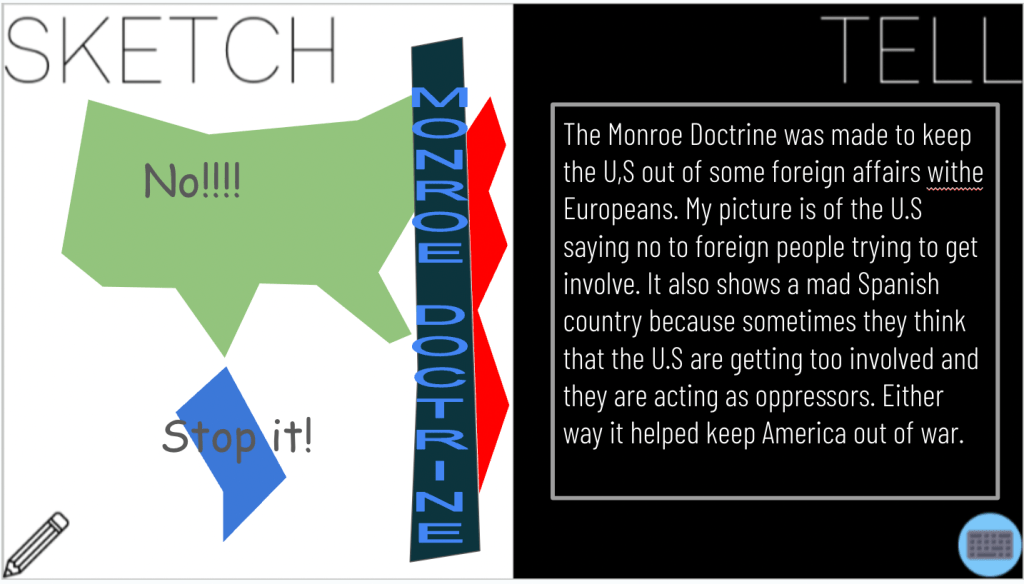
One by one, students looked at the images and made a prediction about what they thought the meaning or purpose of the Monroe Doctrine was based on the cartoon. After predicting, they watched an EdPuzzle video to check their understanding. I followed this up with a “sketch and tell” activity – students had to draw their own political cartoon showing the meaning of the Monroe Doctrine and explain it. We ended with a Thin Slide: “One thing you learned, one image, one word” to wrap up the remaining 8 minutes.

Wednesday and Thursday

On Wednesday and Thursday, I wanted to wrap up the unit with a familiar activity since I was out on Wednesday attending an AI conference. When I’m gone, I’ve learned students engage better with familiar tasks rather than introducing something brand new. As a result, I left instructions for hexagonal learning. We have done this five times already this year. I like hexagons because the activity is flexible enough to be an assessment allowing students to demonstrate their learning in creative ways. With so many recent absences due to illness, it also works for students at multiple levels – I can tailor it as needed by removing or adding hexagons.

Some students I just asked to connect hexagons, others I asked to connect and share five things they learned. When I returned Thursday, students checked their work against a success criteria checklist I provided. Some criteria included: 3 connections explaining Federalist views, 2 connections showing how a president responded to foreign threats, 2 connections about strengthening national government. I also had a simpler checklist for struggling students: make 5 connections about anything learned.

We also discussed adding more descriptive detail, using transition words like “because” instead of just turning the hexagon text into a sentence. To wrap up, students completed a Quizizz mastery check. They had 10 minutes to earn at least 90% to demonstrate their knowledge.

Friday

On Friday, I found a review game on EMC2Learning rather than start something new before the weekend. The game was like Scattergories. I put up a topic like George Washington, Declaration of Independence, or Bill of Rights. A video scrolled through the alphabet and I stopped it on a random letter. Students had 2 minutes to brainstorm related words starting with that letter. We shared words in groups, some students had to explain connections back to content. It was fun, made them think creatively, and worked on listening skills as groups crossed off duplicate words.

The Week That Was In 505

This week we continued with our study of the first five presidents of the United States, exploring this question: “How well did the major decisions under Washington, Adams, and Jefferson live up to the Federalist and Democratic-Republican visions for America?” This week we looked at Thomas Jefferson and the Louisiana Purchase and James Madison and the War of 1812. A common theme throughout this unit has been having students put themselves in someone else’s shoes and examine different events from other perspectives. This has been a recurring theme throughout the entire unit.

My classes were still a bit uneven, so I did some things this week to get all my classes back on fairly even ground. Between lessons on Jefferson and Madison, I incorporated review with a Resource Rumble and an engaging “culture shock” lesson I adapted from Mr. Roughton, which allowed me to catch all my classes up to the same point again. The main EduProtocols I utilized this week were Thin Slides, Archetypes, CyberSandwich, 3xCER, and Number Mania.

Tuesday – Louisiana Purchase

Wednesday – Mr. Roughton website

Thursday and Friday – War of 1812, History4Humans, Gimkit

Tuesday

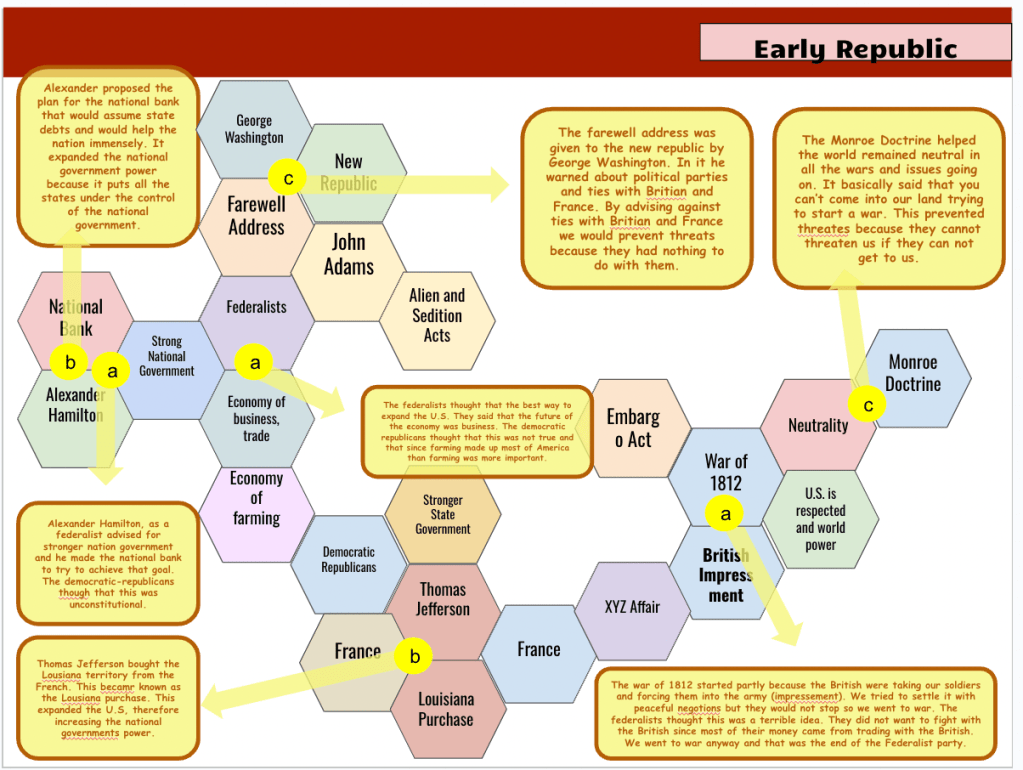
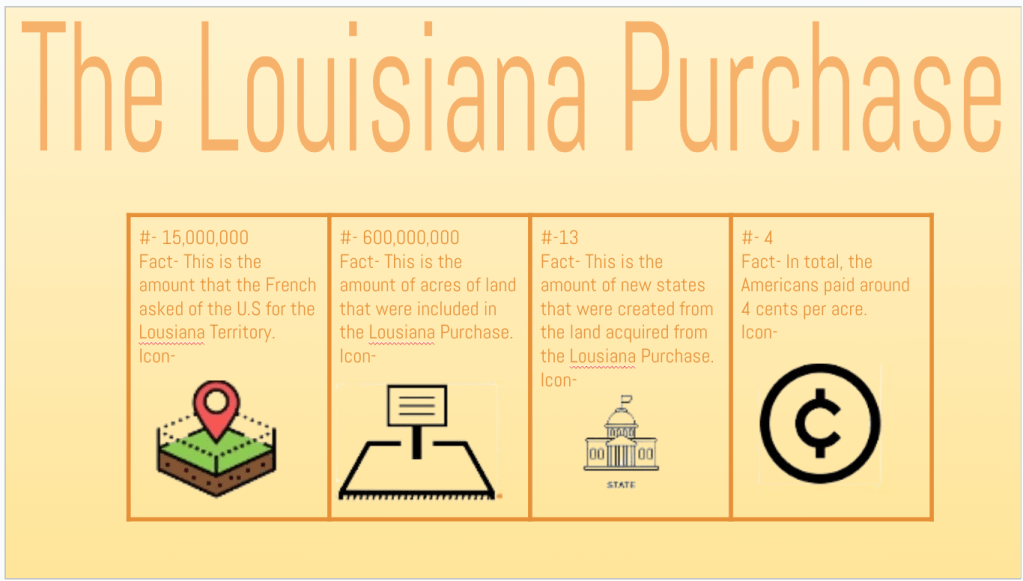
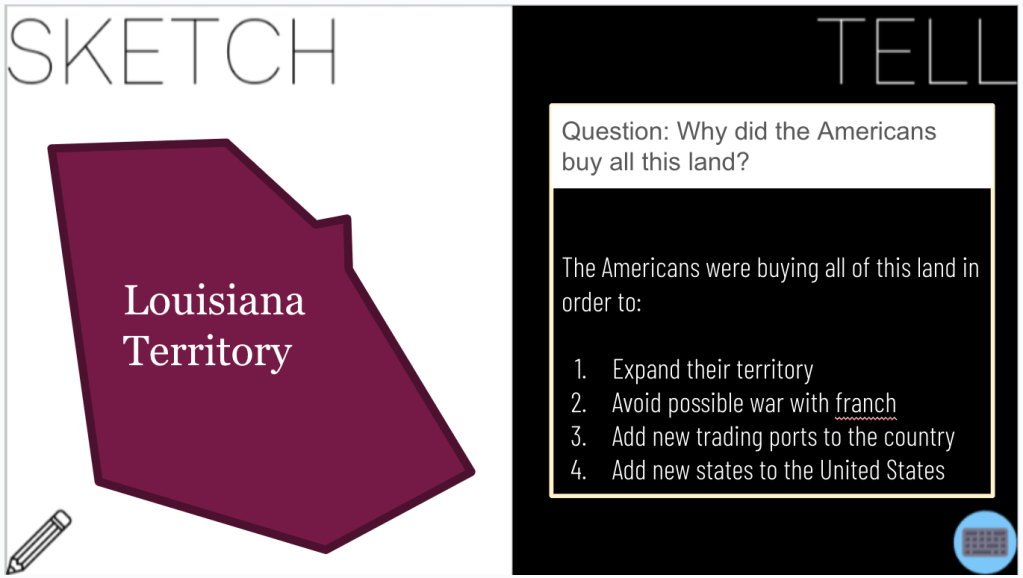
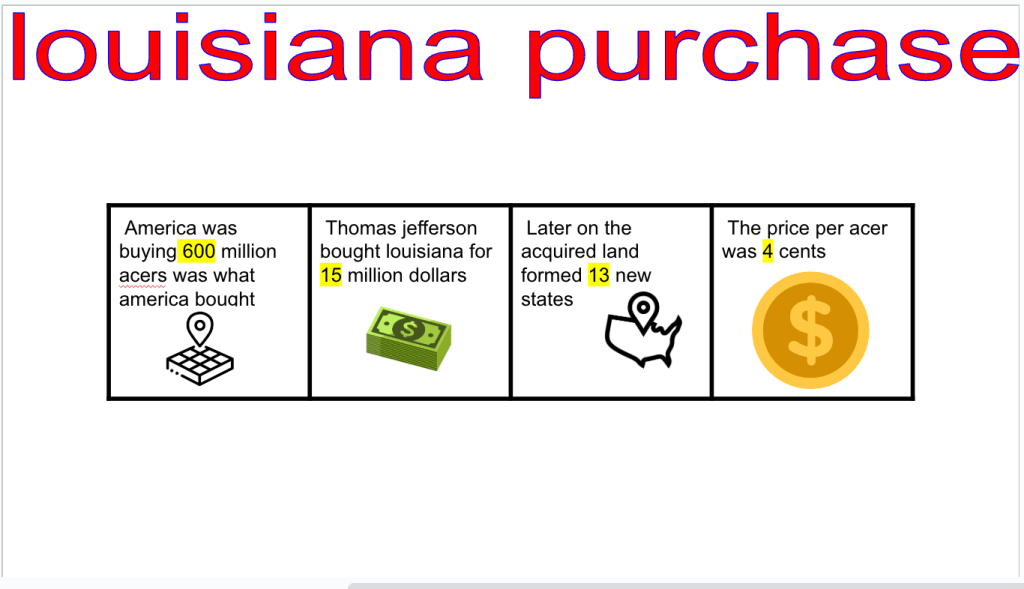
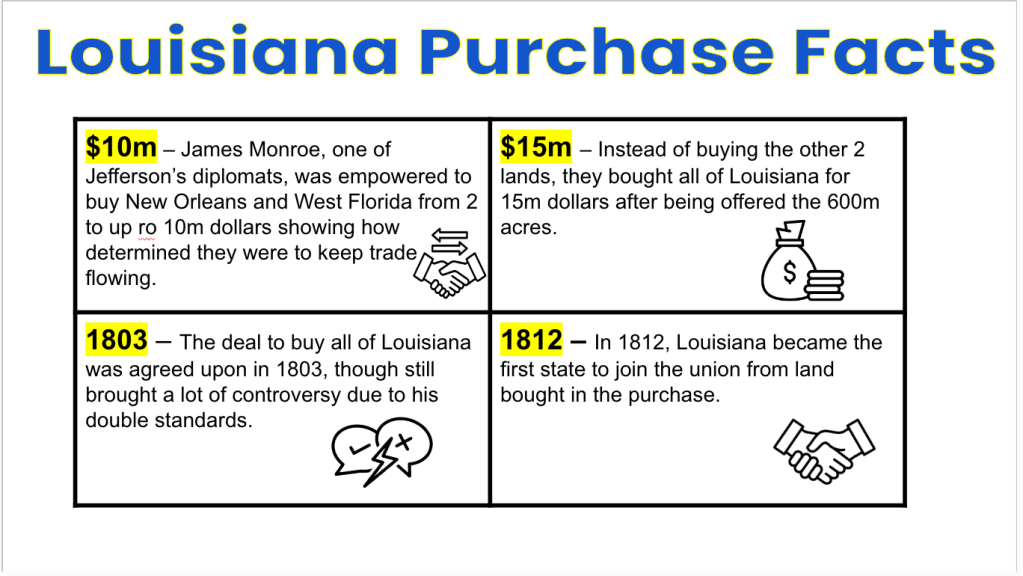
On Tuesday, we did a lesson on the Louisiana Purchase. I asked why Federalists opposed the purchase. First, I provided relevant background knowledge before students could answer. I started with a Thin Slide, asking students to find an interesting fact about Thomas Jefferson to share with a partner. Next, I gave students a section of the textbook on the purchase, enhanced with AI to incorporate more statistics. With Number Manias, I often give a quote for students to support with facts and numbers. The quote: “Expanding the country west was a key goal for Jefferson. So even though it went against some of his usual policies, Jefferson made the daring choice to buy all of Louisiana from France.” Before the Number Mania, students completed a Frayer model for the word “diplomat”—I should have done this last week with the XYZ Affair. Students then had 5 minutes to read and find 4 numbers to support the quote, followed by 15 minutes to design slides.

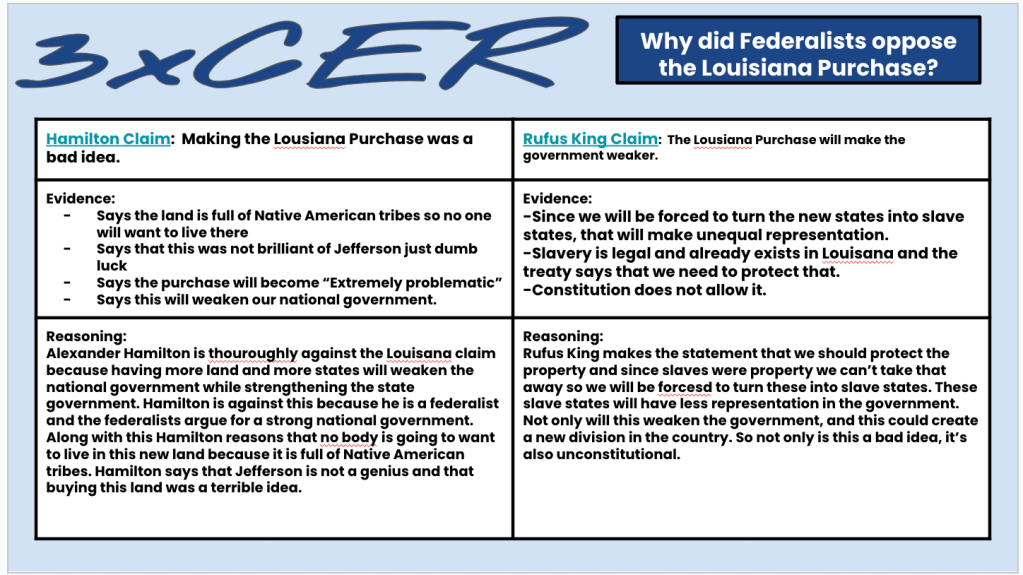
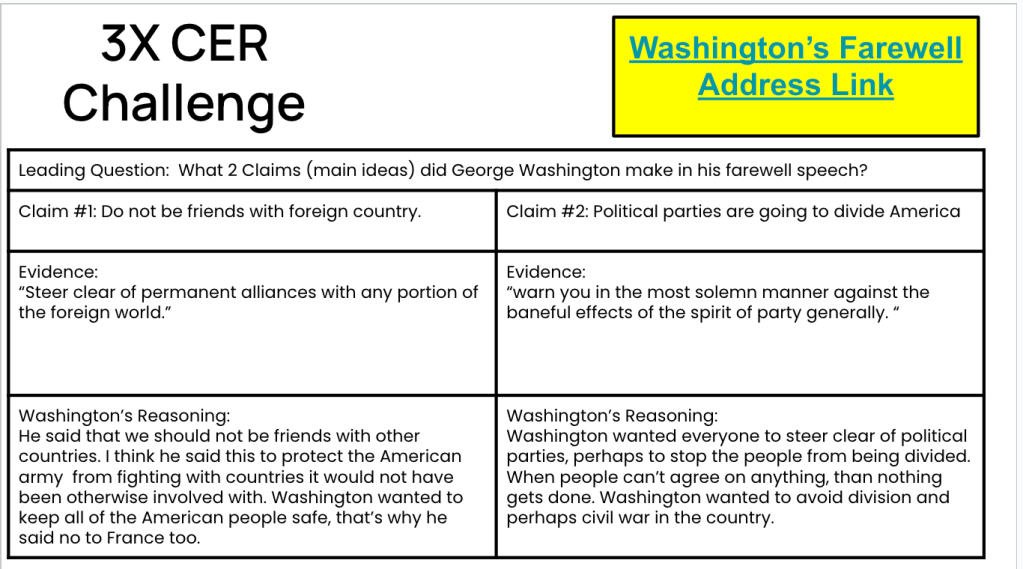
We then did a 3xCER, answering why Federalists opposed the purchase. I emphasized that although doubling the U.S. size seemed positive, Federalists objected. This ties back to whether these presidents upheld party visions. Students read Hamilton’s editorial, recorded his claim/evidence/reasoning regarding his opposition, then did the same for a Rufus King letter. I think this showed multiple perspectives—on one hand it seemed beneficial, but Federalists opposed it for potentially expanding slavery, weakening federal power, etc. This foreshadows future learning and reminds that Federalists favored centralized power.

Wednesday

On Wednesday, I wanted some classes to catch up while allowing advanced classes to continue progressing. With one class, we used a Resource Rumble to review Washington, Adams and Jefferson’s presidencies. With other classes, we did Mr. Roughton’s “Culture Shock” lesson. This gave a feeling of early 1800’s life while reviewing past learning. It began by having students write the principal about a policy change, but I blocked out harsh language, relating it back to Adams’ Sedition Acts. We did an activity with political cartoons about presidents. We went outside to sketch leaves, then read Lewis & Clark journal entries to guess the animal, which I tied back to the Louisiana Purchase exploration. Students enjoyed this lesson, so I will use similar ones in the future.

Thursday and Friday

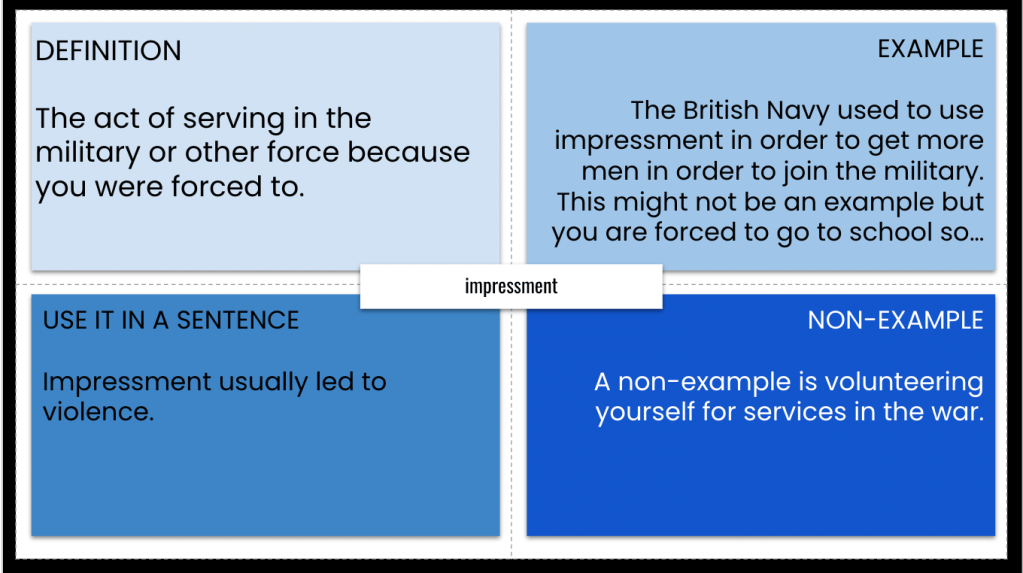
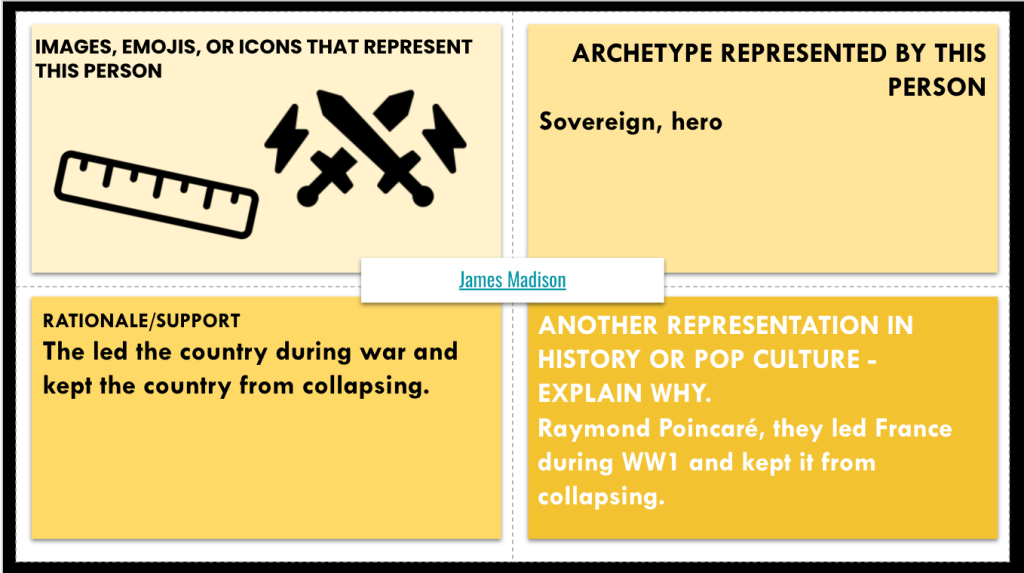
On Thursday and Friday, we began examining James Madison and the War of 1812, asking what he should do about British impressment. Since most students didn’t know Madison or impressment, I structured activities to build background knowledge. We started with a Thin Slide about Jefferson’s Embargo Act, efficiently providing/reinforcing information. Before they began, I rolled dice to determine slide phrase length to encourage concise summarization. My goal was to show Britain/France tensions persisted. I asked students the definition of insanity – trying the same thing but expecting different results – which I likened these first 3 presidents’ failed efforts to avoid war. Next was a Madison Archetype Foursquare, then students Frayer modeled “impressment” and “warhawks.”

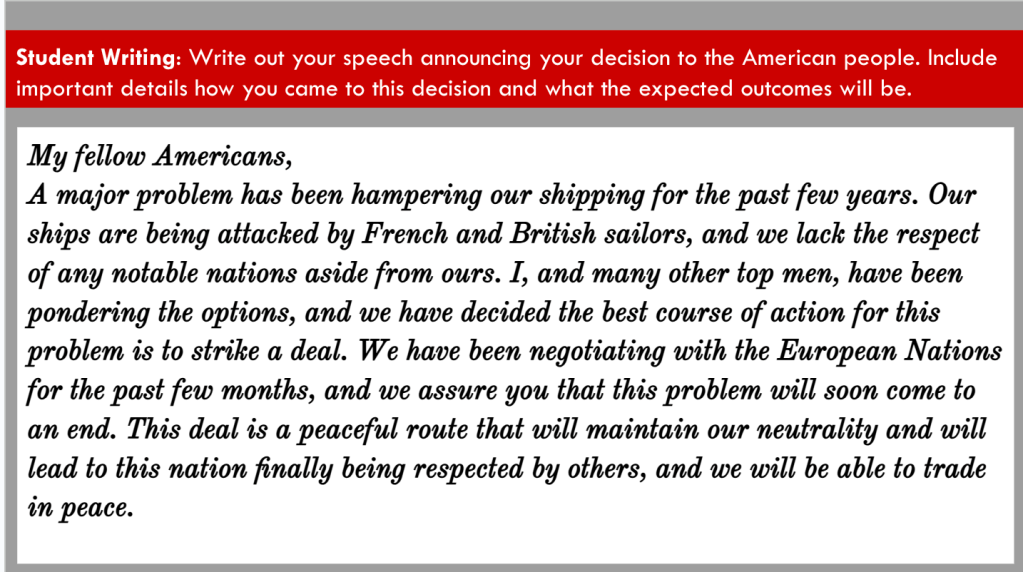
I then added a CyberSandwich using an activity from Dan Lewer’s website putting students in Madison’s shoes regarding impressment. After a briefing/timeline for context, I simply asked them to decide as if they were president. Last time with Adams, students finished quickly, so I modeled weighing options first. We developed a good pro/con list before writing a speech for the public where I provided framework: summarize the issue since there was no instant media, share their decision, and justify why it was best. After writing, I revealed Madison urged war, now called the War of 1812. We watched a video on the burning of the White House, then I shared more outcomes like stalemate, the Battle of New Orleans, Federalists wanting succession, and the Federalist Party’s end. Students enjoyed considering perspectives and options as if they were president.

We closed with a 5-minute Gimkit review game, then partner discussions before a 4-minute rematch, challenging students to beat their prior scores. Every class scored over 80%, demonstrating learning.

The Week That Was In 505

This week was a 4-day week. We had class Monday through Thursday. There must be a lot of sickness going around because I’ve had a lot of student absences recently. Things just seem scattered and disorganized lately. I need to get myself back on track and find some consistency in my lessons and class structure again.

Much of my class focuses on the experience of being actively present within the class sessions and activities. Even though I am regularly using protocols and structured activities, it seems that when a student misses a day, they miss out on a lot of material, as the old adage goes. Having to create some Differentiated Instruction review articles and activities to catch some students up who have missed classes, it’s a quick and simple way to get them back up to speed.

This week we covered some important content. We examined Washington’s Farewell Address and then delved into learning about John Adams’s presidency, including studying the XYZ Affair and the controversial Alien and Sedition Acts.

Monday – 3xCER Farewell Address

Tuesday and Wednesday – XYZ Affair

Thursday – Alien and Sedition Acts

Monday

On Monday we analyzed Washington’s Farewell Address using a 3xCER protocol. I often use the 3xCER method when studying primary sources, as it has students focus on writing claims backed by textual evidence, and then explaining their reasoning.

In this particular lesson, we began class with a Thin Slide. In the Thin Slide, students had to look up one specific precedent that George Washington set during his presidency – 1 picture, 1 precedent. They had 3 minutes. I used this quick activity to set the context that Washington’s famous Farewell Address established precedents and advice that endured long after Washington left office.

Next, I gave students excerpts from the lengthy Farewell Address to read and analyze. Their task was to match sections of Washington’s address to comparable modern concepts and ideas. This helped them understand the still-relevant wisdom in Washington’s speech. I specifically pointed out Washington’s warning about the dangers of emerging political parties dividing the fledgling nation, as well as his admonition to avoid questionable “entangling alliances” with other countries.

I gave students 10 minutes to write their own claims about the address, citing textual evidence and explaining the meaning and their analysis in their own words. I incorporate study of the iconic Farewell Address for two key reasons: first, it’s valuable for students to closely read such an influential primary document that is still so often referred to even today; second, Washington’s parting words of wisdom to the nation provide helpful background context about factors that shaped later controversies and debates during the Adams and Jefferson administrations.

Since so many students had missed classes recently, I wanted to incorporate a retrieval practice review activity. We played a creative dice game where I would ask a question about content we’ve learned previously, roll several dice, and the students would then have to accurately summarize their response to my question in the exact number of words as the dice total. For instance, I might roll the dice and get an 18, then ask a question like “Who was George Washington and what was most important about his presidency?” The students then have 18 words to try to answer correctly. This fast-paced activity kept engagement high while reinforcing key knowledge.

Tuesday

On Tuesday we launched into learning about John Adams’s presidency, starting with the infamous XYZ Affair. I began the lesson with a Thin Slide and a linked reading that set the context by reviewing the contentious election of 1796, where Adams and his Federalist Party narrowly defeated Thomas Jefferson’s Democratic-Republican Party. Under the rules at the time, this made Adams President and Jefferson Vice President, even though they held very different visions for governing the young nation.

In the Thin Slide, I asked students to imagine how it would look if we still followed this election model today. They had an amusing time realizing that would put Biden in the White House and Trump right there beside him as VP! I used this as a discussion prompt to illustrate how much has changed, but also to preview the core theme we would keep revisiting: how much impact presidents and political parties had on shaping the nation, both then and now.

Next, students analyzed a short biography summarizing Adams’ early life and career before becoming president. To make this more engaging, they had to apply an archetype lens, examining Adams’ essential character traits, motives, and drivers using a framework often applied to literature characters. Choosing details from Adams’ pre-presidential life, students had to cite textual evidence to explain what archetype he aligned with most closely and why. As an extension, they compared and contrasted Adams’ archetype to someone in their own life exhibiting similar enduring personality characteristics and motivations. This activity prompted some insightful analysis and discussions about Adams and human nature more broadly.

I next introduced the major scandal that erupted during Adams’ term: the infamous XYZ Affair. This complex incident involved intrigue, international extortion plots, and heated political controversy.

To better understand the XYZ Affair and its impacts, I adapted a lesson plan developed by social studies teacher named Susan Gorman. Her approach made the scandal more accessible by having students examine primary source accounts and piece together the story like detectives. I paired her lesson concept with a CyberSandwich.

In my lesson, students had to closely read a set of fragmentary excerpts from witnesses and participants describing their view of events. As they analyzed each slice of the political drama, students filled out a graphic organizer, layering the pieces together into a coherent timeline. They had to deduce such key points as attempting to identify who the cryptically named French agents X, Y and Z were, why they tried to extort a bribe from America, and how the Adams administration responded.

The CyberSandwich provided helpful structure, allowing students to build up their understanding layer by layer as they progressed through the accounts. Once they read, notated and discussed the various perspectives, they then had to synthesize their learning by writing a summary reflecting their understanding of how and why this diplomatic crisis emerged. The interactive analysis and incremental building of knowledge about the XYZ Affair captured student interest while developing crucial historical thinking and primary source analysis skills.

Wednesday

We devoted the first part of Wednesday’s class to completing the XYZ Affair lesson to ensure students had thoroughly grasped the causes and sequence of events. After discussing their XYZ Affair summaries and analyses in small groups, I transitioned into the next phase of learning.

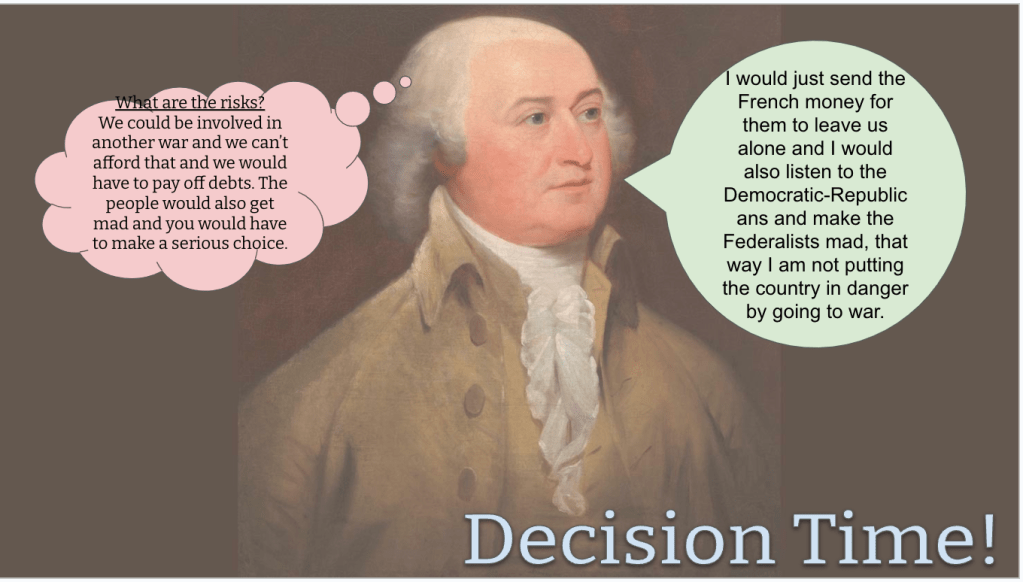
Even with the background factual knowledge from their summaries, students still did not know how President Adams chose to respond to the national crisis and inflammatory public fury sparked by the XYZ revelations. I wanted to simulate the complex decision making challenge faced by Adams to resolve tensions with France without triggering an expensive, risky war that the fragile young America could ill afford.

This reflective judgment activity compelled students to essentially attempt to re-enact Adams’ key decision points regarding the XYZ Affair aftermath. I emphasized that they needed to consider the context Adams faced at the time, based on geostrategic realities, the precedent of neutrality established by Washington, pressure from Adams’ Federalist allies urging war with France, and the perceived need to assert American strength abroad.

With these influential factors in mind, students had to actively debate and judge the wisest course for Adams by closely evaluating multiple options, national priorities, risks and trade-offs. I encouraged them to dig deeply into Adams’ perspective to try to see the situation through his eyes.

In one class, I noticed students racing through this complex deliberation far too quickly, finishing their recommended plan for Adams in just 5 minutes. This signaled they were not truly wrestling with the web of complications Adams had to balance and the judgment call he had to make amidst clashing viewpoints and shaky public morale.

So in the next class section, I deliberately walked students through the full scope of analytical thinking required for sound decision making of this magnitude. I used strategic questioning and patience to incrementally build their context, inquiry and cognitive engagement.

Through this guided interaction, I emphasized that as a Federalist, Adams faced immense pressure from within his own party to enter war against France. Yet he also had to weigh George Washington’s sage advice urging neutrality to give America’s fragile experiment in democracy time to stabilize. I thus set up an insightful realization that Adams was caught in an unenviable lose-lose predicament, with his Federalist allies threatening to desert him even as Republicans continued attacking his policies.

Pushing past knee-jerk solutions, most students dug deeper to thoughtfully grapple with Adams’ impossible situation. They finally realized the complexity of variables, trade-offs and paradoxes facing the president, needing 25-35 minutes of guided decision analysis rather than 5. We debriefed that such deeply consequential decisions require careful execution of critical thinking as much today as then. I ended class having students generate probing questions about the XYZ Affair which their classmates had to answer concisely, putting our debating and judgment skills to work!

Thursday

After analyzing Adams’ impossible decisions on avoiding war with France in the XYZ debacle, on Thursday we transitioned to examining a controversial set of domestic laws subsequently passed by the Federalists under Adams’ administration. Still alarmed by potential French revolutionary infiltration and attacks on American sovereignty after the XYZ Affair, the majority Federalist Congress passed four laws in 1798 collectively known as the Alien and Sedition Acts.

I opened this lesson by giving small student teams realistic scenarios describing French immigrants pathways into America during this volatile period. Teams had to rapidly discuss options and decide on the policy course they would set. This immediately set the context for the tensions and perceived threats posed by aliens and outsiders that in part prompted the Alien Acts.

We next examined the key provisions of these laws, which expanded the duration of residency requirements to 14 years before immigrants could apply for US citizenship. Students used Parafly EduProtocols to paraphrase the essence of the Naturalization and Alien Acts. We then examined a real case study that demonstrated the laws’ power in practice.

I described the fate of Congressman Matthew Lyon, an outspoken Republican critic of the Adams administration. Lyon had notoriously written that President Adams deserved to be put in a “madhouse.” For this perceived insult to the administration, Lyon was prosecuted and convicted under the controversial Sedition Act portion of the Alien and Sedition Acts.

I had students used a Frayer to investigate the meaning and examples of “sedition” more deeply. We analyzed an excerpt from the Sedition Act text itself using Annotate and Tell.

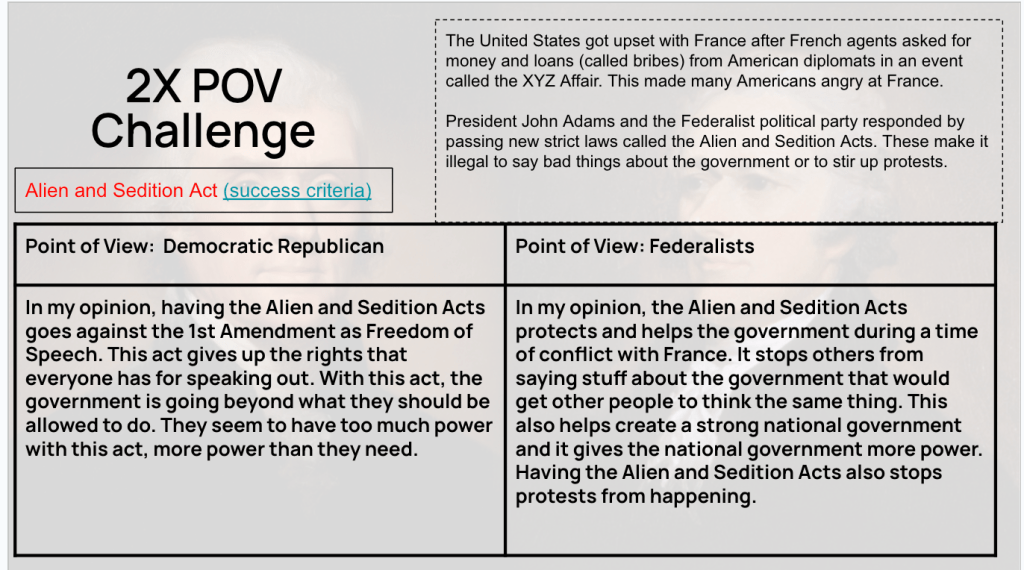
To synthesize their analysis, students wrote a short perspective 2xPOV from the vantage point of Federalists explaining why they strongly supported this law as necessary and proper.

In the last stage of the lesson, I flipped the script, having students write a rebuttal as Democratic-Republicans decrying the laws as hypocritical violations of constitutional liberties of speech, press and due process. By writing sequentially from contrasting political insider lenses, students gained a more balanced insight into the complex debate stirred by the Alien & Sedition Acts.

This multi-perspective analysis and writing task took up our entire Thursday class session. If time permitted by the end, we briefly revisited key concepts and historical figures from the week using the dice game as a quick closing review.

The XYZ Affair and Alien & Sedition Acts proved pivotal episodes in the Adams presidency that also encapsulated major themes of America’s early development. The inheriting tensions over centralized authority versus states’ rights, interpretations of checks and balances, and partisan efforts to control domestic dissent and international affairs resonate into modern U.S. politics. By enacting decisions Adams wrestled with using compelling primary sources and perspective-taking, students gained an enriched understanding of obstacles in governing a fragile new nation – insights equally relevant today.