I decided to add some gamification to Westward Expansion. Students are put into teams and are working to accumulate the necessary supplies for a Westward trip. We are going to have some Side Quest options to earn more supplies, and I have supplies hidden around the school. Supplies include: blankets, food, fire, Guidebooks, cooking utensils, money, maps, etc… However, some of the supplies are a trap. For example, the Donner Party had a bad guidebook that led them astray en route to California. As a result, one of my guidebooks is a trap. Here is my website I put together.
I began the unit today with the Great American Race EduProtocol. “This sounds easy. All we have to do is Google stuff?” – This is usually the quote when I explain the first Great American Race EduProtocol rep. Fast forward to our third rep of the year and the students are asking this question, “Can we have a word bank?” Students quickly learn there’s more to creating clues and researching answers with Google.
My first class I ran a Quizizz, ran a Great American Race, and then a Quizizz again. Here are the Great American Race instructions if you are familiar:
Create an index card with a number on one side and a vocab term on the other side.
The vocab term is the “answer” and instruct students to keep it a secret.
Students had 10 minutes to design their own slide – add the card number to the slide, add clues for the vocab term, and a picture.
To determine the amount of clues to add to the slide, I make it interesting and have 1 student roll a dice.
As students work, I copy their slides, in order, to a large slide deck.
I give feedback as they do this.
Then students have the rest of time to figure out the answer for each slide. I give each students (sometimes each group) 1 paper with answer blanks.
Here are the Great American Race slides:
That’s it. The Great American race. In my opinion, though, my first period setup didn’t produce desirable results. Something needed to change. I opened up Explore Like a Pirate by Michael Matera and began the next class with some Graffiti.
Graffiti
Students walked into the classroom and saw textbooks laying on the desks. “What are these Mr. Moler?” “We haven’t used a textbook all year! I don’t like this.” I quickly correct the student(s), “We have used the textbook all year, you just didn’t realize it.”
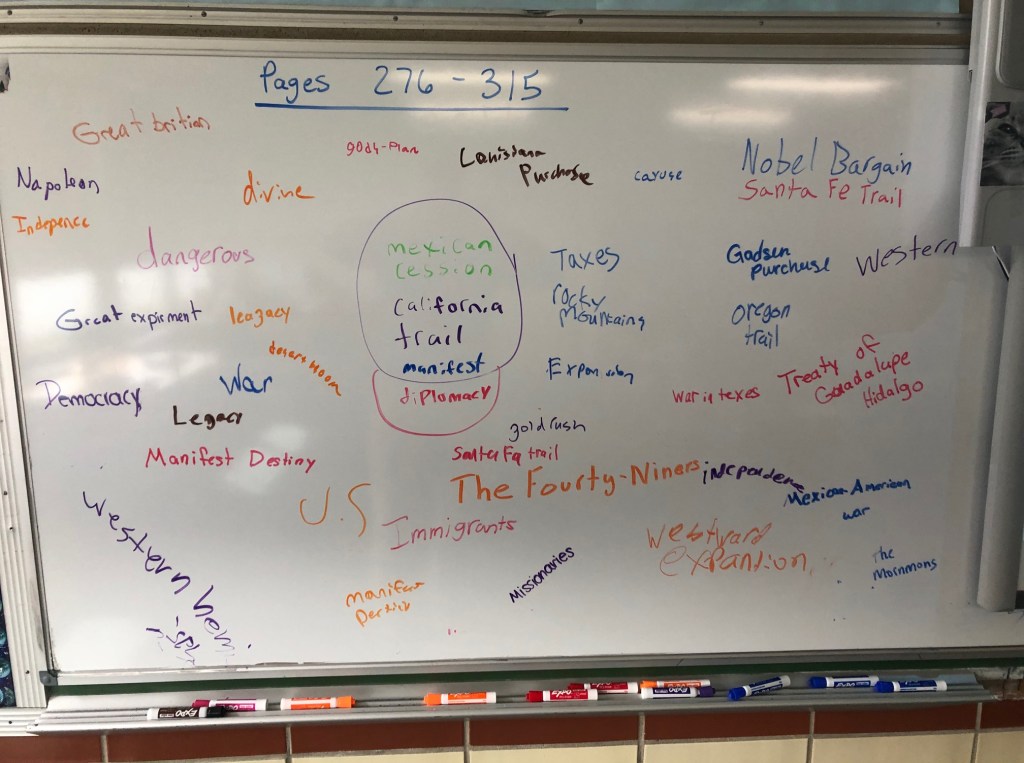
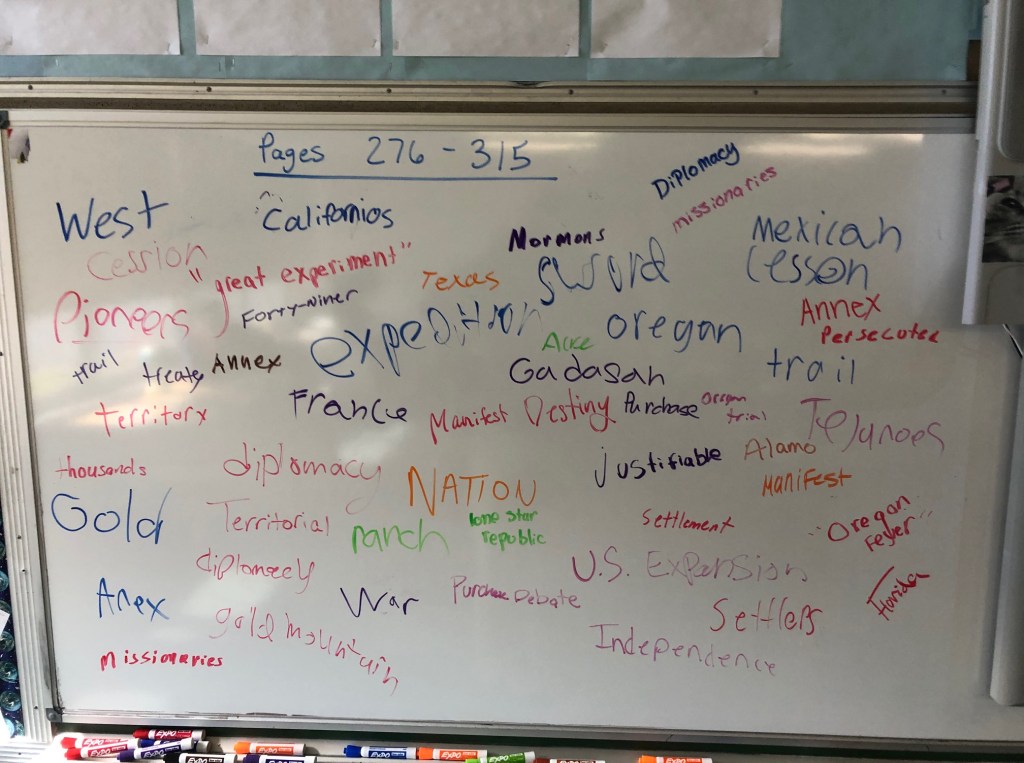
I instructed the students to look at pages 276-315 – skim and preview. I had them find words they thought were important to understanding Westward Expansion. If students found a word, they had to raise their hand and I had to call on them to go. There were 2 catches:
They couldn’t write the same words or phrases on the board.
I added a “magic word” – a secret word that could instantly win the person who wrote it some money for their group. (Think of it like the secret word from Pee Wee’s PlayHouse show). The secret word was “Manifest Destiny” and every class had 1 student that wrote it.
Students had 6 minutes to skim and add words to the board. When we were finished, I summarized the information on the board and surprisingly, students listed 90% of the words I had on the Great American Race Cards. I took a picture of each board and added it to the picture to the Great American Race assignment as a word bank. THIS. WAS. AN. AWESOME. ADDITION. TO. GREAT. AMERICAN. RACE!!! Here are the boards:
This was such a fun element to add to the Great American Race. Students wanted a word bank and so they created their own and fun doing it. The Great American Race results were much better with a word bank and the eneggament was tons better as well. Unfortunately, I didn’t have time a for a Quizizz.
This week I needed to focus on a writing unit. It was brought to my attention that I needed to cover writing more often. So, I sat down and looked at the Common Core Writing standards and I made notes next to each item. Turns out I cover many of the standards already with weekly Frayers, CyberSandwiches, Iron Chefs, and Thin Slides. However, there was one standard I didn’t address yet – Argumentative Writing.
Despite me covering writing standards weekly with EduProtocols, I haven’t formally taught writing. I focus too much on content rather than process. I needed to put together a writing unit that focused on actually teaching the process of writing. The writing had to fit with the Monroe Doctrine because that’s where we are in class. So I sat down, got my mind working, and started with this question:
“Was the Monroe Doctrine a policy of expansion or self-defense?”
The next step of the process I wrote out some I Can statements. Here are those statements:
I can identify 2 policies from the Monroe Doctrine.
I can explain the Monroe Doctrine how the Monroe Doctrine can be seen as a policy of expansion.
I can explain how the Monroe Doctrine can be seen as self-defense.
I can construct a multi-paragraph essay.
Then I had to decide the process of teaching an argumentative essay. I’m not an ELA teacher, but I do love to write. I have never formally taught how to write an essay, and I wanted to keep things SIMPLE.
I chose two resources – a secondary source for background information, and three excerpts from the Monroe Doctrine to serve as a primary source. When I selected my resources, I kept the students in mind. The other dynamic to this writing unit planning was taking into account that some students practice writing essays and paragraphs monthly and others have very little practice. My compromise to this was expecting students to write 3 basic paragraphs to form an argumentative essay.
The last part of my planning process included adding some EduProtocols. Here was my plan:
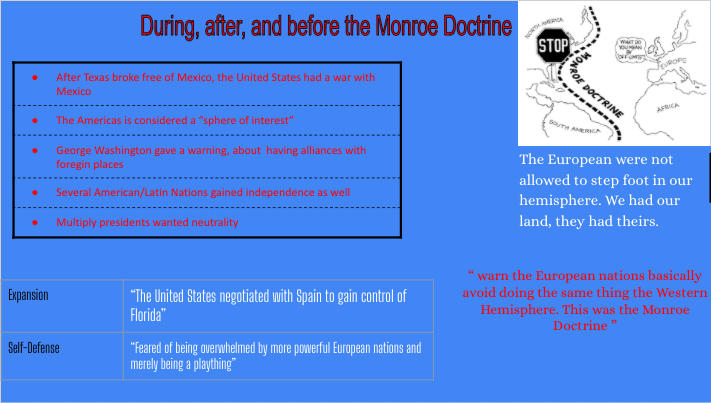
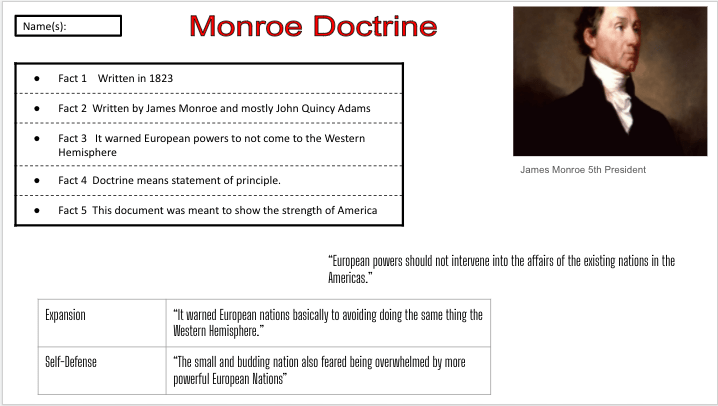
I used a new EduProtocol today – Thick Slides! My focus this week is writing a multi-paragraph using a prompt similar to what will be seen on the state test. I copied and pasted a prompt from the state test and plugged in my own content related to the Monroe Doctrine.
Most prompts on the state test have the students comparing and using evidence from 2 or more sources. In this case, I have a secondary source and primary source the students will be using. My focus is on 3 things for this week. I want the students to be confident with:
Writing 3 solid, cohesive paragraphs.
Creating a good thesis.
Using evidence from the sources to support the thesis.
The Monroe Doctrine is a secondary issue. With these three things in mind, I started to piece together some Eduprotocols to help with writing. What came to mind are these 3 ideas:
Thick Slides – developing a solid paragraph(s).
Parafly to help us make sense of the Monroe Doctrine as our primary source.
Research Protocol – develop a thesis with evidence.
Starting Class
I began class with the empty room and candle scenario in the picture. I had students close their Chromebooks and had them sit and think about the answers. No talking, No questions. Just think. The students seemed confused, and after 3-4 minutes I could tell they gave up. My point with this scenario was 2 things:
Rarely will human beings sit and think long enough to solve a problem.
We solve problems with background knowledge in our working memories. This is true because the only students who got the answer correct were the students I had in my 5th period one year ago. That was the only period I asked the question to last year.
What does this have to do with a writing prompt? Chance are the students won’t sit and think about what a “mile long” writing prompt is asking them unless they have some knowledge of the words and phrases. Essentially I used this as my “why” for working on writing this week.
What is the answer to the question above? Try to sit and think about it for longer than 10 minutes before looking it up.
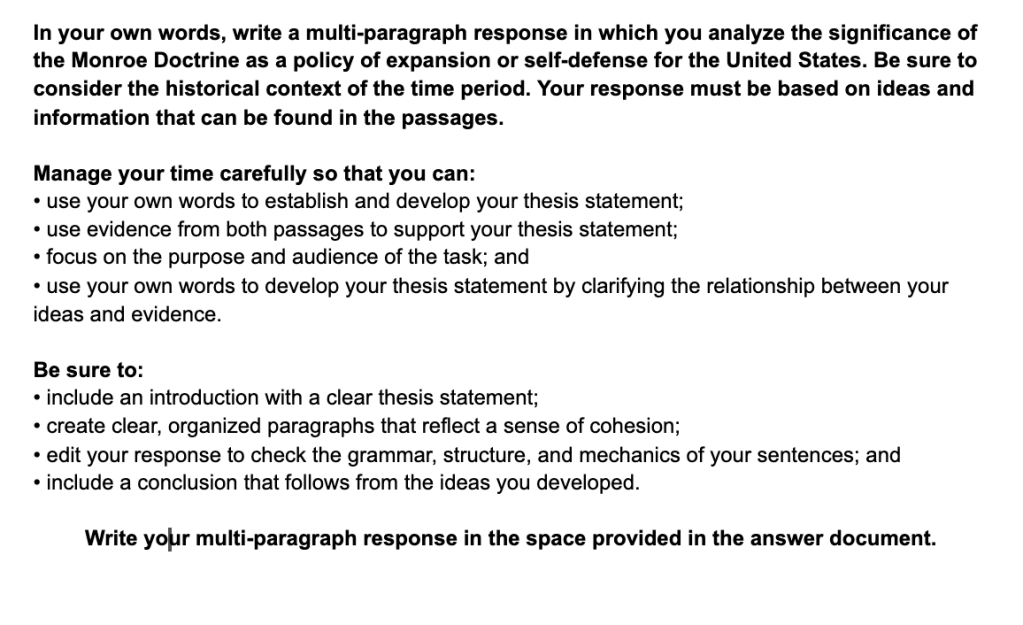
The Prompt
Below is the writing prompt I put together for the students. It’s a long one so I had students read the prompt and submit unknown words and phrases through Mentimeter to create a Word Cloud.
The most common words submitted to the word cloud were: significance, doctrine, Monroe Doctrine, policy, expansion, self-defense, context, thesis, audience, clarifying, mechanics, and cohesion. Here what I learned from the word cloud – don’t assume students know common words. This was followed by a discussion of what the prompt was asking the students to do.
Fast and Curious
To begin building Monroe Doctrine background knowledge with the Monroe Doctrine, students took 4 minutes to do a Quizizz. The Quizizz was 6 questions. The first round wasn’t great. This was followed by feedback and a Thick Slide creation. We finished class with a 2nd round of Quizizz which was much better. Here are the results:
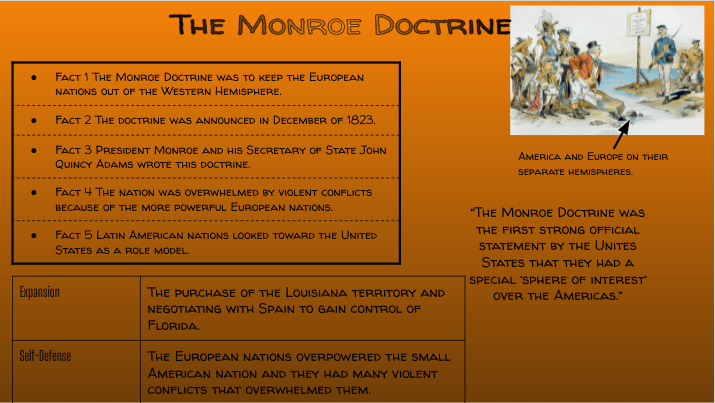
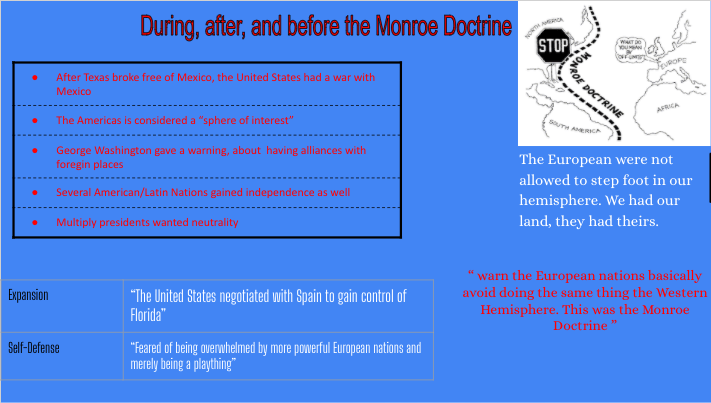
Thick Slides
I have used Thick Slides once…..I think. But, I don’t think I would consider it Thick Slides. I was inspired to use it after watching Kim Voge’s video from EduProtocols Worldwide 3. It was a perfect fit for our essay writing unit. I love the simplicity of the design. Here were my requirements for the slide design with feedback I gave to students:
Add a Title – the title should reflect the main idea of the topic.
List 5 facts – focus on who, what, when, where, why. Many students copied and pasted their facts, but I will have them reword/paraphrase their facts.
Find a relevant picture – add a caption that explain why the image works with the topic.
Quote – find an interesting quote that relates to the main idea of the Monroe Doctrine.
2 pieces of evidence – find a quote that proves the Monroe Doctrine was used for expansion. Find a quote that prove the Monroe Doctrine was used for self-defense.
I gave students 20 minutes to complete their slide(s). Students will use their slides to develop paragraphs for the essay. I pointed out to students they could use this process with their scratch paper for the state test – list 5 facts on the paper, an important quote, etc. They could use this information to develop a solid paragraph.
Differentiating Ideas
One student had a headache and couldn’t look at the screen – I gave a the reading on paper and a blank piece of paper. I helped him set up the blank paper with a title, 5 facts, and a quote.
I added questions into the Facts section of the slide – Who wrote the Monroe Doctrine? What was the Monroe Doctrine? etc…
I provided hard copies of the reading pre-highlighted for the students.
Some students listened to the reading.
Wednesday
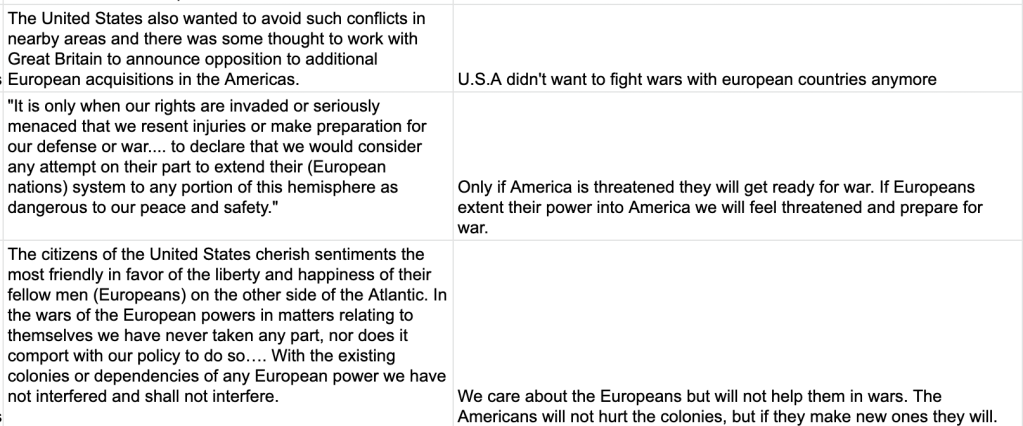
Continuing our essay writing unit with the Monroe Doctrine it was time to move on and look at 3 important excerpts from the primary source. I thought to myself – I could have the students analyze this doctrine with HIPPA or some other fancy acronym. However, I voted against that and went with a parafly. Yes, we want students understanding the context of the document, the author’s purpose, and so on. But I wanted the students to understand the words that James Monroe spoke to Congress. In order to accomplish this goal, I used Parafly which a quick paraphrasing activity. Here are the 3 excerpts I chose for the Parafly:
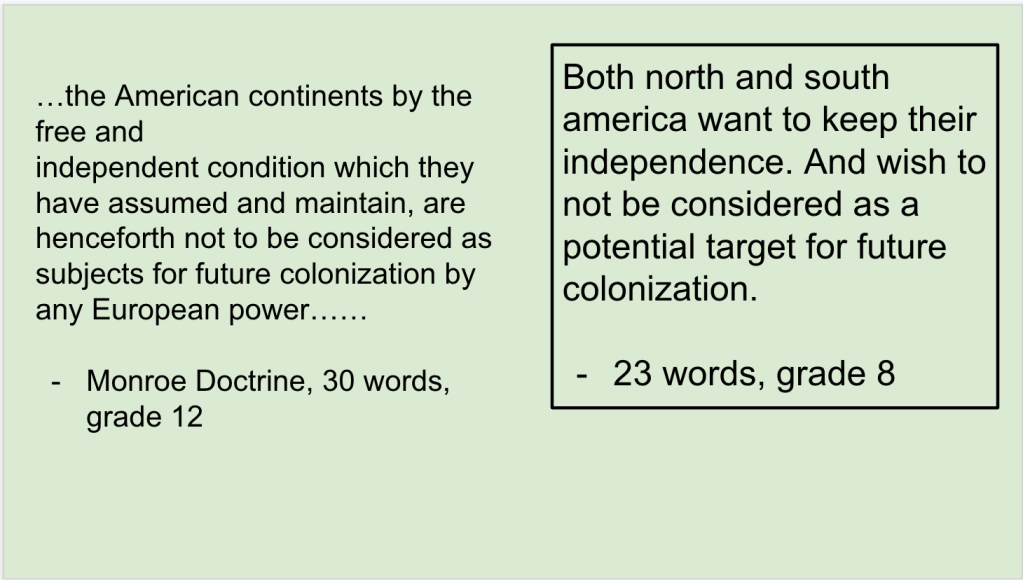
“…the American continents by the free and independent condition which they have assumed and maintain, are henceforth not to be considered as subjects for future colonization by any European power……”
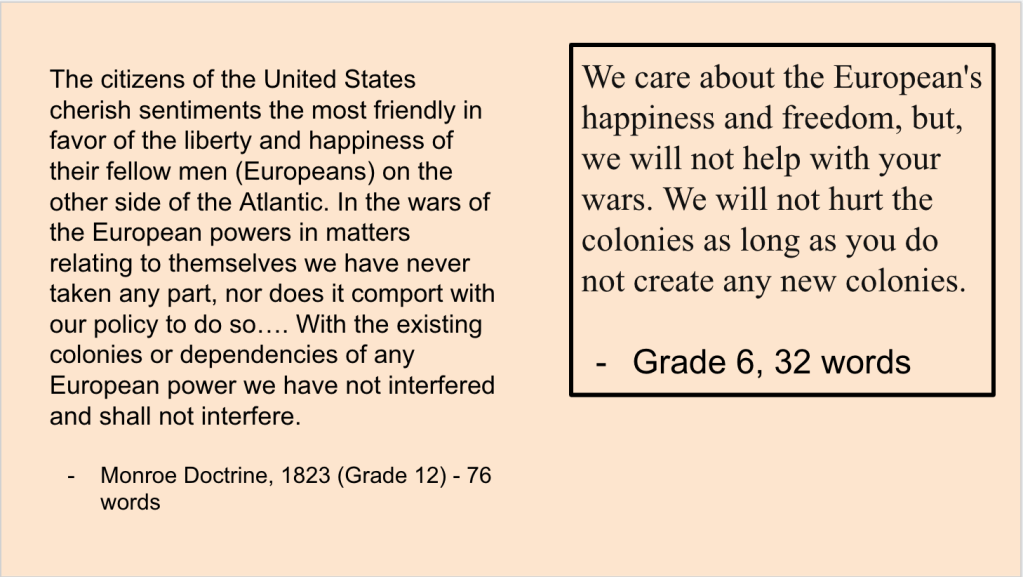
“The citizens of the United States cherish sentiments the most friendly in favor of the liberty and happiness of their fellow men (Europeans) on the other side of the Atlantic. In the wars of the European powers in matters relating to themselves we have never taken any part, nor does it comport with our policy to do so…. With the existing colonies or dependencies of any European power we have not interfered and shall not interfere.”
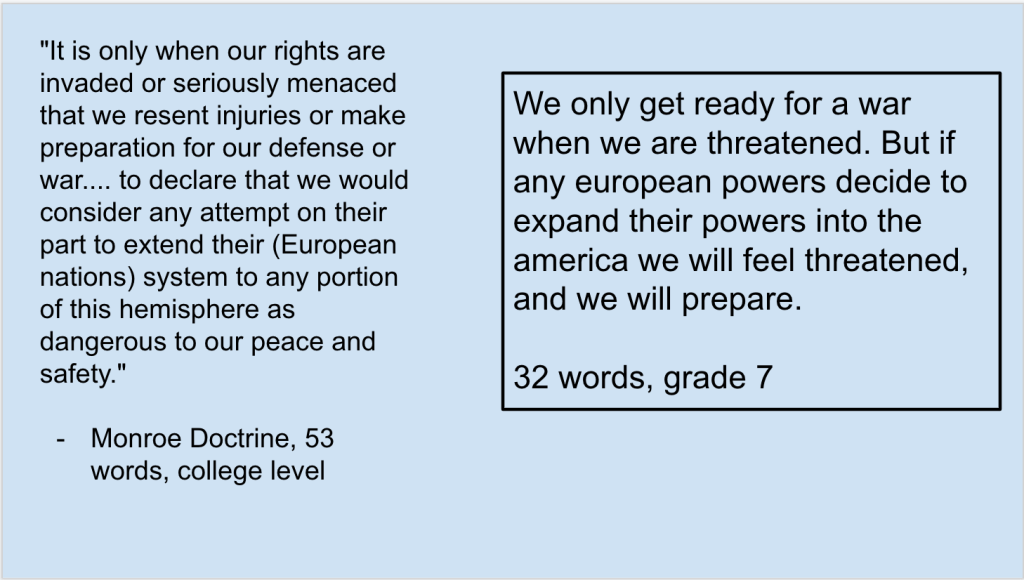
“It is only when our rights are invaded or seriously menaced that we resent injuries or make preparation for our defense or war…. to declare that we would consider any attempt on their part to extend their (European nations) system to any portion of this hemisphere as dangerous to our peace and safety.”
The Tools
I tried out the Parafly with multiple tools during the day. The goal with each tool was to give feedback to students in real time. Here are those tools with explanations:
Peardeck – I began with Peardeck so I could watch students typing in real time on the screen. However, I couldn’t see student names with the free version. This was a good option, but I wanted to see student names.
Nearpod – I liked that I could see student names, hide names, and I could run a timer for 4-5 minutes to keep the process moving. I didn’t like that I couldn’t see responses in real time. But, as students submitted I could provide feedback right away and it was easy to fix and change.
Socrative – This was my least favorite option. Maybe I needed a paid version? Once students submitted, they couldn’t go back and make corrections. Again, maybe I was missing something? However, I really like the voting tool which can turn Parafly into a competition.
Hemingway App – The Hemingway app allows students to edit text and it gives feedback on writing styles. I really like the Grade Level Readability rating. I challenged students to Paraphrase the text to a 6-8 grade level. They really, really enjoyed this challenge!!
Introducing Parafly
My students have never completed a parafly before. Some students practice paraphrasing a lot and some have never done it all. Since none of them have Parafly’d (Paraflied??) the Eduprotocols way I began with a short passage about a Land, Sea, and Air Burger on the McDonald’s menu. Before we began I shared a definition of paraphrasing. According to the Hemingway App the passage was at a 6th grade level. I challenged the students to paraphrase it to a 3-5 grade level. Here is that passage:
The “Land, Sea, and Air” burger is one of McDonald’s largest “secret menu” items. This behemoth of a burger is stuffed with proteins from the Land (beef), Sea (fish), and Air (chicken). Some people even add fries to this monster burger. You order a Big Mac, a Filet-O-Fish, and a McChicken all at once. Then you put the McChicken and Filet-O-Fish patties inside the Big Mac along with however many buns you want and enjoy! Voila – a Land Sea and Air Burger! In our opinion, the Land, Sea, and Air Burger is more than enough to satisfy anybody’s appetite.
As students paraphrased I gave feedback on vocabulary and sentence usage. For example, many students left the word “protein” in their paraphrase. I asked them, “What is a way to paraphrase protein?” Most replied back with, “Oh yeah, meat.” I also mentioned, “Instead of listing out all 3 sandwich names, just say it’s made up of 3 different menu items.” It’s little bits of feedback such as that that get the students thinking.
Paraphrasing a Primary Source
After practicing with a McDonald’s passage, I had students paraphrase a three excerpts from the Monroe Doctrine. Each excerpt represented an important provision from the doctrine. I challenged the students to paraphrase the excerpts from a 12th grade – college level down to a 6-8 grade level.
As we worked through the first excerpt, I noticed that the vocabulary gave students tons of trouble. I suggested Rewordify to help with the vocabulary. The students who used Rewordify properly got the most out of the paraphrasing. With the first excerpt (listed above) I mentioned to students that james Monroe said, “American Continents,” which refers to North AND South America. Many students didn’t pick up on that detail.
I began the day hoping for writing practice, but the Parafly served 2 purposes today:
Paraphrasing and working with vocabulary to understand a primary source.
Reading for important details.
After each excerpt, we discussed as a class the 3 important provisions from the Monroe Doctrine. Here are some results of from our Parafly today:
Thursday
Today we used the Research Protocol that will be featured in the EduProtocols: History Edition by Dr. Scott Petri and me. This protocol is great at getting students finding evidence to support a claim, explaining evidence, and sharing their findings into a class spreadsheet.
Before the lesson began, I ran the same quizizz from Tuesday and the students did well. All class averages were 80% or higher. Following the Quizizz, we began our 2nd rep of the Research Protocol. I shared a Google Form where I posted the prompt question at the top: “Was the Monroe Doctrine a policy of expansion or self-defense?” My expectation was every student submitted 1 piece of evidence for each side of the argument – 1 piece that supported expansion and 1 piece that supported self-defense. I also included links to the sources within the Google Form. Students had 15 minutes to submit 2 pieces of evidence. Here are the results:
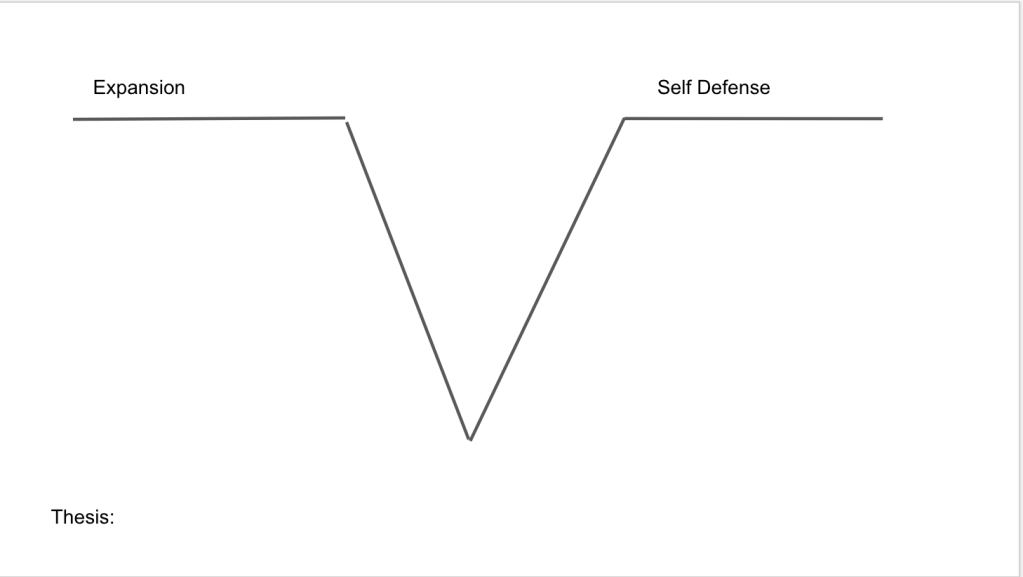
Following the evidence collection I post the Google Sheet, and I give the students a V Diagram where they can collect information. An example is listed here (I use it on paper, but created a digital version).
On the V Diagram, I wanted students to collect 2 pieces of information that supported both sides. Then students weigh the evidence and information then decide how they will write their thesis statement.
The research protocol gives students great practice finding details from multiple sources, analyzing those details, and practice writing a thesis statement.
With the research protocol completed, the students were heading into Friday ready to write their essays. They had a Thick Slide deconstructed paragraph to use, paraphrases of the Monroe Doctrine, and a V-Diagram with information, evidence, and a completed thesis.
Friday
Today was the day. Writing essays. Here were my different expectations for the variety of students in my classroom:
Write 4 or more paragraphs, focus on a counter claim (advanced ELA students)
Write 3 paragraphs
Write 2 paragraphs
Focus on writing a really good 1st paragraph with a hook, information, and thesis with all pieces organized correctly.
Write 1 paragraph about the Monroe Doctrine.
Fill out the graphic organizer.
Give me a thesis with a reason.
This is differentiation. This seems like a lot, but it’s not. This is my classroom on a regular basis.
Before I had students write essays, I posted a graphic organizer and a model essay on the Google Classroom assignment (I turned off the copy and share settings). The essay gave step by step directions for setting up paragraphs with some transitional word suggestions. Then I read my model essay as I shared my thought process while writing. I typed my thought process as comments. Having students hear good writing and hearing a thought process is an effective strategy.
After reading my essay, it was time for students to write. I reminded them of their Thick Slide and V-diagram organizer to help guide them. It was time to write. Here are some of the completed essays:
In this collection, I chose essays to represent ALL students. This, to me, is the power of EduProtocols – which essays were written by students with IEP’s versus not on IEP’s?
Despite my feeling like I bored the students with focusing on writing, I felt like this unit was successful. The students gave me feedback and really enjoyed the Thick Slides the most, and the second most like items was the V-Diagram. Having the thick slide with facts, quotes, and other information was a game changer.
My Messages for the Week
Exciting News
I copied this from Scott Petri – we have a cover!!
Continuing our essay writing unit with the Monroe Doctrine it was time to move on and look at 3 important excerpts from the primary source. I thought to myself – I could have the students analyze this doctrine with HIPPA or some other fancy acronym. However, I voted against that and went with a parafly. Yes, we want students understanding the context of the document, the author’s purpose, and so on. But I wanted the students to understand the words that James Monroe spoke to Congress. In order to accomplish this goal, I used Parafly which a quick paraphrasing activity. Here are the 3 excerpts I chose for the Parafly:
“…the American continents by the free and independent condition which they have assumed and maintain, are henceforth not to be considered as subjects for future colonization by any European power……”
“The citizens of the United States cherish sentiments the most friendly in favor of the liberty and happiness of their fellow men (Europeans) on the other side of the Atlantic. In the wars of the European powers in matters relating to themselves we have never taken any part, nor does it comport with our policy to do so…. With the existing colonies or dependencies of any European power we have not interfered and shall not interfere.”
“It is only when our rights are invaded or seriously menaced that we resent injuries or make preparation for our defense or war…. to declare that we would consider any attempt on their part to extend their (European nations) system to any portion of this hemisphere as dangerous to our peace and safety.”
The Tools
I tried out the Parafly with multiple tools during the day. The goal with each tool was to give feedback to students in real time. Here are those tools with explanations:
Peardeck – I began with Peardeck so I could watch students typing in real time on the screen. However, I couldn’t see student names with the free version. This was a good option, but I wanted to see student names.
Nearpod – I liked that I could see student names, hide names, and I could run a timer for 4-5 minutes to keep the process moving. I didn’t like that I couldn’t see responses in real time. But, as students submitted I could provide feedback right away and it was easy to fix and change.
Socrative – A great option. Once students submit their paraphrase, no changing/editing. They are committed to submitting quality work. Keep it moving, give quality feedback. Try to knock out 3 paraphrases in 12-15 minutes. THEN have students summarize.
Hemingway App – The Hemingway app allows students to edit text and it gives feedback on writing styles. I really like the Grade Level Readability rating. I challenged students to Paraphrase the text to a 6-8 grade level. They really, really enjoyed this challenge!!
Introducing Parafly
My students have never completed a parafly before. Some students practice paraphrasing a lot and some have never done it all. Since none of them have Parafly’d (Paraflied??) the Eduprotocols way I began with a short passage about a Land, Sea, and Air Burger on the McDonald’s menu. Before we began I shared a definition of paraphrasing. According to the Hemingway App the passage was at a 6th grade level. I challenged the students to paraphrase it to a 3-5 grade level. Here is that passage:
The “Land, Sea, and Air” burger is one of McDonald’s largest “secret menu” items. This behemoth of a burger is stuffed with proteins from the Land (beef), Sea (fish), and Air (chicken). Some people even add fries to this monster burger. You order a Big Mac, a Filet-O-Fish, and a McChicken all at once. Then you put the McChicken and Filet-O-Fish patties inside the Big Mac along with however many buns you want and enjoy! Voila – a Land Sea and Air Burger! In our opinion, the Land, Sea, and Air Burger is more than enough to satisfy anybody’s appetite.
As students paraphrased I gave feedback on vocabulary and sentence usage. For example, many students left the word “protein” in their paraphrase. I asked them, “What is a way to paraphrase protein?” Most replied back with, “Oh yeah, meat.” I also mentioned, “Instead of listing out all 3 sandwich names, just say it’s made up of 3 different menu items.” It’s little bits of feedback such as that that get the students thinking.
Paraphrasing a Primary Source
After practicing with a McDonald’s passage, I had students paraphrase a three excerpts from the Monroe Doctrine. Each excerpt represented an important provision from the doctrine. I challenged the students to paraphrase the excerpts from a 12th grade – college level down to a 6-8 grade level.
As we worked through the first excerpt, I noticed that the vocabulary gave students tons of trouble. I suggested Rewordify to help with the vocabulary. The students who used Rewordify properly got the most out of the paraphrasing. With the first excerpt (listed above) I mentioned to students that james Monroe said, “American Continents,” which refers to North AND South America. Many students didn’t pick up on that detail.
I began the day hoping for writing practice, but the Parafly served 2 purposes today:
Paraphrasing and working with vocabulary to understand a primary source.
Reading for important details.
After each excerpt, we discussed as a class the 3 important provisions from the Monroe Doctrine. Here are some results of from our Parafly today:
I used a new EduProtocol today – Thick Slides! My focus this week is writing a multi-paragraph using a prompt similar to what will be seen on the state test. I copied and pasted a prompt from the state test and plugged in my own content related to the Monroe Doctrine.
Most prompts on the state test have the students comparing and using evidence from 2 or more sources. In this case, I have a secondary source and primary source the students will be using. My focus is on 3 things for this week. I want the students to be confident with:
Writing 3 solid, cohesive paragraphs.
Creating a good thesis.
Using evidence from the sources to support the thesis.
The Monroe Doctrine is a secondary issue. With these three things in mind, I started to piece together some Eduprotocols to help with writing. What came to mind are these 3 ideas:
Thick Slides – developing a solid paragraph(s).
Parafly to help us make sense of the Monroe Doctrine as our primary source.
Research Protocol – develop a thesis with evidence.
Starting Class
I began class with the empty room and candle scenario in the picture. I had students close their Chromebooks and had them sit and think about the answers. No talking, No questions. Just think. The students seemed confused, and after 3-4 minutes I could tell they gave up. My point with this scenario was 2 things:
Rarely will human beings sit and think long enough to solve a problem.
We solve problems with background knowledge in our working memories. This is true because the only students who got the answer correct were the students I had in my 5th period one year ago. That was the only period I asked the question to last year.
What does this have to do with a writing prompt? Chance are the students won’t sit and think about what a “mile long” writing prompt is asking them unless they have some knowledge of the words and phrases. Essentially I used this as my “why” for working on writing this week.
What is the answer to the question above? Try to sit and think about it for longer than 10 minutes before looking it up.
The Prompt
Below is the writing prompt I put together for the students. It’s a long one so I had students read the prompt and submit unknown words and phrases through Mentimeter to create a Word Cloud.
The most common words submitted to the word cloud were: significance, doctrine, Monroe Doctrine, policy, expansion, self-defense, context, thesis, audience, clarifying, mechanics, and cohesion. Here what I learned from the word cloud – don’t assume students know common words. This was followed by a discussion of what the prompt was asking the students to do.
Fast and Curious
To begin building Monroe Doctrine background knowledge with the Monroe Doctrine, students took 4 minutes to do a Quizizz. The Quizizz was 6 questions. The first round wasn’t great. This was followed by feedback and a Thick Slide creation. We finished class with a 2nd round of Quizizz which was much better. Here are the results:
Thick Slides
I have used Thick Slides once…..I think. But, I don’t think I would consider it Thick Slides. I was inspired to use it after watching Kim Voge’s video from EduProtocols Worldwide 3. It was a perfect fit for our essay writing unit. I love the simplicity of the design. Here were my requirements for the slide design with feedback I gave to students:
Add a Title – the title should reflect the main idea of the topic.
List 5 facts – focus on who, what, when, where, why. Many students copied and pasted their facts, but I will have them reword/paraphrase their facts.
Find a relevant picture – add a caption that explain why the image works with the topic.
Quote – find an interesting quote that relates to the main idea of the Monroe Doctrine.
2 pieces of evidence – find a quote that proves the Monroe Doctrine was used for expansion. Find a quote that prove the Monroe Doctrine was used for self-defense.
I gave students 20 minutes to complete their slide(s). Students will use their slides to develop paragraphs for the essay. I pointed out to students they could use this process with their scratch paper for the state test – list 5 facts on the paper, an important quote, etc. They could use this information to develop a solid paragraph.
Differentiating Ideas
One student had a headache and couldn’t look at the screen – I gave a the reading on paper and a blank piece of paper. I helped him set up the blank paper with a title, 5 facts, and a quote.
I added questions into the Facts section of the slide – Who wrote the Monroe Doctrine? What was the Monroe Doctrine? etc…
I provided hard copies of the reading pre-highlighted for the students.
Another shortened week. We are 7 or 8 weeks into the 3rd quarter and we haven’t had a full/normal week of school yet. That’s not a joke. As frustrating as it is, I didn’t choose for that to happen. The only choice I can make is how I respond to the inconsistencies. I keep a positive mindset and try to make the most of it with the lessons and students learning.
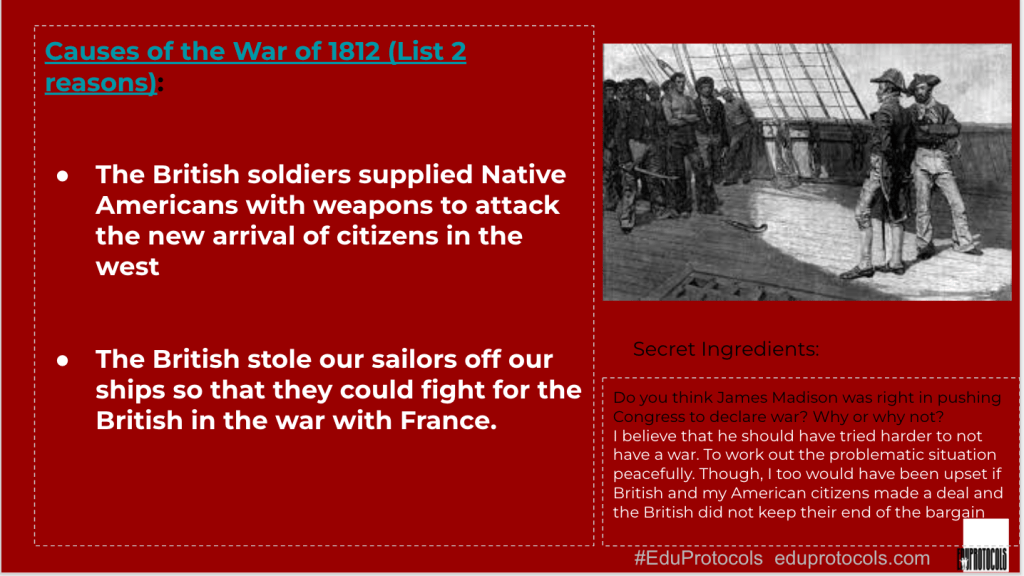
This week we began the War of 1812 and studied the causes, effects, and different perspectives about the war with Federalists and Democratic-Republicans. This lesson has a good mixture of EduProtocols that eventually led to the students creating a blog post or Yelp review.
When I took a step back this week and looked at where we were, I decided to end the unit after the War of 1812 lesson. I need to shift my focus on writing thesis statements, multi-paragraph essays, and getting students ready for writing on the state test. I usually don’t explicitly focus on this because it’s not engaging. However, it needs to be done. As a result, I have some ideas running through my mind and I’ve been collaborating with Scott Petri (@scottmpetri) on some ideas. More to come on this…
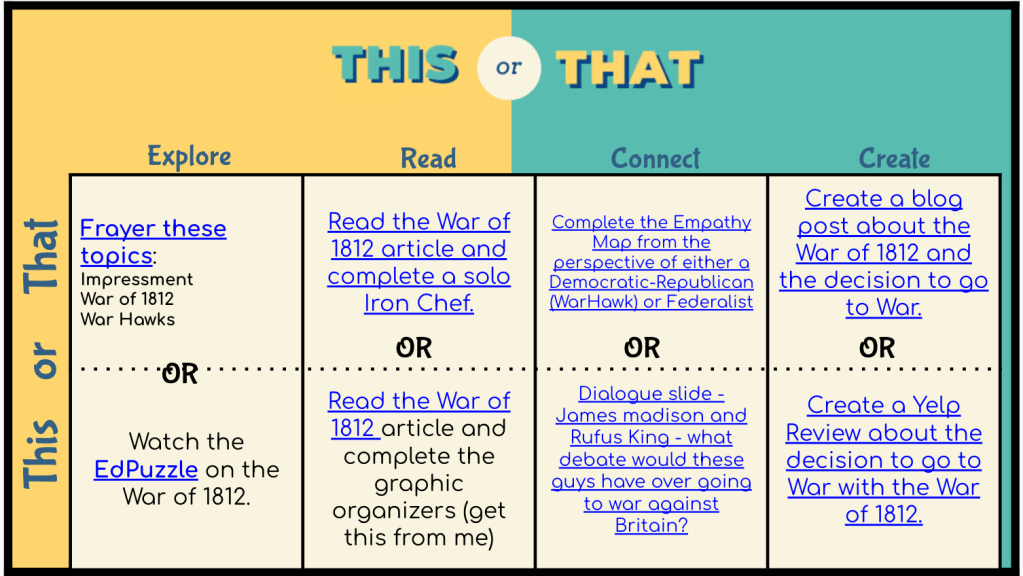
Here was my week as I used a This or That Choice Board Template from Stephanie Howell (@mrshowell24)…
Monday – Thin Slide, GimKit, Choice: EdPuzzle or Frayer
Today was the day to start the War of 1812. This quarter I have a student teacher and he had a great prompt idea for a Thin Slide – Why do countries go to war? and Why do countries want to avoid war? – This was an awesome way to begin the War of 1812. I gave students 4 minutes to add one picture and one word for both sides of the prompt. At the end of 4 minutes I had students choose one side to present, from their seats, in 10 seconds or less. Here is an example of the thin slide.
I had students choose one side or the other when presenting because I wanted to point out their reasons for, or not, going to war were similar to the reasons brought up by Federalists and Democratic-Republicans. Following the Thin Slide presentations, we switch to a GimKit.
I have been using GimKit lately because students gets more repetition with questions. Plus, it uses Interleaving which helps students learn the content. I ran the gimkit for 5 minutes and gave feedback. Then I ran the same Gimkit again for 5 minutes at the end of class. With 10 total minutes of a Gimkit, all classes answered a total of 800 to 1,200 questions. This sounds awesome, but, BUT, BUT……teach your students to not just click through answers and learn.
After the first GimKit, students had a choice of watching an EdPuzzle video or completing a Frayer for these 3 words: War Hawks, Impressment, and War of 1812. The EdPuzzle video covered these terms, so this is why I had it as a choice. Students had 10-15 minutes to complete one of these options.
Tuesday
On this day I began class with another Thin Slide focused on vocabulary. Students designed a slide based on one of these three words: War Hawk, Impressment, or War of 1812. Students had 3 minutes to design their slide by adding the word, a picture, and their OWN definition. At the end of 3 minutes we had a twist – go to another slide and add to their definition or fix their definition.
After our Thin Slide, students had a choice of completing a Solo Iron Chef or a worksheet with various graphic organizers (cause/effect, venn diagram, and a bubble map). I hand made this worksheet. Most students chose the worksheet. I had the same reading paired with both assignments. The reading was set up as causes of the War of 1812, differences between War Hawks and Federalists, and Results of the war. Here are some of the Solo Iron Chef Slides:
The last 10 minutes of class I ran the same GimKit as the day before and raised our first day averages by 20% or higher.
Wednesday
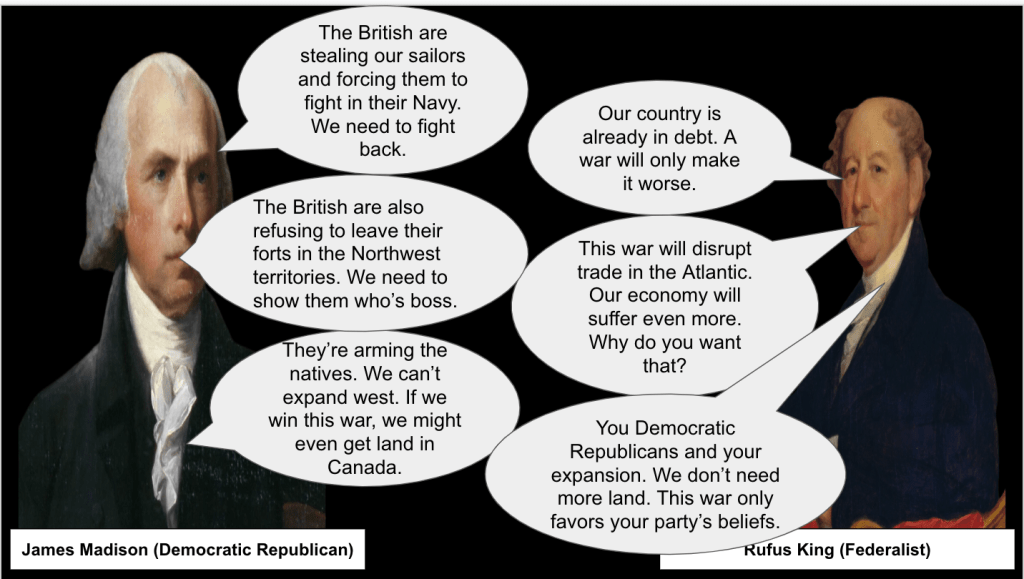
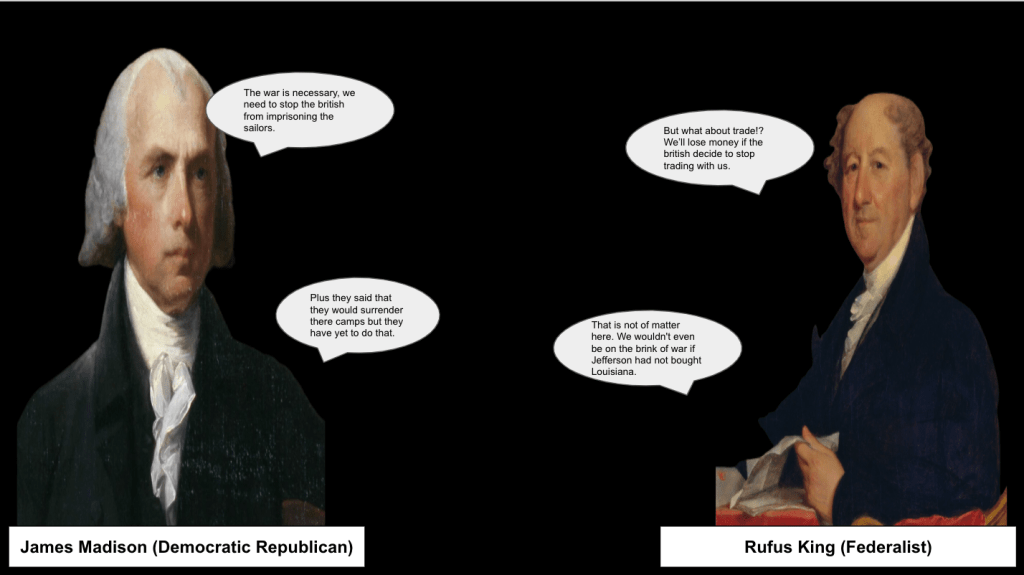
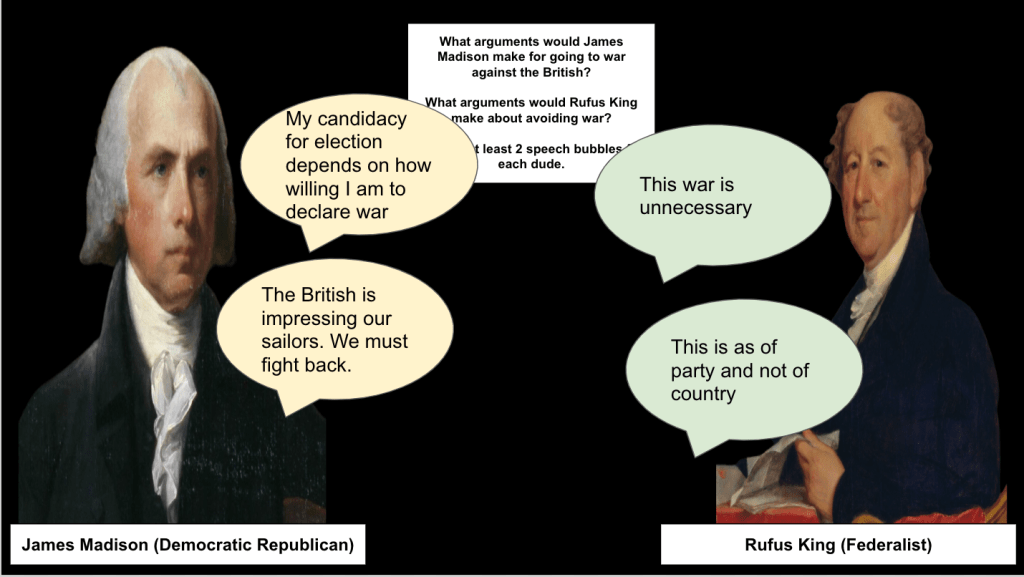
The goal for Wednesday was finishing the Solo Iron Chef or worksheet from the previous day. Then students had a choice to connect what they learned through an Empathy Map or a Dialogue Slide. Both of these activities had students looking at reasons for going to war or avoiding war with different perspectives. Here are some examples:
We finished out the day with a GimKit to review the War of 1812. The more reps you can get with GimKit, Quizizz, or Blooket the better. These reps with the questions will help eliminate the Forgetting Curve and help with learning.
Thursday
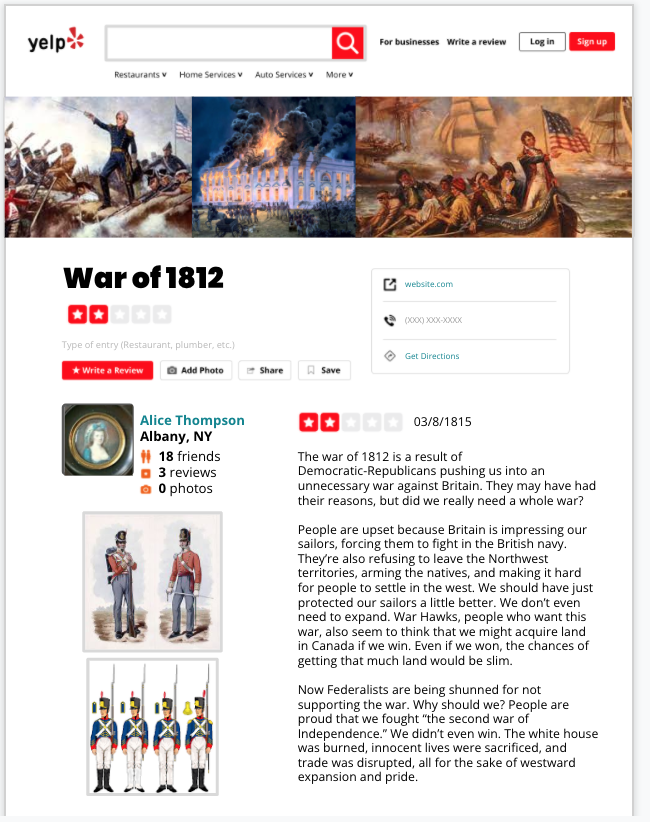
Today was the final day for the War of 1812 and students had a choice with all of the information they collected – write a blog post or create a Yelp Review from the perspective of a Federalist or Democratic Republican. Some students seemed overwhelmed with writing a new blog or Yelp, but I reminded them they had all of the information. I had to show them they had the information and this was the point of a graphic organizer – to help you create!! Nevertheless, students were doing great and completed some awesome blogs and reviews. By the end of class we were doing a GimKit with ALL the content from our unit on the New Republic. Here are some blogs and Yelp reviews…
And that’s it – the end of the unit. This unit should have taken 5 weeks to complete, instead, it took 7-8 weeks to complete. I can’t let it bother me as I choose how to respond. I made the most of this unit and have some ideas up my sleeve for next year.
Looking back on this unit with the New Republic, if there was one thing I would change it would be eliminating the choice for the blog, Facebook profile, or Yelp Review. I would like to eliminate the Facebook profile as most students didn’t connect with that platform.
My 505 Room Messages
The Daily Drop In
I was on the Daily Drop In earlier this week with Rae Hughart. Check it out!!
This week we continued the Early Republic Unit (I feel like this is a constant blog now). Between field trips, remote days, and snow – this 5-6 week unit is now moving into 7 weeks. Part of me want to end the unit now and move on, another part of me wants to finish it out and tinker with some new lessons. This week we lost Monday due to a field trip to a vocational school. Therefore, we had Tuesday, Wednesday, and Thursday for the Louisiana Purchase.
The Louisiana Purchase focus is building some background knowledge and then understanding how Federalists and Democratic-Republicans viewed the purchase. Here are the I Can statements I created:
I can identify the Louisiana Territory.
I can explain why Thomas Jefferson purchased the Louisiana Territory.
I can identify why the Louisiana Purchase was controversial.
I can analyze the Louisiana Purchase from multiple perspectives.
Thursday – I stopped the CyberSandwich and did the Research Protocol.
Friday – Field Trip
Tuesday
Tuesday was a background knowledge building day with the Louisiana Purchase. I started class off with a Fast and Curious with the following 1st rep scores – 71%, 46%, 52%, 68%, and 45%. This Fast and Curious was 8 questions and focused on Thomas Jefferson, basic Louisiana Purchase knowledge, and questions about Federalists and Democratic Republicans. All questions tied to my I Can statements listed above.
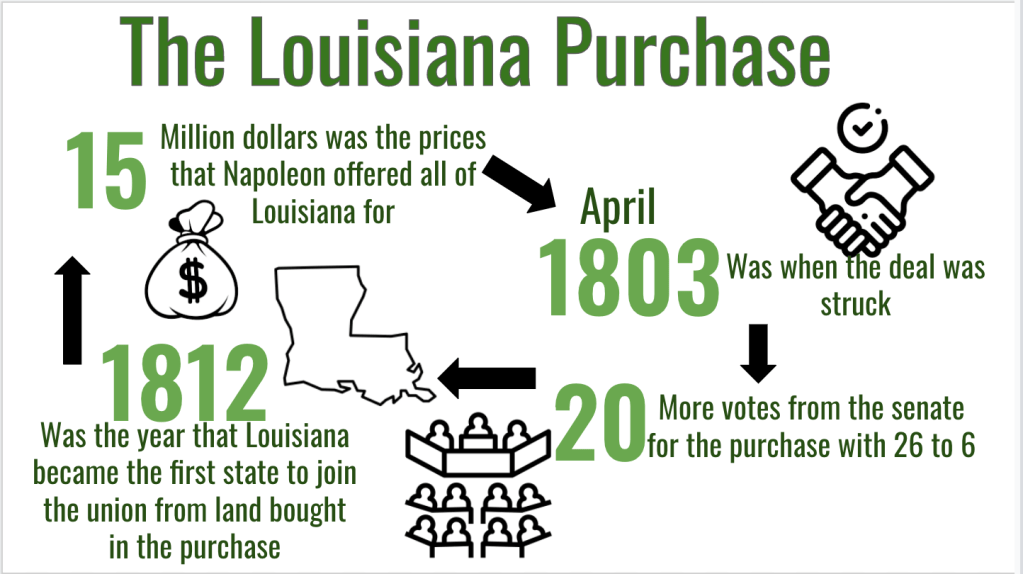
Following the Fast and Curious was a Number Mania. I found an article on the Louisiana Purchase and included lots of numbers into the article. I framed the Number Mania by asking the students to retell the story of the Louisiana Purchase. They were to include 4-5 numbers and facts, a title, organize the information, and be creative. The students read for 10 minutes, highlighted numbers and important information, then they created their infographics. Here are some examples:
After 20 to 25 minutes we switched gears to another Fast and Curious. The results were as follows: 88%, 68%, 82%, 83%, and 75%. Two things stand out to me after looking at the percentages – I didn’t get a higher percentage raise than I normally do with a CyberSandwich, and the highest percentage (88%) was the class that did a Thin Slide first. I had to cut out the Thin Slide because the Guidance Counselor stopped in to hand out scheduling information for high school. This set us up for another Fast and Curious try on Wednesday and extending our knowledge on Federalists and Democratic Republicans’ thoughts on the purchase.
Wednesday
We began Wednesday with a Thin Slide and this prompt – “What was your biggest takeaway from the Louisiana Purchase?” Students had 3 minutes to include 1 word and 1 picture. Then I had students use their Number Mania to construct a paragraph on their slide or in the speaker notes.
I gave students 3-4 minutes to write their paragraph, and then I had them jump slide to slide using the Nacho Paragraph. With the Nacho Paragraph, I had students go to someone else’s slide and add information to the paragraph. I asked them to do 2 things:
Add a new number and explanation to the paragraph.
Change the topic sentence to something new and better.
This was a great way to get the students to think, and they had fun. This activity was followed by a Fast and Curious and every class raised their averages – 89%, 88%, 84%, 90%, 81%.
After our Fast and Curious, I switched gears to a CyberSandwich which I paired up with a Stanford History Education Group lesson (SHEG) – Louisiana Purchase. The main question for the lesson was, “Why did Federalists oppose the Louisiana Purchase?” I had students work in groups of 3 and I had the following documents ready for them:
A letter from Alexander Hamilton
A letter from Rufus King
I typed up a secondary source about Democratic Republicans
I added questions to the note taking slide and gave students 10 minutes to read. Then I had students discuss. By this time, class was over. By the end of the day, I don’t know why, but I was questioning my use of the CyberSandwich. It seemed thrown together and forced. I don’t like that feeling, and I pursue better on a daily basis. By the evening, I found myself at home and I had a good conversation with Scott Petri who gave me a great idea – he suggested I use the Research Protocol.
Thursday
The Research Protocol is a new protocol Scott and I will be introducing in our new Eduprotocol for History book (When will this come out? I don’t know). I took Scott’s version of this idea and applied it to Middle School. So, I threw out the CyberSandwich lesson, but still used the same SHEG resources for the Research Protocol. I switched to this lesson because students would be working through multiple primary and secondary sources, finding important information and quotes, and explaining those quotes all while collaborating. Here was my set up:
I posted the central question – “How did Federalists and Democratic Republicans feel about the Louisiana Purchase?”
I shared a Google Form that allowed students to share a quote and explain it. Then I passed out the 3 sources I mentioned above.
Students had 15 minutes to share 2 reasons Federalists opposed the purchase and 2 reasons Democratic Republicans supported the purchase.
I had students fill out a V Diagram with 3 reasons for Federalists and 3 reasons for Democratic Republicans.
Then I had students choose a side and then write a thesis statement.
This led to a discussion of thesis statements and a self assessment.
This was such and awesome protocol to get students collaborating, finding relevant information, evaluating and comparing multiple sources, writing thesis statements. While students were sharing quotes and explanations, I was able to give feedback in real time. There were so many great pieces to this lesson – so it’s something to look forward to when our book comes out! Here are some pics from that day:
All in all, this was a productive week with many Eduprotocols. I need to get back to using to EMC2Learning resources as I have failed at that recently. I feel like we have reached that point in the year with a lot of apathy, and I need to plug in some excitement.
Well, not much a week in 505 – snow and ice cut the week short. The month of January was filled with interruptions – we went to remote learning twice, high school scheduling stuff for students, three or four snow days, and some upcoming field trips. My early republic unit, we are currently in, should have taken 5 to 6 weeks. However, we are only halfway through it. What should have been 5-6 weeks, will now be 7-8 weeks. Everything is a mess, but we just go with the flow and adapt.
With remote learning last week, students studied John Adams and the Sedition Act. However, I only had 42% students engagement. When we came back from remote learning this past Monday, I needed something that could serve as an introduction to John Adams, yet serve as a continuation of student learning from remote. I couldn’t find much, so I typed up a one page article about the sedition act with background information and how both parties felt about the act. We also did some review this week with Blooket and Gimkit. I was hoping to get to Thomas Jefferson, but weather cut our plans short.
With the start of the week, I had to be absent from school. So, my student teacher took over and ran a lesson I put together. Remote learning engagement from the previous week was awful, so I needed something to get all students on the same page. I needed something familiar, easy to run, and effective. I needed a CyberSandwich + Fast and Curious combo!!
I try to run a CyberSandwich at least once a week. It gives students a chance to read and practice with informational text, discussing information text, and summarizing their learning. Since work completion was not great last week, I needed a reading about John Adams that could introduce background information and add information for anyone who completed work from the previous week. The main goal of each Quest is to learn about a decision made by each of the first five presidents. Then students analyze that decision from the perspective of a Federalist or Democratic-Republican.
I ended up typing a one page document about John Adams and linking it to a CyberSandwich. Then I created a ten question Quizizz about the reading and John Adams. When I create a Quizizz for a Fast and Curious, I try to keep it to 10 questions or less. If I created this with a Gimkit or Blooket,I would add more questions since those games are based on time.
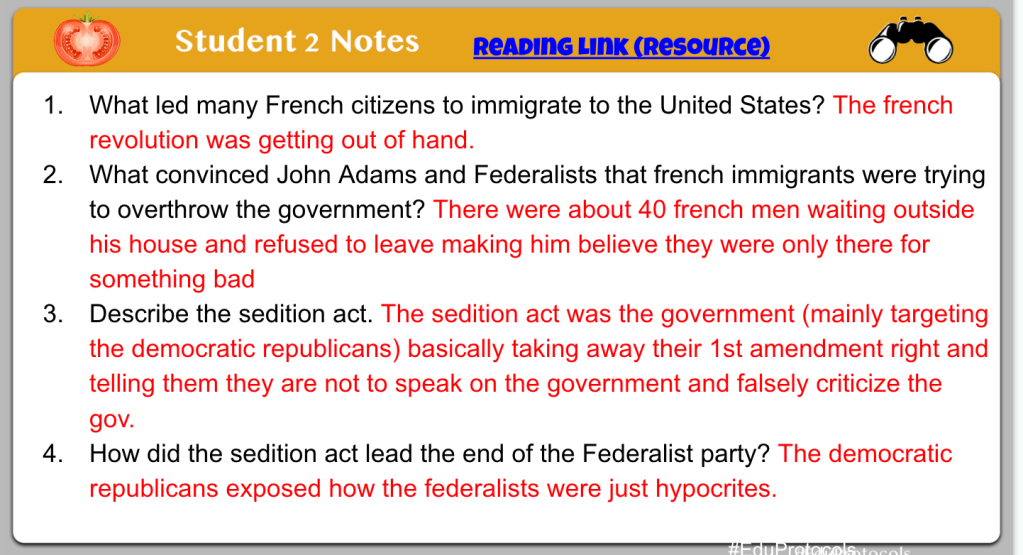
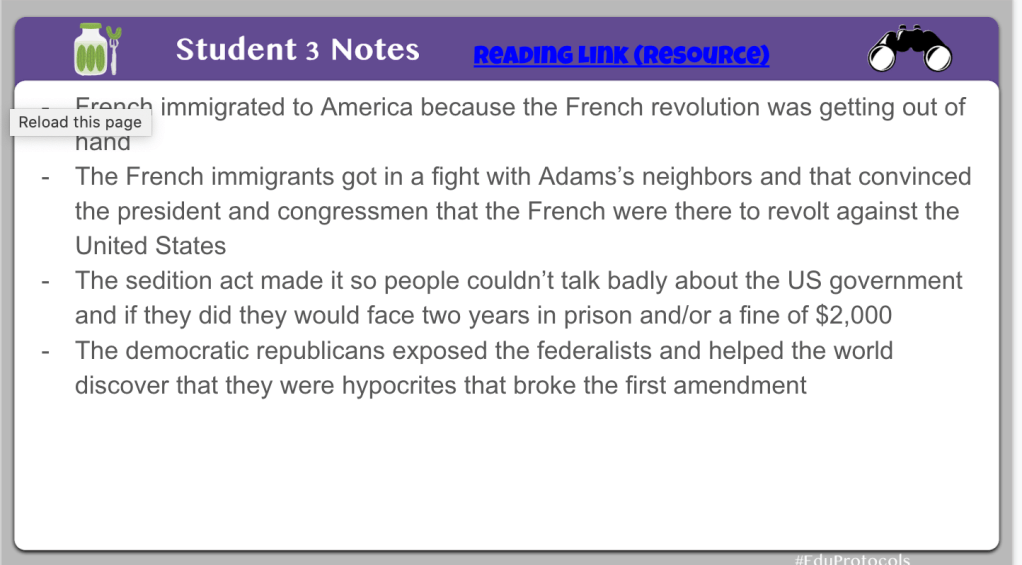
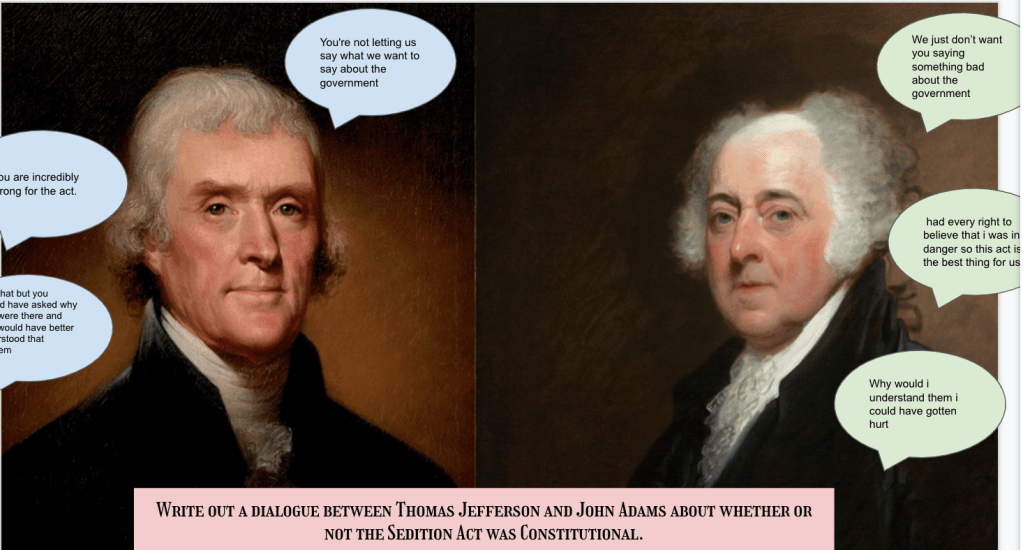
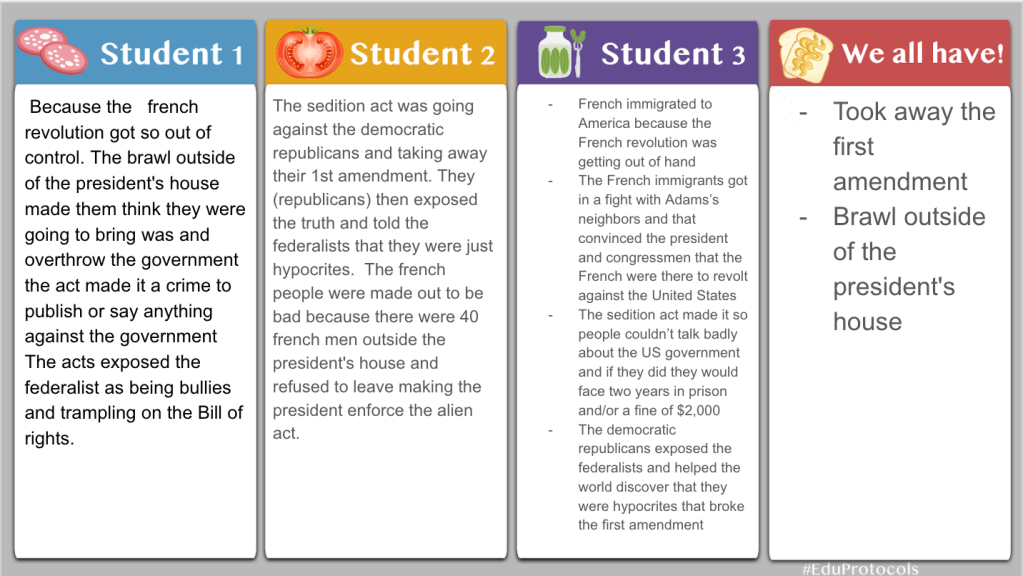
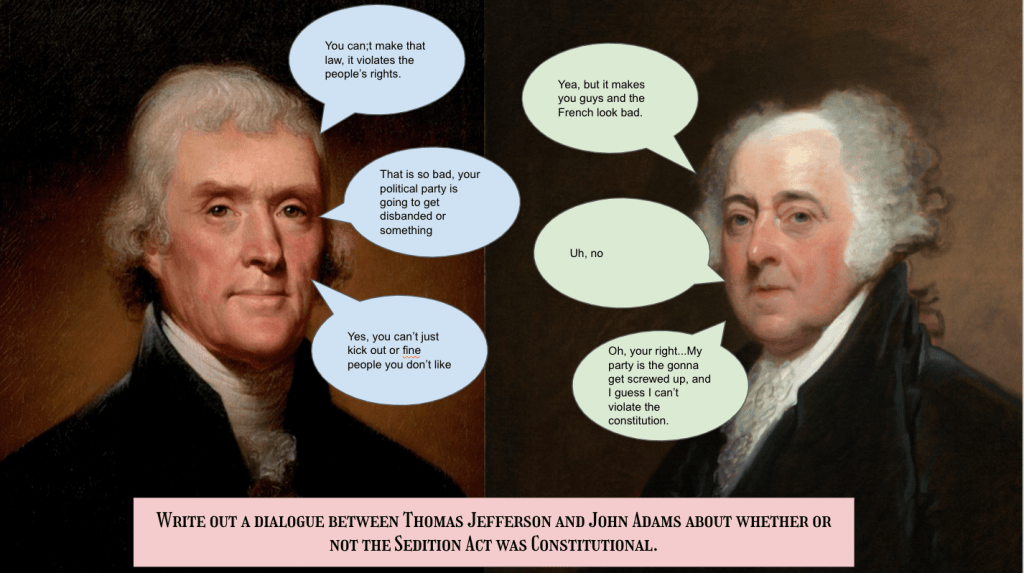
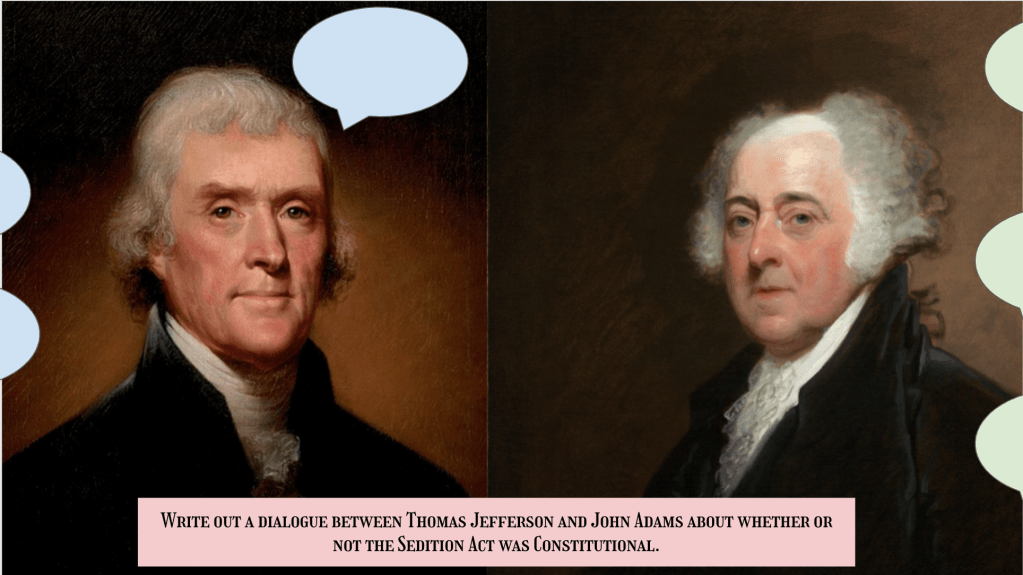
With this particular CyberSandwich, I added four questions to provide some scaffolding support for students. Instead of a summary at the end, I had students create dialogue between John Adams and Thomas Jefferson about the Sedition Act. I like to mix up the CyberSandwich from time to time to help with students engagement. However, the process stays the same – 10 minute, 5 minute discuss and compare, 10 minute summary or creation.
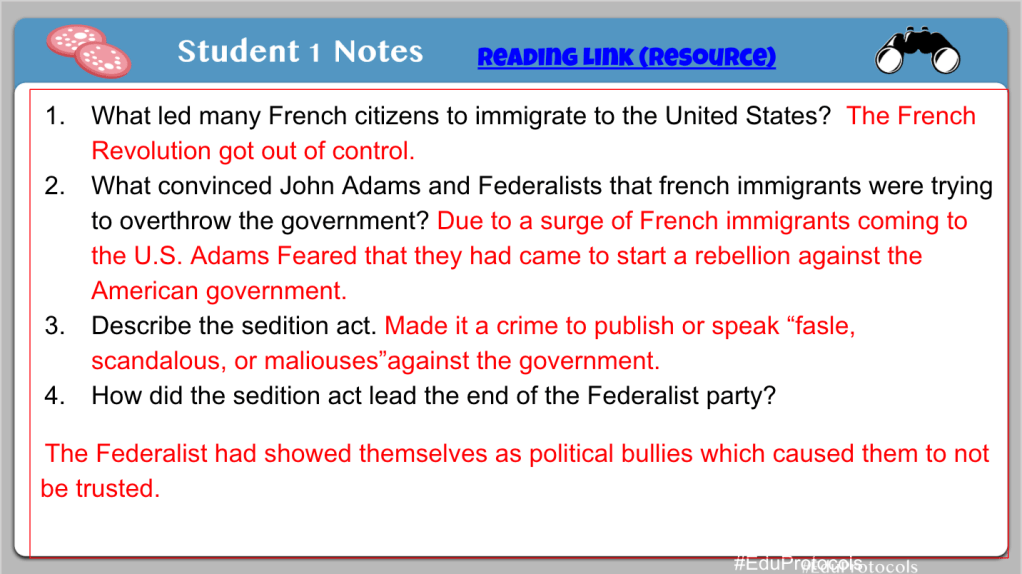
Here are some student examples:
The students did great with the Fast and Curious Quizizz as well. Part way through the day, I texted the students teacher in my room and asked him how everything was going. He took a picture of the Quizizz results and said, “You have these students trained well.” Here are those Quizizz results:
Tuesday
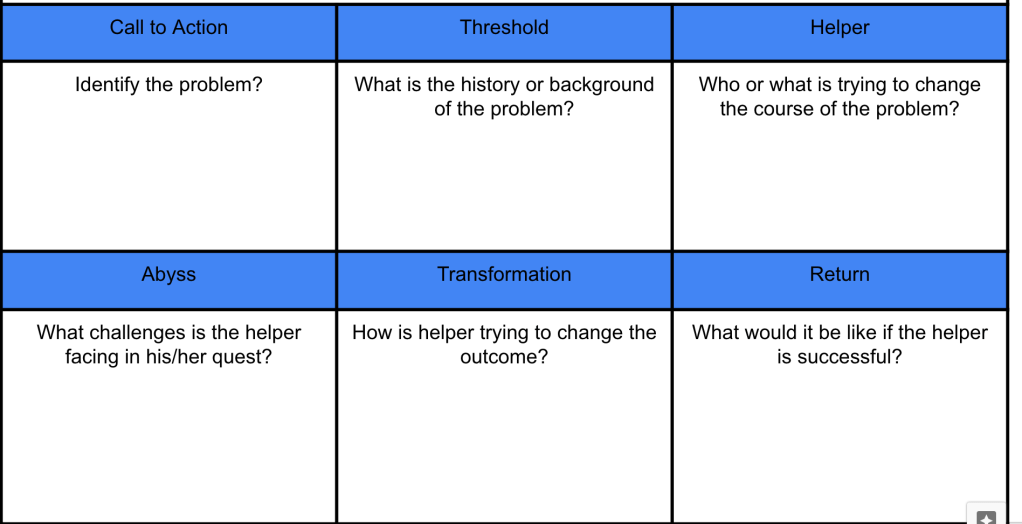
As I stated above – The main goal of each Quest is to learn about a decision made by each of the first five presidents. Then students analyze that decision from the perspective of a Federalist or Democratic-Republican. Tuesday, I wanted to have students fill out an empathy map from the perspective of a Federalist or Democratic-Republican regarding the Sedition Act. I decided not to do a digital copy and printed 100 empathy maps. By the time 5th period rolled around, I wanted to try out a new EduProtocol I learned from Dr. Scott Petri (@scottmpetri) called the Hero’s Journey. Scott likes to use this EduProtocol at the end of a lesson or unit. I wanted to use it in place of an Empathy Map – it had that same empathy map feel to it.
Basically, students fill out a storyboard format as they map out how a character changes through a story. Here is that story map:
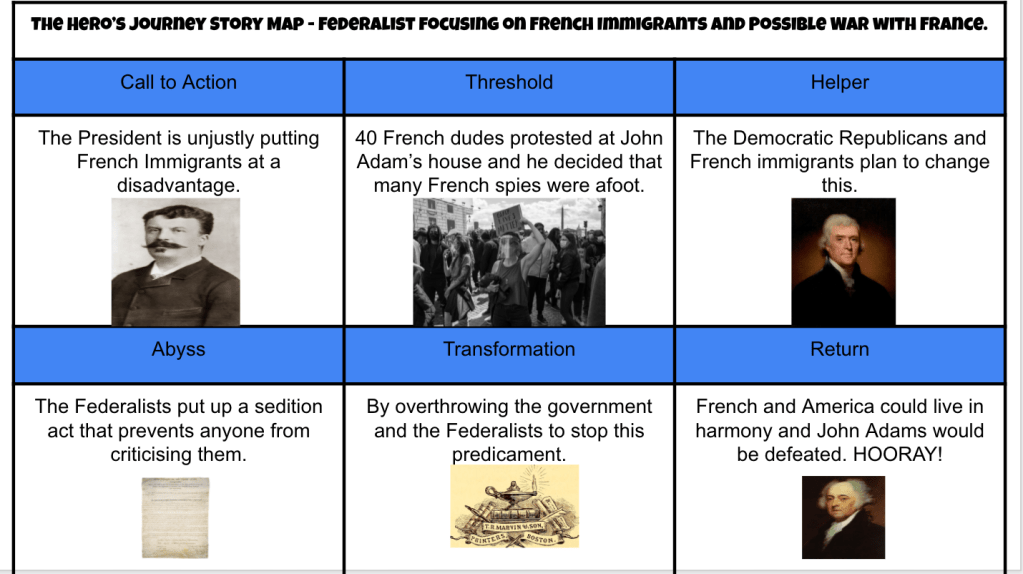
Through the Call to Action down to the Return – I thought this fit perfectly with analyzing the Sedition Act from multiple perspectives. I decided to try this lesson out with my 5th period and it worked out great. Here are the directions:
I encouraged students to keep it simple and add pictures and/or icons.
Students used examples from the CyberSandwich reading. This lesson gave students a chance to reuse the CyberSandwich reading a 2nd time. The more students can interact with a reading the better.
I had students focus on one perspective as they filled out each box and followed the questions/prompts.
Whether it’s an Empathy Map or Hero’s Journey – these organizers can help students create their final project for Quest 3 – Facebook Profile, Blog, or Yelp Review. Here are some student journey examples:
Wednesday
Wednesday was project choice day for Quest 3. Students could choose between 3 options: Facebook Profile, Yelp Review, or writing a blog on their Google Site. The goal with choice is to have students discuss the Sedition Act and impact of the Sedition Act signed into law by John Adams.
I shared a Google Doc with all the project choices listed out. I even linked in directions videos, some scaffolding support, I can statements, and a rubric. When I give feedback on student work, I always refer back to the I can statements. Here are some student examples:
Thursday and Friday
These days were Blizzard Bag days as we got hit with snow and ice for much of the day Thursday. So, I shared a reading about Thomas Jefferson from Icivics. This reading served as an introduction to Jefferson and the Louisiana Purchase for when we return to school.
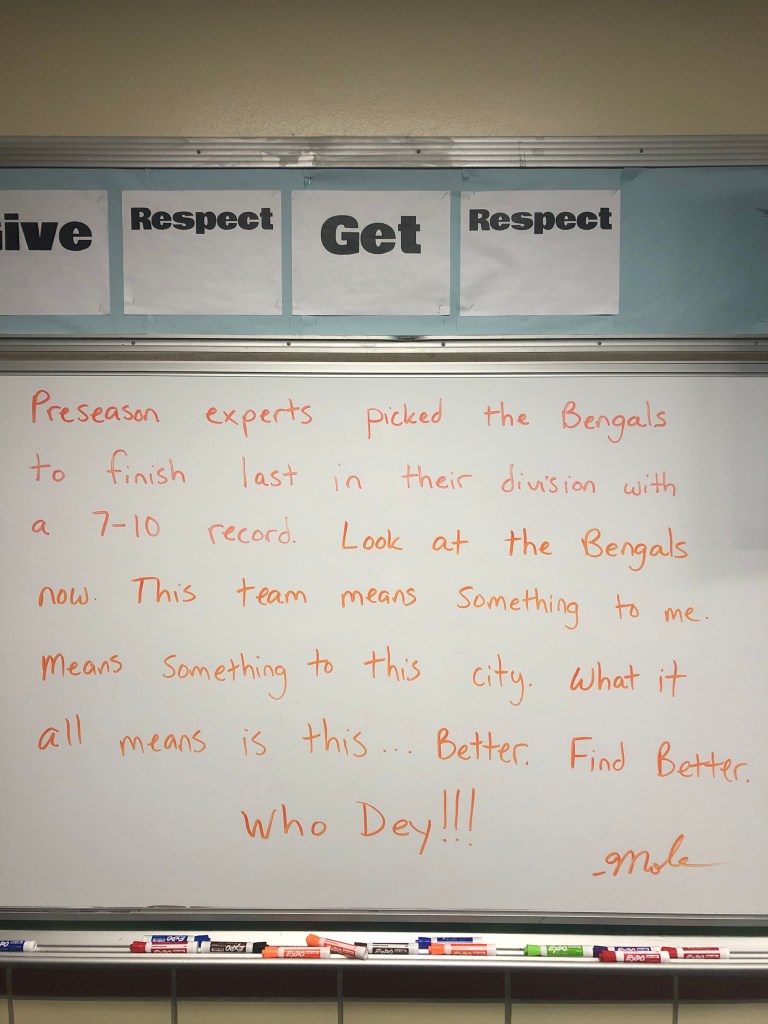
The Cincinnati Bengals are going to the Super Bowl! I never thought I would see a playoff win in my lifetime. Now I have seen 3 in just as many weeks. Who Dey baby!!!
Down 21-3, I’ve been so “Bengalized” I thought it was over…until the Chiefs decided to get greedy right before the half. This new Bengals came out of the locker room with new energy. New life. When it came down to the coin flip…again, I’ve been so “Bengalized” that I thought it was over. BUT, this is a new team, new attitude, turning over a new leaf, and Cincinnati is like a new city.
For people outside of Cincinnati, and may not get it, this means the world to us. This is monumental. There is nothing cooler, happier, more down to Earth than Cincinnati when the Bengals are winning. Cincinnati. Is. Back. Baby!!!
However, at the end of the game, I was told I was being too loud. To which I replied, “I don’t care. I can be as loud as I want.” You see, for 2 1/2 years there hasn’t been much to cheer about. As a teacher, I’ve been stressed, overworked, beaten down. It’s rare that people ask a simple question, “How are you doing?” My answer, honestly, is……..not great.
Between COVID, politics, and rude people there hasn’t been much to cheer about. Seriously, it’s not that hard to follow COVID rules. It’s not hard to give up some freedoms for the betterment of others. It’s not hard to be nice to people. It’s not hard to listen to people and agree to disagree. It’s not hard to use common sense, yet, we make these things impossible, so it seems.
So, yeah, I’m going to cheer as loud as I want to because there is something positive about this Cincinnati Bengals team. Something magical. Something that we can all learn from – a belief that there is something better.
This week was one big jumbled hot mess. We began the week with remote learning Monday through Wednesday. Then the entire week was made to be remote learning. Student engagement was 42%. Like I mentioned above – one. big. jumbled. hot. mess.
With remote learning, I usually slow down what I’m doing. If I expect 1 class period in person for something to finish, I usually give 2 to 3 remote learning days. With that, here is the week we had:
The entire goal of my Quest unit on the early republic is to get students thinking from someone living during the 1790’s to 1820’s as a Democratic Republican or Federalist. Some of the bests blogs, Facebook profiles, or Yelp review activities happen when I can help students really place themselves in the moment. One of the best ways to have students place themselves in the moment is an Empathy Map. The empathy map I use came from EMC2Learning so I will not share it, but you can find empathy maps all over the internet.
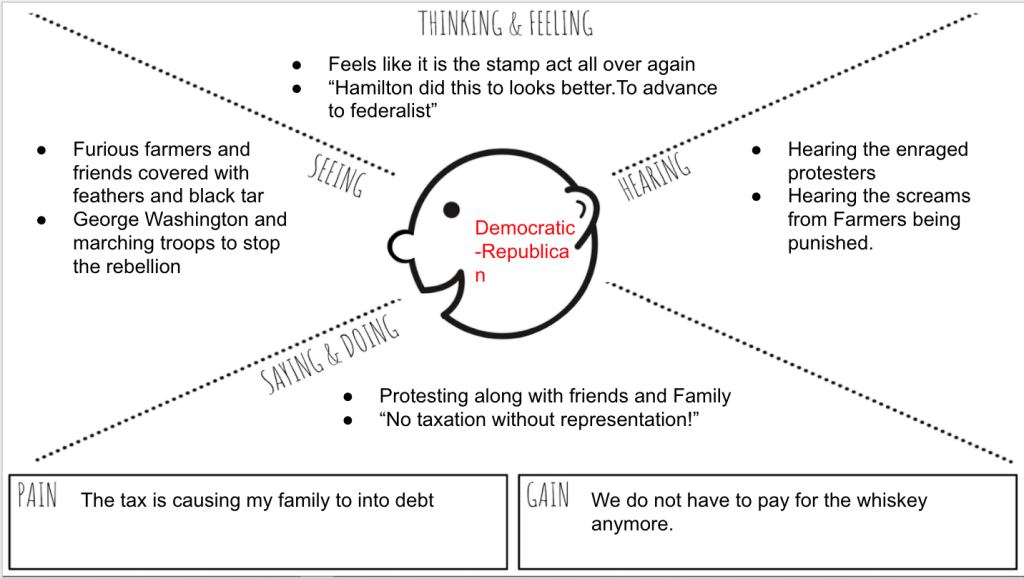
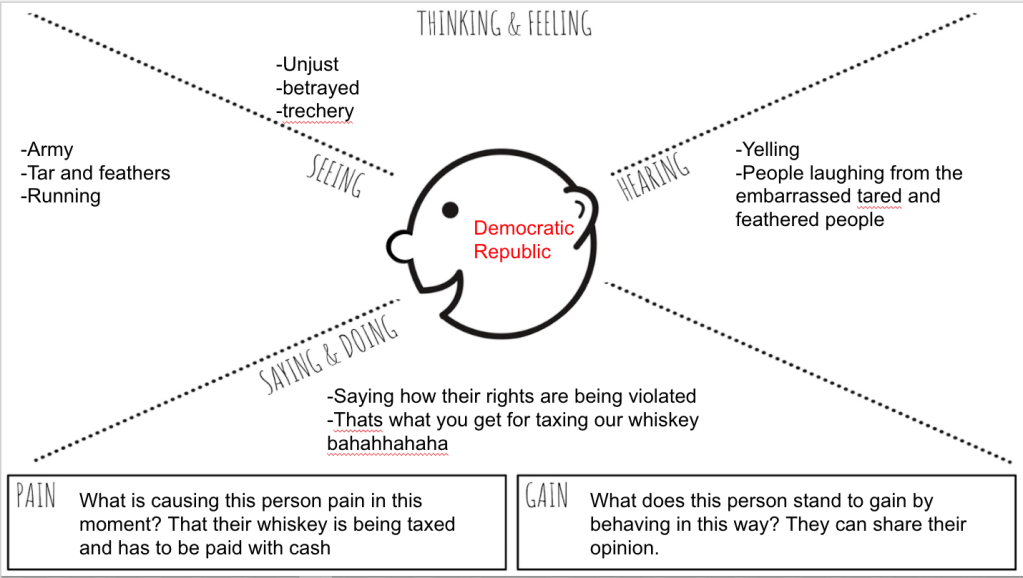
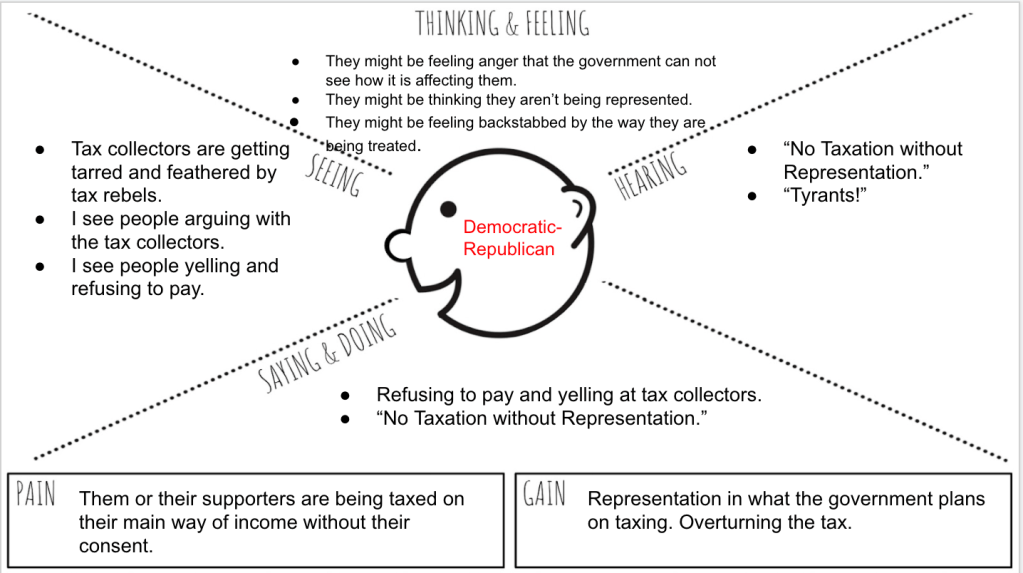
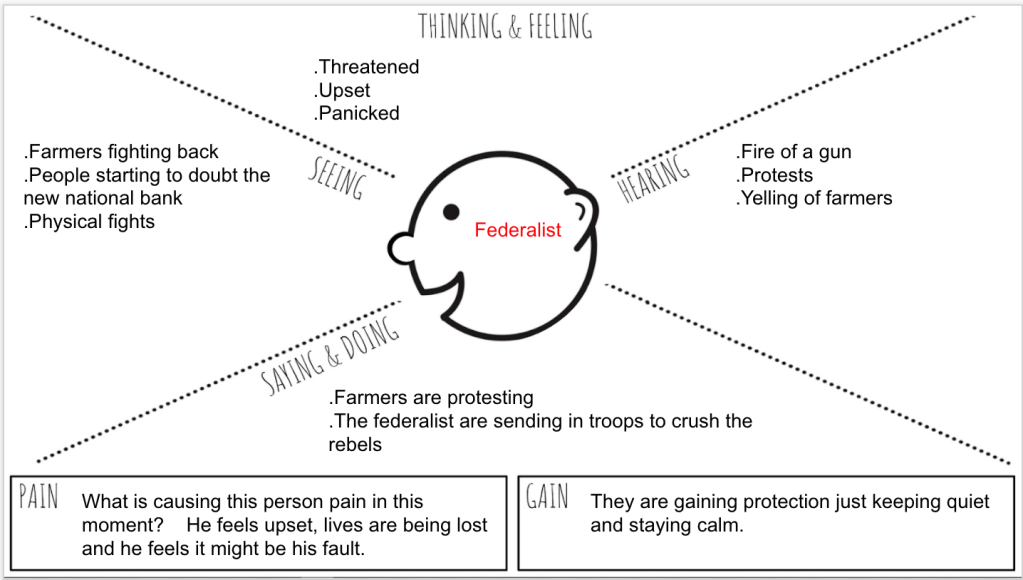
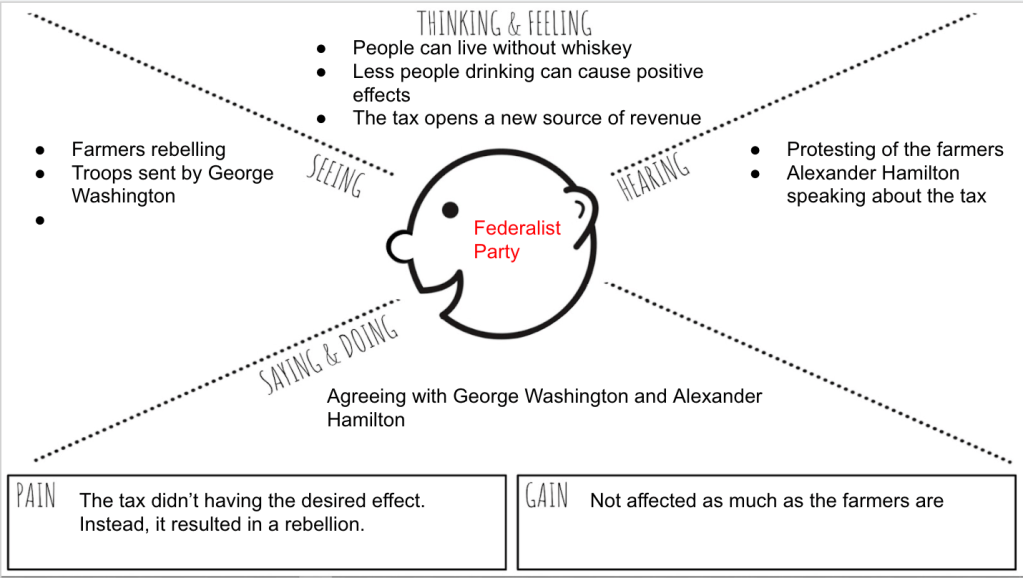
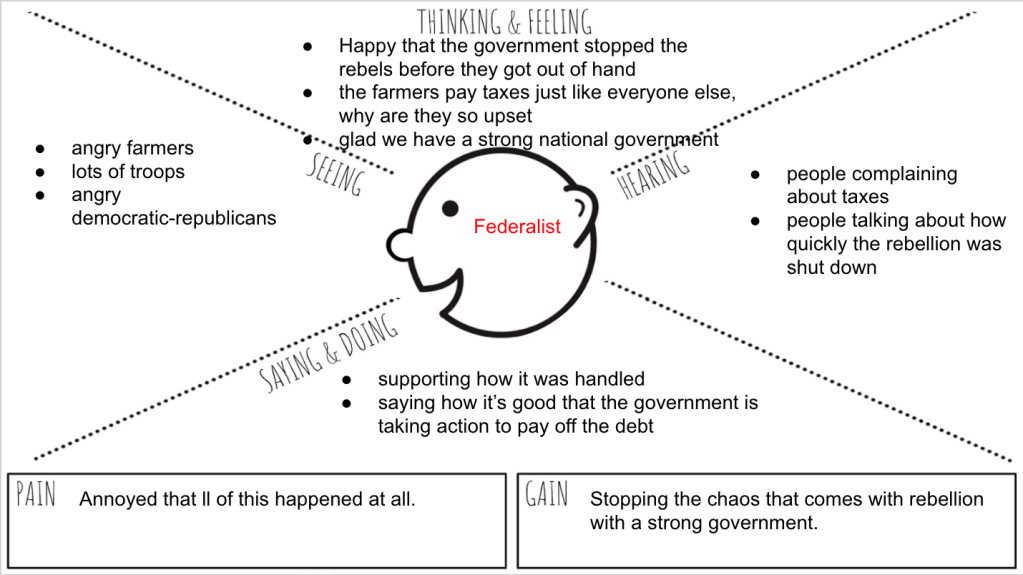
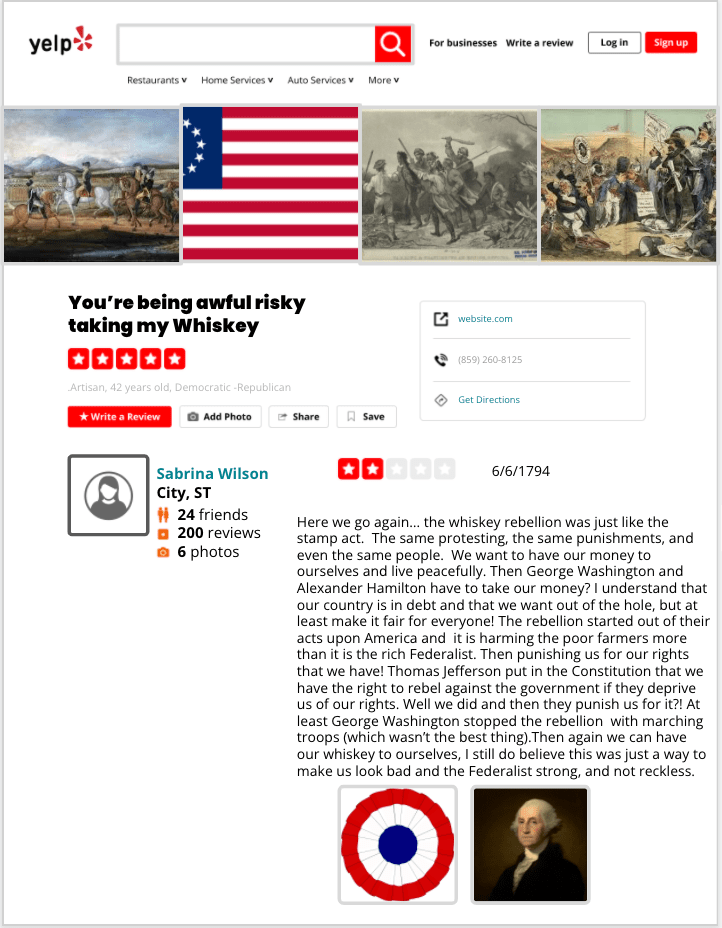
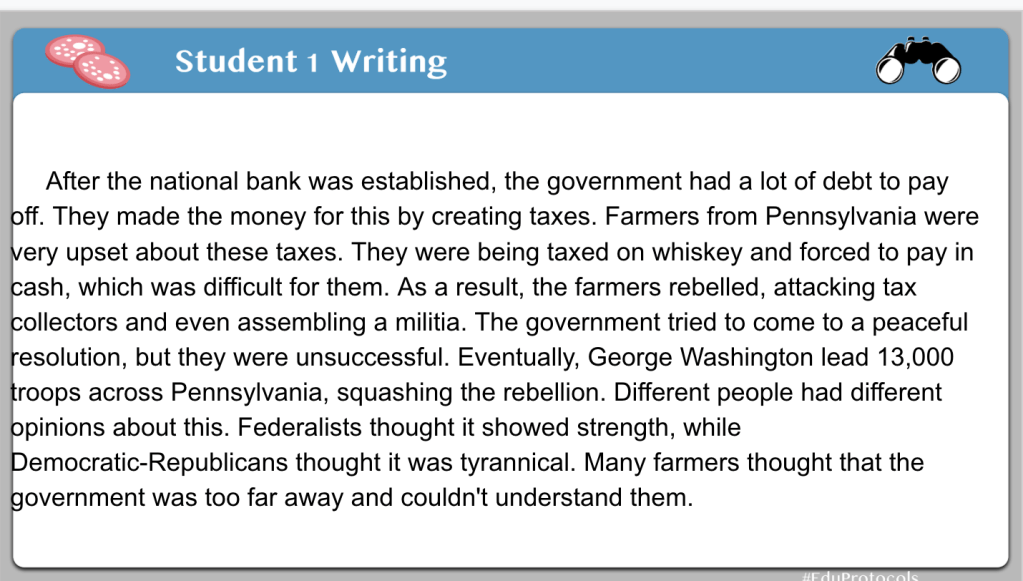
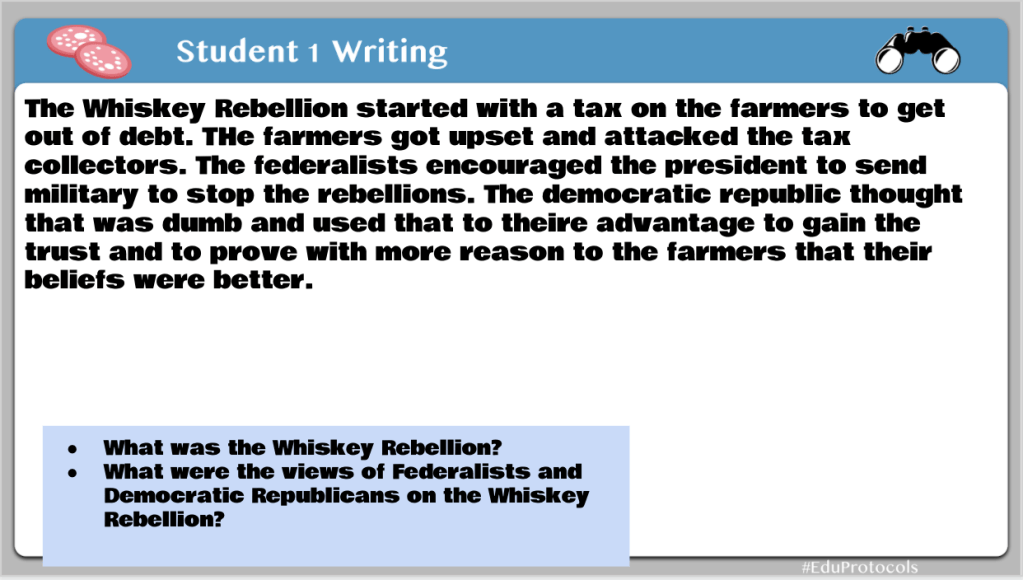
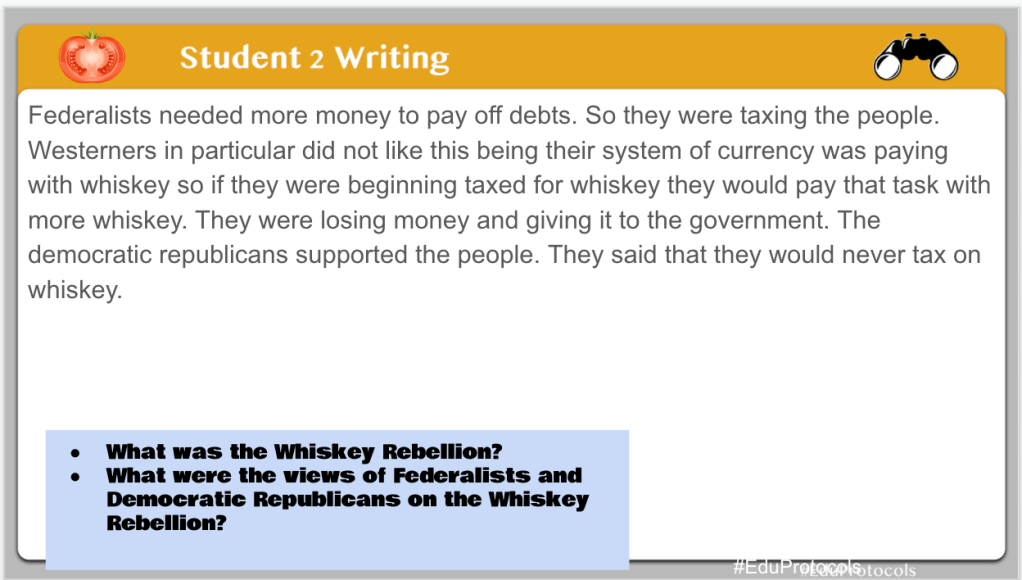
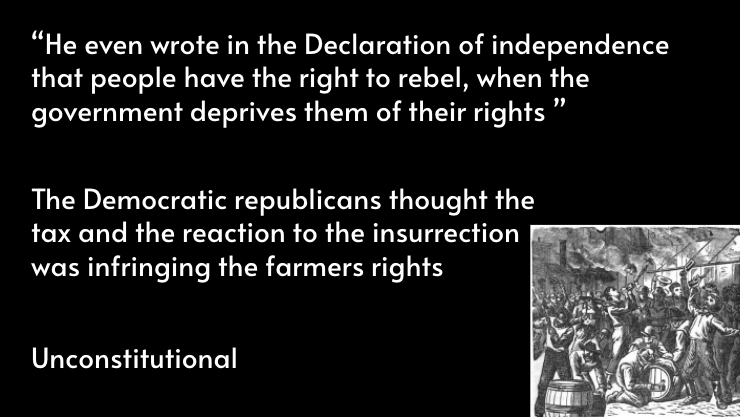
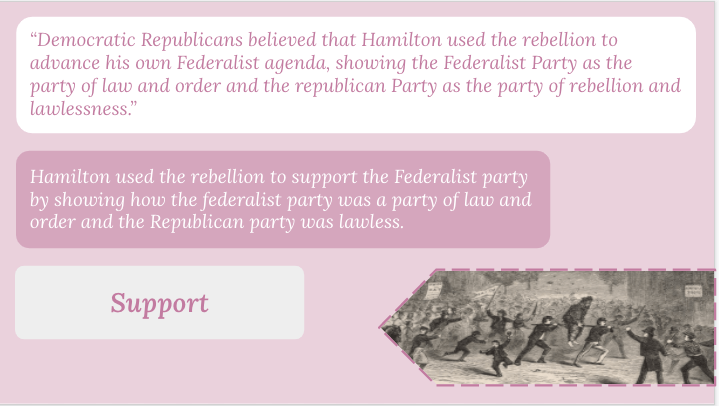
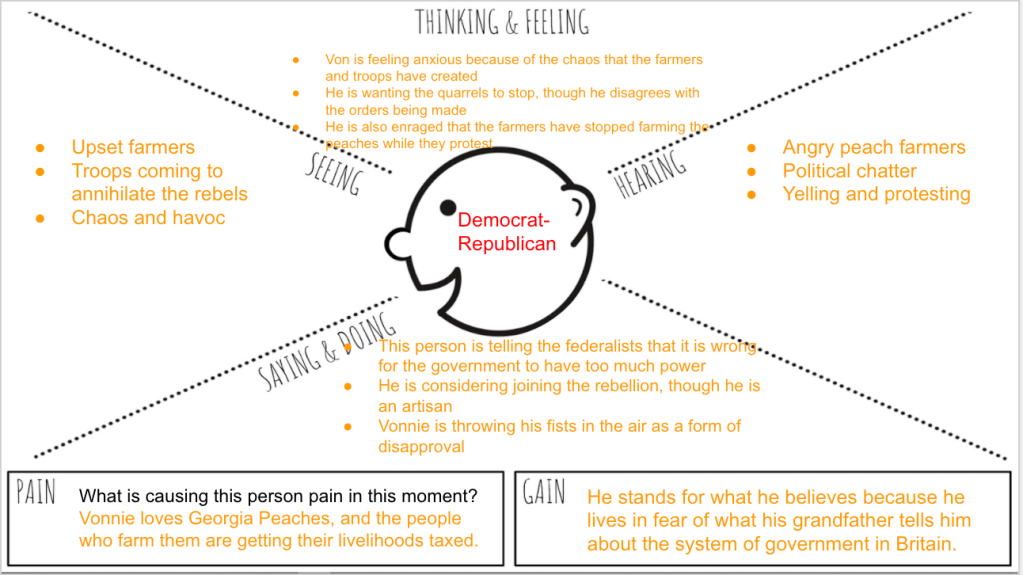
I had students look back at Quest 1 and the character they created with their chosen political party. Next I had students write that party in the middle of the empathy map. This was followed by having students think about how a Federalist or Democratic Republican would view the whiskey tax, farmers rebelling, and the use of military force to end the rebellion. This type of mindset really helped students create some awesome blogs, Facebook profiles, and Yelp reviews for the final assessment for Quest 2. Here are some student created empathy map examples:
Tuesday and Wednesday
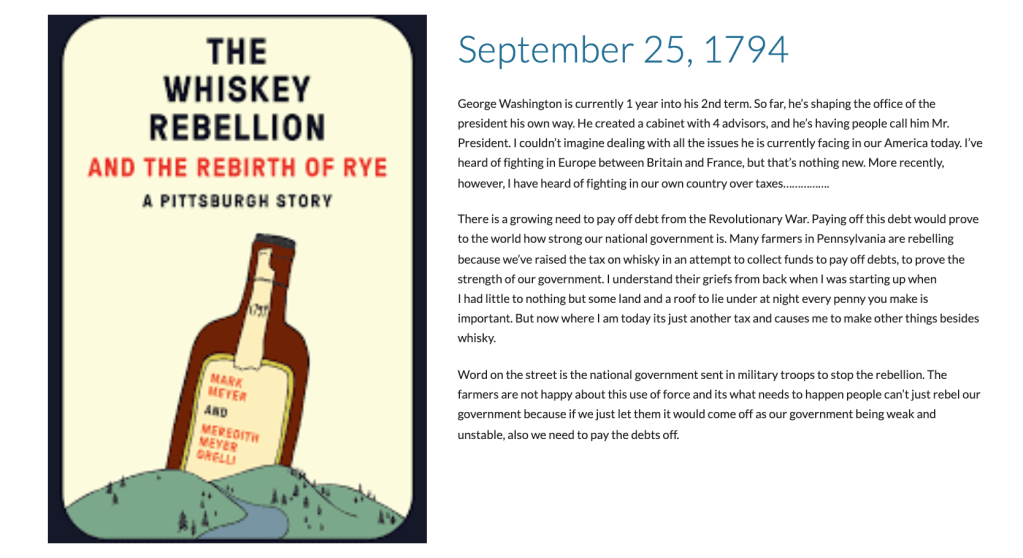
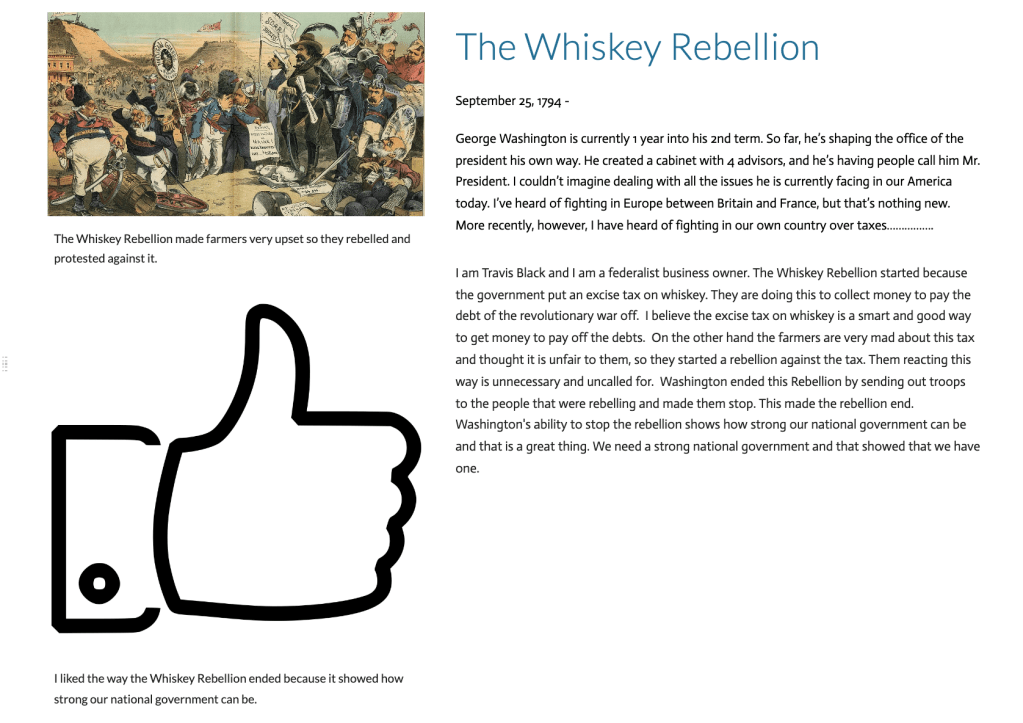
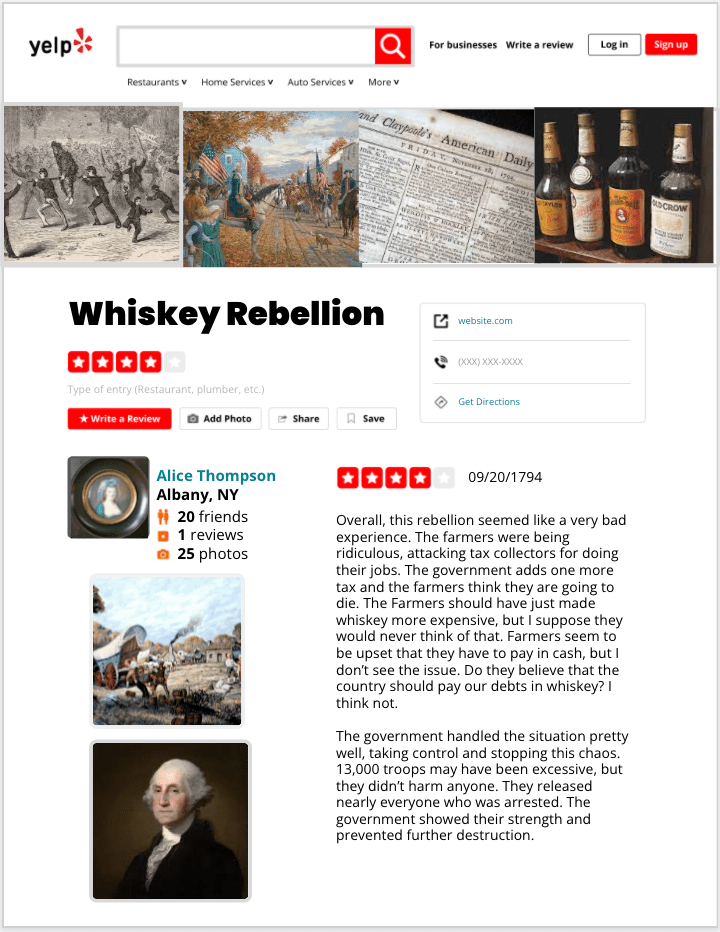
Tuesday and Wednesday were devoted to choosing and finishing a project choice for Quest 2 – the Whiskey Rebellion. The goal with these project choices is for the students to get into character and analyze decisions made by presidents. In this case, students would write about or review the decision made by George Washington to end the Whiskey Rebellion. The two most popular items students completed were the blog post or the Yelp review. Here are some examples:
Thursday and Friday
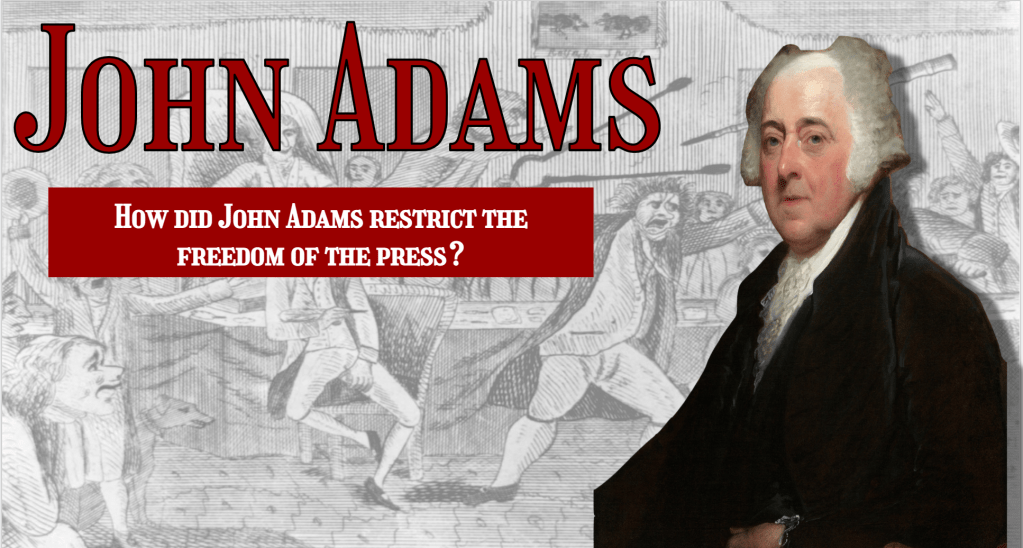
My hope going into THursday and Friday was that most students completed a Quest 2 blog, Facebook, or Yelp review. However, 42% of students completed one of those items. However, I sent emails, comments, or videos trying to increase work completion. I can’t hold up the rest of students for some. So, I posted Quest 3 – John Adams and the Sedition Act. I chose to only focus on the Sedition Act because it’s an act that is still relevant today. Plus, it’s an act that Federalists and Democratic Republicans can debate. Democratic Republicans felt John Adams signed the Sedition Act into law to silence their party. Federalists urged John Adams to go to war against France. This lesson has many interesting takes.
To begin this Quest, I chose an Edpuzzle video that fits perfectly with the lesson. The video discusses background information to the Sedition Act such as the tensions with France and the XYZ affair. I also had students take a Quizizz with the information they need to know with this quest.
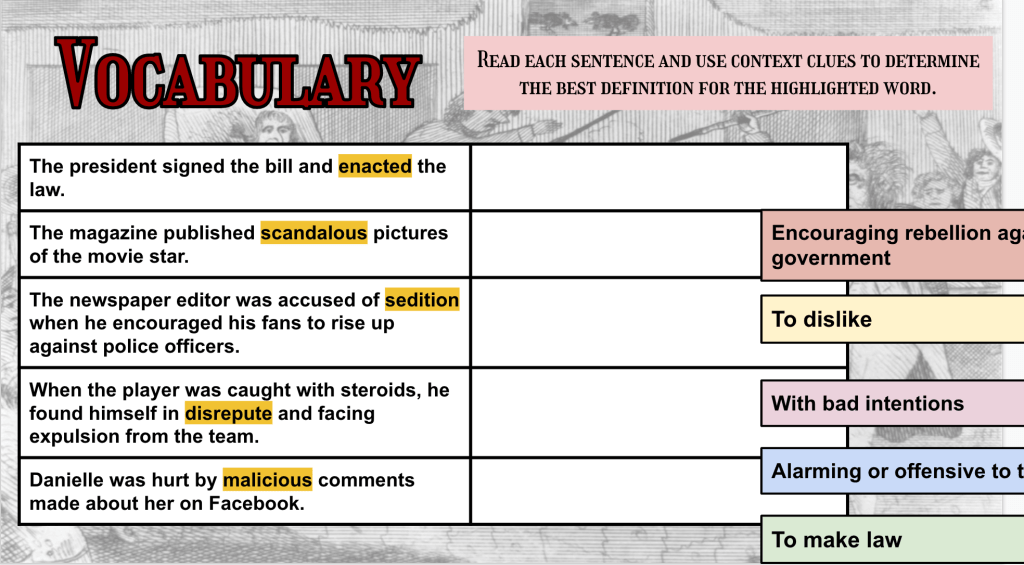
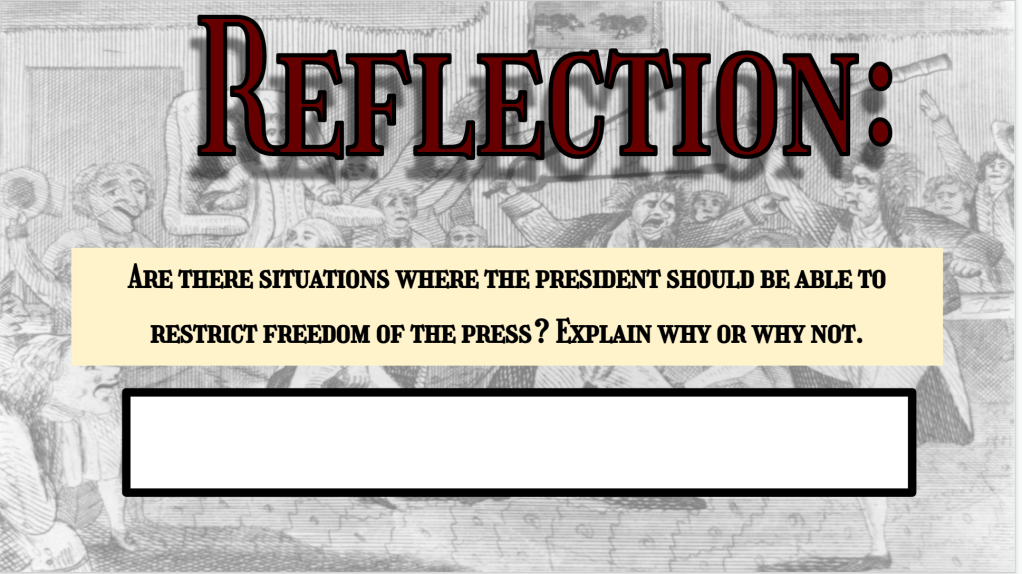
The last activity I uploaded to the assignment was a primary source analysis with the Sedition Act. In this file I included a vocabulary sort with context clues and a reading of the Sedition Act. Then I have students creating a discussion between John Adams and Thomas Jefferson. Finally, students reflect on if a president should limit free speech.
What a week! A short week for me. Students returned from remote learning on Tuesday. These days are usually a cluster as the students are all on different pages coming off of remote learning. Some students do everything, some students do some, and some students do nothing. As a result, Tuesday was a catch up day.
As I mentioned in the last post, students are creating a character that is a Federalist or Democratic Republican and they write a blog criticizing presidential decisions. My website for the unit can be found here: New Republic Quest. This week shaped out like this:
Thursday –Quizizz, Content Compactor, Empathy Maps (I cannot share these 2 items because they are located on www.emc2learning.com)
Friday – High School scheduling related stuff from the school counselor.
Tuesday
Today was a remote learning catch up day. In my last post, I mentioned that 60% of my students complete everything, 20% completed half of the assignments, and 20% did nothing. On days like this, I use a Gimkit. The best Gimkit mode for a day like this is the Fishtopia mode. This mode works best because I can set it to run for 25 minutes or longer and it maintains students engagement.
While students are competing on Gimkit, other students can work on their missing work from remote learning. I can also focus on helping students while others are playing the Fishtopia mode. I know…..I know….this sounds great and fantastic. However, Gimkit stopped working throughout the day. So, plan B was put into effect. We closed Chromebooks and got out the games – Uno, Jenga, Apples to Apples, and Operation. It turned out to be a great day because many students completed work for Quest 1 while other simply had fun.
Wednesday
Today was an introduction to the Whiskey Rebellion. I don’t like to talk too much if it’s not necessary. So, I introduced the years of George Washington’s presidency and quickly mentioned how a group of farmers challenged the new government. This led into our next activity – the fast and curious Quizizz.
For the Quizizz, I created 9 questions about the Whiskey Rebellion all tied to the I can statements for the lesson. I ran the Quizizz at the beginning of class then gave some quick feedback. Students completed a Frayer and a CyberSandwich. Then Class ended with one more rep of the same Quizizz. Here are the results I tracked throughout the day along with a a side by side comparison of one class period.
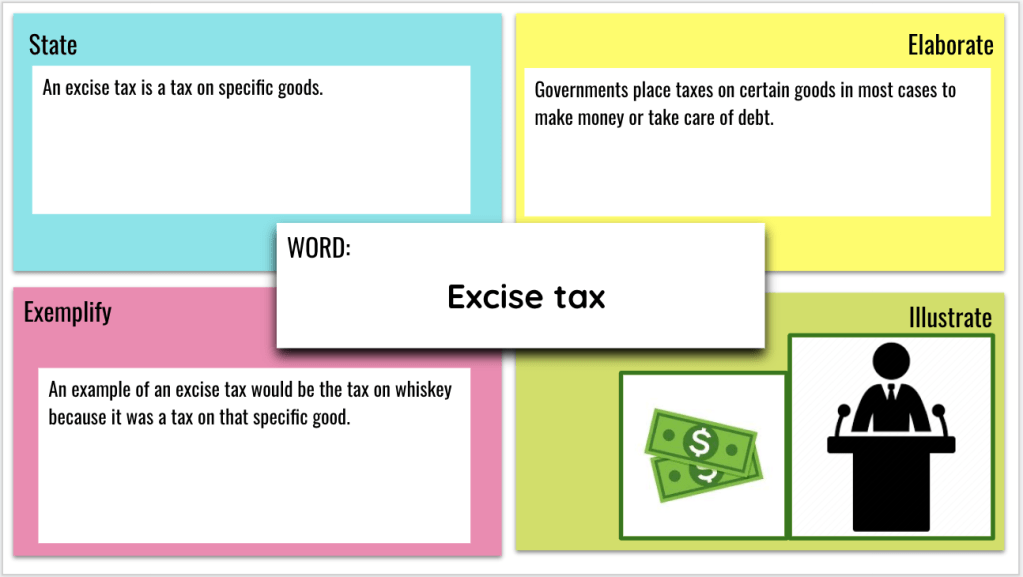
After the first rep of the Quizizz, I had students Frayer the word, “Excise Tax.” Taxes are things many 8th graders don’t fully understand. I felt this word was important to understanding the Whiskey Rebellion. Students used the SEE IT model for the Frayer – state the definition, elaborate on the definition, list 3 examples, illustrate, and talk about it. Here is an example of a completed Frayer…
After 4 minutes and quick discussion, students jumped into the CyberSandwich. This was a quick 10 minute read and note taking, 3 minute Discuss, and a 5 minute summary. I had to shorten the discussion and summarizing pieces so we could get one more rep of the Quizizz in before class. We had a shortened class period. After the 2nd rep of the Quizizz, all students and class averages improved significantly. Here are some CyberSandwich examples:
Here is a quick grading tip for everyone – at the conclusion of a CyberSandwich, Sketch and Tell, or any type of writing piece, I have students copy and paste their summary into a Google Form and submit. This way I have all summaries in one space and don’t have to waste time clicking through Slides.
Thursday
The ultimate goal of this quest through the Whiskey Rebellion is to have students analyze the rebellion through the eyes of a Federalist or Democratic-Republican. How would people from these parties feel about the taxes? How would they feel about the farmers rebelling? How would they feel about the use of military force to end the rebellion? The best way to do that is with an Empathy Map from Emc2Learning.
With this lesson I wanted to do more than an Empathy Map so I began class with the same Quizizz. Every class raised their Quizizz class average from the previous day which was awesome! I followed the Quizizz with a great activity from EMC2Learning called the Content Compactor.
Before starting this activity, I had students look at their blog from Quest 1 to remind themselves of the political party they chose for their character. With the Content Compactor, I had students finding a quote from a reading that would show how their character would feel about the Whiskey Rebellion. Students then summarized the quote. Then they narrowed their summary down to 1 word. Here are some awesome examples:
The Content Compactor was great getting students into the mindset of their character. (There are reasons I do certain activities in certain orders. Everything is intentional and has a purpose.) I followed the Content Compactor with the Empathy Map where I had students think about what their character (Federalist or Democratic Republican) would hear, say, see, and think about the Whiskey Rebellion taxes, farmers rebelling, and use of force. This Empathy Map will help students complete a blog, Facebook Profile, or Yelp review for the final project for Quest 2. Here are some examples:














































 Moler's Musings