History teacher at New Richmond Middle School. Tennis coach at SUA, Beechmont Racquet and Fitness, Lunken Playfield, and KCC. Striving to learn, create, and innovate one day at a time.
If you follow my blog, you know I’ve been writing a lot lately—reflections, ideas, quick thoughts, lessons, frustrations, the works. And while I’m still posting everything to Moler’s Musings like always, I’ve decided to start sharing on Substack too.
It’s, flexible, I can still write like I always do, and I can also post short audio or video pieces when the mood hits. It’s all in one place, easy to use, and honestly just gives me more ways to share and connect.
I learned about Substack from Jake Carr, and he’s doing some really cool things with it. If you’re into teaching, AI, and new ideas that push your thinking, check out his podcast What Teachers Have to Say—definitely worth a listen.
In 2006, when I first started teaching tennis, I ran a bunch of classes for 3 to 5 year olds. We had all the right equipment—mini nets, low-compression balls, small racquets—the stuff that actually made sense for little kids. But I was still running drills like we were using regular tennis balls on a full court – stuff that was way too big and too much for where they were.
One day, my boss—who also happened to be a great mentor—watched one of the classes and asked, “Why don’t you have these kids rally?”
I kind of shrugged and said, “They’re not ready for that. They’ll struggle. What are they going to get out of it?”
To which he replied, “Maybe this week they get one ball in a row. Maybe next week they hit two. Maybe the week after that, none. But you’re giving them a chance. You’re giving them the opportunity to build the skill.”
That moment stuck with me for years. Recently, it’s been popping into my head again. Not for tennis. Rather, because of AI.
When AI tools first started popping up in education, I wasn’t sure what to think. I didn’t want it to become a shortcut. I didn’t want kids to stop thinking. I didn’t want to lose the craft of teaching and learning.
That conversation about rallying stayed with me. I realized—maybe AI is the ball. Maybe we just need to let kids rally.
Now I’m using tools like Magic School, Class Companion, and Snorkl in class. Not just for the sake of using them, but to give students opportunities.
Let them try. Let them fail. Let them get one good idea this week, maybe two next week.
Class Companion gives them real feedback on their writing—feedback they actually use. Snorkl lets them explore thinking with AI scaffolds. Magic School helps them dig deeper and ask better questions. These tools aren’t doing the work for them—they’re helping them build skills.
But here’s the key: we still have to be the coach.
We’ve got to teach them how to interact with AI, not just copy and paste. We’ve got to help them ask better questions, process feedback, revise, and think. That’s what AI literacy is really about.
So no—AI isn’t perfect. But if we avoid it because we think kids can’t handle it… we’re missing the whole point.
They can’t rally if we never give them the ball.
Let them rally. Stand on the sideline. Feed them another one. That’s how they grow.
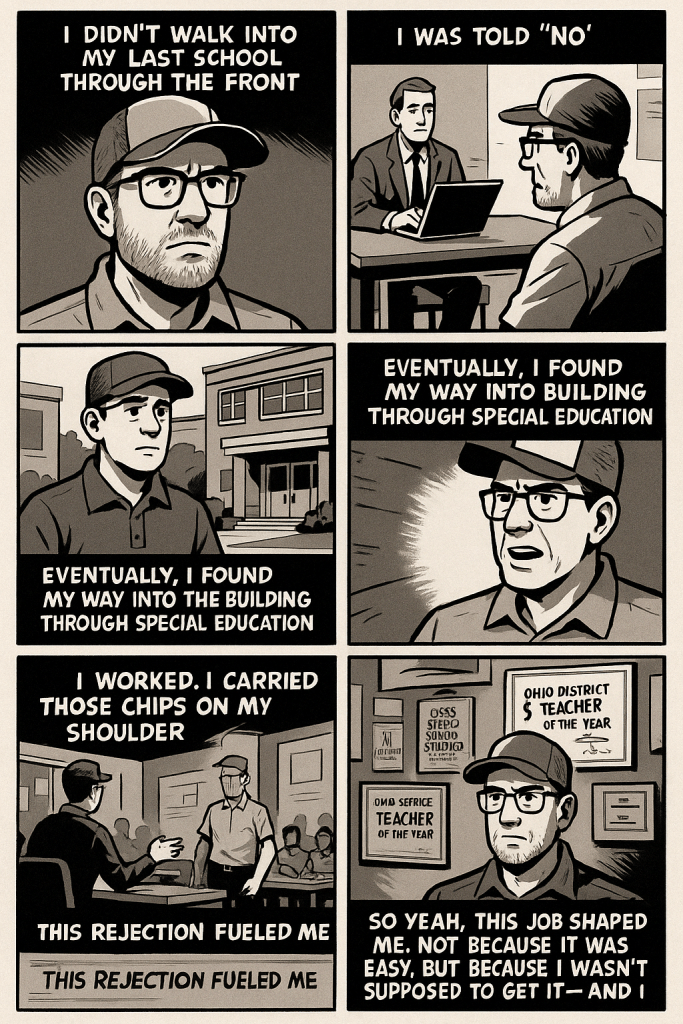
I didn’t walk into my last school through the front door. I didn’t get hired because I was the obvious choice. I wasn’t recruited or celebrated. In fact, I was told “no” multiple times.
I first interviewed there for a high school social studies position. Didn’t get it. Later, I applied for a middle school social studies job. Didn’t get that either. But they did ask me if I wanted to coach tennis. I said, “No.” That didn’t sit well with me – how could I be good enough to coach, but not good enough to teach?
Eventually, I found my way into the building through special education. I didn’t have a degree in special ed, but I promised them I’d go back and get it—and I did. I finished my master’s in special education in a year and a half.
As soon as I finished my master’s in special ed, another social studies position opened up. I applied. And again, they told me no—they wanted to hire a football coach without a teaching degree. The board denied the hire. I was the backup. The “Plan B.” So, I took the job. And in the back of my mind, I told myself: I’m going to show everyone.
I worked. I carried those chips on my shoulder into every lesson, every interaction, every chance I had to connect and grow. I found ways to innovate, brought in new tech, found fresh ways to make learning matter. I built relationships with students, families, colleagues. I was driven by rejection.
This rejection fueled me, and eventually, I became the Ohio District 5 Teacher of the Year. Then the OCSS Middle School Social Studies Teacher of the Year. I became an AI consultant. A presenter. A published author.
The result of me getting told “no.”
So yeah, this job shaped me. Not because it was easy. But because I wasn’t supposed to get it—and I made damn sure they didn’t regret it.
This week wasn’t about cramming in new content or racing toward a test—it was about building something that lasted. We used a layered mix of retrieval, reading, analysis, structured writing, and reflection, and each protocol helped us answer a bigger question. Coming off spring break, I knew students would need structure but also some momentum. So I stacked the lessons with intention.
We used Fast & Curious with Quizizz every day, not just to review terms, but to show how retrieval works when it’s spaced out and tied to deeper learning. We layered in Annotate & Tell for close reading and sourcing, and we used Graph & Tell to compare data with perspective. Students analyzed primary sources, revised flawed writing, and built arguments from multiple viewpoints.
We pulled in Archetype Four Square to reframe historical figures like Eli Whitney, then brought it full circle with Class Companion, Thick Slides, and a hands-on word wall review to tie everything together.
We came back from spring break, and I knew better than to pretend everything would pick up right where we left off. After 10 days off, kids needed a ramp—but that didn’t mean the day had to be a throwaway. I wanted to build back some content momentum while still reinforcing writing skills. So I stacked the lesson around a clear essential question and layered the tasks with a mix of retrieval, source analysis, and structured writing.
Quizizz:
We kicked things off with a Quizizz that blended review and preview questions from our industrialization unit. The idea was to warm up their brains without pressure. It gave me a quick read on what stuck over break, what needed refreshing, and where we could push forward.
Primary Source Pack: Framed by a Big Question
The textbook has a set of primary source lessons—usually I tweak or skip them, but this one had potential. The essential question was: How can changes in work and social life affect a society?
I ran all six sources through AI and had it reword them to be more accessible without losing meaning. I also had AI generate two basic questions per source to give kids a little guidance. After each source, students wrote a 6-word summary that directly tied back to the essential question. That’s what kept the focus. No wandering. Every source came back to that one big idea.
The sources included:
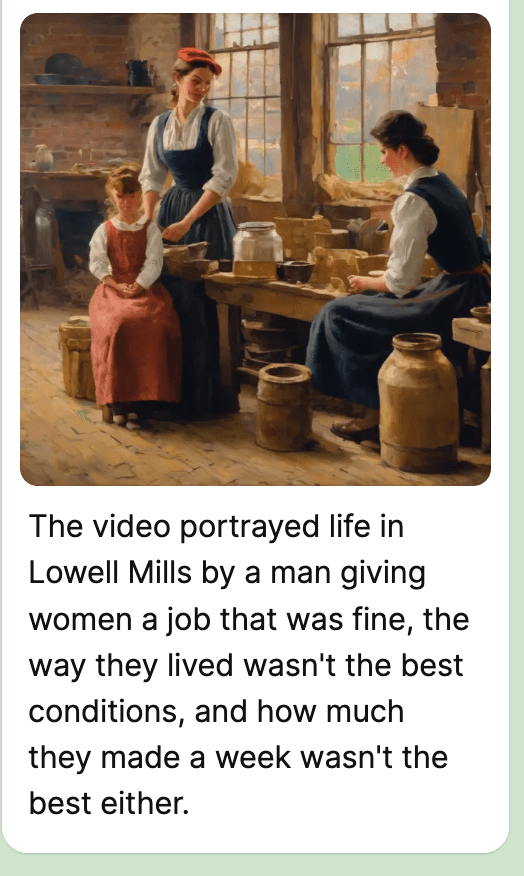
A Lowell Mill girl’s journal
An immigrant’s first letter home
A factory owner’s defense of conditions
A political cartoon from the time
A protest flyer
An anti-immigrant speech
Each gave students a different perspective, and the layering really helped them start to think critically about the intersection of work, immigration, and social change in the 1800s.
Short Answer: Revising a Bad Paragraph
Once we had enough content, I dropped them into a Short Answer task. I gave them a clearly incorrect paragraph that oversimplified everything. Their job was to revise it using evidence from the sources.
Here’s what they had to fix: Changes in work and population didn’t really affect anything. Most people stayed on farms and worked outside. Immigrants had an easy time finding jobs and were treated fairly. Factory workers only worked a few hours a day, and their jobs were fun and safe. No one complained, and the government made sure everything was perfect.
The responses were solid. Short Answer let them see peer examples and compare their thinking, which always boosts engagement. We weren’t writing full-blown essays—just clean, focused revisions with evidence and reasoning. That’s the kind of writing practice that sticks.
Fast and Curious Again:
To finish class, we went back to Quizizz with a Fast and Curious round. It was the same set as earlier, but now students had background knowledge from the readings and writing. I wanted to see if the scores improved, and they did. Retrieval practice works—especially when the content is layered.
Tuesday
This lesson was all about getting students to see the layers of impact behind Eli Whitney’s invention—not just the praise in textbooks, but the real, complicated ripple effects. We used a mix of protocols to help students analyze, compare, and respond to those consequences.
Quizizz Check – Fast and Curious
We started with a Fast & Curious Quizizz round. The goal was to preview key terms tied to the cotton gin: invention, economy, agriculture, slavery, unintended consequences. I saw right away where the gaps were. Some students had never really connected the cotton gin to slavery. That told me the rest of the lesson needed to go beyond “Eli Whitney invented something helpful.”
Archetype Four Square: Who Was Eli Whitney?
Next, we moved into an Archetype Four Square. After reading a short bio of Eli Whitney, students picked an archetype they felt best represented him. Then we had them support it with evidence from the reading and make a historical or pop culture comparison. It sparked some great thinking. Was he a hero? A sage? A magician?
Annotate & Tell
From there, we jumped into an Annotate & Tell using two primary sources—newspaper articles from 1818 and 1825 celebrating the cotton gin. Students highlighted quotes that showed the invention’s impact: increased cotton production, land value, and Southern prosperity. Then we paused and asked the real question: What’s missing from this praise?
Graph & Tell
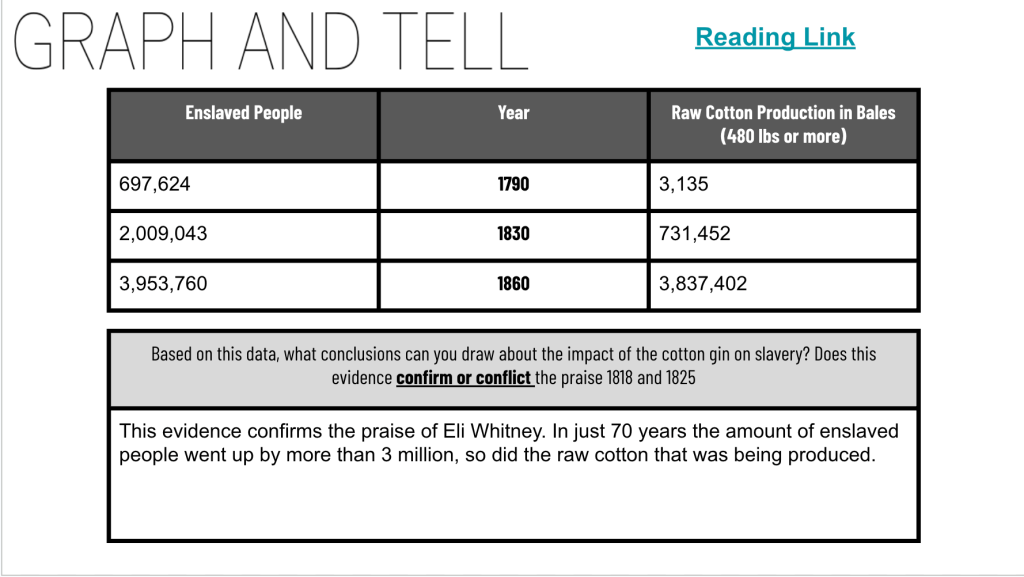
To bring in the other side, students examined a chart showing the rise of enslaved persons alongside the rise of cotton production. This was our Graph & Tell moment. They filled in a chart and wrote a short summary of what they noticed: a clear correlation between more cotton and more slavery. Then we pushed further—Does this data support or challenge what the primary sources said? That question changed everything.
Class Companion
To wrap things up, students went to Class Companion and wrote from a chosen point of view: Eli Whitney, a plantation owner, an enslaved person, or a Northern factory worker. Their task was to explain the consequences of the cotton gin from that lens, including both short- and long-term effects.
The AI feedback blew me away. It didn’t just give grammar tips—it recognized their POV and gave specific feedback tied to it. For example, students writing as enslaved people got suggestions on expressing emotion or explaining hardship more clearly. It was targeted, authentic, and helped them revise in real time.
Wednesday – Friday
Wednesday through Friday were choppy. State testing threw off our schedule, kids were in and out, and nothing was consistent. But in some ways, that made the lesson better. We had space to slow down and focus on the people most impacted by what we’d learned earlier in the week—enslaved individuals.
After exploring the unintended consequences of the cotton gin, we shifted into the question: What was life like for the people whose lives were changed by it? It wasn’t about moving on—it was about going deeper.
Starting with Language
We began with a short but important conversation about how we talk about people in history. I introduced person-first language:
“enslaved person” instead of “slave”
“enslaver” instead of “master”
“freedom seeker” instead of “runaway”
I told students these words don’t just sound better—they shift how we see people. They’re human first. Not property, not background characters in someone else’s story. The kids caught on quickly and started using the new terms without being reminded. That one shift helped everything else land better.
Quizizz
Next, we ran a Quizizz. I built it around key vocabulary like abolitionist, resistance, enslaver, overseer, and oppression. I also kept a few questions from earlier in the week to bring back some of the Eli Whitney and cotton gin context. The goal wasn’t a grade—it was to activate thinking, catch misconceptions, and see what needed clearing up before we hit the heavier stuff.
A lot of kids didn’t fully understand “resistance,” so that told me where to lean in next.
EdPuzzle
We watched a high school-level EdPuzzle on slavery and resistance. I picked the 9–12 version on purpose—it talked about the Underground Railroad as a metaphor instead of a literal train line. That helped break a common misconception right away.
More importantly, the video gave a broader definition of resistance. It wasn’t just running away—it was breaking tools, learning to read, preserving family bonds, working slowly on purpose, singing coded messages in songs. It gave them a new way to understand how enslaved people fought back.
Annotate & Tell
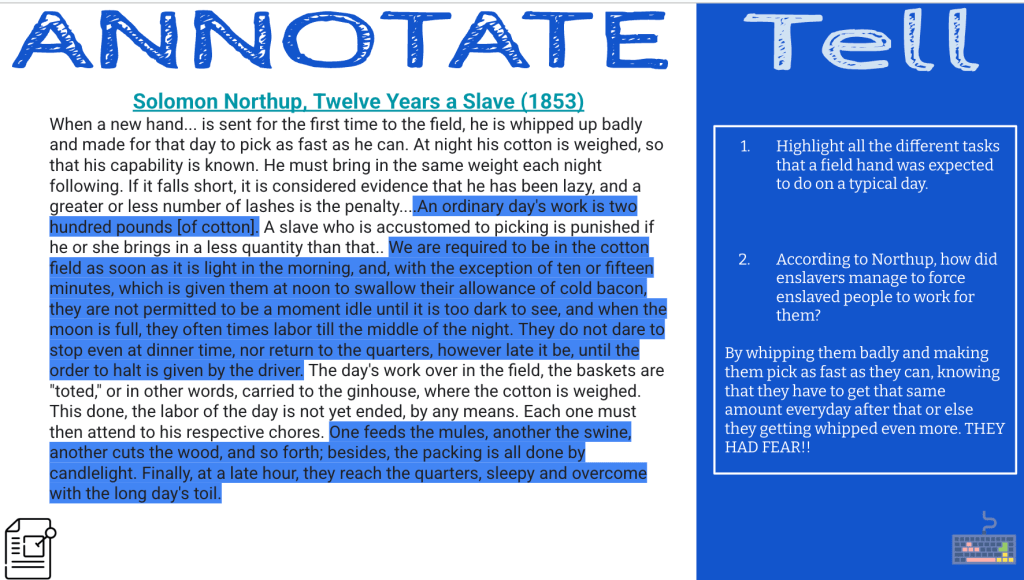
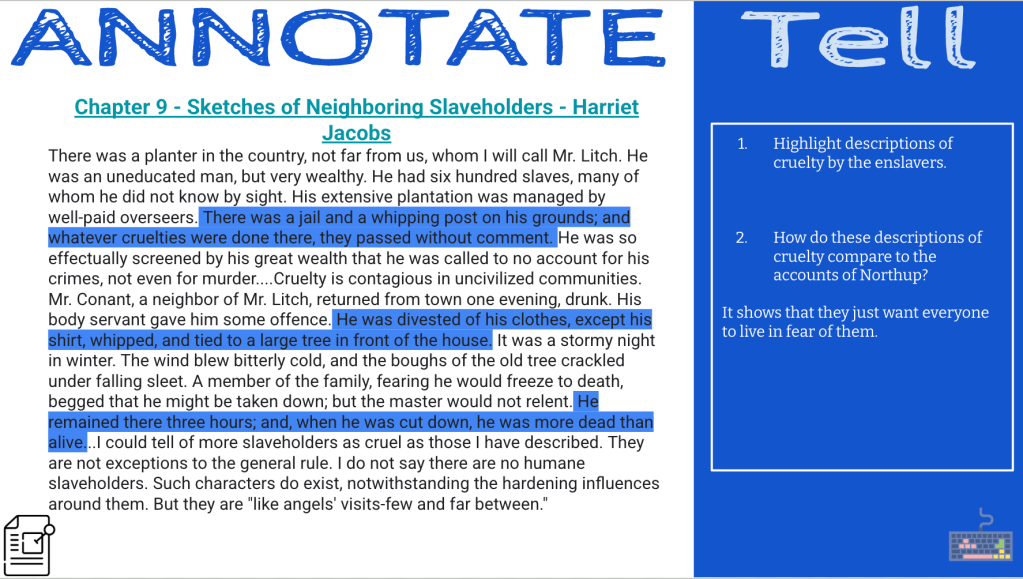
After that, we moved into Annotate and Tell with two powerful excerpts:
Solomon Northup from Twelve Years a Slave
Harriet Jacobs from Incidents in the Life of a Slave Girl
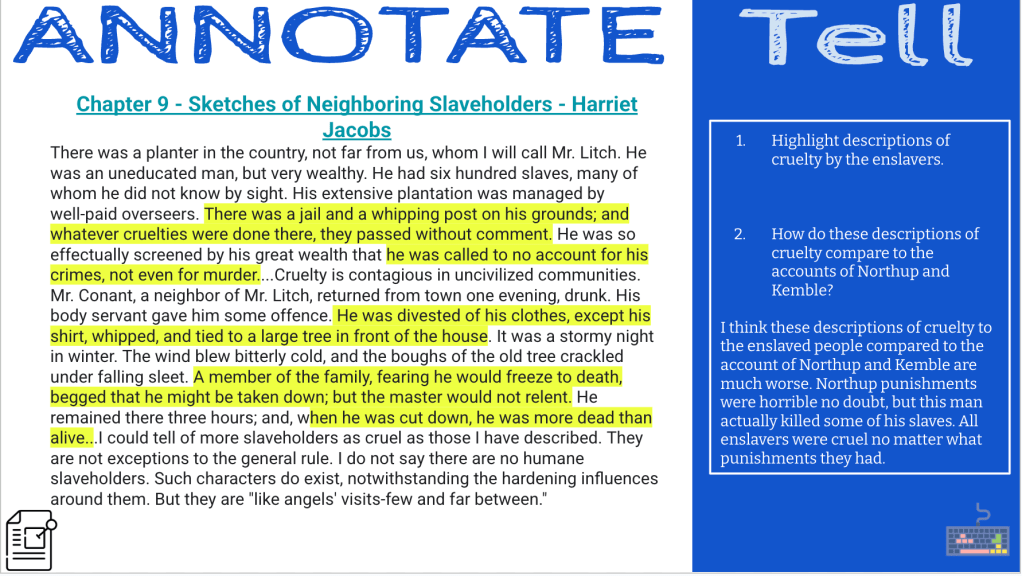
We started with short background blurbs so students knew who these people were and why their stories mattered. Then we read each passage together, pausing to highlight key phrases and answer focused questions.
Northup described long days in the field, being forced to pick 200 pounds of cotton, being punished if you fell short, and chores that lasted well into the night. Jacobs described the cruelty and control that came with wealth—enslavers who tortured without consequence and normalized abuse.
Thick Slide: Be the Abolitionist
Then it was time to apply what they learned. Students created a Thick Slide from the point of view of an abolitionist trying to convince others that slavery must end. Their slide had to include:
Three quotes from the readings that exposed the reality of slavery
An explanation of why those quotes mattered
One form of resistance from the EdPuzzle and why it was important
A Human Spotlight featuring Harriet Jacobs, Solomon Northup, or someone from the video
A picture and a short caption telling that person’s story—what they saw, suffered, or stood for
Some students picked quotes that showed the physical brutality. Others focused on how people kept resisting anyway. Their captions were sharp, and a few were honestly emotional. They weren’t just checking boxes—they were making a case.
Teaching the AI Workflow
After they built their slides, I walked them through a quick Chromebook skill: Ctrl + Shift + Window Switcher = screenshot tool.
Then I showed them how to upload that screenshot into a MagicSchool chatbot I had set up. I modeled how to ask for specific feedback. As I always say, “If you give the AI tool crappy prompts, you’re going to get crap back.”
The whole point was to show them how to use AI after the thinking is done—to reflect, revise, and improve. Not to let AI do it all for them.
Word Wall Review
To wrap everything up, we did a drag-and-drop word wall. Students sorted terms and ideas between North and South—factory, agriculture, slavery, resistance, cotton, railroads, canals, unions, etc. It tied together everything we’ve covered the last two weeks in one quick review. Fast, visual, and a good reset after a deep few days.
Truth With Sprinkles
On Friday, I wanted something new for retrieval practice. I began class with a Class Companion – but with a twist!
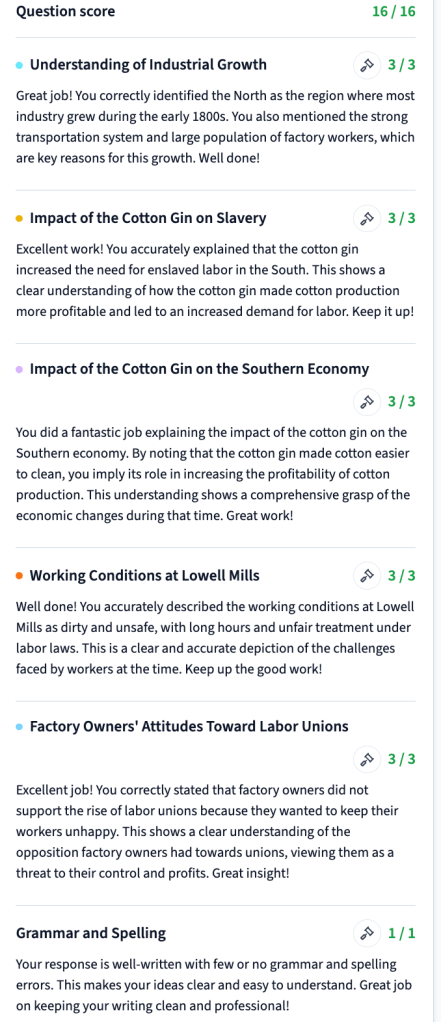
I had AI create 2 paragraphs with 4 historical errors. Here is what AI came up with:
In the early 1800s, the United States began to shift from farming to factory work. Most industry grew in the South because of its strong transportation system and large population of factory workers. One major invention that helped speed up this progress was the cotton gin. Created by Eli Whitney, this machine made cotton easier to clean and reduced the need for enslaved labor in the South.
Meanwhile, in Massachusetts, young women flocked to places like Lowell Mills for clean and safe factory jobs. They worked short hours and were treated fairly under new labor laws. Many factory owners supported the rise of labor unions because they wanted to keep their workers happy. These early unions helped workers demand better conditions with the full support of the people in charge.
I called it “Truth with Sprinkles” – sprinkles of fiction, that is! I brought sprinkled donuts for my 1st period because they worked so damn hard on the state test. It was unbelievable. They wrote their hearts out and gave it everything they had – it was awesome.
So, as they were eating their donuts (some with chocolate frosting and sprinkles) they were finding the sprinkles of fiction in the paragraphs. They were historical detectives.
I set up the Class Companion for only 1 submission – I didn’t want them submitting right away and trying to get the answers. They were discussing, analyzing, and acting as historical detectives fixing the errors. This was an awesome retrieval practice. Class Companion gave them great feedback on each error they tried to correct – it worked out so well!
In my blog series, The Week That Was, I try to open up my classroom and my mind—how I plan, how I teach, what I try, what works, what doesn’t. But the more I think about it, the more I realize that maybe I need to open up more about myself. Not just what I do in the classroom, but who I am, and the things that have shaped me into the teacher I am today.
One of the biggest things that shaped me is tennis.
I’ve played my whole life—through elementray, middle school, and high school. I was my high school’s only state qualifier in tennis, and my old racquet is still in the glass case at the school. But here’s the funny thing: I’m not a naturally competitive person. Not in the loud, intense kind of way. But tennis taught me how to compete. And not just with other people—with myself.
Tennis is a game of integrity. You make your own line calls. You call the score out loud. If the ball double bounces on your side, you’re the one who’s supposed to admit it. There’s no ref on the court. You and your opponent are the refs. It’s a game of sportsmanship, honesty, and respect. No matter how tough the match is—whether you win or get your ass kicked—you shake your opponent’s hand and say “nice match.”
I’ve had moments where I’ve wanted to lose it. One time, a guy intentionally pegged me with a ball between points—not during the play, just straight up drilled me. I was heated. Had a few choice words. But I still walked to the net and shook his hand. Because that’s the game.
There’s no game clock in tennis. No buzzer. You play until someone wins the last point. It’s just you and your opponet, figuring each other out. It’s physical, mental, emotional. You have to get creative. You gotta adjust. You have to find a way.
Tennis didn’t just teach me how to play. It taught me how to carry myself, how to bounce back, how to keep my head, how to quietly prove people wrong. It’s shaped how I teach, how I coach, how I reflect, and how I grow.
That’s what this new series, Things That Shaped Me, is about. The moments and experiences behind the lesson plans. The stuff that built me. Because teaching isn’t just about what you do. It’s about who you are. And if I’m going to open up my classroom, I might as well open up a little more of myself too.
In a recent interview, I was told: “Your pedagogical knowledge is impressive. I haven’t seen anything like it. But we hire people who can build relationships.”
The comment came from nowhere. I was taken back. The interview wasn’t even over. I didn’t even have time to respond. But since then, I’ve been sitting with it—annoyed, frustrated, and a little fired up.
Because here’s the truth: pedagogy and relationships are not exclusive. They work together.
You want to build relationships with students? Start with someone who knows what the hell they’re doing when the bell rings.
Someone who knows how to make the content accessible. Someone who knows how to design lessons that let kids shine. Someone who knows how to lower stress and raise expectations—at the same time.
I don’t need chaos to connect with kids. I need consistency. And consistent, thoughtful lesson design frees my brain to actually be present. To notice who’s having a bad day. To check in. To make space.
So yeah, I took that comment personally. Because this job demands both.
Things are getting expensive. Teachers don’t wanna pay for stuff. Free versions are usually watered down or full of ads. I’m just here to share some tools that have useful free versions. These are ones I’ve been using and they’ve helped me plan better, save time, and still give students solid feedback and learning experiences.
I’ll keep it simple: what it is, why I like it, and how I use it (with a solid teaching idea thrown in—usually paired with EduProtocols that make sense).
Even with the free version, Class Companion gives your students feedback like a champ. It tracks writing progress over time, breaks feedback down into categories like organization and evidence, and gives consistent scoring. You can assign short-answer questions or extended responses, turn off copy/paste (huge during state testing season), and export their progress.
Why I like it: I don’t have to manually grade everything and I still get useful data. Feedback is fast and targeted. It’s perfect for helping kids write better without burning myself out.
Teaching Idea: Pair with Nacho Paragraph. After doing a Number Mania, reading, or Frayer-based content build, have students write a one-paragraph response that argues a claim. Class Companion gives AI feedback on the claim, evidence, and reasoning. It’s also great after a MiniReport—combine two sources, write a response, and let AI provide revision tips. Great test prep without being test prep.
Brisk is like having an AI sidekick built right into Google Docs and Slides. You can highlight text and ask it to simplify or raise the reading level, turn a website into a quick Google Slide presentation, or even generate questions. You can use it to leave AI-generated feedback on student work, but I mostly use it for materials prep.
Why I like it: It’s fast, doesn’t take me to a new platform, and it helps me tailor materials for students at different levels in seconds.
Teaching Idea: Use Brisk to level a source before a Cyber Sandwich. Take a tough article, simplify it for one group of students, and leave the original for another. Have them annotate, partner-share, and write a summary. You can even ask Brisk to generate questions for a thin slide or fast and curious warm-up.
This is my go-to when I want a fast, interactive lesson that looks good but doesn’t take hours to make. Curipod lets you create engaging, Nearpod-style lessons. You can add open-ended questions, quick polls, drag-and-drop, even AI-generated reflections or historical figure Q&A simulations. The drawing and writing feedback features are a huge bonus.
Why I like it: I can turn a warmup into a 20-minute meaningful discussion with a couple clicks. Students actually enjoy the format and get to respond anonymously or collaboratively.
Teaching Idea: One way you could try using Curipod is by adding a few Sketch and Tell prompts throughout the lesson. Students draw and write a quick response, and the platform gives them feedback right away. After the Curipod, you might follow it up with a Thick Slide—have students share four important facts, two visuals, and a comparison. It’s a simple way to turn the lesson into something more student-centered and reflective.
Final Thoughts
These three AI tools won’t replace your teaching—but they do make it faster, easier, and more manageable. You don’t need 12 tools, and you definitely don’t need to drop $25/month to get value.
Try one this week. Layer it into an EduProtocol you already use. Let the AI handle some of the prep or feedback so you can focus more on the conversations and connections that matter.
When I was putting together my “Turning Whatever Into Wow” presentation, I kept coming back to one truth: don’t let AI create your lesson. Use it to support your thinking, not replace it.
You are the human in the loop. You know your students. You know your standards. You know what they need to know and be able to do by the end of a lesson.
That’s how every lesson should start—with the end in mind. What skill are we building? What misconception are we clearing up? What connection are we hoping they make? Once I know that, then I bring AI into the process—not to do the work for me, but to help sharpen the work I’m already doing.
AI is powerful, but your thinking still drives everything.
Teachers are often put in situations where we’re expected to react quickly. And let’s be honest—most of us are pretty reactionary by nature. We think we know how we’d handle a situation, and sometimes we even rehearse those responses in our heads. But when the moment actually happens? It’s never exactly like you imagined.
Today I was thinking about a student I had who wore a camping bracelet. I didn’t think much of it until I saw him sparking it—yes, like actual sparks. Turns out, it had flint and a small knife hidden in it. In my head, I could hear the imagined reactions of others: panic, write-ups, sending him out immediately, maybe even calling security.
But instead, I just stood there, and took it in. A few minutes later, I walked back and asked him calmly to tell me what it was. As he explained, I texted the right people behind the scenes. Admin came down, had a quiet conversation, and that was that. The student left. No spectacle. No scene. I never saw him again.
That moment stuck with me. Because yeah, I could’ve reacted. But I didn’t need to. Not every situation requires a high-stakes response. Sometimes it’s not about how you want to react—it’s about how you need to respond. There’s a difference.
This isn’t about being passive. It’s about being thoughtful. Teaching is hard, and every kid, every situation, every choice is different. We don’t always have to meet intensity with intensity. Sometimes the best thing you can do is pause, listen, and make your move quietly.
This week was all about variety, structure, and student voice—anchored by a solid lineup of EduProtocols. I leaned on Fast & Curious for foundational vocab, layered in Annotate & Tell to break down complex readings, used Number Mania to push students toward using evidence, and wrapped lessons with Short Answer and Nacho Paragraphs to bring writing and thinking together. We even threw in some creative fun with Thin Slides, Craft-a-Cola, and a few MagicSchool tools to help students prompt and produce in more engaging ways. It wasn’t just about covering content—it was about designing experiences that stuck.
We kicked off the week with a lesson on industrialization and how it changed the northern states—and I tried a Rack and Stack combo I was really happy with. It wasn’t flashy, but it had purpose at every step. Each EduProtocol built on the last, and everything came back to our guiding question: How did industrialization change the northern states?
Fast and Curious: Vocab First
We opened with a Gimkit Fast and Curious using vocabulary that kids were likely to struggle with—rivers, factories, mass production, loom, spinning, sewing machine. A lot of times I assume kids know basic words, but they don’t. After the first round, I gave feedback and cleared up confusion around things like loom and mass production. Then we ran it again. By the second round, scores had gone way up—evidence that repetition and feedback work.
Thin Slide: Why the North?
Next, I used a Thin Slide variation I learned from Justin Unruh. Students were asked to answer the question: Why did industrialization occur more in the North? using the keywords rivers and factories. They found or created an image and gave a one-sentence explanation. They had 8 minutes total—then they shared live, 8 seconds per student. This was a great way to preview the bigger concepts without overwhelming them.
Annotate and Tell: 3 Phases of Industrialization
We moved on to an Annotate and Tell with a short reading on the three phases of industrialization. Students highlighted the three phases in yellow and highlighted any inventions or machines in blue. The reading wasn’t long, but it was packed with information. I asked them two big questions to process:
What are the three phases of industrialization, and how did each one change the way goods were made?
How did machines like looms and sewing machines change the way people worked in factories?
Kids worked in partners to discuss and respond, and I was impressed with how well they broke it down.
Sketch & Tell Comic Edition: Visualizing the Phases
After the reading, I had students create a 3-frame comic using the Sketch and Tell Comic Edition to show how the three phases changed life and work. I got this idea from Justin Unruh again, and it’s become one of my favorite go-to protocols for visual processing. Instead of just retelling, students visualized each stage and added one sentence of explanation. This helped students slow down and make sense of how the shift happened over time—from breaking down tasks, to building factories, to powering machines.
Padlet Thin Slide: Bringing It Back to the Big Question
To wrap it up, we returned to our original question—How did industrialization change the northern states?—with a final Thin Slide posted on Padlet. I gave them 5 minutes to respond using what they had just learned, and they had to include at least one piece of evidence from the comic or Annotate and Tell. This helped me see who really got it and who might need more support.
It was a solid Rack and Stack, and I loved how each piece of the lesson connected. The goal wasn’t to cover everything—it was to build background, layer the concepts, and give students multiple ways to process. That’s what makes EduProtocols work.
Tuesday
I’ll be honest—Monday didn’t go how I hoped. The engagement across all my classes hovered around 25%, and that’s not something I’m used to. It frustrated me, and it forced me to take a step back. I told the students on Tuesday that I intentionally design lessons to build on familiar ideas. I don’t want them to feel overwhelmed—but I also don’t want them to zone out.
So I had to flip the script.
Fast and Curious: Quizizz Rebound
We opened class with a Fast and Curious on Quizizz using questions tied directly to industrialization in the North. This wasn’t just vocab—it was context-based. Words like steamboat, reaper, plow, and telegraph were sprinkled in. I noticed how often students missed even basic terms. Sometimes we assume students know what words like “petition” or “shift” mean, but they don’t. The data from Quizizz told me exactly where to go next.
Frayer Models With a Twist
We jumped into a Frayer activity using the textbook reading on four major inventions of the 1800s: the steamboat, the mechanical reaper, the steel plow, and the telegraph. But this wasn’t just a regular Frayer. I added some chaos—two dice rolls per invention. The first determined how many bullet points they had to write, the second decided how many words each bullet needed. This created structure, accountability, and a layer of challenge.
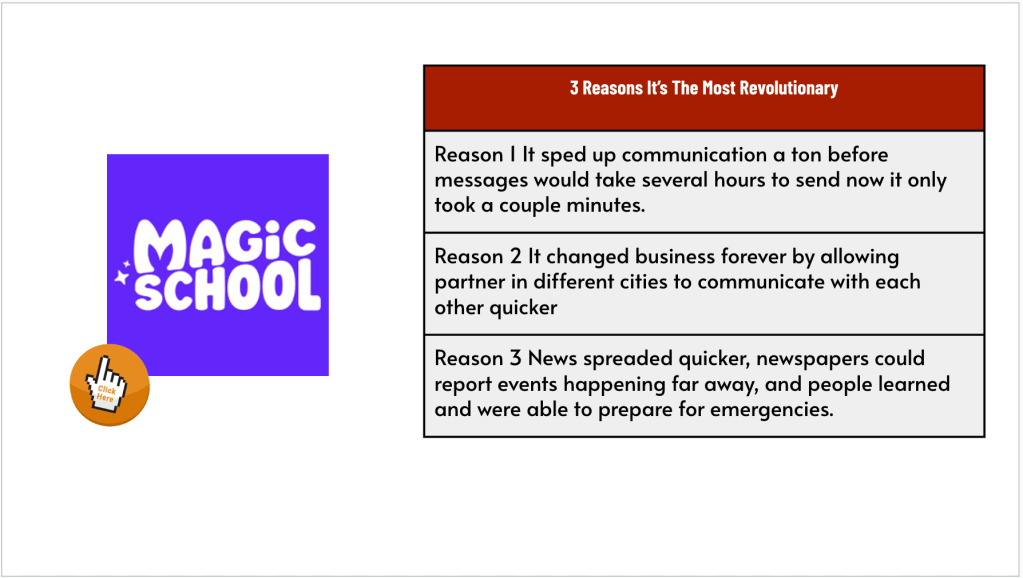
Chatbot Collaboration: Magic School AI
Next, I had students select the invention they thought was the most revolutionary. Using Magic School’s chatbot, they prompted the AI to speak as if it were that invention. They asked follow-up questions and gathered more support. This was one of my favorite moments—watching students debate themselves through the screen, pushing AI for deeper evidence.
Short Answer: Writing With a Purpose
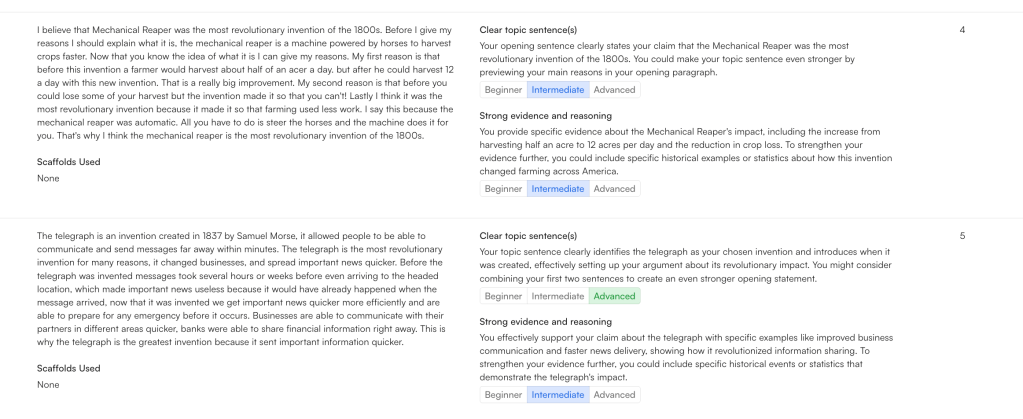
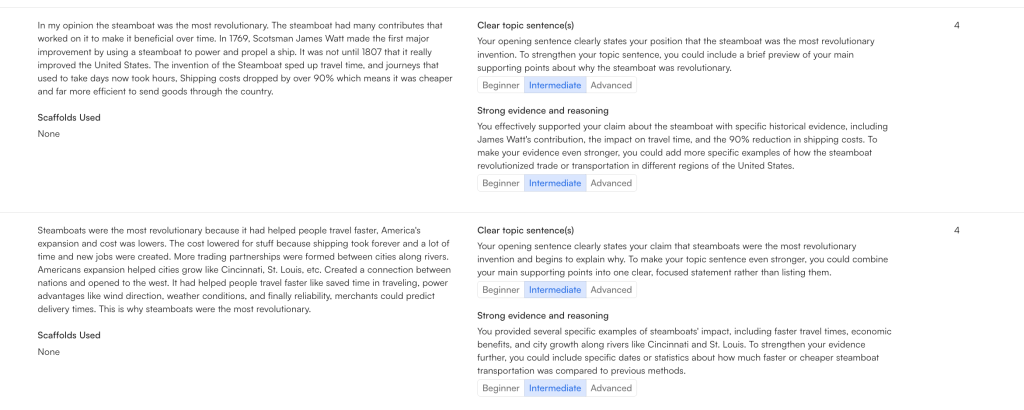
We wrapped up with a Quick Write on ShortAnswer. This tool has been a game-changer. I selected two rubric elements: clear use of evidence and strong conventions. The AI gave instant feedback and categorized responses as beginner, intermediate, or advanced. Then it added up class scores to see if we hit our class goal. Three of my four classes crushed it.
But the best part? I disabled copy and paste. The words they wrote were their own.
I told them if they hit the class goal, I’d wipe away their Monday mess. They locked in and crushed it. Students were writing. For real. Because the task had structure, purpose, and a chance to improve.
Wednesday
Today’s lesson was all about one sentence: “The Lowell Mill Girls had an extraordinary opportunity.” That was it. That was the line that carried us through the whole class. My goal? Get students to keep circling back to that claim—support it, refute it, challenge it, reframe it. Think about it, talk about it, write about it.
I used a Rack and Stack of familiar EduProtocols, but I tried to tweak the flow a little to hit a rhythm. And honestly, it worked.
Fast and Curious: Start with What They Don’t Know
We kicked things off with a Fast and Curious using Gimkit. Vocabulary was pulled straight from the lesson: boardinghouse, wage, petition, strike, shift. You’d be surprised how many students don’t know what a “shift” is. Or “petition.” Or “boardinghouse.” After one 3-minute round and some direct feedback, we ran it again—and it made a big difference. The repetition and immediate correction helped lock it in. And it gave us a foundation to move forward.
EdPuzzle + Thin Slide = Instant Reflection
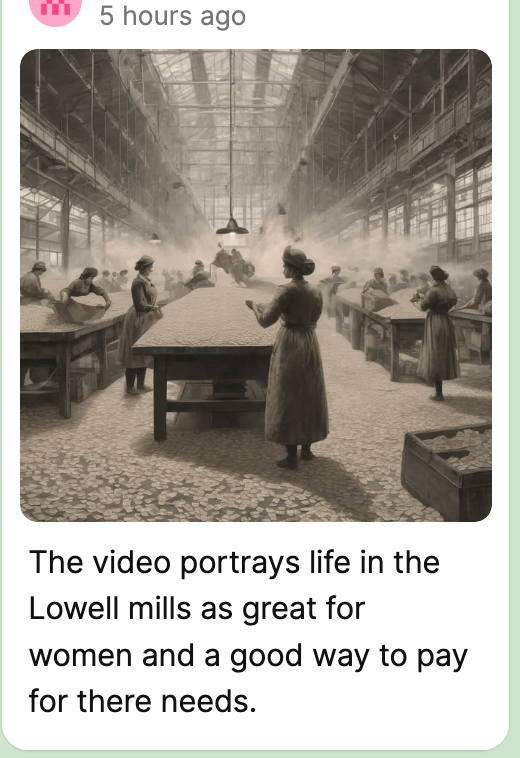
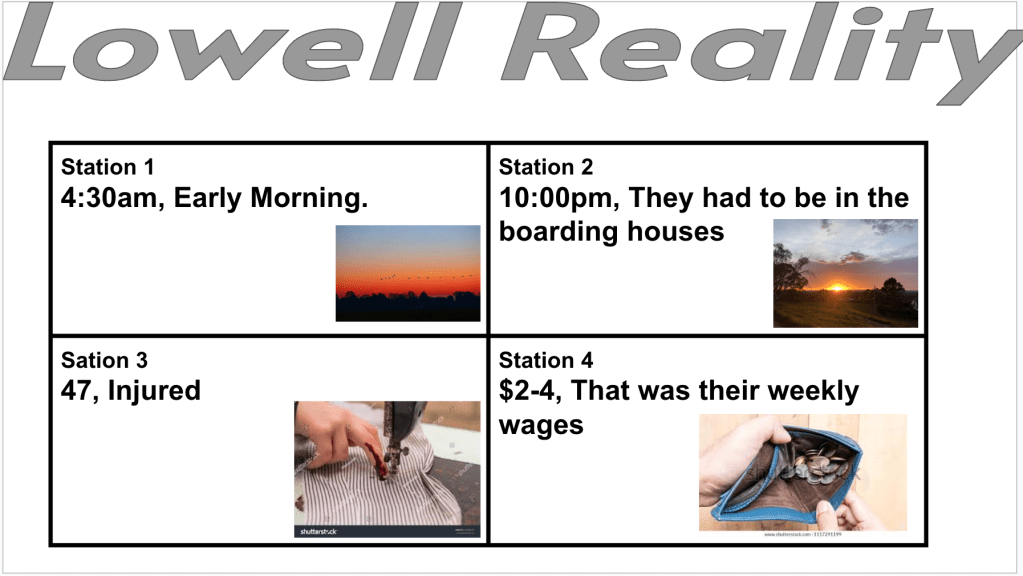
Next, we watched a 4-minute EdPuzzle about the Lowell Mill Girls. I embedded a Thin Slide right in the middle and brought the original claim back: “Did this video support that statement or not?” Some said yes—they got paid, they had housing. Others said no—the pay was awful, the work was grueling, and the living conditions weren’t great either. It was cool to see students start forming opinions and backing them up with specific parts of the video. The Thin Slide forced them to pick a side and start thinking critically before we even got to the meat of the lesson.
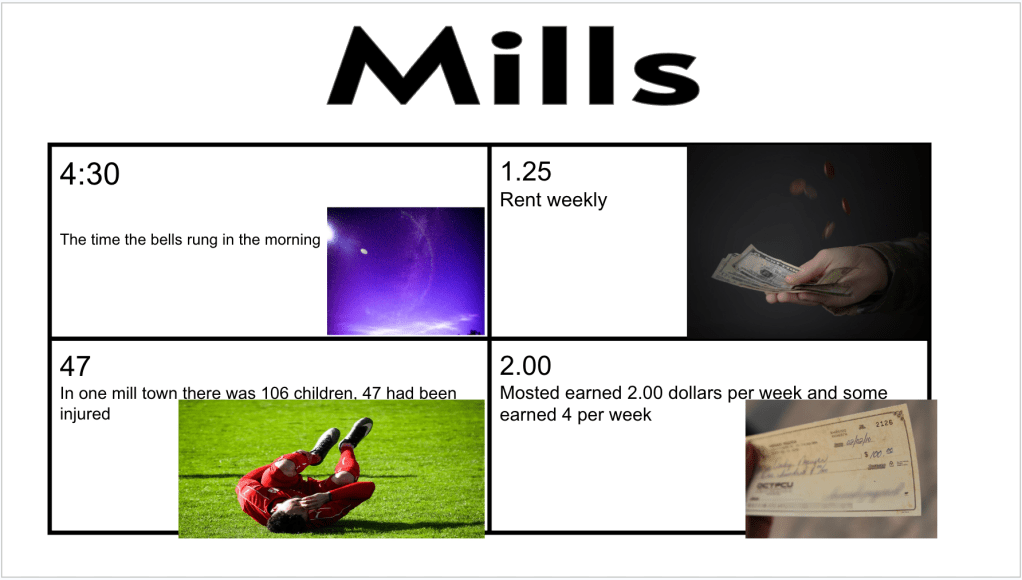
Number Mania: Let the Numbers Talk
Then we moved into Number Mania. Originally, I had six stations planned, each with a short reading—some primary, some secondary. But after thinking about cognitive load (and remembering that part in Blake Harvard’s book), I cut it down to four. Best decision I made all week.
At each station, students had to pick a number from the reading that could be used to refute the original statement. Of course, we had to stop and break down what “refute” actually meant—another word straight off the state test that most students didn’t know.
To make it even more fun (and to fight copy-paste laziness), I rolled dice. The first die told them how many words they had to use. That forced them to be intentional and selective with their evidence. Every station, every round, they got better at it.
Short Answer x Nacho Paragraph: Final Hit
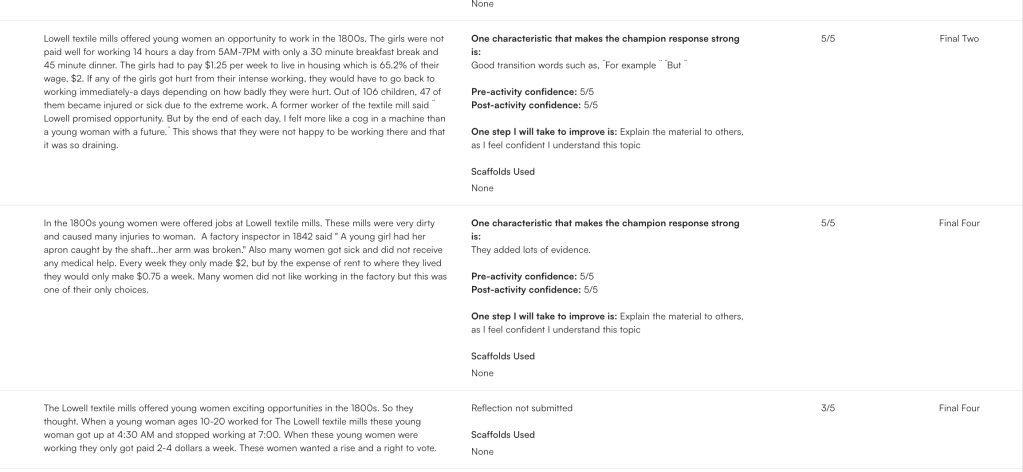
To bring it all together, we used the Nacho Paragraph protocol inside Short Answer. I told students to copy and paste the original statement and revise it. Fix it. Refute it. Use the numbers and facts they just found in the Number Mania.
We ran it Battle Royale style. They saw each other’s answers. They compared. They got feedback. And most importantly, they thought.
They were engaged. They weren’t writing because I told them to. They were writing because they had something to say.
Thursday
After a deep dive into the Lowell Mill Girls earlier in the week, I wanted to extend the conversation—this time with a focus on labor unions and how the legacy of early industrial labor still echoes today.
We kicked things off with a short, one-page reading about the Lowell Mill Girls and labor unions. The reading did a solid job tying the historical context to modern labor movements. Students answered five questions to check comprehension and pull key ideas.
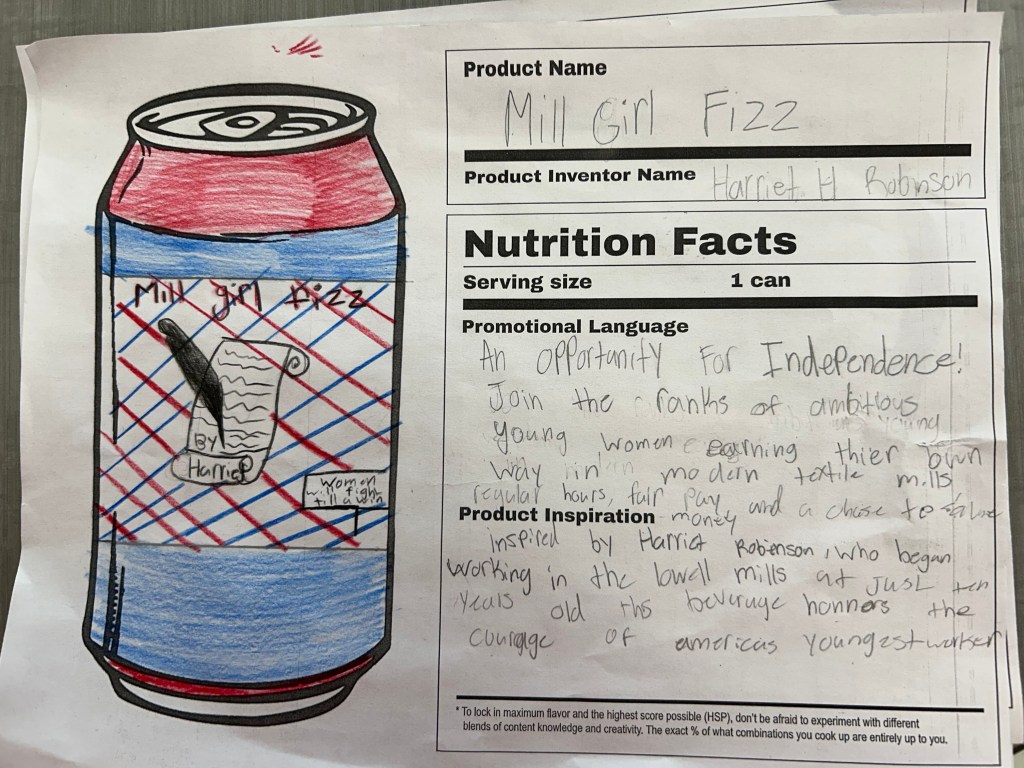
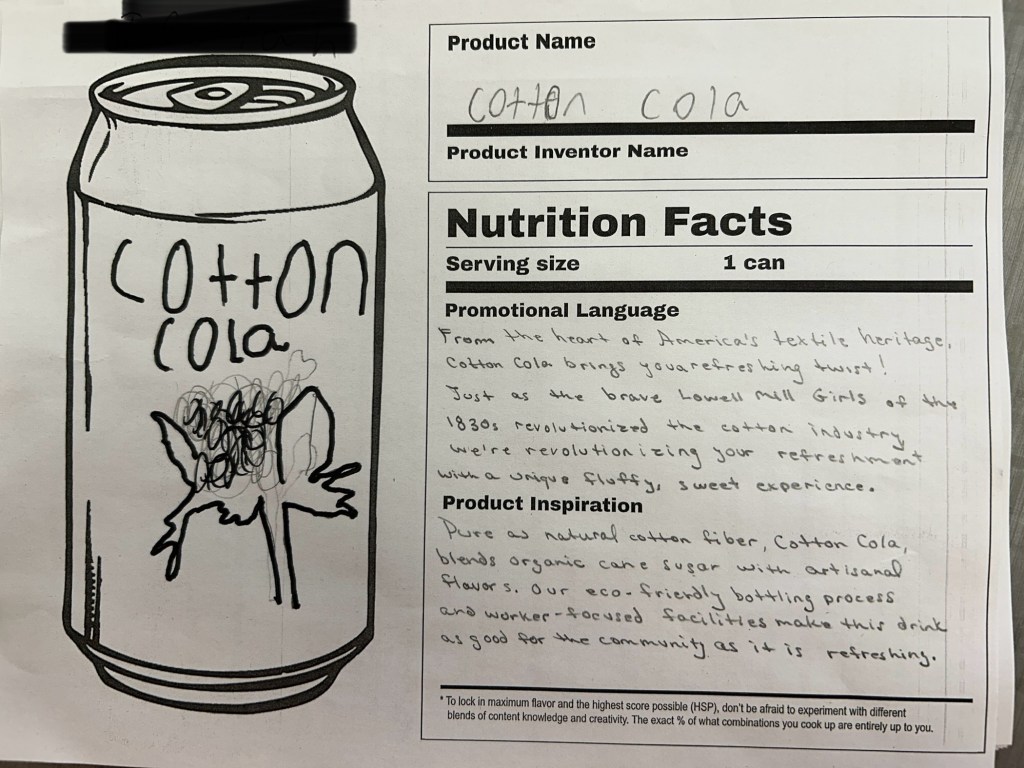
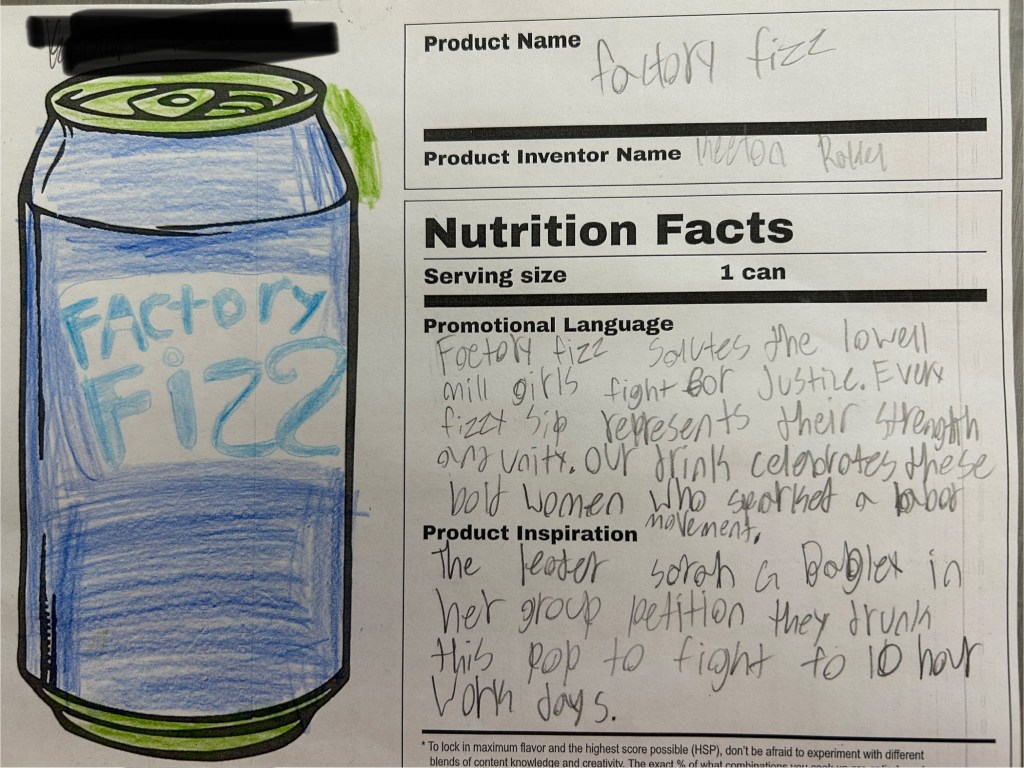
Then we pivoted into something a little more creative: a template from EMC² Learning called Craft-a-Cola.
Here’s the setup: Students had to design a pop can inspired by the Lowell Mill Girls and the rise of labor unions. Their can needed:
A creative soda name
A slogan or promotional phrase
A short write-up explaining the historical inspiration behind their product
This was a fun twist, but I knew right away some students would struggle with generating ideas. So I built a Magic School classroom with a custom idea generator chatbot. Students used it to brainstorm potential pop names and promotional language.
Here’s what I learned: 8th graders don’t always know how to prompt clearly. At first, a lot of the results were pretty off—or the bot responded with something like “I can’t do that, but here’s a suggestion…” It turned into an unexpected mini-lesson on how to write better prompts.
We took a few minutes to break down what makes a good prompt, rewrote some together, and suddenly the ideas started flowing.
What I liked most about today’s lesson:
It gave students a new way to process content they’ve been learning about all week
It tied creative thinking to historical understanding
It sneakily taught them better AI prompting skills without me planning for that to happen
Some of their designs were pretty awesome. A few were flat-out hilarious. But all of them reflected some understanding of how labor unions began and why they mattered—proof that even a pop can can tell a powerful story.

















 Moler's Musings