History teacher at New Richmond Middle School. Tennis coach at SUA, Beechmont Racquet and Fitness, Lunken Playfield, and KCC. Striving to learn, create, and innovate one day at a time.
The first time a student told me, “This sounds smart, but I don’t think it’s right,” in response to an AI-generated answer—I knew we were onto something.
That moment sparked Fray-I—a thinking routine I’ve been developing to help students analyze AI responses, not just accept them. It’s still a work in progress, but it’s already changing how my students interact with both history and technology.
Here’s the flow:
Students engage with content – a primary source, textbook excerpt, or short video.
They ask a question based on the reading or viewing—either one they create or one I provide (especially if the source leaves something unanswered or unclear).
They run that question through an AI tool like ChatGPT or MagicSchool.
They get a response and analyze/evaluate.
Here’s what Fray-I looks like:
Claim: What is the AI saying? What’s the main idea or argument?
Evidence Used: What support, facts, or examples does it include?
What’s Missing?: What voices, perspectives, or key historical context are left out?
Push It Further: How could this answer be stronger? More accurate? More complete? Would you use this response?
This turns AI into the text—not the shortcut. Students question the bot like they would a biased newspaper article, a government document, or a historical speech.
Why Fray-I works:
It puts students in the driver’s seat. They’re not copying—they’re critiquing.
It reinforces essential social studies skills: sourcing, bias, perspective, and evidence-based reasoning.
It meets students where they are—working with the tools they’re already curious about.
And honestly? The engagement is different. When students start noticing what the AI got wrong, what it ignored, or how it could be improved, they feel ownership.
Fray-I isn’t finished. I’m still tweaking sentence starters and scaffolds to support all learners. But it’s already doing what I hoped: Helping students think like historians in a world where information is instant—but not always insightful.
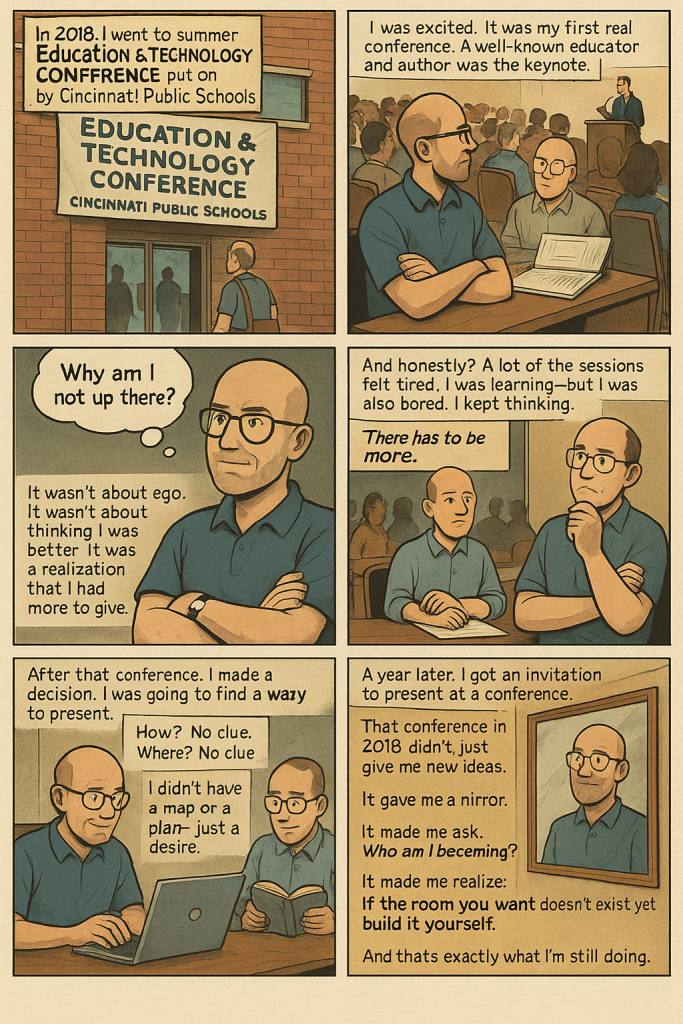
In 2018, I went to a summer Education and Technology Conference put on by Cincinnati Public Schools.
I was excited. It was my first real conference. A well-known educator and author was the keynote. I signed up for my sessions. I filled my notes with new ideas. I sat there ready to learn.
But somewhere in the middle of it all, a different thought started creeping in: “Why am I not up there?”
It wasn’t about ego. It wasn’t about thinking I was better. It was a realization that I had more to give.
And honestly? A lot of the sessions felt tired. I was learning—but I was also bored. I kept thinking, There has to be more.
After that conference, I made a decision: I was going to find a way to present.
How? No clue. Where? No clue. I didn’t have a map or a plan – just a desire.
To me, setting a goal isn’t about listing all the things you have to do. It’s about asking yourself: “Who do I need to become to get there?”
So I went to work. I started sharing more. I started creating more. I started reading more. I started sequencing EduProtocols differently – combining them, remixing them, making them my own. I started thinking bigger.
A year later, I got an invitation to present at the Summer Spark conference in Milwaukee, Wisconsin. I ran a workshop on EduProtocols. Then I presented at Spring CUE in Palm Springs, California. Then at NCSS in Nashville, Tennessee. Then all over the U.S. – sharing EduProtocols and AI from Boston to Los Angeles and everywhere in between. I built what I once just dreamed about.
That conference in 2018 didn’t just give me new ideas. It gave me a mirror. It made me ask, Who am I becoming? It made me realize: If the room you want doesn’t exist yet, build it yourself.
When ChatGPT dropped in November 2022, I jumped in shortly after. I started playing with it, wrote my first post about using it in education by January 2023 (here it is).
A few months later, I was presenting on AI locally and, eventually, across the country—showing teachers how it could actually make their lives easier. Somewhere along the way, I became an AI consultant. I gave about five presentations. After one of them, the head guy pulled me aside and told me I did an excellent job.
Me being me, I asked, “Are you serious or just being nice?”
He said, “I don’t say things I don’t mean. That was excellent.”
That moment stuck with me.
And then… silence.
No more calls. No more opportunities. I reached out—asked if I was fired. They said no. I asked if I needed to fix anything. They said no. I asked for feedback. Nothing.
Same story with job interviews. Get the call. Get told, “We went in another direction.” I ask for feedback, and get told, “You were great, but someone else rose to the top.” I get told, “The other candidate stood out.” No feedback. No real explanation.
And honestly?
It’s ridiculous.
We work in education. We preach feedback. We tell kids and teachers it’s the key to getting better. We build entire evaluation systems around it.
But when it comes time to give real feedback to each other? Crickets. Excuses. Vague compliments and generic rejections.
It’s cowardly. It’s bullshit. And it’s hypocritical.
We owe people better than that.
Especially if we actually believe half the stuff we say about growth, learning, and improvement.
This week was about layering, connecting, and getting students to own the content—not just memorize it. Every protocol, every sequence was designed to move students from basic retrieval to deeper understanding without overwhelming them.
Nothing fancy. Nothing over the top. Just intentional teaching.
Monday kicked off our Abolitionist Movement work. I always try to bring in local figures like Harriet Beecher Stowe, John Rankin, and James G. Birney alongside Frederick Douglass, Sarah Grimké, and William Lloyd Garrison. Students need to see the local connection—that history didn’t just happen “out there.”
We started with a Thin Slide: “Change begins when someone refuses to stay silent.” One picture. One word or phrase. Fast. Immediate. It set the tone for the day—thinking about voice, action, and courage.
Then we jumped into a short EdPuzzle. It wasn’t to “teach” the content—it was just to jog memories and fill in some quick context before they picked an abolitionist to dive deeper into.
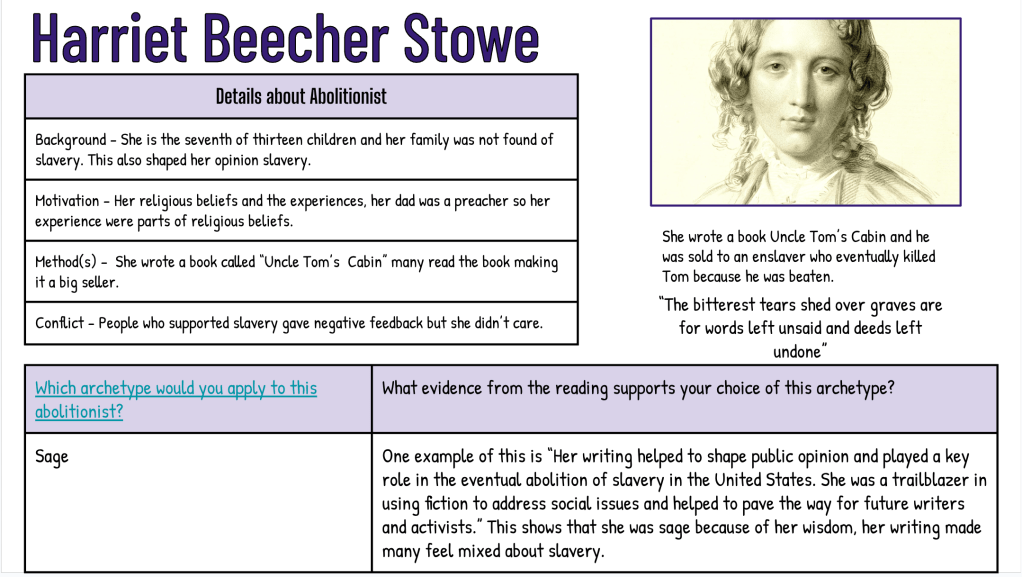
The Thick Slide was the real meat of the day: Each student chose one abolitionist and built a slide that included:
A short background
Their motivations for ending slavery
The methods they used (writings, speeches, helping people escape, etc.)
One powerful quote or moment that showed who they were
This wasn’t just copying facts—it was asking students to curate what mattered.
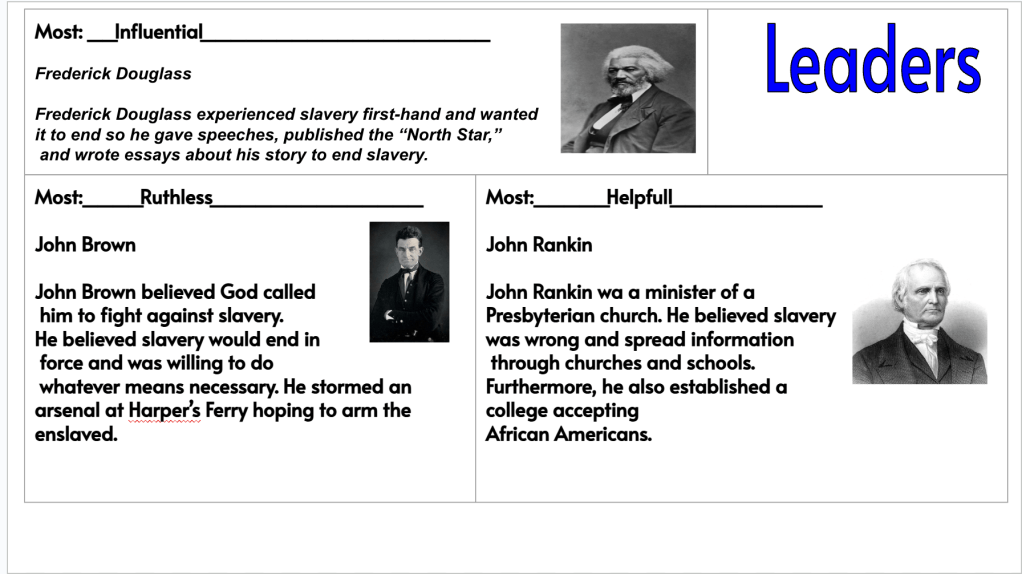
After they shared, classmates used a Frayer Model to capture the background, methods, and motivations for four abolitionists.
Why I sequenced it this way:
Thin Slide to frame the emotional/critical thinking lens
EdPuzzle for quick retrieval
Thick Slide to produce and contribute
Frayer to actively listen, gather, and process others’ work
Every move had a purpose: students weren’t just learning about abolitionists—they were seeing patterns of activism.
Tuesday: Finishing Abolition With Superlatives
Tuesday was another strange day because of science OST testing.
We opened with a Fast and Curious on Quizizz. Nothing complicated—just another layer of retrieval on the same reform movement content:
Words like suffrage, reform, abolitionism, and goals of different movements
Then we finished Monday’s work with a Superlatives activity (shoutout to Kim Voge). Students had to pick 2–3 abolitionists and apply superlatives like Most Courageous, Most Determined, Most Visionary, etc.
At first, I had them tie it back to the Thin Slide quote from Monday…but after first period, I realized that overwhelmed them. So I pivoted and just let them focus on the superlatives.
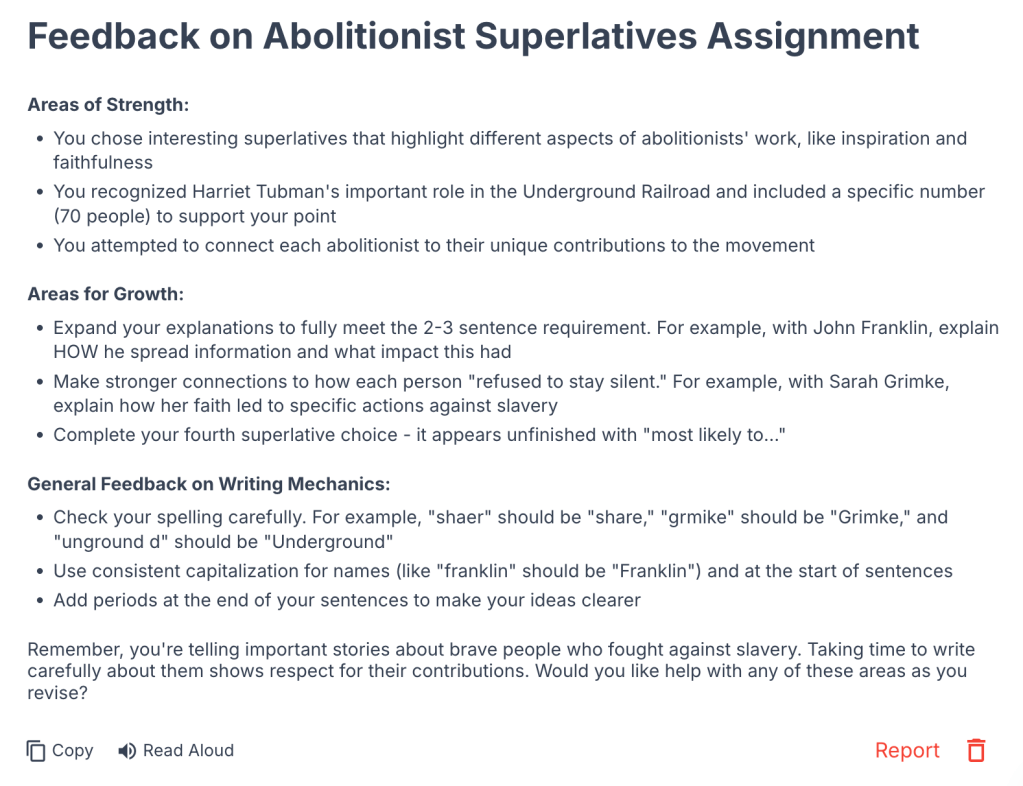
After students completed the Superlatives, they used Magic School’s writing feedback tool to add in ideas. They took a screenshot, attached the screenshot to the feedback tool, and generated feedback. It led to discussions of evaluating feedback and choosing to pay attention to the feedback that matters.
Why this worked:
Fast and Curious warmed them up with retrieval
Superlatives required them to compare, judge, and defend choices
It wasn’t just recalling facts—it was applying understanding
The pivot mattered. Sometimes you have to drop something mid-day when you realize it’s not helping kids think better.
Wednesday: Thinking on My Feet With Real-World Skills
Wednesday was a little chaotic—still on the weird science testing schedule. Some classes finished their superlatives and quizzes early, and I knew I needed something meaningful that wasn’t just busy work.
I thought back to a Friday Check-In I ran months ago: “If I could teach you anything besides social studies, what would you want to learn?”
The most common answer? – Jobs. Taxes.How to get a job.
So I threw together a quick, no-internet-needed lesson:
Started with a Google Form:
What’s more important—skills or attitude?
Would you hire yourself right now?
Number Mania on Padlet:
What are two labor laws that surprised you?
I shared a quick story about my first job working clay tennis courts—how doing the little things no one asked for got me better hours and more money.
Why this worked:
It was personal.
It was relevant.
It used EduProtocols (Number Mania + fast reflection) in a real-world context.
The best moments come when you connect content to what actually matters for students’ futures.
Thursday: Connecting Abolition and Women’s Rights (with Purposeful AI)
Thursday was all about tying movements together—and introducing AI not as a shortcut, but as a thinking partner.
Our goal: Understand how the Abolitionist and Women’s Rights movements were connected—and why they eventually split apart.
The flow:
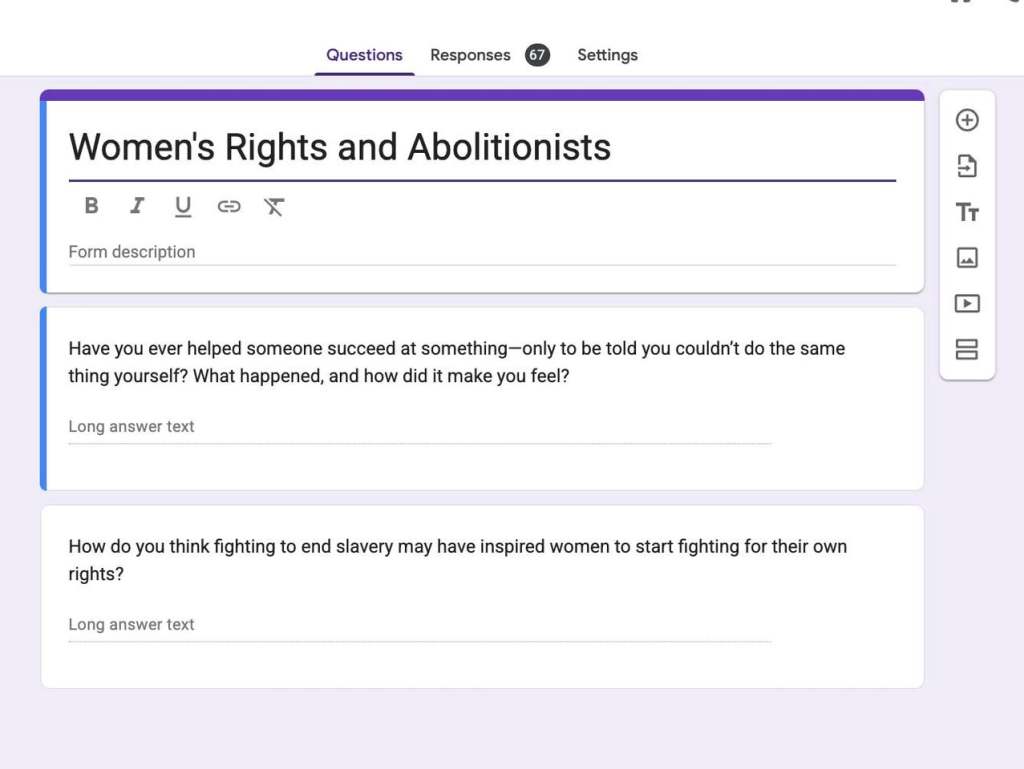
Opened with a Google Form to prime thinking: Where do you see connections? Where could you see division?
Annotate & Tell: Students read a short article and answered four guiding questions that helped them think about motivations, conflicts, and context.
Then came the AI part—and this was intentional:
Students used MagicSchool ChatBot Raina to ask a question about the reading. I did not preload the ChatBot with any extra information.
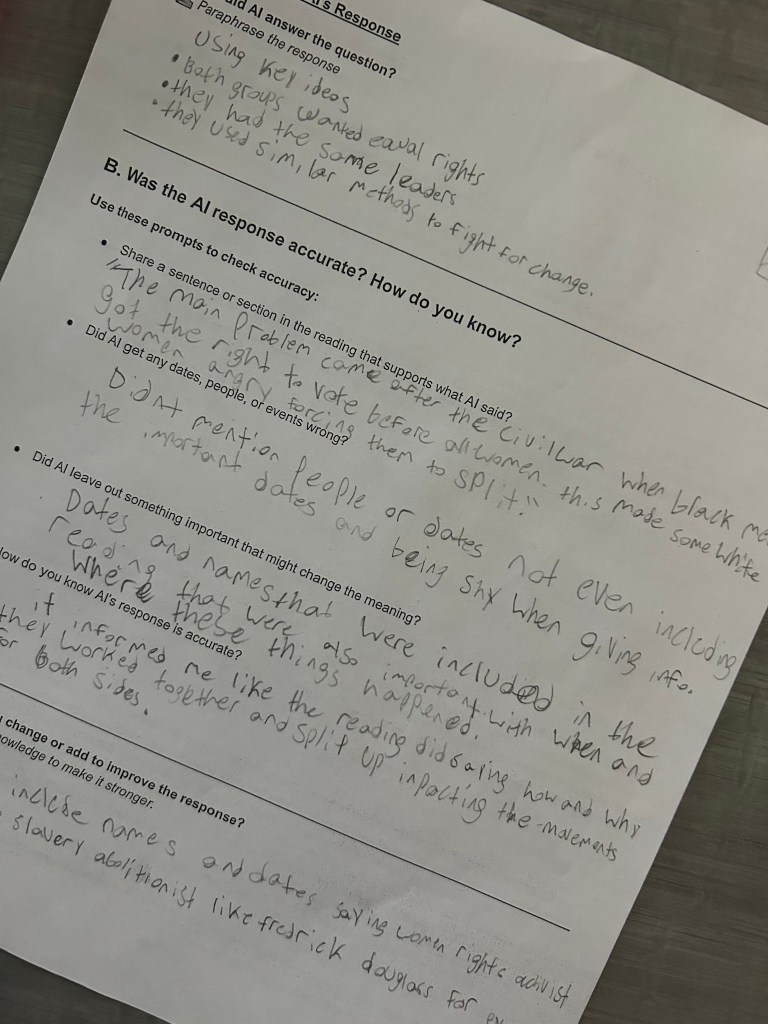
They had to paraphrase the AI response
Then they had to evaluate it:
Was it accurate?
Was anything missing?
How could it have been better?
This wasn’t just “use AI.” This wasn’t generate ideas and copy. It was: engage with AI, challenge it, think critically about it.
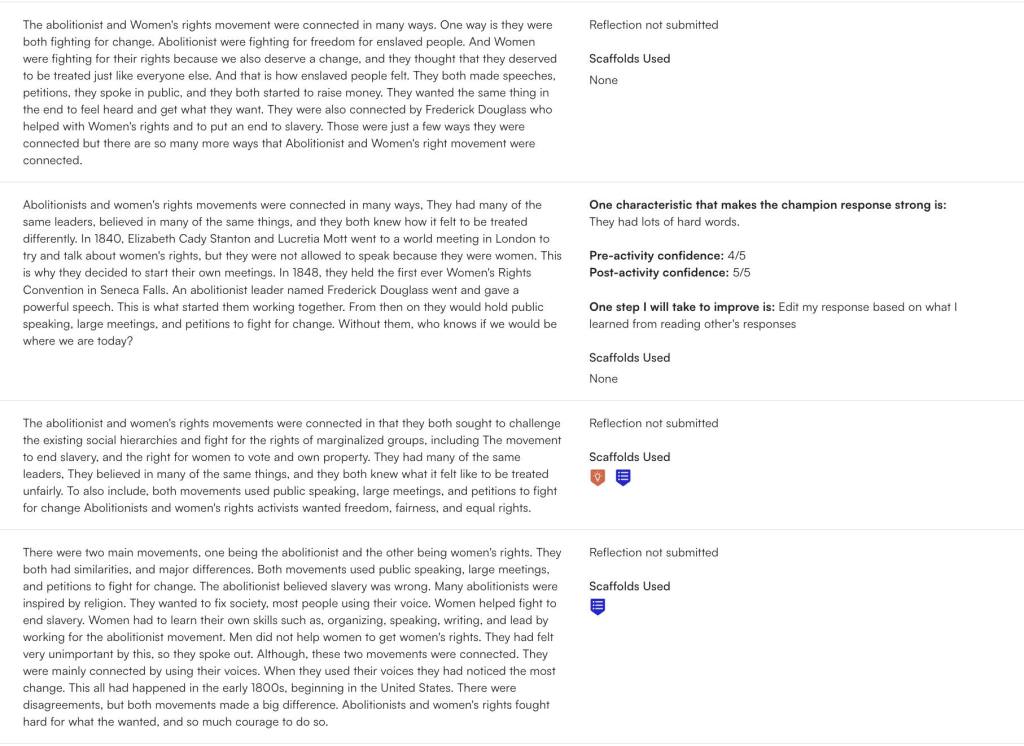
We closed it all with a Short Answer Battle Royale: Explain how the two movements were connected.
Why this worked:
The Google Form opened thinking.
Annotate & Tell slowed down reading.
AI added reflection, metacognition, and sourcing conversations.
Short Answer forced a full-sentence, evidence-based response.
AI wasn’t a crutch. It was a springboard for better thinking.
Friday: Wrapping Reform With Solo Iron Chef
Friday was about pulling everything together.
We started with a Fast and Curious on Quizizz (class averages were solid: 83%–90%) to hit key reform concepts one last time.
Then, students completed two Solo Iron Chef slides:
I set the timer for 15 minutes per slide. Students had to screenshot their work and use MagicSchool to get AI feedback on it. And again—the feedback conversations were the best part. A student said, “The AI said to change my title but I made mine rhyme and I like it.” I said, “Then why listen to it? It’s a tool—not the truth. You know your purpose better than the AI does.”
When I went to college, I knew one thing: I wanted to play tennis. Beyond that, I had no clue. I went to an open house at NKU, and during the welcome session they told everyone to go meet with their major. I didn’t know if that meant I had to choose right then, but I assumed I did. And once I pick something… I stick with it. So, I chose education.
It wasn’t some deeply thought-out decision. It was instinct. But maybe it wasn’t all that random after all. Teaching runs in my family. Both of my grandmothers were teachers. My grandfather was a teacher. My stepdad was a teacher. I saw it up close.
It was my stepdad’s example that really shaped me. He worked in some of the toughest neighborhoods in Cincinnati Public Schools for over 34 years. I saw what true dedication looks like. I saw what it meant to pour everything into students, even when the system didn’t make it easy. I saw what it meant to care way past the final bell.
Every Christmas, he would go to Big Lots and buy a gift for every student—Barbies, Hot Wheels, hats, gloves, socks. And we would wrap every single one. Every single one. Because to him, every kid deserved to feel seen. To feel thought of.
He didn’t stop there. He planned field trips for his class—trips that weren’t just fun days off but literal windows into the world. Amish country. Farms. Cows, chickens, horses. Simple stuff, maybe to us, but for some of his kids, that was their first time outside the city. Their first time seeing life from another angle.
Watching all of this, I realized something. Teaching isn’t just about delivering content. It’s not about just doing your job. It’s about seeing people. It’s about giving kids access—to knowledge, to experiences, to care.
I didn’t know it at the time, but that open house moment? It wasn’t a mistake. It was the first step into something bigger. Something I was already being shaped for without realizing it.
Sometimes the things that shape us start as a guess. But they end up becoming part of who we are.
When AI first came out, I was intrigued. I started thinking of ways to use it creatively to help me. Ways to boost engagement. Ways to support learning. I was the guy making presentations with titles like “10 Ways to Use ChatGPT in Class” or “5 Ways to Increase Engagement with AI.” And those were useful—at the time.
But we’re past that now.
AI is here. It’s constantly evolving. It’s inevitable. Students will use it. So I’ve been trying to use it with them—not just for me. I’ve been using MagicSchool to help kids generate ideas, model how to write prompts, and get personalized feedback. I’ve shown them how to paraphrase AI-generated content instead of copying it. I’ve trying to show them to to analyze the content AI spits out. I’ve used Class Companion to give them feedback on writing, hoping they’ll read it and revise.
Some do.
Some don’t.
Some use it to improve. Some copy and paste. Some avoid it entirely and insist on thinking for themselves. Some don’t engage at all. It’s like a mini snapshot of society—some are all-in, some resisting, some just watching.
The real question now is: How do we use AI meaningfully? How do we turn it into a thought partner—not a shortcut?
Here are two ways I’ve started doing that in class:
Use AI to Practice the Process, Not Just Produce the Product One of the most effective ways I’ve used AI in class is to treat it as a starting point, not the final product. I have students use AI to generate a response, then paraphrase it in their own words, critique what’s missing, and decide what they’d keep or change. This process helps them engage with the content, reflect on their own thinking, and develop stronger writing and reasoning skills. Whether it’s analyzing a historical event or building an argument, the focus is always on using AI to support the learning—not replace it.
Evaluate the Feedback Itself One thing I do regularly: students create a slide summarizing their thinking, screenshot it, and upload it to MagicSchool. AI gives feedback, but here’s the key—they don’t just revise based on it. They evaluate it. Was it helpful? Confusing? Did it miss the point entirely? This makes feedback a thinking task. It gives students the power to decide what advice is worth using—and what isn’t. They’re not blindly following directions; they’re making choices. That’s real learning.
When I was 23, I was living in my parents’ basement. I had just graduated college with my teaching degree and license in hand, but teaching tennis was what I really wanted to do. At first, it felt like the right path. The hours were picking up and the income was solid.
But the days were unpredictable. Early mornings on court. Long stretches of nothing during the day (unless you could line up private lessons). Back on court from 4 to 7 PM most nights. The weeks were inconsistent.
I was making good money, but I was freeloading at home. Living rent-free in my parents’ house. My mom asked me if I could chip in for the bills, maybe pay a little rent. And I pushed back.
Looking back now, I honestly don’t know why I did that. I don’t know why I felt the need to push back, why I acted like I was above it. But it was the wrong move.
What happened next? I’ll never forget…
My mom came down to the basement and looked me in the eye and said, “You’re a f—king a—hole. You have two weeks to get out of my house.”
I stood there in silence.
How bad must you be for your own mom to say that to you?
It was that moment I had to look in the mirror and humble myself. It was that moment I realized I had to say less. It was that moment I realized I needed to grow up and be on my own. It was that moment I realized I had been the a—hole—and I needed to change. It was that moment I never wanted to reach again. It was that moment I felt it differently—because I’m an only child.
How bad must I have been for my own mom to call me an a—hole… and give her only child the boot? A heavy dose of reality. It woke me up.
That moment shaped me. Iit was honest. It forced me to get real about who I was and who I was becoming. It taught me that success without humility is just noise. That growth doesn’t come from being told “you’re great.” It comes from hard moments—the ones that hurt and stay with you. The ones that remind you to be better.
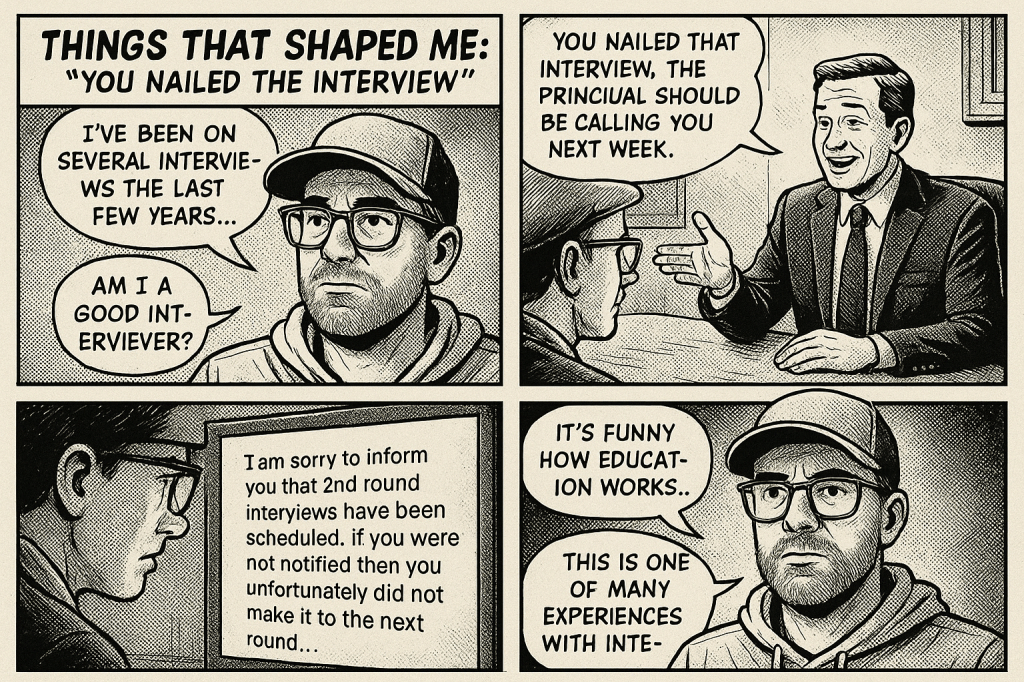
I’ve been on several interviews the last few years. Am I a good interviewer? No. I try to be humble. I try not to talk about “Teacher of the Year.” I try not to bring up the book I co-authored. I try to be genuine. I try to be modest. I try to just be me.
And sometimes that works against me.
Through some conversations, I’ve learned two things about why some of those interviews haven’t gone my way: I’m either seen as “too out of the box” or they assume I’ll leave for something “bigger and better.” Neither of those things are my intention. I just want to do good work. I want to make things better for kids and teachers. That’s always been my goal.
And yet, I’ve got stories—interview stories for days, that still leave me scratching my head. Here’s one that’s stuck with me…
A few years ago, I had a screening interview for a teaching position. I showed up ready. At the end, the assistant superintendent told me, “You nailed that interview. The principal should be calling you next week.”
Next week came and went. No call. So, I followed up with an email to both the superintendent and principal.
I got a short reply: “I am sorry to inform you that 2nd round interviews have been scheduled. If you were not notified then you unfortunately did not make it to the next round. I am sorry to have not gotten back to you sooner.”
That one confused me.
Especially because… this was the same person who, just a year earlier, had DM’d me to say that their district would be “lucky to have someone of your caliber.”
It’s funny how education works.
I used to think accomplishments would help. That the resume would speak for itself. That being named teacher of the year, co-authoring a book, presenting, and mentoring might open some doors.
Sometimes they do the opposite.
This is one of many experiences with interviews that shaped me. They made me think harder about who I am, what I value, and intentionality. I’ve learned that accomplishments and experience don’t always matter—not in the ways you’d expect. In education, things flip fast: one day it’s praise, the next it’s silence and being let down. But I keep working. Creating. Grinding. Sharing. And having fun.
This week was all about keeping the momentum going—connecting reform movements, industrialization, and women’s rights in ways that actually made sense to students. Some lessons flowed just like I hoped. Others forced me to think on the fly (shoutout to the surprise Wi-Fi outage). But through it all, I leaned on purpose-driven protocols, reframing simple tasks to get kids thinking deeper, and using tools—whether AI or no-tech—intentionally.
I’ve really grown to love the way a well-structured Rack and Stack can turn a test review into something way more meaningful than just a study guide. The trick is keeping it fast, focused, and rooted in retrieval. Monday’s review hit all of those.
Each protocol I used was capped at 5 to 8 minutes. That time limit keeps the pace quick and the energy up. Shoutout to Dominic Helmstetter—this structure is 100% something I borrowed from him, and it just works.
Here’s how we ran it:
Annotate and Tell: A quick dive into industrialization sources. Students highlighted key sentences and had to explain what they meant in their own words.
Sketch and Tell: We processed key events and concepts visually—simple drawings, one-sentence blurbs. It forced kids to make connections and explain big ideas fast.
Frayer Model (Labor Unions): We broke down this concept in four parts—definition, facts, examples, and why it mattered. Took no more than 8 minutes.
Cause and Effect (Cotton Gin): Straightforward but powerful. Students made the link between inventions and unintended consequences. This also worked as a setup for Tuesday’s writing.
Parafly (Immigration): Students had three paragraphs and rewrote it using clearer language, and discussed how it could be improved. We did it fast, but it stuck.
We ended the day with a Quizizz practice test, and I threw in a little extra credit for any student who scored 100% on their first try. Four students pulled it off. That’s big.
To wrap up the period, I had students begin the Bento Box final—a creative, visual summary showing key differences between life in the North and South. The Bento Box is an Amanda Sandoval creation. They had to use symbols, captions, and organization to demonstrate understanding, not just spit out facts.
Tuesday
Tuesday was test day. No frills. No extras. Just students showing what they’ve learned—and the numbers speak for themselves.
When this unit started, my first-period class had a 35% average on the pretest. By the final test? 85%.
Second period? From 34% to 77%.
Fifth period? 35% to 81%.
Sixth period? 35% to 79%.
You can’t fake that kind of growth. It doesn’t happen by accident. That’s the result of layering protocols, keeping the tasks meaningful, and giving students multiple ways to engage with the content.
After the test, students finished up their Bento Boxes comparing life in the North and South. These were creative, visual, and packed with insight. It’s always a great way to reinforce what we’ve learned without just regurgitating facts.
And if there was still time? We rolled right into the next unit—the Second Great Awakening and Reform Movements. I had an Edpuzzle ready to go as a soft launch into that next wave of content. No wasted minutes.
The transitions were smooth, the growth was real, and the learning kept moving.
Wednesday
Wednesday kicked off the second half of our unit. The first part was focused on life in the North and South—slavery, the cotton gin, immigration, all of it. Now we’re pivoting into reform movements, and based on how heavy the content can feel, I knew I needed to chunk it.
Thin Slide: The Second Great Awakening and Reform
We started class with a Thin Slide about the Second Great Awakening. I gave students a couple paragraphs with the keywords “religion” and “reform” highlighted, and asked them to think about how a religious revival could lead to social change. I also made a local connection to Utopia, Ohio—a small town just down the road from us that people literally named “Utopia” while trying to build a perfect society in the 1840s. That little story gave the kids something to anchor to and brought the big ideas a bit closer to home.
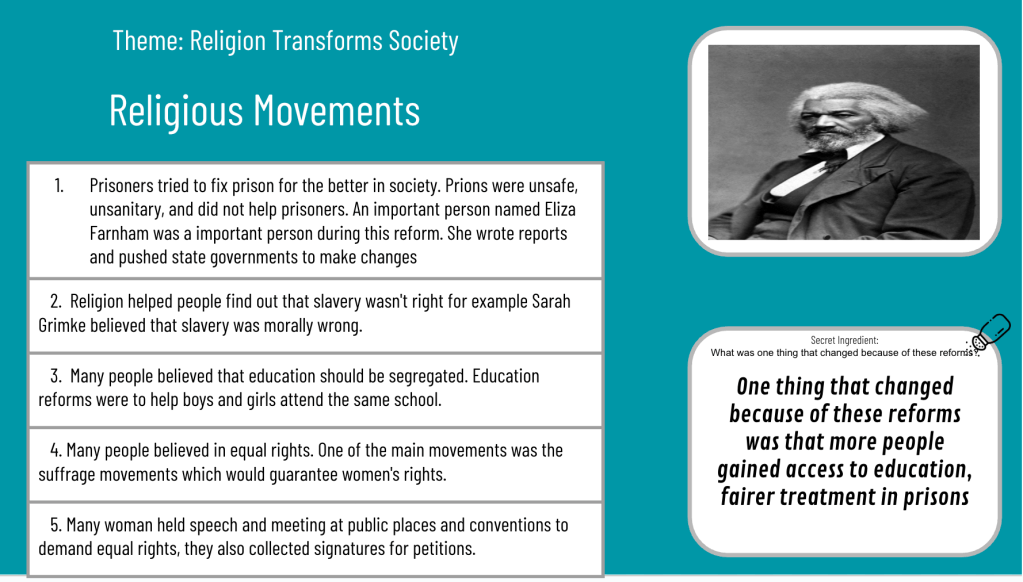
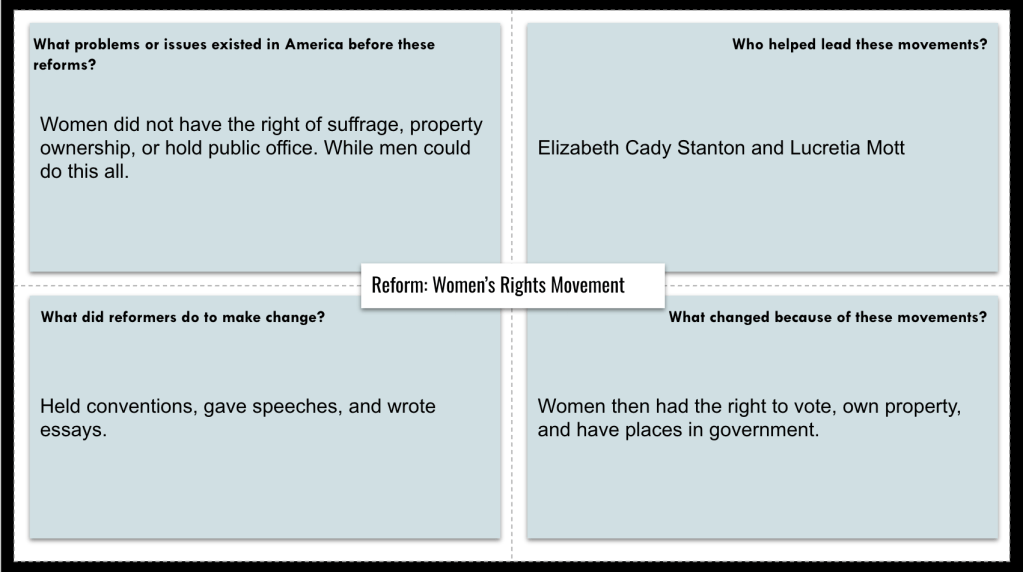
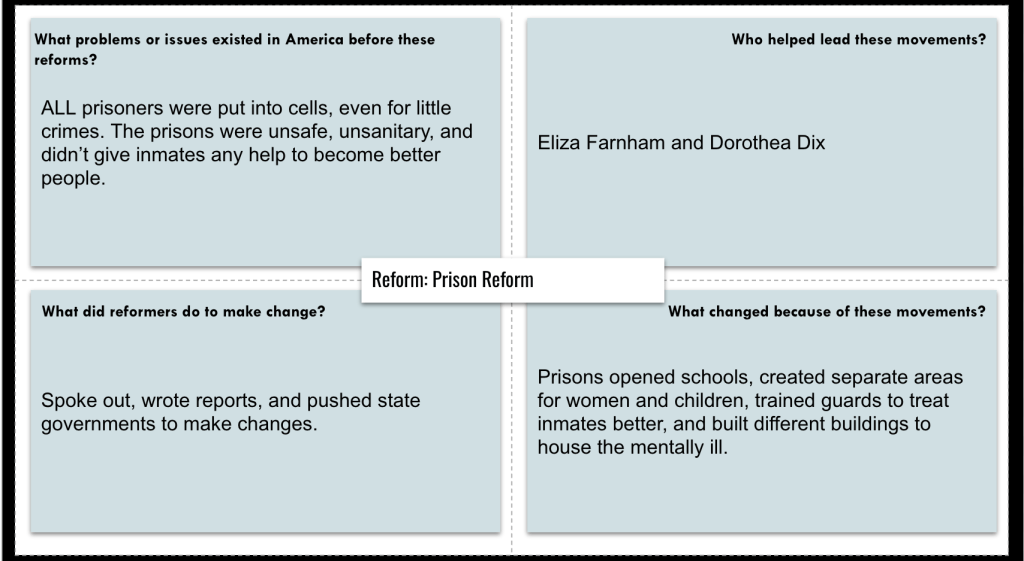
Reform Movement Frayers
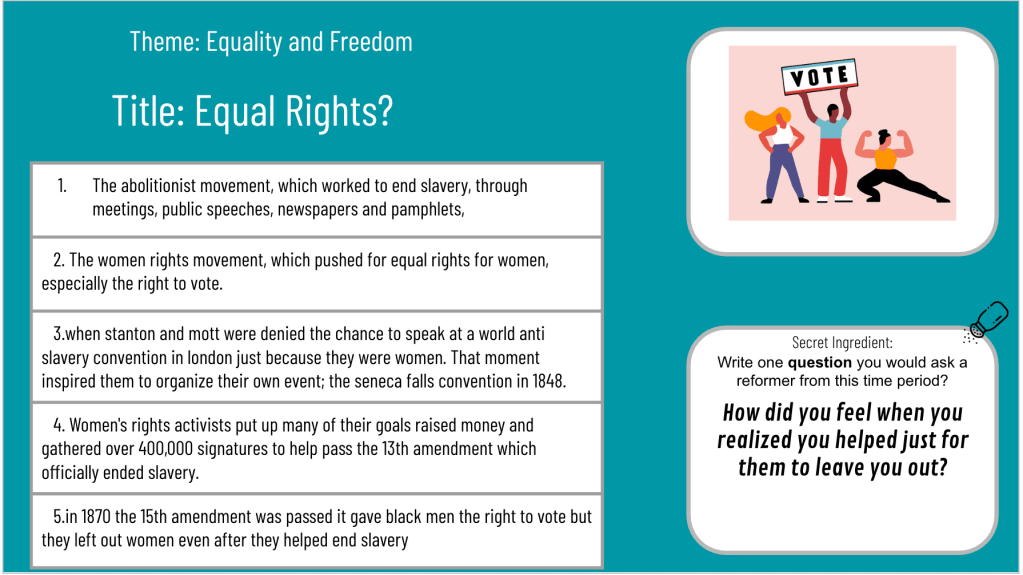
Then we jumped into four reform movements: education, prison, temperance, and women’s rights. I gave them one-page readings for each. They had to pick two and fill out a Frayer Model—with prompts like:
What were the problems before the reform?
Who was involved?
How did people push for change?
What changed?
It was all about giving them enough structure to make sense of what they read without overwhelming them.
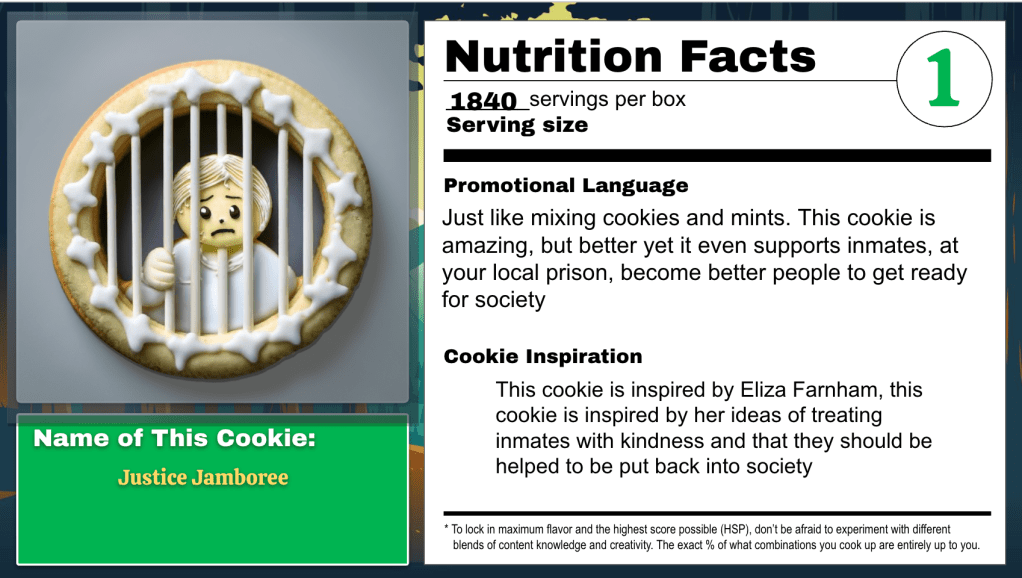
Designing a Reform Movement Cookie
The fun part came next. I had each student pick one reform movement and design a cookie that symbolized it—name, promotional language, and inspiration. Not because I think students should go into advertising, but because it gives them a creative outlet to synthesize what they’ve learned. I didn’t use a fancy template. I just gave them space and a task: connect what you learned to something that feels new and fun.
But I knew this would be a challenge. So I built a MagicSchool Idea Generator for them to use. That’s where the AI came in.
Some kids got it immediately. Others just hit “enter” and copied the first thing that popped up. That led to some awesome conversations about how to prompt AI and how to be more intentional with your thinking. One student said, “It said it couldn’t help me… then gave me a list anyway?” Welcome to AI. That’s how it works sometimes.
We talked about AI literacy without even planning to. We talked about responsible use. About editing. About pushing your thinking. It all came up naturally just by giving students a space to explore and test things out.
Why This Mattered
Some people might ask, “Why let kids use AI for something like this?” And honestly, this is exactly the kind of task where they should.
Because it’s not about copying. It’s about prompting, refining, questioning, and thinking through ideas in real time. These students are growing up in a world where AI isn’t going away. They need practice using it—not just to get an answer, but to develop a thought, build on it, and decide if it’s even worth using.
Watching students try to get the right response from the AI was the best part. Some had to reword their question three or four times before they got something useful. That’s the kind of persistence we want. That’s literacy—not just reading and writing, but digital reasoning, critical thinking, and adaptability.
It wasn’t perfect. But it was meaningful. And it was real.
Thursday
Thursday morning started with one of those classic curveballs—no Wi-Fi. Not ideal, but it forced me to think fast and strip things back to what mattered. I still wanted to build off the reform movement lesson from the day before, but I needed something fully offline that still had purpose.
I knew I wanted the lesson to focus on women’s rights—more specifically, the role suffrage played within that movement. So I kept it simple: what do I want students to understand by the end of class? I wrote that down—“Explain why suffrage was important to the women’s rights movement.”
First, I pulled a section from the textbook about the Seneca Falls Convention and the demands women were fighting for. Then I found a short, 4-minute History Channel video that gave the movement some faces and energy. I was able to play that from my desktop—no internet needed on the student end.
To process all of this, I created a Sketch and Tell-o with three textbook questions and a fourth space that asked: “Why was suffrage important to the women’s rights movement?”
But even as I was making the copies, I thought to myself—this feels basic. It felt like a worksheet. So I reframed the whole lesson with a challenge.
I started class with this statement: “Suffrage wasn’t that important to the women’s rights movement—it was just one of many demands.” Change my mind.
That one sentence shifted the tone. Suddenly they weren’t just answering questions—they were preparing a rebuttal. They watched the video, read the section, answered questions, and sketched visuals of what women were fighting for. And at the end, they had to change my mind.
It took some time to click. Some students didn’t totally get what I meant by “change my mind.” I ended up clarifying—I’m asking you to explain why voting was important. Convince me it wasn’t just another demand—it was the demand.
Once I shared an ideal response and modeled what a strong one might look like, the gears started turning. And honestly, the thinking that came out of it was way better than I expected for a no-tech day. The reframing really mattered.
We closed class with a quick Quizizz to check understanding of reform movements, suffrage, and the Seneca Falls Convention. Results were solid—and the engagement? Way better than if I’d just handed them a worksheet.
This morning started in chaos. The WiFi was down. I scrambled. I needed something fast, something engaging, something that didn’t rely on the internet—but still moved our learning forward.
I could’ve defaulted to a worksheet. Basic questions. Called it a day.
But that’s not really my style.
I knew today’s goal: students needed to be able to explain the importance of suffrage to the women’s rights movement. So I reframed the whole thing.
I found the textbook section on the Seneca Falls Convention. Pulled a quick video to provide a visual. And then we did a Sketch and Tell-o using three basic questions pulled from the reading. Nothing flashy. Just layered and intentional.
But here’s where the shift happened. Before anything else, I put this statement on the board:
“Suffrage wasn’t that important to the women’s rights movement—it was just one of many demands.” Change my mind.
I didn’t ask for answers. I didn’t ask for agreement or disagreement. I just planted the idea to frame the entire lesson.
Reframing like this shifts the role of the student. They’re no longer just receivers of information. They’re investigators. They’re critics. They’re thinking, “How can I change Moler’s mind?”” It forces them to process the content with a lens—to notice not just what’s said, but what’s emphasized, what’s missing, and why it matters.
By the time we got to the end of class, they weren’t just summarizing facts. They were defending ideas. They were deciding how important suffrage really was—based on what they had just read, watched, and sketched.
It’s the same content. The same objective. But the task changes the thinking. That’s the power of reframing. And it didn’t require anything fancy.









 Moler's Musings