The Week That Was In 505

First week back from Spring Break. A new unit began – The Industrial Revolution. In past years, I asked the question, “To what extent was the Industrial Revolution beneficial for people?” In the old unit, I would focus on new inventions, Lowell Mills, cotton production, etc. It just felt like it was isolated, and no context.

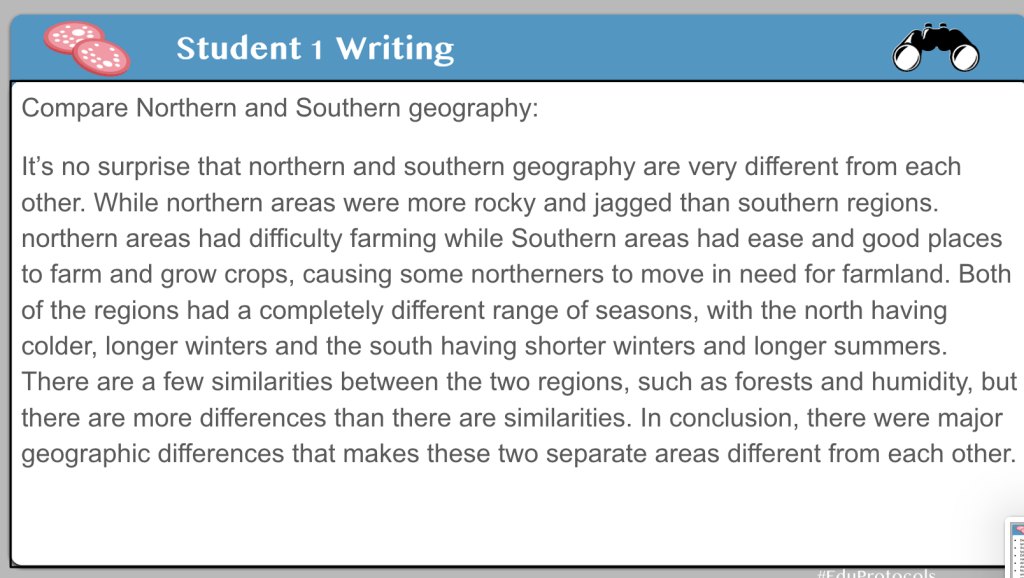
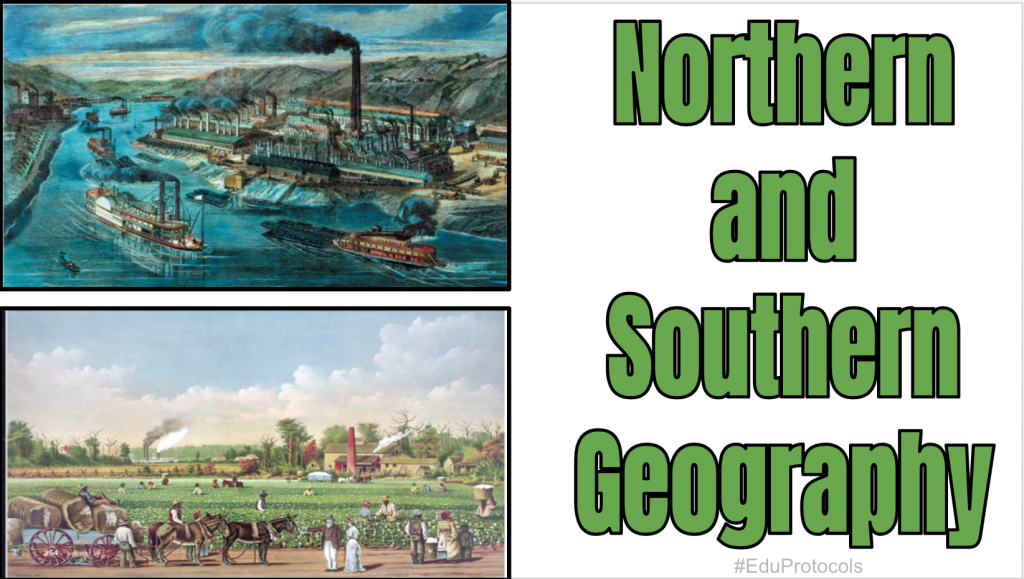
This year, I decided to focus on the differences in North and South based on the Industrial Revolution. We focused on geography, economy, and transportation. I wanted to go this route because it provided context and would eventually set us up for the Civil War unit afterwards.

Monday – Industrial Revolution – whirlygigs (Mr. Roughton lesson)

Tuesday – Fast and Curious, CyberSandwich

Wednesday and Thursday – Station Rotation, Fast and Curious

Friday – Thick Slide, Annotated Map Directions, Annotated Map

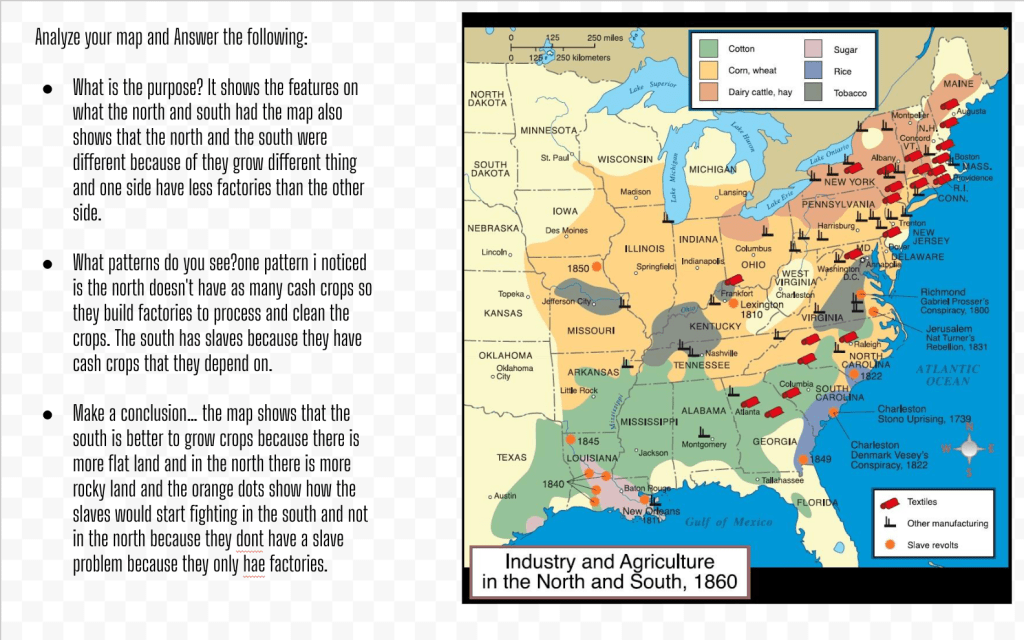
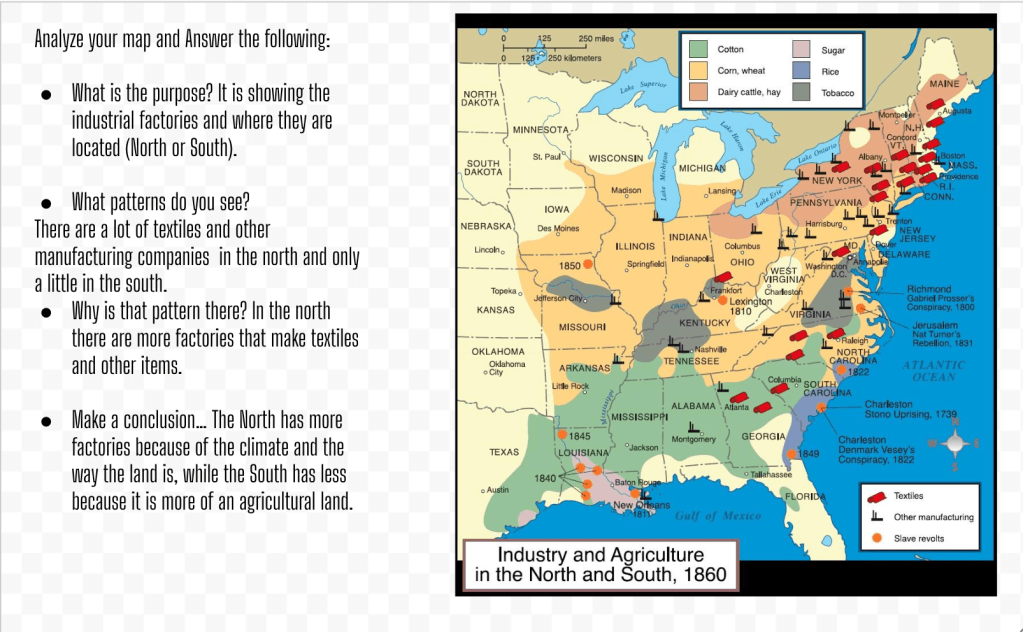
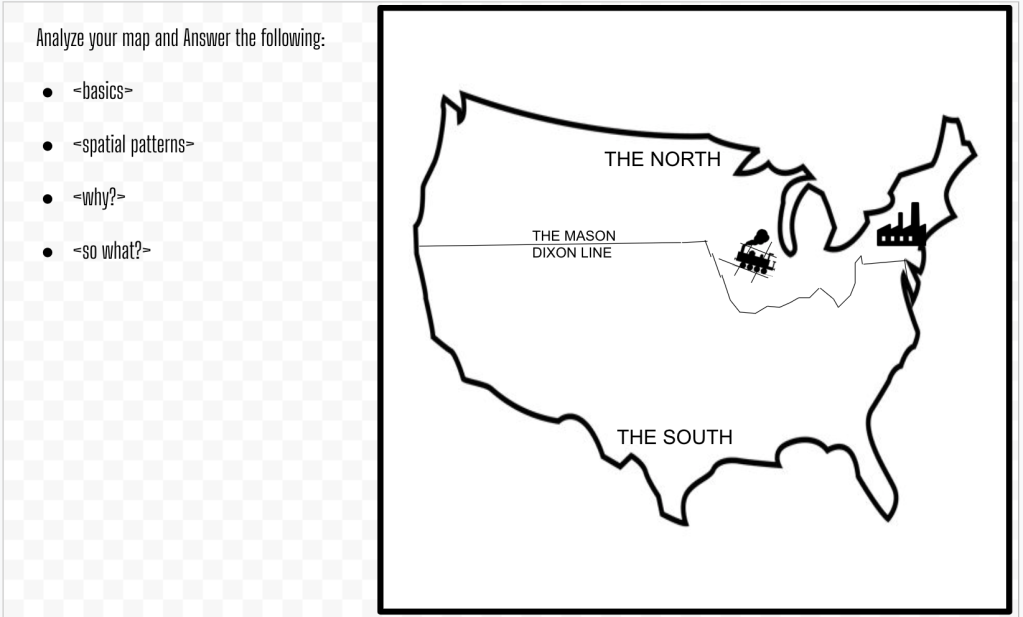
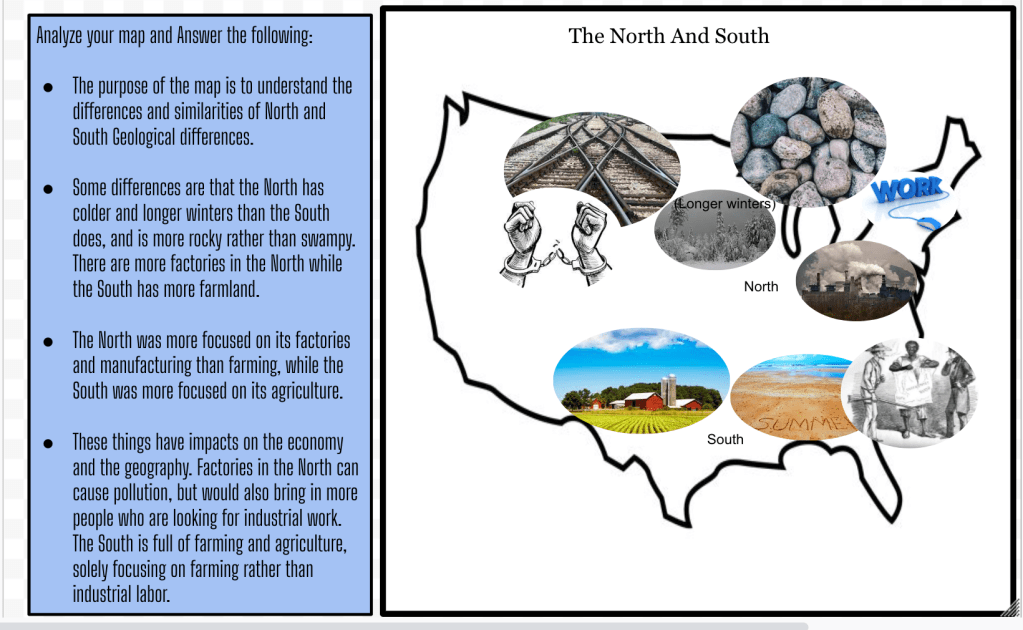
The end goal of the unit for students is having them understand how the Industrial Revolution impacted northern and southern states differently. The end assessment is an annotated map where students create symbols highlighting the differences and analyzing their maps.

Monday

This was the first day back from Spring Break. I needed something uplifting. I needed a hook to get the students into the Industrial Revolution. Then I suddenly remembered a lesson I saw on Mr. Roughton’s Website – it was a lesson where students experienced the transition from the Cottage Industry to Factory life making whirlygigs. This lesson is engaging and helps the students understand that some people made things in their homes; we didn’t always have factories.

For this lesson, I found some old paper (It’s a paper waster). Before we began, I showed the students a whirlygig and how it twirls around when dropped in the airs. For the first round, I didn’t give any instructions on how to make it. I didn’t give students any tools. They were frustrated as they tried to figure it out. After 5 minutes, I had them record their feelings and the number of functional whirlygigs they created.

The next round, I actually gave instructions, rulers, and scissors (but no paper clips). Students had 5 minutes to work independently to make as many whirlygigs as possible. At the end of time, I had them record the number of functional whirlygigs they created. I also had them record their feelings during this round. The big idea I pointed out during this round was some whirlygigs were better than others due to various reasons: we understood the directions differently and some had better tools than others. Lastly, I asked the students, “What would make this better?” They thought and thought and finally someone said, “If we got into groups, we could each specialize in something.” Lightbulb moment.

The third round, I had students get into groups. Each students specialized in creating some part of the whirlygig. Someone cut rectangles, someone cut a slit down the middle, someone folded the edges, and someone added a paper clip. This time the whirlygigs were similar, functional, and I brought up the idea of interchangeable parts with the paper clip.

This lesson idea is awesome and super engaging. It was a great way to introduce the Industrial Revolution and a great way to kick off the week the first day back from Spring Break.

Tuesday

Tuesday I got into the first main part of the lesson – the differences in geography between Northern and Southern states. Here is my initial lesson set up…

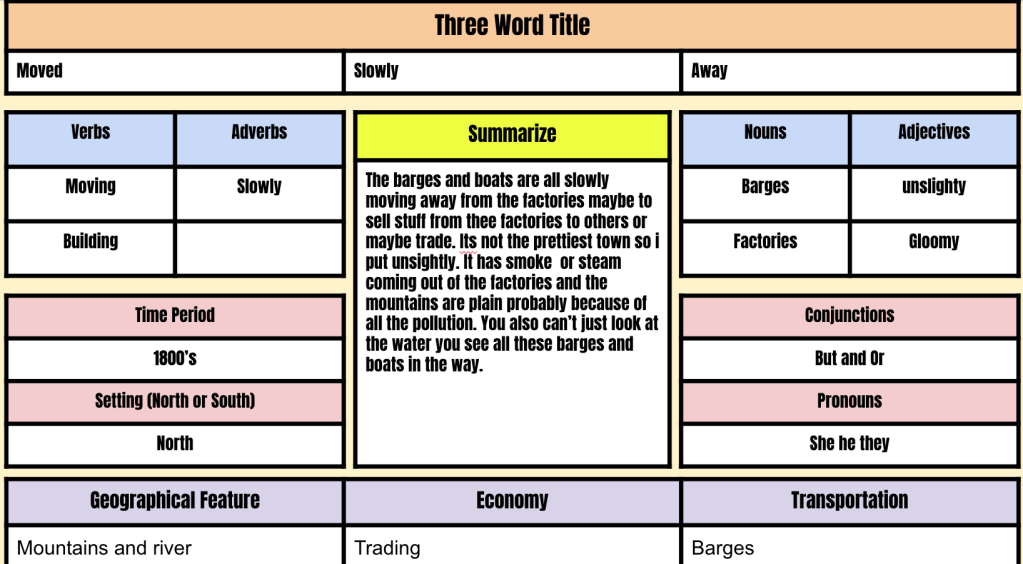
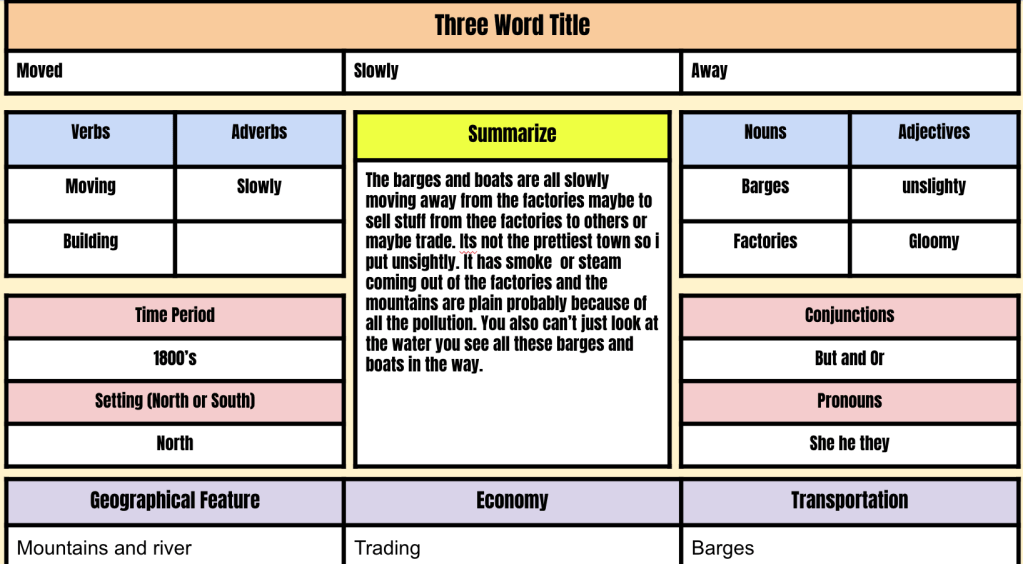
  1. Begin with an 8parts – I wanted the students to choose an image representing the North or the South. Students gave it a 3 word title, focused on nouns, adjectives, verbs, and adverbs. They would also list out an example of geography, economics, and transportation.Students finished the 8parts by writing a descriptive paragraph about the image.
  2. Transition to a Quizizz – the Quizizz had 12 questions, 5 vocabulary words and 7 questions related to Geography. If students did well with vocabulary that meant I didn’t have to waste time doing vocabulary activities.
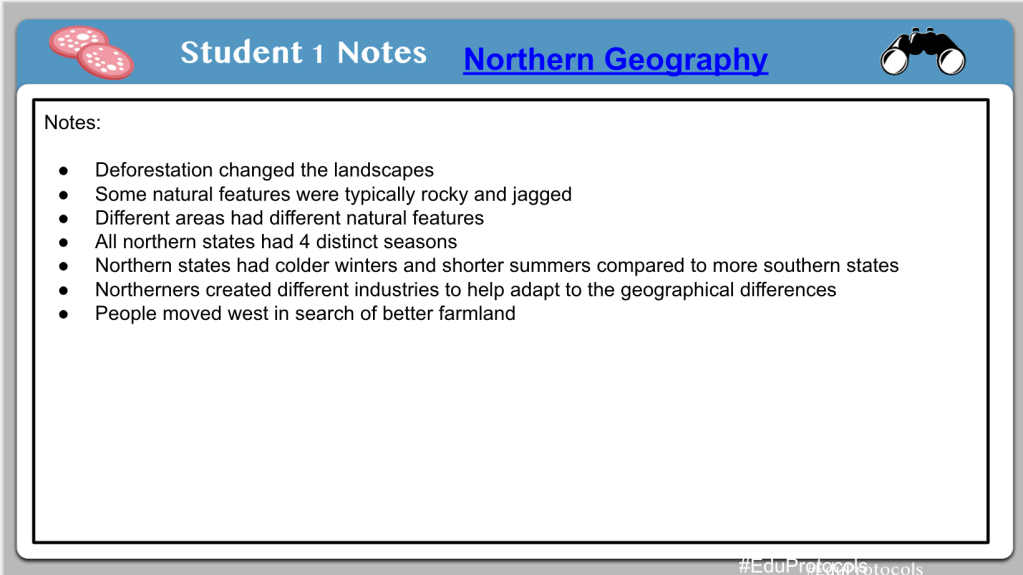
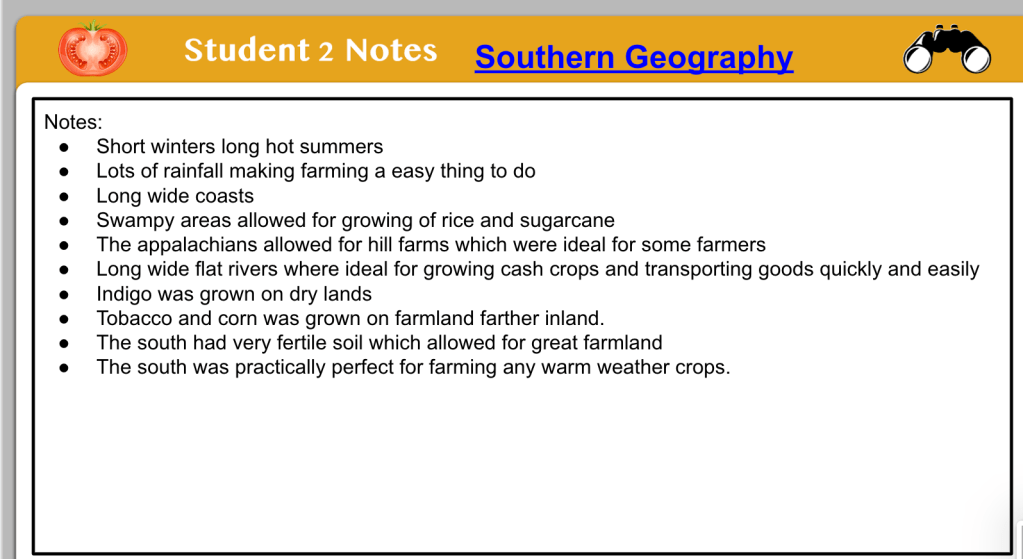
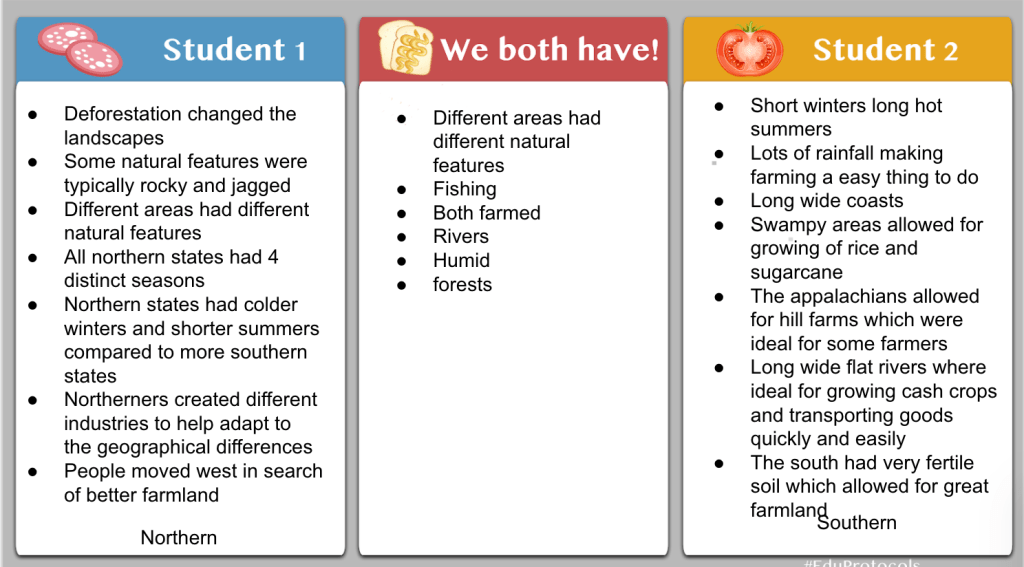
  3. CyberSandwich – The CyberSandwich would be a 10 minute read and note take, 5 minute discuss, and a 10 minute summary. One students would read about northern geography and their partner would read about southern geography.

This plan would change throughout the day…

8Parts

I began the day with this period and took a chance with the 8Parts. I broke a golden rule and used the 8Parts for the first time this year with actual content. I should have known better. It’s interesting, though, because students that had me last year did an excellent job with this activity. However, I didn’t like some of the results and the 8Parts took entirely too long. Again, I should have known better – low cognitive load to begin and more reps!!

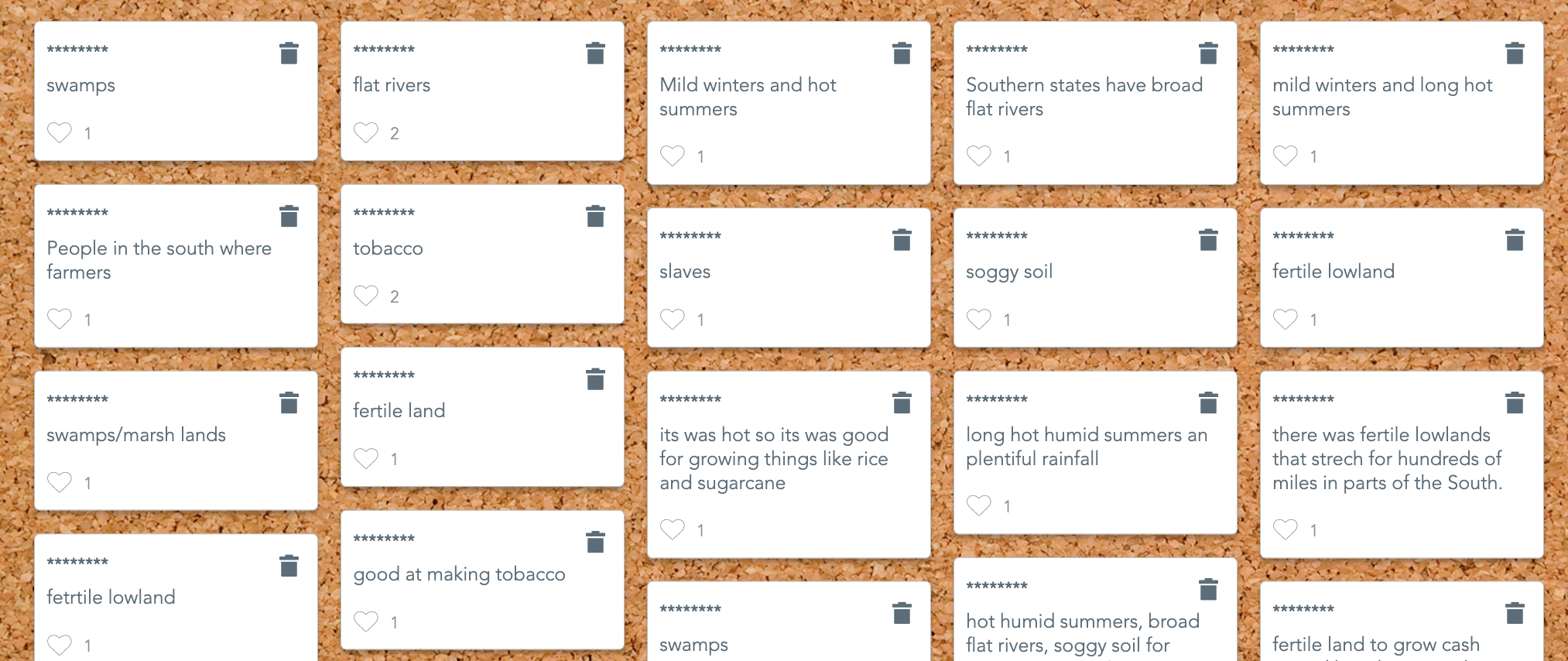
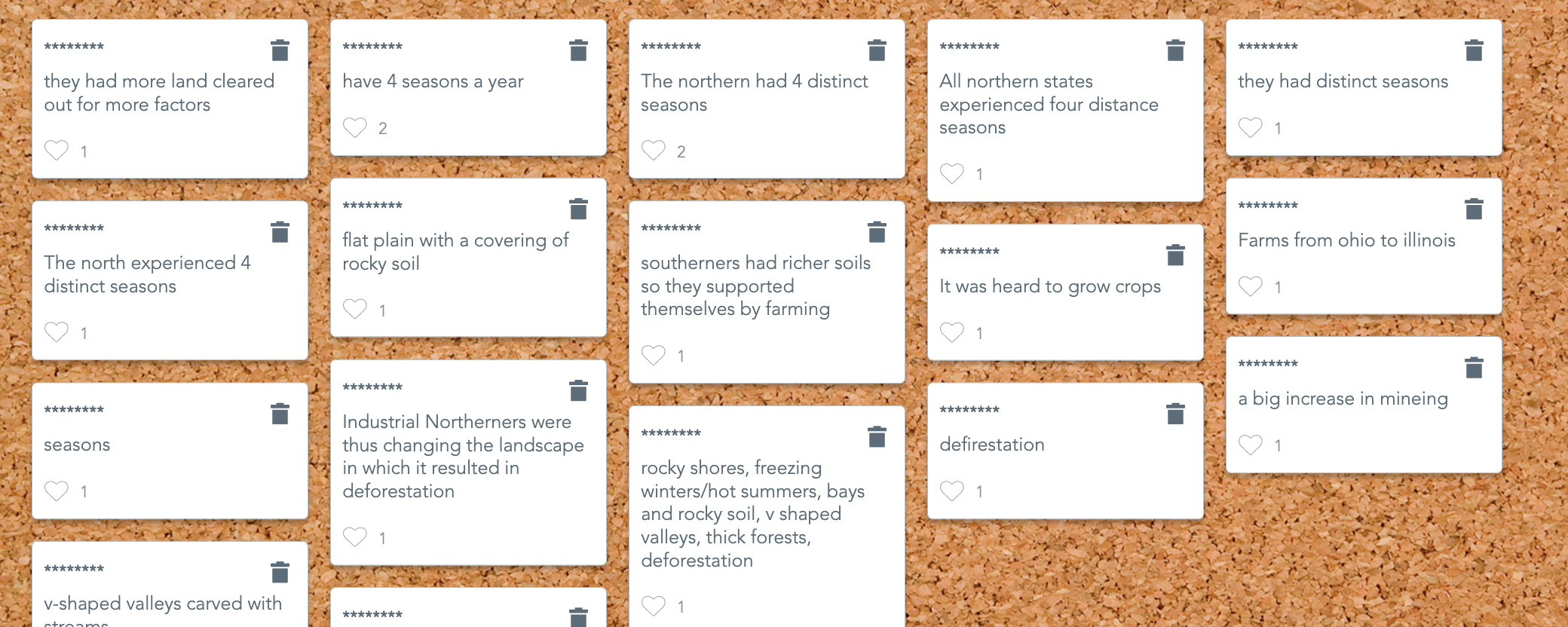
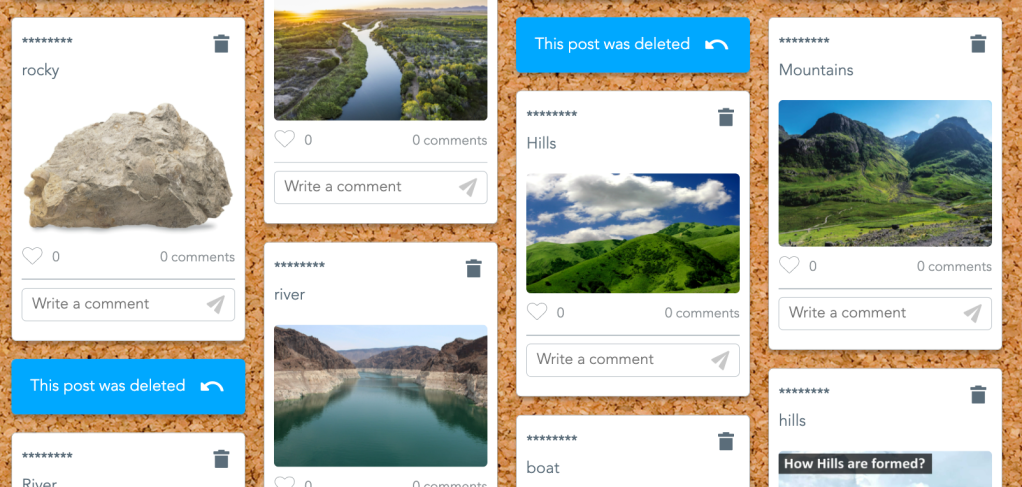
I decided that I needed something simpler and quicker. As a result, I switched this to a Thin Slide. However, the Thin Slide was done with a NearPod Collaborative Board. I uploaded the same images and gave students 3 minutes to share one word and one picture of a geographical feature they observed. This proved to be more effective as we looked for similarities in the posts…thank goodness for the Thin Slide in my toolbox. Plus, the setup on Nearpod was super easy!

Quizizz – Fast and Curious

The Quizizz I put together had 12 questions – 7 questions related to geography and 5 related to vocabulary. I included vocabulary questions to see how the students would do. The class average on vocabulary questions was 90% or higher across all classes. The class averages on geography questions was 40% or lower across all classes.

The goal was to run the Quizizz twice before the end of class. Here were the class averages the first time taking the Quizizz – 62%, 57%, 49%, 40%, 33%. After completing the CyberSandwich, the class averages were: 82%, 86%, 89%, 79%, 77%. This was a significant jump and shows the power of the Fast and Curious reps.
CyberSandwich

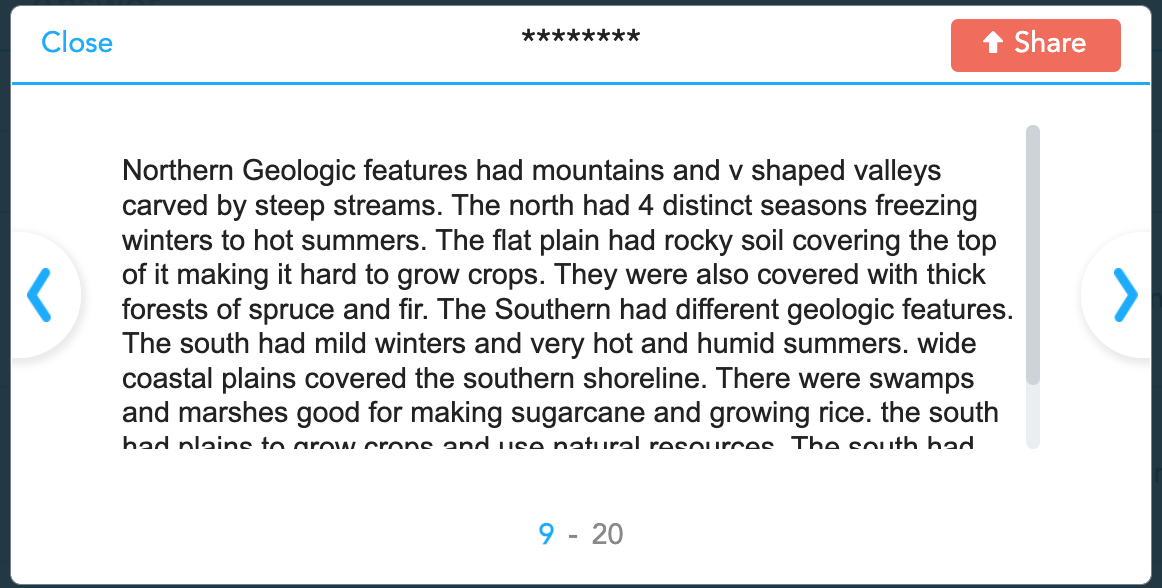
The CyberSandwich evolved throughout the day. We began the day with a completely digital CyberSandwich using Google Slides. One student read about northern geography and their partner read about southern geography. I felt bad that I didn’t have paper copies of the reading available of a physical copy of a note taking sheet. I try to have these things available for students. For 4th period and beyond, I had the copies available.

By the time 7th period rolled around, I had to switch up the CyberSandwich. This class is made up of 50% or more of students with an IEP and it’s tough for me to get around to everyone. With this class differentiation and UDL is a must. As a result, I created a CyberSandwich on Nearpod.

The Nearpod adaptation was such a great mixup!! I shared my Nearpod link and gave every student a Venn Diagram on paper and had them takes notes. I also had physical copies of the readings as well. There’s no doubt if I left the CyberSandwich as a Google Slide, it would not have gone as smoothly. I set up my Nearpod like this:

1st slide – I can statements.

2nd slide – Thin Slide with a Drawing Slide

3rd slide – Thin Slide with a Drawing Slide

4th slide – Read about Northern Geography – takes 4-5 notes.

5th slide – Collaborative Board – share 1-2 important notes you wrote

6th slide – Read about Southern Geography – takes 4-5 notes.

7th slide – Collaborative Board – share 1-2 important notes you wrote

8th slide – type a summary, write a summary on paper, or record audio of your summary.

All in all, it was cool how this lesson evolved throughout the day. My goal is to strive for better for my students and myself on a daily basis. Switching the CyberSandwich to a Nearpod was a huge move that proved to be effective for my 7th period students.

Wednesday and Thursday

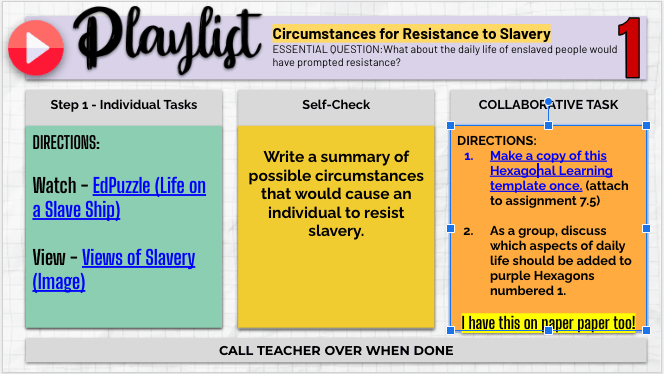
For Wednesday, I was going to roll with another CyberSandwich. As usual, my mind changed and I wanted to try something different. I created a station rotation model that was to be completed in 2 days. The station rotation was set up on an interactive image made created with Genial.ly. When I created this set up, it was intentionally done with these options:

  1. EdPuzzle – Lowell Mills and the women of Lowell Mills (watch).
  2. Listenwise – NPR Podcast and the negative effects of the Industrial Revolution (listen).
  3. CyberSandwich – read about the Northern/Southern economies, discuss, and summarize.
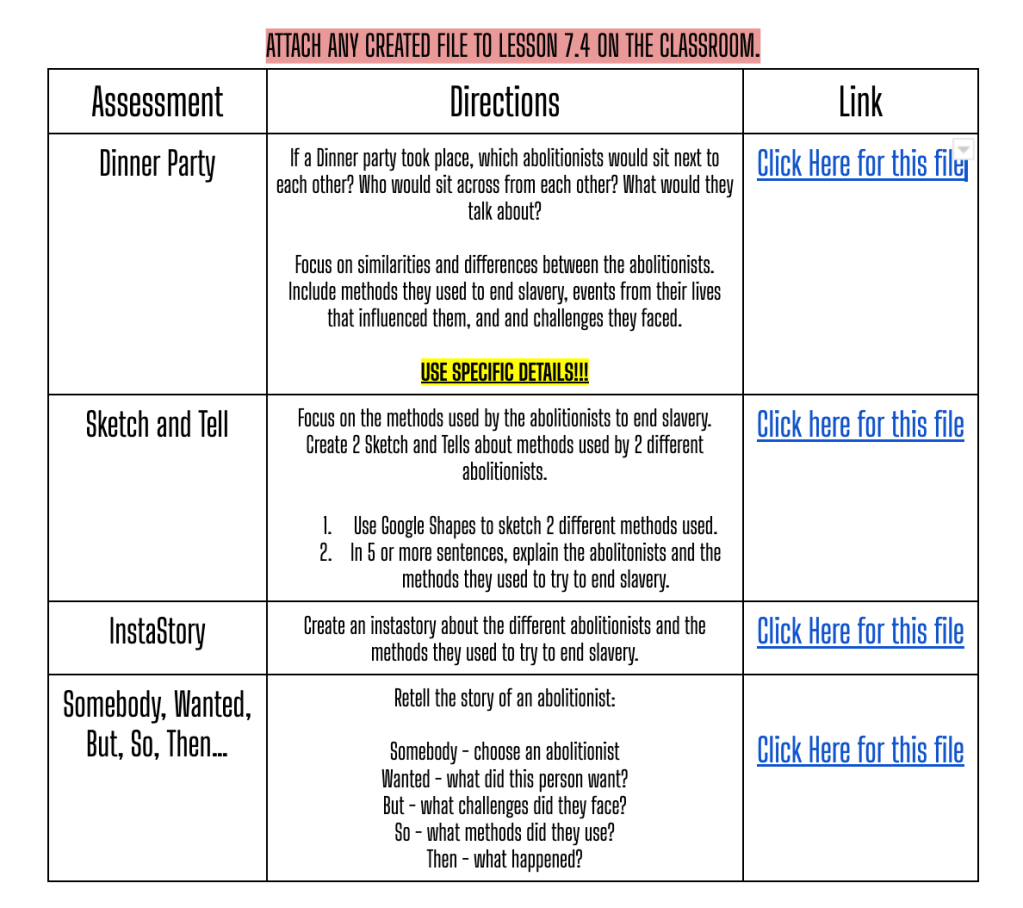
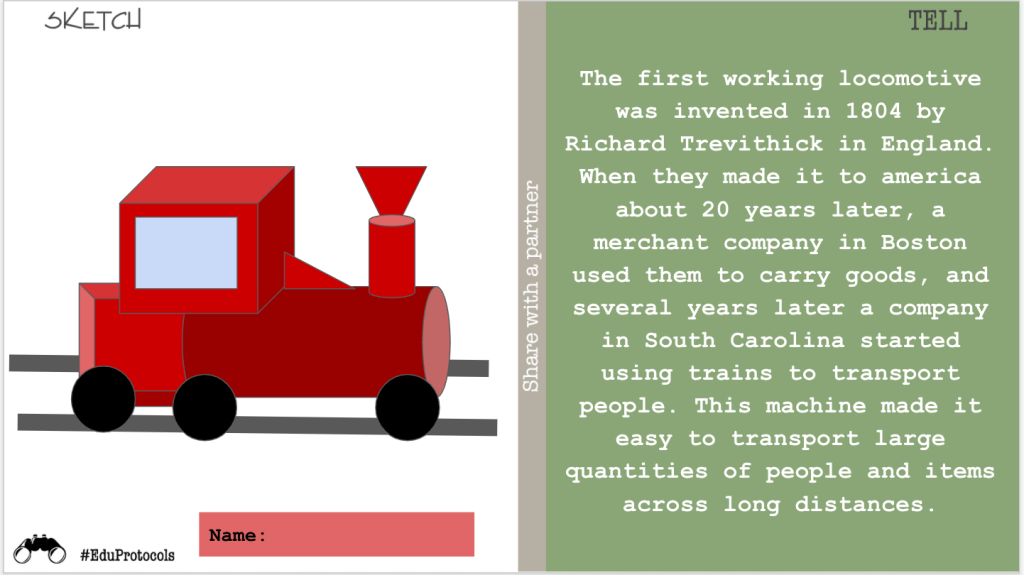
  4. Sketch and Tell – Research an invention that was invented between 1790-1840 and summarize your findings.
  5. Card Sort – get the paper bag and sort pictures into Northern or Southern categories.

Within these lessons, I provide accommodations and modifications as necessary. For example, if a students didn’t want to do a CyberSandwich with a partner, I had them read about the northern economy and I would share notes I created. Then we discussed the information together. In some cases for the written summary, I provided sentence starters for students. I also showed students how to use voice typing for a summary. As usual, I offered physical copies of the CyberSandwich and the readings. With any lesson or activity, my special education background kicks in for all students. All in all, the station rotation model was engaging and I had 80% of students complete all 5 stations.

Friday

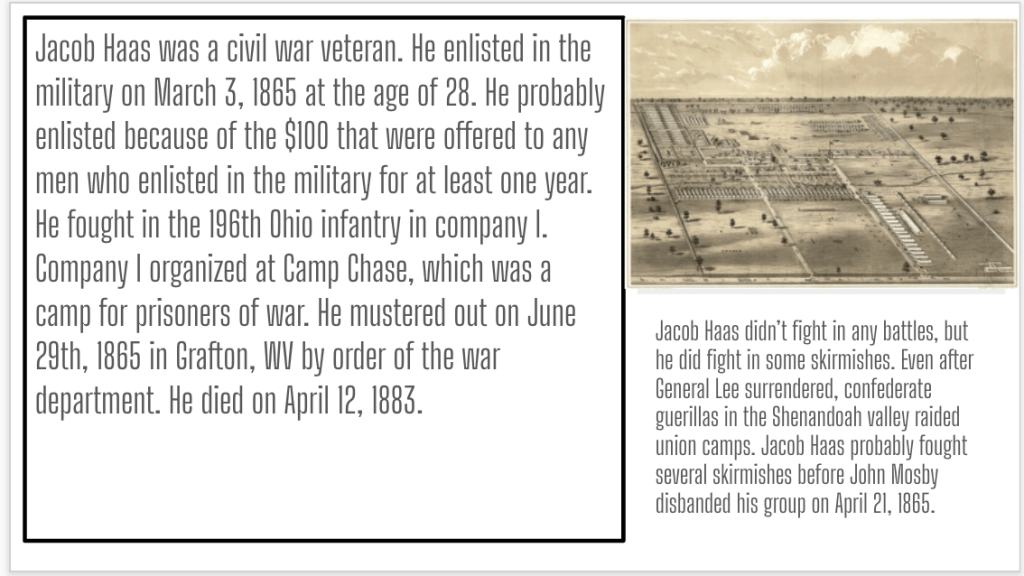
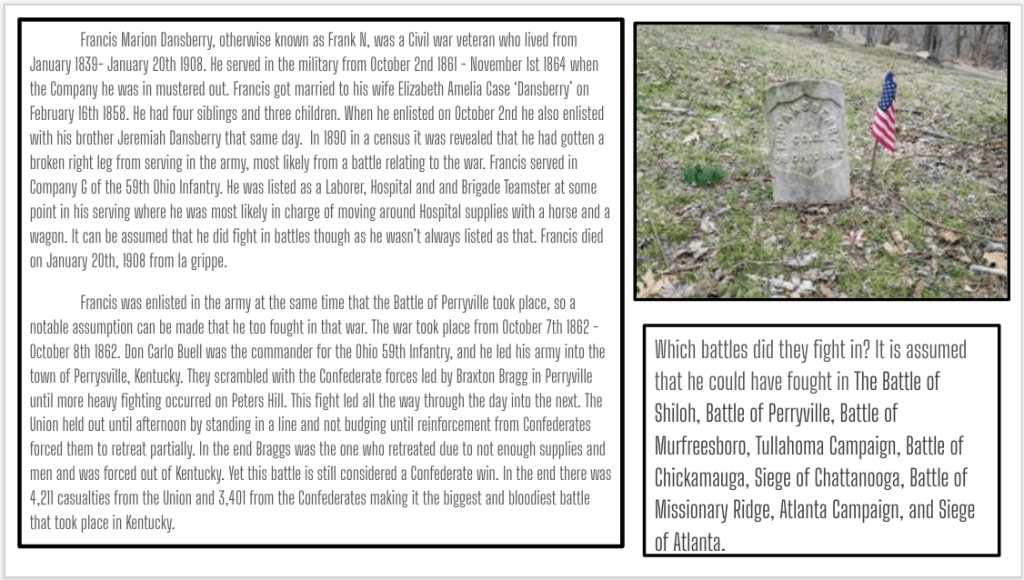
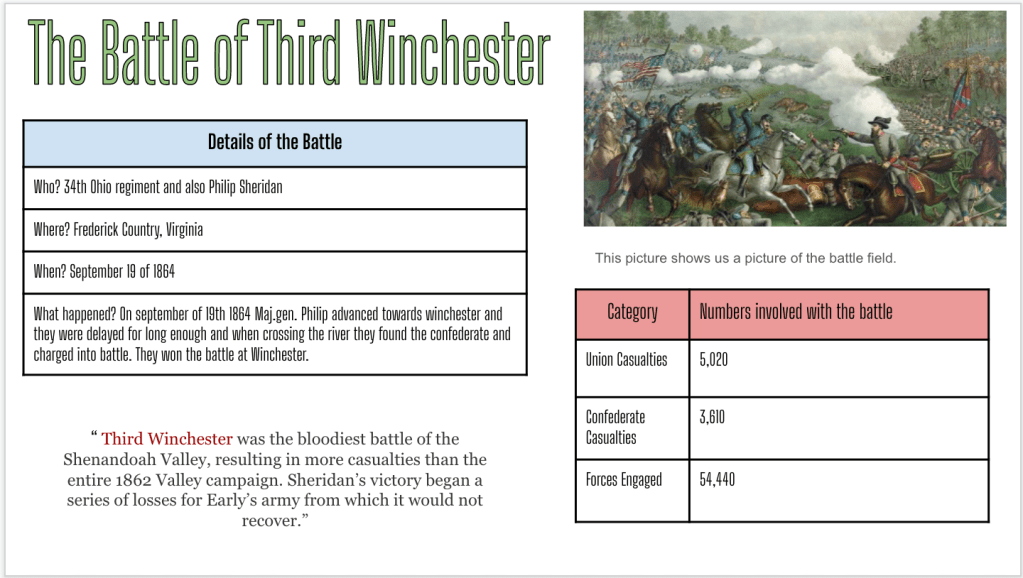
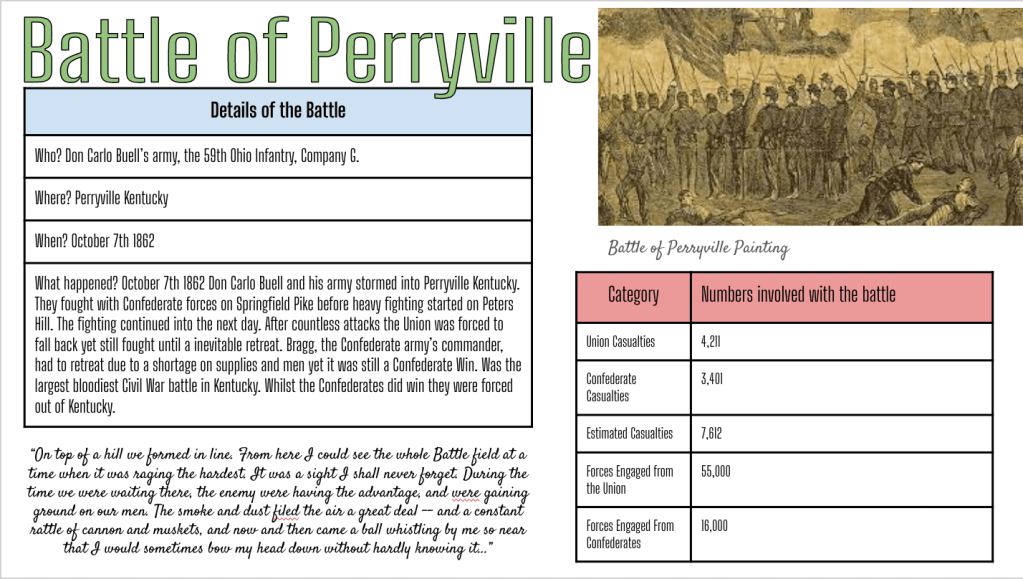
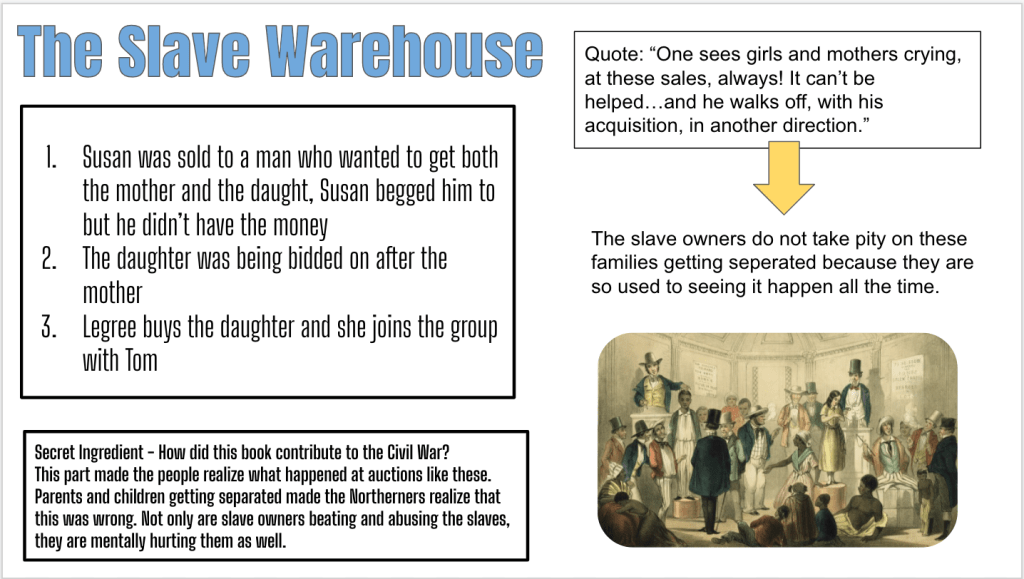
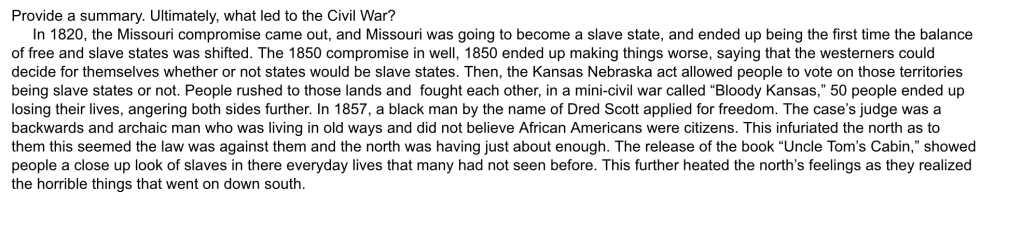
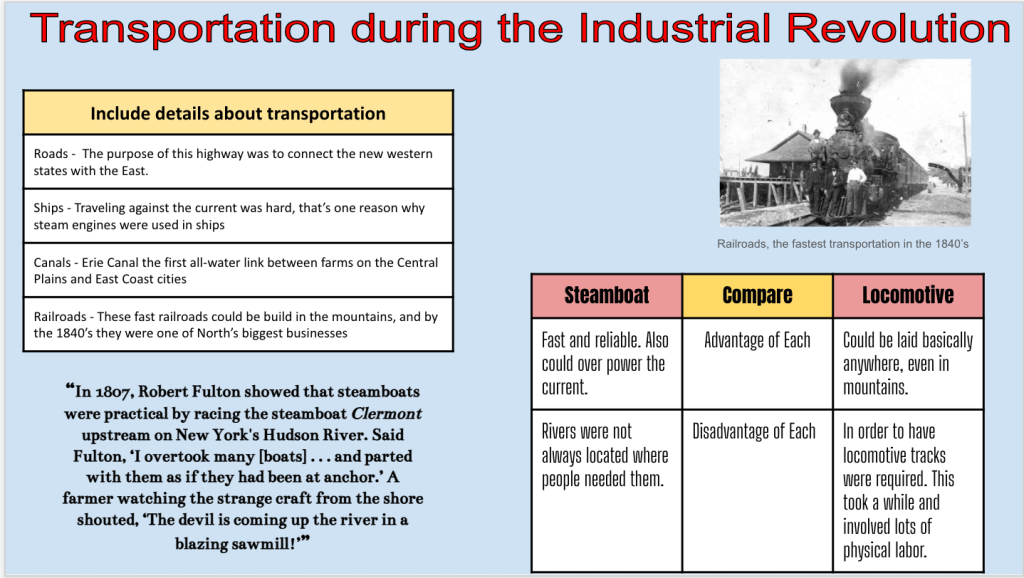
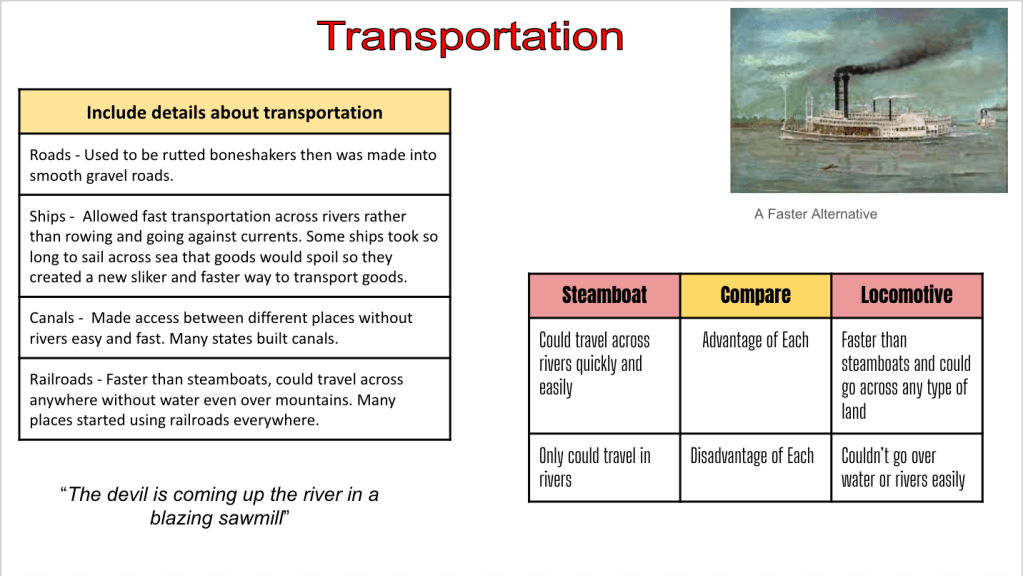
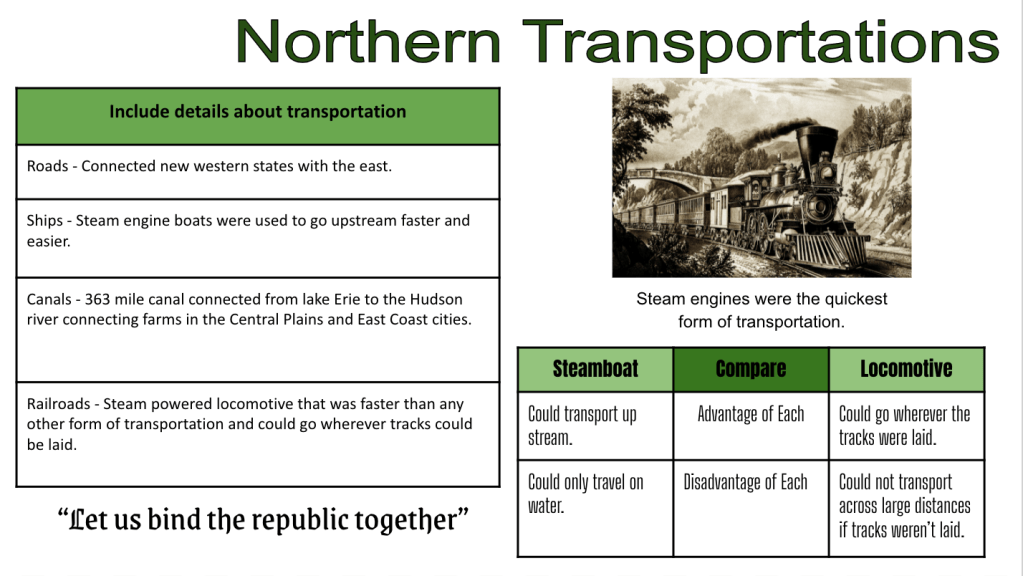
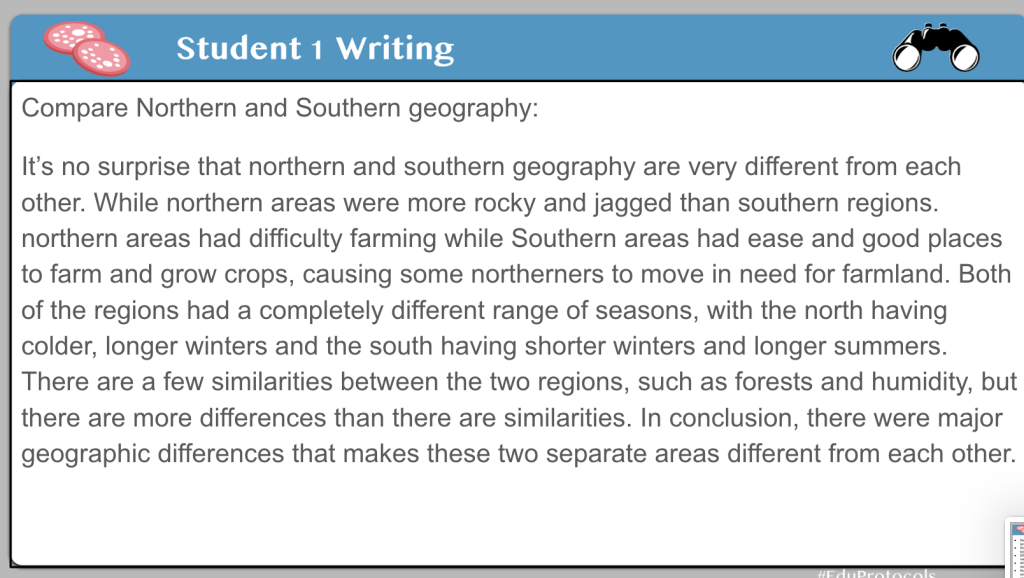
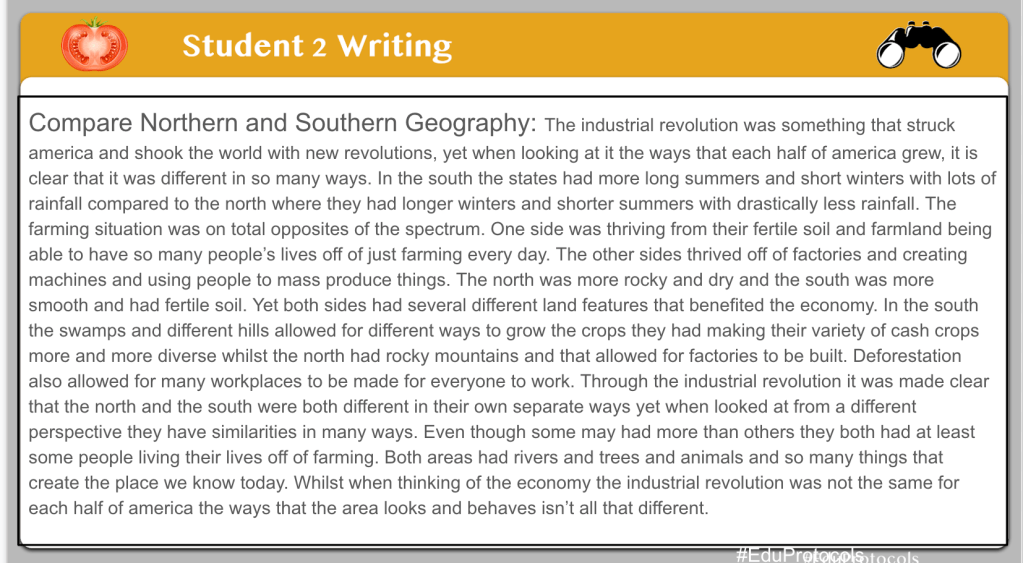
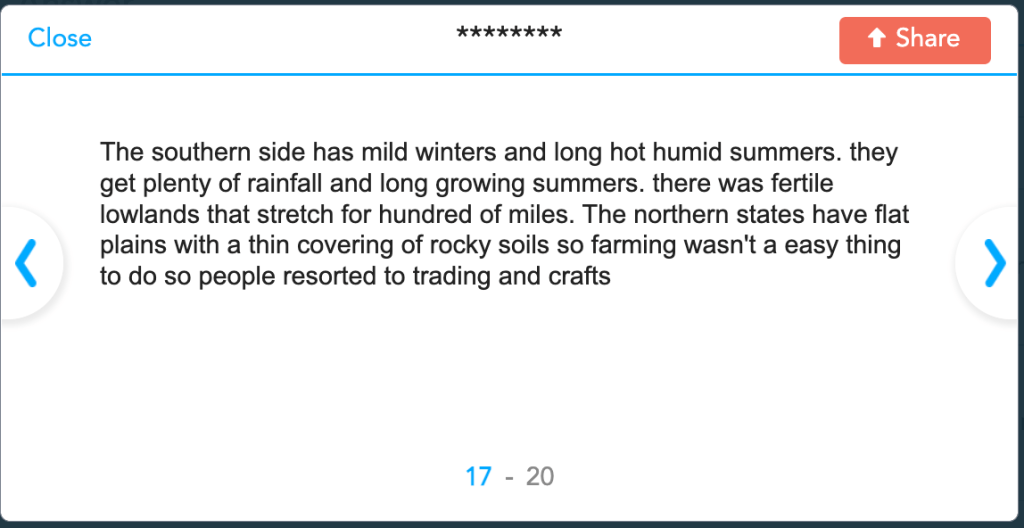
Friday was used to cover changes to transportation in the North. Students created a Thick Slide about railroads, canals, and steamboats. I gave students 20 minutes to read and design their slide. This is the 4th or 5th Thick Slide we have done, and they are getting so much better. Plus, the students love creating their slide. Reps are important!! Here are some student samples:

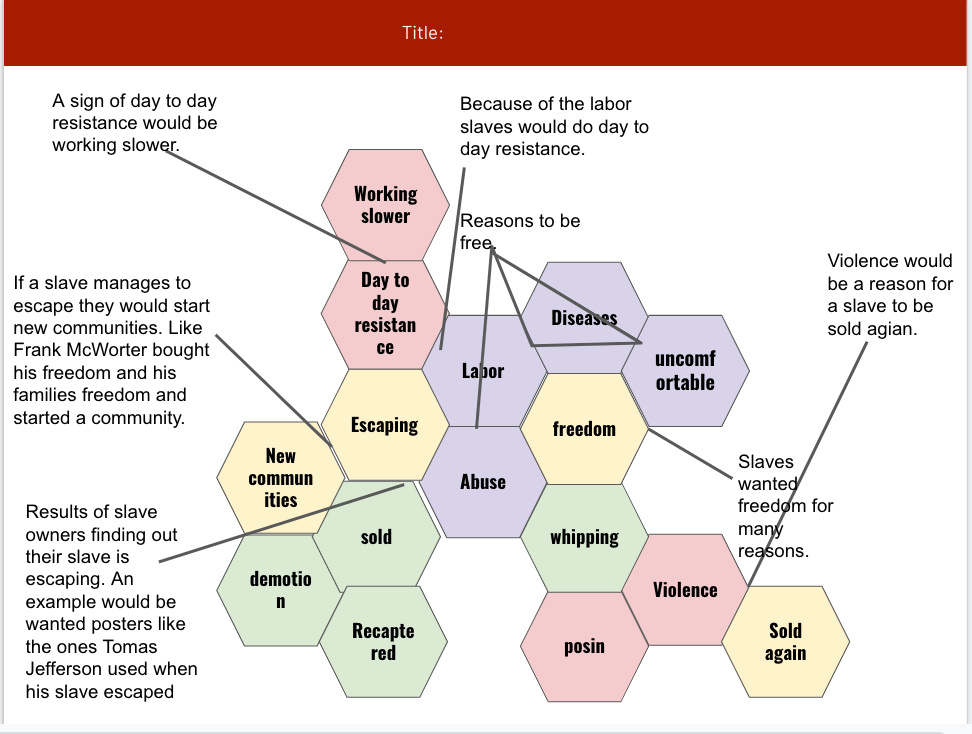
Through the week I kept emphasizing the CyberSandwiches and Thick Slide served a purpose. The students would look back on the information to help them create an annotated map. Here is the start to one of the maps:

My Final Thought

Earlier in the week I visited another class and walked the students through a Thick Slide. The students could choose a section to read for their slide. The slide had students writing details about the topic, copying a quote, adding a relevant picture, picture cation, and they explained a vocabulary term. I showed some examples and then gave them 20 minutes.

Near the end the states to me, “How do I know they’re done? What if they aren’t adding a caption? I’m going to have to take 10-15 minutes to go over this so they have everything they need.”

I replied, “It’s okay. They’re fine.”

She replied, “How do you know? Some of these kids aren’t going to have a caption or a quote. I come from a generation where I did everything asked of me.”

I replied, “I’m 38 with a masters degree. You have a masters degree. They’re in 6th grade. I come from a different generation, and I would have everything required of me too. There are people from all generations that don’t do everything required of them. It’s okay. You’re working too hard.”

Then I proceeded to use something I learned from Kim Voge at Spring CUE. I had all the students partner up and then I had them state one “glow” and one “grow” for their Thick Slides. Students gave each other feedback and they proceeded to correct the thing they didn’t have.

I don’t know where this distrust of students came from? To me it’s a self-fulfilling prophecy – if you expect them not to do things, then you will treat them as such, and that creates a negative situation for everyone involved. Kids are remarkable people and will rise to the occasion. We were blown away by their feedback and corrections and it took about 5 minutes. Trust students. Give them opportunities to speak with each other.

A Lesson Evolving – My 100th Post

This is my 100th overall post on this site since I created it about 4 years ago. I started this blog as a way to reflect on my teaching and lesson designing. This particular post is a reflection for my new unit on the Industrial Revolution in relationship to Northern and Southern states.

I have the unit set up for students to learn about the Northern and Southern region differences from 3 perspectives geographical perspective, economic perspective, and transportation perspective. Ultimately, students need to understand how geography contributed to the types of jobs and economies of each region, they need to understand how the Industrial Revolution impacted the North versus the South, and they need to understand why the North had different means of transportation from the South.

I’m writing this post to share my thought process on a daily basis with my lessons. For me it’s an ongoing reflective process throughout the day. Here was my initial plan:

  1. Begin with an 8parts – I wanted the students to choose an image representing the North or the South. Students gave it a 3 word title, focused on nouns, adjectives, verbs, and adverbs. They would also list out an example of geography, economics, and transportation.Students finished the 8parts by writing a descriptive paragraph about the image.
  2. Transition to a Quizizz – the Quizizz had 12 questions, 5 vocabulary words and 7 questions related to Geography. If students did well with vocabulary that meant I didn’t have to waste time doing vocabulary activities.
  3. CyberSandwich – The CyberSandwich would be a 10 minute read and note take, 5 minute discuss, and a 10 minute summary. One students would read about northern geography and their partner would read about southern geography.

This plan would change throughout the day…

8Parts

I began the day with this period and took a chance with the 8Parts. I broke a golden rule and used the 8Parts for the first time this year with actual content. I should have known better. It’s interesting, though, because students that had me last year did an excellent job with this activity. However, I didn’t like some of the results and the 8Parts took entirely too long. Again, I should have known better – low cognitive load to begin and more reps!!

I decided that I needed something simpler and quicker. As a result, I switched this to a Thin Slide. However, the Thin Slide was done with a NearPod Collaborative Board. I uploaded the same images and gave students 3 minutes to share one word and one picture of a geographical feature they observed. This proved to be more effective as we looked for similarities in the posts…thank goodness for the Thin Slide in my toolbox. Plus, the setup on Nearpod was super easy!

Quizizz – Fast and Curious

The Quizizz I put together had 12 questions – 7 questions related to geography and 5 related to vocabulary. I included vocabulary questions to see how the students would do. The class average on vocabulary questions was 90% or higher across all classes. The class averages on geography questions was 40% or lower across all classes.

The goal was to run the Quizizz twice before the end of class. Here were the class averages the first time taking the Quizizz – 62%, 57%, 49%, 40%, 33%. After completing the CyberSandwich, the class averages were: 82%, 86%, 89%, 79%, 77%. This was a significant jump and shows the power of the Fast and Curious reps.
CyberSandwich

The CyberSandwich evolved throughout the day. We began the day with a completely digital CyberSandwich using Google Slides. One student read about northern geography and their partner read about southern geography. I felt bad that I didn’t have paper copies of the reading available of a physical copy of a note taking sheet. I try to have these things available for students. For 4th period and beyond, I had the copies available.

By the time 7th period rolled around, I had to switch up the CyberSandwich. This class is made up of 50% or more of students with an IEP and it’s tough for me to get around to everyone. With this class differentiation and UDL is a must. As a result, I created a CyberSandwich on Nearpod.

The Nearpod adaptation was such a great mixup!! I shared my Nearpod link and gave every student a Venn Diagram on paper and had them takes notes. I also had physical copies of the readings as well. There’s no doubt if I left the CyberSandwich as a Google Slide, it would not have gone as smoothly. I set up my Nearpod like this:

1st slide – I can statements.

2nd slide – Thin Slide with a Drawing Slide

3rd slide – Thin Slide with a Drawing Slide

4th slide – Read about Northern Geography – takes 4-5 notes.

5th slide – Collaborative Board – share 1-2 important notes you wrote

6th slide – Read about Southern Geography – takes 4-5 notes.

7th slide – Collaborative Board – share 1-2 important notes you wrote

8th slide – type a summary, write a summary on paper, or record audio of your summary.

All in all, it was cool how this lesson evolved throughout the day. My goal is to strive for better for my students and myself on a daily basis. Switching the CyberSandwich to a Nearpod was a huge move that proved to be effective for my 7th period students.

The Weekend That Was Not In 505

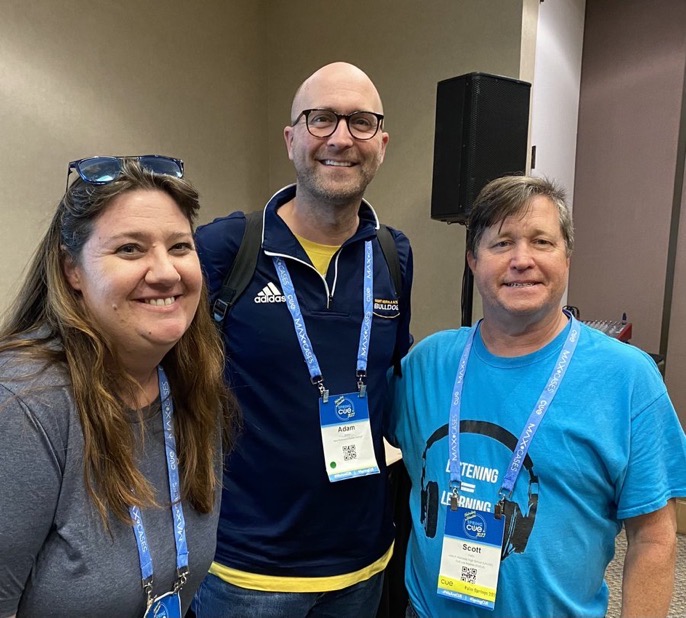
This past weekend two awesome events happened:  my school started Spring Break and I spent my time at the Spring CUE conference in Palm Springs, California. At the conclusion of the conference, Jon Corippo asked me a simple question, “What was your biggest take away?” I replied, “The people.” 

I feel like I live 3 lives on a daily basis. My family life. My tennis life. My Education life. When I my education life – I refer to New Richmond, Twitter world, EduProtocols. Spring CUE gave me a chance to meet my Twitter/EduProtocol friends in person. The magic of social media made me feel like I have known these people for a long time. 

While in California I experienced great conversations, new learning experiences, connecting with others, and visiting other schools. I attended many great sessions at Spring CUE as well. 

The People

Here are some awesome people to follow on Twitter: 

Dr. Scott Petri (@scottmepetri) – We are co-authors of EduProtocols: Social Studies and talk once or twice a week. Every time I speak with Scott, I learn something new. Sometimes a new piece of research data. Sometimes it’s a new teaching strategy or idea to use in my classes. It was a pleasure to meet Scott in person. I had the honor of visiting John F. Kennedy High School and observing Scott’s interactions with students. He’s. heck of a teach and an even better person!

Jon Corippo (@jcorippo) – From 3,000 mile away, Jon changed my life. The power of social media and technology. Jon is another person that teaches me something new every time we talk. This time I had the pleasure of meeting Jon in person and being a part of one of his live sessions featuring EduProtocols. Despite my extensive use of EduProtocols, I learned two new protocols – the 3x genre protocol and the For the People protocol.

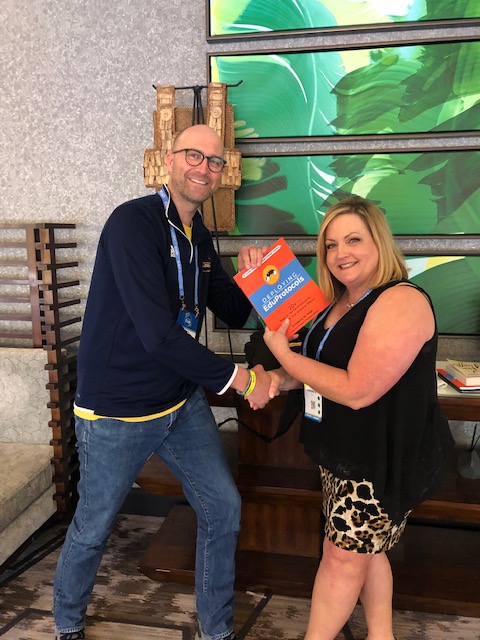
Kim Voge (@kvoge71) – Kim warned me I was getting a hug when I arrived in Palm Springs. As soon as I arrived, the first session I attended was Kim’s session on EduProtocols. Sure enough – I got a hug and a selfie. Through the power of Twitter, I feel like we have known each other for years. She featured Thick Slides, Thin Slides, and Iron Chef. Despite using these items on a regular basis, I took away some new, awesome ideas from the session to implement in class. Oh yeah, Kim’s new book came out – Deploying EduProtocols. It’s a must read for any teacher or administrator. Great ideas for planning or the research behind implementing EduProtocols.

Val Sun (@mllevalsunshine) – Val is another person who I feel like I have known for a long time. Val has great ideas for implementing EduProtocols and uses them with the future teachers she trains with her college class. Plus, she has a book, Navigating Dual Immersion releasing soon! OH yeah, she laughs at my stupid dad jokes too.

Jacob Carr (@mrcarrontheweb) – It was fun meeting Jacob in person. He is the future author of the EduProtocols: Language Arts edition. I thoroughly enjoyed Jacob’s session on implementing EduProtocols at the DOK-1 level. I learned some Dutch with Fast and Curious which was fun. Lastly, I learned about a possible new protocol called the Repuzzler that I’m excited to use when I return from Spring Break next week.

Brianna Davis (@MrsDavisRCHS) – It was great meeting Brianna Davis. I believe I introduced myself in the Hilton parking lot (which was probably creepy, but oh well). Brianna is an avid user of EduProtocols and Social Studies. She also makes some rad templates and lessons for her students. She was awesome to create a template for the Archetype Four Square lesson featured in the EduProtocols: Social Studies edition book!

Diane Mapes (@mrsmapess) – It was great to connect with Diane as she is another avid user of EduProtocols with Social Studies. Look for her great ideas using Great American Race, CyberSandwich, and Thin Slides. It was great meeting Diane for dinner with Jon and Kim the first night of the conference.

Robert Mayfield (@MrMayfieldRHS) – Robert has been rocking the EduProtocols lately with his classes.He’s been using some CyberSandwich, Great American Race, Iron Chef, and Thin Slides. Oh yeah – he even invented a new protocol called Thin Chef (2 pictures and 2 words). Robert is another person I feel like I have known for a while and I look forward to him visiting Cincinnati in June.

Jamie Halsey (@mrsjamiehalsey) – It was great meeting Jamie briefly at the EduProtocols Social Studies session. Then talking more in depth at Shakey’s Pizza. Jamie is an EduProtocols and EMC2Learning expert and does amazing stuff fusing gamification into the protocols. Please, please, please check out her stuff and templates. Oh, and thanks for helping me charge my phone!

Adam Juarez (@techcoachjuarez) – Although briefly, I met Adam Juarez. He has great ideas infusing technology into lessons. It was awesome of him to give me a copy of his book – The Complete EdTech Coach. I can’t wait to dive into this book!

The Sessions

Through EduProtocols and virtually presenting, I have learned the importance of creating a session that is hands on. People learning new ideas actually need to do something to learn how to implement those ideas. From each session, I took notes and tried to take away something positive and something new to use with my classes.

Relationships – One of my favorite sessions was on the importance of building relationships. This session was run by Roni Habib (@Roni_Habib). The session was interactive and he had the participants connecting. I liked his honesty and straight talk in the session. I liked getting to know my partner Justin Berzon throughout the session. Each activity we did took 30 seconds and really had us listening, laughing, and sharing honestly.

EduProtocols – With EduProtocol sessions, I took away some new ideas. The For the People protocol is a great idea to get students working on feedback using a Google Form. I also like the idea of Glows and Grows from Kim Voge. Glows and rows has a nice positive spin for peer to peer feedback.

I can’t wait to use the RePuzzler lesson I learned from Jacob Carr. It’s a great, hands on activity (reminded me of a concept sort) with vocabulary. This lesson can easily be adapted to any subject.

Listenwise – I learned about Listenwise from Dr. Scott Petri. Listenwise is a short podcast site that can be used for any subject. The 6-7 minute podcasts, or news stories, were archived by NPR and can now be used to incorporate with any lesson. They are used to help students work on listening skills and really help students visualize being in the story. Here are 2 other things I learned during this session:

  1. Students can read 2-3 grade levels above their level as they listen to the reading along with a transcript.
  2. Students need a working vocabulary of 50,000 or more words by the time they graduate high school.

Keynote – The message of the Keynote from Amanda Sandoval (@historysandoval) was incredible. I loved Amanda’s Group Playlist idea for this crazy time in education. The Group Playlist is a spin on Catlin Tucker’s Station Rotation Playlist idea. What I took away the most, however, were these 4 questions Amanda used to help her design the group playlist:

  1. What is most important?
  2. How does this connect to the real world?
  3. Will this engage students?
  4. Will they find it meaningful?

These are the questions she developed from students survey answers and the questions used to help design lessons. In this age of Covid, these questions are crucial for any teacher developing lessons.

All in all, this was an awesome conference. Amazing people. Amazing sessions. What an awesome experience!

The Week That Was In 505

I am currently writing this post from the Spring CUE Conference in Palm Springs, California. I made the trip out on Wednesday after school. This week is the last week before Spring Break begins. So that means craziness ensues. It’s unlike me to begin class with a stern lecture, but it had to happen this week.

As for the lessons and content, the goal for the week was wrapping up the Westward Expansion Unit. I wanted the content focus to be on the motivations for territorial expansion and the motivations for people moving west. The grand finale of the unit is a digital breakout I put together with some puzzles and clues to help the students.

Monday – Thick Slide combined with a SHEG Lesson.

Tuesday – Wrap up the SHEG lesson with a GimKit

Wednesday – CyberSandwich

Thursday – Text Quest Wrap Up

Friday – Digital Breakout

Monday and Tuesday

After finishing the traps and treasures lesson to give students background knowledge on how the United States expanded west through purchases, treaties, and wars – the perfect lesson is the Manifest Destiny SHEG Lesson. This lesson has students consider what motivated American territorial expansion. The lesson uses the familiar painting American Progress, and 3 other primary sources with different perspectives.

I decided to shorten this lesson down for middle school and I only had students analyze 2 sources:

  1. John O’Sullivan’s article on reasons for expansion (O’Sullivan coined the term Manifest Destiny).
  2. Theodore Parker who was an abolitionist and minister and offered the reasons for expansion were expanding slavery and showing power.

In order to analyze these perspectives, I created a Thick Slide for students. I set the Thick Slide up so students could source the documents, close read the documents, and compare the perspectives. I also had the students add a quote, picture, and caption.

With the lesson set up, the first task was reading a textbook excerpt about Manifest Destiny. I asked students to consider the information presented by the text – what was a reason for Manifest Destiny? This was followed up with the students reading 2 sources and completing the Thick Slide. Here are some student examples:

After the Thick Slide was completed, we circled back to the original textbook excerpt we started with and asked the question, “What more could you add to this excerpt?” Students used their thick slides and previous knowledge to create new paragraphs or insert new information. Here are some student samples:

Wednesday and Thursday

Wednesday we focused on groups of people that traveled west. Instead of going through all the groups, I have students focus on 3 of them: Mormons, 49er’s, and Pioneer Women. The Mormons and 49er’s are listed in our standards. Pioneer women I chose because they make references to voting rights which ties nicely to reform movements and the Women’s Suffrage Movement.

For this lesson, I set up a CyberSandwich where students could choose which group they wanted to study. I ran the standard 10 minute read and note taking, 5 minute discuss, and 10 minute summary. Instead of a summary at the end, students could choose to do an Icon Board which is an idea I got from Matt Miller at Ditch That Textbook. For the CyberSandwich, I had students focus on 2 questions:

  1. What motivated groups of people to move west?
  2. What legacy did these groups leave?

Here are some student samples:

The day after this lesson, I had students complete the Text Quest they started last week. During the first part of the Text Quest, I had students look at 3 items to figure out what all 3 had in common. Here is that slide:

The second part of the lesson, I had students go back and reread the articles from the CyberSandwich. This time, however, I had them look for examples of Bravery, Empathy, Fortitude, etc…

How did this lesson end up? I don’t know yet…….

Friday

The final day of the week, I put together a Digital Break. Here is the breakout:

In this breakout I included several clues to help students:

  1. A puzzle they have to put together.
  2. A hidden word, word search (Find all the words, the unused letters reveal the answer).
  3. My favorite – a Where’s Waldo page where I placed in my own Waldos with clue links embedded in. Students have to find the correct Waldo that holds the correct clue….

The Week That Was In 505

This week 505 continued Westbound and Down unit on Westward Expansion. My goal for this unit is for students to understand how we acquired territories in the United States, understand the concept Manifest Destiny, and understand what motivated groups of people to risk everything and travel west. These are the Ohio expectations for learning:

  1. Describe how the United States added to its territory through treaties and purchases. (Standard 10)
  2. Analyze debates over sectional issues, war with Mexico and the displacement of American Indians in relationship to westward expansion.(Standard 11)
  3. Describe the movement of people, products and ideas that resulted in new patterns of settlement and land use. (Standard 17)

Monday – Continuation of Traps and Treasures with a Gimkit

Tuesday – MAP testing round 3

Wednesday – MAP testing round 3

Thursday – Quizizz and Text Quest or Side Quest

Friday – Text Quest or Side Quest

Monday

Monday was a continuation of Traps and Treasures with learning about the different territories the United States acquired through purchases, treaties, and war. We had 2 rounds left to complete. A quick recap – I put different point totals and power ups in an envelope with readings about the territories. Students selected the territories at random. Then I collected and added points on the board. Surprisingly the team scores were super close.

We finished the game of traps and treasures with a chance game. Any student who thought the game was over was wrong. During the chance game students sent 1 team representative to the front of the room. Each representative had a choice: choose bananas from the Banana Blast game or select an envelope from the skull’s mouth. The risks involved:

  1. If a student pulled a banana and the monkey jumped on the first turn, they lost every point.
  2. If they pulled a banana and the monkey didn’t jump, they could lock in their point total. They could keep adding point with each subsequent banana pull.
  3. The skull’s mouth envelope selection could give negative points or a lot of points.

This was just a fun way to end the game. In the end, I gave each team some money for their Westward trip during our game.

After we finished the game, I began a Gimkit with questions related to the readings from Traps and Treasures. Based on the class averages, I was a bit disappointed. No class average was above 78%. I stopped to think about why…and I realized some of the students were engaged and discussing as a group while others were not. Some of the rounds were rushed and chaotic. As a result, I will get the point stuff out of the way at the beginning and then start the timer. I will also make the rounds a bit longer. Finally, I need to remind the students to stay focused, and on task during the game.

Thursday and Friday

After 2 days of MAP testing, we got back to westward expansion. I wanted to start a Text Quest which is another great lesson format from EMC2Learning. I cannot share this lesson or the files, but check out www.emc2learning.com.

Since the GimKit scores were low from Monday, I decided to go to Quizizz because I feel I get more accurate test results. Gimkit and Blooket are great for repetition of questions, however, after a while, students stop reading the questions. That’s where I step I explain why I use Blooket and Gimit and teach them the Forgetting Curve.

Before I had students take the Quizizz I explained to them what was riding on the quiz…

  1. An 80% or higher they could move on and join the Text Quest.
  2. Below an 80% they had to watch an EdPuzzle and retake the Quizizz.

As I tell all the students, “Failing is not an option in 505.” Out of 104 students, 24 students got below an 80%. The rest of the students got into their teams and we began the Text Quest.

The Text Quest began with a game called Odd One Out. I gave the students 3 pictures of territories (Mexican Cession, Louisiana Purchase, and Gadsden Purchase) and they talked with each other about which territory didn’t belong. I chose these territories to debate because there is not one right answer – only better answers. Students had 5 minutes to discuss and submit their answer through Socrative. At the end of time, I revealed the group responses, read them out loud, gave feedback and decided on 1st through 4th place. I also explained why I placed the responses the way I did. The reading and feedback are key to learning during this time. Here are some quick examples of student responses:

  1. “The Louisiana purchase does not belong. This is because both the Mexican Cession and the Gadsden purchase have states involved such as New Mexico and Arizona.”
  2. “We think that the Gadsden Purchase doesn’t belong because it was the smallest purchase brought compared to the Mexican Cession, and the Louisiana Purchase. We also think that the Gadsden Purchase doesn’t belong because the only reason that it was bought was that the land was needed to be able to finish a railroad that was being built.”

Next we moved into final piece of the Text Quest – analyzing the painting, American Progress by John Gast. I wanted to use an 8Parts to analyze it, but then I changed my mind at the last second. Instead, I used the Word Scramble from EMC2Learning (I cannot share this file). Here are the rules:

  1. 15 minutes – analyze the painting and work together to create as many relevant words as possible.
  2. Using your words, write a paragraph relating the painting to westward expansion and manifest destiny.
  3. There was a catch with the paragraph writing – Each person had to write a sentence. I set a timer for 45 seconds to write a sentence. Then they had to pass the chromebook. This got everyone writing and the teams were giving each other suggestions for writing. This was an awesome mix up. On the fly I decided to call it the Sentence Swing.

Here are some student examples:

Side Quests

The other part to the Westward Expansion unit are Side Quests. Side Quests are a way to have students explore interests and create something, or they can use information they already learned and create something. I tried to include all different kinds of activities for Side Quests – some easy, some hard, music related projects, timeline creation projects, and I even throw in some EduProtocols (Sketch and Tell and Number Mania). The Side Quests are a way to earn extra supplies and badges.

During a Side Quest Day, students must create 1 or more Side Quests during a class. Students can even work on Side Quests at home, during learning period, or when they have extra time in class. Either way, all Side Quests are due by the end of the unit. So far, I have seen some awesome creations…

Exciting News

I’m excited to leave next Wednesday as I head out to Palm Springs, CA for Spring CUE to present with Dr. Scott Petri and Jon Corippo!

The Week That Was In 505

This week we are coming off a successful week of EduProtocols helping students organize information to write an essay. Many students liked the different ways we organized the information with a Research Protocol and Thick Slide. However, they were not fans of learning how to write an essay or actually writing an essay. We write ALL the time in my class because writing is important. However, last week was not a normal week for 505 – students are used to walking into the unknown. I try to create a different experience for everyone.

With that in mind, I needed to create a different experience with Westward Expansion. I needed something uplifting. I needed something fun. On Saturday, an idea hit me – create a gamified unit similar to an Oregon Trail like game. Saturday night, I slept on this idea and thought about it more. I needed to create a story, think of game elements to incorporate, and think of how to piece together the unit. When I plan a unit, I lay out the standards and work my way backwards…

The students need to know how the US acquired territories through purchases, wars, and treaties. The students also need to know the groups of people who went west – Mormons, 49er’s, and Oregon Pioneers. From this information, I put together the story, created a website, and Westbound and Down was born.

Here is the story I created:

The wild west. Gold. Resources. Riches. The United States keeps expanding and you want to follow suit. It’s time to pack up the family and see what the hype is all about. Oregon? California? Texas? You want to go, your family wants to go, but you must plan very carefully. You need to learn as much as you can about the territories out west – how did we acquire them and why? Your knowledge will earn you the necessary supplies to make the trip. The wagon needs to be carefully packed and supplies organized as you are about to embark on a long, treacherous journey out west!

Along with the story, I made supply badges students could earn throughout the unit. The badge creation is an ongoing process throughout the game. I like to create different twists and turns. Along with the supplies, I put together a spreadsheet to keep track of teams, money, and supplies. Here is the spreadsheet. The supplies are earned through mastery, through games, and I hid supplies around the school. For example, I took a Map badge, cut it in half and hid the halves in the school. I hid guidebooks throughout the school. However, one of the guidebooks was faulty just like the one the Donner Party had that got them lost. Here are the supplies I put together for students:

The last piece of the puzzle was creating Side Quests for students. Side Quests are ways for students to explore topics on their own, show off their creativity, and earn extra badges. Here is a Side Quest example link. I love these gamified units because they allow me to be creative. Anything goes. It build curiosity, builds teamwork, and builds motivation.

Monday – Monroe Doctrine Breakout

Tuesday – Introduced West Bound and Down, Great American Race.

Wednesday – Resource Rumble

Thursday – Traps and Treasures

Friday – Traps and Treasures

Monday

Monday was used for finishing the Monroe Doctrine essays and “breaking out” of the Monroe Doctrine into the next lesson. Around 5 years ago I created a Monroe Doctrine Breakout that used political cartoons. Students had to solve the locks by using my clues and using the political cartoons. I created a website to go along with this as well.

I gave students 30 minutes to work through the breakout which then led them to an empty locker in the school. My final clue stated, “You successfully completed the breakout! BUT…..there’s more to thee. The winning decided by whatever’s behind locker door 503.” Students had to find locker 503, open it, and inside was an introduction to the next unit.

The next unit introduction was an ABC chart where students had to list as many relevant words as possible related to westward expansion. As the clock was winding down, students turned in their ABC charts and I left the class with this, “The team with the most relevant words will gain an advantage in tomorrow’s class.”

This type of line leaves them with excitement and intrigue for the next day.

Tuesday

I began Tuesday and our new unit with the Great American Race EduProtocol. The advantage winning teams got from the previous class was 1 free answer with the Great American Race.

“This sounds easy. All we have to do is Google stuff?” – This is usually the quote when I explain the first Great American Race EduProtocol rep. Fast forward to our third rep of the year and the students are asking this question, “Can we have a word bank?” Students quickly learn there’s more to creating clues and researching answers with Google.

My first class I ran a Quizizz, ran a Great American Race, and then a Quizizz again. Here are the Great American Race instructions if you are familiar:

  1. Create an index card with a number on one side and a vocab term on the other side.
  2. The vocab term is the “answer” and instruct students to keep it a secret.
  3. Students had 10 minutes to design their own slide – add the card number to the slide, add clues for the vocab term, and a picture.
  4. To determine the amount of clues to add to the slide, I make it interesting and have 1 student roll a dice.
  5. As students work, I copy their slides, in order, to a large slide deck.
  6. I give feedback as they do this.
  7. Then students have the rest of time to figure out the answer for each slide. I give each students (sometimes each group) 1 paper with answer blanks.

Here are the Great American Race slides:

That’s it. The Great American race. In my opinion, though, my first period setup didn’t produce desirable results. Something needed to change. I opened up Explore Like a Pirate by Michael Matera and began the next class with some Graffiti.

Graffiti

Students walked into the classroom and saw textbooks laying on the desks. “What are these Mr. Moler?” “We haven’t used a textbook all year! I don’t like this.” I quickly correct the student(s), “We have used the textbook all year, you just didn’t realize it.”

I instructed the students to look at pages 276-315 – skim and preview. I had them find words they thought were important to understanding Westward Expansion. If students found a word, they had to raise their hand and I had to call on them to go. There were 2 catches:

  1. They couldn’t write the same words or phrases on the board.
  2. I added a “magic word” – a secret word that could instantly win the person who wrote it some money for their group. (Think of it like the secret word from Pee Wee’s PlayHouse show). The secret word was “Manifest Destiny” and every class had 1 student that wrote it.

Students had 6 minutes to skim and add words to the board. When we were finished, I summarized the information on the board and surprisingly, students listed 90% of the words I had on the Great American Race Cards. I took a picture of each board and added it to the picture to the Great American Race assignment as a word bank. THIS. WAS. AN. AWESOME. ADDITION. TO. GREAT. AMERICAN. RACE!!! Here are the boards:

This was such a fun element to add to the Great American Race. Students wanted a word bank and so they created their own and fun doing it. The Great American Race results were much better with a word bank and the eneggament was tons better as well. Unfortunately, I didn’t have time a for a Quizizz.

Wednesday

Following the Great American Race was a Resource Rumble. I cannot share the slides because they are located on EMC2Learning. I wanted a way for students to learn vocabulary words related to the Great American Race from Tuesday’s class. I took the 8 most important words and put them into 8 different treasure chests, and taped them to my board. Teams had 35 minutes to complete a TIP Chart and collect Legos to win supplies for their western trip.

A TIP Chart is a vocabulary strategy that stands for Term, Information, and Picture. My TIP Chart is located here. The TIP Chart is a good vocabulary strategy to use it as an organizer and the picture element involves dual coding which helps students retain words and information (Think Sketch and Tell). Students worked together in teams to write down a term, they paraphrased a definition, and drew a picture (It was like a Parafly and Sketch and Tell combined). Before a team could roll dice and earn legos, they had to bring up their charts, say the term out loud and read their definition. I was amazed at how many students had trouble pronouncing words like: cession, annex, and diplomacy. Once approved, teams rolled dice and collected legos.

Near the end of time, students had to build a Lego creation related to a vocabulary word. I told them I should be able to look at the creation and guess the word. This helped the thought process and quality of Lego construction. All in all, this was a blast and the Resource Rumble is a hit.

Thursday and Friday

With vocabulary knowledge built up a bit, next we moved into learning how the United States obtained some of its territories. I wanted to try Traps and Treasures. I cannot share this file as it is on EMC2Learning.

To make Traps and Treasures happen, I collected sections from the Textbook and made copies – Louisiana, Florida, Texas, Oregon, and the Mexican Cession. Then I put together a Main Idea organizer to pair with the readings. My idea was that students would work in their teams, read for 10 minutes, take 5 minutes to discuss their notes, and take 5 minutes to write a paragraph. Most groups/students rose to the challenge and did a great job organizing a paragraph. However, this would take a lot of time. I changed this to a basic read and comprehend on Friday to make it go quicker.

When students came into the room, I had a map of the United States drawn on the whiteboard. Students got into their groups and got ready for the day. I took the readings from the Textbook and placed them in a large envelope. Then inside the large envelope was a smaller envelope which had a trap or treasure. The trap or treasure would give or take away points for each team. I also included some of the Power Up options into some of the envelopes. With each round, the points and power ups were changed to keep things interesting.

At the end of the class period, I threw in a twist. Each team had an option to add more points or lose them. I went to Walmart and purchased the game Banana Blast. Each team had a chance to go up to the monkey and pull a banana. If they pulled one banana, they solidified their team score for the day. If the monkey popped up ON the first pull, they lost ALL of their points. If the monkey popped up AFTER the first pull, the team lost the extra points they earned. Students could choose to stop pulling bananas at any moment. This was a simple way to add a new element to the game. At the end of both days we used a Gimkit to review information.

We are going to finish Traps and Treasures on Monday.

Great American Race Reflection

I decided to add some gamification to Westward Expansion. Students are put into teams and are working to accumulate the necessary supplies for a Westward trip. We are going to have some Side Quest options to earn more supplies, and I have supplies hidden around the school. Supplies include: blankets, food, fire, Guidebooks, cooking utensils, money, maps, etc… However, some of the supplies are a trap. For example, the Donner Party had a bad guidebook that led them astray en route to California. As a result, one of my guidebooks is a trap. Here is my website I put together.

I began the unit today with the Great American Race EduProtocol. “This sounds easy. All we have to do is Google stuff?” – This is usually the quote when I explain the first Great American Race EduProtocol rep. Fast forward to our third rep of the year and the students are asking this question, “Can we have a word bank?” Students quickly learn there’s more to creating clues and researching answers with Google.

My first class I ran a Quizizz, ran a Great American Race, and then a Quizizz again. Here are the Great American Race instructions if you are familiar:

  1. Create an index card with a number on one side and a vocab term on the other side.
  2. The vocab term is the “answer” and instruct students to keep it a secret.
  3. Students had 10 minutes to design their own slide – add the card number to the slide, add clues for the vocab term, and a picture.
  4. To determine the amount of clues to add to the slide, I make it interesting and have 1 student roll a dice.
  5. As students work, I copy their slides, in order, to a large slide deck.
  6. I give feedback as they do this.
  7. Then students have the rest of time to figure out the answer for each slide. I give each students (sometimes each group) 1 paper with answer blanks.

Here are the Great American Race slides:

That’s it. The Great American race. In my opinion, though, my first period setup didn’t produce desirable results. Something needed to change. I opened up Explore Like a Pirate by Michael Matera and began the next class with some Graffiti.

Graffiti

Students walked into the classroom and saw textbooks laying on the desks. “What are these Mr. Moler?” “We haven’t used a textbook all year! I don’t like this.” I quickly correct the student(s), “We have used the textbook all year, you just didn’t realize it.”

I instructed the students to look at pages 276-315 – skim and preview. I had them find words they thought were important to understanding Westward Expansion. If students found a word, they had to raise their hand and I had to call on them to go. There were 2 catches:

  1. They couldn’t write the same words or phrases on the board.
  2. I added a “magic word” – a secret word that could instantly win the person who wrote it some money for their group. (Think of it like the secret word from Pee Wee’s PlayHouse show). The secret word was “Manifest Destiny” and every class had 1 student that wrote it.

Students had 6 minutes to skim and add words to the board. When we were finished, I summarized the information on the board and surprisingly, students listed 90% of the words I had on the Great American Race Cards. I took a picture of each board and added it to the picture to the Great American Race assignment as a word bank. THIS. WAS. AN. AWESOME. ADDITION. TO. GREAT. AMERICAN. RACE!!! Here are the boards:

This was such a fun element to add to the Great American Race. Students wanted a word bank and so they created their own and fun doing it. The Great American Race results were much better with a word bank and the eneggament was tons better as well. Unfortunately, I didn’t have time a for a Quizizz.

The Week That Was In 505

This week I needed to focus on a writing unit. It was brought to my attention that I needed to cover writing more often. So, I sat down and looked at the Common Core Writing standards and I made notes next to each item. Turns out I cover many of the standards already with weekly Frayers, CyberSandwiches, Iron Chefs, and Thin Slides. However, there was one standard I didn’t address yet – Argumentative Writing.

Despite me covering writing standards weekly with EduProtocols, I haven’t formally taught writing. I focus too much on content rather than process. I needed to put together a writing unit that focused on actually teaching the process of writing. The writing had to fit with the Monroe Doctrine because that’s where we are in class. So I sat down, got my mind working, and started with this question:

“Was the Monroe Doctrine a policy of expansion or self-defense?”

The next step of the process I wrote out some I Can statements. Here are those statements:

  1. I can identify 2 policies from the Monroe Doctrine.
  2. I can explain the Monroe Doctrine how the Monroe Doctrine can be seen as a policy of expansion.
  3. I can explain how the Monroe Doctrine can be seen as self-defense.
  4. I can construct a multi-paragraph essay.

Then I had to decide the process of teaching an argumentative essay. I’m not an ELA teacher, but I do love to write. I have never formally taught how to write an essay, and I wanted to keep things SIMPLE.

I chose two resources – a secondary source for background information, and three excerpts from the Monroe Doctrine to serve as a primary source. When I selected my resources, I kept the students in mind. The other dynamic to this writing unit planning was taking into account that some students practice writing essays and paragraphs monthly and others have very little practice. My compromise to this was expecting students to write 3 basic paragraphs to form an argumentative essay.

The last part of my planning process included adding some EduProtocols. Here was my plan:

Monday – No School

Tuesday – Fast and Curious, Thick Slide

Wednesday – Parafly

Thursday – Quizizz, Research Protocol (Google Form, V-Diagram)

Friday – Write the Essay (Essay organizer and model)

Tuesday

I used a new EduProtocol today – Thick Slides! My focus this week is writing a multi-paragraph using a prompt similar to what will be seen on the state test. I copied and pasted a prompt from the state test and plugged in my own content related to the Monroe Doctrine.

Here is my Thick Slide link.

Most prompts on the state test have the students comparing and using evidence from 2 or more sources. In this case, I have a secondary source and primary source the students will be using. My focus is on 3 things for this week. I want the students to be confident with:

  1. Writing 3 solid, cohesive paragraphs.
  2. Creating a good thesis.
  3. Using evidence from the sources to support the thesis.

The Monroe Doctrine is a secondary issue. With these three things in mind, I started to piece together some Eduprotocols to help with writing. What came to mind are these 3 ideas:

  1. Thick Slides – developing a solid paragraph(s).
  2. Parafly to help us make sense of the Monroe Doctrine as our primary source.
  3. Research Protocol – develop a thesis with evidence.
Starting Class

I began class with the empty room and candle scenario in the picture. I had students close their Chromebooks and had them sit and think about the answers. No talking, No questions. Just think. The students seemed confused, and after 3-4 minutes I could tell they gave up. My point with this scenario was 2 things:

  1. Rarely will human beings sit and think long enough to solve a problem.
  2. We solve problems with background knowledge in our working memories. This is true because the only students who got the answer correct were the students I had in my 5th period one year ago. That was the only period I asked the question to last year.

What does this have to do with a writing prompt? Chance are the students won’t sit and think about what a “mile long” writing prompt is asking them unless they have some knowledge of the words and phrases. Essentially I used this as my “why” for working on writing this week.

What is the answer to the question above? Try to sit and think about it for longer than 10 minutes before looking it up.

The Prompt

Below is the writing prompt I put together for the students. It’s a long one so I had students read the prompt and submit unknown words and phrases through Mentimeter to create a Word Cloud.

The most common words submitted to the word cloud were: significance, doctrine, Monroe Doctrine, policy, expansion, self-defense, context, thesis, audience, clarifying, mechanics, and cohesion. Here what I learned from the word cloud – don’t assume students know common words. This was followed by a discussion of what the prompt was asking the students to do.

Fast and Curious

To begin building Monroe Doctrine background knowledge with the Monroe Doctrine, students took 4 minutes to do a Quizizz. The Quizizz was 6 questions. The first round wasn’t great. This was followed by feedback and a Thick Slide creation. We finished class with a 2nd round of Quizizz which was much better. Here are the results:

Thick Slides

I have used Thick Slides once…..I think. But, I don’t think I would consider it Thick Slides. I was inspired to use it after watching Kim Voge’s video from EduProtocols Worldwide 3. It was a perfect fit for our essay writing unit. I love the simplicity of the design. Here were my requirements for the slide design with feedback I gave to students:

  1. Add a Title – the title should reflect the main idea of the topic.
  2. List 5 facts – focus on who, what, when, where, why. Many students copied and pasted their facts, but I will have them reword/paraphrase their facts.
  3. Find a relevant picture – add a caption that explain why the image works with the topic.
  4. Quote – find an interesting quote that relates to the main idea of the Monroe Doctrine.
  5. 2 pieces of evidence – find a quote that proves the Monroe Doctrine was used for expansion. Find a quote that prove the Monroe Doctrine was used for self-defense.

I gave students 20 minutes to complete their slide(s). Students will use their slides to develop paragraphs for the essay. I pointed out to students they could use this process with their scratch paper for the state test – list 5 facts on the paper, an important quote, etc. They could use this information to develop a solid paragraph.

Differentiating Ideas
  1. One student had a headache and couldn’t look at the screen – I gave a the reading on paper and a blank piece of paper. I helped him set up the blank paper with a title, 5 facts, and a quote.
  2. I added questions into the Facts section of the slide – Who wrote the Monroe Doctrine? What was the Monroe Doctrine? etc…
  3. I provided hard copies of the reading pre-highlighted for the students.
  4. Some students listened to the reading.

Wednesday

Continuing our essay writing unit with the Monroe Doctrine it was time to move on and look at 3 important excerpts from the primary source. I thought to myself – I could have the students analyze this doctrine with HIPPA or some other fancy acronym. However, I voted against that and went with a parafly. Yes, we want students understanding the context of the document, the author’s purpose, and so on. But I wanted the students to understand the words that James Monroe spoke to Congress. In order to accomplish this goal, I used Parafly which a quick paraphrasing activity. Here are the 3 excerpts I chose for the Parafly:

  1. “…the American continents by the free and independent condition which they have assumed and maintain, are henceforth not to be considered as subjects for future colonization by any European power……”
  2. “The citizens of the United States cherish sentiments the most friendly in favor of the liberty and happiness of their fellow men (Europeans) on the other side of the Atlantic. In the wars of the European powers in matters relating to themselves we have never taken any part, nor does it comport with our policy to do so…. With the existing colonies or dependencies of any European power we have not interfered and shall not interfere.”
  3. “It is only when our rights are invaded or seriously menaced that we resent injuries or make preparation for our defense or war…. to declare that we would consider any attempt on their part to extend their (European nations) system to any portion of this hemisphere as dangerous to our peace and safety.”
The Tools

I tried out the Parafly with multiple tools during the day. The goal with each tool was to give feedback to students in real time. Here are those tools with explanations:

  1. Peardeck – I began with Peardeck so I could watch students typing in real time on the screen. However, I couldn’t see student names with the free version. This was a good option, but I wanted to see student names.
  2. Nearpod – I liked that I could see student names, hide names, and I could run a timer for 4-5 minutes to keep the process moving. I didn’t like that I couldn’t see responses in real time. But, as students submitted I could provide feedback right away and it was easy to fix and change.
  3. Socrative – This was my least favorite option. Maybe I needed a paid version? Once students submitted, they couldn’t go back and make corrections. Again, maybe I was missing something? However, I really like the voting tool which can turn Parafly into a competition.
  4. Hemingway App – The Hemingway app allows students to edit text and it gives feedback on writing styles. I really like the Grade Level Readability rating. I challenged students to Paraphrase the text to a 6-8 grade level. They really, really enjoyed this challenge!!
Introducing Parafly

My students have never completed a parafly before. Some students practice paraphrasing a lot and some have never done it all. Since none of them have Parafly’d (Paraflied??) the Eduprotocols way I began with a short passage about a Land, Sea, and Air Burger on the McDonald’s menu. Before we began I shared a definition of paraphrasing. According to the Hemingway App the passage was at a 6th grade level. I challenged the students to paraphrase it to a 3-5 grade level. Here is that passage:

The “Land, Sea, and Air” burger is one of McDonald’s largest “secret menu” items. This behemoth of a burger is stuffed with proteins from the Land (beef), Sea (fish), and Air (chicken). Some people even add fries to this monster burger. You order a Big Mac, a Filet-O-Fish, and a McChicken all at once. Then you put the McChicken and Filet-O-Fish patties inside the Big Mac along with however many buns you want and enjoy! Voila – a Land Sea and Air Burger! In our opinion, the Land, Sea, and Air Burger is more than enough to satisfy anybody’s appetite.

As students paraphrased I gave feedback on vocabulary and sentence usage. For example, many students left the word “protein” in their paraphrase. I asked them, “What is a way to paraphrase protein?” Most replied back with, “Oh yeah, meat.” I also mentioned, “Instead of listing out all 3 sandwich names, just say it’s made up of 3 different menu items.” It’s little bits of feedback such as that that get the students thinking.

Paraphrasing a Primary Source

After practicing with a McDonald’s passage, I had students paraphrase a three excerpts from the Monroe Doctrine. Each excerpt represented an important provision from the doctrine. I challenged the students to paraphrase the excerpts from a 12th grade – college level down to a 6-8 grade level.

As we worked through the first excerpt, I noticed that the vocabulary gave students tons of trouble. I suggested Rewordify to help with the vocabulary. The students who used Rewordify properly got the most out of the paraphrasing. With the first excerpt (listed above) I mentioned to students that james Monroe said, “American Continents,” which refers to North AND South America. Many students didn’t pick up on that detail.

I began the day hoping for writing practice, but the Parafly served 2 purposes today:

  1. Paraphrasing and working with vocabulary to understand a primary source.
  2. Reading for important details.

After each excerpt, we discussed as a class the 3 important provisions from the Monroe Doctrine. Here are some results of from our Parafly today:

Thursday

Today we used the Research Protocol that will be featured in the EduProtocols: History Edition by Dr. Scott Petri and me. This protocol is great at getting students finding evidence to support a claim, explaining evidence, and sharing their findings into a class spreadsheet.

Before the lesson began, I ran the same quizizz from Tuesday and the students did well. All class averages were 80% or higher. Following the Quizizz, we began our 2nd rep of the Research Protocol. I shared a Google Form where I posted the prompt question at the top: “Was the Monroe Doctrine a policy of expansion or self-defense?” My expectation was every student submitted 1 piece of evidence for each side of the argument – 1 piece that supported expansion and 1 piece that supported self-defense. I also included links to the sources within the Google Form. Students had 15 minutes to submit 2 pieces of evidence. Here are the results:

Following the evidence collection I post the Google Sheet, and I give the students a V Diagram where they can collect information. An example is listed here (I use it on paper, but created a digital version).

On the V Diagram, I wanted students to collect 2 pieces of information that supported both sides. Then students weigh the evidence and information then decide how they will write their thesis statement.

The research protocol gives students great practice finding details from multiple sources, analyzing those details, and practice writing a thesis statement.

With the research protocol completed, the students were heading into Friday ready to write their essays. They had a Thick Slide deconstructed paragraph to use, paraphrases of the Monroe Doctrine, and a V-Diagram with information, evidence, and a completed thesis.

Friday

Today was the day. Writing essays. Here were my different expectations for the variety of students in my classroom:

  1. Write 4 or more paragraphs, focus on a counter claim (advanced ELA students)
  2. Write 3 paragraphs
  3. Write 2 paragraphs
  4. Focus on writing a really good 1st paragraph with a hook, information, and thesis with all pieces organized correctly.
  5. Write 1 paragraph about the Monroe Doctrine.
  6. Fill out the graphic organizer.
  7. Give me a thesis with a reason.

This is differentiation. This seems like a lot, but it’s not. This is my classroom on a regular basis.

Before I had students write essays, I posted a graphic organizer and a model essay on the Google Classroom assignment (I turned off the copy and share settings). The essay gave step by step directions for setting up paragraphs with some transitional word suggestions. Then I read my model essay as I shared my thought process while writing. I typed my thought process as comments. Having students hear good writing and hearing a thought process is an effective strategy.

After reading my essay, it was time for students to write. I reminded them of their Thick Slide and V-diagram organizer to help guide them. It was time to write. Here are some of the completed essays:

In this collection, I chose essays to represent ALL students. This, to me, is the power of EduProtocols – which essays were written by students with IEP’s versus not on IEP’s?

Despite my feeling like I bored the students with focusing on writing, I felt like this unit was successful. The students gave me feedback and really enjoyed the Thick Slides the most, and the second most like items was the V-Diagram. Having the thick slide with facts, quotes, and other information was a game changer.

My Messages for the Week

Exciting News

I copied this from Scott Petri – we have a cover!!

A Parafly Reflection

Continuing our essay writing unit with the Monroe Doctrine it was time to move on and look at 3 important excerpts from the primary source. I thought to myself – I could have the students analyze this doctrine with HIPPA or some other fancy acronym. However, I voted against that and went with a parafly. Yes, we want students understanding the context of the document, the author’s purpose, and so on. But I wanted the students to understand the words that James Monroe spoke to Congress. In order to accomplish this goal, I used Parafly which a quick paraphrasing activity. Here are the 3 excerpts I chose for the Parafly:

  1. “…the American continents by the free and independent condition which they have assumed and maintain, are henceforth not to be considered as subjects for future colonization by any European power……”
  2. “The citizens of the United States cherish sentiments the most friendly in favor of the liberty and happiness of their fellow men (Europeans) on the other side of the Atlantic. In the wars of the European powers in matters relating to themselves we have never taken any part, nor does it comport with our policy to do so…. With the existing colonies or dependencies of any European power we have not interfered and shall not interfere.”
  3. “It is only when our rights are invaded or seriously menaced that we resent injuries or make preparation for our defense or war…. to declare that we would consider any attempt on their part to extend their (European nations) system to any portion of this hemisphere as dangerous to our peace and safety.”
The Tools

I tried out the Parafly with multiple tools during the day. The goal with each tool was to give feedback to students in real time. Here are those tools with explanations:

  1. Peardeck – I began with Peardeck so I could watch students typing in real time on the screen. However, I couldn’t see student names with the free version. This was a good option, but I wanted to see student names.
  2. Nearpod – I liked that I could see student names, hide names, and I could run a timer for 4-5 minutes to keep the process moving. I didn’t like that I couldn’t see responses in real time. But, as students submitted I could provide feedback right away and it was easy to fix and change.
  3. Socrative – A great option. Once students submit their paraphrase, no changing/editing. They are committed to submitting quality work. Keep it moving, give quality feedback. Try to knock out 3 paraphrases in 12-15 minutes. THEN have students summarize.
  4. Hemingway App – The Hemingway app allows students to edit text and it gives feedback on writing styles. I really like the Grade Level Readability rating. I challenged students to Paraphrase the text to a 6-8 grade level. They really, really enjoyed this challenge!!
Introducing Parafly

My students have never completed a parafly before. Some students practice paraphrasing a lot and some have never done it all. Since none of them have Parafly’d (Paraflied??) the Eduprotocols way I began with a short passage about a Land, Sea, and Air Burger on the McDonald’s menu. Before we began I shared a definition of paraphrasing. According to the Hemingway App the passage was at a 6th grade level. I challenged the students to paraphrase it to a 3-5 grade level. Here is that passage:

The “Land, Sea, and Air” burger is one of McDonald’s largest “secret menu” items. This behemoth of a burger is stuffed with proteins from the Land (beef), Sea (fish), and Air (chicken). Some people even add fries to this monster burger. You order a Big Mac, a Filet-O-Fish, and a McChicken all at once. Then you put the McChicken and Filet-O-Fish patties inside the Big Mac along with however many buns you want and enjoy! Voila – a Land Sea and Air Burger! In our opinion, the Land, Sea, and Air Burger is more than enough to satisfy anybody’s appetite.

As students paraphrased I gave feedback on vocabulary and sentence usage. For example, many students left the word “protein” in their paraphrase. I asked them, “What is a way to paraphrase protein?” Most replied back with, “Oh yeah, meat.” I also mentioned, “Instead of listing out all 3 sandwich names, just say it’s made up of 3 different menu items.” It’s little bits of feedback such as that that get the students thinking.

Paraphrasing a Primary Source

After practicing with a McDonald’s passage, I had students paraphrase a three excerpts from the Monroe Doctrine. Each excerpt represented an important provision from the doctrine. I challenged the students to paraphrase the excerpts from a 12th grade – college level down to a 6-8 grade level.

As we worked through the first excerpt, I noticed that the vocabulary gave students tons of trouble. I suggested Rewordify to help with the vocabulary. The students who used Rewordify properly got the most out of the paraphrasing. With the first excerpt (listed above) I mentioned to students that james Monroe said, “American Continents,” which refers to North AND South America. Many students didn’t pick up on that detail.

I began the day hoping for writing practice, but the Parafly served 2 purposes today:

  1. Paraphrasing and working with vocabulary to understand a primary source.
  2. Reading for important details.

After each excerpt, we discussed as a class the 3 important provisions from the Monroe Doctrine. Here are some results of from our Parafly today:

Thick Slides Reflection

I used a new EduProtocol today – Thick Slides! My focus this week is writing a multi-paragraph using a prompt similar to what will be seen on the state test. I copied and pasted a prompt from the state test and plugged in my own content related to the Monroe Doctrine.

Here is my Thick Slide link.

Most prompts on the state test have the students comparing and using evidence from 2 or more sources. In this case, I have a secondary source and primary source the students will be using. My focus is on 3 things for this week. I want the students to be confident with:

  1. Writing 3 solid, cohesive paragraphs.
  2. Creating a good thesis.
  3. Using evidence from the sources to support the thesis.

The Monroe Doctrine is a secondary issue. With these three things in mind, I started to piece together some Eduprotocols to help with writing. What came to mind are these 3 ideas:

  1. Thick Slides – developing a solid paragraph(s).
  2. Parafly to help us make sense of the Monroe Doctrine as our primary source.
  3. Research Protocol – develop a thesis with evidence.

Starting Class

I began class with the empty room and candle scenario in the picture. I had students close their Chromebooks and had them sit and think about the answers. No talking, No questions. Just think. The students seemed confused, and after 3-4 minutes I could tell they gave up. My point with this scenario was 2 things:

  1. Rarely will human beings sit and think long enough to solve a problem.
  2. We solve problems with background knowledge in our working memories. This is true because the only students who got the answer correct were the students I had in my 5th period one year ago. That was the only period I asked the question to last year.

What does this have to do with a writing prompt? Chance are the students won’t sit and think about what a “mile long” writing prompt is asking them unless they have some knowledge of the words and phrases. Essentially I used this as my “why” for working on writing this week.

What is the answer to the question above? Try to sit and think about it for longer than 10 minutes before looking it up.

The Prompt

Below is the writing prompt I put together for the students. It’s a long one so I had students read the prompt and submit unknown words and phrases through Mentimeter to create a Word Cloud.

The most common words submitted to the word cloud were: significance, doctrine, Monroe Doctrine, policy, expansion, self-defense, context, thesis, audience, clarifying, mechanics, and cohesion. Here what I learned from the word cloud – don’t assume students know common words. This was followed by a discussion of what the prompt was asking the students to do.

Fast and Curious

To begin building Monroe Doctrine background knowledge with the Monroe Doctrine, students took 4 minutes to do a Quizizz. The Quizizz was 6 questions. The first round wasn’t great. This was followed by feedback and a Thick Slide creation. We finished class with a 2nd round of Quizizz which was much better. Here are the results:

Thick Slides

I have used Thick Slides once…..I think. But, I don’t think I would consider it Thick Slides. I was inspired to use it after watching Kim Voge’s video from EduProtocols Worldwide 3. It was a perfect fit for our essay writing unit. I love the simplicity of the design. Here were my requirements for the slide design with feedback I gave to students:

  1. Add a Title – the title should reflect the main idea of the topic.
  2. List 5 facts – focus on who, what, when, where, why. Many students copied and pasted their facts, but I will have them reword/paraphrase their facts.
  3. Find a relevant picture – add a caption that explain why the image works with the topic.
  4. Quote – find an interesting quote that relates to the main idea of the Monroe Doctrine.
  5. 2 pieces of evidence – find a quote that proves the Monroe Doctrine was used for expansion. Find a quote that prove the Monroe Doctrine was used for self-defense.

I gave students 20 minutes to complete their slide(s). Students will use their slides to develop paragraphs for the essay. I pointed out to students they could use this process with their scratch paper for the state test – list 5 facts on the paper, an important quote, etc. They could use this information to develop a solid paragraph.

Differentiating Ideas
  1. One student had a headache and couldn’t look at the screen – I gave a the reading on paper and a blank piece of paper. I helped him set up the blank paper with a title, 5 facts, and a quote.
  2. I added questions into the Facts section of the slide – Who wrote the Monroe Doctrine? What was the Monroe Doctrine? etc…
  3. I provided hard copies of the reading pre-highlighted for the students.
  4. Some students listened to the reading.