The Week That Was In 505

This week we continued our study of the Early Republic. Last week I mentioned that I don’t have the energy to do the normal lesson I run – a blogging unit about the Early Republic. As a result, I decided to change how I teach this lesson to following the textbook structure paired with some EduProtocols.

The structure of the textbook for this lesson is okay. It seems disjointed. For example, it focuses on Washington and the Whiskey Rebellion with the Farewell Address. Then it switches to Federalists versus Democratic Republicans. The chapter concludes with John Adams.

The next lesson focuses on foreign involvement and goes back to Washington again. Then it discusses John Adams and the XYZ Affair. This is followed by Jefferson’s purchase of Louisiana, Madison’s War of 1812, and ends with the Monroe Doctrine. The set up is weird. I liked how I had my blogging unit set up – focusing on one president at a time. But, it is what it is.

This week we began with a lesson on Federalists and Democratic Republicans.Students focused on writing paragraphs about these two political parties. This was followed up with some review and a Peardeck lesson on John Adams. We reached the end of the unit with more review and a final assessment.

Monday CyberSandwich (Federalists), Fast and Curious

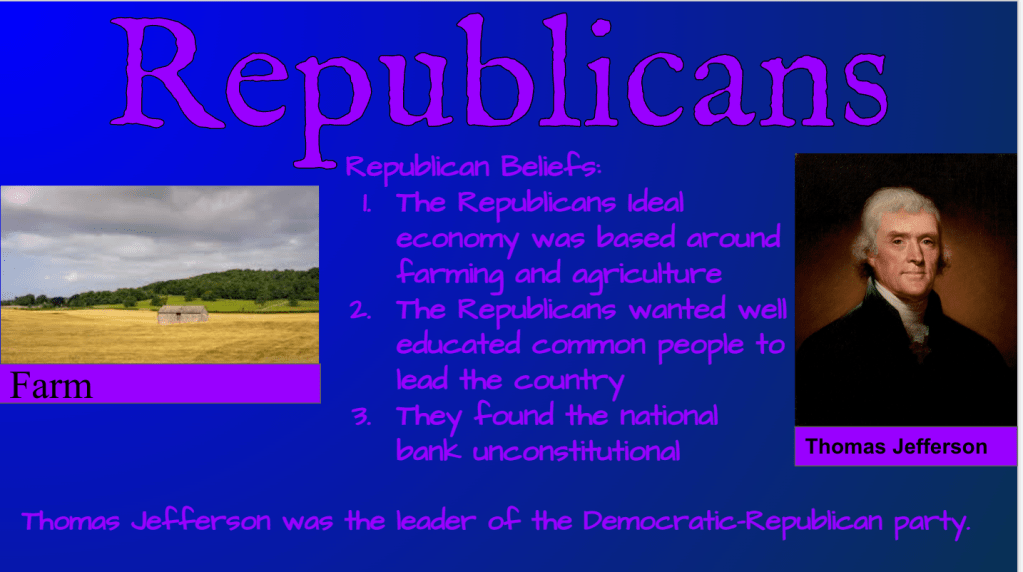
Tuesday – CyberSandwich (Democratic-Republicans), Fast and Curious

Wednesday – John Adams Peardeck, Fast and Curious

Thursday – Review Day, Fast and Curious, Word Up Wednesday

Friday – Hexagonal Learning, Fast and Curious

Extra activities I created on the fly: Assessment Choices, John Adams Primary Source (adapted from Rosalie Metro), Frayer (@historysandoval template)

Monday

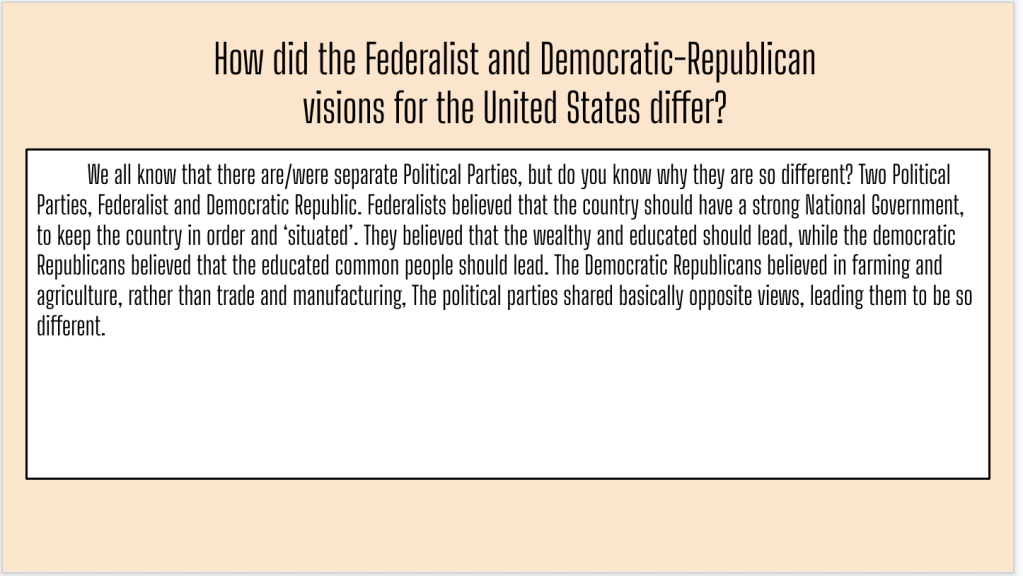
The main question for this unit is, “How did the Federalist and Democratic-Republican visions for the United States differ?” Last year, I created a choice board for the Federalists and Democratic-Republicans. This year, I divided up the political parties into two days as we did a CyberSandwich.

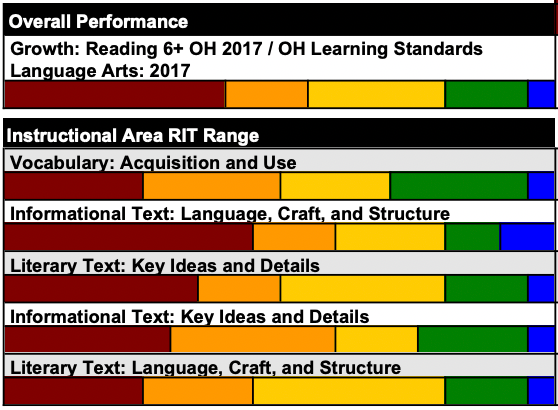
Before our CyberSandwich, I ran a five minute Fast and Curious with Gimkit. The Gimkit had basic vocabulary from last week and new questions related to content from this week. After five minutes, the class averages were: 47%, 67%, 72%, 52%, 74%. I gave some quick feedback and we transitioned to a CyberSandwich.

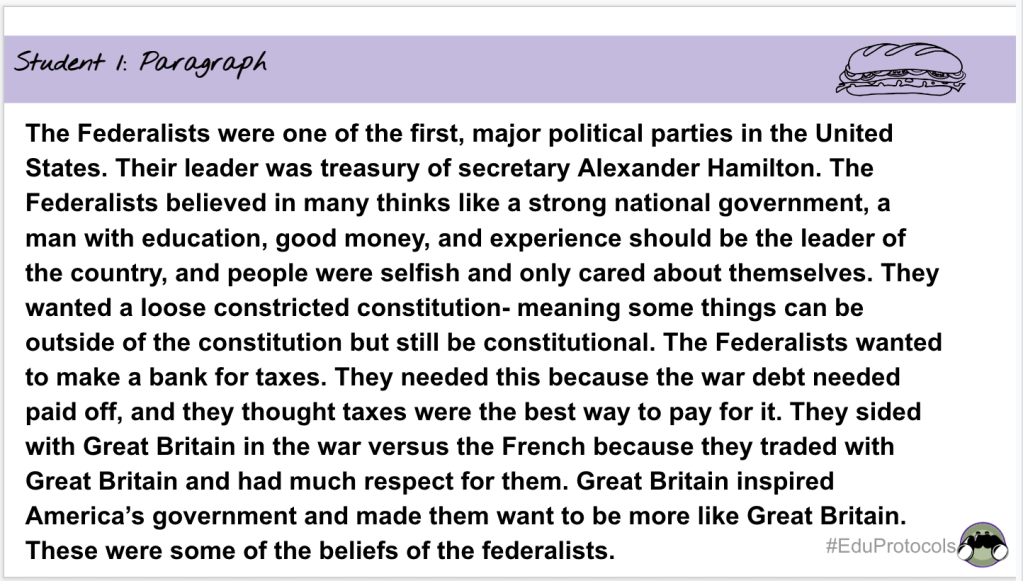
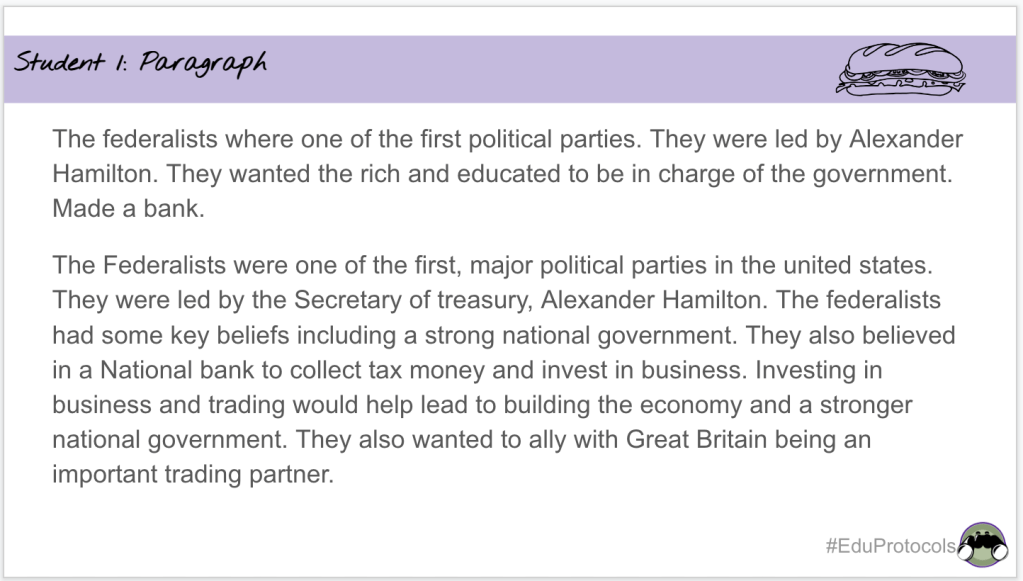
I ran a typical CyberSandwich with a 10 minute reading and notetaking. I had students write down four important facts (beliefs) from their notes and discuss with a partner. Then we focused on writing a basic paragraph with a topic sentence, details, and a concluding sentence.

One thing I changed this time was the use of Chat GPT. If you don’t know what that is, please visit my blog post about this amazing site. I used Chat GPT to change the reading level of the textbook section so a third grade student could understand it. I went to Chat GPT and literally type, “Convert this textbook section into something a 3rd grader could understand.” Within seconds, I differentiated for several students and copied the converted article to a Google Doc. AMAZING!

At the end of the CyberSandwich, I ran the same Gimkit again for five minutes. This time class averages went to: 72%, 70%, 80%, 65%, 83%.

As the day continued, I began to think about Chat GPT again. I wanted to know how I could use it for feedback. I began copying and pasting student paragraphs into the chatbot asking it, “Grade this paragraph on Federalists.” It spit out some great feedback. It was fairly consistent. However, I learned to be more specific with my requests.

I decided to change my requests to, “Give feedback about the paragraph based on the topic sentence, 3 key beliefs of Federalists, and a concluding sentence.” Amazingly, it gave incredible feedback. It even picked up on students only identifying one key belief of Federalists. I was able to get feedback for 90% of my students in less than an hour. I copied and pasted the feedback as a private comment into Google Classroom.

I also found commonalities in the feedback and used it for a teachable moment on Tuesday.

Tuesday

From Chat GPT, I found commonalities in the feedback with weak topic sentences and using more details. Before we began to do a CyberSandwich about Democratic-Republicans, I shared the feedback with students. We discussed writing topic sentences and including more details. I provided a model paragraph as an example.

The students are really great with including information right in front of them. For example, they are great at including three key beliefs. However, they are weak with adding their own thoughts, or more information. This same feedback would be said again on Friday with the Hexagonal Learning.

Again, I used Chat GPT to differentiate reading levels for the students. We ran a typical CyberSandwich with a 10 minute read, 5 minute discuss, and a 10 minute summary write. This time, however, I wanted students to focus on feedback to improve their paragraphs. I felt like the topic sentences and inclusion of more details was better after the feedback, example, and more reps.

After the CyberSandwich, I ran another Fast and Curious on Gimkit. The class averages were as follows: 81%, 81%, 80%, 71%, and 86%.

Wednesday

I hate lecturing. Sometimes it needs to be done. Sometimes I need to explicitly say why things happen, or explicitly say connections between historical events. Wednesday was reserved for a PearDeck. I prefer Nearpod, but I didn’t have time to convert my slides.

I had a PearDeck about John Adams and his presidency. It focused on the Election of 1796, XYZ Affair, Alien and Sedition Acts, and the Election of 1800.

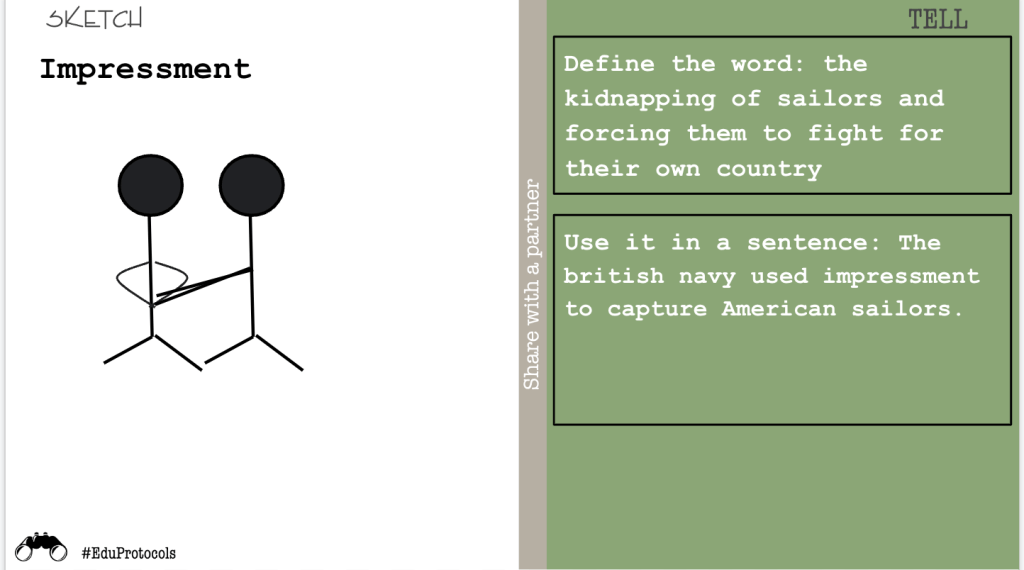
The PearDeck was interactive with some Sketch and Tell built in. It contained some summary writing practice as well. Now, I don’t know how you view student engagement. I view students engagement as, “Enthusiasm, curiosity, optimism, motivation, or interest toward a lesson.” With my definition, student engagement is not great with PearDeck or Nearpod. If my definition of students engagement was: “Listening attentively, participating in discussions, turning in work on time, and following rules and directions,” then these tools are awesome. I had 88% student engagement throughout the day.

A quick Chat GPT note to add – I copied and pasted some of the paragraphs from the PearDeck slides into the chatbot. I requested it to, “Create a multiple choice question for this paragraph.” It was awesome because I suck at writing questions.

My last period of the day saw we were doing a PearDeck. They flipped out. It’s a small, good class. I don’t take offense to stuff like this. I simply asked them, “What do you want to do?” They responded, “Anything but a PearDeck.” Then I asked, “Does anyone want to do a PearDeck?” A few raised their hands. For the rest I created a new lesson with an EdPuzzle video and a primary source analysis. Everybody was happy. Some even mentioned, “I’ve never seen a teacher just completely change a lesson on the fly like that.” My response, “Never fear when Moler’s here.”

At the end of all the lessons, I had students complete the Fast and Curious Gimkit again. I added new questions about John Adams. This time scores took a dip. However, the scores were fascinating as EVERY class averaged a 76%. (76%, 76%, 76%, 76% and a 76%).

Thursday

I was feeling the Fast and Curious wasn’t enough to check for understanding. I created a bunch of review activities. Here is what I put together:

  1. Gimkit for Fast and Curious – same questions and the class averages were: 84%, 84%, 85%, 78%, and 87%.
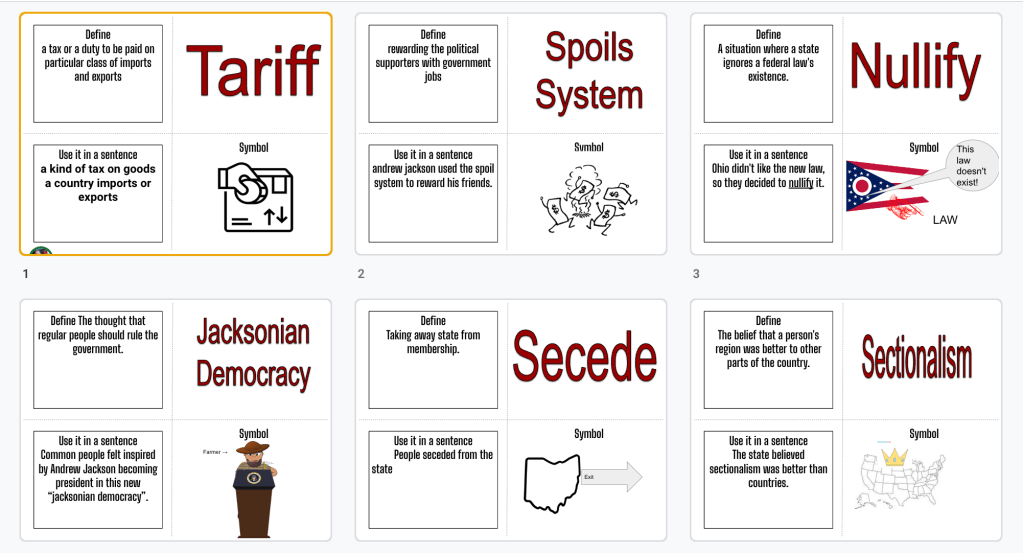
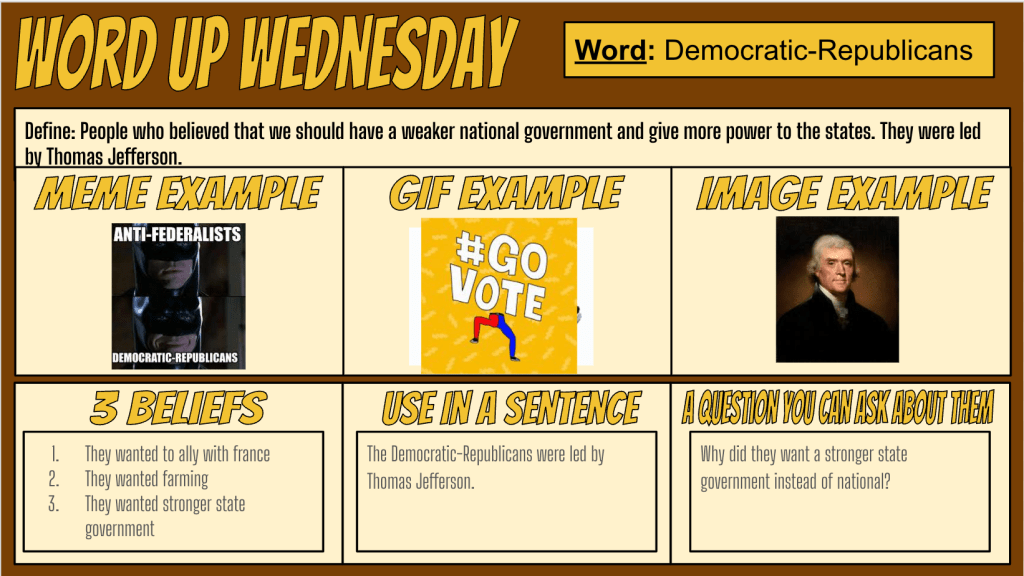
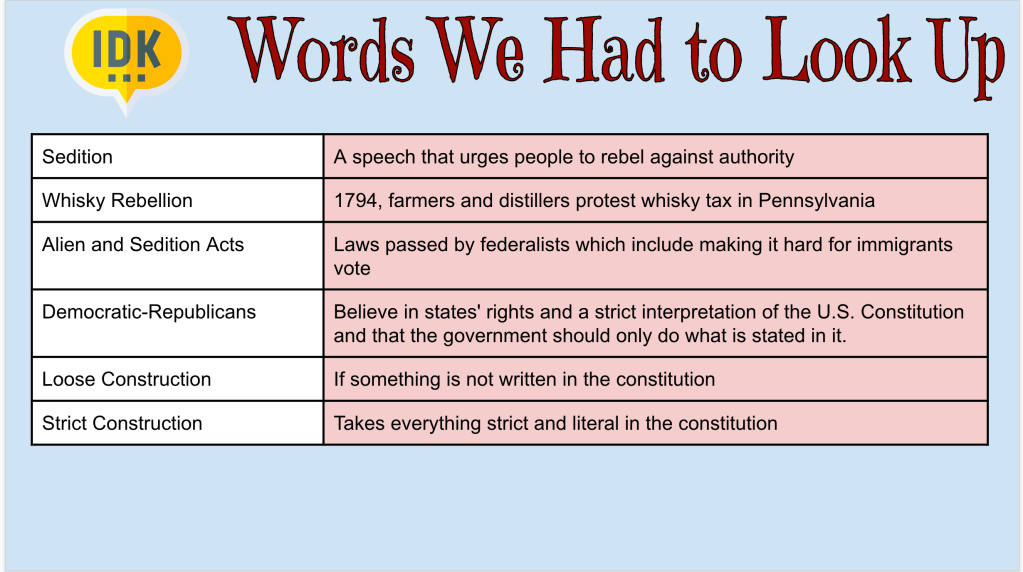
  2. Word Up Wednesday – students were still struggling with Federalists and Democratic-Republicans beliefs. I saw this on the Gimkit data. This worried me, and so I had students partner up to research the beliefs of the political parties, write definitions, and apply images.
  3. Frayers – one class really needed something different. I had them do the Gimkit and I took the most commonly missed questions and developed a series of Frayer Models. The most commonly missed questions related to: Federalists, Democratic Republicans, Washington’s Farewell Address, and the Alien and Sedition Acts.
  4. Find 6 errors – I asked Chat GPT, “Write a short, nonfiction text about the Alien and Sedition Acts and include 3 factual errors.” It wrote the article, I copied and pasted it to a Google Doc, and added in the errors myself from the Chat GPT suggestions. In the past, I would have done this myself and it would have taken an hour. With Chat GPT, it took 30 seconds. I had students get into groups and they had 8 to 10 minutes to find a correct the six factual errors in the article.

Overall, it was a good review day. Lots of different activities. One students even mentioned, “This class flies by.” Yes, when you’re doing multiple things in one class period, yes it does. When you’re working bell to bell, yes it does.

Friday

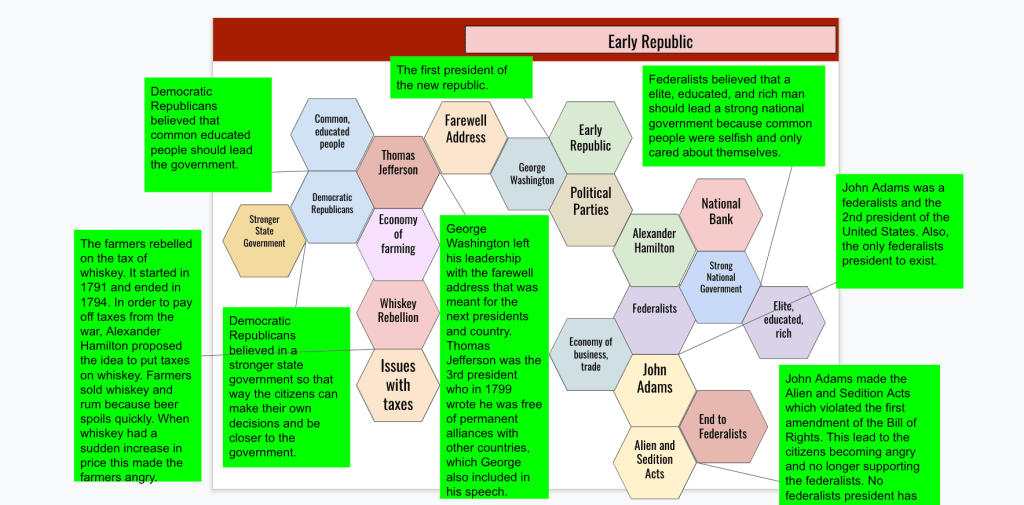
We used Friday as the day to wrap up the lesson about Federalists and Democratic-Republicans. I posted Hexagonal Learning which is a familiar lesson for the students. Hexagonal Learning was created by Betsy Potash (@betsypotash) and featured in Kim Voge’s (@kvoge71) book, Deploying EduProtocols. The template I used was designed by Stephanie Howell (@mrshowell24).

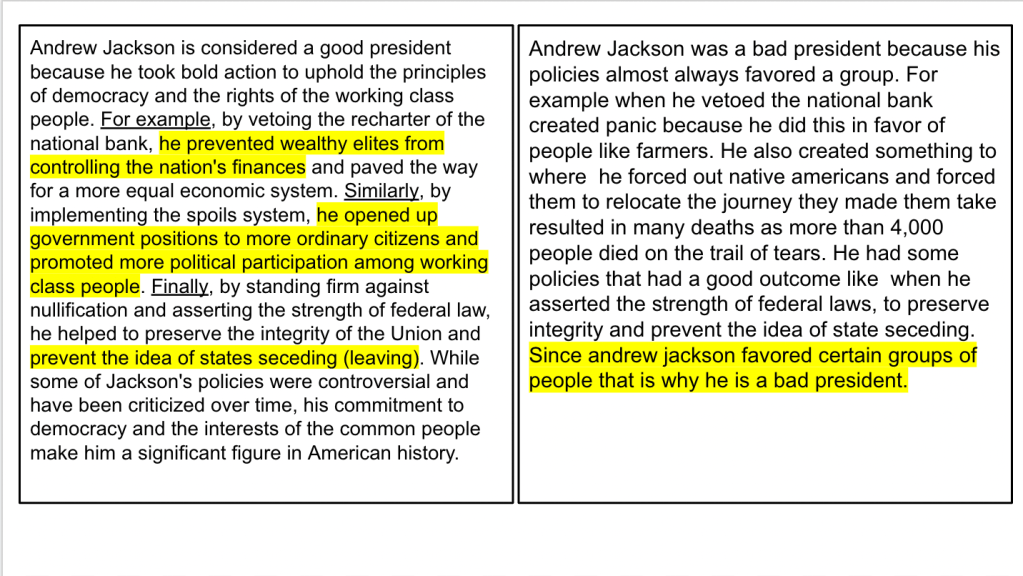
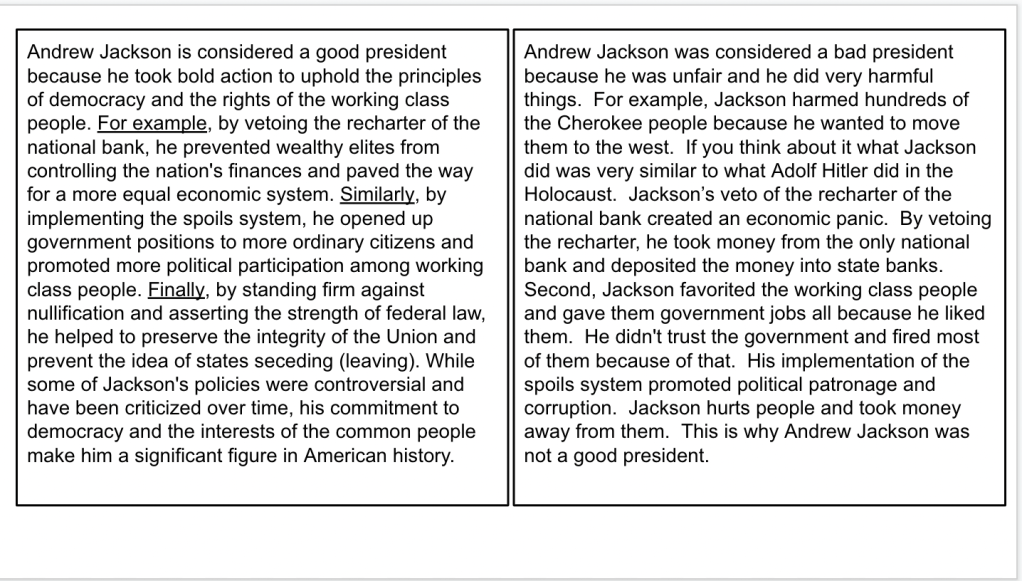
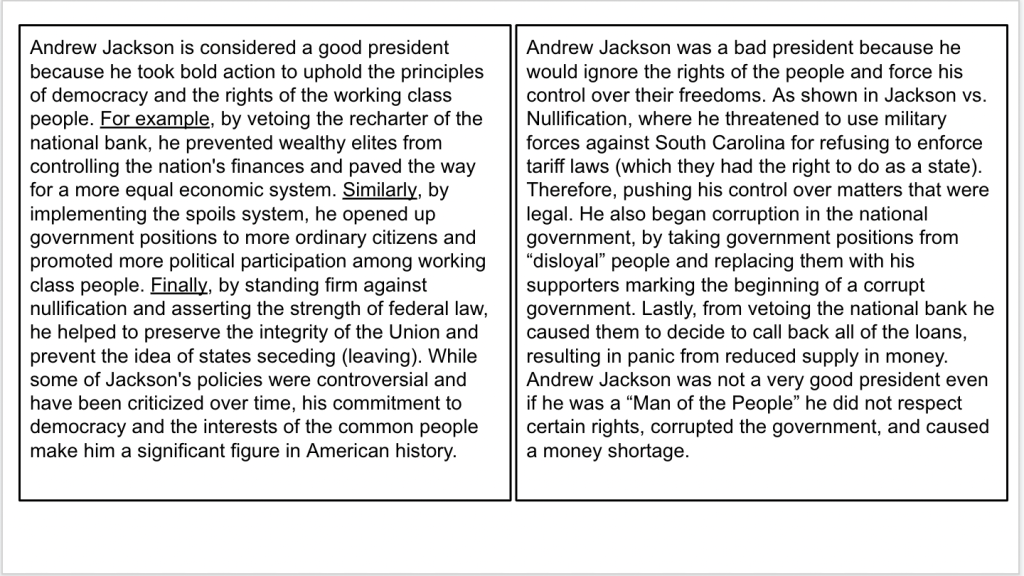
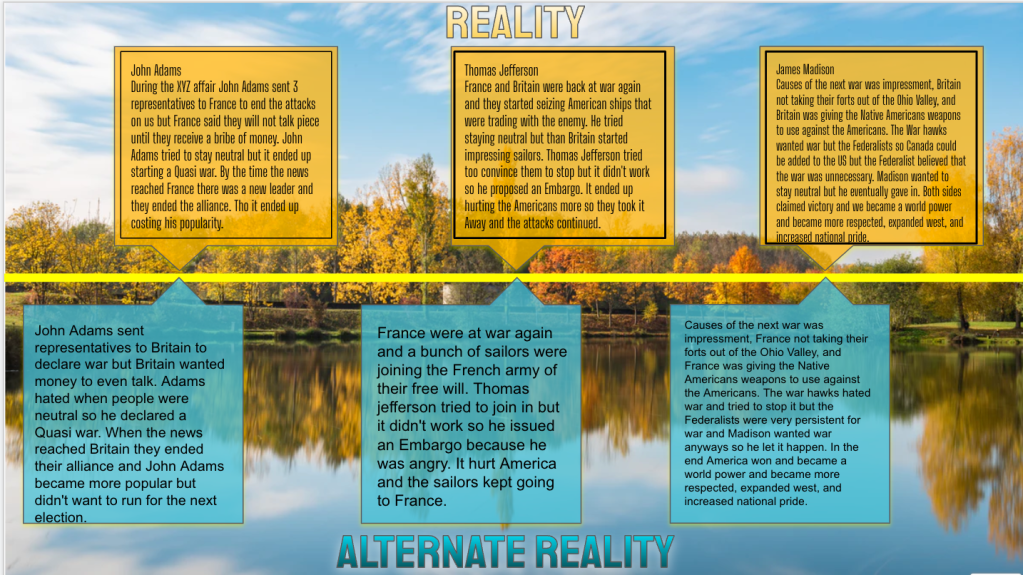
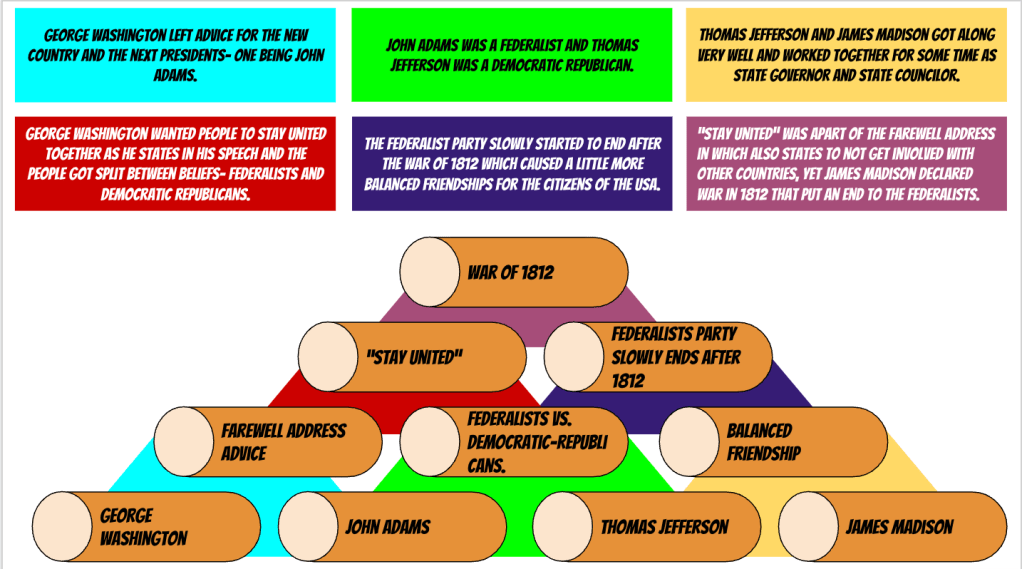
On Thursday, one group of students completed a Hexagonal Learning template. They turned it in, and I gave them some feedback. What appears to be awesome work was vague, and needed more details. Here is what they turned into me:

The students didn’t like my feedback, but it was helpful. I used their template as an example for my other classes. For every class, I posted this example (names removed) and had the students grade it on a 4 point scale. Most students gave this a 3 or a 4. I gave this a 2 or 1.5. My classes were surprised to learn this grade. However, I explained, “These students simply rewrote the information in the hexagons with a sentence. No extra information. No extra detail were added.” This analysis really helped the students with completing these activity. The discussions among partners was awesome too!!

One of my classes (a different class from Thursday) started complaining about Hexagonal Learning. So, I put together a list of choices:

  1. A solo iron chef – design a slide about Federalists, design a slide about Democratic-Republicans, use the information to construct a paragraph answering the essential question. – by yourself
  2. Netflix – create a series about the fight (beliefs) between Federalists and Democratic-Republicans. Your series description should answer the essential question above. -by yourself
  3. Hexagonal Learning – Use and connect all the hexagons. Add in new/missing information for 8 connections. (an example in bright green is provided) – partner/2 people

This class was really appreciative of this change and addition of choices. Typically, I don’t get much from this class. BUT, most students finished their choice. It was awesome.

At the end of all classes, I ran a Gimkit for 7 minutes and took their average as a grade. I had one criterion – you must answer 22 or more questions. Anything less than 22 questions resulted in a 1 out of 10 grade in ProgressBook. The class averages were as follows: 87%, 87%, 87%, 84%, 91%. Overall, a successful week despite me feeling like this lesson is disjointed and not great.

More Chat GPT Stuff

I thought of two more ways to use Chat GPT:

  1. 2 Truth and 1 Lie – have it create a list of 2 truths and 1 lie related to social studies content. Absolutely amazing and a great way to get students thinking.
  2. Odd one out – have it create a list of 3 items with 1 item being one that doesn’t belong. This is great, but I wish the items were more closely related to create more a discussion and debate on the odd item out.

Using Chat GPT to Enhance Learning

Chat GPT is the current, controversial topic in education. I understand the disdain of people with this new tool. However, having an immediate, negative reaction is way too easy. Throwing up your hands and questioning why we even have to teach is way too easy.

I see a tool like Cat GPT and think, “How can I use this to make my life easier? How can I use this to enhance my instruction? How can I use this to enhance my feedback?”

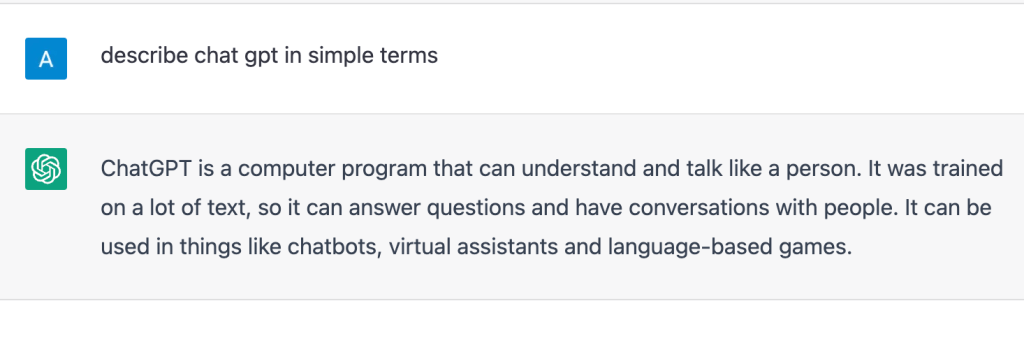
What is Chat GPT? Rather than me explain it, I visited the chatbot and asked it to describe itself. Here is a screenshot of that query:

In other words, artificial intelligence to answer questions, have conversations, or write essays. However, what can it be used for to help teachers? Here are some ways I have used Chat GPT in my social studies class:

Differentiation – I wanted a quick way to differentiate for multiple levels of students within my social studies class. I took a textbook section we used for a CyberSandwich and I asked the chatbot to, “Rewrite this textbook article for a 3rd grade reading level.” I also asked it to, “Rewrite this textbook article for a 10th grade reading level.” Within seconds, I have differentiated for various reading levels in class.

Feedback – the more specific you are with your queries, the better. During our CyberSandwich about Federalists, I wanted students to write a summary about Federalists and their beliefs. I wanted students to focus on topic sentences, 3 key beliefs, and a concluding sentence. Later that night, I decided to see if Chat GPT could grade. At first, I was asking it, “Grade this paragraph about Federalists.” The feedback was okay. I changed the query to, “Give feedback on this summary about Federalists focusing on the topic sentence, 3 key beliefs, and a concluding sentence.” The feedback was AMAZING. I was able to give feedback to 90% of my students by copying and pasting it as private comments through Google Classroom. I also picked up on commonalities of feedback and gave class feedback on improving topic sentences and adding more details. Based on the feedback, the paragraphs with our second CyberSandwich with Democratic-Republicans was tons better.

New ways of thinking – I asked Chat GPT to, “Create a nonfiction, short text about the Alien and Sedition Acts with 3 factual errors.” In seconds, it created a short text that I copied and pasted to a Google Doc. It suggested errors that I manually put in myself. That day, I had students get into groups and gave them 8 minutes to read, identify, and correct all the factual errors.

Questions – I am the worst at creating questions. During one of my lessons, I needed some quick questions to add to a PearDeck. I got on Chat gPT and asked it, “Create multiple choice questions based on this passage…” I copied and pasted the passage from the PearDeck slide and I have multiple choice questions within seconds. I also copied and pasted a textbook section and asked it, “Create multiple levels of questions for this textbook section…” Within seconds, I had multiple DOK leveled questions I could copy and use.

UPDATE**

This new idea falls under questions.

  1. Create a video using Screencastify and upload the video to Youtube.
  2. Paste the Youtube URL into YouTubeTranscript. This will automatically create a transcript.
  3. Copy and paste the transscript into ChatGPT and ask it to make questions.
  4. Load your video into EdPuzzle and copy and paste the questions into the video.

As I hear, or think about, new ways to use Chat GPT, I will keep adding more information to this post. Is this system perfect? No. But, it can provide ideas to get us thinking. It can be used to save time. It can be used to enhance learning. It’s definitely a game changer…in the right hands.

UPDATED (2/28/23)***

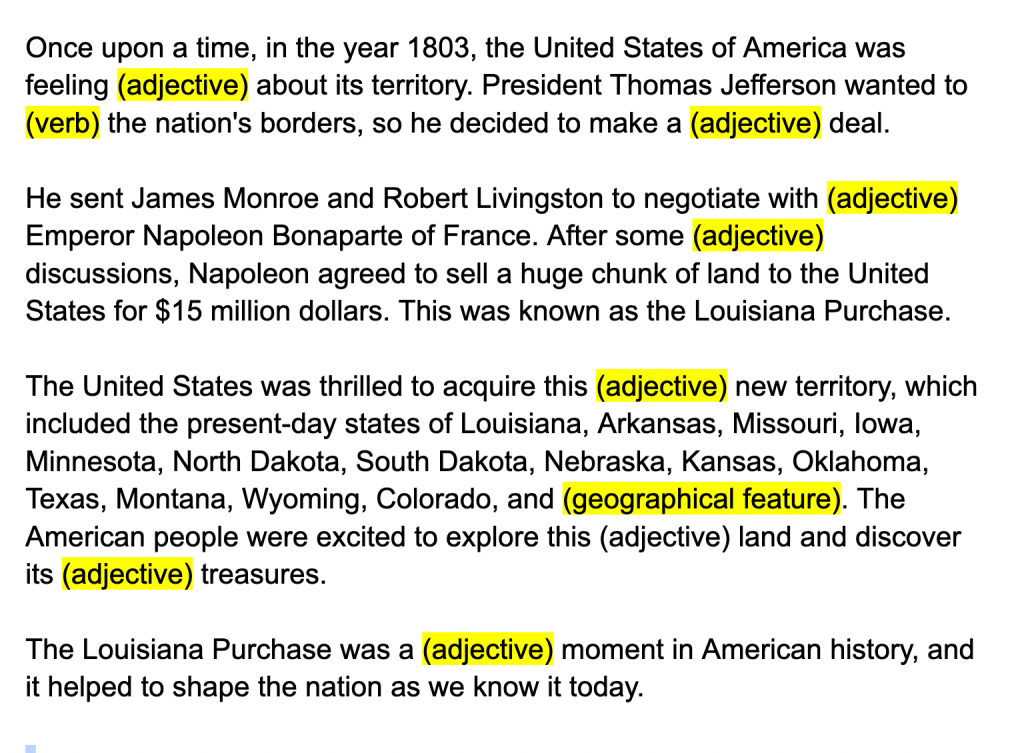
  1. Use ChatGPT to create a historical Mad LIb. I first asked, “Do you understand mad libs?” It responded with a long explanation of Mad Libs. Then I asked it, “Create a Mad Lib about the Louisiana Purchase.” It created a nice, detailed Mad Lib with spots for nouns, adjectives, verbs, etc. I copied the creation to a Google Doc and highlighted the blank spaces.
  1. I saw this on TikTok and it blew my mind – use ChatGPT to create questions for a Blooket game in seconds. I had to try it myself and made a video…

The Week That Was In 505

Back at it with a three day week and a new unit. We began the Early Republic unit where we focus on the first five presidents of the United States. I decided to make some changes to my unit this year.

In the past, I used this as a blogging unit. Students would learn about Federalists and Democratic-Republicans, create a character, and blog from that characters perspective. They would analyze the decisions of the presidents from their character’s perspective and party affiliation. I would infuse the lesson with EduProtocols, and it was awesome. However, I’m tired. I’m exhausted. I’m worn down. As much as I love this unit, and set up of the unit, I don’t have the energy to ready 115 blog posts. I don’t have the energy to motivate students to keep blogging and writing.

With that being said, I decided to use the lesson from our History Alive book and infuse it with EduProtocols. In my opinion, a regular textbook lesson, infused with EduProtocols, is just as effective and engaging as my blogging lesson.

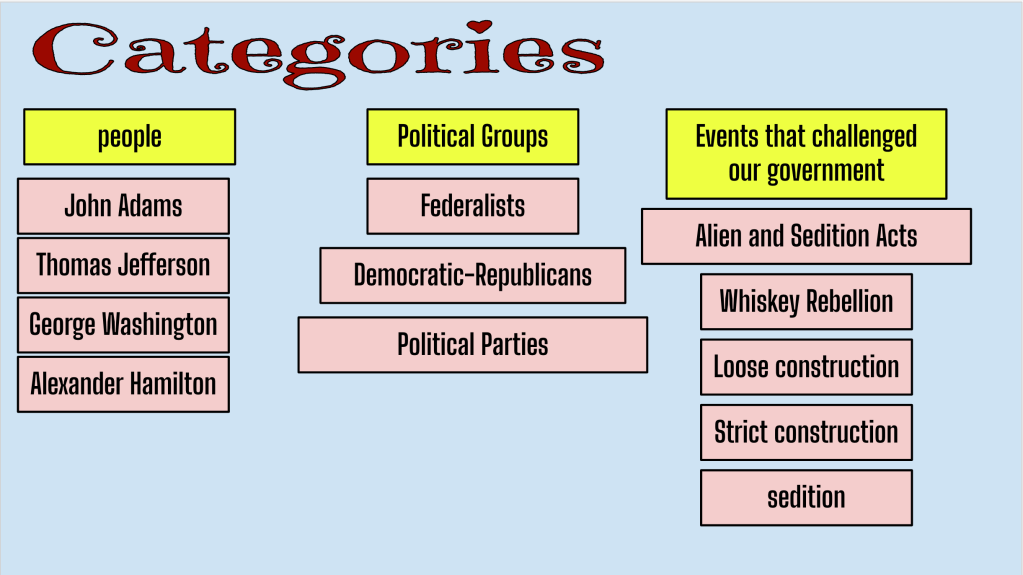
The first lesson in my unit focuses on political divisions in the early republic. We look at the different viewpoints of Federalists and Democratic-Republicans. We also focus on George Washington, his cabinet, the Whiskey Rebellion and a growing divide between the political parties.

This week’s focus was on some vocabulary and the George Washington presidency. Here was our week of learning:

Wednesday – Thin Slide, Pile of Words Vocab, Fast and Curious

Thursday – Word Up Wednesday, Iron Chef, Fast and Curious

Friday – Nearpod Farewell Address, 3xCER, Fast and Curious

Wednesday

I’m always searching for better ways to introduce vocabulary. On Tuesday, I happened to see a Tweet from Stephanie Howell (@mrshowell24) referencing a blog post from Dr. Catlin Tucker (@Catlin_Tucker) about a vocabulary strategy called Pile of Words. When I dove into the blog post, I realized the strategy was created by Jay McTighe. As I read about this strategy I was intrigued and had to use it with my eighth graders. The strategy works like this:

  1. I looked through the lesson and compiled a list of the most important vocabulary words.
  2. I added the words to a slide deck.
  3. I had students partner up into groups of two or three and discuss the words they knew.
  4. The students made a list of the words they knew and wrote their own definitions. (5 minutes)
  5. Then students made a list of the words they didn’t know and looked up the definitions. (10 minutes)
  6. Then students discussed what they learned and categorized their words. They created their own categories.
  7. As students discussed, I walked around asking questions.
  8. Finally, I had students predict what the lesson would be about.

I used this strategy with no context to the lesson. It was interesting to read some of their predictions. Some were great, Many were okay. The students need to get better at thinking beyond what’s in front of them. They need to get better at making connections. They need to get better at articulating their thoughts. Here are some responses:

  1. “I predict that this lesson will be about the first few presidents who had relations with the creation of the U.S. government, The different views that can be taken on the government and constitution such as loose and strict construction, and actions that were taken in revolt to certain things and what the government did in reaction to this.”
  2. “I can predict that in this unit we will be talking about people’s political beliefs and what people do in order to protect their rights. I can also predict that this unit will be about founding fathers and connecting to past lessons. Finally predict that we will be learning about new things about the government.”
  3. “I think this lesson will be about the government along with the political parties. We’ve heard many vocab words relating to this so i think that it makes sense for this lesson to be about government and political parties.”
  4. “This lesson will be about views on government, actions, and the people who were involved and their actions.”
  5. “I think that it will be about what happened after the constitution was written and after George Washington was elected.”

The last two responses listed reflect many responses. I’m trying to teach students to add more thought, and more details, to their writing. Either way, the main focus of this vocabulary strategy was engaging students with something new and building some background knowledge. Here is a group example from a class period:

After the completion of the Pile of Words strategy, we did a quick Thin Slide EduProtocol. I played a song entitled, Hail Columbia, and had students use one picture and one word to show the mood of the song. Many students mostly listed happy or proud for the mood. I timed the Thin Slide with song length – three minutes. At the conclusion of the song, students presented their slide. We finished class with a Gimkit fast and Curious with vocabulary and unit related questions. The initial class averages were as follows: 54%, 52%, 67%, 53%, and 63%.

Thursday

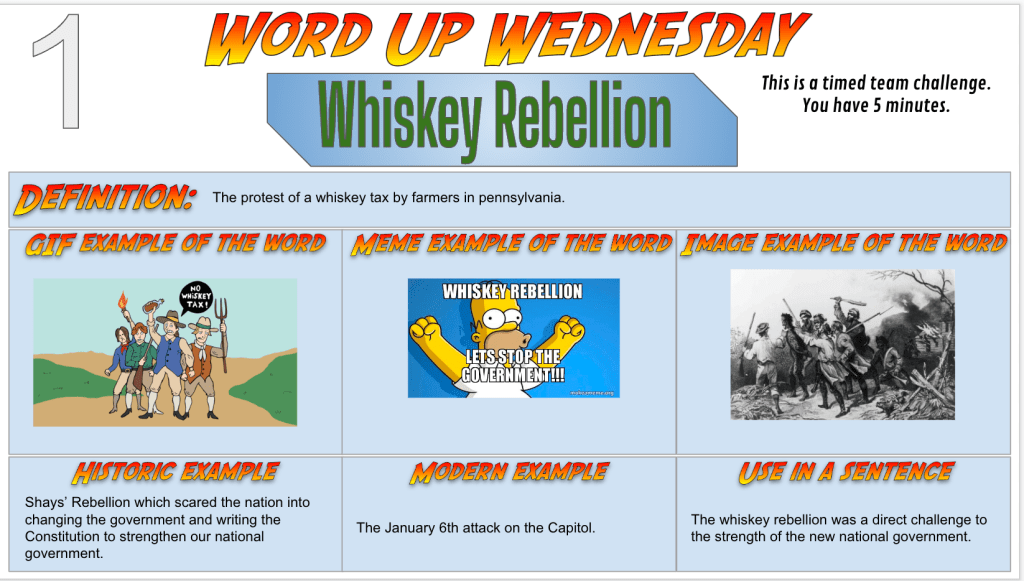
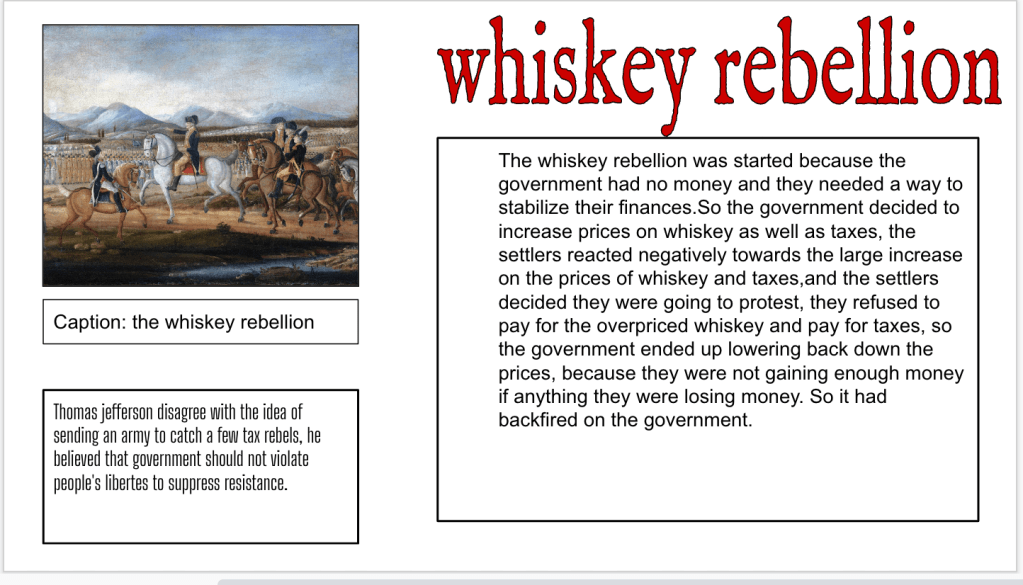
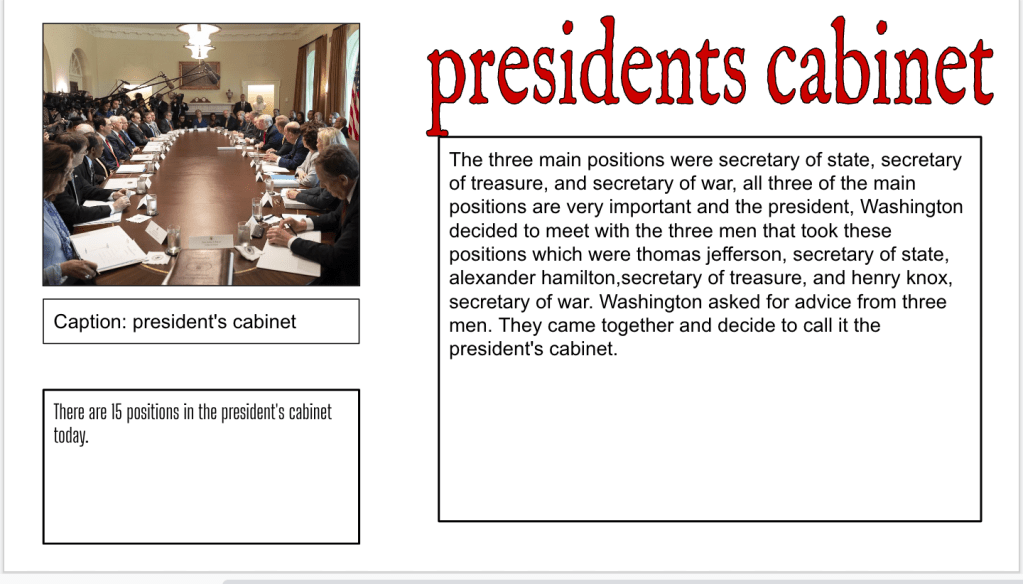
Thursday was another day to try something new. I reviewed the Gimkit data and determined the most commonly missed questions related to the presidential cabinet and the Whiskey Rebellion. As a result, I found a Word Up Wednesday template created by Shaun Moriarty (@MoriartyHistory). The original concept of Word Up Wednesday was created by Ryan Stephans (@Coach_Stephans).

Before the lesson began, I created two different slide decks. One slide deck contained the word Whiskey Rebellion. The other slide deck contained the word Presidential Cabinet. Here was my procedure for the lesson:

  1. Students got into groups of two to three.
  2. I timed the first round for six minutes.
  3. Students claimed a slide on the slide deck and began collaborating to complete their slide.
  4. Students had to define the term in their own words.
  5. Students had to find a GIF, meme, and image representation of the word.
  6. Students had to use the word in a sentence, find a historical example, and find a modern example.

The first round, students really struggled to complete the slide. However, most students quickly learned the importance of dividing and conquering together.

The students also struggled with finding historical and modern examples. I had to pause the timer at one point and show them how to find an example. Furthermore, I had to give some ideas for examples. I’m really trying to help them critically think….I really am 😩. At the end of it all, the students really enjoyed beginning class with Word Up Wednesday.

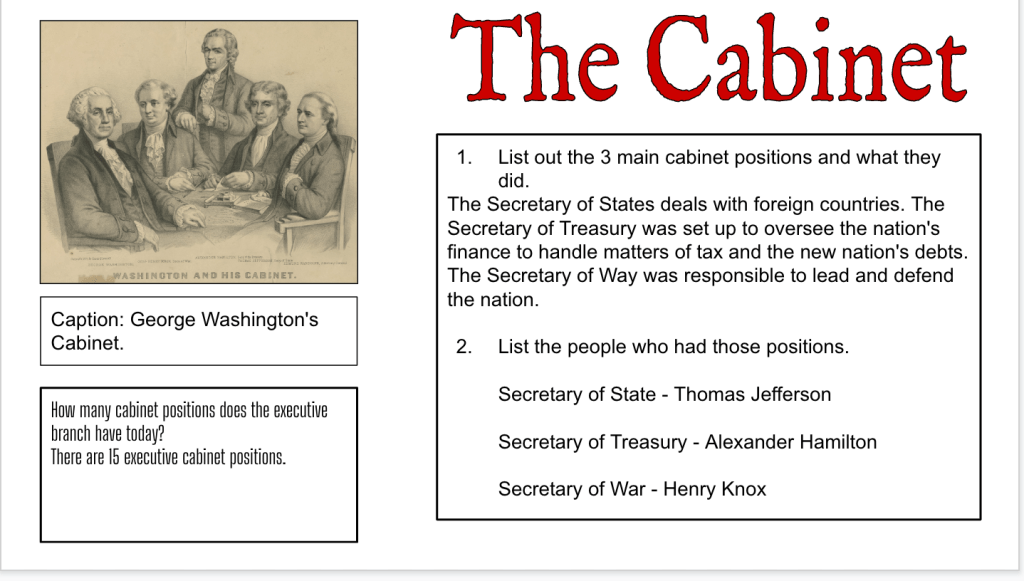
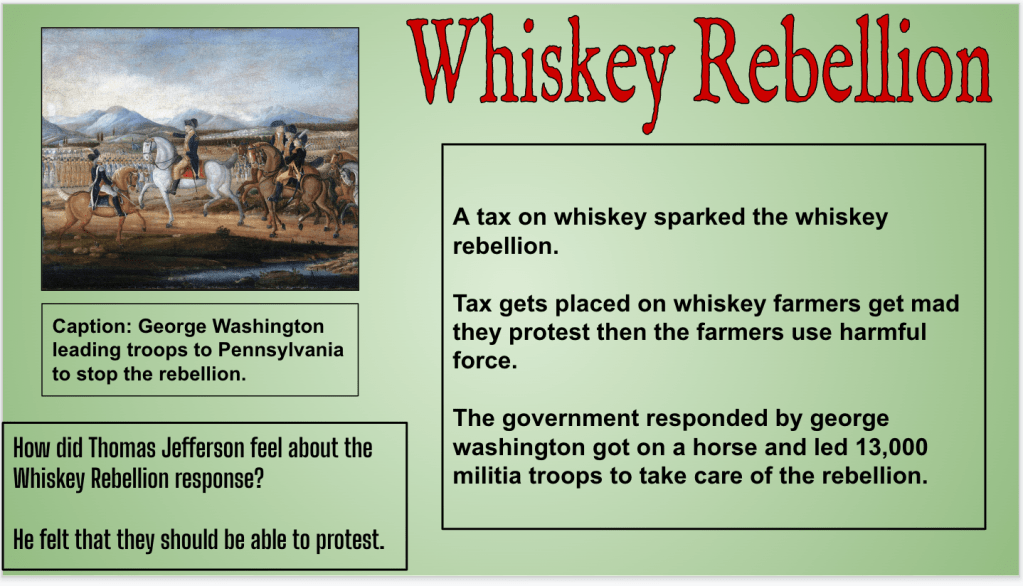
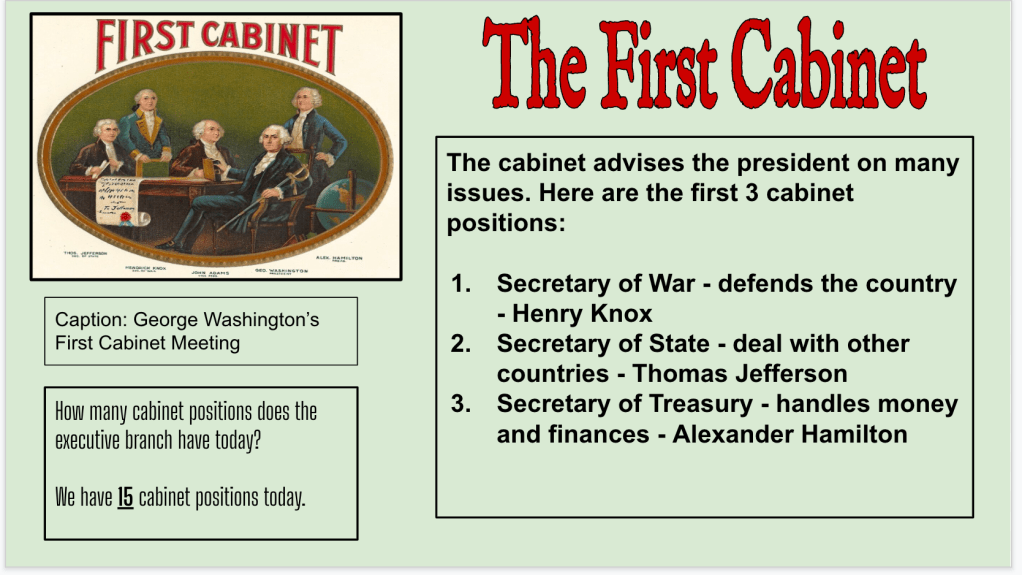
When transitioning to the Iron Chef, I made sure to mention the words from Word Up Wednesday were important because it was time to understand the historical significance of them. The Iron Chef for the day was about George Washington’s cabinet and the Whiskey rebellion. For the Iron Chef reading, I took two major sections from History Alive, condensed them down and use the important information.

I set a timer for 18 minutes to have the students complete their slides. They worked individually as they added pictures, changed the title, answered the questions, and completed the secret ingredient questions. Here are some examples:

To wrap up class, we used the same Gimkit from Wednesday. I ran the Gimkit for 8 minutes. This time class averages were as follows: 67%, 65%, 73%, 58%, 76%.

Friday

Friday we transitioned to Washington’s Farewell Address. In years’ past, I usually began with Federalists, Democratic-Republicans, and Hamilton vs. Jefferson. This year, I used Washington’s warning about political parties to set up to for next week’s topic of Federalists vs. Democratic Republicans. Through this reflection, I like beginning with political parties better. It just makes more sense to me. The structure of my current lesson, however, is the path I chose so I’m sticking to it.

When students came in, I had a Nearpod code on the board. In the Nearpod, I put together some slides to help students make sense of Washington’s Farewell Address. Here was my setup:

  1. Slide 1 – intro slide
  2. Slide 2 – What do you know about George Washington? collaboration board.
  3. Slide 3 – two minute intro video on George Washington (this served as review of his cabinet and Whiskey Rebellion from Thursday).
  4. Slide 4 – context slide about the Farewell Address.
  5. Slide 5 and 6 – translate Washington’s Farewell Address drag and drop slide.
  6. Slide 7 – Washington’s main warnings – fill in the blank
  7. Slide 8 – A link to a 3xCER slide deck.

It was important for me to help students translate Washington’s words into modern english. With the words translated, followed up with a fill in the blank summary of Washington’s warnings – it would only serve to help the students complete the 3xCER. If I didn’t have students translate his words, the 3xCER would have been a disaster.

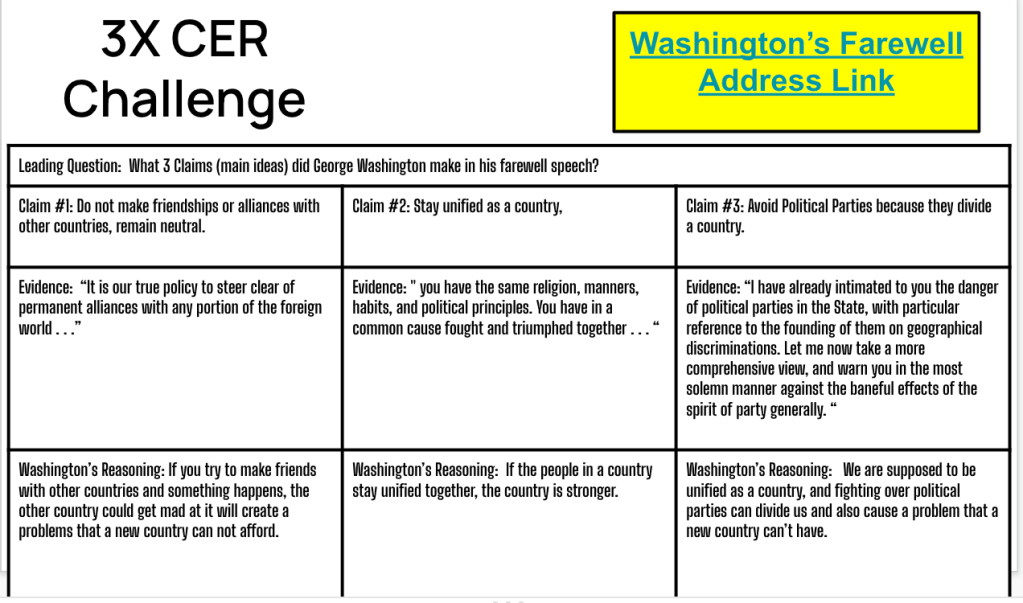
I gave students 12 to 15 minutes to complete the 3xCER. They did an excellent job placing claims (Washington’s warnings) in their own words. They used quotes from the Farewell Address as evidence. Finally, I wanted them to think about Washington’s reasoning for the warnings. For the most, the students’ reasoning was okay. They still needed to add more detail and thought. Here are some examples:

To conclude class, we did a Fast and Curious with the same Gimkit. This time class averages were as follows: 72%, 75%, 78%, and 83%. Not all classes were able to do the Gimkit.

The Week That Was In 505

December, so far, has been the longest month ever. In my past 11 years of teaching, I can count on one hand how many times I’ve missed school. This year, this semester, I have missed 15 days, A combination of sick, personal, and professional.

Since Thanksgiving it’s been a multitude of issues – flu, covid, pink eye, other random viruses, the axle broke on my car during rush hour, and a death in the family. I finally got around to getting a Christmas tree – the $2.99, tabletop special from Kroger.

Chances are it will go without lights, but we’ll put some ornaments on it. However, that tree seems pretty symbolic of my December…so far.

Now, back to school. This week my goal was to finish the Constitution unit. I had two more remaining items – popular sovereignty and federalism. I was hoping to try some new things with these topics, but that wasn’t the case. I decided to stick with what I knew, and what I had available. As a result, we go through popular sovereignty, federalism, and did a review for the Constitution unit.

By the end of the week, I gave my Constitution citizenship test again. I asked the same 10 questions I asked three week ago. I like to take the first results and compare them to the second, or last, results after the students learned basic principles of government within the Constitution.

Due to some of my absences, I offered different challenges for students with the Citizenship test. I made a fil in the blank version with Quizizz and a multiple choice version. The results were great considering I felt like I did a poor job with this unit.

Monday – Popular Sovereignty CyberSandwich, Fast and Curious

Tuesday – Federalism Mystery Box Sketch and Tell, Federalism Notes

Wednesday – Resource Rumble Review

Thursday – Branches of Government Breakout, Citizenship Test (version 1, version 2)

Friday – Gimkit Reviews

Monday

Popular sovereignty was up first this week. The goal for this lesson is to have students understand the idea of popular sovereignty, and to have students identify the idea of popular sovereignty in the words of founding documents. I began class with a Quizizz that had students show their understanding of the definition for popular sovereignty and examples of popular sovereignty. The class averages were as follows: 45%, 50%, 55%, 47%, 65%. After the quiz finished, I asked all my classes, “What is the commonality among all the questions?” Each class was quick to understand the word ‘people’ in all the questions.

Next, I had a reading about popular sovereignty. I chose to read this article because I like to read to the class. Plus, Story Time with Moler is a crowd favorite. Some students also had the opportunity to watch a video about popular sovereignty. I scaffolded the CyberSandwich with these questions:

  1. What is popular sovereignty?
  2. List 3 ways popular sovereignty is expressed in a democracy.
  3. Include 1 quote from a founding document that shows popular sovereignty.

At the conclusion of the reading, I had students complete a Sketch and Tell for their summary. I think it’s important for them to take this abstract idea and construct it with an image. With their summary writing, I offered these four things to focus on:

  1. Define popular sovereignty.
  2. One way in which it is expressed today.
  3. A quote from a founding document.
  4. Concluding sentence

Here are some students examples:

After the CyberSandwich, we took the Quizizz again and the class averages were as follows: 80%, 88%, 93%, 95%, and 98%. This lesson is what I consider to be simple and basic, but it’s pretty powerful and produces consistent results.

Tuesday

The lesson on Federalism is one of my favorites. I set up this lesson as a mystery box lesson. I was hoping to combine the mystery box with a CyberSandwich, but I didn’t have time to set it up this year. In years’ past, however, I have run out of time for the Sketch and Tell portion. As a result, I cut out the Quizizz this year.

Here is the set up:

  1. Students come in and I have Oreo’s hidden in a mystery box.
  2. I have a guided notes sheet and I go through notes on Federalism.
  3. I start off the lesson with a hint to the mystery box: the number 3
  4. I go through expressed, concurrent, and reserved powers.
  5. At the end of the lesson, I give more hints to the mystery box – stuff, milk, filling, and Sam Porcello.

By the end of the lesson, students usually guess what’s in the box. They completely understand why the Oreo relates to Federalism. Last year, I had students create a picture with the Oreo. This year, some of my classes created pictures with Oreos representing expressed, concurrent, and reserved powers. Other classes I had them use Google shapes. Some classes I trust, some I don’t – it’s that kind of year. Here are some students samples:

Wednesday

Wednesday began with a student asking me, “Moler, can we do something where we get up and move?” I replied, “Yep.” Then I changed my entire lesson plan. I asked the class to give me five minutes as I wrote down eight review questions for a resource rumble.

All of the questions related to branches of government, checks and balances, popular sovereignty, and federalism. Basically, anything on the Citizenship test I was going to give to them again.

I can’t dive into the details, and set up of a resource rumble, but it was a fun time. The students love that review game and I’m glad a students spoke up.

Thursday

Thursday I was away from school for a funeral. So, I left the Citizenship test and a branches of government break out. (The branches of government breakout was a file I purchased on TPT about 7 years ago – therefore I can’t share it. I’m ashamed I admitted that 🤦‍♂️).

When I gave the citizenship test 3 weeks ago, I told the students the goal was to get six or more questions correct. Here are the results from the first time:

1st – 2/18 got six or more correct, 26% class average.

3rd – 0/29 got six or more correct, 24% class average.

5th – 2/24 got six or more correct, 25% class average.

7th – 2/20 got six or more correct, 27% class average.

8th – 3/14 got six or more correct, 34% class average.

After three weeks of lessons involving oreos, sketch and tells, choice boards, CyberSandwiches, and other EduProtocols, here are the final results:

1st – 18/18 got six or more correct, 89% class average.

3rd – 25/29 got six or more correct, 83% class average.

5th – 20/20 got six or more correct, 92% class average.

7th – 16/20 got six or more correct, 81% class average.

8th – 13/14 got six or more correct, 96% class average.

The caveat to this is it’s a combination of fill in the blank and multiple choice quizzes. However, I set up the Quizzes like this:

  1. Fill in the blank – students could take this quiz up to two times.
  2. Multiple Choice – students could take this quiz once.
  3. They could not take both quizzes. I encouraged them to challenge themselves and go for the fill in the blank.

Most students, however, chose the multiple choice test. In fact, 65% of my students chose the multiple choice, while 35% chose to do the fill in the blank.

Friday

Friday, I was out for the funeral again. Last day before winter break – I didn’t know what to do. I created a Friday Check In and put together a Gimkit of all first semester material. A very last minute, cliche thing to do, but I was making this in the hotel lobby at 10:30 PM. Story of my life – constantly finding ways to get things done, barely keeping my head above water. However, I usually manage to find a way.

With that – happy holidays!

The Week That Was In 505

This week we continued our unit on the Constitution. I focus on the principles of the Constitution – separation of powers, checks and balances, individual rights, popular sovereignty, federalism, judicial review, and limited government.

This week’s focus was on individual rights and judicial review. I was hoping to get to popular sovereignty, but a calamity day and a sudden switch to remote learning changed my plans.

Overall, it was a good week. Teaching the Bill of Rights is one of my favorite lessons. I try to find ways to help students engage and connect with government.

With my judicial review lesson, I used to have students go through Supreme Court cases. However, I needed a change. I put together a lesson with some EduProtocols. I was able to lead one, 48 minute class through a Fast and Curious (twice), Frayers, and a reading paired with a Thick Slide. The rest of my classes, with my absence, struggled to get through a Fast and Curious and Frayers.

Monday – Bill of Rights lesson

Tuesday – A modified version of a Resource Rumble (EMC2Learning)

Wednesday – Fast and Curious, Frayer, Thick Slide

Thursday – Calamity Day

Friday – Review Gimkit

Monday

On Monday, I began with a Fast and Curious Quizizz with the Bill of Rights. Most people remember the first two amendments, then it goes downhill from there. My Quizizz is ten questions long. The beginning class averages were the following: 45%, 42%, 38%, 25%, and 51%.

Next, I handed out a paper I created using Google Docs – it contained ten empty boxes for students to take notes. I asked the students to number the boxes and they could write notes or draw pictures. Whatever helped them the most. Then I proceed to act out the first ten amendments. I give the students ways to remember the ten amendments. I received from Dave Burgess a long time ago. Here are two examples of what I do:

  1. 3rd amendment – I talk about the story Goldilocks and the Three Bears. Goldilocks made herself at home and the 3rd amendment prevents the quartering of soldiers.
  2. 6th amendment – I show a clip of a pick six interception by Mike Hilton against the Steelers from the 2021 Bengals season. Then I mention how you need to be speedy to get a pick six. This leads to a fair and speedy trial.

I can’t share the rest of this because it’s Dave’s lesson. This lesson is one of my favorites. It’s engaging, the students laugh, I laugh, and it works. As I’m acting out the amendments, I keep coaching the students and reminding the students how to remember the amendments.

At the conclusion of the lesson, I have the students put away their amendment notes. Then I start of the fast and curious Quizizz again. I listen for the students making connections as the questions come up. For example, 3 bears, no quartering of soldiers, 3rd amendment. The class averages were the following after the lesson: 83%, 83%, 91%, 97%, 100%.

Tuesday

The day after the Bill of Rights lesson, every class begins with that fast and curious Quizizz from the previous day. I gave the students 3-4 minutes to answer the ten questions. The class averages were as follows: 80%, 81%, 85%, 88%, 95%. A slight drop, but still awesome class averages.

Now that we learned about the Bill of Rights, I wanted students to be able to apply the amendments to real life Supreme Court cases. I found a bunch of cases involving students and schools. Here are some of the examples I found:

  1. West Virginia State Board of Education v. Barnette (1943) – Pledge of Allegiance
  2. Mahanoy Area School District v. B.L. (2021) – Freedom of Speech with Social Media
  3. Ingraham vs. Wright (1977) – School Punishment

Around the room, I had eight envelopes up. Six of the envelopes contained Supreme Court Cases. Two of the envelopes had some checking for understanding stuff – a Quizizz and EdPuzzle. The EdPuzzle was a quick 2 minute video on how a case gets to the Supreme Court.

The students worked in groups of three to four and had forty minutes to complete as many of the envelopes as possible. Each of the students had to do 2 things:

  1. Discuss and guess which amendment was in question with each of the Supreme Court cases.
  2. Guess how the court ruled in each case.

Each group brought their papers to me and they did a fantastic job guessing the amendments involved. They were all pretty surprised on how the Supreme Court ruled when I told them the results of each case. After I checked their papers, I gave each group a piece of a question. I typed out this question, “Which amendment gave 18 year olds the right to vote?” I cut the question into eight sections. The groups had to piece together the question, find the answer, and the answer unlocked a lockbox.

Inside the lockbox were ten QR codes. Nine of the QR codes were NOT winners. Only one QR code was the winner. Surprisingly, three groups actually chose the winning QR code. I have no clue how.

Now, eighth graders are pretty tricky and sneaky. I know they share my secrets. As a result, I changed the question and lock box code during the day. The other question I typed was, “Which amendment limits the president to two terms?”

Wednesday

The use of Supreme Court Cases on Tuesday leads to a lesson on judicial review. I found an article on iCivics about Marbury vs. Madison. The iCivics article was good, however, I put myself in my students’ shoes and realized I needed to clarify a few things. Basically, I took the articles and reworded some sentences, added a few sentences, and changed some words.

I don’t know why, but background information leading to Marbury vs. Madison is easy for me to understand. However, I have a hard time wrapping my mind around the ruling in the case. I had to read it a few times to process it, and figure out to explain it to 8th graders.

When students arrived in class, I had a Quizizz up on the board with 9 questions about Marbury vs. Madison. I’m only sharing one class in this post because I had to leave school early. The class average for the first quiz was 48%. I went over some important words and questions such as: writ of mandamus and judicial review.

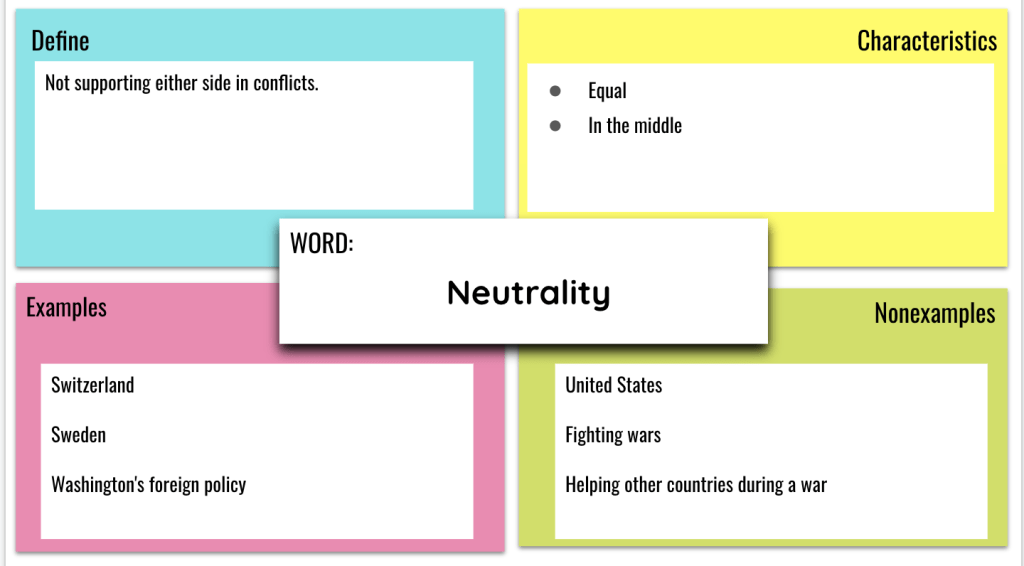
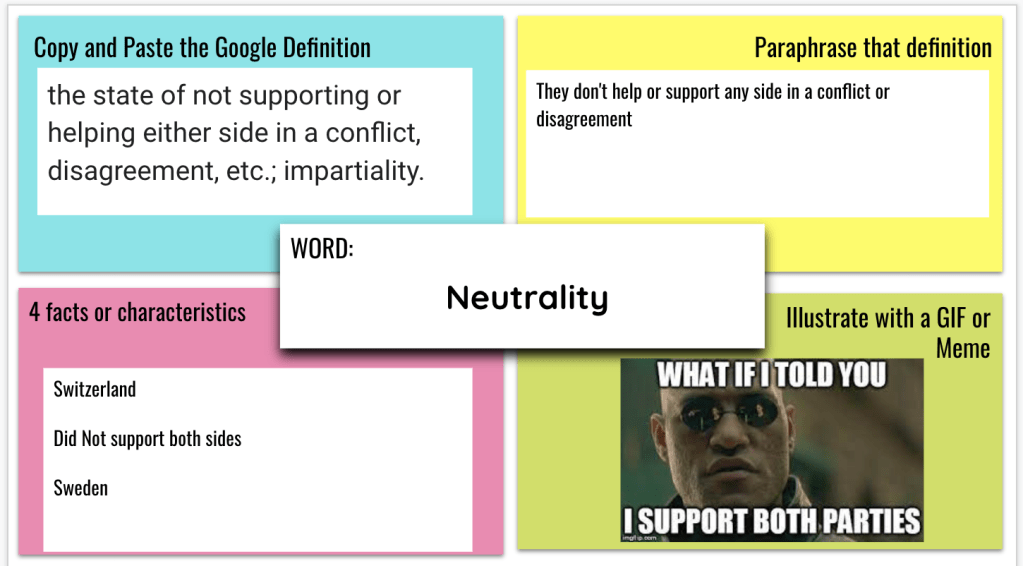
Next, I had students use a Frayer with the Supreme Court and Judicial Review. They copied and pasted a Google definition, paraphrased that definition, added 4 characteristics, and added a meme or gif. The students had 8 minutes to complete both Frayers. I really liked how they used information from the EdPuzzle video about the Supreme Court. For example, many of them included that the Supreme Court only hears about 1% of cases that are submitted. Some included that nine justices serve for life.

Next I had the students read the article on Marbury vs. Madison. I also included a History Channel link to a 3 minute video on the case. Students had the option of reading or watching and listening. Many of them chose to do the reading.

The students read about Marbury vs. Madison, and highlighted, for 5 minutes. Then I challenged them to design a Thick Slide using recall with what they just read. Some of them answered the challenge, but most students did not. That’s okay. The Thick Slide had students sharing background information for the case, defining judicial review, including arguments, and decisions, and adding relevant pictures. Here are some samples:

After twenty minutes, we took the same Quizizz again and raised our class average to 83%. My main goal from this lesson was to have the students understand the importance of Marbury vs. Madison and understand Judicial Review. With understanding the importance of Marbury vs. Madison – 85% got that question correct. With understanding Judicial Review – 85% got that question correct as well.

Thursday

No school – calamity day. Staff had to report, but I had to stay home and take care of my daughter. This has been the month from hell with sickness – flu, pneumonia, coughing, and pink eye.

I used the opportunity to plan for our remote learning day on Friday.

Friday

Friday was a remote learning day. This means that I keep things simple. I put together a Constitution review Gimkit. The questions related to the branches of government, Bill of Rights, and the judicial review. For 2 weeks of material, the class averages were okay – 74%, 76%, 79%, 70%, and 84%. At the conclusion of the game, I reviewed the most commonly missed questions. The data was telling me, however, that I need to go back and reteach the Separation of Powers. I may have an Iron Chef or a Retell in Rhyme for next week.

The Week That Was In 505

Saturday night I began to feel weird. Sunday I felt even worse. I knew I wouldn’t be able to go to school Monday. It’s rare for me to get super sick, but it seems to be happening more frequently the last few years. Rather than being concerned for myself, I was more concerned how I would begin the Constitution unit being absent from school.

I thought about it, and decided the separation of powers would be the best way to go. Most students are familiar with branches of government, and I had a self-paced choice board. I reviewed the choice board and made a few slight changes. I replaced the Quizlet link with a WordWall link, I changed the Quizizz links, and I replaced the EdPuzzle link from last year with a new video.

Normally, I don’t like to begin the Constitution unit with the Separation of Powers, but it was the best option. With Thanksgiving break, typical school interruptions, and my absences this unit on the Constitution seems to be disjointed, piecemealed together, and rushed. I’m not liking it so far.

I need to slow down a bit and build in more review opportunities. However, I have 2 more weeks before winter break begins. (Last year I had 4 weeks for this unit) I also need to focus more on vocabulary. As a result, I’m currently stuck on:

  1. Do I slow down by adding more gamified review opportunities and vocabulary review? – Doing this means the unit will not be finished before winter break. Our winter break lasts 17 days this year and that’s a loooong time and will affect their 2nd scores on the citizenship test.
  2. Maintain my pace? – I do build in review opportunities with Fast and Curious, and I can get this unit finished by winter break. Most students will probably do well on the citizenship test when I give it again.

I think too much.

Monday – Separation of Powers Choice Board

Tuesday – Separation of Powers Choice Board

Wednesday – Separation of Powers

Thursday – Checks and Balances Breakout (Created by Dominic Helmstetter)

Friday – Choice Day – What Do You Need?

Monday, Tuesday, Wednesday

The easiest way to begin the Constitution unit, with my absence, was with the Separation of Powers choice board. I created this choice board last with intentional activities for multiple processing styles. The choice board includes different activities such as Frayer, create an infographic, concept sort, EdPuzzle, etc.

Last year’s version had a Quizlet, but I changed this to a WordWall. If you haven’t checked out WordWall, please check it out. I pay, out of pocket, for certain edtech tools (Gimkit, Blooket, Screencastify) and WordWall was instantly added to the list. This site can be used to turn content into review games. It also contains many premade games in the community. Since I already had a concept sort, I created a Separation of Powers game where students wager points before they know each question. They LOVED it.

With all of the activities, students had multiple ways to learn about the different branches of government. They had multiple ways to create learning artifacts they could use to design a superhero as the application activity.

The choice board also contains clear learning goals and an application activity. The learning goals are:

  1. I can identify characteristics and powers of the executive branch
  2. I can identify characteristics and powers of the legislative branch
  3. I can identify characteristics and powers of the judicial branch
  4. I can explain why we have separation of powers
  5. I can create a representation of a branch of government through superhero

The application activity if one of my favorites during the year. I have the students choose a branch of government and turn it into a superhero. While I was out, they could draw a superhero and upload the picture to an action hero template from EMC2Learning. However, when I returned, instructed the students to do the activity on paper. Here are some superhero drawings:

Thursday

I followed up separation of powers with checks and balances. However, I needed something to get the students collaborating, communicating, and moving. With many lessons, I can easily think of something: CyberSandwich, lecture, some sort of a Gimkit assessment, etc… I needed something new.

As I mentioned at the top of this post, I think too much. I came in Thursday morning fully prepared to lecture and do a Gimkit. Then I remembered my friend, Dominic Helmstetter, has amazing government lessons that he does with his freshman class.

I opened up Twitter and found this amazing escape room that Dominic put together. The escape room had some review material, guided notes on checks and balances, a built in assessment, and four locks to solve on with a Google form.

I honestly couldn’t figure out the locks early on Thursday morning, so I made copies of all the files and reworked it for my class. I ended up creating a a 3 step process escape room. Here is what I changed/added:

  1. Iron Chef Review – I took the branches of government review material and deleted the information. I turned it into an Iron Chef. Students worked in groups of 2 or 3 to complete the branches of government Iron Chef. Students had to complete their slides, with my approval, before I gave them the clues/notes sheets on checks and balances. This Iron Chef served as a review for Monday and Tuesday’s separation of powers choice board. If students understood the material, the Iron Chef was easy to complete and wouldn’t hold them back from escaping within 40 minutes. Groups that understood separation of powers finished their Iron Chef slides in under 10 minutes.
  2. Clues/Notes Sheet – The clues/notes sheet is a fill in the blank sheet that paired with a checks and balances chart. I changed some of the blanks to fill in on the sheet. The blanks that students filled in actd as the Google form lock answers.
  3. Assessment – The assessment contained questions relating to the branches of government as well as checks and balances situations. I had to change some of the wording for the questions. This was a nice assessment option to check for student understanding. At the end of the assessment the students got 4 words to unscramble. These words helped unlock one of the four locks on the Google Form.
  4. Lockbox – I have a 3 digit lockbox that students were competing to unlock. If they successfully unlocked all four locks on the Google Form, I gave them a question to unlock the lock box. The question was, “How many total senators and representative make up Congress?” The lockbox code was 535.

When students came into class on Thursday morning, I gave brief directions and gave the students 40 minutes to escape/or breakout. They had a ton of fun. They were communicating, collaborating, engaged, and moving. I love breakouts!

Friday

Friday I was out again taking care of my family. Due to me being out for three days this week, students were ALL OVER the place in terms of work completion and understanding. I needed something to address all those needs. So, I stayed up late on Thursday night creating a Google Doc titled, Decide Where Are You and What You Need.
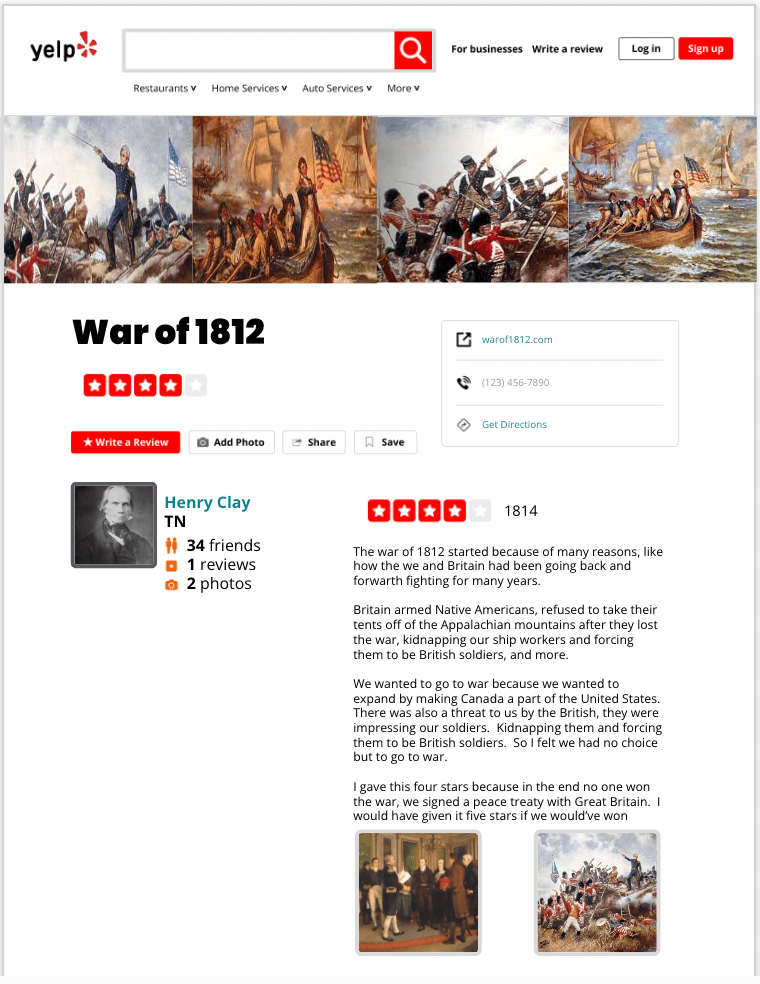
This doc had 4 parts/choices to it:

  1. I need to finish the superhero drawing from lesson 4.1 as well as some other missing work.
  2. I’m confused about Checks and Balances and need to learn more. (Choice Board inspired by Amanda Sandoval)
  3. I understand Checks and Balances but want to explore how it applies to the real world. (Thick Slide news article summary)
  4. I understand Checks and Balances, but I want to learn more about the importance of limited government. (Limited Government lesson created by Amanda Sandoval)

Each part contained a directions video and links for the assignments. Did students take advantage of the options? I have no clue and will know more on Monday. Until then, my beloved Bengals play the Chiefs on Sunday – Who Dey baby!!

The Week That Was In 505

What a week! This is going to be short post. I am usually an early riser and arrive at school by 6:00 AM…..most days/ On Monday morning, however, I just couldn’t bring myself to getting out of bed. I’m tired. Exhausted. Mentally exhausted. As a result, I arrived to school by 6:45 and was dragging.

Around 7:20 AM, twenty minutes before school began, the power went out. Was this a short power outage? Were we going home? Staff and students waiting….

Administration made a quick decision and decided to send everyone home. We had an unexpected day off!! It was much needed. I left school and drove to a local racquet club to watch my wife play tennis. I haven’t watched her play tennis in five years.

Monday – Day off…..no power.

Tuesday – Shortened class periods – we did some surprise Gimkits.

Tuesday

I hear it all the time, “These students just don’t know basic stuff.” I often think, “Well, okay, I agree. However, what are you doing about it?” I do know one thing, though; complaining doesn’t help. I’ve resorted to doing surprise Gimkits.

A surprise Gimkit is having the code up on the board, ready to go, and the students not knowing what the questions are about. I try to do this once or twice a week. The Gimkits are always with questions that address ‘basic stuff’ students should know. Here are my surprise Gimkits:

  1. US States – many people complain that students don’t know their states. Here you go. We started the year with a low 60% class average. Now we are in the low to mid 80% range.
  2. Citizenship Test – basic knowledge of government and history stuff.
  3. Dad Jokes – this is great for working on context clues to choose the best punchline.
  4. General Knowledge – math, science, history, ELA questions.
  5. Are you smarter than a 4th grader? – 4th grade questions.
  6. Who Is This President? – recognize presidents by picture

Rather than complaining, I try to address the issue with this simple, quick EduProtocol (Fast and Curious). Hopefully you can find some use with these. Have an awesome Thanksgiving!

The Week That Was In 505

In the last four years I’ve had a simple focus – how can I get students critically thinking, creating, collaborating, and communicating (The 4 C’s) with their learning? This is what drives my teaching with or without technology. However, when technology is used, I hope it’s intentional and ties to the 4 C’s listed above. This is why I love EduProtocols so much – it’s practical, intentional, ties to the 4 C’s, and provides consistency for the students and myself.

With the students I try to see each student as unique with their own set of strengths. One question that helps me with students – How can I give every student a chance to be successful? Everyone in this life deserves a chance to have fun and be successful with something and if my class is that one chance then I’m happy with that.

This week, we finished the Constitutional Convention, did a mini-lesson on Federalists and AntiFederalists, and we began one of my favorite units – The Constitution. The main goal of the Constitutional Convention was having the students analyze, and evaluate, compromises from the Convention. We used a 3xCER and Nacho Paragraph to complete this unit.

Following the Constitutional Convention, I do a mini lesson on Federalists and Anti-federalists. I created a choice board for this. The choice board has clear learning goals, an application activity, and an evaluative activity.

On Thursday, students wrapped up the Federalists/AntiFederalists unit. Then we began the Constitution Unit with a 10 question quiz from the United States Citizenship and Immigration services quiz. The goal is to reach six questions correct, which is rarely accomplished.

Monday – 3xCER and Nacho Paragraph, Fast and Curious

Tuesday and Wednesday – Federalist/AntiFederalist Choice Board

Thursday – Citizenship Test, Vocabulary Evaluation

Friday – Resource Rumble – Parts of the Constitution

Monday

On Friday, students completed a 3xCER evaluating why the founding fathers kept slavery in the Constitution. I wanted them to keep that practice going writing claims, evidence, and reasoning. With EduProtocols, reps are important!! On this 3xCER, the question was, “Should the Constitutional Convention be considered a success?”

On the CER doc, the first column had the students evaluate the convention as a success. The middle column had them evaluate it as unsuccessful. The third column had students create their own claim about the convention.
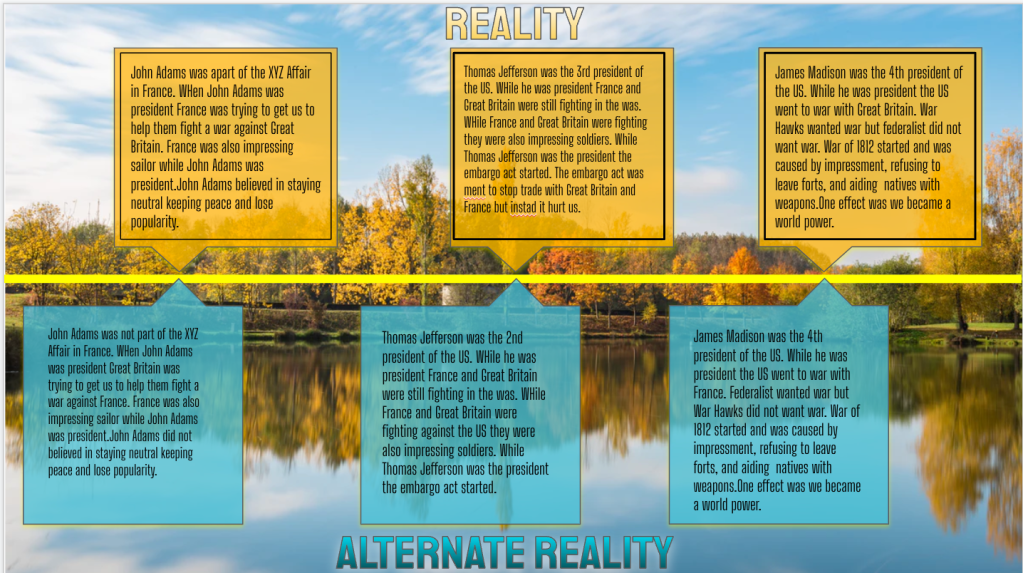
As we did this activity, I noticed that students are getting better at writing claims. The evidence piece needed some work. The students had trouble remembering the compromises and classifying them as a success or not. As a result, by 5th period, I created a concept sort to help students evaluate the compromises at the convention. I created a list of items and had students sort them into categories…

  1. The Great Compromise
  2. Small states and large states compromised to create 3 branches of government and set up our modern day Congress.
  3. The Founding Fathers created a government that still exists today.
  4. The 3/5th Compromise.
  5. They had a chance to end slavery, but built slavery into the words of the Constitution.

This is just a small sample of the evidence I listed out for students to sort. This definitely helped the students create, and write, evidence which ultimately helped their reasoning skills as well.

After students wrote their claims with evidence and reasoning, I set up a Socrative short answer question and share the student login link. Students signed into Socrative and I had them use their last column of the CER to construct a paragraph. As students submitted their paragraphs, I was giving feedback on the evidence and reasoning.
After a short time, I hit the “start vote” button in Socrative and the students were able to read each other’s paragraphs. We voted for the best paragraph, then I created a new Socrative Short answer question.

I copied and pasted the best paragraph into the question box of the new Socrative short answer question. Students signed back into Socrative, and we did a Nacho Paragraph. I instructed the students to copy and paste the paragraph into their response box, and I was going to have them edit the paragraph. Here are the edits I had them do…(It’s important to teach them NOT to submit their response until you tell them to do so)…

  1. Rewrite the claim so it still makes sense with the paragraph.
  2. Add a transition word to the evidence. With this one, I heard, “How do I do that?” My response was, “Look it up.”
  3. Add a concluding sentence to the paragraph.

At first, the nacho paragraph seemed like a lot to them, but they started getting the hang of it. The student whose paragraph we chose said they felt weird that everyone was editing their paragraph. This is definitely something I will have the students do again because this is phenomenal for working on writing skills.

At the end of class, I ran a Gimkit Fast and Curious that I told them was for a grade. It’s amazing how much the class averages shot up when I mentioned this! Every class average fell between 85% and 96%. Amazing stuff.

Tuesday and Wednesday

After the conclusion of the Constitutional Convention unit, I moved into a mini-lesson on Federalists and AntiFederalists. It’s funny because I often refer back to this blog to see what I did last year. When I saw I created a choice board, I was like, “Sweet!”

Before I had students get into Federalists and AntiFederalists, I had them look up the definition for the word “Federal.” Google provides three definitions so I asked them, which definition would work best to help them understand the word Federalist. They agreed that this definition would help, “relating to or denoting the central government of the US.”

My next question was, “Based on that definition, what do you think a Federalist was?” A proud teacher moment happened when a student who struggles with reading, inferencing, and making connections spoke up and said, “Oh, they supported a strong central government.” Then I asked, “What do you think an ANTI-Federalist was?” Another connection made, “They would not support a strong central government.” Then I asked, “Why not?” The response was, “Because they wanted strong state governments and would probably support the Articles of Confederation.” I cried 😭 a little.

Earlier in the week, I had a student request that I lecture and they could take notes. I asked, “Why would you want that?” The response was, “Because you’re good a telling stories and do a nice job of relating the stories to us.” The lecture style is more for students who need structure and certainty to help them process what they are learning. The choice board I set up had a variety of activities for all types of processing styles. The activities on the choice board included the following:

  1. Quizizz for the check for understanding – students could take this twice.
  2. EdPuzzle to take the place of a lecture style.
  3. WordWall for practice – a concept sort.
  4. CyberSandwich for those who want some partner work and discussion.
  5. A student paced PearDeck – sketch and tell included.
  6. Frayer Models
  7. Primary Source analysis from SHEG.

The choice board also included clear learning goals:

  1. I can identify and explain 2 differences between Federalists and AntiFederalists.
  2. I can identify the compromise made between Federalists and AntiFederalists over the Constitution.

Finally, I also included four application activities on the choice board to choose from. The application activities included:

  1. Imagine you are a Federalist or AntiFederalist – write a letter persuading people to accept or not accept the constitution. Include 4 or more important facts/reasons in your letter.
  2. Select a Federalist or AntiFederalist – design an action figure (An example) (this is on paper – get the paper from me)
  3. Story Cubes – relate 8 story cubes to the beliefs and characteristics of Federalists and AntiFederalists. (This is on EMC2Learning)
  4. Choose a Federalist or Anti-federalist – if they got a tattoo, what design would they get and why? Draw your design on paper, take a picture and add it to the slide. Then fill in the missing details around it. (This is on EMC2Learning)

Over 2 days, students did geat completing the activities. The most chosen activities were the EdPuzzle, WordWall, and Quizizz. This was chosen the most because it was the quickest and easiest to do. However, I challenged the students to complete the Word Wall with 100% accuracy in under one minute.

Thursday

On Thursday, we began my favorite unit – The Constitution. I love government. I love teaching government. I love the challenge of taking something that is not exciting, not easy to connect with and making it exciting. Here are my two compelling questions for the unit:

  1. How does the constitution limit government’s power?
  2. What are 6 principles of government found in the Constitution and how do they relate to your life?

I always begin this unit with a citizenship test from the USCIS website. I ask ten questions that relate to the unit, and students need to get six correct. I ask the questions out loud and they need to write their responses on paper. I use this as baseline data for the unit. Here is my data:

  1. First Period – 2/20 got six correct. 27% class average.
  2. Third Period – 0/29 got six correct. 24% class average.
  3. Fifth Period – 2/24 got six correct. 26% class average.
  4. Seventh Period – 2/20 got six correct. 24% class average.
  5. Eighth Period – 3/14 got six correct. 34% class average.

After the citizenship test, I have the students evaluate their own knowledge of vocabulary words from the unit. I had them go through 12 words and decide the following:

  1. Know it – they could write a definition in seconds without looking it up.
  2. Not sure – they have seen the word but don’t know how to define it.
  3. Don’t know it – they have never seen the word before.

I noticed that some thought they knew Federalism. However, they confused this with the Federalists. Some thought they knew Bill of Rights and Republic but didn’t have keywords in their definitions. For example, for a republic, most students left out the words representative or elected. So, it’s important to circulate and give quick feedback during this activity.

With the time we had left, I ran a “secret” Gimkit on the states. Students like the secret Gimkit. Sometimes it’s a Gimkit about states, 4th grade trivia, or basic things they should know. I hear a lot of teachers complain that students don’t know “stuff” anymore. I would agree this is true, but why not use reps with Gimkit to address the issue? This is the 4th time my classes have used the Gimkit about states – we began the year with a 60% average, and we are now above 80% on state recognition.

Friday

Before I get into the principles of the Constitution, it’s important for students to understand the structure of the document. I gave students a choice: I could lecture on the Articles and amendments of the Constitution, or they could do a Resource Rumble.

The students chose the Resource Rumble. Students used the Constitution in the textbook to answer a variety of questions. As I approved the questions, they collected legos. At the end of the resource rumble, they had to build something with their legoe related to Article I, Article II, or Article III.

The Week That Was In 505

This week we continued with our unit on the Constitutional Convention. Our question is, “Should the Constitutional Convention be considered a success?” Students are weighing multiple options – a stronger national government was created. However, at the same time, the Constitution was created without the consideration of enslaved persons or women.

The supporting questions we explored this week were:

  1. What argument over representation led to the Great Compromise?
  2. How did slavery influence the writing of the Constitution?
  3. Why did the Founding Fathers keep slavery in the Constitution?

I used a variety of EduProtocols this week including Sketch and Tell, Number mania, and the 3xCER. The Sketch and Tell works great with the Great Compromise. This helps students visualize structures of the legislative branch that was proposed. The Number Mania paired with the 3/5ths Compromise was okay. I always love the 3xCER as this was our third rep this year.

We had a weird week with en Election Day interruption. Plus, we had Veterans Day on Friday. Happy Veterans Day, and thank you, to all veterans for your service!!

Monday – Fast and Curious, Thin Slide, Sketch and Tell

Tuesday – election day (no school)

Wednesday – Fast and Curious, Number Mania

Thursday – Egg Dash Challenge, Fast and Curious

Friday – 3xCER

Monday

The question to begin the day on Monday was – What argument over representation led to the Great Compromise? To begin class, I had up a Fast and Curious using Quizizz. The Quizizz had 10 questions, and the class averages were as follows: 54%, 52%, 50%, 33%, 45%. The questions focused on the Virginia Plan, New Jersey Plan, the Great Compromise, and basic legislative branch questions. I expected these class averages because 8th graders (and a lot of people) struggle with government related stuff.

The next step for the lesson was a Thin Slide. I gave students 5 minutes to add a picture of a state, add the name of the state, add the amount of representatives for the state, and how many the senators for the state. I quickly learned that I needed to directly link the House of Representatives and the US Senate to the instructions. When the timer went off I asked the students, “What do you notice?” Right away, they noticed that every state had 2 senators and the amount of representatives varied. Then. I asked, “Why do you think one number stays the same and the other number varies?” They had some guesses, but this was the point of the lesson for the day.

Next we moved onto a Sketch and Tell. With these ideas of a house, a senate,and representatives, students have a hard time visualizing these things. This is why I love using Sketch and Tells with government content. Some classes, I let them go and they did their thing. Other classes we did an I Do, We Do, You Do. Students filled out a chart with information then created a sketch to show the structure of Congress as proposed by the plan. When we ended the lesson, students took the Quizizz again and the class averages were all between 75% and 92%.

Wednesday

On Wednesday I began class with a Spot the Differences photo. I went to 270toWin and took screenshots of the 2020 election map and the 2022 election map. Students had to spot 10 differences.

One by one, students came up and circled differences. When we were done, I told the class, “The number represents the amount of representatives, plus two senators.” Then I asked, “Why did Ohio go from 18 representatives to 17 representatives in 2022?” I was hoping students could use their knowledge of the house of representatives to guess…..and they got it right!!

Then we switched gears to a Number Mania and the 3/5ths Compromise. Before out Number Mania, I combined Great Compromise questions with 3/5ths Compromise questions. The students did well with Great Compromise questions, and awful with 3/5ths Compromise content.

Next, I had students read an articles on the compromises over slavery. I had them choose two numbers related to compromises, 2 numbers related to effects of those compromises, and another random number. The Number Manias were okay, I need something else to pair with the article (textbook section) I have for the students. Here are some examples:

Thursday

Thursday, I wanted to extend the Constitution and Slavery compromises lesson to a SHEG lesson on, “Why did the Founding Fathers keep slavery in the Constitution?” However, someone threw water all over the hallway, I slipped and fell, I cleaned up the water, and drama was happening. It wasn’t even 7:45 AM. I decided I needed a lesson to cheer me up so we did the Egg Dash Challenge. This is a great review game from EMC2Learning.

I don’t want to give away all the detail, but here is a link to John Meehan’s blog about the Egg Dash Challenge. I had the plastic eggs, I created 21 questions, and I gave the students 20 minutes to answer as many questions as possible. The first 5 minutes they could not use their Chromebook.

The students had a blast, I had a blast. This was a much needed lesson for the bad start to my day. At the conclusion of the lesson, I had the students do a Gimkit with similar, and the same, questions from the Egg Dash. The final class averages were: 82%, 84%, 83%, 81%, 89%. The questions were copied from the Quizizz I used for the Great Compromise, 3/5ths Compromise, and previous Gimkit questions about the Articles of Confederation.

The bolded number above (81%) came from my 7th period. When I first began the Gimkit, they were talking and randomly clicking. I stopped the game 3 minutes in. They were not happy. However, I explained to them (I’m know for my off the cuff speeches – sometimes rants):

“I stopped the game because this class has failed to get over a 58% class average on a Gimkit we have taken 4 or 5 times. It appears I’m mad at you, but I’m not. However, I’m confused. I’m disappointed. If anything, I’m mad at myself. Mad at myself because I’m a teacher of the year twice over and I can’t figure it out. I can’t figure this class out. I tried to motivate you by asking everyone to answer 20 or more questions, get a class average of 70% or higher, and I would give you 4 extra credit points. But that didn’t work. I can’t lower the bar to 60%. That’s the equivalent of me asking you to practice hard for only 10 minutes at practice. How good are we going to be at football, basketball, or wrestling if I ask you to work hard for 10 minutes at 2 hour practice? Do better. Be better. Not for me, but for you.” That’s not word for word, but that’s pretty damn close.

We tried again, and the class average miraculously went up to an 81%. I jokingly said, “I can’t give an impromptu motivational speech everyday.”

Friday

On Friday we went back to the lesson I wanted to do on Thursday. There is a SHEG lesson about slavery in the Constitution. The perfect pairing with this lesson was a 3xCER that I learned from Ariana Hernandez.

We began the lesson by discussing the grievance on slavery removed from the Declaration of Independence. We looked at these questions:

  1. How did Jefferson describe slavery?
  2. Who did he blame for the slave trade?
  3. Why do you think they removed this grievance?

Then I copied and pasted four quotes from the Founding Fathers, and two historian interpretations on why the Founding Fathers kept slavery in the Constitution. I love using the 3xCER with this because it allows the students to practice using claims, evidence, and reasoning 3 times as opposed to once with the original lesson.

Some of the classes, I did an I Do, We Do, You Do. Other classes, I reminded them about a claim and the purpose of reasoning. Here are some examples:

One Final Thought

You can follow me on TikTok now – @moler3031. I posted a video on TikTok about changing the settings on a Google Doc, Slide, or Sheet to prevent people from copying your file or prevent students from copying and pasting. I just made a video to share something that could be useful.

In 2 1/2 days, it has been viewed over 33,000 times, 2,300 likes, favorited 750 times, and many many comments. Like most things, 90% of the comments are great. However, I’m going to address the 10% negative comments…

  1. “You’re just trying to control student engagement.” – No. I don’t turn copying and pasting off every time. I only turn that off when I need students to think, and write something from their own mind.
  2. “He’s just trying to sell books.” – Yes, I’m trying to sell books. But I have given many, many books away because I want to. Plus, read this blog – I open up my classroom and give it away.
  3. “Make a more engaging lesson and students won’t copy and paste.” – I have many engaging lessons. Not every lesson is engaging. It doesn’t have to be. However, I don’t always turn off the copying function. Certain lessons, however, I do because I want the students to write on their own.
  4. “Did you notice he said he copied and pasted a textbook section to a doc and turned off the ability for students. Ridiculous.” – I do copy and paste sections and articles all the time so I can change some of the vocabulary or remove some of the fluff. I think textbooks add too much irrelevant stuff – that’s why I do that.
  5. “Why? Sometimes I want students to copy and paste text evidence without typos.” – Great! I don’t turn off the copying function EVERY time. Even if a student has a typo, the computer spell check feature, or Grammarly, will catch it.

I just turned off the comments. Sometimes as teachers, we are all or nothing. My 1 minute video isn’t suggesting to turn off the copying feature every time you share a Google Doc or Slide. I’m not suggesting that students are horrible cheaters. I’m simply throwing an option out, another tool, for teachers to use if it’s needed.

My last thought…One thing I would never do is comment on another teacher’s stuff in a negative fashion. I have no need to say something negative to a person I don’t know, or have never met in person. Plus, I have never visited that person’s classroom. A 280 character tweet, a 1 minute video, a picture doesn’t define the day in and day out stuff of a classroom or a teacher. Therefore, I refuse to comment negative, or critical stuff to another teacher. I may be turning comments off in the future.

The Week That Was In 505

This week we began the Articles of Confederation, Shays Rebellion, and the Constitutional Convention. I love this unit. I saved a Google Classroom from last year that I often look at to reflect. I looked at last year’s lessons, and thought to myself, “How can I adjust this for the students this year?” I always think to myself, “How can I make it better?”

I started at the standards to revamp this unit. Here are those standards:

  1. Analyze how the problems arising under the Articles of Confederation led to debate over the adoption of the U.S. Constitution.
  2. Explain how participation in social and civic groups can lead to the attainment of individual and public goals.

After reviewing the standards, I broke the unit into 3 essential questions:

  1. Why did the United States want to create a stronger national government?
  2. Was the Constitutional Convention successful?
  3. What were the differences between Federalists and Anti-Federalists?

From here, I thought to myself, “How would my students need to think in order to answer those essential questions?” So I made a list of items:

  1. Students need to understand the Articles of Confederation was our first government to help us through the American Revolutionary War.
  2. Students need to understand that we have state level and national level government (federalism).
  3. It was intentionally made weak due to the abuses of power by King George III and the British Parliament.
  4. The weaknesses led to problems like Shays Rebellion which exposed the Articles of Confederation.
  5. The Northwest Ordinance was created under the Articles of Confederation – an ordinance is a law and helped territories become states (Ohio – 1803).
  6. The Constitutional Convention brought together many political leaders to strengthen our national government by creating 3 branches but limiting its power.
  7. From the Constitutional Convention, 2 groups emerged and ultimately created our first two political parties. The Federalists and Anti-federalists debated how strong the national government should be and how to protect people’s rights.

By doing this process, and looking at this unit through the eyes of a student, it helped me put together different activities, assessments, and questions with each lesson.

Monday – Fast and Curious Gimkit, Frayer Vocab

Tuesday – Iron Chef, Fast and Curious

Wednesday – Fast and Curious, Rolling Recap, Emoji Paragraphs

Thursday – CyberSandwich, Fast and Curious

Friday – Fast and Curious, Portfolio

Monday

For Monday, I began with a Gimkit of 15 questions about basic vocabulary related to the Articles of Confederation and Shays Rebellion. Many of the words relate to government and are unknown to most of the students. This was shown in the class averages of 52%, 54%, 50%, 33%, 58%.

At the conclusion of the Gimkit, I gave some feedback on most of the questions. We switched gears to a Frayer. I had students Frayer the word Articles of Confederation (@historysandoval Frayer template). Then I had them choose two other words they might have trouble remembering. Most students chose: ordinance, Northwest Ordinance, or central government.

Students took 15 minutes to complete 3 slides for their Frayer. The last 10 minutes of class were used to take the Gimkit again. Most scores were raised to a 60% and one class raised their class average to a 70%.

Personally, I felt like their scores should have been higher. I had a conversation with them that I played a Gimkit the previous week about Halloween trivia. The first 19 questions I missed (no joke). However, I read the correct answers and didn’t miss a question after that. Using the time, and effort, to read and understand why a question was missed is soooo beneficial.

Tuesday

To begin class, I used this awesome strategy I learned from Dominic Helmstetter. At MassCUE, Dominic told me he uses a “spot the differences” in pictures to begin class sometimes. He uses a site called Cleanup Pictures to create the differences, or remove items, from a picture. So, I used a picture I found on Google related to the Northwest Ordinance. I removed important items related to the day’s lesson. It was awesome, and students got so into it!! Can you spot the differences?

Last year I had students do a solo Iron Chef to learn about the Articles of Confederation and Shay’s Rebellion. I had them read a textbook section and design a slide. We set aside 15 minutes for each slide. I kept my timer going, and switched them throughout the class. It was okay, but there was no discussion.

This year, I had students create groups of three and share a slidedeck. I printed off paper copies of the textbook sections and handed them out. Students had 12 minutes to read and design a slide.

At the end of 12 minutes, I passed out a paper Frayer model to each student. Each box had a prompt for what I wanted the students to focus on in regards to the Articles of Confederation, Northwest Ordinance, and Shays Rebellion. I labeled each box with:

  1. What were 4 weaknesses of the Articles of Confederation?
  2. Describe the Northwest ordinance – territories becoming states and rules for the Northwest Territory.
  3. Describe the importance of Shays’ Rebellion.
  4. Five sentences – how did weaknesses of the Articles of Confederation lead to a new government?

I tried to have each student present their slide to a group – some did great, while most did not. But that’s okay. Some students like to work independently, work at their own pace, and write their own notes.

Some students complained about writing 5 sentences which gave me an idea for Wednesday’s class (stay tuned)…

Overall, for a 2nd Iron Chef, the students great. Awesome creativity, they were engaged, I may have went a bit too fast for some. However, there is always room for improvement. At the conclusion of class, we finished up with a Gimkit. The Gimkit results are a bit skewed, because I often keep adding new questions related to the content. Some class averages remained the same, and some went backwards.

I set up the Iron Chef differently for my 7th period class because I don’t fully trust them to share and work together cooperatively. As a result, I would read a textbook section to the class and added clarification along the way. Then I gave them 8 minutes to make their slide. Then I read another textbook section, and so on. Sometimes I am doing too much, but at the same time, I am saving my sanity and doing what I feel is right. It worked out much better for this class.

Wednesday

On Tuesday, I took the, “We can’t write 5 sentences,” as a challenge. I wanted to do some review of the Articles of Confederation, Northwest Ordinance, and Shays Rebellion. I also wanted to have a little fun.

To begin class, students did a 5 minute round of Gimkit. Class averages were okay. They ranged from the 57% to 80% range. After the Gimkit, we did more review with a Rolling Recap from EMC2Learning. I can’t really give this review activity away, but I roll four dice and ask random questions related to content. Students work together in groups of two to three and are totally engaged.

All of this review was working toward my big lesson of the day – Random Emoji Paragraph. The students said they couldn’t write five sentences, but they ended up writing 15 or more sentences by the end of class. Basically, they wrote three paragraphs. To access the Random E

I began the Emoji paragraph by having the random emoji generator on the board. If you want access to it, sign up for free at the EduProtocols website. This created intrigue and many questions. I explained the purpose of a paragraph – pursue an idea. Then we ran two practice rounds. The students loved it, couldn’t wait to share, and asked if we could do it again. Even if it’s not related to your content area, this is a great way to begin or end class to get students thinking, writing, and having fun.

The last round of the Emoji paragraphs, I challenged the students to relate the emojis to the Articles of Confederation, Shays Rebellion, or both. If students did a great job with the Gimkit, Iron Chef, and Rolling Recap – this was no problem. The students that didn’t bother to do much, really struggled. Relating random emojis to describe a historical topic requires some special creative thinking. Most students did great. They were engaged and couldn’t wait to share. What they came up with was pretty amazing:

Thursday

On Thursday, we were ready to move onto the Constitutional Convention. I used a Quizizz at the beginning of class. It was nine questions, and the class averages were as follows: 62%, 53%, 50%, 46%, and 60%. The Quizizz had basic questions about the Constitutional Convention.

Next, I had students read a section of the textbook and take notes using a Main Idea note taking strategy. I like this strategy for this particular CyberSandwich because it helps the students write their summary at the end.

The Main Idea note taking strategy has students turn the section title into a question. Then it has them write down who, when, where, why, and what. At the conclusion of the reading and note taking, I had the students select 4 of the most important facts they typed.

Choosing 4 important facts helps guide the discussion and comparison piece of a CyberSandwich. The discussion were MUCH better and organized with choosing 4 important facts. This also helped with the summaries at the end.

The summary for this particular CyberSandwich is a newspaper clipping the students create. They visit a newspaper clipping generator site and attempt to create a summary answering the question – What was the purpose of the Constitutional Convention? After students typed their summary, I had them check how many facts they had in their article using this self assessment doc. Here are some students samples:

At the conclusion of the lesson, we went back and did the same Quizizz again. This time, the scores went way up!

Friday

Friday was a weird schedule day. Each class was 30 minutes long. As a result, I had students complete the Friday Check In, Gimkit, and add to their Google Site Portfolio. I added the Thursday quizizz questions to the Gimkit.

For the Google Site Portfolio, I had students create a new page for the last unit – Unit 2 American Revolution. Then I had them select three items they created in unit 2 that they were proud of.