The Week That Was In 505

This week I asked myself this question, “Do I spend four to five days teaching about westward territorial expansion, or do I finish it in two to three days?” I opted for the two to three days. This is what I love about EduProtocols – students are familiar with the routines and we can get through some content faster.

One of my favorite ways to cover lots of content in a short time is with a Thick Slide and Frayer. Students create a slide with information, pictures, and quotes. Then students share the slide through a Google Form. Finally I hand out a Frayer that students fill out with notes and information as they read each other’s slides. Instead of a Frayer, students went from slide to slide and wrote summaries on their annotated maps.

We spent Tuesday and Wednesday finishing annotated maps. I forgot to take pictures of the completed maps (I’ll have some soon). The students did an excellent job! I shared an example of an annotated map when we first began the lesson and the most common response was, “Whoa, that’s a lot of work. I can’t do that.” In the end, they did it, they did it well, and basically wrote a six to seven paragraph essay.

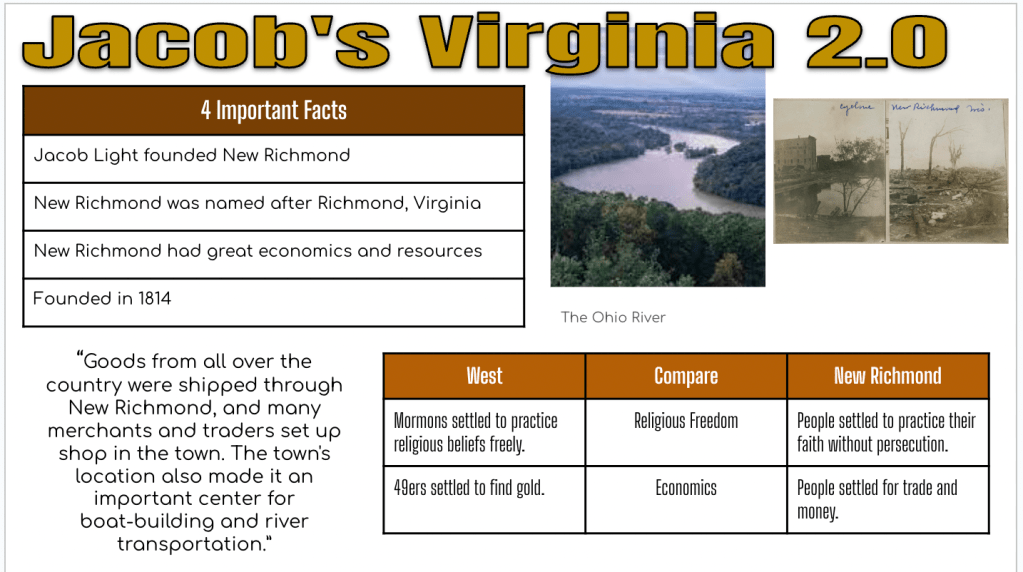
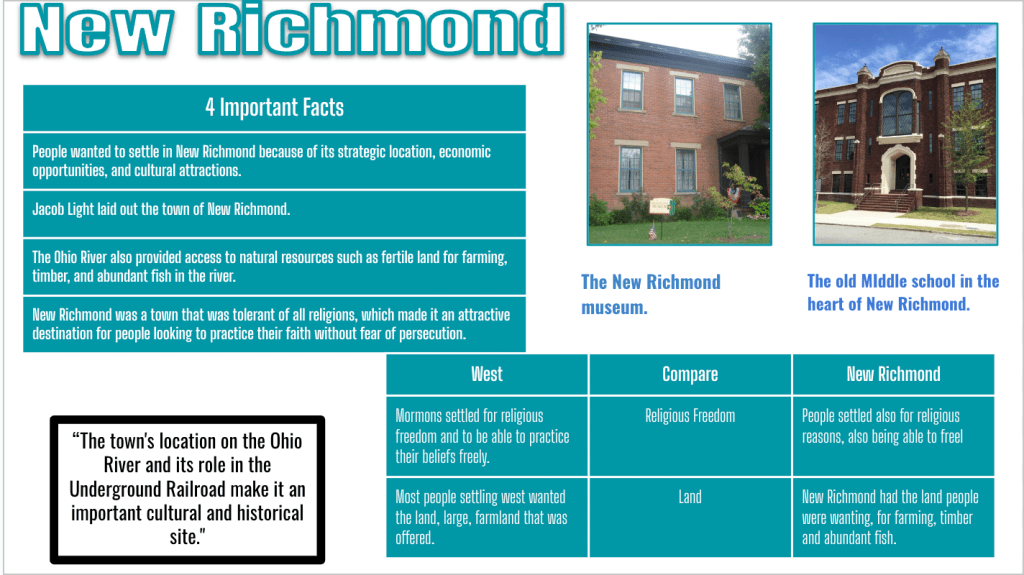
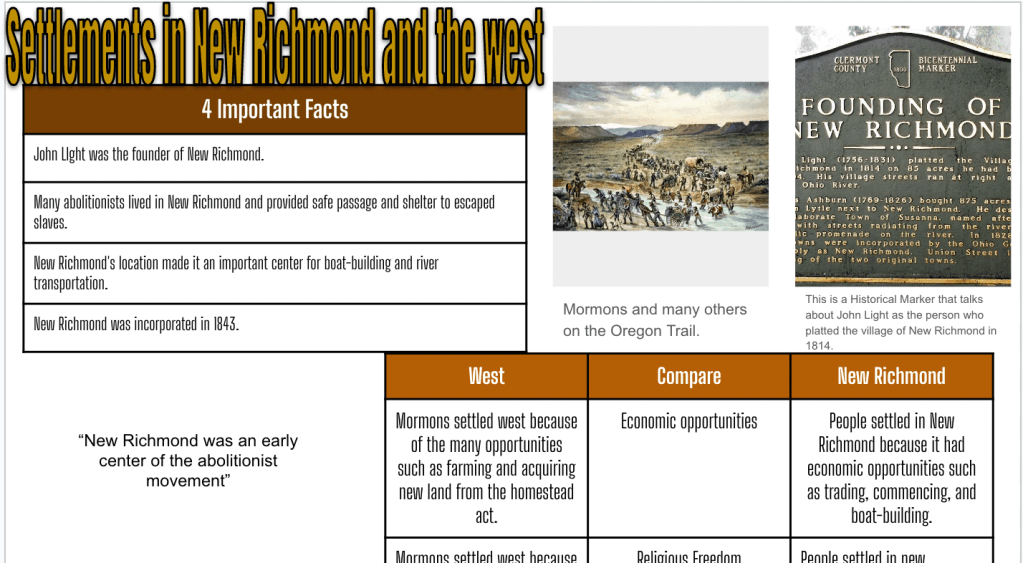
After we learned how the United States used purchases, war, and treaties to expand westward, the next phase of the lesson is to learn about the people that went west. My ultimate goal for the lesson is to have students learn about the reasons people went west and compare that to reasons people settled in our community of New Richmond. I’ve never done this before but I’ve been planning it with our tech coach Jordan Petri who fors for Forward Edge.

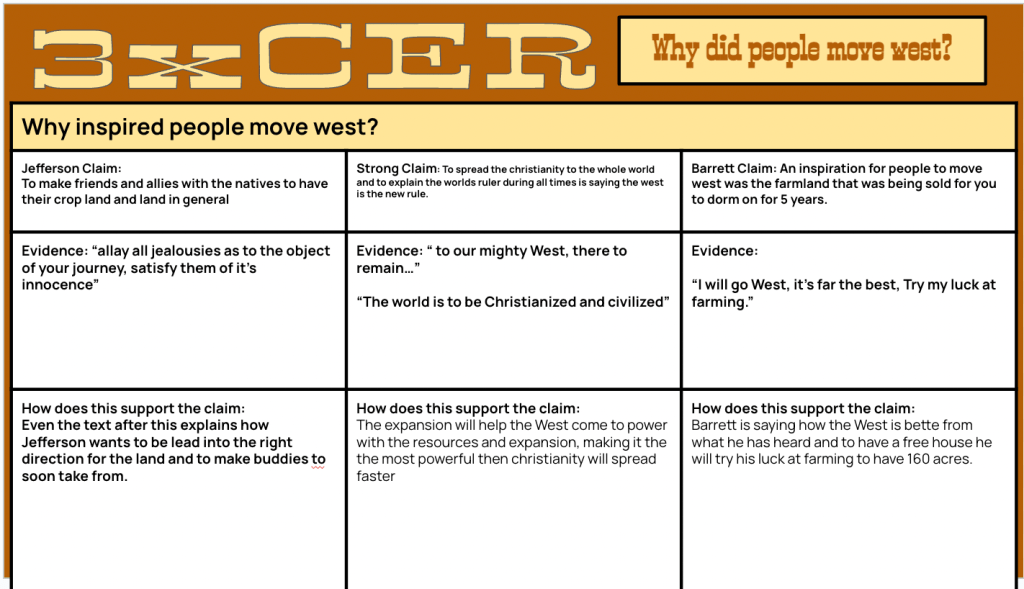
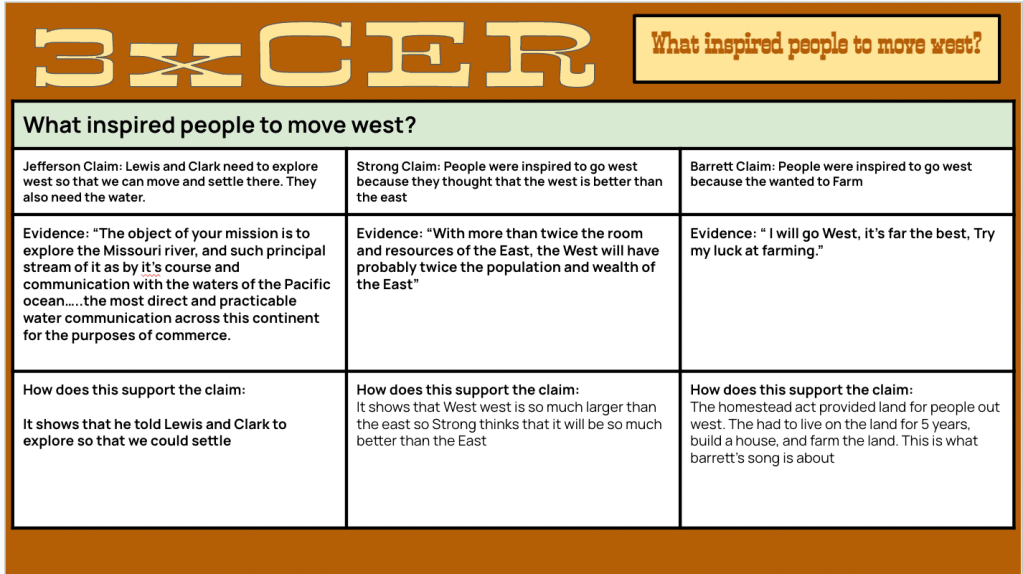
The first lesson the students completed asked the question, “What inspired people to go west?” I took the opportunity to create a new rack and stack combo with EduProtocols. Students completed an 8pArts, 3xCER, and Sketch and Tell as we analyzed 4 sources and worked on writing paragraphs. All in all, it was a successful lesson.

Monday – Thick Slide, Fast and Curious

Tuesday – Annotated Map

Wednesday – Annotated Map

Thursday – 8pArts, 3xCER

Friday – 3xCER, Sketch and Tell

Monday

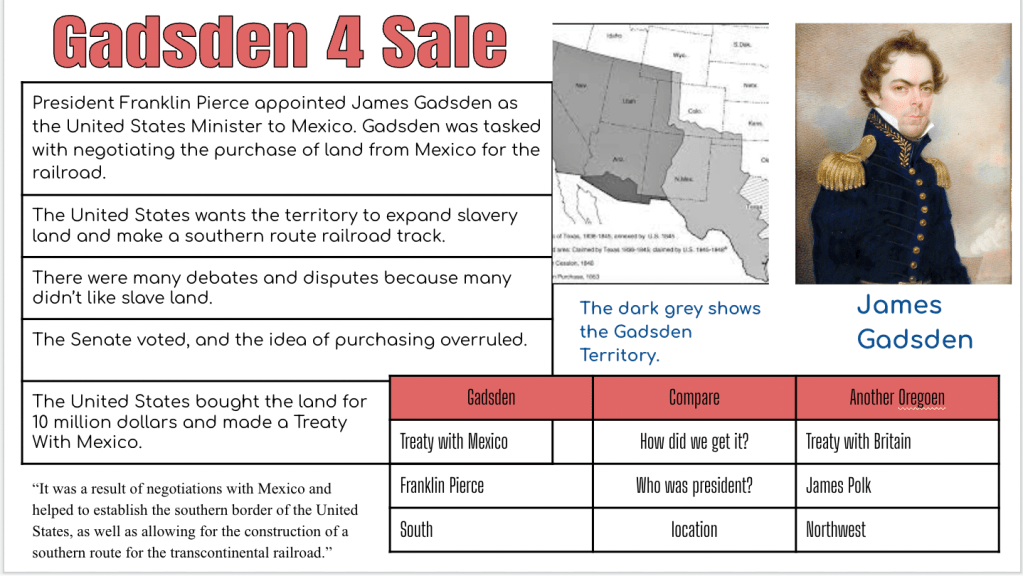
Monday began with a Fast and Curious using Gimkit. I added questions about Oregon, the Mexican Cession, and the Gadsden Purchase. All classes did as I expected with new questions added to the old questions – 74% class average or higher.

As I mentioned up top, I didn’t want to spend four to five days covering the remaining territories of Oregon, Mexican Cession, and the Gadsden Purchase. I’ve seen other lessons, or mini-units, that cover all the territories in two to three days. I think that’s too short. At the same time, I didn’t want to drag out the lesson too long.

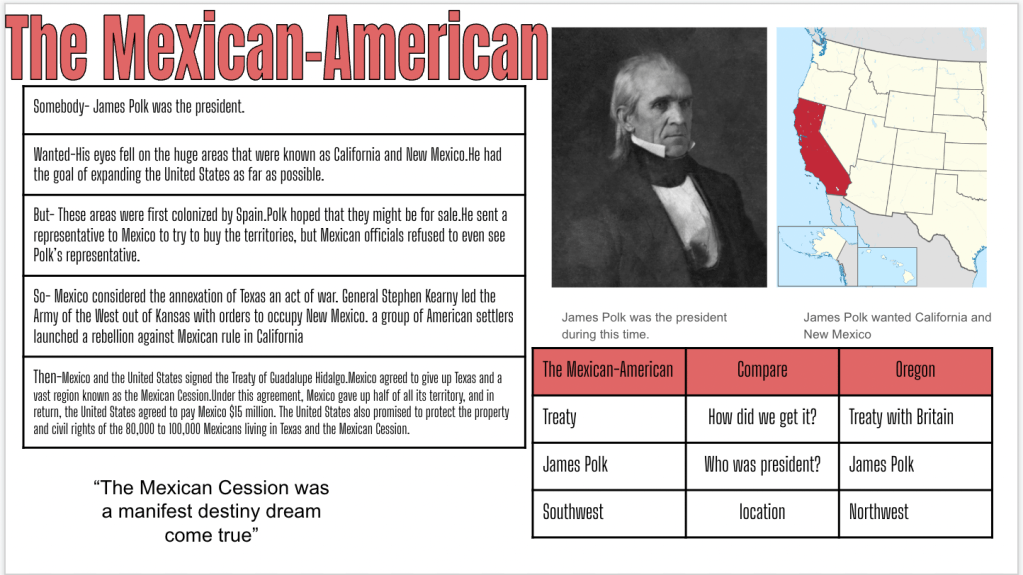
To help get through the final territories, I created a Thick Slide template. As I was developing this template, I knew the goal was to have students write summaries on their annotated maps explaining how we got these territories. At first I set up the Thick Slide notes with a sequencing organizer because the reading was written in sequence. However, I changed it for my later class period to a Somebody, Wanted, But…..organizer. I had one student comment they liked the Somebody, Wanted organizer because it was easy to follow and helped them process the reading better.

I also included on the Thick Slide a comparison chart where students compared the territory they chose (Oregon, Mexican cession, Gadsden Purchase) to another territory they learned about. At first the students were confused on what to compare, so I added in categories – who was president, how did we get it, and location. Lastly, I wanted students to include a quote from the reading about the impact of the territory on people or the United States as a country.

To begin this lesson after the Fast and Curious, I had students read for 5 minutes and highlight the parts of the organizer – Somebody, Wanted, etc. Then I gave students 20 to 25 minutes to create their slide and share. Here are some great examples:

After students shared their slides, we finished class with a Fast and Curious one more time. This time class averages ranged from 84% to 95%. I like the Gimkit as a way to cover material that students might miss looking through student created slides. Maybe students didn’t pick up on important information about a territory – so the questions I include on the Gimkit have information I want the students to know.

Tuesday and Wednesday

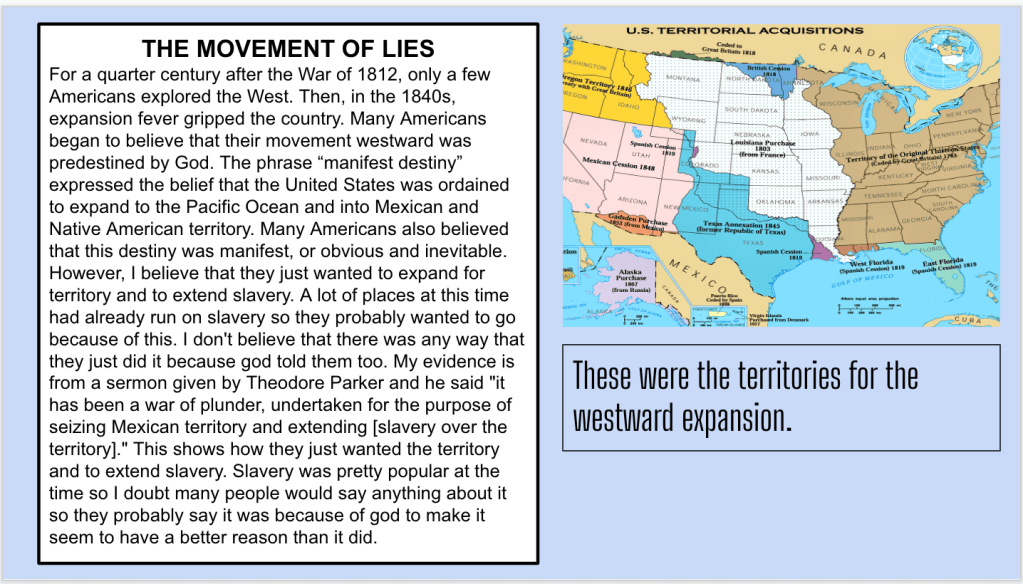
Tuesday and Wednesday were devoted to finishing the annotated maps. The entire goal of an annotated map is to connect history with geography. Start with a question, in this case, it was, “How did manifest destiny drive westward expansion?” The students learned about manifest destiny as motivation from God and christians to spread American values. However, they also learned about it as a way to justify starting wars, spreading slavery, and displacing indigenous people.

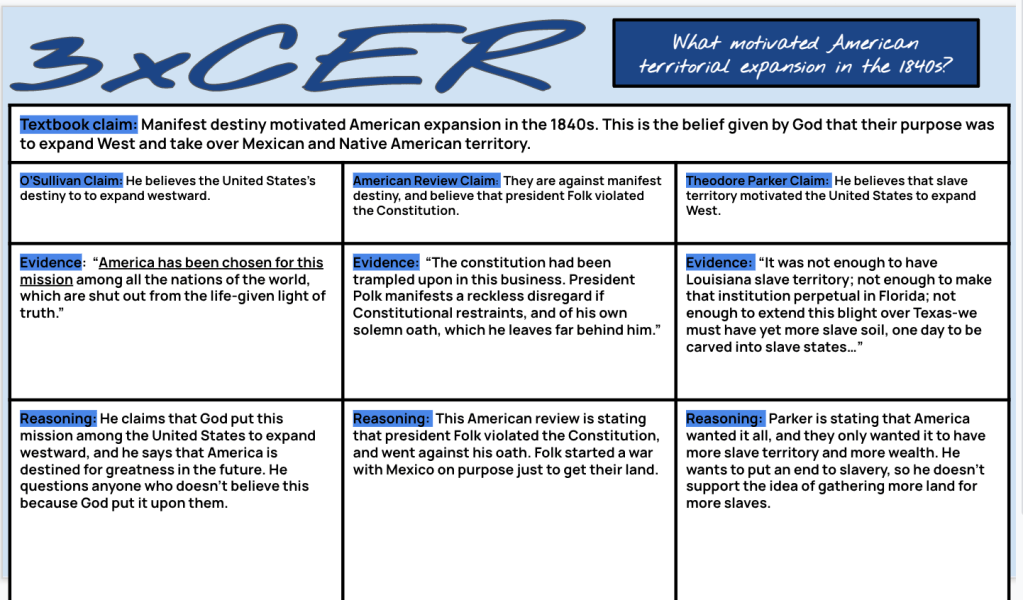
Students started their maps with the question in mind, researched and learned about the territories, and they circled back to the original question. They struggled to answer the question because they weren’t making connections between what they learned about manifest destiny to what they learned about the territories. I directed them back to the 3xCER lesson from last week:

I had them use this past lesson and what they recently learned as a starting point to answer the original question. I have told my students since day one, “Everything we do serves a purpose. It’s intentional.” So many students go from one day to the next completing tasks, worksheets, etc with no purpose. When I reminded them to go back to this lesson, they said, “Oh yeah, now it makes sense.”

Overall, the students did a fantastic job on their annotated maps. Their maps and the Fast and Curious Gimkit served as their summative assessment. I will add pictures soon.

Thursday

Thursday we began a new lesson where the question was asked, “What inspired people to go west?” The lesson had some background knowledge readings and 4 sources for students to analyze. Here were the sources:

  1. A painting entitled, Westward the Course of Empire Takes Its Way.
  2. A letter written by Thomas Jefferson to Lewis and Clark.
  3. Two excerpts out of the book, Our Country: Its Possible Future and Its Present Crisis, written by Josiah Strong.
  4. Song Lyrics from the song, “I Go West,” by JP Barrett.

I set up this lesson to where I read the background information, then students analyzed the source. I don’t know why, but I only shared the sources with them and not the background information. Looking back on that, I made a mistake so I corrected it for Friday. I put all of the information and sources on one piece of paper – front and back.

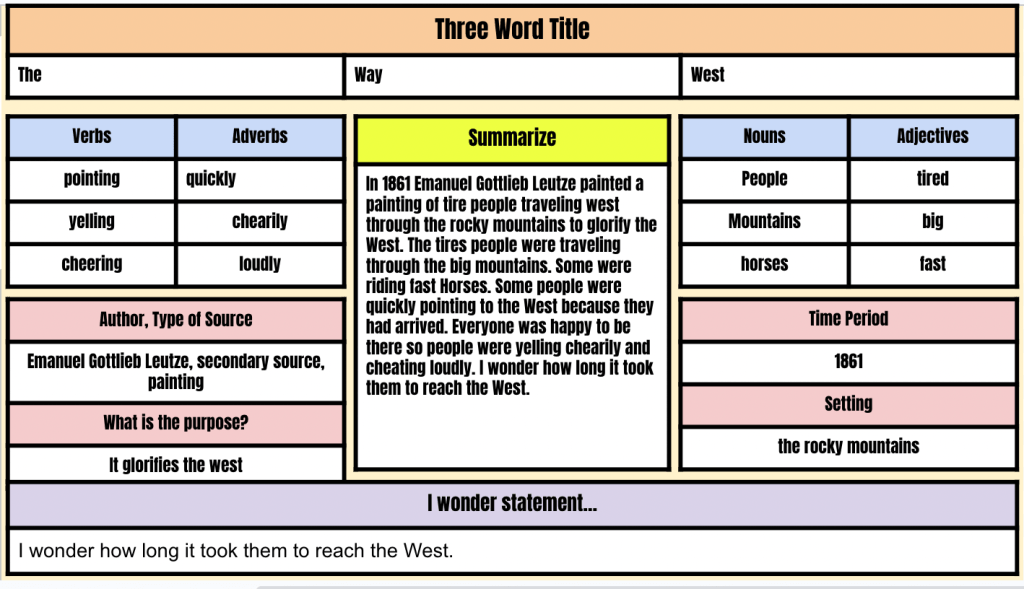
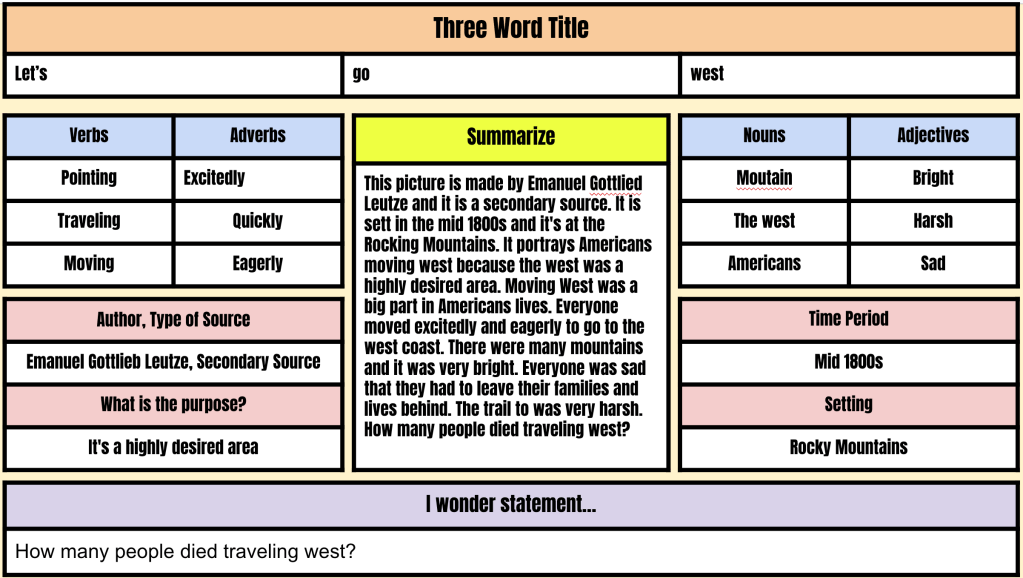
The first source we looked at was the painting. I read the background information, pointed out certain images to look at, and students analyzed the painting with an 8pArts. Students filled out the nouns, adjectives, etc. in 7 minutes. They wrote their summaries in 3 minutes. Here are some examples:

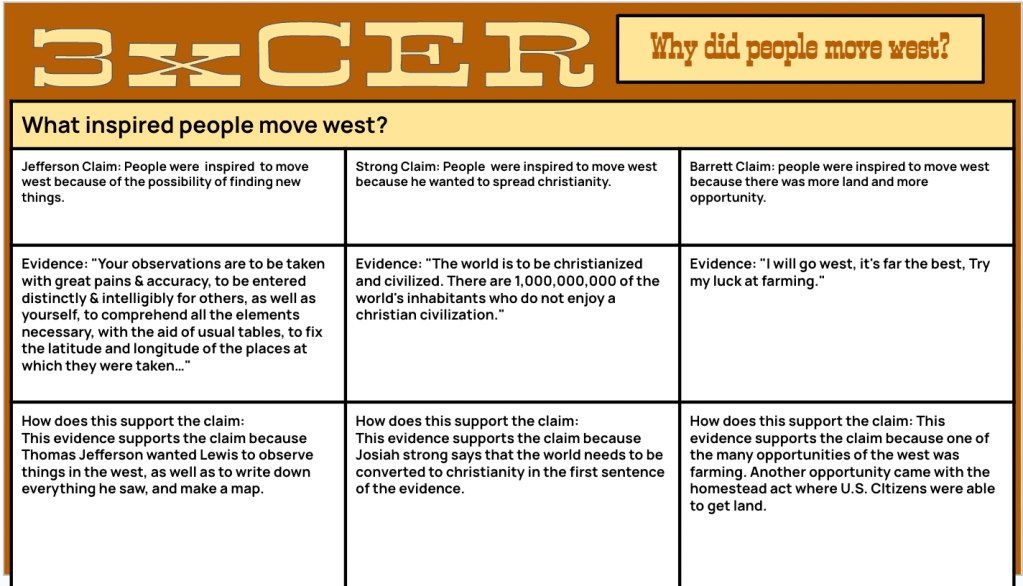
Then we followed up the 8pArts with a 3xCER. I would read the background information, and students read the source. I had two different versions of the sources – the original wording and a 5th grade level. I pasted the sources into ChatGPT and requested it keep the tone and meaning, but rewrite it for a 5th grade student. It did an excellent job.

As we did the 3xCER, I was teaching the students that a claim would restate the original question. The evidence would support the claim. Finally, instead of reasoning, I wrote it as a question, “How does the evidence support the claim?” I encouraged the students to include some background information here. Here are some examples:

Friday

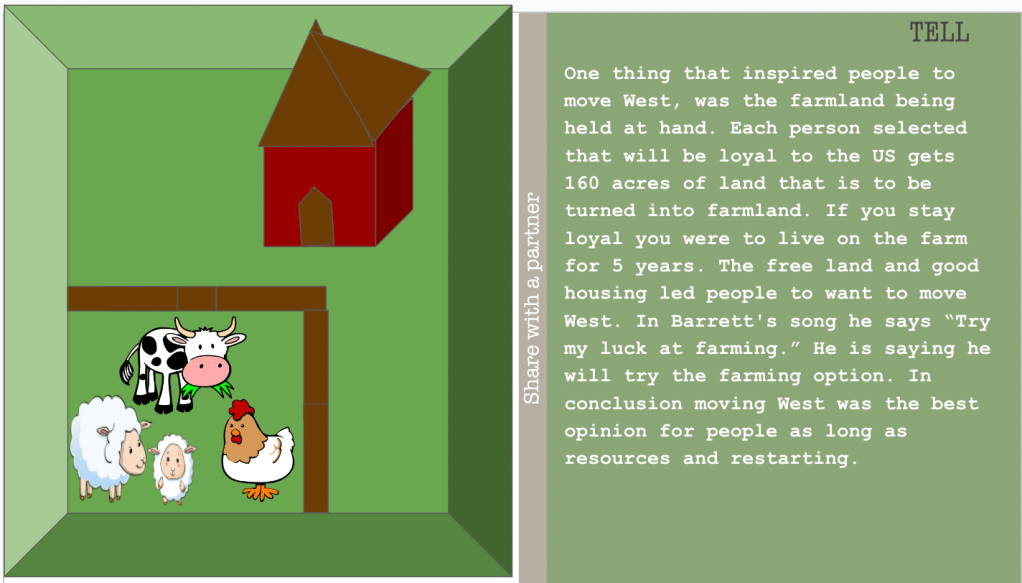
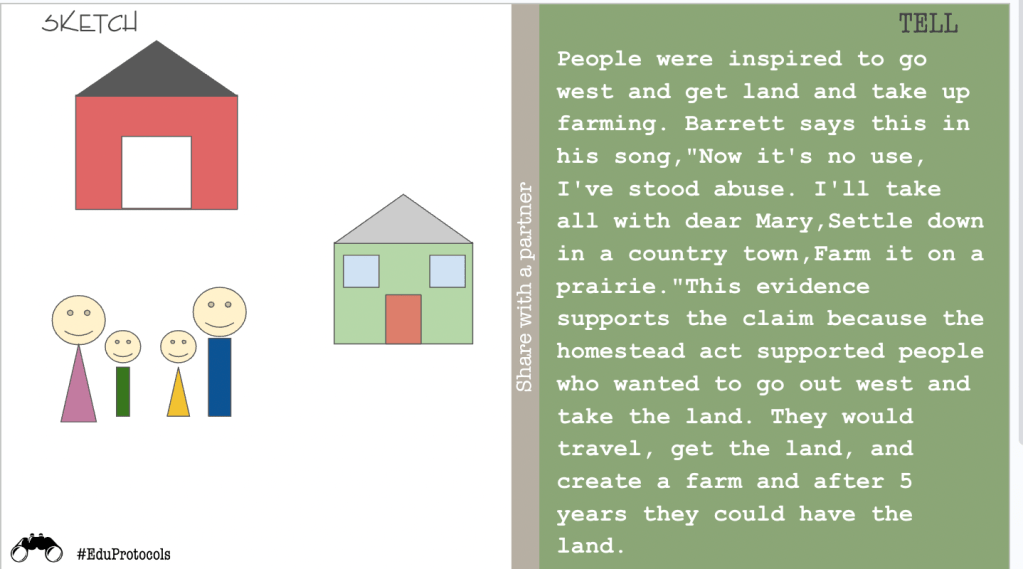
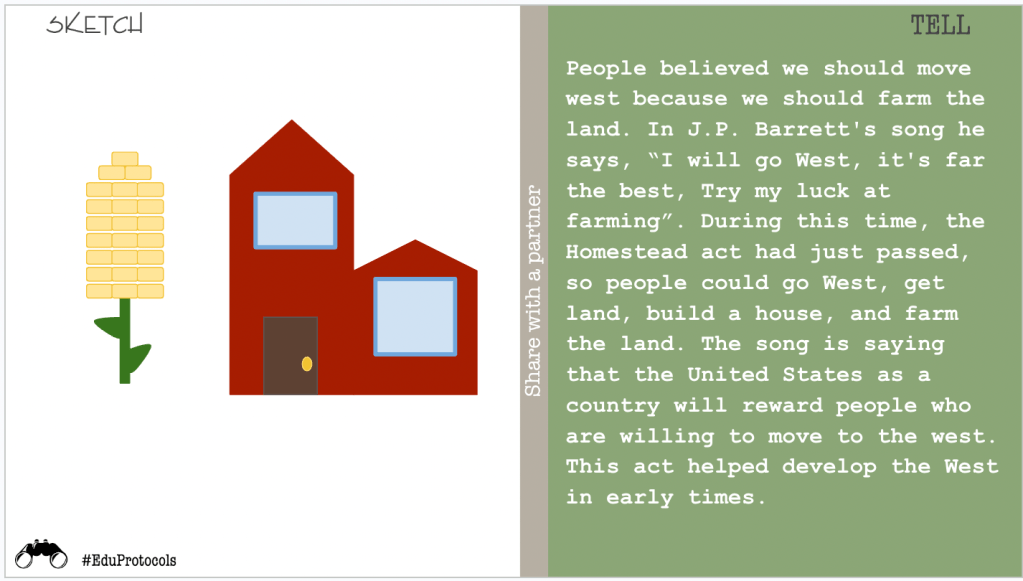
Friday was used to finish up the 3xCER, if necessary, and to take the information to finish a Sketch and Tell. The goal was to have students construct a paragraph with a claim, evidence, reasoning, and a concluding sentence. I don’t like to be like this, but I stated the paragraphs had to be four or more sentences.

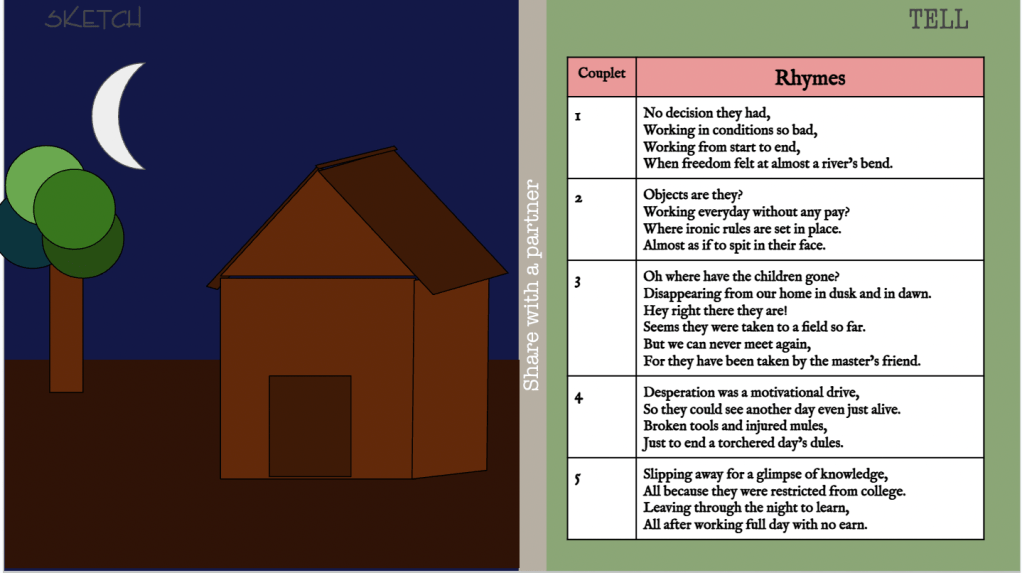
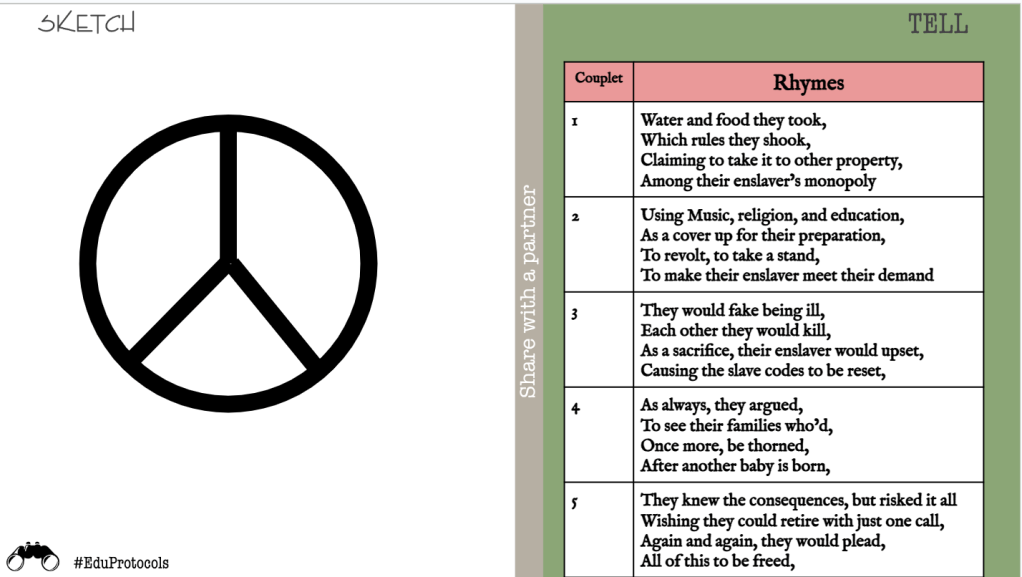
I set up this Sketch and Tell from a UDL mindset of providing multiple ways for students to show what they learned. Students could create an image to answer the questions and/or write a paragraph with their 3xCER information.

Before students began writing, I informed them the 3xCER had to the structure of the paragraph already set up. Pick a column and start writing. Here are some awesome examples:

Podcast

The Week That Was In 505

Last week we learned about Manifest Destiny for our new unit on westward expansion. The main question for the first part of our unit is, “How did manifest destiny drive westward expansion?” We focused on manifest destiny because I remember a story from a book I read where the teacher taught a unit about immigration and during the final assessment, umerous students didn’t know the meaning of immigration. We spent two days on manifest destiny and the interpretations of the phrase.

This week we were learning how we acquired different territories to fill in the United States. I usually go in chronological order. We began with the Louisiana Purchase, Florida Cession, and the Texas Annexation. The focus is on how we acquired all these different territories.

I usually do an annotated map with this unit. Last year I decided not to do the map. This year, I brought the map back. An annotated map contains a labeled hand drawn map, a question, and historical summaries surrounding the map. These maps are great for connecting geography to history.

During this week, we sued a variety of EduProtocols to learn about these territories. We used a CyberSandwich, 4xFlorida, and another Cybersandwich. Each one of these protocols I infused with some text structure material. For example, on the Cybersandwich, I included on the student notes section, “What text structure is the reading?” The students are starting to pick up that most informational texts we use in class are sequenced with some other structure such as cause/effect or compare/contrast.

Monday – Louisiana CyberSandwich, Gimkit

Tuesday – 4xFlorida, Roll Dice Writing Options, Gimkit

Wednesday – Annotated Map (still a work in progress)

Thursday – Texas CyberSandwich, Iron Chef/Archetype Smash (Brianna Davis creation)

Friday – Annotated Map, Retrieval Practice

Monday

As I was driving into work Monday morning, I was thinking about how to approach the week of teaching how the United States acquired it’s territories. Did I want to assign a territory to each students and have them share? Do I stack CyberSandwiches? The only thing I was sure of was using text structures within the lesson. With that in mind, the option became clear – a CyberSandwich.

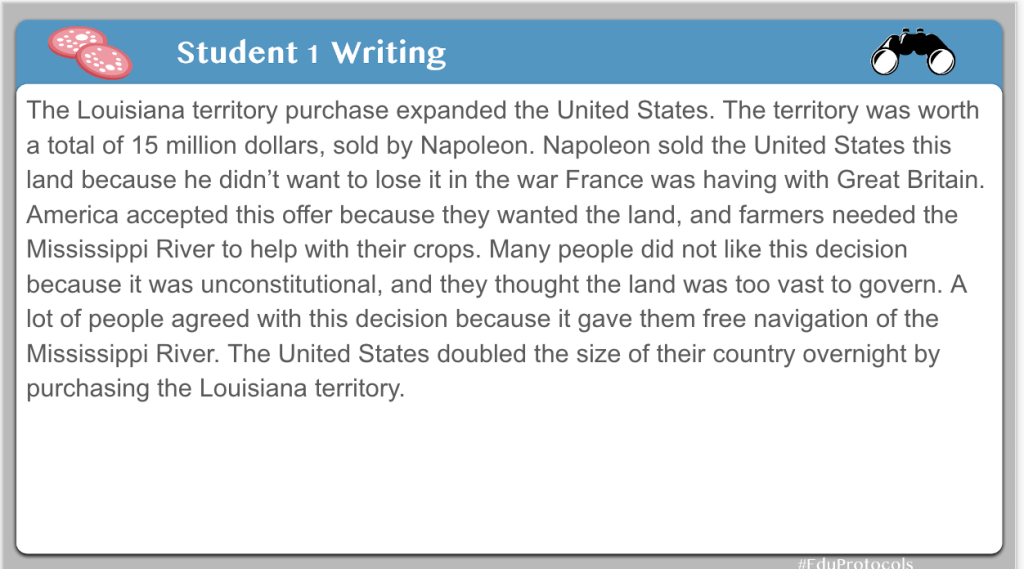
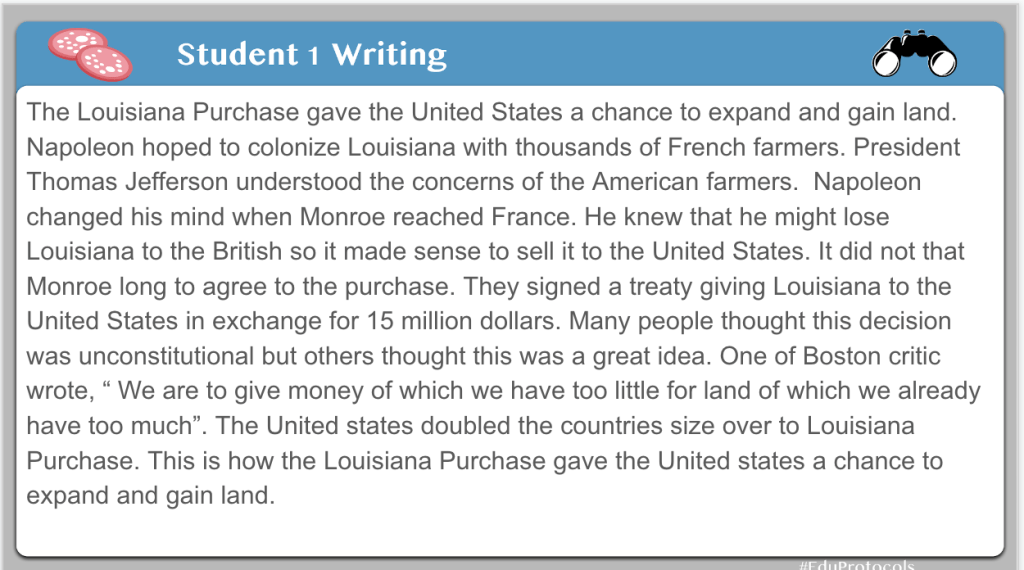
On the CyberSandwich notes slide, I scaffolded the notes and added a question about the text structure. With the text structure question, around 50% of students got it correct – sequence and cause/effect structure. The scaffolded notes were broken up into different categories such as: people involved, why we wanted Louisiana, reasons for, and reasons against the purchase.

In a typical CyberSandwich, I gave students ten minutes to read and take notes. Then I had students write down four important facts on the compare/contrast slide. Next, we did three categories – bazinga, 3 facts, or questions. For the three categories, i had students get up and write their responses on one of three boards. Finally, I gave students 8 minutes to write a summary paragraph.

We finished class with a Fast and Curious Gimkit. So far, the Gimkit has 14 questions. I will add more as the unit progresses. As students start to master certain questions, I take them away. Every class was at an 80% average or higher.

As I went home that evening, I read through the paragraphs written by the students. I used mote to give audio feedback. The biggest issue I noticed was a topic sentence with details that didn’t fit with the main idea of the paragraph. For example, the student might say, “The Louisiana Purchase was controversial,” and not mention any type of controversy surrounding the purchase.

Tuesday

Tuesday began with the students listening to the feedback on Mote. I gave whole class feedback on the issue mentioned above. Then I had students listen to their individual feedback. I gave them 10 minutes to revise, make changes, and highlight any changes.

At the conclusion of 10 minutes, we moved into learning about Florida. I added a sequencing graphic organizer at the bottom of the page. Then I asked the students, “Based on the organizer, what is the text structure?” From the visual of the organizer, over 90% of the students got the structure correct.

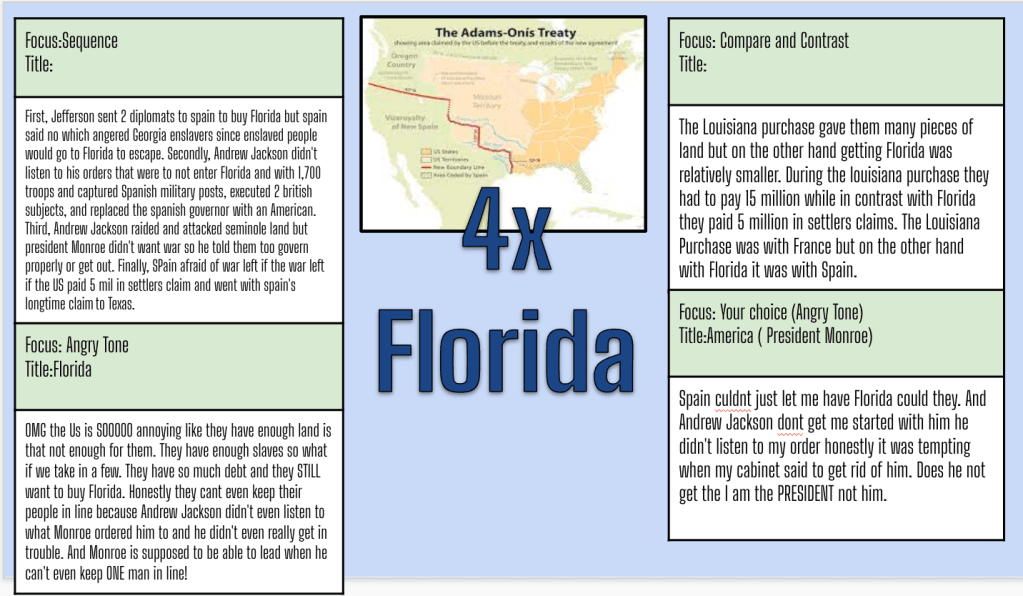
I gave students 8 minutes to read and fill out the sequencing graphic organizer. I thought about doing a CyberSandwich stack, but I decided to switch it up. The 4xTextstruxture lesson entered my mind. I wanted a similar lesson. As a result, I created the 4xFlorida. I also created a sheet with 8 different styles of writing – sequencing, angry tone, compare/contrast, narrative, Spain’s perspective, etc. Any time dice is involved, it’s fun.

When it was time to summarize how we got Florida, I rolled the dice and gave students four minutes to write. Overall, the students did a great job as this was the 5th or 6th time we did this style of lesson this year.

Wednesday and Friday

I’m combining Wednesday and Friday into a single heading because students worked on their annotated maps. For Wednesday, I handed out 11×17 size sheets of paper and had students tracing/drawing maps of the United States. Here are the steps I left for them:

  1. Write the question at the top of the paper, “How did manifest destiny drive westward expansion?”
  2. Draw an outline of the United States and label these territories: Louisiana, Florida, Gadsden purchase, Mexican cession, Oregon, and Texas.
  3. Leave room around the map.

I offered for students to try Google My Maps and only 2 students took em up on that offer. Here is an example:

For the last 10 minutes of class son Wednesday, students completed a Fast and Curious Gimkit. This particular Gimkit was on U.S. territories and I added continent related questions to it. The students were asking if France was a continent. This prompted my decision to add continent questions.

On Friday, students were outlining, coloring, and adding information to their maps. I had them open their Louisiana CyberSandwich summaries and transfer their responses to the map. If they felt their summary was too long, I had them paraphrase.

When they were writing about Florida on their map, they asked me, “Which writing for Florida do we add?” I responded with, “Which writing do you think works best?” They quickly realized the sequence, narrative, or cause/effect writing worked best. It was not my intention to use the entire class period for Wednesday and Friday, but that’s the way it goes.

***In some of the classes, the students finished early and we did some retrieval practice the last 10 minutes of class. I made a new retrieval board and they did awesome!

Thursday

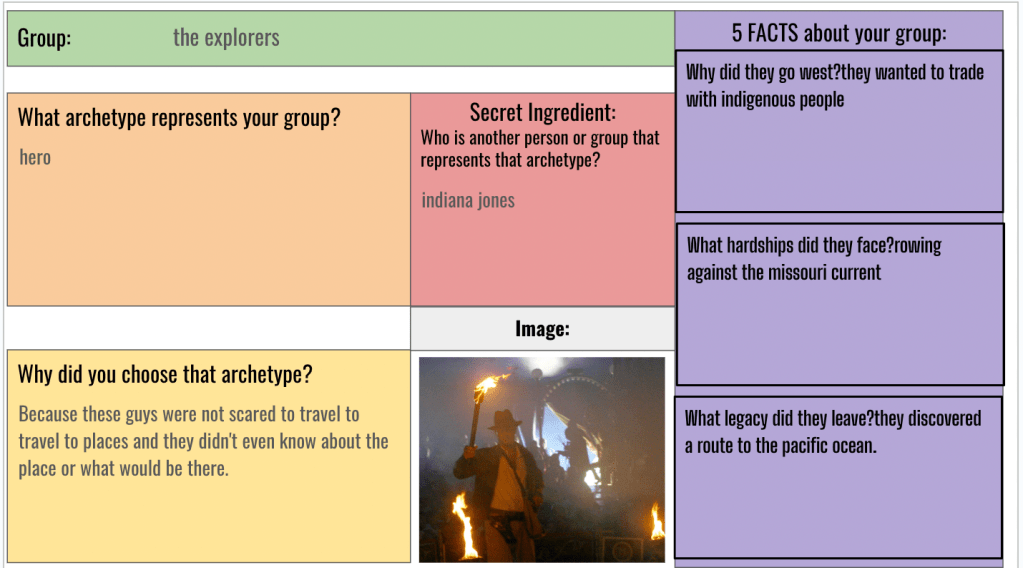
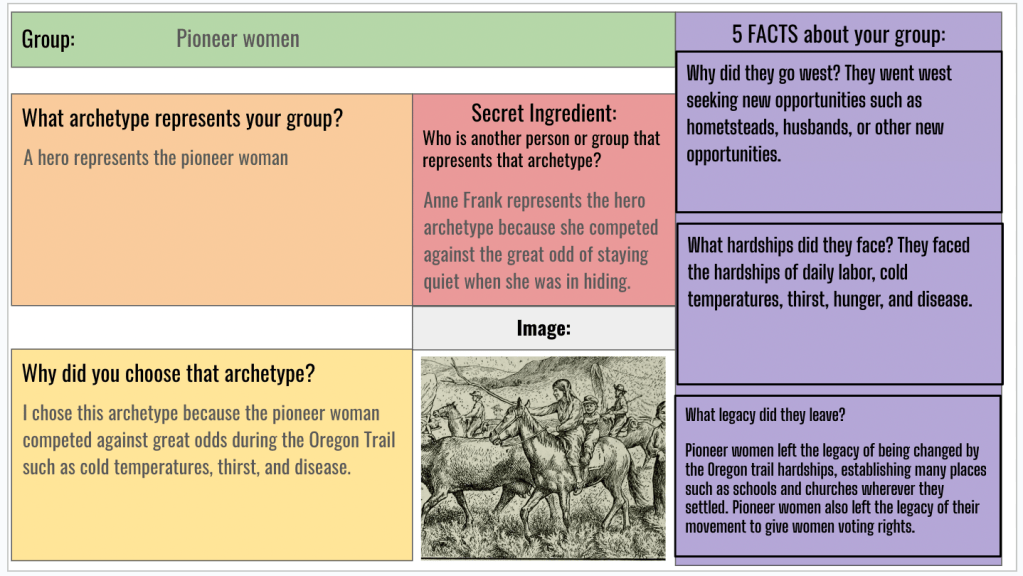
On Thursday, I decided to go back to a CyberSandwich for the Texas Revolution and annexation. There are many parts and people to the story of the Texas revolution. Before we began the CyberSandwich, students completed an Archetype/Iron Chef EduProtocol smash.

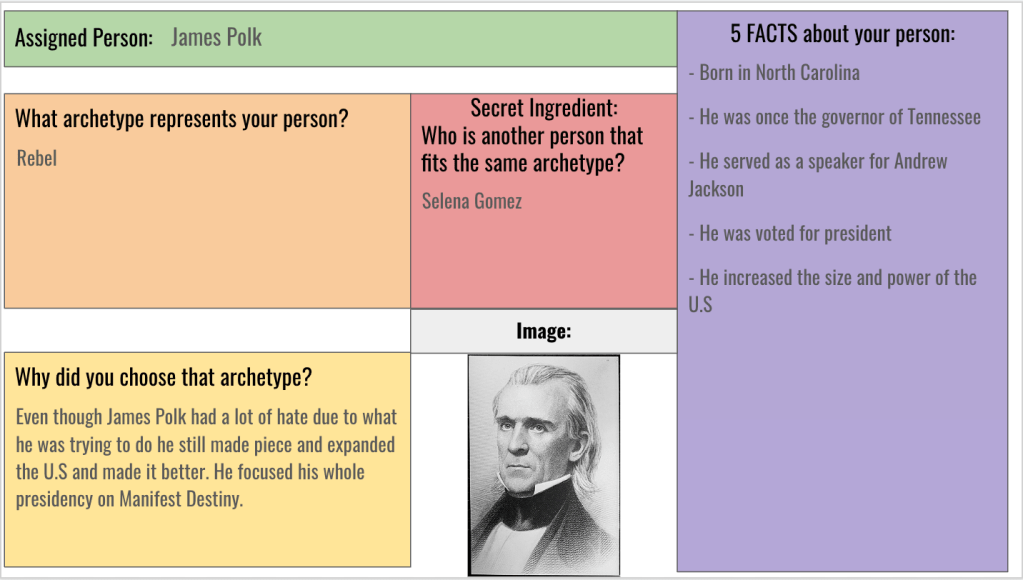
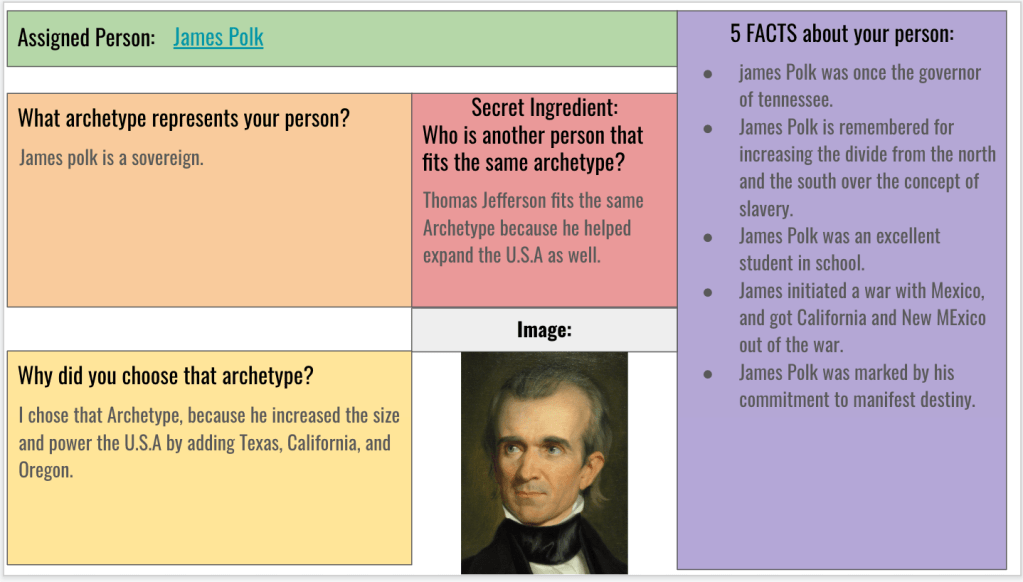
This year we have done archetypes once or twice, but never in the format of an Iron Chef. I know I should go with a low cognitive load, but I went for it anyway. I gave the students 4 people to read and write about – James Polk, General Santa Anna, Stephen Austin, and Sam Houston.

Here is how I ran the lesson:

  1. 12 to 15 minutes to read and design the slide.
  2. List 5 facts about the chosen person first.
  3. Choose an archetype and use evidence to justify the choice.
  4. Make a connection and list another person who fit the archetype (historiucal or modern person)
  5. Add an image.
  6. I had students share them in a single slide deck and gave students 5 minutes to read and look through the Texas Revolution characters.

This lesson turned out okay…I should have started with a low cognitive load, but, that’s the way it goes. The main goal was to build some background knowledge for the Texas Revolution. I thought it was cool that students made comparisons between Sam Houston and Andrew jackson. They made comparisons between James Polk and Thomas Jefferson. Comparisons were made between James Polk and Selena Gomez – I don’t know?

We followed this lesson with a CyberSandwich. The reading paired with this was looooonger than normal. I created a CyberSandwich with a sequencing organizer on the note taking slide. I read the reading to the students, and offered some clarification after each section. At the end of each section, I paused and students filled out a box for the sequencing organizer. At the conclusion of the reading, students discussed and shared their organizers. On Friday, they directly wrote their summaries on their Annotated Maps.

Other Stuff

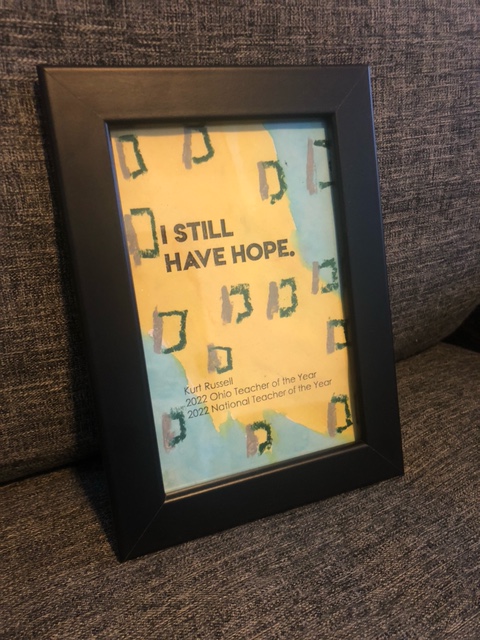
The pictures, notes, and random mess of stuff in my classroom has a story and serves a purpose. Sometimes I don’t quite know what the purpose is, but ultimately time let’s me know. In October at the Ohio District Teacher of the Year festivities, we had a banquet where former Ohio teacher of the Year Jonathan Jurivich gave us student made painting with inspirational quotes that we shared with him in July. My inspirational quote was from Monte Syrie, “Do. Reflect. Do better.” He also shared with us a quote from the 2022 Ohio and National teacher of the year, Kurt Russell, that said, “I still have hope.”

I’ve had the, “I still have hope,” picture up in my room since October. I didn’t know it’s purpose, or story, until this week. Two weeks ago we had a horrific tragedy happen in our community. An entire family was lost including one of our 7th grade middle school students. The lone survivor, the sister, was a former student of mine. The story and the purpose of that picture became clear to me – it’s not for me anymore. That picture is for her. That picture is for the new world she is entering on the other side of her recovery. If you feel like donating to her GoFundMe, please visit and donate by clicking here.

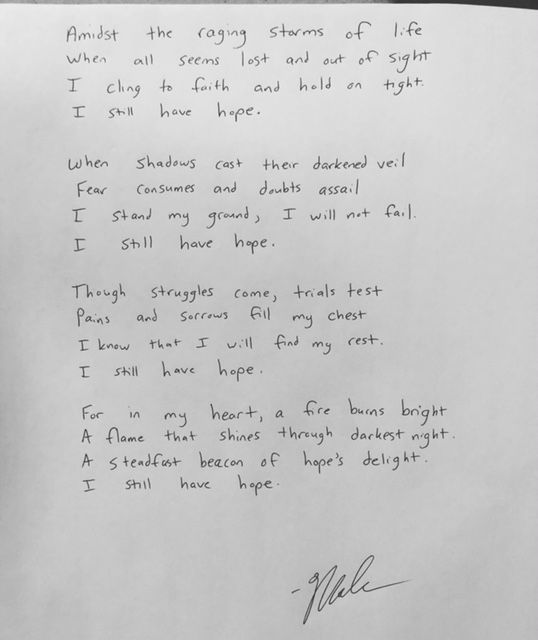
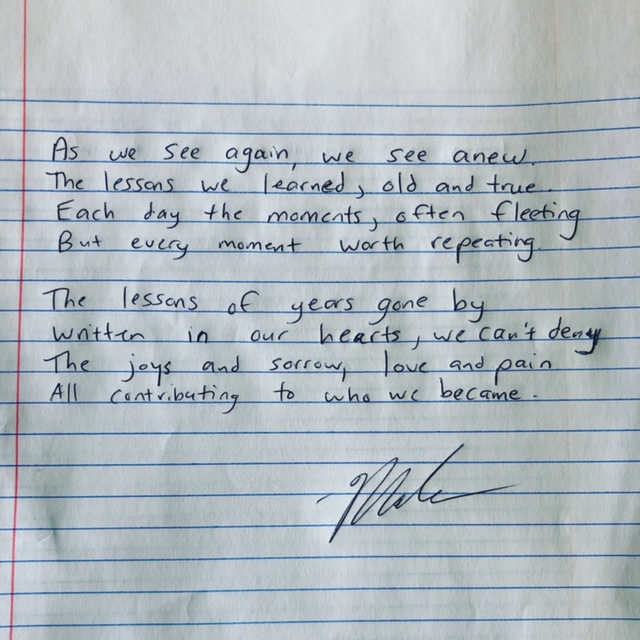
Through tough times, I need to write. Whether it’s a poem, story, anything, I need to write. I wanted to pair a poem with that picture. Most of the stories for the objects in room 505 are stored in my memory bank. However, the story for this picture needed to be put into words. When I arrived at school on Friday morning, I stared at that picture and wrote:

Other Writings

Podcast

Coming soon…..

The Week That Was In 505

This week in 505, we covered a range of topics and used various teaching strategies to engage the students in text structures and westward expansion.

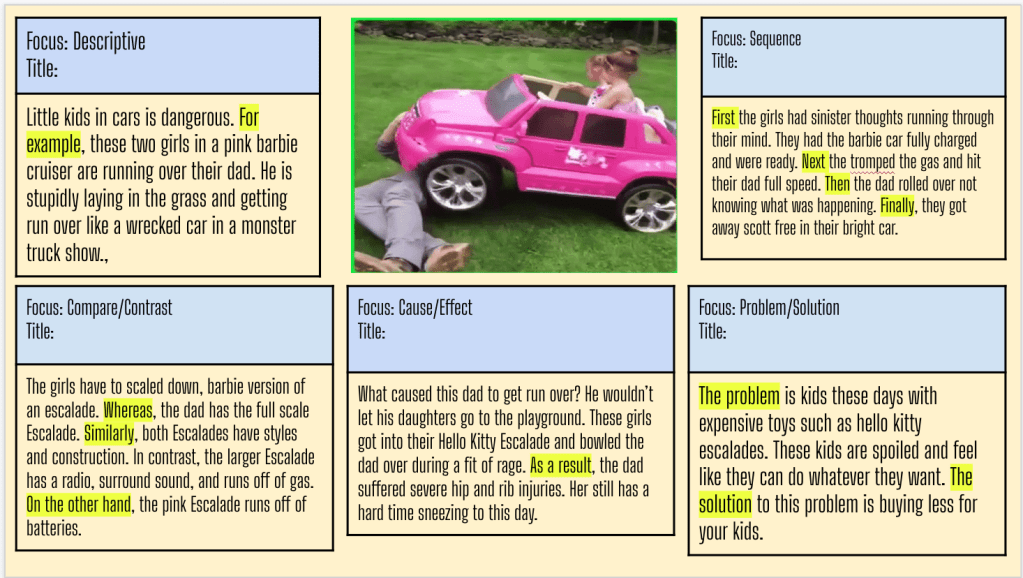
On Monday, we started off the week by writing with different text structures as we examined a funny photograph. This was a great way to get the students thinking critically about the photograph and the different ways in which they could present their thoughts.

Tuesday was a bit of a strange day, with very little emphasis on teaching.

Wednesday was when we started talking about westward expansion. We used a questioning strategy lesson, where students wrote questions about the painting “American Progress.” They then wrote a summary using the 8Parts eduprotocol. This was an effective way to help students engage with the material and understand the key concepts related to westward expansion.

On Thursday, I was presenting at the Hamilton County Educational Service Center about uses of A.I. to enhance learning and instruction. Whenever I’m out, I leave familiar lessons and protocols. I left a Sketch and Tell for westward expansion vocabulary, along with an edpuzzle video. This was a great way to help students understand key terms and concepts related to westward expansion, and to engage them with the material in a fun and interactive way.

Finally, on Friday, students examined motivations for American territorial expansion using a primary source and the 3xCER Eduprotocol. This was paired up with a SHEG lesson that I often use year after year. This was an effective way to help students understand the reasons behind American expansionism, and to engage them with the historical context surrounding this important topic.

Monday – 5xText Structure

Tuesday – some things are more important than school

Wednesday – Wicked Hydra JamBoard, 8pArts, Gimkit

Thursday – EdPuzzle, Sketch and Tell, Gimkit

Friday – 3xCER

Monday

When class began Monday, I created different Repuzzler cards, printed them and handed them out. I took away vocabulary words and added definitions. Now the 4 cards the students had to piece together were: definitions, example paragraph, signal words, and a graphic organizer. We followed up the Repouzzler with a Fast and Curious on Gimkit focusing on text structure definitions, signal words, and examples. All classes had a class average of 80% or higher. The Repuzzler and Fast and Curious took 10 minutes of class time.

Last Friday students were walking around the room, pulling cards from a ‘treasure chest’ and determining the type of text structure being used. After reading multiple paragraphs and determining text structure, I wanted the students to be able to write with different structures. I had an idea to change the 5xGenre EduProtocol to a 5xText Structure.

I tried to explain my idea to someone and it was kind of cast aside. It made me think my 5xText Structure wouldn’t work. However, I did it anyway. It worked great. The kids loved it.

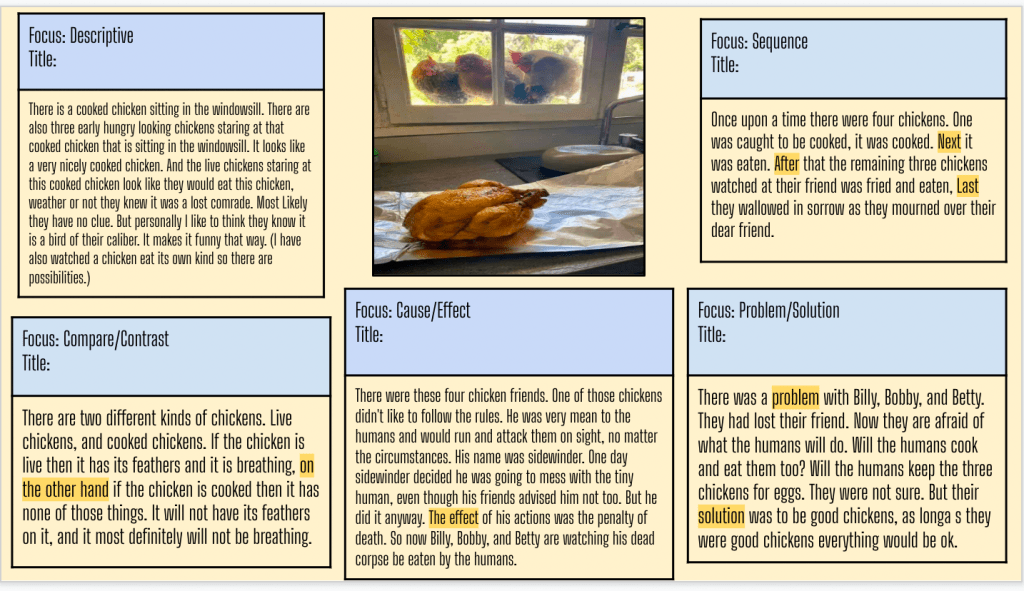
When I introduce a new writing strategy in class, I try to use funny pictures. I try to use a low cognitive load as well. In the EduProtocols Community Facebook group, someone posted a funny picture of 3 chickens looking through a window at a cooked chicken on the counter. This was the perfect picture for the 5xText Structure. Here is how I set up and ran the 5xText Structure:

  1. I created a slide with 5 different boxes for each text structure (descriptive, sequence, cause/effect, compare, and problem/solution). I left a blank space in the middle for a picture.
  2. I remember reading in a research article about teaching text structures to begin with descriptive or sequence first. The top two boxes are for those text structures.
  3. I set the timer for 4 minutes and had students write in a descriptive text structure about the image.
  4. I encouraged them to use signal words. I also had them highlight signal words.
  5. At the end of 4 minutes, we switched to the sequence text structure.
  6. I ran the timer again for another 4 minutes.
  7. We did this until the end of class. It was awesome! The kids loved it.

Since the introduction of the 5xText Structure, I had students create a new slide with a new picture. We begin class now by writing with a new text structure each day. One text structure a day, and now we are down to 3 minutes. Here are some examples:

Tuesday

Tuesday was a difficult day. Some things are way more important than school. People often ask me what I learned about education during Covid and I always respond, “I learned that it’s just school.” Many kids will come into our classrooms and at the end of the day, at the end of the quarter, at the end of the semester, or the end of the year they will always remember how they felt. I tried to do some school on this day, but I changed my mind. It didn’t feel right.

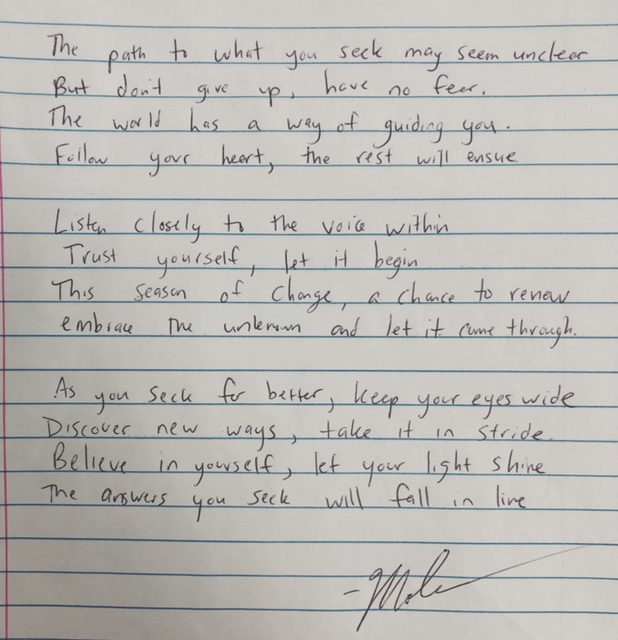
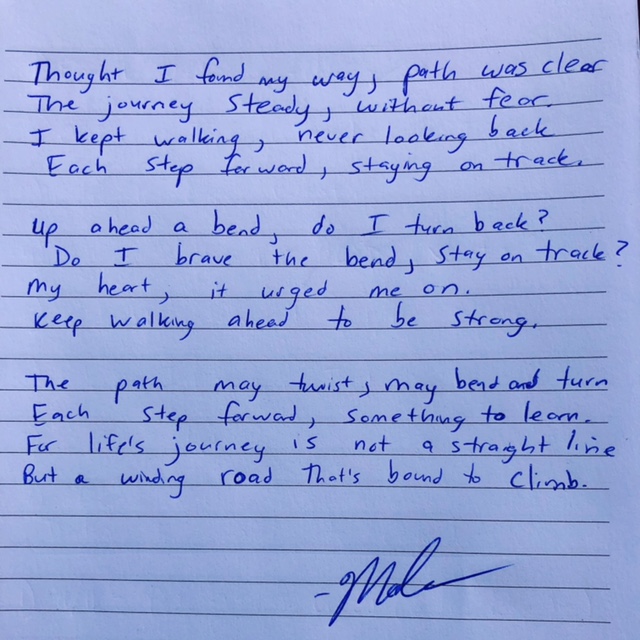
I often write random poems for school, tennis, or life. This moment called for me write a poem:

Wednesday

Wednesday we came back ready to begin a new unit. I have moved onto westward expansion. My overall question for this unit is, “How did manifest Destiny drive westward expansion?” So, priority number 1 is helping the students understand the phrase Manifest Destiny.

I took nine vocabulary words from the lesson on westward expansion and created a Blooket and a Gimkit using ChatGPT. (It’s mind blowing!) Here is how I made them in 5 minutes or less:

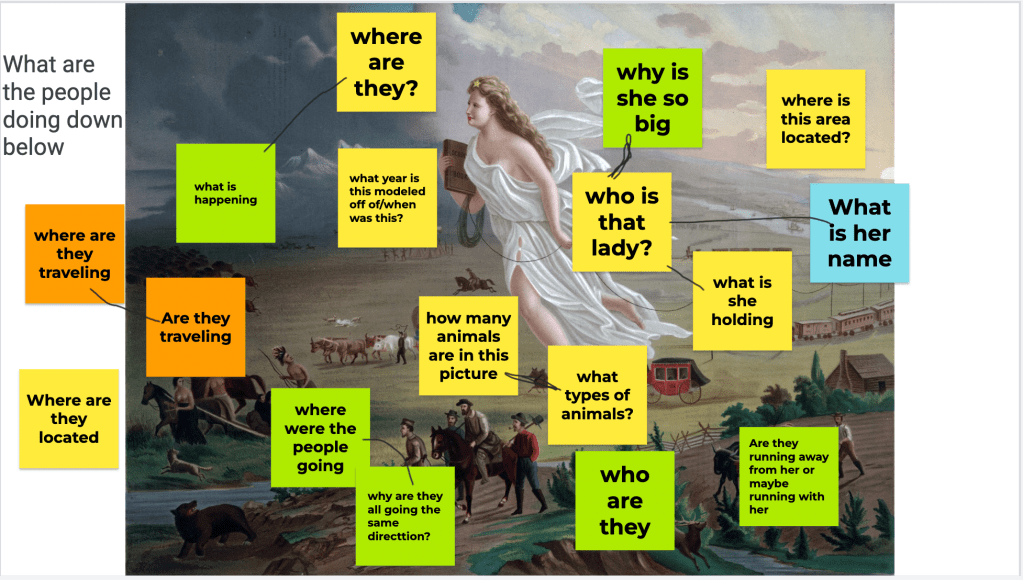
Before we even used the Gimkit, I wanted students to ask questions about the image, American Progress. This image is Manifest Destiny. I copied this image onto a jamboard and had students share with each other. This image has so much going on that it naturally creates curiosity and questions. I gave students 5-6 minutes to ask questions. The students used the post-it note feature on jamboard to ask their questions. At the end of 5-6 minutes, we had a brief discussion about the image.

One thing I usually have to point out about American Progress are the two halves – light vs. dark. Most students to pick up on this, but several students asked the question, “Why are they moving into darkness?” “Why is one side lighter?” It led to great discussions – I love Jacob Carr’s Wicked Hydra EduProtocol.

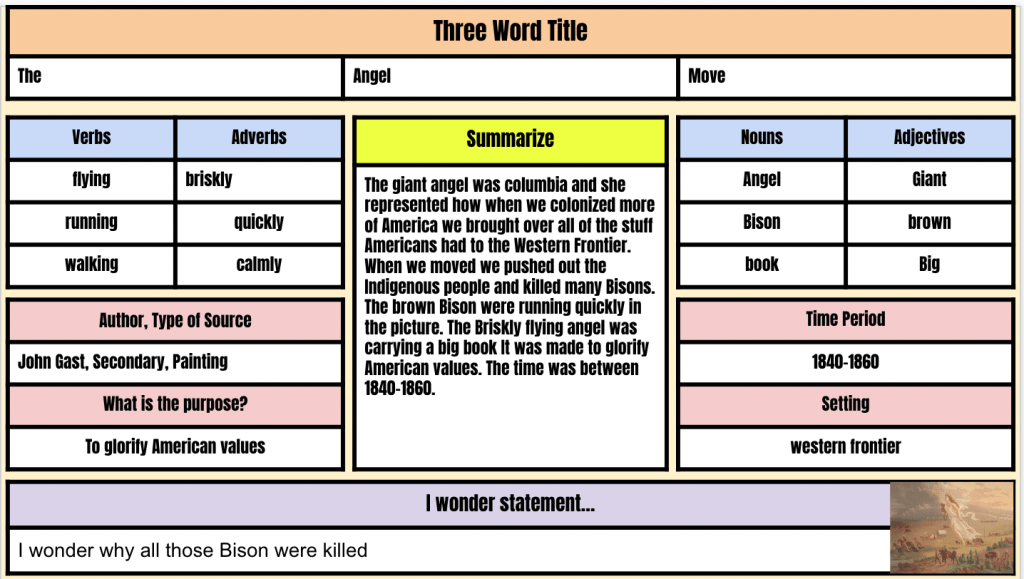
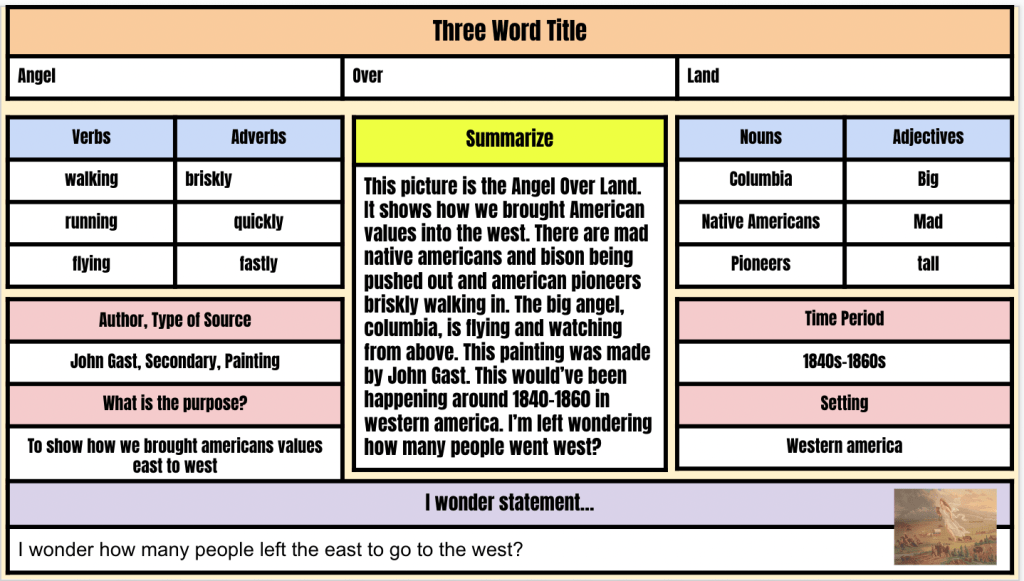
In an effort to keep writing as a theme in my class, we followed up the Wicked Hydra with an American Progress 8pArts. Now, students had some basic background information with the painting and I wanted to see how they could use that information to write. The first thing I had students do was take a question from their Jamboard and turn it into an I Wonder statement on the 8pArts.

We haven’t completed an 8pArts in a long time and it showed. I had to remind 8th grade students what verbs and adverbs were. As a result, we did the 8pArts together. After we filled in the boxes, they wrote their summaries.

To conclude class, we played a Gimkit with westward expansion vocabulary words. All of the class averages ended up at 67% or higher. The most commonly missed words were: cession, annexation, and diplomacy.

Thursday

On Thursday I was out presenting. I was at the Hamilton Education Service Center presenting 10 Ways to Use A.I. to Enhance Learning and Instruction. If you want any ideas or want to contribute an idea, here you go:

  1. My Presentation – some of the highlights include: mad libs, creating questions, and pairing some EduProtocols with AI.
  2. Share an A.I. idea here on a Thin Slide.

Whenever I’m out, I always leave something familiar for the students. So, I left a Sketch and Tell, and EdPuzzle video about westward expansion, and a Gimkit. When I looked back through the student work, I had 74% student engagement. I received only 1 email from a student and it said, “Can you please reset my EdPuzzle?”

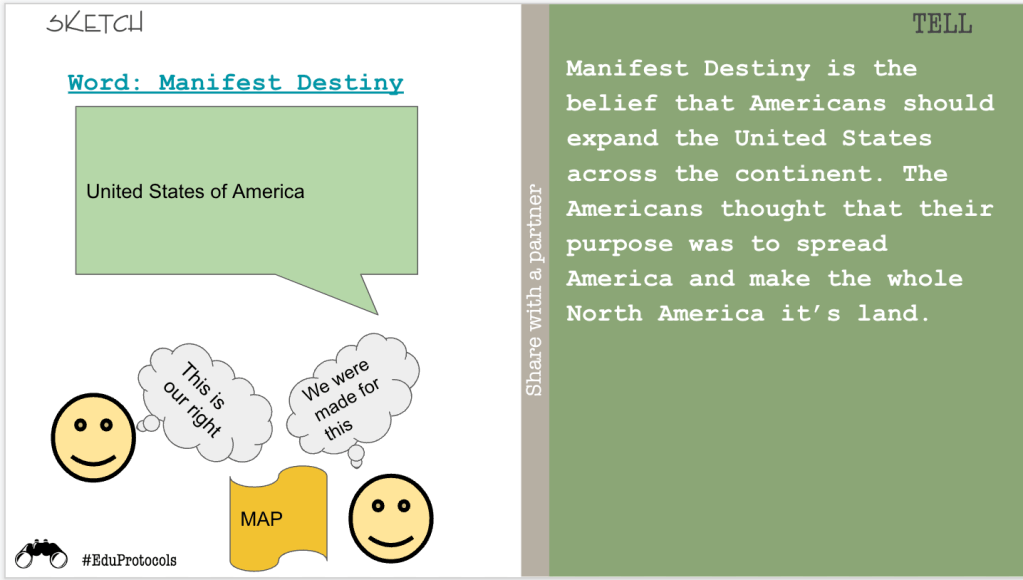
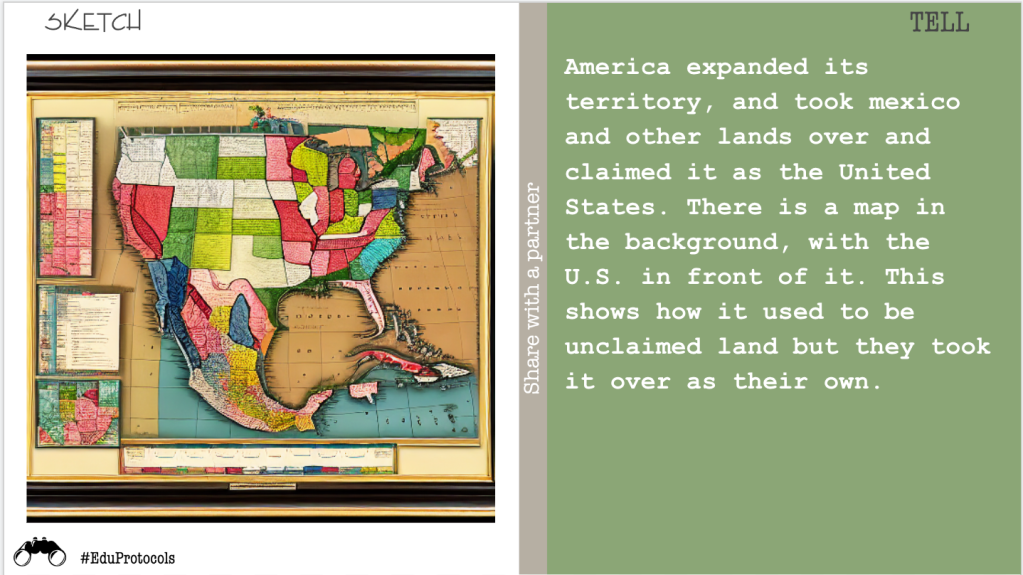
For the Sketch and Tell I had students paraphrase westward expansion definitions for cession, annexation, diplomacy, and Manifest Destiny (The most commonly missed words from Wednesday’s Gimkit). Students could use Google Shapes or Scribble Diffusion. Scribble Diffusion is an A.I. site that takes your drawings and converts them into images. It’s super cool. Here is a disclaimer – I have used scribble diffusion several times and 98% of the time it has been awesome! A student showed me a drawing he made for ‘cession’ which was a stick figure. He showed me his description, “someone surrendering,” and Scribble Diffusion create an inappropriate image. It was weird. Out of the hundreds of images I created, and the students created, this only has happened once.

Friday

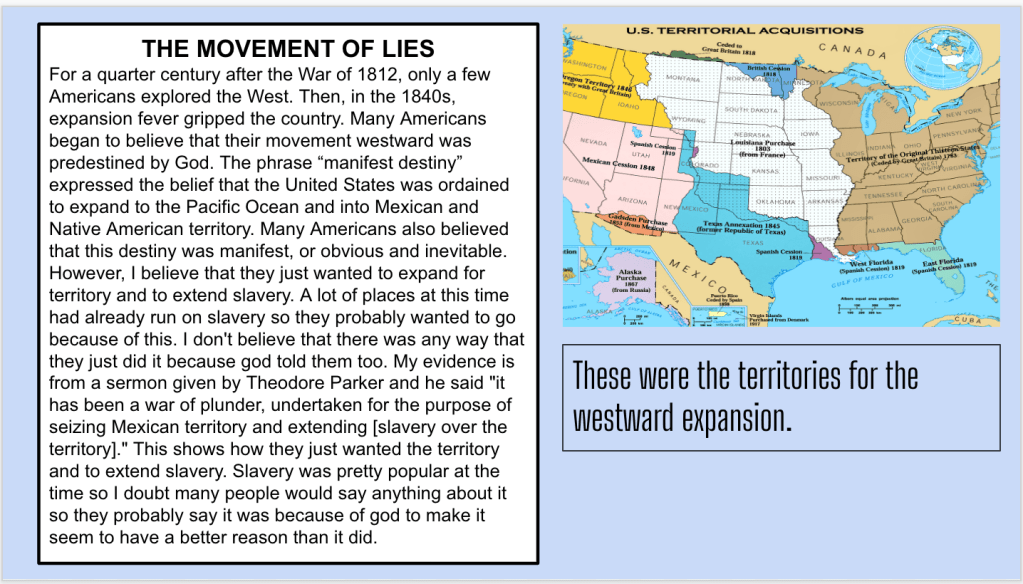
Friday I took a SHEG lesson (Stanford History Education Group) about Manifest Destiny. The lesson asks the question, “What motivated American territorial expansion in the 1840’s?” I like to pair the 3xCER with SHEG lessons.

In this lesson, students read an excerpt from a textbook about Manifest Destiny. Then students read three more excerpts from John O’Sullivan, the Whig Party, and Theodore Parker. Each excerpt offers different insight to motivations for Americans.

I pointed out to students that the textbook and John O’Sullivan point out that territorial expansion was motivated by this belief that we were heroes, saving people, and bringing them American values. The other two perspectives show America as greedy for money, resources, and showing its strength.

Either way, I set up the 3xCER so students could write down the Textbook claim. We worked on trying to restate the main question in our claims. We also worked on not using, “I think…” in our claims. For the other three excerpts, I set a timer for 6 minutes on each one.

Here is what I love about the 3xCER – In just over 20 minutes, students wrote 4 claims, found/used 3 pieces of evidence, and used reasoning 3 times for their claims and evidence.

This particular lesson goes in a circle, and we circled back to the original textbook section we read. This time, the students had the option to add more information to the textbook article. Or, they would rewrite the textbook article. I had them add a picture, caption, and create a new title. Here are some students examples:

Podcast

The Week That Was In 505

This week we wrapped up the Age of Jackson with some new protocols and some new lesson ideas. I tend to get ideas and run with it because….why not? To me, education is one big experiment. I’m going to try stuff, see if it works, see if it’s engaging, and reflect. If something sucks, I’ll ask myself or the students why and try again.

This week I tried some new things with retrieval practice, a new EduProtocol (thank you Lauren Richardson, Ashley Morrison, and Jacob Carr), and a new use for ChatGPT. I love new ways to use technology to enhance the learning experience.

As I mentioned in my podcast last week, retrieval practice is often forgotten about. For some, maybe it’s the DOK 1 nature of the practice. For me, I get caught up in the day to day stuff of teaching and don’t make time. I have vowed to make more time.

The new protocol I tried came from jacob Carr’s brilliant mind – the Wicked Hydra. In seeing posts on Facebook, Twitter, and beyond it appears that Wicked Hydra can be used at the beginning of a unit or at the end of a unit. It’s an EduProtocol so it’s versatile.

With ChaGPT, I had it create arguments why Andrew Jackson is considered a good president and a bad president. I had a realization that it’s hard for students to write argumentatively when the argument is obvious. It’s easy to write about why Andrew Jackson could be a bad president. The good argument isn’t so obvious. As a result, ChatGPT spit out some some good arguments based on the prompt I typed out.

Near the end of the week, I was looking at some testing data and it showed up with the yearly trend – Informational Text craft, purpose, and structure. The data isn’t good. I decided that I’m going to address this problem with some mini lessons and infuse my future lessons with text structure prompts.

Monday – No School

Tuesday – Retrieval Practice, Number Mania

Wednesday – Argumentative Writing

Thursday – Wicked Hydra, Fast and Curious, Repuzzler

Friday – Fast and Curious, Resource Rumble

Tuesday

Tuesday’s class began with a retrieval practice grid. I learned this idea from Lauren Richardson and Ashley Morrison at the Pickerington Schools Conference. The grid has four columns, four rows with different colored boxes. Each box represents something from a different lesson throughout the school year. When I chose which questions to include, I thought about important information included in the standards.

When students walked into 505, I had this grid posted on the screen. I didn’t want students using chromebooks, so I created a google doc that mirrored the grid you see above. I printed off the grid and handed it out to groups to avoid the chromebook fight. Students had 15 minutes to earn 15 OR MORE points.

At first, the students were struggling. It quickly turned around and they started coming up with answers. If you give students time to think, it will come back to them. Some people asked me some questions about this:

  1. “How do I check for accuracy?” – My students ask me to check on them and look at their work all the time. Plus, I had them turn their papers in to me so I could check the answers. Then I began thinking about this – why do I always need to check for accuracy?
  2. “What is the point of this?” – through social media, this seemed pretty direct and condescending. However, we don’t use retrieval practice enough. I will use it a lot between now and the end of the school year.

At the conclusion of the retrieval practice grid, I went back to the Trail of Tears lesson from last week. I left a long reading, and many students didn’t complete the lesson. As a result, I compromised and had students revisit the Number Mania slide. On the slide I left a statement from the article, “The trail of the exiles was a trail of death.” I asked the students to find 4 numbers and facts to support that statement.

Lately, I have been all about finding a quote from a reading and having students use numbers and facts as textual evidence to support a statement. It focuses the students and helps focus my feedback. I know when I’m giving feedback if a student uses, “1830 – the Indian Removal Act,” it’s not necessarily supporting that statement.

For the students that were finished, I extended the activity to a Holocaust project they are doing in language arts. I threw out to the students it seemed Hitler’s lebensraum was influenced by America’s Indian removal policy. So, I had students compare the Trails of Tears to the Holocaust using a Venn diagram. The students did an exceptional job with their information.

I ended the last 10 minutes of class with the Fast and Curious Gimkit the students created throughout the unit. Every class was at 76% or higher.

Wednesday

I wanted to wrap up the unit on Andrew Jackson. It has been choppy with me being out and other interruptions of school. It was time to move on. With most of my summative assessments I like to use a Fast and Curious paired with a performance task.

At the start of the unit, I wanted to use the question, “Was Andrew Jackson good for democracy?” Then I realized I should have covered the word “democracy” and I didn’t. Knowing my students, it would have been a disaster. I’ll have to cover democracy later (even though they studied this word multiple times in the past). To keep things simple, I changed the question to, “Should Andrew Jackson be considered a good president or bad president?” Simple? Yes. Too simple? Maybe. It is what it is.

Arguing that Andrew Jackson is a bad president seems simple since we just studied the Trail of Tears. Sometimes we ask students to make arguments that seem so obvious that it’s hard to write about and make an argument. I know from experience. So, I went to ChatGPT for help.

I asked ChatGPT, “Create a short argument why Andrew Jackson is a good president based on the nullification crisis, spoils system, and national bank.” It spit out a wonderful argument. I had to change a few words and it was good to go. Then I asked ChatGPT, “Create a short argument why Andrew Jackson is a bad president based on the nullification crisis, spoils system, national bank, and Trail of Tears.” Again, I changed a few words.

I copied both of the arguments to separate slides on the same slide deck and shared with students. Then I had students choose an argument and write a counterargument (I used the word rebuttal and we had a good laugh that I said butt – it’s middle school). I wanted the students to practice writing a claim, using evidence, and reasoning. In the counterargument I was hoping students would use information they learned in the unit.

My goal since the beginning of this year was getting better at writing a decent paragraph – argumentative or descriptive. I used Mote to give audio feedback to every student. The next day, I had students listen to my feedback and make corrections. We are getting better at writing! Here are some examples:

Thursday

I began Thursday by having students listen to my feedback from Mote and making corrections. I set a timer and gave them 10 minutes. Then I decided to have them highlight and revisions they made. When the timer sounded, we moved onto our new lesson.

This new lesson, I stopped and asked, “Hey, do you want to try something new?” They, of course, said, “Yes.” I busted out the Wicked Hydra. I don’t even know if I did it correctly, but I loved it. The students loved it.

Some of the periods I used the white boards because they are small classes. Other classes, I had huge pieces of paper. I had the students pair up based on rows and write, “Andrew Jackson,” in the middle of the board or paper. I gave students 7-8 minutes to write questions about Andrew Jackson – anything and everything – whether you know the answer or not – ask it, write it. When the timer went off, I had them rotate around the room to a new board or paper. I gave them 3 minutes to add new questions. Then we rotated again – repeat.

The students came up with questions related to topics they learned at the beginning of the unit that I completely forgot about. This was an awesome way to end the unit on Andrew Jackson. I learned two things from this:

  1. The students subtly shared things they learned that they didn’t include in their argumentative paragraph or the gimkit.
  2. Not every lesson, unit, activity needs closure.

After the Wicked Hydra I switched to a new lesson completely – Text Structures. Why Text Structures?

The data is telling me that I need to focus on text structures. I decided I’m going to take three days to focus on text structures and author’s purpose and infuse these ideas into future lessons. I’m willing to bet that the lack of text structure knowledge is contributing to the lack of key ideas and details knowledge.

I had the students do a Fast and Curious with text structures using Gimkit. The Gimkit had 17 questions about signal words, definitions, and passages dealing with informational text structures. I had the students play the Gimkit for 5 minutes. Then I went over the 3 most commonly missed questions, and set up another game to run for 4 minutes. The students love this format.

We followed up the Gimkit with students completing the slides for the Repuzzler. The students shared the slides and divided the work. Each slide had the students researching an individual text structure – a paragraph example, signal words, and a graphic organizer. This took about 10 minutes and class was over. A full class period bell to bell.

Friday

Friday we began class with a Fast and Curious Gimkit on text Structures. This was followed by a Repuzzler. Most of the students completed the Repuzzler in seven to ten minutes. Following the Repuzzler, we did a resource rumble with text structures.

I went to ChatGPT to help me write eight different paragraphs, with different text structures, related to history. I asked ChatGPT, “Write a 5 sentence, 5th grade level paragraph about the Monroe Doctrine using a cause/effect text structure using cause/effect signal words.” Within seconds, it created a great paragraph. However, I should have done a better job at checking the paragraphs because one of them stated, “The American Revolution spilled over into Europe.” This was the only mistake I read.

I placed each paragraph into an envelope around the classroom. Each paragraph I had ChatGPT create related to something from the retrieval practice grid from Monday – everything I do is intentional. I created an organizer for students to keep track of their information. They had to read the paragraph, guess the text structure, write down signal words, and fill out a prompt about the information in the paragraph. All in all, this was a fun lesson that got the students up and moving.

Podcast

The Week That Was In 505

One thing we don’t do enough within our lessons is the use of retrieval practice. We spend so much time putting information into the students’ minds. As a result, we spend less time having them get that information back out. Retrieval practice is an aspect of my teaching I wanted to focus on this week.

Last week students watched an EdPuzzle about Andrew Jackson. This was followed by the creation of a thick slide featuring a “battle” that Andrew Jackson fought within government. Students shared their slides through a Google Form to created a curated bank of thick slides. Then I gave students a Frayer model to take notes from the other slides.

This week we finished up taking notes on Monday and started creating these fight posters about Andrew Jackson vs. someone or something. It was a nice. ix up because it was done on a paper. Yes, I’m a believer that it’s good to mix some paper into my lessons or units. However, paired with this was some retrieval practice strategies.

Near the end of the week, students finished up Jackson’s battles and we moved onto the Trail of Tears. I created a mini lesson paired with a reading. The reading I left was longer than normal, and it yielded some interesting results.

Monday – Jackson’s Battles (posters), Retrieval Practice, Fast and Curious

Tuesday – Career Planning

Wednesday – Trail of Tears Lesson with a Number Mania

Thursday – Finish stuff catch Up Day

Friday – PD Day

Monday

I’m going to just focus on the retrieval practice for Monday. If you want to learn more about the Jackson’s battles thick slide, please refer to last week’s blog post. When class began, I gave students 15 minutes to work on finishing notes on the Frayer or creating the fight poster. Then I followed this with students creating questions for our running Gimit. After students submitted some questions, we played the Gimkit for ten minutes. I started with the Frayer and poster work so it would feed into helping students create questions for the Gimkit.

After the Gimkit finished, I had groups get into pairs. Some students got into a group of three (not ideal, but okay). I handed out a dry erase marker to every group. At first they were confused and curious which is what I wanted. I then stated, “We are going to play the marker game.” I explained the rules:

  1. I read a true/false statement.
  2. Only grab the marker if you think the statement is true.
  3. If grab the marker, or touch the marker, and the statement is false – you lose a point.
  4. If you grab the marker, and the statement is true, you gain a point.

Pretty simple rules. No tech required. The students had a blast. I used ChatGPT to create true/false statements about Andrew Jackson. Some of the statements I had to change the wording to fit with the vocabulary I’ve been using, but they were good statements. Here are some of the true/false statements:

This was a great retrieval practice strategy I learned from Lauren Richardson and Ashley Morrison from the Pickerington Conference I recently attended. The students had a blast.

Wednesday

Tuesday was a lost day. However, I had a data team on Tuesday for a half day. It had an interesting conversation. The conversation included thoughts on reading stamina for map tests. Do we build reading stamina? Do we make reading basic article seem like a daunting task? For example, how often do we say, “I know this reading is long, but….” I’m guilty and never thought about it before. We also discussed if students realize how long it would take to read a longer passage.

Wednesday I was presenting some EduProtocols at OETC in Columbus, OH and I left a longer than normal reading passage about the Trail of Tears. I wanted to see who would take on the challenge of reading and completing a couple of slides. With the reading, here is what I did:

  1. I left printed copies of the reading.
  2. I had a digital version of the reading.
  3. I used Screencastify to record an audio of the reading. Then I linked the audio to the digital copy. (If students are listening to audio of a reading, and following along with a text, students can read and comprehend at grade level, or two levels above.)
  4. I used ChatGPT to rewrite the reading at a 5th grade level.

Needless to say, I covered my bases. Some students would challenge themselves. Some chose to listen to the audio. Some opted for the edit, fifth grade level. My engagement level is usually around 70-75% when I’m away. Again, I define engagement as opening the lesson and attempting to do something worthwhile. On Wednesday, my engagement level percentage was 50-55%.

The assignment I left with the reading was a Google Slide with three parts. My request for students was simple:

  1. LISTEN TO THE DIRECTIONS
  2. Read or listen to – The Trail Where They Cried.
  3. Complete the activities on 2 or more slides.

The three parts to this assignment were a sequential order slide (I used an Amanda Sandoval template for that slide), a conversation slide, and a Number Mania. I included the sequential order slide because I wanted to see how students would do with putting events in order.

I had a realization during our data team meeting on Tuesday – I need to do a better job with informational text structure and craft. The data from the informational text – key details and main idea wasn’t good either. However, this could be due to not understanding the structure of the text. It could also be due to students reading information text with no background knowledge or working memory of what they’re reading (this is a major problem I have with testing). Why not include readings on the ELA state tests that involve social studies topics we covered this year? It makes sense to me. My mini-rant is over.

Either way, I need to focus on teaching text structure and my mind is wandering that way. In looking at the sequential order slide I put together, the students didn’t do a good job with putting the events in order. It was scary. I need to do better.

On the Number Mania slide, I took this quote from the article, “…the sufferings of the Cherokees were awful. The trail of the exiles was a trail of death,” and wanted the students to create a slide with four numbers and facts to prove that statement true.

One thing I’ve been trying to get the students to think about are the numbers that aren’;t directly stated. For example, the article stated the forced march took place in “below freezing” temperatures. I encouraged the students to think about, “What’s a below freezing temperature?” That could be a number.

I’m trying to up my Number Mania game. Let’s use numbers and facts as textual evidence. Let’s also think beyond explicitly stated numbers and facts.

Thursday

Thursday was a day to finish Jackson fight posters. It was also a day to finish the Trail of Tears activities I left on Wednesday. I also used Thursday to ask students how long they thought it would take to read the Trail of Tears reading that I left. Here are the answers I got –

  1. 50% of students said 20 minutes.
  2. 30% said 30 to 40 minutes.
  3. 10% said 10-15 minutes.
  4. 10% said 5 minutes.

We were all over the place. This tied into helping students realize that long reading don’t take as long as they think. I told them the reading should take 10 to 15 minutes which is the same amount of time we read during SSR time last year. They were truly surprised to realize to make that connection, and have that realization.

I also shared with the students I had to take a remedial reading class in college because my reading scores were low. I seriously took a basic level, remedial reading class. At the time I was embarrassed. I shared that story to help them realize that if you practice reading, find things you life to ead, you can find better. One student asked me, dead serious, “Did you get better at reading?”

I’m stopping it there. 🤦 If you want to purchase my book, check it out on Amazon!

Podcast

The Week That Was In 505

This week came and went so fast.

I find myself saying this many times throughout the school year. The students mention to me quite a bit, “This class flies by.” When we are jumping protocol to protocol – yes, it flies by.

This week I got a student teacher for a brief stint of five days. At one point I asked him, “Do you realize how much the students have done in these class periods?” I proceeded to map it out on the board:

We got after it this week studying the Age of Jackson. We learned important vocabulary with Repuzzler (a new EduProtocol from Jacob Carr). Students were collaborating and creating cards on Tuesday for a game on Wednesday.

This was followed by a CyberSandwich to learn about the Election of 1828. Since Wednesday, I have been painting this picture of Andrew Jackson as a tough, stubborn, champion of common people. It was only fitting to learn how he became president.

I continued sticking with my theme during this unit – students will create their own questions. After the CyberSandwich, students made questions about the Election of 1828.

We continued into Wednesday with some vocabulary word practice with the Repuzzler cards made by the students. They created their own questions on Gimkit, and we played some Fast and Curious. We finished class with a Thin Slide – one picture, one word or phrase – What did you learn today?

I wanted to create a contributive learning lesson with Jackson’s battles. From this I learned that students thought he fought actual battles against these people and things 🤦. We started with an Edpuzzle video about Andrew Jackson. It was 4 minutes long with 7 questions. Next, students chose a topic: nullification, bank, indigenous people, or government officials. They read about their topic and created a Thick Slide.

Students shared their Thick Slide through a Google Form, and they used a Frayer to process the other topics.

Monday – career planning

Tuesday – Repuzzler, CyberSandwich

Wednesday – Repuzzler, Thin Slide

Thursday – Edpuzzle, Thick Slide

Friday – Frayer, Poster, Success Criteria, Examples

Tuesday

Last Saturday was the Catalina Lesson Mixer put on by EduProtocols+. I attended a virtual session, hosted by Jacob Carr, about Repuzzler. This is a new protocol coming out in his AP Language Arts book. From this session, I was inspired to try the Repuzzler on Tuesday.

When I walked into class, I asked the first student in each row to open the Repuzzler file and share it with everyone in the row. This was followed by, “What? How do I do that?” That was followed me saying, “You have 2 minutes to figure it out.” Guess what? They figured it out.

I gave the groups 10 minutes to complete the entire slidedeck. The Repuzzler had eight slides with each of the eight vocabulary words. The students had to add a definition, use it in a sentence, and add a symbol to represent the word. Last Friday students completed a TIP chart with vocabulary. I handed the TIP charts back to them for reference. After students completed the Repuzzler, they asked me, “What are we doing with those?” I responded, “You’ll see tomorrow.”

After the Repuzzler was a CyberSandwich. I found a NewsELA article on the Election of 1828. I created two different lexile levels of the article and linked it to the notes slide. The students had to describe the Election of 1828 and how Andrew jackson won. I ran a traditional CyberSandwich with a 10 minute read with notes, and a 5 minute discussion. However, I shortened the time for a summary down to 5 minutes and didn’t tell the students. They cranked out quality paragraphs in five minutes and didn’t realize it. Our reps are paying off!!

At the end of the CyberSandwich, students created questions, with Gimkit Kitcollab, about the Election of 1828. I LOVE the Kitcollab because I can give feedback to the students:

  1. Reword this question because….
  2. Change this word because…
  3. Add a question mark.
  4. Capitalize this or that….

Wednesday

On Wednesday morning, I went through all the Repuzzler slide decks. I chose the best decks, printed them, and cut them into fourths. I clipped the cards together and had them ready. Students came into class curious about the vocabulary cards they created on Tuesday. I had them get into groups of two to three, gave each group a different set of cards, and said, “Piece them back together. Have fun.”

This worked wonderfully! It was something new for 505. I loved it. The students loved it. Repuzzler worked for the first time because it was only 8 vocabulary terms (32 total cards to piece together).

The fastest finisher was around 10 minutes. Other finishers lasted between 15 to 20 minutes. Either way, when groups were finished, I had them use the cards to create questions for the Gimkit.

Following the question creation, we played some Fast and Curious. I set up the Gimkit to run for five minutes. When it ended, I went over the three most commonly missed questions. Then I set up the Gimkit again for four minutes. I challenged the groups to answer more questions and earn a higher class average. Most students thought this was impossible. However, every class beat the challenge.

To end class, I set up a Thin Slide that asked, “What did you learn today?” Students added 1 picture and 1 word. It was a great way to end class.

Thursday and Friday

Thursday and Friday we were building off of vocabulary and exploring Jackson’s battles. I added these “I can” statements to the activity:

  1. I can analyze the battles that Andrew Jackson fought within the government.
  2. I can analyze Jackson’s impact on democracy. 

I wanted to create a contributive learning lesson with some EduProtocols. To help my student teacher, we planned the lesson out with a Madeline Hunter lesson design template.

Anticipatory Set – TedEd Edpuzzle video to build some background knowledge. The video puts Jackson on trial and discusses some of his battles and decisions he made for the country.

Objectives – Students will be able to analyze battles that Andrew Jackson faced within government. Students will be able to analyze Jackson’s impact on democracy.

Input – Repuzzler and Gimkit to build vocabulary knowledge.

Guided Practice – Students will choose one of Jackson’s battles and create a Thick Slide. Students could choose from the following – Jackson vs. Banks, Jackson vs. Nullification, Jackson vs. Indigenous People, or Jackson vs. Government Officials. I set up the Thick slide so students could list the cause of the battle, two key details, and the outcome of the battle. They had to include two pictures, give the battle a catchy nickname, and write a claim analyzing Jackson as a president.

Once completed, students shared their slides through a Google Form. I converted the form data to a Google Sheet and shared the links. Then we handed out a Frayer model to the students. They went through the links collecting information about the three other topics they didn’t read about. They were writing down the cause, details, and the outcome for each.

Independent Practice – Students were using their Thick Slide (or Frayer) and creating a battle “fight”poster. To do this, I created success criteria. The students had to include pictures, a catchy nickname for the fight, causes, and an outcome. Students have the option of completing the poster on paper or a Google Drawing.

Check for Understanding – Students used their Thick Slide and frayer to help create questions for the Gimkit. I asked them to focus on general understandings of the battles. For example: Why did Andrew jackson want to end the national bank?

Modeling – We provided several “fight” posters as examples. Any type of modeling is beneficial for student success.

This lesson is still in progress, but it’s quite successful so far. The Thick Slide format is familiar, Gimkit is familiar, the Frayer is familiar, and this is the third contributive lesson we have done this year. The reps are paying off.

One student completed a Google Drawing poster which is here:

Odds and Ends

I have a super challenging class and I will never forget this line Jon Corippo said to me, “They’re in your head. Get into their heads.” So, I did just that…

  1. We played a Fast and Curious and this class answered 370 questions in 7 minutes with a 67% class average. I lowered the time down to 4 minutes, had half the class close their Chromebooks. Then I challenged them to answer more questions and raise the class average. They answered 360 questions and got a 76% class average. They were screaming to play one more time because they wanted to beat the challenge. Guess what? They did it. They answered 500 questions with an 83% class average with only 10 chromebooks open with some teamwork.
  2. I played a retrieval practice game with this class called The Marker Game. I learned this at the Pickerington Local School District Conference in a session run by Lauren Richardson and Ashley Morrison. In the Marker game, students partner up and each pair puts a marker between them. I ask true/false questions. Students race to grab the marker first. If it’s true, the student who grabbed the marker gets a point. If it’s false, they lose a point. It was a BLAST!!
  3. I used a brain break in the middle of a lesson during this class, and they loved it! We played the Counting game. It works like this: the students collectively count to 50, but they can only count 1 at a time. When two students count at the same time, they have to start over at zero. The rules are – no talking and no gesturing. This game promotes emotional intelligence, and we celebrated each time we messed up. It was awesome.
Events
  1. I will presenting at OETC (Ohio EdTech Conference) on February 15th. I’m presenting EduProtocols to get students talking. I’m also presenting Retell in Rhyme.
  2. On February 16th, at 9:00 PM EST, Scott Petri and I will be hosting a live show on EduProtocols+. We will be discussing Thin Slides as we talk with Ben Harrington and Dominic Helmstetter.
  3. Jon Corippo and I were on a, EdPuzzle Live show discussing EduProtocols and EdPuzzle. It was a great show with some awesome insight and new ideas…

The Week That Was In 505

We had our first snow day of the year this week. We also had a field trip to a vocational school. That left Monday, Wednesday, and Friday for learning. As we ended one unit on foreign affairs in the early republic, I found that I was 3 weeks ahead of schedule. I had to make a new unit.

I was asked how I am to Jackson with it being early February. The fluff gets cut out. I could have done my blogging unit from last year, but I didn’t feel like draining myself urging/motivating students to write every day. Plus, EduProtocols help getting through material. The protocols are familiar so I don’t have to waste time explaining and re-explaining.

If I need to improve upon anything, it’s using more formative assessments throughout the lesson. I use a lot of Quizizz and Gimkit as a check for understanding. However, I need to incorporate more things like haiku, 5xGenre, Retell in Rhyme, or maybe some Penny Pedagogies from EMC2Learning.

The new unit I created is a unit I haven’t had time to focus on in years’ past. It’s the Age of Jackson. I wanted to begin the unit with an introduction to Andrew Jackson because he has a lot of interesting history. Here is a layout of the unit I had in mind:

  1. Students will be able to analyze the impact of decisions made by Andrew Jackson on the United States.
  2. Essential Question – What impact did Andrew Jackson’s presidency have on the nation?
  3. Learn about Andrew Jackson’s background.
  4. Learn some vocabulary (spoils system, tariff, secede, sectionalism, Indian Removal Act, Trail of Tears, Jacksonian Democracy)
  5. Learn about the Election of 1824 and 1828.
  6. Learn about the battles Andrew Jackson had with people (Spoils System, National Bank, Tariffs, Indigenous People).

Monday – Fast and Curious, Great American Race

Tuesday – Snow Day

Wednesday – Thin Slide, Number Mania

Thursday – Field Trip

Friday – Andrew Jackson Vocabulary TIP Chart

Monday

We used Monday to finish up the early republic and foreign affairs unit. We used the Jeopardy style Gimkit (This is a favorite of mine – I love how you can wager your money at the end) as an assessment. The students did okay (I feel like I didn’t do a very good job on this unit). The averages were as follows: 81%, 74%, 75%, 59%, and 84%. Considering we began in the 40% to 50% range, maybe that’s good?

The class that got a 59%, I had to do something different. I created a Great American Race EduProtocol. It’s easy to set up. I found 17 index cards – one for each student. I wrote a number on each card and a term, person, or phrase on the other side. All the terms were related to the unit:

  1. George Washington
  2. Federalists
  3. XYZ Affair
  4. Embargo Act
  5. War of 1812
  6. Monroe Doctrine
  7. James Monroe
  8. Thomas Jefferson

When the data tells us something is not working, then we need to stop and do something different. All too often, the data is overlooked, we blame the students, and we move on. Or, if we reteach something, we reteach it the same way we taught it before. The Great American Race was something different.

The students made a slide with 3-4 clues and a picture. I compiled all the slides together and shared the slidedeck. Some slides I had to help correct. But, I tried to give feedback as the students were creating slides. After I shared the slidedeck, students had the rest of class to find the answers to all 17 slides. This Great American Race served as their assessment and they did an excellent job as most students found 13-17 answers for the slides.

For my other classes, when they finished their Gimkit, I gave the students a Virtual Story Dice template from EMC2Learning. I gave them 2 options:

  1. You can choose 9 random story cubes to make random connections with anything you learned in the unit.
  2. You can choose 9 story cubes to retell a story or series of stories from the unit.

The students that needed a challenge, challenged themselves. The students that needed to keep it simple, did just that.

Wednesday

Wednesday we began a new unit on the Age of Jackson. Andrew Jackson is an interesting person. The stories that surround him are interesting to most 8th graders – his duels, carrying a bullet in his chest and arm, being held as a prisoner of war at the age of 13, and on and on.

We began class with a Thin Slide – 1 pic, 1 word or phrase – find the most interesting fact about Andrew Jackson. The most interesting fact earned a piece of candy. I set a timer for 3 minutes and let the students explore. Here are some things they shared.

After the Thin Slide, we transitioned to a Number Mania. One thing I’m tired of is the use of a birthdate as a fact. For some students, it’s a good starting point. However, it’s tiresome see the most basic of facts shared on a Number Mania, or in student writing. I wanted a way around this, so I thought and thought and changed the approach of the Number Mania.

When students opened the Number Mania slide, they read a statement, “Andrew Jackson was nicknamed Old Hickory due to his toughness, stubbornness, and controversial leadership.” The students had to read, and find four numbers with facts, to support the statement. Number Mania as textual evidence.

I also had the students add a title, icons, pictures, and wanted them to be creative. Overall, the students did a fantastic job. I used my new favorite tool – Mote – to give feedback. If you haven’t checked out Mote, please do so. I rarely buy things out of pocket unless it’s life changing. I purchased Mote. With Mote, I leave feedback within Google Classroom private comments as audio. It tells me when the student listened to it. It also allows the students to respond with audio, or marking the feedback as, “I’m understanding,” or “I need help.” Here are the tech tools I purchase out of pocket:

  1. Gimkit
  2. Screencastify
  3. Mote

After the Number Mania, I set up a Gimkit Kitcollab and students created their own questions about Andrew Jackson. I love how the questions come up, I can give feedback, and I can accept or reject questions. The students enjoyed creating their own questions, and then play a Gimkit mode with their questions. I plan on deleting some questions, and letting them build their assessment through the entire unit.

Friday

Friday was used to learn some vocabulary. I wanted a lesson to get the students, moving, and with no chromebooks. I turned to the Resource Rumble from EMC2Learning.

Around the room, I had 8 chests with a card in each. The card contained a vocabulary word and definition. I gave each student a TIP Chart. TIP stands for Term, Information, Picture. The students worked in groups of two to three filling out their tip chart.

After each chest was complete, the students brought me their chart so I could approve. It also allowed me to give feedback on their paraphrases and pictures. In the process, students earned Legos. They had to use the Legos to create something related to a new vocabulary word.

I wish I could share this resource, but visit EMC2Learning for this and other great templates.

The Week That Was In 505

This week in 8th-grade social studies, we delved into the War of 1812 with a unique and interactive “This or That” choice board assignment. Students were given the task of exploring different aspects of the war, but with a twist. Instead of traditional options such as writing a diary entry or creating a political cartoon, students had the choice of creating either a Netflix series or a Yelp review about the War of 1812.

The “This or That” choice board was a hit with the students, as it allowed them to think creatively and engage with the material in a way that was both fun and meaningful. The Netflix series option gave students the opportunity to develop a plot, characters, and a setting for a fictional show about the War of 1812, while the Yelp review option allowed them to explore different perspectives on the war from Federalists or War Hawks.

In addition to the War of 1812, we also covered the Monroe Doctrine. To do this, we followed a CybereSandwich format, where students read a section of the textbook, took notes and discussed them in small groups. But to make it more interactive, we also did a variety of activities such as Retell in Rhyme, Upside Down Learning, or the new 5xGenre.

All in all, it was a great week of learning about these important historical events. The “This or That” choice board and the various activities helped to make the material more engaging and interactive for students. The student’s understanding of the War of 1812 and the Monroe Doctrine was greatly enhanced as a result, and they had fun while doing so.

I have been using ChatGPT in a variety of ways – differentiating for various reading levels, creating 2 truths and 1 lie, creating essays with factual errors, creating questions for readings, and even writing the opening to this blog post that you just read. (I wanted to try this out to see what it could come up with. I was specific with my requests for writing this opening. But this blog is too personal for me to have a computer write it.)

Monday – This or That War of 1812

Tuesday – This Or That War of 1812

Wednesday – This Or That War of 1812

Thursday – Monroe Doctrine CyberSandwich, 5xGenre

Upcoming Shows – EdPuzzle Live with Corippo, EduProtocols+

Monday and Tuesday

The War of 1812 is often overlooked and under taught. Last year, I used a This or That Choice Board template created by Stephanie Howell (@mrshowell24). I like this style of choice board because each new column builds on the previous one.

For this particular choice board, I created three I Can statements:

  1. I can identify and describe 2 causes of the War of 1812.
  2. I can analyze perspectives of Federalists and War Hawks when deciding to go to war or not.
  3. I can identify and describe 1 effect of the War of 1812.

For the Explore column, I wanted two activities to introduce the War of 1812. I decided to add a Frayer because it’s familiar. Plus, I could have paper copies of a Frayer. I also included an EdPuzzle as a choice. EdPuzzle is familiar for all the students, and I always try to choose videos that are under 10 minutes. This particular video on the War of 1812 was created by EdPuzzle and is around 7 minutes long.

In the Read column, I had a Thick Slide as an option because it’s familiar to the students. I also used ChatGPT to create questions with the textbook section. I pasted the textbook section into ChatGPT and asked it to create five questions. Some students like the traditional read and answer the questions (even though it makes me cringe). The questions also allowed me to have paper copies. Both the Thick Slide and questions focused on causes, reasons for war, and effects of the war. The Thick Slide or questions could be used as a resource. Everything we do in 505 has a purpose.

In the Connect Column I wanted students to think of the War of 1812 from the perspective of a Federalist or War Hawk. The options were an Empathy map or Dialogue slide. The empathy map has students thinking about the war from a Federalist or War Hawk perspective. The Dialogue slide had the students creating a conversation between James madison and Rufus King. These two men were mentioned in the article from the Read column.

The Create column I changed from last year. This year I had students write a Yelp Review as a federalist or War Hawk. Students also had a choice of creating a Netflix series. The Netflix template is familiar. The Yelp Review was new.

Some students had trouble thinking about how to write a Yelp Review so I got on ChatGPT. I literally asked it, “Write a yelp review about the war of 1812 from the perspective of a federalist.” Sure enough, it spit out an amazing review. I copied and pasted the review to a Google Doc, shut off the ability to copy and paste, and shared it with students. (The review, however, didn’t identify 2 causes of the war or effects of the war. But, it was a good starting point for students.)

Overall, this choice board was successful. The students enjoyed it, and did a nice job completing all the activities. If I could change one thing, I would change the Connect column. Something about doesn’t seem to fit. I might add in more of an exploration of the war and it’s battles. Maybe a Number Mania? Maybe focus on some of the people? I don’t know….this is me thinking out loud.

Wednesday

I was hoping the students would be finished with the Choice board by Tuesday. In my mind, Monday and Tuesday were enough. However, I gave them another day. I felt like I was going too fast and rushing them through stuff. Every now and then I need to remind myself to slow down.

When Wednesday rolled around, I had some students finished with everything. Most were behind. For the students that were ahead, I wanted them to have a day where they could review, and make connections with the he content they have learned up to this point.

To help with this, I went to EMC2Learning and found some Penny Pedagogies. Penny Pedagogies are quick, ready-to-use lessons that can work with any subject area. The Penny Pedagogies I chose were (I cannot share these – please visit the EMC2Learning Site):

  1. Linking Logs – Students add people, places, events, ideas and find the connections with each layer.
  2. Upside Down Learning – Students retell the real story of an event. Then underneath they create a false story by changing some minor details.
  3. Content Crossword – Students play on a scrabble board using letter tiles and making words and connections related to the content.

Overall, it was a good day. The students that needed to finish Netflix or Yelp reviews had a chance. The students who were finished had an opportunity to review content, make some connections, and take their thinking to the next level.

Thursday

Thursday we learned about the Monroe Doctrine. I began with a Thin Slide and asked the questions, “List a continent in the Western Hemisphere.” Students had 2 minutes, 30 seconds to locate and list a continent. This was done to build background knowledge and give the students a sense of location.

After a quick discussion, we used a remixed CyberSandwich. Students read and took notes for ten minutes. I used a Main Idea note taking strategy where students looked up who, where, what, why, etc. with the article. Then students discussed their notes. This was followed by a simple twist of bazinga, 2 important facts, or questions. This is a great way to get a sense of students learning, and a great way to get your class communicating and collaborating. What do these 3 categories mean?

  1. Bazinga – students wrote on the board a fact that surprised them.
  2. Two important facts – students wrote on the board two important facts.
  3. Questions – students wrote down a question they had from the article.

Students could choose to contribute to any category. It allowed me to clear up any misconceptions and answer any questions.

We ended the CyberSandwich with a Retell in Rhyme. The students had 10-15 minutes to write as many couplets as possible. They did okay. I need to use this more often in class.

Throughout the day, however, I changed the CyberSandwich summary to a 5x Genre. I found the template on the EduProtocols Community on Facebook. The 5x Genre has premade genre’s, or focus areas, for students to write about. This EduProtocol has students shift their thinking while writing about content, pictures, or videos.

Instead of having premade genres, I created 8 different genres, or focus areas and we rolled dice. I timed each writing prompt 4 minutes, but then shifted it down to 3 minutes after two rounds. The students loved this new EduProtocol. I was going to stop at 4 rounds, but the students asked to do another round. The dice added a new level of fun.

Here were the eight different focus areas:

  1. Informational (Did you know…)
  2. Use Rhyme (Monroe made a statement clear, Europe stay out of here.)
  3. Narrative (Once upon a time…)
  4. Persuasive…(This is the best/worst because)
  5. Point of View (Europe)…
  6. Angry Tone
  7. Happy Tone
  8. Haiku…(3 lines, 5-7-5)

Upcoming Shows

EdPuzzle Live Event – To learn more about EduProtocols, 505, or any of the lessons you see on hear join Jon Corippo and me on the EdPuzzle Live show Feb. 9, 2023 at 7:30 PM est. In this Edpuzzle Live we’re exploring how teachers can create student-centered learning experiences using EduProtocols. Register for Free.

EduProtocols+ To learn more about EduProtocols, implementing EduProtocols, and connect with other teachers and coaches, sign up for EduProtocols+. Join Dr. Scott Petri and me as we do a live show each month to discuss implementing EduProtocols in the Social Studies classroom. Also featured on the site:

  1. Nearly a dozen live EduProtocols-based shows featuring effective instructional practice.
  2. Access live, video and AUDIO versions of all the shows + each show comes with a companion guide with all the links.
  3. Exclusive access to reusable lesson frames and resources not found in any of the books.

The Week That…Why?

““I will keep constant watch over myself and—most usefully—will put each day up for review. For this is what makes us evil—that none of us looks back upon our own lives. We reflect upon only that which we are about to do. And yet our plans for the future descend from the past.” – Seneca

I truly believe stoic philosophy has a place in teaching. I truly believe it can make classrooms better. I truly believe it can help us create a better classroom experience, not only for ourselves, but for our students.

Why did I get into stoicism? I started listening to the Daily Stoic podcast (Ryan Holiday) on the way to school each morning. I never heard of stoicism. Didn’t know how to define it. However, as I started listening, the messages within the philosophy reminded me of some of the ways I think about the world. I’m not a religious person by any means. I don’t turn to religion for guidance and reflection. But stoicism gives me a way to reflect and think about the world around me. It gives me a way to become a better person.

Why did I begin writing each week for The Week That Was In 505? It stems from the quote from Seneca above. Everyday should be up for review. What we put up for reflection is that what we can learn from. Reflecting is the most important part of teaching.

As I’m typing these blogs, I’m outwardly sharing my thoughts and lessons with the world. However, I’m inwardly criticizing myself and thinking about BETTER.

Find ways to reflect. Find ways to be critical of yourself. Even if you think you have the best lesson in the world, be critical of it. I, we, can all find ways to improve each day…not only for us, but for our students.

The Week That Was In 505

This week we started a new lesson titled, Foreign Affairs of a Young Nation. We are taking a look at George Washington’s advice, and foreign policy, mentioned in his Farewell Address. We are also taking a look at how our first presidents involved our country in world affairs. Did they practice isolationism? Did they involve us in world affairs? At what cost?

Last year, part of this lesson was a blogging unit I out together. This year, as I mentioned in older posts, I’m taking a new approach. I’m using some classic rack and stack combinations of EduProtocols. Moreover, I’m trying some new rack and stack combinations.

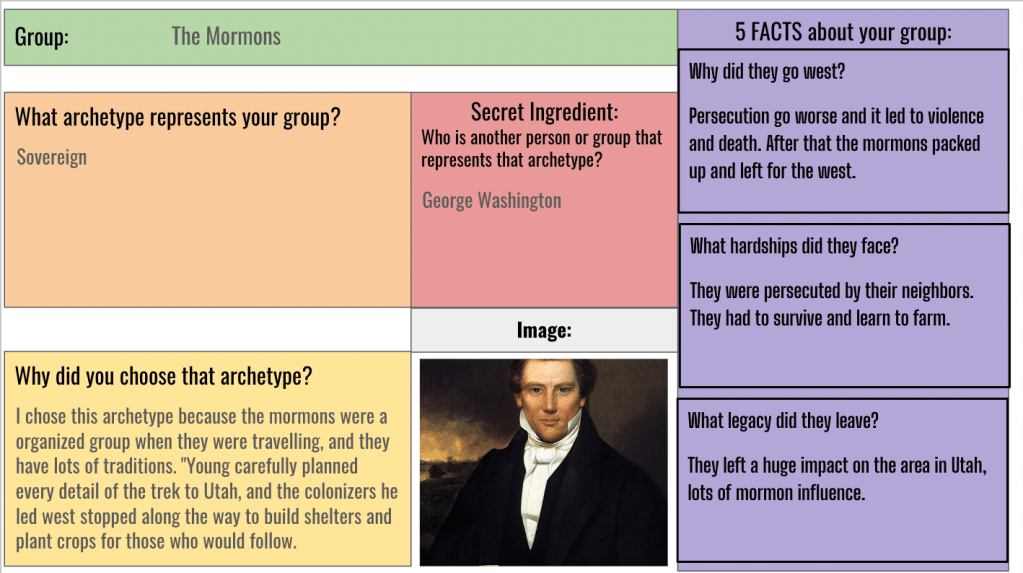
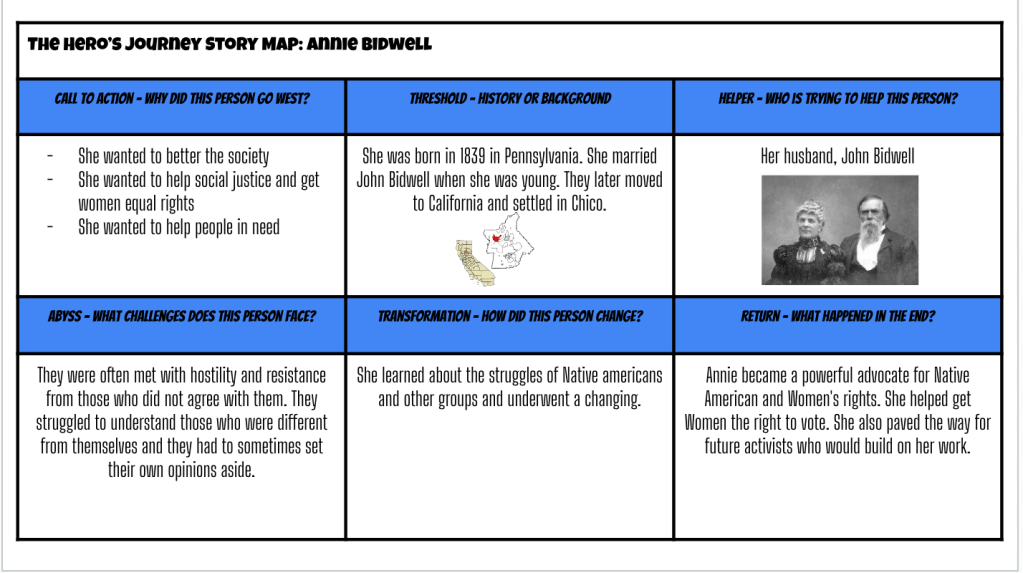
I began this new lesson with some vocabulary using the Pile of Words strategy created by Jay McTighe. We followed this up with some Fast and Curious on Quizizz. The next day brought a CyberSandwich with Washington’s foreign policy with a Fast and Curious. Then we used a Hero’s Journey and Archetype Four Square combination with presidents.

The stories of the first few presidents trying to uphold President Washington’s advice is a perfect match with the Hero’s Journey. The Archetype Four Square is a great way to reflect on the presidents. It’s also a great way to get students making connections with evidence and reasoning.

Monday – No School

Tuesday – Pile of Words, Fast and Curious

Wednesday – CyberSandwich, Frayer, Fast and Curious

Thursday – Hero’s Journey, Archetype Four Square, Fast and Curious

Friday – Hero’s Journey (Jefferson), Archetype Four Square, Fast and Curious

Tuesday

Every year I try to discover new, and better, ways to teach vocabulary. I’m always looking for new strategies. As my co-author, Scott Petri, mentions from a Marzano study, students get 55% of their academic vocabulary from social studies classes. Teaching vocabulary correctly is important.
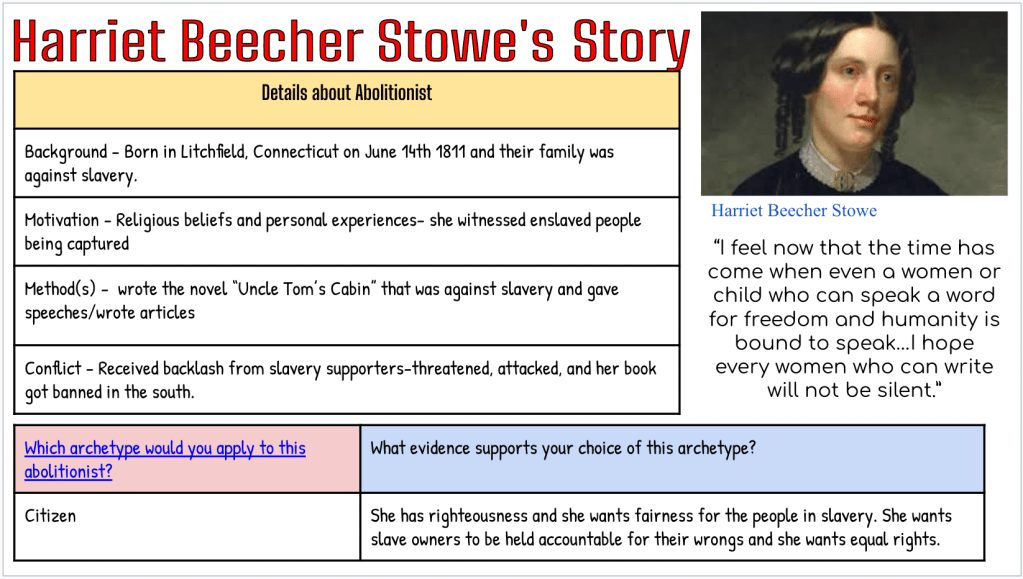
One of my new favorite strategies is the Pile of Words created by Jay McTighe. I went through the new lesson and made a list of important words. The words were already listed out in the History Alive chapter. However, I always add in a few extra words of my own. For example, I added the word: foreign policy.

When students came into class, I had the list of words posted on the Newline board and pronounced each one. I gave students 5 minutes to go through the list and pick out words they already knew. This was an interesting one because most students only knew one word out of the ten listed. The one word they remembered came from last week’s lesson: XYZ Affair.

Next I had students go through the words they didn’t know. I gave them 15 minutes to lookup and define the unknown words. I gave them this much time because they had so many words to lookup. After the timer went off, I had students discuss the words and categorize them. I have found that many students like to create categories FIRST. I try to coach them up and have them sort words FIRST, create categories SECOND. After the discussion, I had students predict what the lesson was about.

This time around, I didn’t do a fast and curious. I didn’t give any background information to the lesson. I wanted the predictions to be based purely on the vocabulary. Here are some predictions:

  1. “War and politics and how George Washington’s Farewell had an effect on what is going to happen or if it will help them. Amd america expanding or other countries expanding”
  2. “I think we will learn about how the U.S expanded and kicked out Spain colonies,Great britain colonies and french colonies. I also think we will learn about how different countries were involved with each other and how dIfferent words Involved U.S history.”
  3. “This lesson is going to be about how wars were fought over disputed land claims in north america, the body of the foreign policy, about treaties, the war of 1812, the monroe doctrine, and finally, about blockades and embargoes.”

Following the Pile of Words, students completed a Quizizz for a Fast and Curious. The Quizizz was a combination of vocabulary and content. The class averages were: 49%, and 52%.
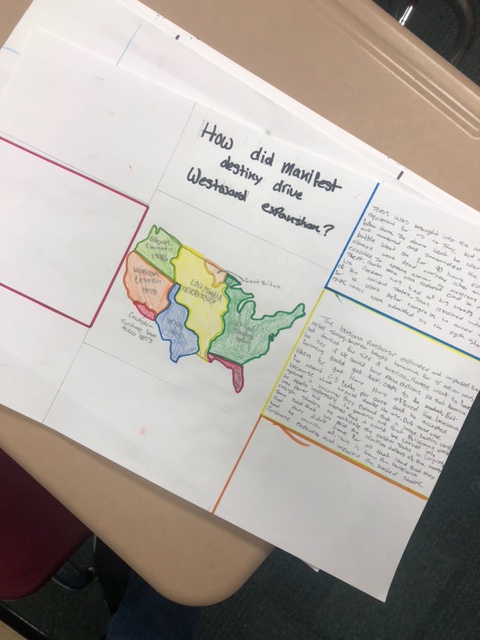
Unfortunately, I had to leave for the 2nd half of the day. Therefore, I changed my lesson plan completely. This is the beauty of EduProtocols. I switched my lesson to a Sketch and Tell paired with an EdPuzzle, and a Quizizz set up as an assignment. Whenever I’m gone, I try to leave FAMILIAR activities. The students understand Sketch and Tell, Edpuzzle, and Quizizz.

There was no guest teacher to cover my class. They were in the “learning lab” (sarcastic quotes) with supervision. Even in that situation, I had 75% student engagement. I’m defining engagement in this situation as students opening ONE of the assignments and completing it.

On the Sketch and Tell I left, students had to define four words, use it in a sentence, and create a picture to represent the word. The words I left were: embargo, impressment, neutrality, isolationism. The EdPuzzle video was a review of Washington’s Farewell Address. The Quizizz was 15 questions with a combination of vocabulary and content knowledge.

Wednesday

I began class on Wednesday with a Fast and Curious. I did this so I could give some feedback on the commonly missed questions and give feedback with vocabulary related questions.

Following the Fast and Curious, students completed a Frayer with the words neutrality and foreign policy. The template I used was created by Amanda Sandoval (@historysandoval). I felt like this word was important to understanding the textbook section about Washington’s Foreign Policy.

Following the Frayer, we began a CyberSandwich with George Washington’s foreign policy. We are getting better and used the process of a CyberSandwich. The reading and notetaking took eight minutes. I had the students add four important facts to the Venn Diagram and discuss for 3 minutes. Finally, I had students write a paragraph and submit it through Socrative.

I like having students submit their paragraphs through Socrative for these reasons:

  1. Everything is in one spot. This means good feedback and quick grading.
  2. If I have class tiem leftover, I hit the “start vote” button on Socrative. Students read each other’s work and vote for the best paragraph. Then I will take that paragraph with the most votes, start a new Socrative question, and have students add more to the paragraph. Maybe I will have them change the topic sentence. Maybe it’s adding a vocabulary word. Either way, it makes them think differently.

We have been focusing on writing paragraphs with topic sentences, details, and a concluding sentence. If you knew some of the students who wrote those, you would be proud (I am). I have some awesome students!

We ended class with a Fast and Curious Quizizz. The class averages were: 60%, 62%, 65%, 58%, 68%. This was followed by some quick feedback for the most commonly missed questions.

Thursday and Friday

I was driving to school Thursday morning listening to my Daily Stoic podcast and thinking, “What the hell am I going to do today?” I do my best thinking in the car, mindlessly driving. It hit me about 5 minutes out from school – The Hero’s Journey and Archetype Four Square. It’s something new for the students, I have templates ready, and it’s a different way of comprehending. Plus, it works perfect with the stories of presidents trying to keep us out of wars against European countries.

France attacking ships. The XYZ Affair, Insecure John Adams losing popularity. Jefferson paying ransoms to pirates. France and Great Britain impressing sailors. It works perfect with Hero’s Journey. How can these presidents follow Washington’s advice and avoid conflict?

Typically, I would do a low cognitive first rep with Hero’s Journey. I would suggest having the students map out a commercial with Hero’s Journey. However, I took a chance. I went for it. I read the textbook section about John Adams and did an I do, We do, You do with three boxes on the Hero’s Journey. For example:

  1. I do – I completed the problem on my own as I talked through the problem with the students. (France was attacking US ships.)
  2. We do – I asked the students, “What was the background to the problem?” They responded with, “France was mad at the Jay Treaty.”
  3. You do – I asked the students, “Your turn. Who is the helper or hero?” Some students said, “John Adams.” Other students said, “Napoleon.” They were all correct.

For any student needing extra help, I showed them some Hero’s Journey examples with Cinderella, Moana, and Harry Potter.

Once students were ready to go, I let take over on their own. They completed the Hero’s Journey with John Adams. With some feedback, they did a really nice job.

Following the Hero’s Journey, we completed an Archetype Four Square on John Adams. This a great way to get students reflecting on historical figures, using evidence, using reasoning, and making connections. Most students chose John Adams as a rebel. Some chose him as a magician. I said to them, “There are not right or wrong answers, only better answers. Justify your choice with evidence. Why is it the better choice?”

The next day, to keep reps going, students completed a Hero’s Journey and Archetype with Thomas Jefferson. I told them to focus on one problem Jefferson faced – Great britain and France attacking our ships or Barbary pirates. Overall, this second rep was better and I will provide it as a choice when we study the War of 1812.