Deepening Thick Slides with DOKs

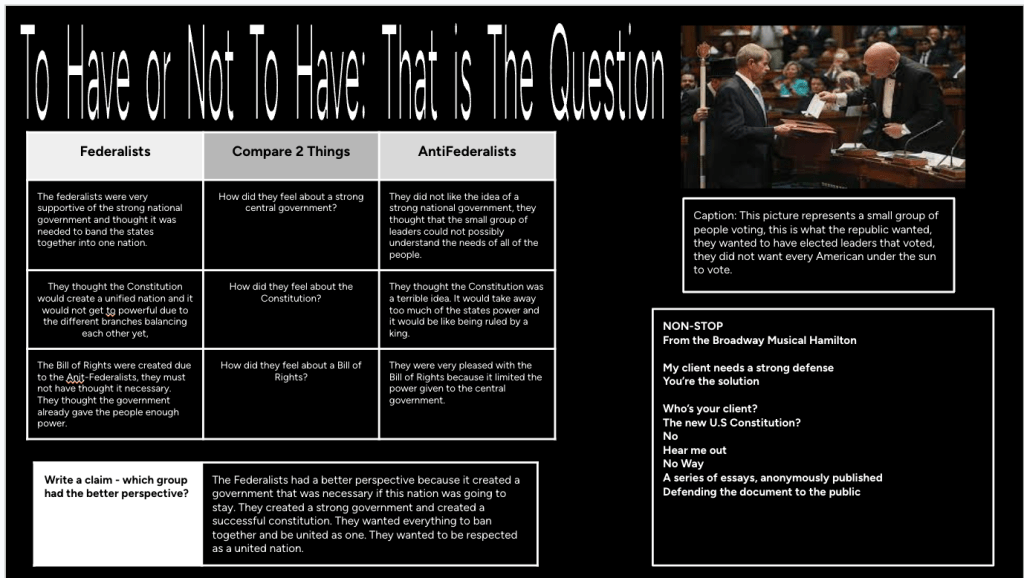
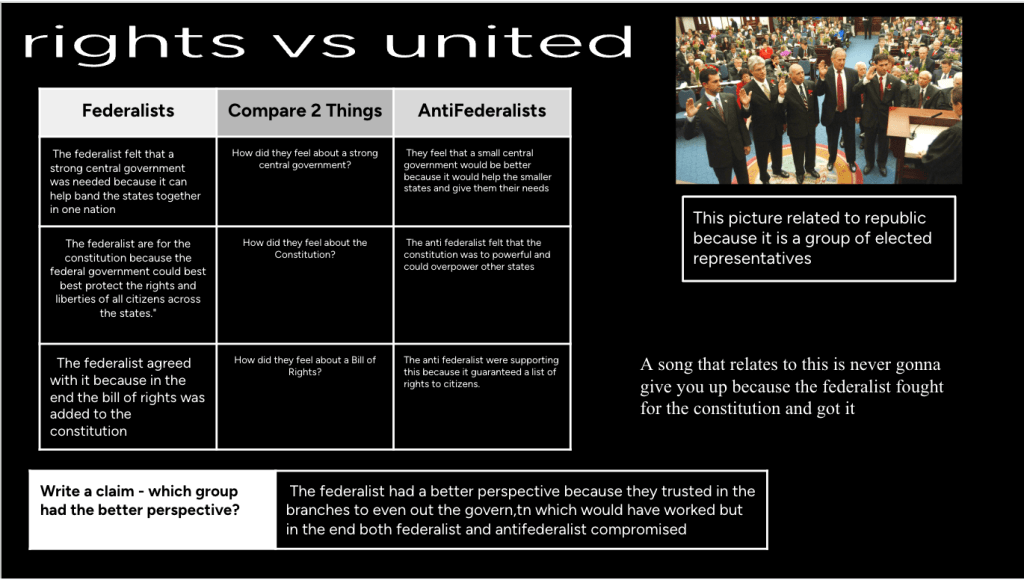
I have posted about Thick Slides before – read about it here. This time I’m back with some ways to add various DOK 1, DOK 2, and DOK 3 levels to Thick Slides. If you are unfamiliar with a Thick Slide, it’s a fan favorite in the EduProtocol world.

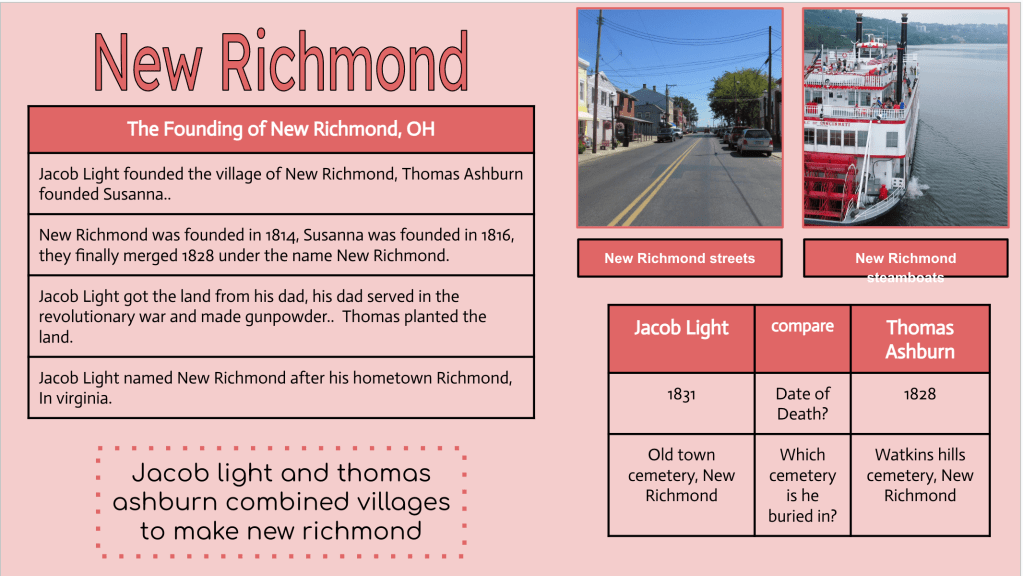
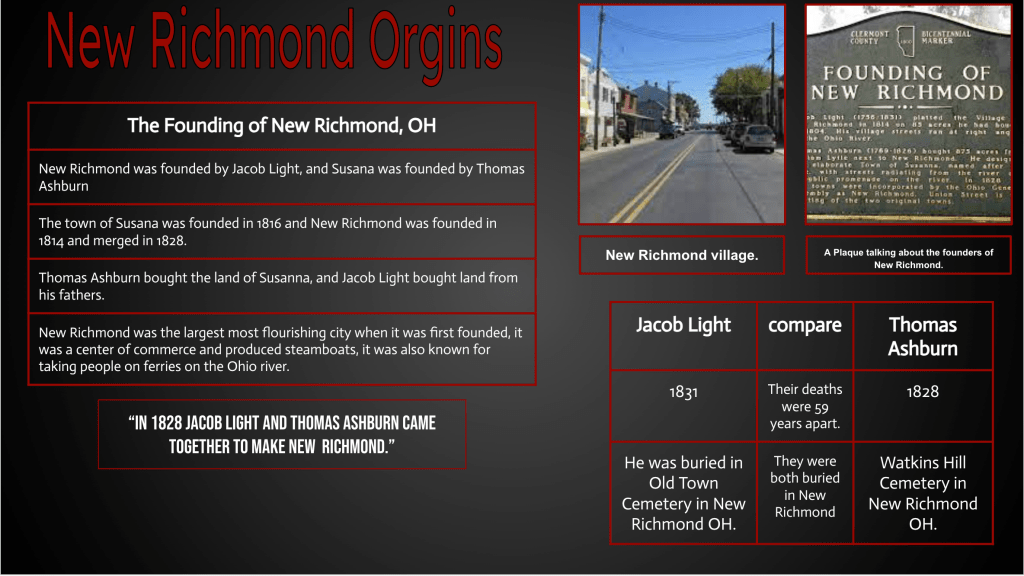
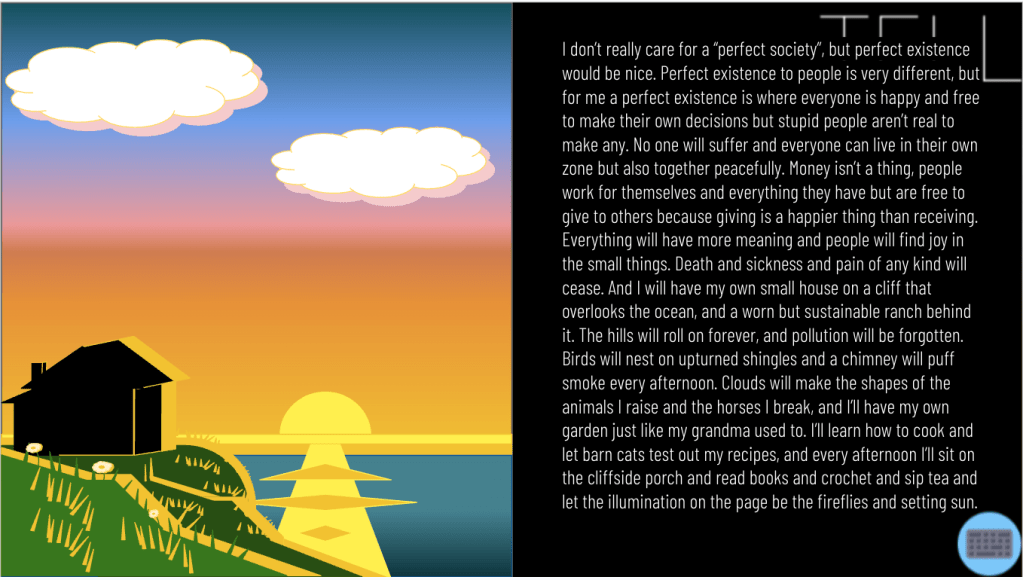
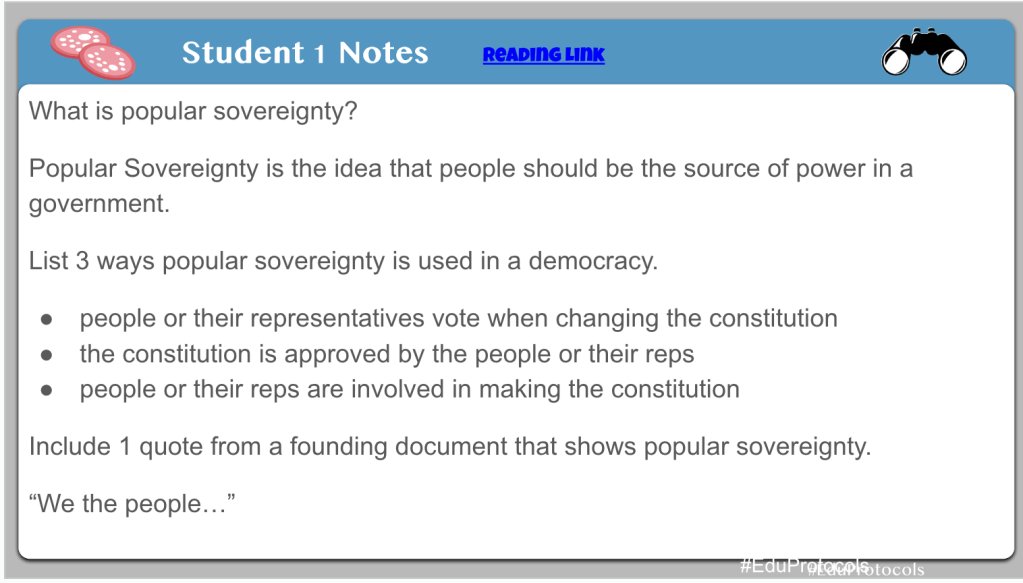
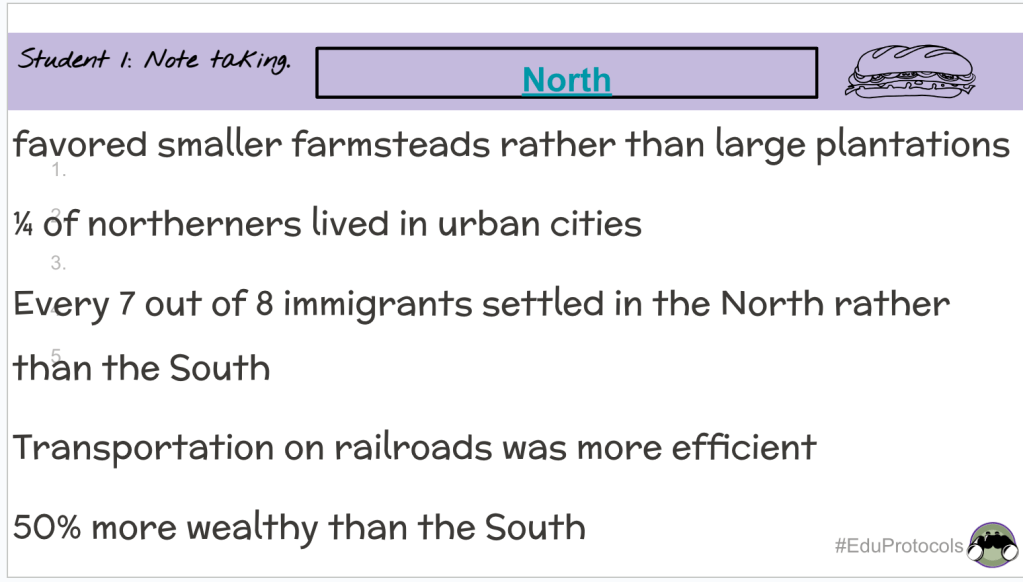
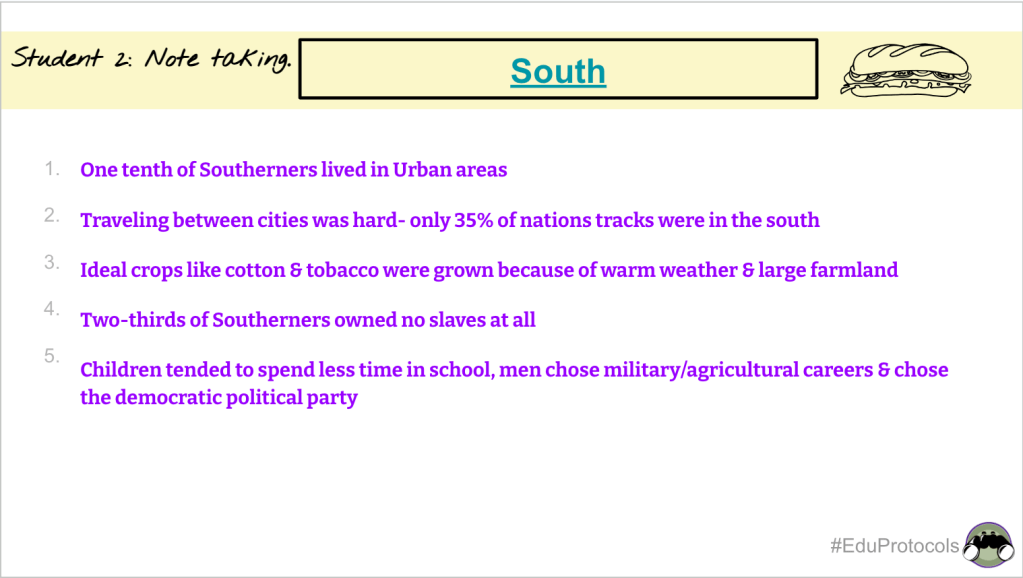
The Thick Slide is simple – it’s a deconstructed paragraph that includes the following:

  1. A title
  2. One or two images with captions
  3. 4 to 5 facts
  4. A quote (this could also be whatever you want it to be such as writing a claim, sharing a number, etc.
  5. Comparing or defining content words.

All of these things can be done on a Google Slide, Powerpoint, Canva, or on paper. The options with a Thick Slide are endless. It can be used as a formative assessment summary piece or as a summative assessment piece.

Formative Assessment

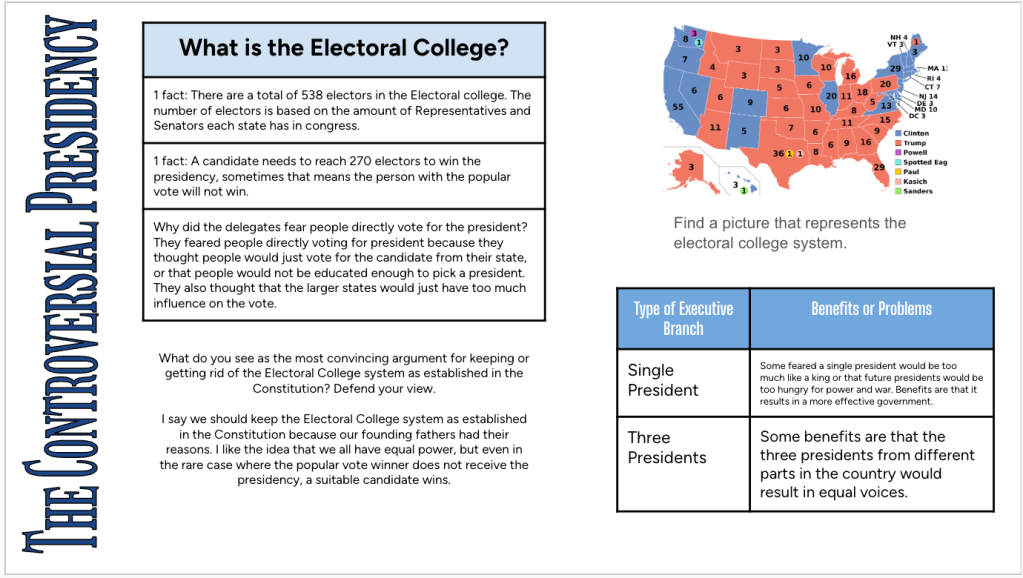
Last week I designed a lesson on the Electoral College. When students came into the room, I had a Thin Slide prompt on the board: “Two people ran for president – Candidate 1 got 66 million votes for president. Candidate 2 got 63 million votes. Who should win the election and why?” Students were surprised when I revealed the winner was Donald Trump who received 3 million less votes in 2016. Next, I had students make predictions about the Electoral College before we read an article. After reading the article, students designed a Thick Slide as a summary of what they just read. On the slide I included:

  1. Give it a title (DOK 0.5 maybe)
  2. Share 2 facts about the Electoral College (DOK 1)
  3. Why did the delegates fear people directly vote for the president? (DOK 1)
  4. Compare the Founding Fathers’ fears of having one president versus three. (DOK 2)
  5. Include a picture and caption related to the Electoral College. (DOK 0.5)
  6. What do you see as the most convincing argument for keeping or getting rid of the Electoral College system as established in the Constitution? Defend your view. (DOK 3)
Summative Assessment

I used the Thick Slide as a summative assessment to end the causes of the American Revolution unit. I did this because I was out of town and wanted to leave something familiar. When I finished putting the Thick Slide together, I was ready to share it, but then I stopped. I wanted more out of it since it was a summative assessment. I thought about a bit more and came up with this…

  1. Add a title (DOK 0.5)
  2. Identify and describe 2 british acts or taxes. (DOK 1-2) Rank them from most to least offensive to the colonists. Explain why. (DOK 3)
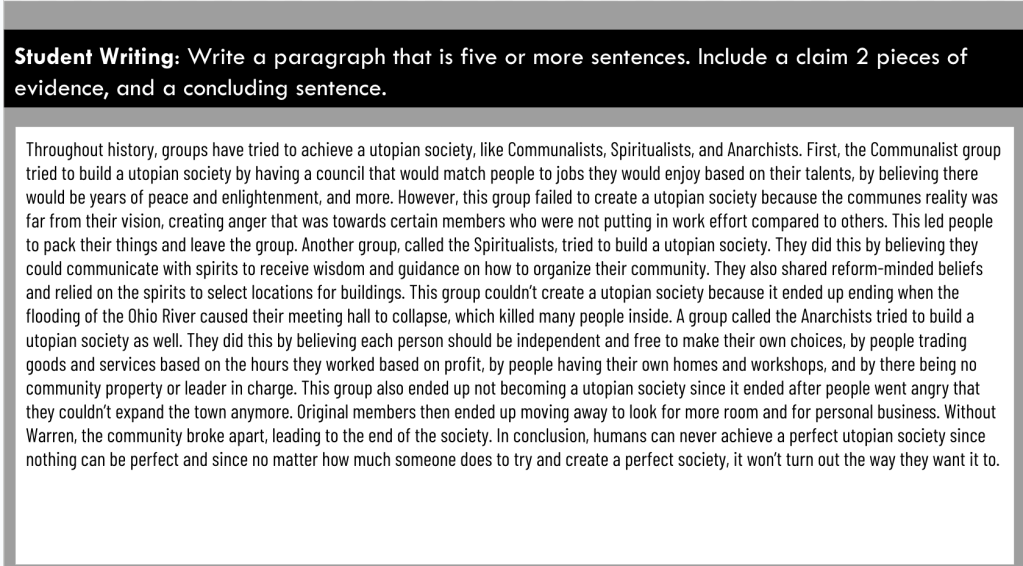
  3. Insert a picture that shows one important reason the colonists wanted independence from Britain. In the caption, tell why you picked that picture and how it connects to the colonists’ reasons for rebellion.(DOK 3)
  4. Compare the Sons of Liberty to Loyalists. (DOK 2)
  5. “Find a quote from the Declaration of Independence that shows an influence from John Locke and the Enlightenment.” (DOK 2-3)

For a summative assessment, it needed more depth with the DOK levels. This is why I love Thick Slides – they can be whatever you want them to be.

DOK Ideas for Thick Slides

DOK 1 (Recall of Information):
  • Basic facts about a historic event or scientific concept
  • Vocabulary definitions
  • Formula/equation used in a process
  • Sequence of steps in a procedure
  • Key dates or timeline of events
  • Descriptive elements of a literary work/character
DOK 2 (Application & Analysis):
  • Explain the significance of a quote from a speech/text
  • Compare perspectives of different eyewitnesses to an event
  • Identify patterns/relationships within a dataset
  • Categorize types of poetic devices used in a poem
  • Concept map/flow chart of a process or system
  • Classify or categorize the elements and details within an image (e.g. group literary devices used in a poem illustration)
  • Explain how an image connects to thematic or symbolic concepts from a text
  • Label important parts of an image and describe their significance
  • Outline the sequence of events shown in a historical photograph/artwork
  • Relate the perspective or tone within a quote to a character’s motivations and actions
  • Compare and contrast interpretations of meaning from multiple quotes
  • Apply the context or insights from a quote to another situation as an example
DOK 3 (Strategic Thinking):
  • Develop an alternative solution to a complex problem
  • Critique an author’s argument in a controversial editorial
  • Design a model to predict future outcomes based on variables
  • Support/dispute the ethics of a political/scientific decision
  • Analyze impact of setting on a character’s development
  • Find or create their own image that is a visual metaphor for a concept, theme, or abstract idea from the content
  • Annotate areas of an image to explain deeper analysis
  • Find a quote and analyze its connection to (or disconnection from) the topic, explaining their reasoning
  • Critique or dispute the interpretation/reasoning within a quote
  • Connect insights from quote to a real-world scenario or example

The Week That Was In 505

This week we wrapped up out unit on the Constitutional Convention. Starting with Monday, we dissected the Electoral College, sparking some questions. Tuesday and Wednesday were dedicated to a three-part assessment, integrating hexagonal learning on paper and 3xCER reflections.

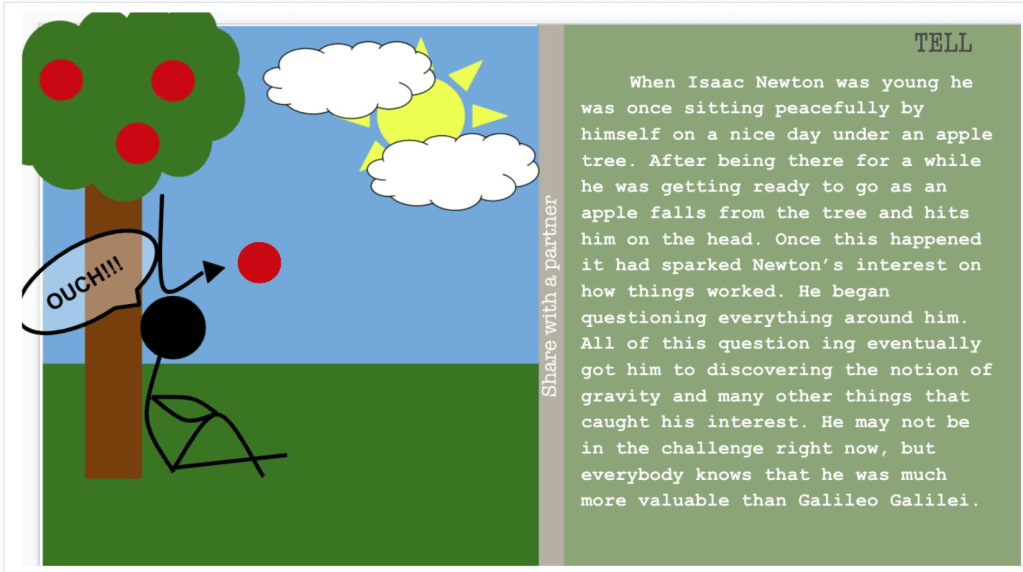
Thursday introduced Federalists and Anti-Federalists, and here’s where EduProtocols played a pivotal role. We used a Gimkit Fast and Curious, 8pArts primary source analysis, Frayers, and a Sketch and Tell activity. The EduProtocols framework injected dynamism into our exploration.

Finally, on Friday, we navigated government preferences using EduProtocols like Frayers, a concept sort, and an annotate and tell session. Join me as we unravel the layers of each day and reflect on the effectiveness of our instructional choices.

Monday – Quizizz, Thick Slide

Tuesday – Hexagonal Learning, 3xCER, Quizizz

Thursday – EduProtocol Lesson Collection (ratifying the Constitution)

Friday – EduProtocol Lesson Collection (SHEG Lesson), Gimkit

Monday: Decoding the Electoral College

Our week commenced with a focused exploration into the intricate workings of the electoral college. To kick things off, I presented a Thin Slide that posed a deceptively simple question: “Two people ran for president – Candidate 1 got 66 million votes for president. Candidate 2 got 63 million votes. Who should win the election and why?” The unanimous response from students was in favor of Candidate 1 due to their higher vote count.

However, the big reveal came when I showcased the 2016 election data from www.270towin.com, exposing the fact that Candidate 2 was Donald Trump, who secured the presidency despite receiving fewer popular votes. This revelation ignited curiosity and set the stage for a deeper dive into the electoral college.

We examined the electoral college map, prompting questions about the varying values assigned to different states and the origins of these values. I explained, “Different states are worth different amounts of points based on their number of representatives,” leading to a moment of connection for some students who grasped the analogy between losing representatives and losing electoral votes.

Capitalizing on this newfound interest, I encouraged students to predict why the founding fathers opted for an electoral college system. Subsequently, students delved into an article to validate or revise their predictions. Class concluded with a Thick Slide summarization and a Quizizz session incorporating questions related to the Great Compromise, 3/5ths compromise, and the Electoral College.

Monday was more than an introduction; it was a strategic unraveling of a complex system, leaving our students with both questions and a solid foundation to build upon in the days to come.

Tuesday and Wednesday: Assessing and Reflecting

In the midweek stretch, we transitioned into a comprehensive three-part assessment to gauge our understanding and encourage critical thinking. The assessment aimed to evaluate the success of the constitutional convention and provided an opportunity for students to reflect on their learning from the past six class periods.

Part 1: Hexagonal Learning on Paper

Tuesday kicked off with the first part of our assessment—a hexagonal learning activity on paper. Students were tasked with cutting out hexagons, arranging them, and adding missing details related to the unit. This hands-on approach aimed to reinforce connections between different concepts and promote a holistic understanding of the material.

Part 2: Evaluating the Constitutional Convention

Moving on to the second part of the assessment, students delved into the central question: “Should the constitutional convention be considered a success?” Using a 3xCER framework, they crafted one claim in favor of it being a success, one against, and finally, one expressing their personal opinion. The emphasis was on substantiating each claim with evidence drawn from lessons covered over the previous six classes.

Throughout this process, I encouraged students to ponder, “Whatever evidence you have that proves it to be a success—what makes it successful?” This critical reasoning added depth to their reflections. While the paper-based approach provided a tangible change, the logistical challenge of maintaining a uniform pace between the paper and Chromebook options surfaced.

Part 3: Quizizz – Recapitulating Six Days of Learning

The assessment concluded on Wednesday with a Quizizz session encompassing questions related to the entirety of our six-day journey. Covering topics such as the Great Compromise, 3/5ths compromise, and the Electoral College, this segment aimed to consolidate knowledge and reinforce key concepts.

This comprehensive Quizizz provided an opportunity for students to showcase their understanding of the intricate details we explored throughout the week. The results would not only serve as a measure of individual comprehension but also guide future instructional decisions as we ventured further into the complexities of our curriculum.

Thursday: Navigating Federalists and Anti-Federalists with EduProtocols

Thursday unfolded as a deep dive into the realms of Federalists and Anti-Federalists. To streamline the exploration, I drew inspiration from Justin Unruh’s EduProtocols templates, infusing engagement into our lesson plan.

Setting the Stage with a Compelling Question:

The day commenced with a pivotal question: “What was the argument over ratifying the Constitution?” This set the tone for a thought-provoking class.

Part 1: Gimkit – Igniting Interest:

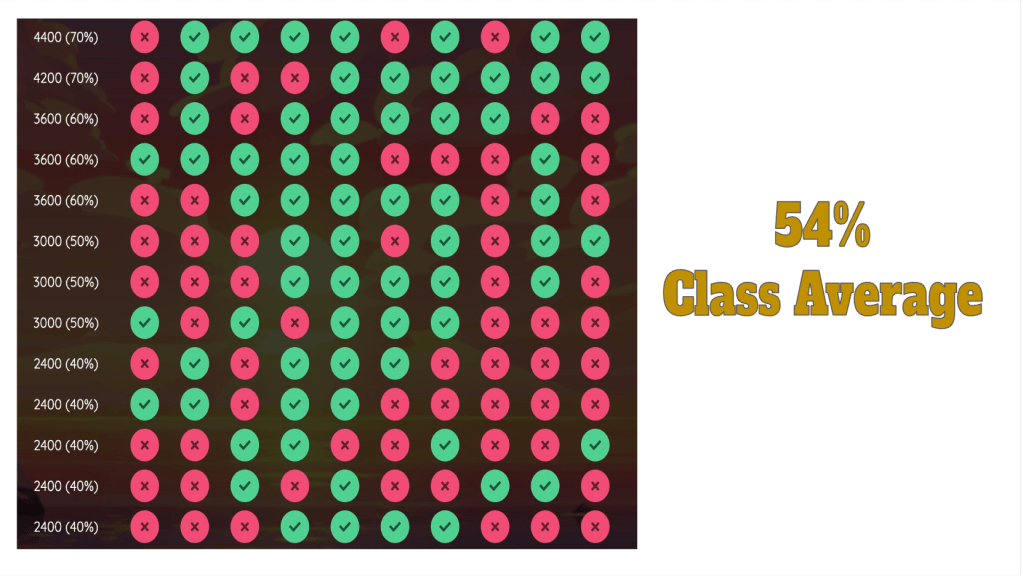
To engage the students right from the start, we began with a Gimkit session. The initial class averages were noted as follows: 52%, 75%, 52%, 54%, and 63%. This interactive approach not only sparked interest but also served as a baseline for the progress we would see throughout the lesson.

Part 2: 8pArts Primary Source Analysis – Digging Deeper:

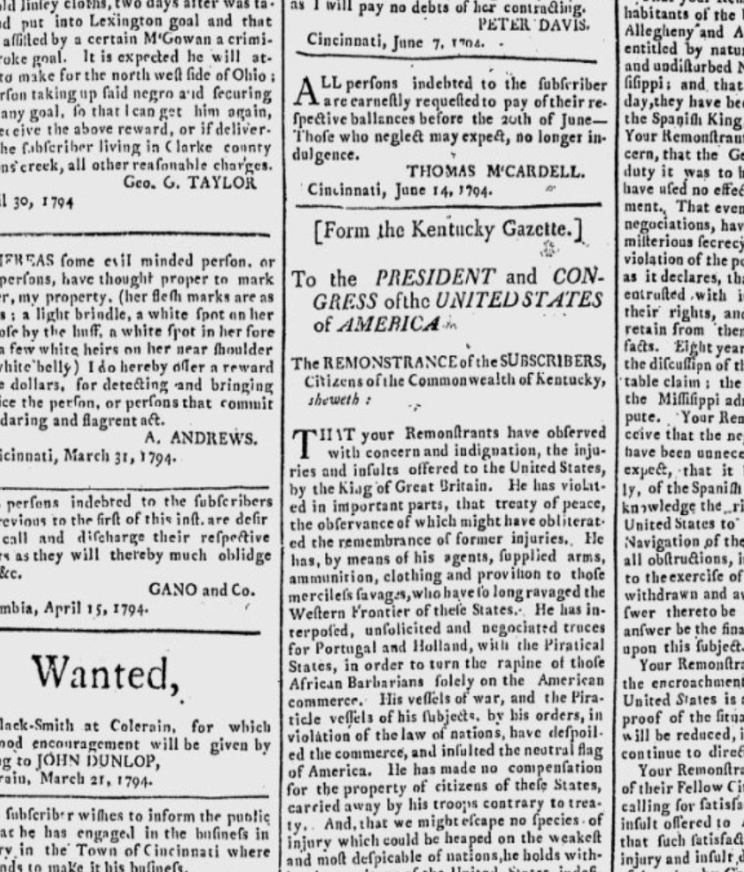
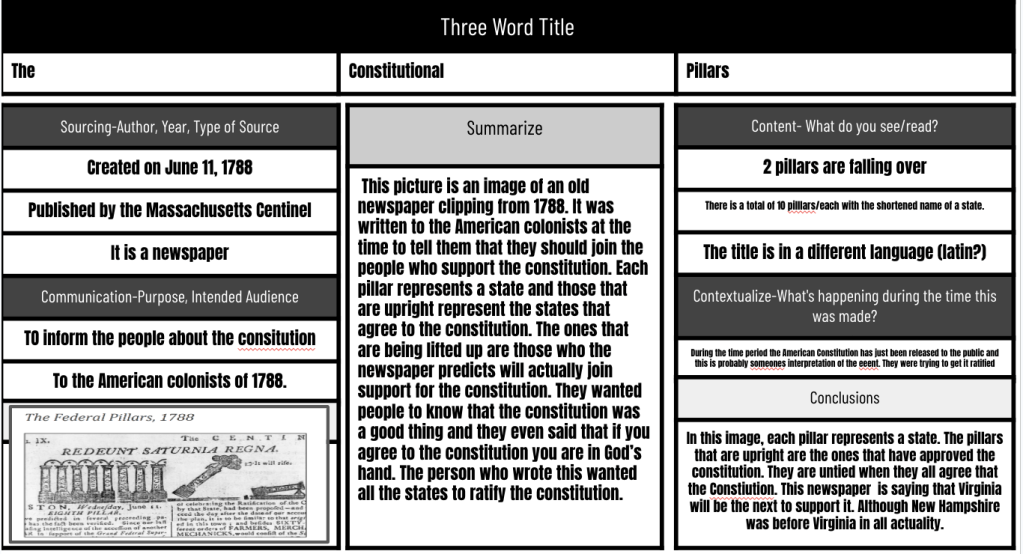
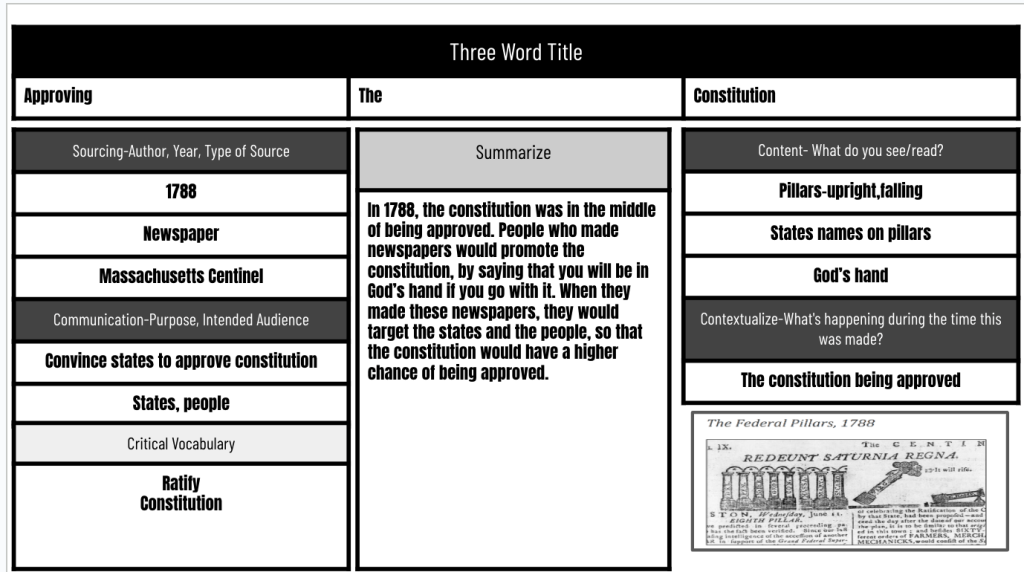
Building on the momentum, we delved into an 8pArts primary source analysis, focusing on the Federal Pillars image. I provided background information, emphasizing that nine states were needed to ratify the constitution, and some individuals expressed dissatisfaction with the final document. This visual analysis aimed to deepen our understanding of the sentiments surrounding the Constitution’s ratification.

Part 3: Frayers – Visualizing Federalists and Anti-Federalists:

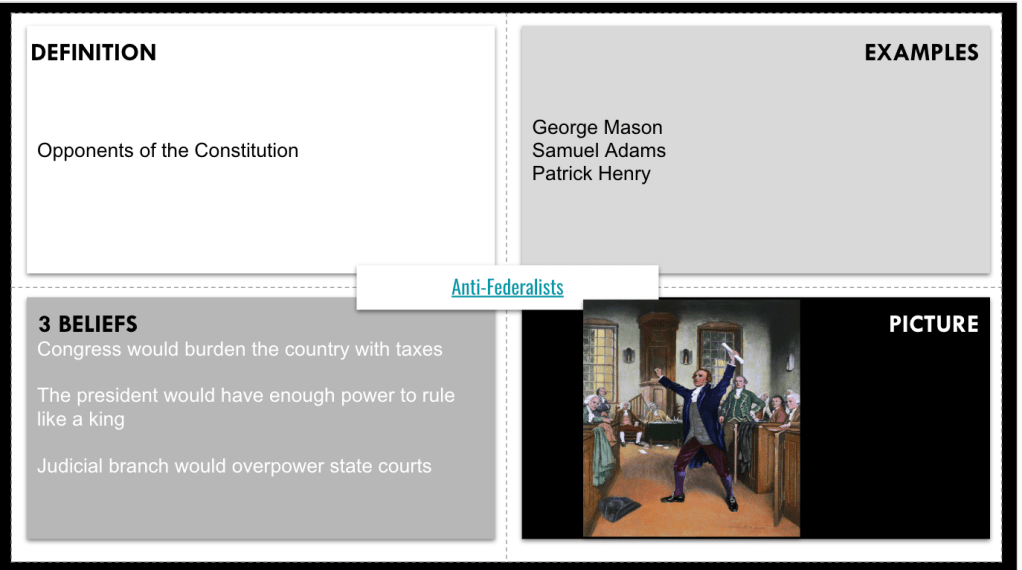
Next, we navigated through two Frayers, shedding light on Federalists and Anti-Federalists and encapsulating their respective beliefs. The visual and interactive nature of this EduProtocols activity offered a tangible representation of these historical figures, fostering a clearer comprehension of their ideologies.

Part 4: Sketch and Tell – Personal Reflections:

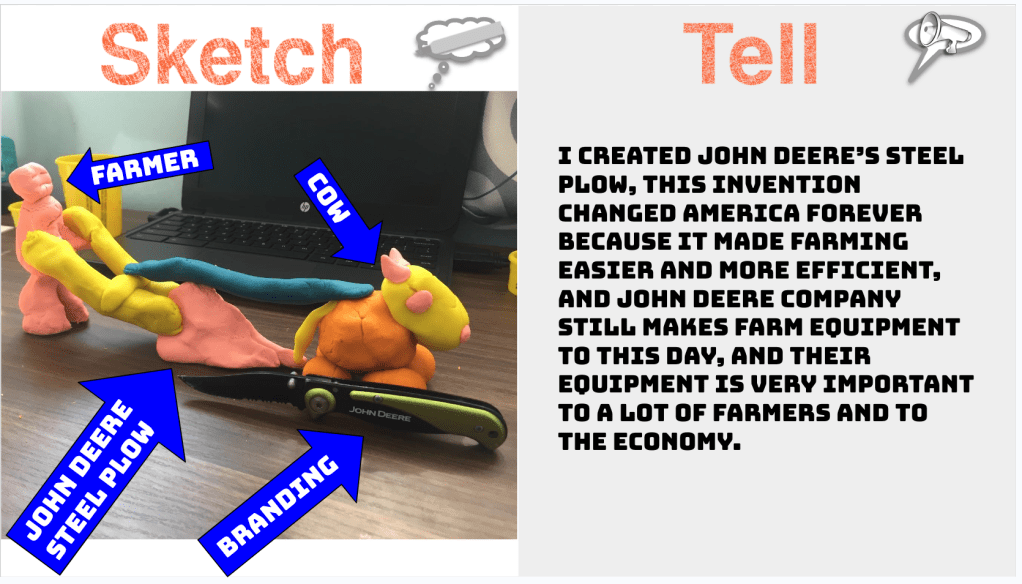
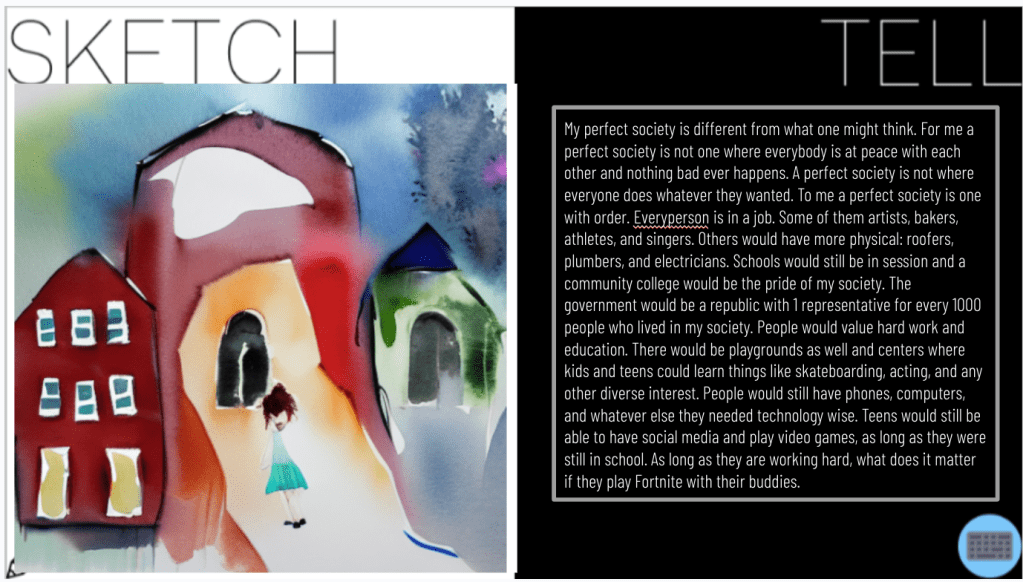
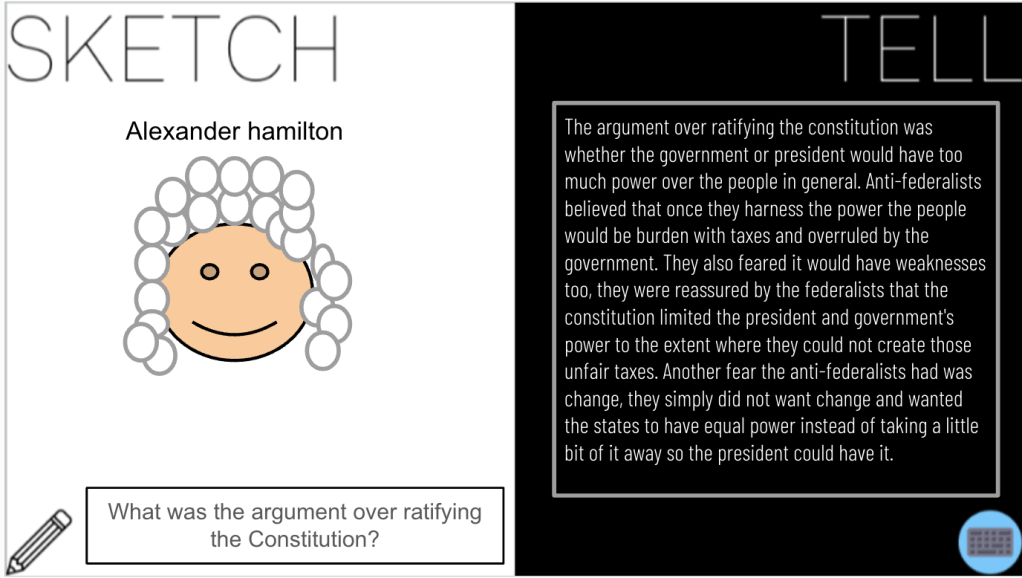
To wrap up the session, we engaged in a Sketch and Tell activity. Students sketched out and articulated their responses to the initial question, “What was the argument over ratifying the Constitution?” This not only encouraged creativity but also provided a platform for students to express their evolving understanding of the subject matter.

Closing with a Gimkit:

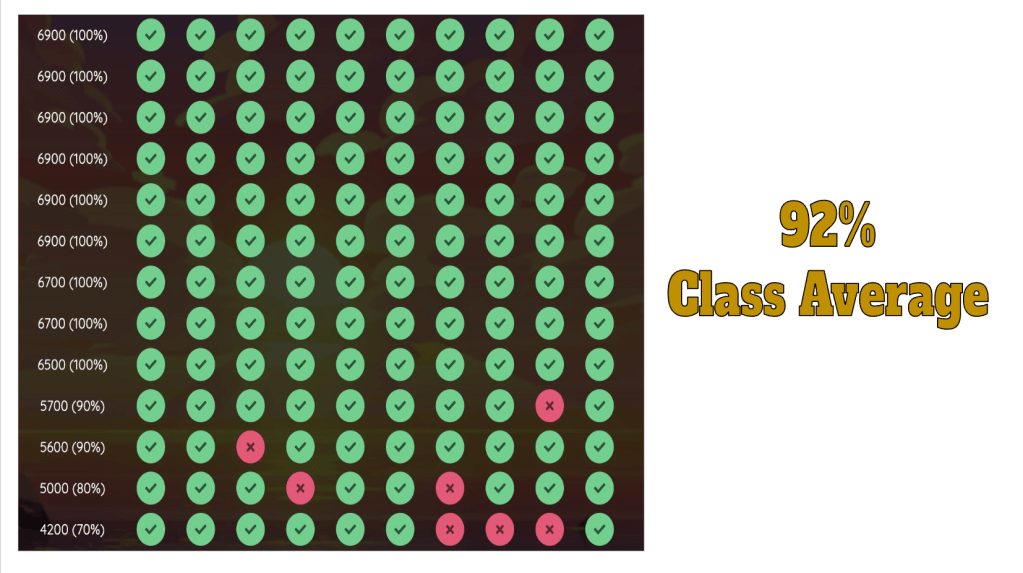
The day concluded with another Gimkit session, and the class averages showcased a remarkable improvement: 85%, 90%, 80%, 87%, and 93%. The interactive nature of EduProtocols, coupled with thoughtful discussions, not only elevated engagement but also reflected a deeper grasp of the content.

Thursday’s lesson demonstrated the effectiveness of EduProtocols in making complex topics accessible and engaging for our students. As we delved further into Federalists and Anti-Federalists, the groundwork laid on this day paved the way for nuanced discussions and a deeper exploration of historical ideologies.

Friday: Unraveling Government Preferences with SHEG and EduProtocols

Friday unfolded with a strategic combination of Justin Unruh’s templates and Stanford History Education Group (SHEG) lessons, creating a dynamic session that navigated the government preferences of Federalists and Anti-Federalists.

I began the day with a thought-provoking question: “What types of government did Federalists and Anti-Federalists prefer?” This central query laid the groundwork for our exploration into the perspectives held by these historical groups.

Part 1: Frayers – Understanding Republics and Direct Democracy:

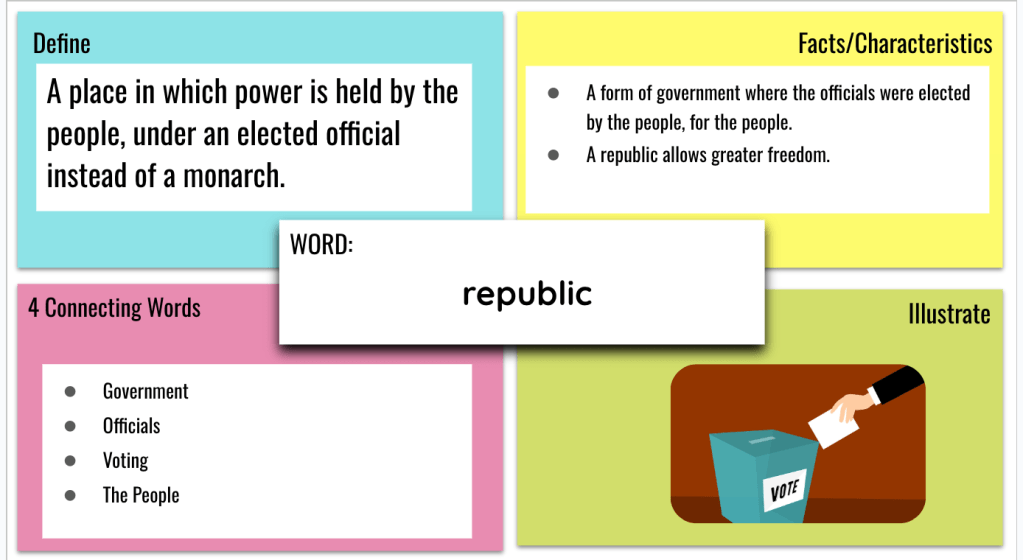
To establish a foundational understanding, we began with two Frayers—one focused on Republics and the other on Direct Democracy. This visual exploration allowed students to dissect and internalize the key characteristics of these government systems, providing essential context for the day’s discussions.

Part 2: Concept Sort – Organizing Characteristics:

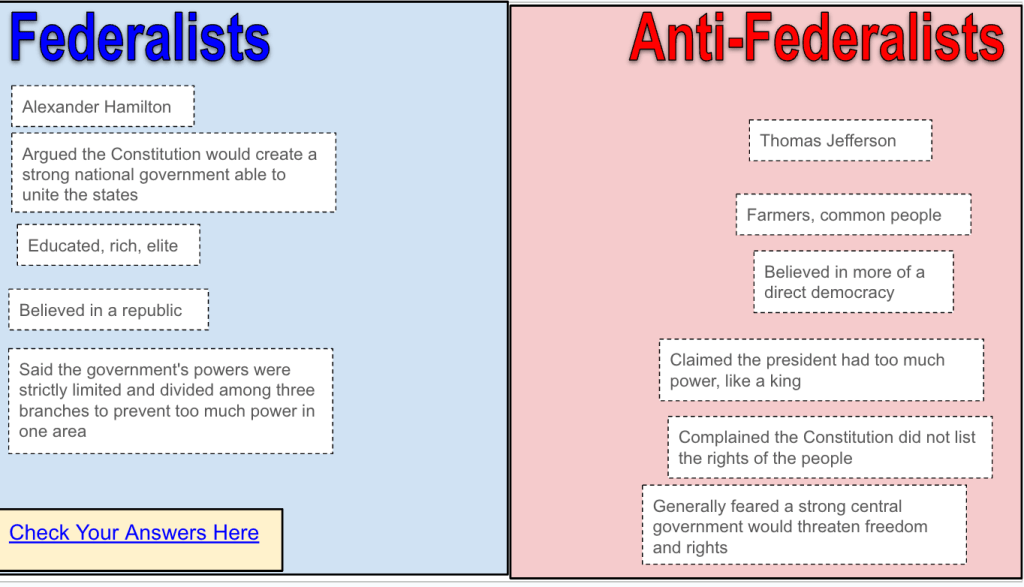
Students then engaged in a concept sort, organizing characteristics of Federalists and Anti-Federalists into the appropriate categories. This interactive exercise encouraged critical thinking and prompted students to draw connections between theoretical principles and the historical figures we were studying.

Part 3: Annotate and Tell – Analyzing Primary Source Letters:

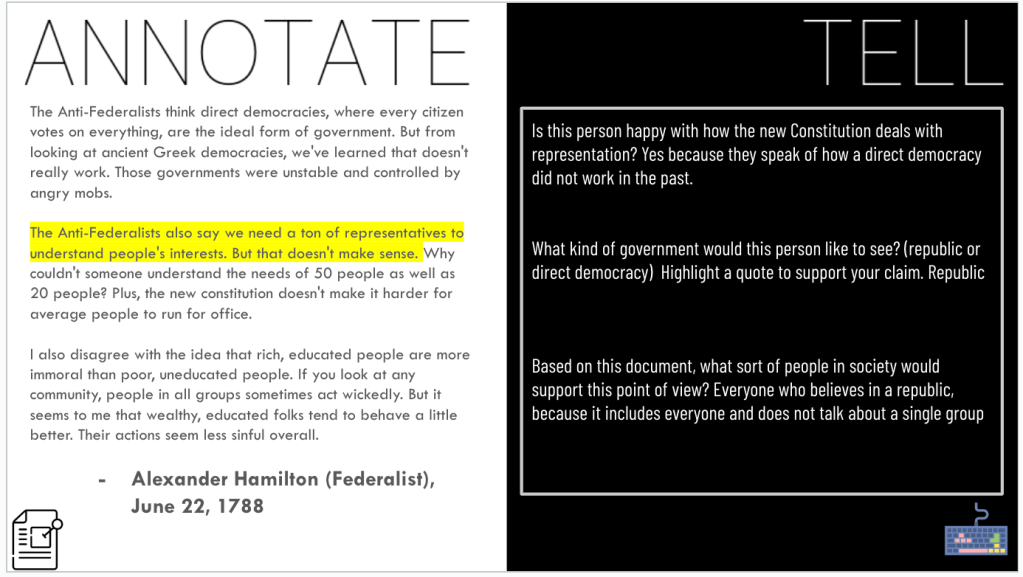
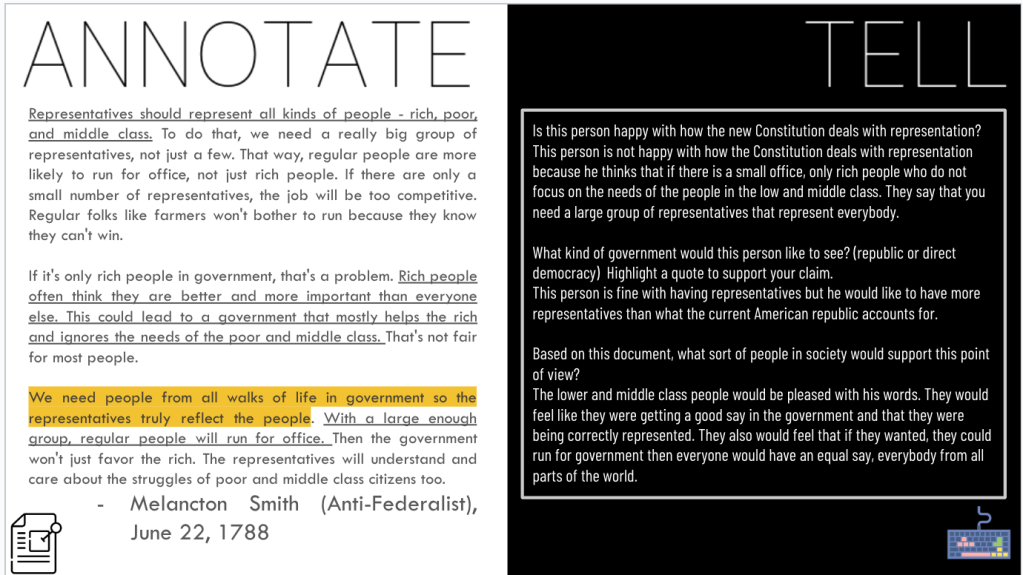
Our exploration involved an Annotate and Tell activity. Students read letters—one from an Anti-Federalist and another from a Federalist—and answered questions related to the content. The task included highlighting text evidence to support their responses.

This activity aimed not only to decipher the personal opinions and arguments of these historical figures but also to emphasize the stark contrast in their preferences. I wanted students to understand that Federalists supported a government where a few, rich, elite, and educated individuals could represent the masses, while Anti-Federalists leaned toward stronger local governments, almost resembling a direct democracy, but not quite.

Reflection on Government Preferences:

As we navigated through these primary sources, I left the students with a task—reflecting on the government preferences of Federalists and Anti-Federalists. I’m going to use Monday to explain that Anti-Federalists wanted a government with more common people involved. More representation among the people. Close to a direct democracy, but not quite.

Closing with a Gimkit:

To gauge understanding and reinforce key concepts, I set up a Gimkit for a check of comprehension. The overall average from the five classes came in at an impressive 83%.

The Week That Was In 505

As we approached the impending Christmas break, a sense of chaos typically accompanied the days. To maintain a semblance of order and to appease restless students, I employed a strategy I whimsically call “Story Time with Moler.” During this post-lunch session, I occasionally read aloud the text we were studying that day. Not only did this practice help in managing the chaos, but it also provided me with an opportunity to inject additional information into the narrative. However, I tread carefully, avoiding fostering dependency among the students. This week, our focus revolved around the Articles of Confederation leading to the Constitutional Convention, the Great Compromise, and an exploration of the 3/5 compromise.

Monday – Resource Rumble (EMC2Learning)

Tuesday – Fast and Curious, Frayer, CyberSandwich

Wednesday – Fast and Curious, Thin Slide FaceOff, Sketch and Tell

Thursday – Branches Notes, Fast and Curious, Frayer/Empathy

Friday – Keyword Prediction, 3/5ths CyberSandwich, Fast and Curious

Monday: Energizing Articles of Confederation Review with Resource Rumble

Monday set the tone for the week, post-Thanksgiving, with a vibrant review session. The day was dedicated to a comprehensive recap of the Articles of Confederation using the engaging Resource Rumble from EMC2learning. This strategy involved strategically placing questions in envelopes around the classroom. Students, working collaboratively without the aid of Chromebooks, participated in a lively retrieval practice. Upon answering questions, they sought real-time feedback from me. Acceptable responses were rewarded with the opportunity to roll dice for building blocks, contributing to the construction of towering structures. The group that managed to erect the tallest tower emerged as the victors. This not only facilitated a solid revision of the Articles of Confederation but also injected an element of fun and activity into the post-holiday return to the school routine.

Tuesday: Unveiling the Constitutional Convention

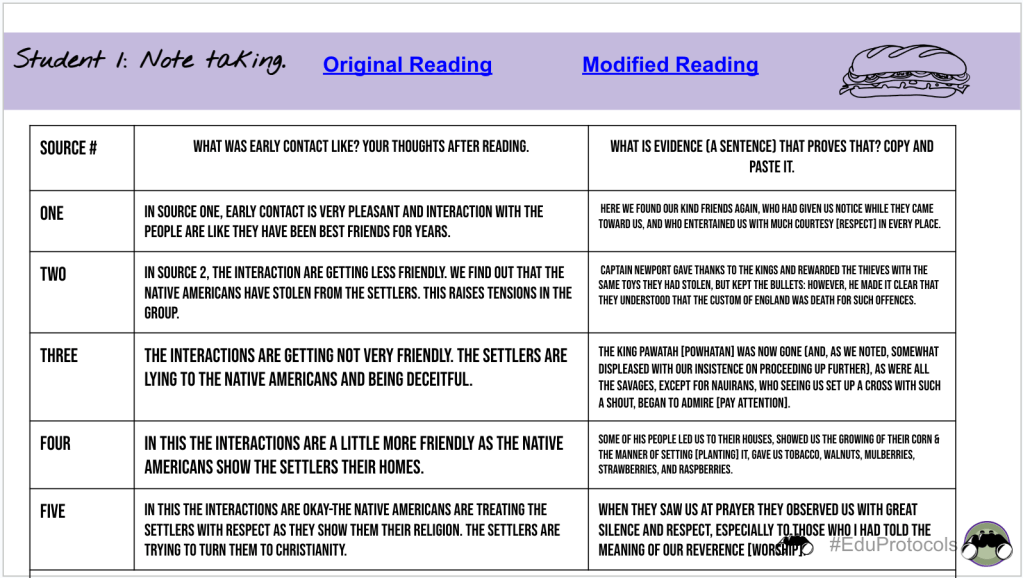
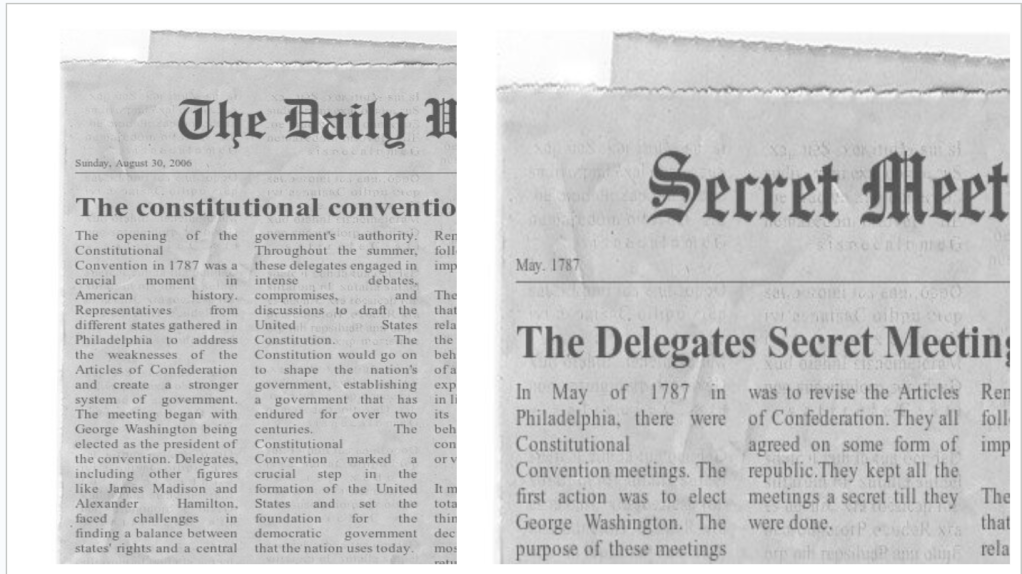
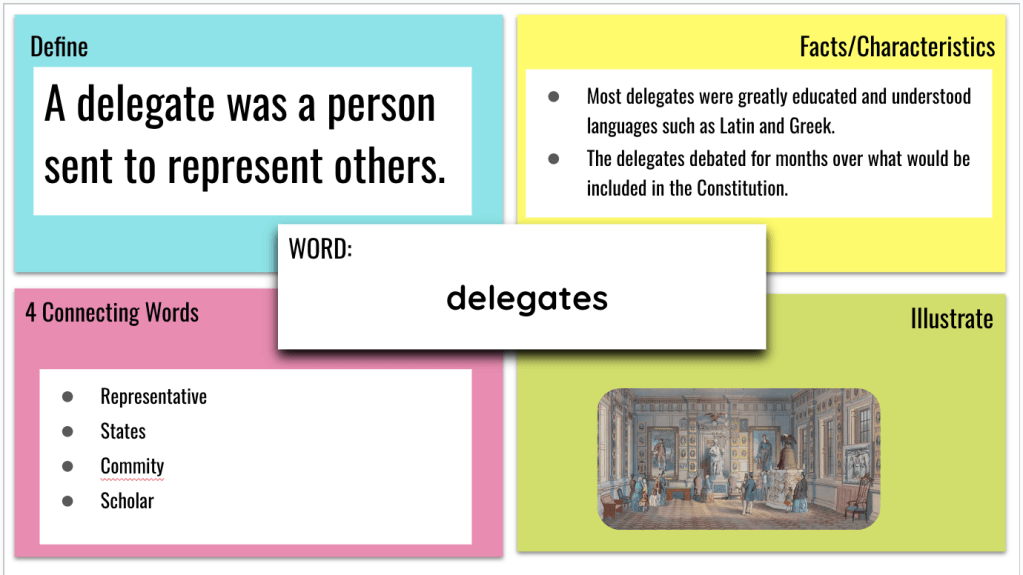
Tuesday marked the commencement of a new and intriguing mini unit, grappling with the question of whether the Constitutional Convention should be regarded as a success. The initial lesson delved into the reasons behind the Constitutional Convention. Kicking off with the Fast and Curious Eduprotocol, the class engaged in a rapid quiz encompassing fundamental information about the Constitutional Convention. Following this, students embarked on (Amanda Sandoval template) Frayer model for the terms “delegate” and “Republic.” The choice of these terms stemmed from their significance in comprehending the subsequent text. The Frayer process involved students defining the terms in their own words, sharing key facts and characteristics, identifying four connecting words, and incorporating an illustrative image. Notably, the term “delegate” was chosen due to unfamiliarity among students. Post-Frayer, a Cybersandwich ensued, wherein students, armed with a main idea note-taking strategy, delved into a textbook section on the Constitutional Convention. This strategy prompted students to document essential information such as who, what, when, where, why, and how. The information gleaned from this exercise was then channeled into the creation of a newspaper headline and clipping, serving as a creative synthesis of the acquired knowledge. The class concluded with a revisit to the Fast and Curious quiz, fostering reinforcement of key concepts.

Wednesday: The Great Compromise Unveiled – Thin Slide Face Off and Creative Sketching

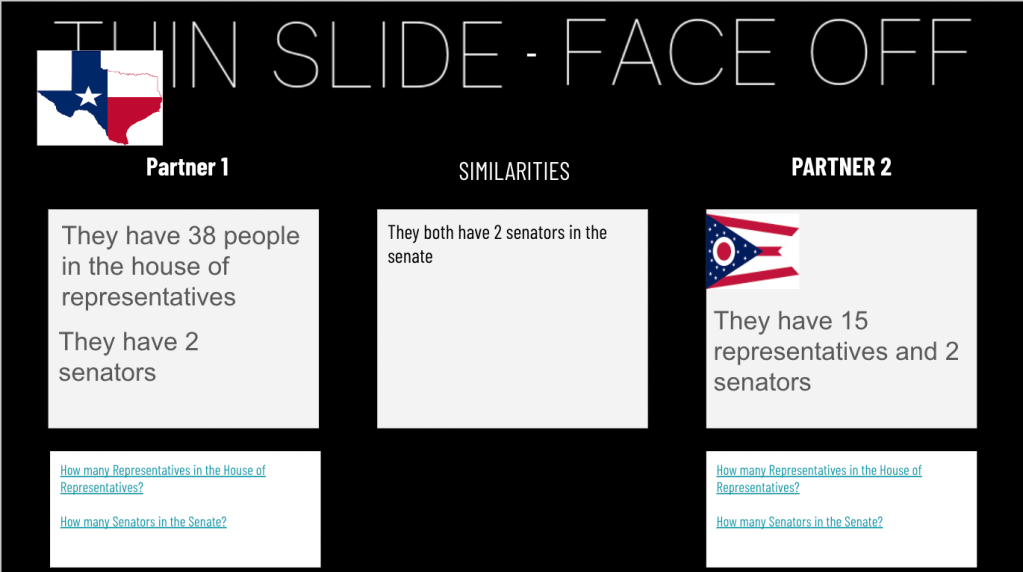
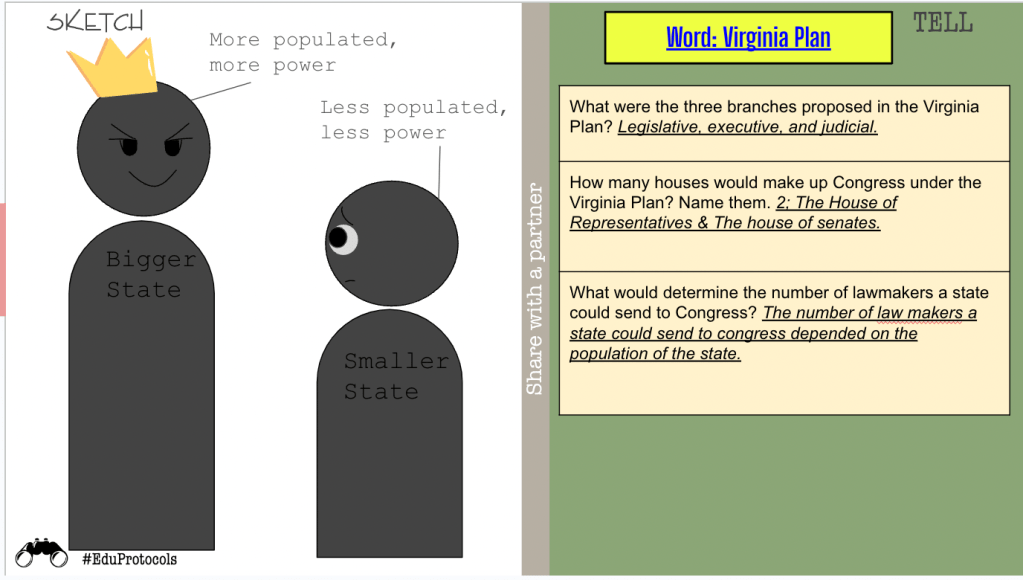
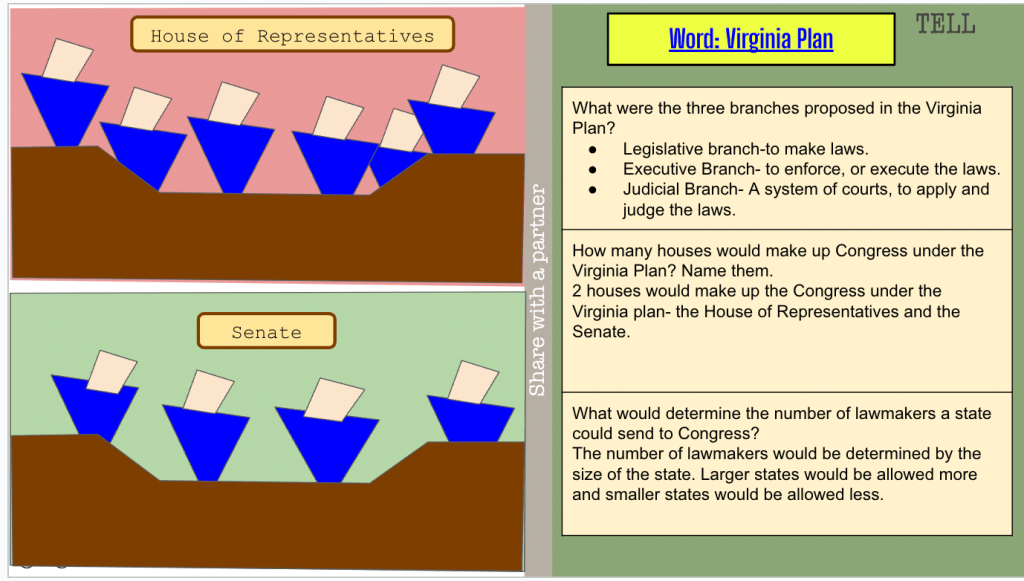
Wednesday delved deeper into the Constitutional Convention, specifically exploring the argument over representation that led to the Great Compromise. The day commenced with the Thin Slide Face Off, a captivating version of a Thin Slide created by Justin Unruh. Students partnered up and shared slides, comparing information about the number of representatives each state had in the House of Representatives and the Senate. This exercise unearthed a common challenge—students’ varied understanding of the distinctions between state, national, and local government levels. Recognizing this, adjustments were made to provide links for students to access the required information easily. The subsequent step involved students comparing information with their partners, identifying similarities and differences between states. The exercise culminated in a lively sharing of findings on whiteboards, offering a visual representation of the variations in House of Representatives and Senate numbers. This interactive session sparked insightful questions about the rationale behind different representation structures, laying the groundwork for the day’s exploration. Following this, a Sketch and Tell activity centered on the Virginia Plan unfolded. Students read about the plan and translated their understanding into visual representations using Google shapes. The Sketch and Tell component prompted students to answer key questions about the Virginia Plan, encapsulating the branches of government it proposed, the number of houses of Congress it advocated for, and the representation of states in that Congress. This creative exercise aimed to bridge the gap between abstract ideas and concrete comprehension for the students. A realization dawned during the lesson—students grappled with the concept of branches of government, a topic typically introduced in elementary school. Sensing a gap in foundational knowledge, a decision was made to prepare a brief presentation on the branches of government to ensure clarity for the students. The day concluded with a quiz that expanded on the previous day’s questions, fostering consolidation of knowledge.

Thursday: Navigating Historical Minds – Frayer Modeling and Empathy Maps

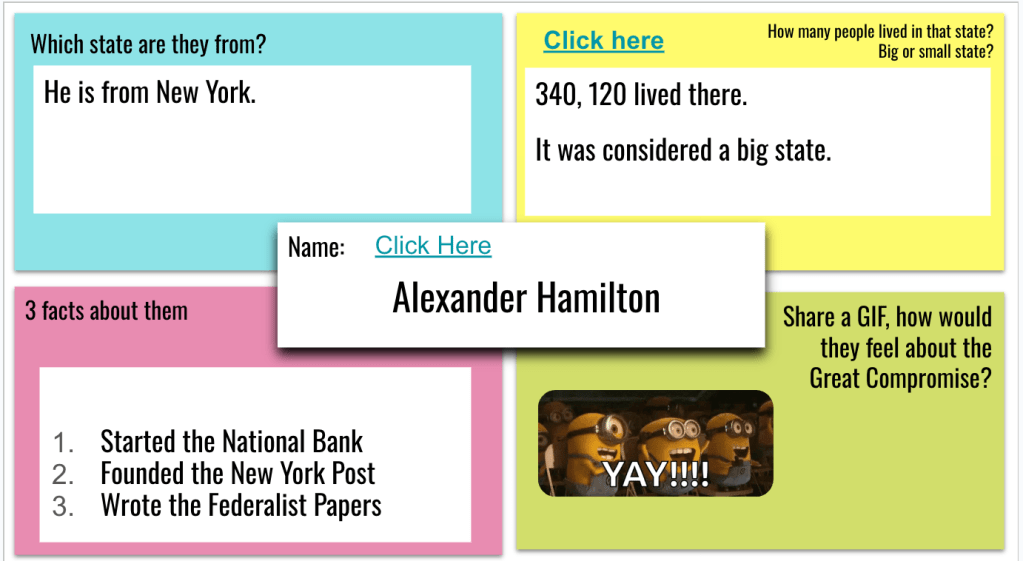
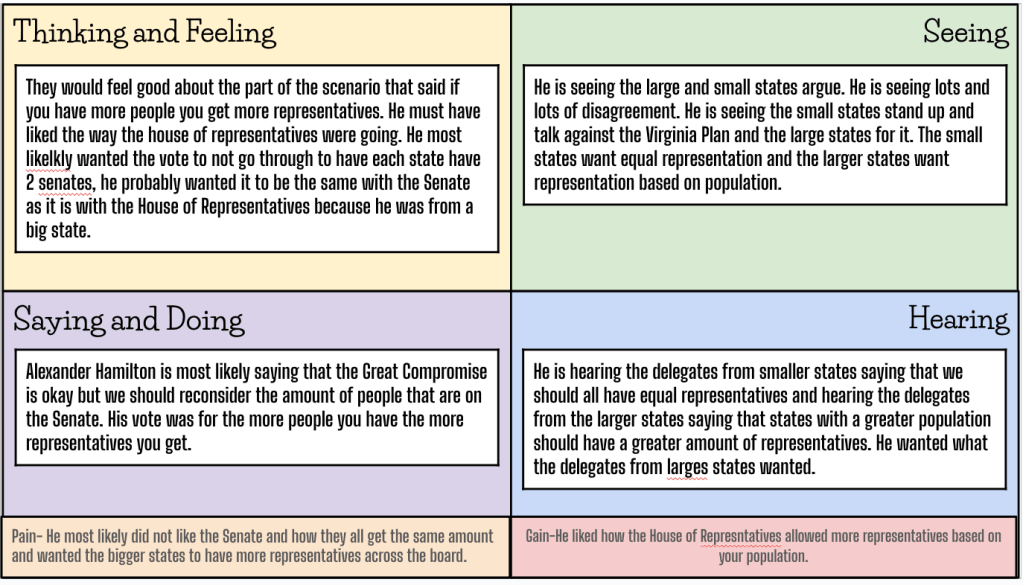
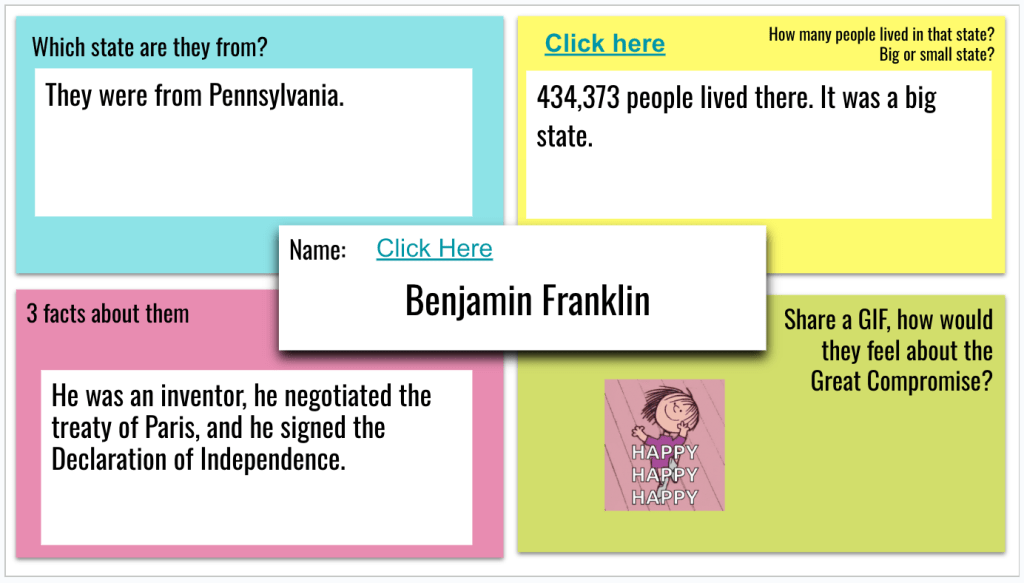
Thursday sustained the exploration of the Great Compromise, building on the Thin Slide Face Off findings and the insights gained from the previous day’s activities. Students completed the Sketch and Tell activity initiated on Wednesday, focusing on the representation proposed by the Virginia Plan. Acknowledging the persistent challenge in understanding the branches of government, a hastily assembled presentation addressed this foundational concept, providing students with a clearer understanding. With a renewed grasp of this crucial aspect, students delved into a deeper exploration of historical figures present at the Constitutional Convention. The day featured a Frayer activity dedicated to a historical person involved in the convention. Utilizing AI-generated information, a list of the ten most recognized figures from the Constitutional Convention, along with details about their state, accomplishments, and potential sentiments toward the Great Compromise, was compiled. Students engaged in Frayer modeling, encapsulating the name of the delegate, their state of origin, whether they represented a large or small state, notable accomplishments, and a GIF representing the delegate’s potential feelings toward the compromise. Following the completion of the Frayer activity, students embarked on an empathy map exercise, delving into the thoughts, feelings, and perspectives of the historical figure regarding the Great Compromise. This strategic approach encouraged students to delve into the minds of convention delegates, fostering a nuanced understanding of their positions. The day concluded with the customary Curious quiz, wrapping up a week of layered exploration and engagement.

Friday: Shifting Focus to Slavery and the Constitution – Keyword Predictions and CyberSandwich

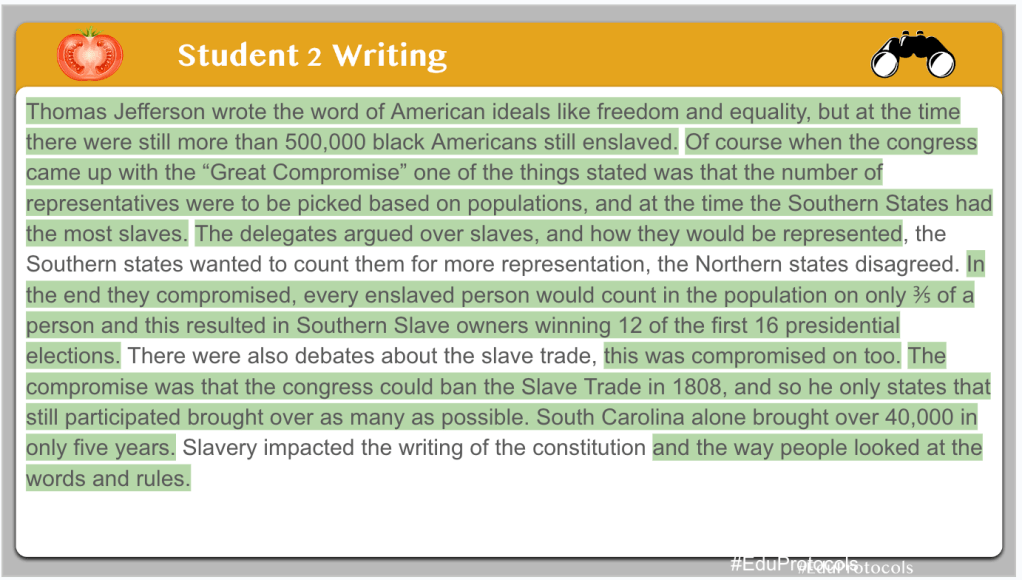
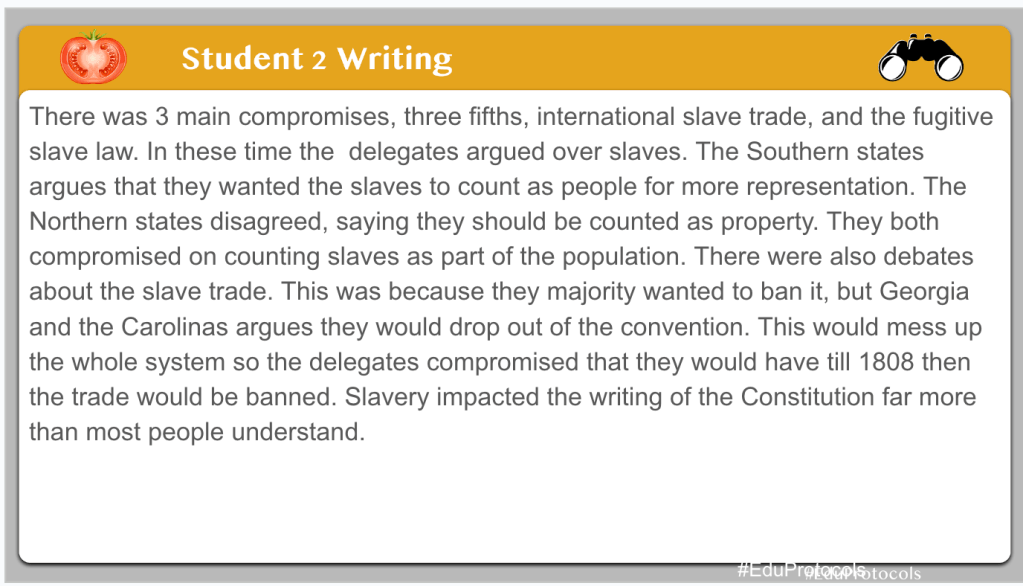
Friday shifted the focus to a new facet—Slavery and the Constitution. The day’s guiding question probed into the impact of slavery on the writing of the Constitution. The class commenced with the Key Word Predictor strategy, a dynamic tool for encouraging predictive thinking before delving into textual content. The central term, “slavery,” was placed at the heart of the predictor, surrounded by keywords such as “3/5,” “1808,” “representation,” and “House of Representatives.” These terms were strategically chosen based on their relevance to the text students were about to explore. Students were prompted to draw lines connecting “slavery” with each surrounding keyword, making predictions about the connections between these elements. This strategic exercise set the stage for the subsequent exploration of three compromises over slavery at the Constitutional Convention. A CyberSandwich unfolded, requiring students to read about these compromises and their effects, all while keeping their keyword predictions in mind. The reading session lasted 10 to 12 minutes, followed by a partner discussion to fill in any gaps in understanding. To add a layer of creativity, instead of a traditional summary, students were tasked with a unique challenge—Claude AI was employed to generate a bland paragraph about the impact of slavery on the writing of the Constitution. The paragraph lacked detail and context intentionally, serving as a blank canvas for students to enhance with the information they had gathered. This approach facilitated a natural differentiation, with students choosing various levels of intervention, from rewriting the entire paragraph to making minor tweaks. The class concluded with the customary quiz, now expanded to include questions about the 3/5 compromise. Impressively, all classes exhibited mastery levels ranging from 80% to 100%, reflecting a solid understanding of the week’s complex topics and fostering a sense of accomplishment among the students.

The Week That Was In 505

Introduction

This past week was an exciting one in my 8th grade social studies classroom! We started a new unit on the Northwest Ordinance, the Northwest Territory, and the Articles of Confederation. With Thanksgiving break coming up, I decided to go more in-depth on these topics now and then pick up with the Constitutional Convention when we return. I incorporated some new gamified activities, protocols, and review games to keep things engaging before break.

Monday – Geography Challenge (TCI)

Tuesday – Frayer, CyberSandwich

Wednesday – Sketch and Tell, Quizizz, Content Compactor

Thursday – Retell in Rhyme, Haiku Hijinks

Friday – Word Warriors

Monday – Geography Challenge

On Monday, I wanted to start off the week with something easy and incorporate more geography. Despite not always being a fan of pre-made maps, I decided to use a geography challenge from TCI. It came with background reading to establish context about the colonies and three different map analyses – population, free vs enslaved population, and labeling the 13 colonies. After reading, students had 25 minutes to analyze and label the maps. This was a great activity to reinforce their knowledge of colony locations. In the past, labeling maps took a long time with students flipping back and forth between a map and their paper. By timing this activity, it kept students focused and working efficiently. Almost all students finished labeling their maps!

I also had students analyze population and slavery distribution. To take it a step further, I used AI to generate an additional question about what the debate over state representation was during the creation of our new government after the Revolutionary War. Based on our work with the Fast and Curious game kits, students easily identified the 13 colonies. Tying in geography and historical context was a great way to kick off the week!

Tuesday – Frayer Models and CyberSandwich

On Tuesday, I started with a thin slide asking students to research and find a state created from the Northwest Territory. This got them thinking about how the territory was divided up. Next, we did Frayer Models on the Northwest Territory and Northwest Ordinance to answer: How was the Northwest Territory divided and settled after the Revolutionary War? Focusing on these two main concepts, the Frayer Models helped students understand key definitions, facts, examples, and non-examples.

After that, we did a CyberSandwich reading activity. I took the textbook section from TCI on the Northwest Ordinance and Land Ordinance of 1785 and combined it with a newspaper article from our local Clermont Sun using AI. Including local history helps students connect these early laws to where they live today. For example, Ohio was the first state created from the Northwest Territory. The Clermont Sun article explained how this area was surveyed and granted to Revolutionary War veterans.

Combining these sources, I had students read and take notes for 10 minutes, discuss with a partner for 5 minutes, and then write a summary paragraph in the last 8-10 minutes. Their summarizing skills are improving with some students now able to summarize more concisely in 5-6 minutes. CyberSandwiches continue to be an effective way to improve reading comprehension and writing skills.

Wednesday – Content Compactor & Sketch and Tell

On Wednesday, I wanted to dive deeper into the Northwest Ordinance. I used the Content Compactor strategy from EMC2 to analyze key quotes about how the ordinance allowed for orderly settlement and governance of the territory. Students had to shrink down the quotes by summarizing and condensing them into one word. Getting creative with images and color, this was a great activity to understand main ideas and pick out important details.

After finishing the Content Compactor slides, I had students look at the full set of summarized quotes and answer our essential question for the day in a Sketch and Tell: How did the Northwest Ordinance allow for orderly settlement in the Northwest Territory? Synthesizing the Content Compactor information, the Sketch and Tell gave students another way to explain their understanding. We closed with a quiz on Mastery Peak.

Thursday – Articles of Confederation Reading & Haiku

On Thursday, I wanted a quick lesson on the Articles of Confederation. We started with a thin slide asking students to research which level of government had the most power. Great to see 90% quickly identified the states held more power than the national government! I then read the article aloud and had students highlight issues that demonstrated the Articles’ weaknesses.

In 1st period, we tried the Retell in Rhyme protocol. Students struggled to rhyme, so for the rest of my classes, we did haikus instead. As the last day before break, I wanted to keep the energy positive. I first gave an example haiku, talked about the 5-7-5 syllable format, and let them write one about a favorite hobby. This gave them a chance to try out haikus in a fun way.

We then played Haiku Hijinks, using spinners to determine the syllables per line about why the Articles failed. Students enjoyed the unpredictability, and it pushed them to think creatively about condensing their knowledge into succinct haikus. Writing in different styles like this engages different skills and keeps things interactive.

Friday – Vocabulary Review with Word Warriors

To make reviewing vocabulary engaging before break, we played the Word Warriors game from EMC2. In each round, students chose a power-up, then I used spinners to determine the part of speech and number of words related to the topic they’d share. Another spinner gave them a chance to use their chosen power-up against an opponent.

We did a practice round generating 5 Thanksgiving verbs. Then I switched topics to our social studies content, like the Northwest Ordinance and Articles of Confederation. Needing to quickly brainstorm adjectives, nouns, or verbs on history forced creative thinking. The head-to-head matchups and power-ups made it fun and competitive. It was a lively way to reinforce key vocabulary and end the week before vacation.

Infusing games and protocols throughout the week kept students actively engaged with the content. The geography map challenge injected a sense of urgency by timing the activity. The unpredictability of syllables in Haiku Hijinks encouraged flexibility. And the competitive, gamified vocab review was a hit on the day before break.

Protocols like Frayer Models, CyberSandwiches, and Sketch and Tells provided structured ways to analyze information, improve reading and writing skills, and synthesize concepts. The Content Compactor helped identify key ideas and details. And switching up how students processed and explained information, like with haikus instead of rhyming, kept things fresh and accessible.

The Week That Was In 505

This week we continue the American Revolutionary War. After last Friday, leaving off with weaknesses and strengths of the continental and British armies, we searched ahead and learned about some battles. On Monday, it’s mentioned in the Ohio standards for eighth grade social studies that in terms of the Revolutionary War, students need to have an understanding of key battles and their significance, along with people that contributed to the American Revolutionary War. I guess I understand why battles and people are included here. It used to be that we would learn about the causes of the Revolutionary War, and there was no standard whatsoever about the war itself; it was kind of weird. But now they’ve incorporated having students understand battles and people, and part of me, I don’t know why, feels the need to cover some of these basics of battles and some of the groups of people that contributed to the war. So, on Monday I did a quick lesson on Nearpod about significant Revolutionary War battles.

On Tuesday, it was election day and we had no school. Wednesday we continued with groups of people that contributed to the Revolutionary War. These groups included women, African Americans, and Native Americans. We did a Cybersandwich eduprotocol with this. On Thursday, we did an awesome review game that I got from EMC2learning which involved having students make connections. Making connections between historical people and events is a really tough skill for students to be able to do, and that’s why I really like this review; it’s just a different version of hexagonal thinking—think of it as a gamified version of hexagonal thinking.

On Friday, I was not at school but I left a final assessment Thick Slide eduprotocol as their final assessment with the Revolutionary War unit. As I reflect on this unit, I was talking with my co-author Scott Petri, I feel like there’s so much in the American Revolution that it’s hard to pick out the important topics. I feel like if I narrow things down to a couple of questions to focus on, the students lack context with certain events and it would be hard for them to understand. Ultimately what ends up happening is I try to cover way too much and my unit ends up feeling disjointed and pieced together. I guess with it being another year, certain units are going to be like that and feel like that, but it’s a unit that I would like to eventually clean up in some way.

Monday – Nearpod

Wednesday – CyberSandwich

Thursday – Twelve Topic Stitch, Quizizz

Friday – Thick Slide

Monday

On Monday I put together a Nearpod which covers Revolutionary War battles. The battles covered in the Nearpod included Lexington and Concord, Battle of Bunker Hill, the Battle of Saratoga, the Battle of Trenton, and the Battle of Yorktown. The ultimate goal at the end of this lesson was for students to have an understanding of why each of these battles was significant during the Revolutionary War. The other goal of this lesson was just to be quick, simple and to the point; I wanted it to just be a one-day thing and then move on.

The Nearpod also included some questions to put things in context. For example, I asked the students what they remember about certain events leading up to the Revolutionary War. I also asked the students to label the 13 colonies on a map—just circle the 13 colonies, draw dots on the 13 colonies, a check mark, something—and this would help place the Revolutionary War in context and give them an understanding that the American Revolutionary War was actually fought in the 13 colonies.

The Nearpod also included some awesome 360° panoramic, almost like Google Street View, pictures that took the students right to some of the battlefields where they could look around and look all around at where some of these battles took place. After the students looked around, I had a reading for each battle generated by ChatGPT using the hero’s journey format. I wanted the students to just choose one battle, map it out with the hero’s journey in the Nearpod, and be the expert on that battle.

The next thing is I didn’t want the students to get into groups and share out about their battle while other students took notes on a Frayer model. The students wrote down specific things such as when the battle took place, maybe who was involved, and obviously why the battle was significant.

The Nearpod also had a quiz built into it to test the knowledge of the students, and then we wrapped up the lesson for the day. I asked the students how they felt about their knowledge of American Revolutionary War battles on a scale of 1, 2 or 3; most of them put around a 2, some put a 3, and a few put a 1. I said the ultimate goal here is just to be able to know one battle from the Revolutionary War and have an understanding of why it was important—nothing more than that.

Wednesday

Wednesday I used as a day to teach the students about different groups of people that contributed to the Revolutionary War. These groups included women, African Americans, and Native Americans. The Ohio State Standards specifically says that students need to have an understanding of how these groups contributed to the Revolutionary War and the outcome of the Revolutionary War.

So I set up a CyberSandwich where students worked in groups of three—one student chose women, another student chose African Americans, and the other student chose Native Americans. I wanted to scaffold the note-taking, so I took all three textbook sections and copied and pasted them into ChatGPT and asked it to create three different categories of information that students could look for while reading. It came up with some categories based on commonalities between all textbook sections. The categories that came up to help scaffold the note taking on the CyberSandwich were Impact on Daily Life, Contributions to the War, and Treatment and Opportunities.

Students got into groups of three, one person shared the slide deck with everybody in the group, and they had 10 minutes to read and take notes. Next, the students all discussed things they found related to how these groups contributed to the Revolutionary War. Then I had each group share a Bazinga, or a fact that wowed them or surprised them. Or they could choose to just share a fact, or they could ask a question. The final step in the process was to write a summary comparing at least two groups and how they contributed to the American Revolutionary War.

With the time we had left over in class, we did a Quizizz Mastery Peak just to review the Revolutionary War unit.

Thursday

On Thursday I couldn’t decide if I wanted to just move ahead with a final assessment for the unit or if I wanted to do some sort of review. I settled on doing a review, but I also wanted to bring in and have the students work on the skill of making connections between historical people and events. This is where the 12 Topic Stitch Up comes in, which is an awesome lesson frame from the EMC2learning website. Because it is on this site I’m unable to share it with anybody, but please check out the EMC2learning site—there is so much awesome stuff available to everyone.

With the 12 Topic Stitch Up, it involves taking content that we’ve learned in the last 4 weeks and combining it with some gamification. Students got into groups of three or four, and I had 12 topics listed on the board. I gave each group a sheet divided up into 12 different segments, and the students chose one topic and had to find a way to connect four other topics from the list to that one topic. They could make one entire connection, so for example they could put the American Revolutionary War in the middle and they could connect the Quartering Act, Stamp Act, The Intolerable Acts, and Taxation Without Representation, and ultimately say that all four of those things connect to the American Revolutionary War because they made colonists mad and eventually led to that war. Or students could individually connect each topic back to the original one that they picked.

Once they discussed it as a group and brought the paper up to me to check and give feedback, if I accepted it they had a chance at trying to pull out a piece from the game Operation as a way to earn points for their team, but they only had one shot and if they made the guy’s nose turn red or make it buzz they lost their chance at getting points for that round.

I love this game because it creates discussions and has the students working on a skill that is tough for them, which is making connections between historical people and historical events. Plus it served as a great review before the final assessment that I put together for Friday.

With time left over in class, we did the same Quizizz from the day before using the Mastery Peak. This Quizizz would serve as part 1 of the assessment for the American Revolution unit. I always like to do two-part assessments where students have an opportunity to choose from answer choices and share their content knowledge, and then I always like to do a part two assessment where they create something to show their knowledge. They would have a chance to show their knowledge through creating a Thick Slide for Friday’s class.

Friday

On Friday I was presenting at the OMLA conference, which was a first for me, and I found my way to Sandusky, Ohio for the first time. This conference was awesome—it’s for middle school level educators and the vibe at both of my sessions was super awesome. Middle school educators are awesome. I presented two sessions, one on Eduprotocols and the other session was on harnessing the power of artificial intelligence to basically teach better and work less.

Since I was in Sandusky, I left an American Revolution final assessment for my students. Whenever I am gone I try to leave something familiar for them to do. This time I left a Thick Slide for the students to complete. I originally set it up so students could describe and identify two British Acts or taxes. I also wanted them to share a quote that showed natural rights. I wanted them to compare Loyalists to Sons of Liberty, and then I just wanted to add a picture.

However, the more I thought about it, the more I wanted it to be a little bit more in-depth. And so I went to Claude.ai and in my prompt I explained my American Revolution unit just a bit with the essential questions. I also explained the Thick Slide and what I wanted the students to do on the Thick Slide, and then I asked it to give me some ideas to make some of the Thick Slide parts be a depth of knowledge level 3. After Claude’s suggestions, I went back and changed the Thick Slide all around.

For example, instead of just describing and identifying two British Acts or taxes, I wanted them to evaluate that in terms of which Act or tax do you think was the most offensive and which one was the least offensive to the colonists, and why. Instead of just finding a quote related specifically to natural rights, I changed the wording up and asked the students to share a quote from the Declaration of Independence that showed an enlightenment idea related to John Locke, so then it left it open to more options.

Instead of just simply choosing a picture to add, I had the students find a picture that showed why the colonists were angry and rebelled against British rule, and the caption had to explain why they chose that picture and how it showed that. So AI is awesome at helping me take things more in-depth, because I think too often, myself included and others, we tend to stop at depth of knowledge level 2 and then move on. Simple little changes and shifts like this can make a huge impact at pushing students further with their thinking and creativity.

Since I was gone, about 120 students were at school, and 100 of them were engaged with this Thick Slide and either completed it or got 3/4 of it done, which is about 83% engagement on the day. This is why I love EduProtocols.

The Week That Was In 505

Introduction

In the world of education, change is often a breath of fresh air, a chance to infuse new life and excitement into the classroom. As a teacher, I’m constantly on the lookout for innovative ways to engage my 8th-grade social studies students. This week, I felt a strong desire to shake things up.

My quest for new teaching methods led me to EMC2Learning, a resource that promised to add a thrilling twist to my lessons through gamification. With a membership in hand, I embarked on a journey that would bring the Declaration of Independence to life in ways I’d never imagined.

As we dove into the week, we explored the rich history of the United States, delving into the meaning and significance of the Declaration of Independence. The Super Sentence Smackdown from EMC2Learning became our guiding star. It was an opportunity for my students to not only analyze and paraphrase this historic document but to do so in a way that made learning fun.

The enthusiasm and success of this approach varied from class to class, and I had to adapt, switching to a more explicit style of teaching in some instances. Along the way, we seamlessly integrated Eduprotocols, transforming our learning into an exciting adventure filled with fast-paced challenges and quizzes.

From vocabulary work with the resource ‘Rumble’ to the incorporation of Legos into our lessons, our journey was marked by a blend of creativity and traditional teaching methods. We explored the strengths and weaknesses of the Continental and British armies during the Revolutionary War, culminating in an engaging Iron Chef activity.

But the week didn’t stop there. We wrapped it up with an assessment where students created costume sets for Continental and British soldiers. The students weren’t ready to say goodbye to the Halloween spirit, pointing out that it was also the time for the Day of the Dead on November 1st and 2nd.

As we bid farewell to this action-packed week, we couldn’t resist one more innovative twist. Instead of a traditional lesson, we engaged in a retrieval practice activity using AI, setting the tone for a week filled with discovery, fun, and a deeper understanding of the Declaration of Independence, the vocabulary associated with the Revolutionary War, and the strengths and weaknesses of British and Continental soldiers.

Monday – Super Sentence Smackdown

Tuesday – Fast and Curious Quizizz, Nearpod

Wednesday – Resource Rumble

Thursday – Fast and Curious Quizizz, Iron Chef, Halloween Costume

Friday – Scribble Diffusion

Monday: Delving into the Declaration of Independence

As the week kicked off, I knew I wanted to infuse some excitement into my 8th-grade social studies class. My goal was to dive deep into the Declaration of Independence and help my students understand the concept of natural rights and the social contract it represents. To do this, I turned to a resource I recently acquired: EMC2Learning. This paid platform provided me with a fantastic tool known as the Super Sentence Smackdown.

I began by selecting excerpts from the Declaration of Independence and divided them into six different rounds. To aid my students in comprehending the text, I turned to ChatGPT for help, and it identified key vocabulary words, such as ‘unalienable,’ ‘endowed,’ ‘political bands,’ ‘instituted,’ and ‘Independence.’ I displayed these excerpts on separate slides, and each round allowed the students three to four minutes to paraphrase or translate the excerpt into modern language. To support their understanding, I provided them with a worksheet containing these vocabulary words and their definitions.

My intention was for students to use these vocabulary words as context clues, helping them make sense of the text. However, I soon realized that some students were struggling to do so, despite the vocabulary list containing the underlined words from the excerpts.

After paraphrasing each excerpt, I paired up students, allowing them to engage in friendly competition as they compared their paraphrases and discussed which one was better. To make it even more exciting, I introduced a monetary aspect to the game, with each round being worth different amounts of ‘money.’ The winner of each round rolled a dice, multiplying the round’s money value by the number they rolled, and then recorded their total. This activity spanned several classes and turned out to be a fun and engaging way for students to explore the Declaration of Independence.

Tuesday: Mastering the Declaration of Independence

On Tuesday, we continued with the Super Sentence Smackdown for most of my classes, wrapping up the rounds. We also had some time to explore further through a ‘Fast and Curious’ activity using Quizizz to test their understanding of the words and concepts within the Declaration of Independence.

Based on the Quizizz results from the previous week, where all classes began with an average score of 54%, we had seen improvement, with averages increasing to 68%. However, the real breakthrough came when we attempted the ‘Mastery Peak’ mode. This time, answering every question, our class average soared to 77%, and all classes achieved over 90% mastery of the Declaration of Independence. The questions revolved around understanding the document’s meaning, purpose, and how natural rights and the social contract influenced its contents.

In some of my classes, I noticed that the Super Sentence Smackdown wasn’t as effective as I had hoped. To address this, I created a Nearpod presentation with excerpts from the Declaration of Independence, focusing on explicit teaching and a controlled pace. This approach seemed to help these particular classes grasp the document’s meaning more effectively.

For classes that finished early, I introduced an empathy map activity. I played the song “You’ll Be Back” from the musical Hamilton, explaining that it represented King George III’s reaction to the Declaration of Independence during the Revolutionary War. The students listened to the song and filled out empathy maps, trying to imagine how King George might have responded to the colonists upon receiving the Declaration. I always find that empathy maps are a valuable tool to help students put themselves in someone else’s shoes and understand different perspectives.

Wednesday: Revolutionary War Vocabulary and Legos

Wednesday marked a significant shift in our focus from the Declaration of Independence to the Revolutionary War. In Ohio, the state standards require students to grasp key battles from the Revolutionary War, such as the Battle of Bunker Hill, Battle of Saratoga, Valley Forge, and the Battle of Yorktown, along with understanding the contributions of various groups during the Revolutionary War.

We began the day with vocabulary related to the Revolutionary War. As it was the day after Halloween, I decided to add a touch of fun and movement to the class by introducing the ‘Resource Rumble.’ For this activity, I used ChatGPT to create 10th-grade-level definitions and examples for eight words associated with the Revolutionary War, including the American Revolutionary War, the Continental Army, minutemen, treaties, and allies. Students collaborated in teams, paraphrasing the definitions, and then collected Legos based on the quality of their paraphrases. The challenge was to build something related to one of the vocabulary words they had just learned and explain its connection to the word. This activity not only got the students moving and engaged but also encouraged them to discuss paraphrases and vocabulary words related to the Revolutionary War.

Thursday: Iron Chef and Deeper Understanding

Thursday began with a Quizizz containing 11 questions, testing both the vocabulary words from the previous day and new content regarding the Continental and British armies during the Revolutionary War. The results showed that students did well with vocabulary questions, indicated by most being marked green and yellow. However, they struggled with the content questions, as most of them appeared red and yellow.

After the Quizizz, we transitioned to an ‘Iron Chef’ activity. This Iron Chef featured four slides: ‘American strengths,’ ‘American weaknesses,’ ‘British strengths,’ and ‘British weaknesses.’ I assigned the first person in each row to share the slide deck with their peers, and they had to decide who would complete each slide. To add an element of unpredictability, I introduced a dice-rolling element: the first roll determined the number of bullet points on each student’s slide, while the second roll dictated the maximum word count allowed per bullet point. Students embraced this twist, which not only made the activity more engaging but also enforced the importance of paraphrasing.

During the Iron Chef, students needed to find information related to their topic on the slides, which was directly linked. I also challenged them to find a famous Revolutionary War battle to include in their presentation. Afterward, each group presented their slides to the class, with each student sharing one thing they had learned in eight seconds or less. As they presented, students recorded this information on their Frayer models.

Following this, I asked the students to design a costume set related to either a British or Continental soldier. I obtained this template from EMC2Learning. However, I observed that students found it challenging to include accessories that related to the information they had just learned. Instead of adding typical accessories like muskets, hats, and uniforms, I encouraged them to think creatively and incorporate items connected to their newfound knowledge. This abstract thinking was a bit challenging for students, but it helped them consolidate their understanding of the material.

We concluded the day with another Quizizz, this time using the Mastery Peak mode, which resulted in all classes achieving an 88% or higher score compared to the first time we used it in that class period.

Friday: Scribble Diffusion Showdown

As the week was drawing to a close, we had shortened class periods on Friday, giving me the perfect opportunity to try something different. I introduced the ‘Scribble Diffusion Showdown,’ a novel activity I had discovered on EMC2Learning.

The Scribble Diffusion Showdown was a unique and exciting experience. Scribble Diffusion is an AI-based platform that generates images based on descriptions provided by users. In our showdown, students drew prompts from a bucket, and they had to create the best image based on the description they typed. For example, one prompt might be, “How did the Sons of Liberty react to the Tea Act?” Students would draw their interpretation of this scenario, type their answer, and see what kind of image Scribble Diffusion would generate based on their description.

If students were unsatisfied with the image, they had to rework and reword their descriptions to get the desired results. This activity not only engaged the students but also served as an introduction to the world of artificial intelligence.

In conclusion, it was a week filled with dynamic and engaging activities, from the Super Sentence Smackdown to Iron Chef and the Scribble Diffusion Showdown. By mixing innovative approaches with traditional teaching methods, I was able to make the study of the Declaration of Independence and the Revolutionary War an exciting and meaningful experience for my 8th-grade social studies class. My students not only learned valuable historical content but also developed crucial skills like paraphrasing, critical thinking, and empathy. As a teacher, it was a rewarding week, knowing that my students were not only learning but having fun while doing so.

The Week That Was In 505

Introduction

As an educator, each week in the classroom presents a unique journey filled with both challenges and triumphs. In this reflective blog post, I will take you through my week of teaching 8th-grade social studies, offering an intimate glimpse into my classroom and my pedagogical approach.

Throughout this week, my central aim was to rekindle the spark of intentionality in my teaching. I had reached a point where it felt like I was engaging in a series of disconnected educational activities. The content was substantive, as we were diving deep into the American Revolution, covering topics ranging from the Enlightenment and British actions to the Sons of Liberty and the loyalists.

Yet, I sensed a lack of a unifying thread, a clear intent that would tie these elements together for my students. The fundamental question that nagged at me was, “How can I teach this material with a deliberate purpose, ensuring that my students not only absorb historical facts but also cultivate critical thinking and analytical skills?”

This blog will provide a day-by-day account of my week in the classroom, offering insights into the activities, challenges, and successes I encountered. The week’s primary focus was on cultivating skills related to claims, evidence, and reasoning, a crucial element in any social studies curriculum.

Join me as we delve into the specifics of each day, from Monday’s exploration of the Sons of Liberty and their complex role in history to Thursday’s playful introduction to the Declaration of Independence, replete with a fascinating experiment in working memory. The week concludes with a short Friday, featuring a Number Mania activity that prompts students to find textual evidence to support the claim that the Declaration of Independence was a thoughtful and deliberate endeavor by the Founding Fathers.

Monday and Tuesday – 3xCER, Quizizz, Thin Slide Swap

Wednesday – Nearpod with Loyalists

Thursday – Quizizz, Frayer

Friday – Number Mania

Monday: 3xCER

At the start of the week, I found myself deep in thought about my teaching approach. I had this nagging feeling that I was doing a lot of random things without a clear sense of intentionality. The content was solid – we were delving into the American Revolution, beginning with topics like the Enlightenment, British actions and taxes, resistance from the Sons of Liberty, and the loyalists. But my teaching lacked a coherent focus. So, my primary goal for the week was to regain that intentionality in my teaching.

For Monday, our focus was on the Sons of Liberty and their various forms of resistance, and whether they could be classified as patriots or terrorists. To kick things off, I decided to provide my students with a foundational understanding of what distinguishes patriots from terrorists. I turned to ChatGPT for some assistance, asking it to generate lists of reasons why the Sons of Liberty might be considered patriots and terrorists. This generated discussion and helped students craft their own definitions of these terms.

I also wanted to ensure that my students had a solid background on the Sons of Liberty. We began by having them read about this group and identify four fundamental characteristics. This knowledge-building phase was critical for the subsequent analysis.

To truly understand the Sons of Liberty, we turned to a variety of documents, some primary and some secondary sources. Students were tasked with crafting claims about whether the Sons of Liberty were patriots or terrorists, backing up their claims with evidence from the documents, and then offering reasoning to support their positions. This process was facilitated by the 3xCER template. To gauge their understanding, we concluded the class with a Quizizz quiz, and I was pleased to see an improvement in student performance as they averaged 80%.

Tuesday: Exploring Sons of Liberty’s Forms of Resistance

On Tuesday, we continued our exploration of the Sons of Liberty, focusing on their forms of resistance. I introduced a Thin Slide Swap activity, a fresh approach to Thin Slide developed by Justin Unruh. The prompt was simple yet thought-provoking: “The Sons of Liberty and their forms of resistance.” This prompted some students to ask what “resistance” meant, leading to a productive classroom discussion.

The Thin Slide Swap allowed students to engage visually and collaboratively. They had two minutes to add an image and a single word or phrase related to the prompt. Afterward, they swapped computers and spent three minutes adding why they thought their partner had chosen the image and word.

Continuing our focus on the Sons of Liberty, we dug into two more document analyses, allotting 15 minutes for students to complete them. The final step was to consolidate their findings and craft a paragraph presenting their claim regarding the Sons of Liberty’s status as patriots or terrorists. They had to incorporate evidence from the documents and ensure the presence of a clear transition. To wrap up, we once again measured their understanding with a Quizizz quiz, and the students averaged an impressive 85%.

Wednesday: Enhancing CER Skills and Introducing Loyalists

Wednesday was a day of refining students’ claims, evidence, and reasoning (CER) skills. I had previously created a rubric for CER paragraphs and enlisted the help of Claude.AI for consistent feedback. The primary takeaway from analyzing student paragraphs was the importance of effectively introducing evidence, referencing documents, authors, or titles. So, I focused on helping students use transitional phrases like “according to” or “the evidence from” to set up their evidence more smoothly.

We started the class with a review of my feedback on their CER paragraphs, with students making highlighted corrections to their claims, evidence, and reasoning. These components were assessed, with one point for the claim, one point for the use of evidence, and two points for reasoning.

Then, we transitioned into a new topic: loyalists. I borrowed a lesson plan from the Stanford History Education Group on loyalists and adapted it for Nearpod. To begin, I had students predict why someone might have been a loyalist during the turbulent American Revolution. They were then tasked with close reading and sourcing two documents, followed by a brief quiz to test their contextual and close reading comprehension. The lesson concluded with students corroborating the documents and writing a claim supported by evidence, with a strong emphasis on the use of transitional phrases. If time allowed, we engaged in a “sketch and tell” activity to answer the initial question about loyalists. While not all students completed it, my primary focus was on their ability to craft claims and use evidence effectively, along with the inclusion of transitional statements.

Thursday: The “Breakup Letter” and the Declaration of Independence

Thursday’s class had a unique and playful start. I walked into the classroom about 20 seconds late, carrying various items I had collected while navigating through the 7th-grade locker area. Among the things I “found,” there was a breakup letter. The students were immediately engaged, some even appearing a bit anxious, thinking that this letter might have something to do with them. As I read the letter aloud, their excitement grew.

After building suspense, I revealed that I had written the letter, and it was signed with the initials “A.C.” – which, of course, stood for American Colonists. The purpose of this playful introduction was to connect it to a more serious historical document – the Declaration of Independence.

I explained to the students that Thomas Jefferson had written what could be considered the greatest “breakup letter” in history – the Declaration of Independence. This analogy was intended to help them relate to and better understand the significance of the document.

Following this engaging start, we transitioned to a Quizizz quiz that featured ten questions related to the Declaration of Independence. I decided to begin the class with a Number Mania Eduprotocol, directly tied to the background information about the Declaration. The quiz questions were cleverly interwoven with this background reading, incorporating vocabulary words such as “unalienable.”

To ensure that students fully grasped the key vocabulary, we engaged in a “Frayer” activity. I provided them with 10th-grade level definitions and examples of important terms like “second Continental Congress,” “unalienable,” “treason,” and “grievance.” Their task was to simplify these definitions and create examples and non-examples for each term.

An intriguing experiment took place as we distributed the background reading, which contained a deliberate contradiction that I wanted the students to identify. To prompt their recognition of this discrepancy, I instructed them to place a check mark next to it. The contradiction in the text was the mention of the number of colonies – in one sentence, it stated there were 13 colonies, and in another sentence, it claimed there were 15 colonies.

The data collected from each class period regarding the students’ ability to spot this contradiction varied:

  • In my first period, where both numbers (13 and 15) were written numerically, 18 out of 27 students found the contradiction.
  • To further explore the impact of numerical presentation, I changed it for my other classes, writing out the numbers as words. The results were as follows:
  • In my third period, four out of 13 students found the contradiction.
  • In my fifth period, eight out of 20 students found the contradiction.
  • In my sixth period, five out of 21 students found the contradiction.
  • In my seventh period, eight out of 29 students found the contradiction.
  • In my eighth period, only one out of 14 students found the contradiction.

This experiment not only served to work on students’ working memory but also provided insights into how they read and interpret information, showcasing the fascinating differences in each class’s response.

Friday: A Short Day and Number Mania

Friday marked a shorter day with Halloween celebrations on the horizon. While some classes engaged in the Number Mania, I recognized that it might not be as successful in others and didn’t press the issue. The objective of the Number Mania was to find textual evidence supporting the claim that “The creation of the Declaration of Independence was a thoughtful and deliberate process that involved significant time, effort, and sacrifice from the Founding Fathers.”

I find the Number Mania approach quite effective with middle school students, as it serves a purpose in teaching them how to select meaningful evidence from a text. It also fosters their ability to analyze and utilize evidence to support a statement.

Throughout the week, I strived to reintroduce intentionality into my teaching. Our main focus was on claims, evidence, and reasoning, and we approached it in various ways – from crafting paragraphs and analyzing sources to reading secondary materials and selecting evidence to align with specific statements.

The Week That Was In 505

Introduction

This past week was filled with highs and lows in my 8th grade social studies classes. It started out on a high note as I attended the Ohio Council for Social Studies annual conference in Columbus. I always look forward to this conference as a chance to connect with fellow teachers, discover new ideas and resources, and reignite my passion for the subject. However, when I returned on Tuesday morning, I quickly realized through a short quiz and student survey that my students were still struggling to grasp key concepts from our unit on the causes of the American Revolution. This kicked off several long days of reteaching the material in new ways, providing additional scaffolding, and letting students demonstrate their learning through creative assessments. It was frustrating to have to hit pause on the unit timeline, but I’m glad I took the time needed to ensure real comprehension.

Monday – Frayer

Tuesday – Kevin Roughton created (Parents), Enlightenment Revolution

Wednesday – Assessment Choices

Thursday – 3xCER

Monday – OCSS

On Monday, I headed to downtown Columbus early in the morning to attend the Ohio Council for Social Studies (OCSS) annual conference, which is always one of the highlights of my year. I started off the day by presenting on two topics – using Eduprotocols to engage students, and harnessing AI tools in the social studies classroom. I enjoy presenting as it pushes me to distill my best teaching practices. The audience had thoughtful questions and ideas to further improve my strategies.

After my presentations, I attended a fascinating session all about incorporating ChatGPT into the classroom led by an educator from the Cleveland area. With ChatGPT exploding in popularity among students, it’s clear that AI is here to stay, so I appreciated her perspective on establishing citation methods and protocols. Rather than banning it, she argued we should teach students how to utilize it as a tool ethically. I’m still pondering how to adapt my own policies.

My other favorite session was on leveraging the Library of Congress digital archives for primary sources. The presenter took us through the site and had us explore sets of WWI propaganda posters in a scavenger hunt. While the session was interesting, I found myself wishing for more examples of classroom strategies to actually engage students with the amazing primary source collections. For instance, I love the “retell and rhyme” Eduprotocol my co-author Scott Petri uses – students read a source, then recap the key facts and events in a rhyming poem, keeping track of how many details they included. This interactive approach really sticks with students.

Since I knew I would be absent all day, I left lesson materials for my students to complete independently. I assigned them to analyze the various British taxes and acts from our unit by filling out a Frayer Model chart, listing facts like the purpose, colonist reactions, violations of natural rights, etc. The Frayer Model is a great eduprotocol because its simple format means students can work on it independently. I was pleased to see that over 80% of my students across 5 sections had completed the assignment when I checked on Tuesday morning.

I also left a Gimkit review game on the causes of the Revolution for them to play. Gimkit combines gaming elements with quiz questions for engaged review. However, the class average was only around 70%, suggesting there were still gaps in student understanding I needed to address.

Tuesday – Reteaching

When I returned to class on Tuesday morning, I decided to immediately assess retention again using the same quiz questions, but transferred into a Quizizz format. I’m loving Quizizz’s new AI features, like the ability to upload question banks from other platforms instantly. The Quizizz results confirmed that students were still shaky on being able to explain British acts like the Quartering Act and link them to Enlightenment philosophy concepts like natural rights and social contract theory.

This data showed me that further reteaching was necessary. I started class by surveying students directly, asking them to rate their comfort level with the content on a scale of 1-5. The results skewed heavily towards the lower numbers, with many rating themselves a 2 or 3. When asked what specifically was confusing, common answers included:

  • Connecting Enlightenment ideas to anger over British acts
  • Explaining how the French-Indian War changed the British-colonial relationship
  • Describing the purposes of specific British taxes and policies

Armed with this student feedback, I knew I needed to rework my approach and reteach the connections between Enlightenment ideology, like social contract theory and natural rights, and specific oppressive British legislation like the Proclamation Line and the Quartering Act.

I decided to use a creative metaphor lesson from teacher Kevin Roughton where the buildup to the American Revolution is compared to conflict between increasingly rebellious teenagers and their parents setting harsh rules. The analogy really seemed to help students understand the gradual progression of events and why the colonists became outraged enough to revolt. I could see the lightbulbs going on as we talked through the metaphor!

I also put together a quick slideshow presentation as another way to clarify the relationship between Enlightenment thinking and colonial anger. My goal was to remind them how Enlightenment philosophers introduced new radical ideas about government deriving power from the people rather than divine right. I highlighted examples of British acts that violated colonists’ conceived natural rights, like economic restrictions and housing soldiers in their homes. Then I directly asked questions like: Did colonists have representation in British Parliament? Could they vote out these leaders who were levying unfair taxes and policies? When I framed it this way, it clicked for many students how the colonists felt they had no choice but to revolt when their ideas of government based on social contract and natural rights were being breached. The presentation seemed effective in tying everything together.

Wednesday – Assessment

At this point, we had gone over the projected unit time, but I refused to move forward if students were still struggling with the core concepts. On Wednesday, I introduced a creative summative assessment option for students to demonstrate their learning. They could choose between using story dice to narrate the events leading up to the Revolution with drawings, or a hexagonal learning activity where they had to connect Enlightenment concepts with matching British policies. Both hands-on options allow students to showcase understanding in a visual way that appeals to different learning styles. For some of my students with IEPs, I modified the hexagonal activity by having them complete just a portion of the timeline with a few matched pairs.

In my instructions, I provided suggestions of key events and concepts I wanted to see, such as:

  • Explaining how the French-Indian War changed the relationship between colonists and Britain
  • Identifying and accurately describing at least 3 British taxes/acts
  • Connecting an Enlightenment ideology like natural rights to colonist anger

As I monitored progress and checked in with individual students, I noticed some were still struggling with properly identifying acts like the Stamp Act or connecting violations of rights to Enlightenment theory. With prompting, many were able to grasp the concepts and correct their work, which was really encouraging to see.

Thursday – CER Practice

Some classes needed more time on Thursday to complete their Revolution storytelling assignments, so I allowed a grace period for finishing up. In my sections that were ready to move on, I introduced our next topic by having them practice evaluating evidence and making claims by analyzing commercials – a fun critical thinking exercise they enjoyed as a lead-in to our unit on the Sons of Liberty and using Claims-Evidence-Reasoning frameworks to analyze historical events.

Conclusion

This week was challenging when my students didn’t initially grasp the concepts I thought I had taught effectively. My plans went out the window as I pressed pause on the curriculum timeline to rework my approach through presentations, metaphors, surveying student needs, and offering creative assessment choices. As teachers, flexibility is so key for reflection when something isn’t working, and I’m glad I took time for reteaching despite the unit creeping longer than intended. The week was taxing but rewarding. My students’ final projects demonstrated real comprehension of the complex factors driving colonial rebellion, which made the extra effort worthwhile. I’m reenergized after this reflective process and have new ideas to try for engaging learners who need different avenues. As next week launches new material, I feel confident we built a strong foundation.

The Week That Was In 505

Introduction

This week, our eighth-grade social studies class delved deeper into the heart of the American Revolution, immersing ourselves in the captivating question: “How did the Enlightenment and the colonists’ growing frustration lead to the American Revolution?” As I navigated this fascinating and enlightening week, I discovered the need to make certain concepts more accessible, especially for those students who struggled with terms like “dissatisfaction.” Thus, I replaced the word with simpler ones like “anger” to ensure every student could actively participate in our exploration. Let’s embark on this educational journey, day by day.

Monday – MapWich (French and Indian War)

Tuesday – Hero’s Journey French and Indian War

Wednesday – Frayer a Historical Person

Thursday – Howson History Sketch (retrieval practice)

Friday – Causes of American Revolution Thick Slide

Monday: The Impact of the French and Indian War

Our week commenced with a riveting exploration of the French and Indian War, an event that would profoundly alter the dynamic between the colonists and the British government. To ignite our curiosity, we began with a “Fast and Curious” Gimkit quiz, focusing specifically on the French and Indian War. The initial results were telling, with scores ranging from 47% to 58%, signifying the depth of understanding needed.

Next on our agenda was a Mapwich Eduprotocol, a creative approach inspired by my friend, Robert Mayfield. The Mapwich involved presenting a map of North America’s transformation from 1754 to 1763, directly after the French and Indian War. I encouraged students to discern the map’s purpose, similarities, and differences between the two timelines. The map was a treasure trove of historical insight, including the Proclamation Line of 1763, which we discussed. I aimed to nurture their map-reading skills and their ability to draw meaningful inferences. To facilitate this, I had them partner up, analyze the map, and engage in discussions for a riveting eight minutes. At the end of this thought-provoking exercise, I tasked students with creating brief summaries of the French and Indian War’s impact on North America.

Following this, we revisited the French and Indian War with another Gimkit quiz. This time, the class averages leaped significantly, ranging from 67% to 82%, a testament to the power of engaging, interactive learning.

Tuesday: The Hero’s Journey and French and Indian War Integration

On Tuesday, we set sail on a new educational adventure, introducing students to the captivating Hero’s Journey EduProtocol. This year, my approach has emphasized reducing cognitive load and ensuring that every new concept is accessible. We commenced with a captivating Ted Ed video, skillfully weaving the Hero’s Journey into the lives of our students. The video brilliantly connected iconic stories like Harry Potter and The Hunger Games to the Hero’s Journey. It inspired us to reflect on our own daily experiences, highlighting how we all embark on heroic journeys, encountering the unknown, crossing thresholds, finding mentors, facing challenges, and hopefully emerging as better individuals.

The Hero’s Journey introduction continued with commercials that showcased the Hero’s Journey elements, a tangible link between literature and history. For instance, a Chef Boyardee commercial provided students with a unique opportunity to identify these elements in real-world scenarios.

Once students were comfortable with the Hero’s Journey, I shared a reading, expertly crafted by Diffit AI, which detailed the French and Indian War in Hero’s Journey format. Students were captivated, with 25 minutes to read and chart their Hero’s Journey. This approach enabled them to grasp historical events through the lens of the Hero’s Journey, fostering a profound connection with the material.

The day concluded with another Gimkit quiz on the French and Indian War, and this time, the class averages surged to an impressive 75% to 90%, showcasing a deepening understanding of the topic.

Wednesday: A Cognitive Experiment

On Wednesday, I was absent, but I had set in motion a captivating experiment inspired by a podcast featuring Daniel Willingham, a distinguished cognitive scientist. During the podcast, he discussed an experiment testing working memory during reading comprehension. It involved providing students with passages filled with spelling errors, syntax issues, and contradictions. Surprisingly, students readily identified spelling and syntax errors but struggled to recognize contradictions, even when they were a mere sentence or two apart.

I decided to put this experiment into action, utilizing artificial intelligence. I used Claude.AI to generate one-page biographies about historical figures and groups involved in the American Revolution. Notably, I instructed Claude to include one deliberate lie within each biography, and this process gave rise to intriguing contradictions. Some were positioned back-to-back, while others were tantalizingly spaced three or four sentences apart.

To enhance the exercise’s depth, students engaged in Frayer activities, seeking a deeper understanding of the historical figures and their contributions. Their ultimate quest was to uncover the one lie, effectively mimicking the working memory experiment described by Daniel Willingham.

The results the following day mirrored Willingham’s findings: students grappled with recognizing contradictions, especially those separated by more than two sentences.

Thursday: The Light of Understanding

Thursday was a day of enlightenment and revelation. We returned to the biographies from the previous day, with a twist. I highlighted the contradictions in green and took the opportunity to explain working memory, its significance in everyday life, and its role in learning.

I emphasized the subtlety of contradictions, some positioned just sentences apart, and students’ expressions revealed their amazement. This was a pivotal moment for them, making them keenly aware of the importance of processing information while reading.

I allowed students 10 to 15 minutes to revisit the biographies and determine the truth, a vital step in helping them understand cognitive processes and grasp the significance of correction in the learning process.

In addition, I provided students with an opportunity to catch up on any missed assignments, or they could collaborate in groups to participate in a creative “Sketch and Tell” activity inspired by Howson History. Each group received a sheet of paper with nine different drawings. The students had to select a topic from a bin and then create a drawing representing something they had learned about that topic. It was a dynamic and interactive activity that worked on some retrieval practice.

Friday: Unraveling Colonial Dissatisfaction

As the week drew to a close, we returned to our fundamental question: “How did the Enlightenment and the colonists’ growing anger lead to the American Revolution?” I explained that we would now explore what incited the colonists and how Enlightenment ideas contributed to their mounting frustration.

Students were tasked with selecting from a list of acts including the Stamp Act, Proclamation Line of 1763, Quartering Act, Townshend Act, Tea Act, and the Intolerable Acts. I utilized Diffit to generate articles that seamlessly incorporated Enlightenment ideas like natural rights, social contract, and self-government into each act’s description. It was a move away from traditional textbooks, enabling a richer exploration of historical events.

Before diving into the readings, I instructed students to skim the articles, understand the headings and subheadings, and establish their learning objectives. This enabled them to target their reading effectively and extract the most meaningful information. After reading and highlighting, students had the responsibility of creating “thick slides” to share with the class. They were encouraged to paraphrase their highlights, reinforcing the importance of critical thinking and information processing.

By the end of the class, students had shared their insights through a Google form, and it was clear that they were beginning to recognize the value of these discussions. The day ended with a well-deserved break outdoors, a moment to recharge and reflect on a week filled with profound learning and important discoveries.

This week was an engaging journey of exploration, discovery, and understanding. As we move forward, I hope to continue instilling in my students the importance of critical thinking, the significance of working memory, and the joy of learning. Our educational adventure is far from over, and I’m eager to see where it leads us next.

The Week That Was In 505

Introduction:

Teaching 8th-grade social studies is an ever-evolving adventure, filled with moments of inspiration, challenges, and growth. This week, we embarked on a new journey as we delved into a unit on the American Revolution.

Monday – Repuzzler, Vocabulary Words

Tuesday – CyberSandwich

Wednesday – Influencer Lesson

Monday: Setting the Stage for the American Revolution

The week commenced with an air of excitement as I introduced our new unit on the American Revolution. To frame our exploration, I presented the essential question: “How did the Enlightenment, and dissatisfaction with colonial rule, lead to the American Revolution?” It was imperative for my students to grasp two foundational elements: the Enlightenment and the sources of colonial discontent.

The Vocabulary Challenge: Resource Rumble Repuzzler (3 R’s)

To ignite their curiosity and engage them right from the start, I decided to tackle vocabulary in an innovative way. I merged the Resource Rumble, a classic lesson, with the Repuzzler EduProtocol, resulting in what I humorously called the “Resource Rumble Repuzzler” or the 3 R’s. For this activity, I selected eight crucial terms: enlightenment, revolution, natural rights, social contract, grievance, tyranny, liberty, and taxation without representation.

To create a rich learning experience, I turned to ChatGPT for assistance. It provided brief, clear explanations for each term. These explanations served as the foundation for students to develop their definitions, list three defining characteristics, and create a symbol that encapsulated the essence of each word.

However, the twist that added an element of fun and competition was this: I printed out each term’s explanation, cut them into pieces, and placed them in envelopes scattered around the classroom. The challenge for my students was to form groups of 3 or 4, locate these envelopes, and, using the provided explanations, complete their Repuzzler pages.

The Resource Rumble Repuzzler was not just a vocabulary exercise; it was a competition. The students’ energy levels rose as they moved about, collaborating to decipher these new words and their meanings. I won’t delve into all the details of the competition, as a portion of the activity is from EMC2Learning, a paid site. Nevertheless, the activity was a fantastic mix of movement, collaboration, and vocabulary building.

Tuesday: Unveiling the Enlightenment and Note-Taking Skills

On Tuesday, we continued our exploration of the Enlightenment. Building upon the foundation laid on Monday, I opted for a different approach to keep the momentum going.

Repuzzler Cards: Enhancing Collaboration and Discussion

To kickstart our class, I distributed Repuzzler cards to small groups of 2 to 3 students. These cards were compilations of seven to eight Repuzzlers created by the students themselves. The challenge was to piece together these cards, effectively engaging students in collaboration and discussion.

This activity served a dual purpose. Firstly, it reinforced the importance of collaboration and communication skills. As I traveled through the classroom, I had the opportunity to engage in conversations and provide valuable feedback to each group.

Secondly, it allowed me to gauge their understanding and grasp of the concepts we had discussed on Monday. This formative assessment gave me insights into the areas that needed further clarification.

CyberSandwich EduProtocol: An Introduction to the Enlightenment

Following the Repuzzler card activity, we transitioned into the CyberSandwich EduProtocol. The focus was on providing an introduction to the Enlightenment, a key era that would lay the groundwork for our understanding of the American Revolution.

For this segment, I used a reading from iCivics that offered a straightforward overview of critical Enlightenment concepts such as the social contract, natural rights, and republicanism. In retrospect, I realized that “republicanism” should have been included as a vocabulary term, a note I made for future lessons.

As my students read the provided text for about 10 minutes, they were encouraged to take notes. However, I acknowledged the diverse reading preferences among my students. Some preferred physical copies, with a penchant for highlighting passages. To cater to their needs, I introduced them to a concept from the book “Outsmart Your Brain” by Dr. Daniel Willingham.

Note-Taking Reimagined: Skim, Set Goals, and Highlight with Purpose

I shared Dr. Willingham’s wisdom, suggesting that instead of passively reading and indiscriminately highlighting, they should start by skimming the passage to understand its structure and content. The next crucial step was setting goals. In this case, our overarching goal was to answer the question, “How did the Enlightenment change our understanding of government?”

With this goal in mind, I advised them to highlight only the information that directly contributed to answering that question. This strategic approach to reading and note-taking aimed to equip my students with a valuable skill that transcended this particular lesson.

After their 10 minutes of reading and note-taking, students engaged in a pair-share activity. They shared their notes with a partner, fostering discussion and reinforcing their understanding of the material. Finally, they crafted a summary paragraph that addressed the central question, thus bringing our class to a productive close.

Wednesday and Thursday: The Influencer Lesson

Wednesday was a pivotal day as we ventured into a unique lesson plan inspired by Mr. Kevin Roughton’s “Influencer” lesson. This captivating and well-structured lesson had two primary components: a compatibility quiz and an exploration of Enlightenment thinkers.

The Compatibility Quiz: Exploring Beliefs and Values

Our day began with a compatibility quiz, which probed the students’ beliefs about true freedom and the purpose of government. This engaging activity encouraged introspection and set the stage for what was to come.

Getting to Know the Enlightenment Thinkers: A First-Person Perspective

The heart of this lesson was an in-depth exploration of Enlightenment thinkers, such as John Locke, Rousseau, Montesquieu, and three others. What made this experience unique was the use of first-person narratives in their profiles. To enrich these profiles, I collaborated with ChatGPT, which rewrote the biographies to include each thinker’s beliefs about the role of government and individual liberties.

The objective was clear: students were tasked with associating Enlightenment thinkers with their beliefs on government and personal freedoms. To facilitate this, I had prepared six profiles and distributed them around the room. Students worked in groups, adding valuable information to their Frayer models.

At this juncture, I emphasized the purpose of the lesson: to identify which Enlightenment thinkers resonated most with their own beliefs. I also stressed the broader importance of this exercise, as Enlightenment thought would be a recurring theme throughout their high school journey.

Once students had gathered notes and insights, they analyzed their findings in relation to the compatibility quiz. This comparison revealed which thinkers aligned most closely with their own values and philosophies. The lesson culminated with a “sketch and tell” activity, where students sketched a representation of their most compatible Enlightenment thinker and shared their beliefs with the class.

Friday: Out of Town

Friday marked the end of the school week, and I had a prior commitment that took me out of town on Thursday and Friday. However, this didn’t mean that my students were left without guidance. I had thoughtfully planned a lesson to keep them engaged.

Map Challenge: Contextualizing the American Revolution

For Friday’s lesson, I designed a map challenge that drew from our textbook. It was a straightforward assignment where students were tasked with labeling a map, providing essential context about the onset of the American Revolution. This task not only reinforced geography skills but also served as a natural segue into our upcoming discussion on the Seven Years’ War, scheduled for the following Monday.

Conclusion: A Week of Engagement, Exploration, and Growth

As I reflect on this week of teaching 8th-grade social studies, I am reminded of the dynamic nature of education. Each day brought new challenges and opportunities, and I strived to make the learning experience engaging and meaningful for my students.

We embarked on our journey into the American Revolution by first understanding the Enlightenment and the colonial discontent that fueled the revolution. The Resource Rumble Repuzzler brought vocabulary to life in a competitive and interactive manner.

On Tuesday, we honed our note-taking skills while diving deeper into Enlightenment concepts. The Repuzzler cards facilitated collaboration, ensuring that students were actively engaged in the learning process.

Wednesday and Thursday were highlighted by the “Influencer” lesson, where students explored the beliefs of Enlightenment thinkers. This exercise not only deepened their understanding of history but also encouraged introspection about their own values and beliefs.

Even on a day when I was out of town, I ensured that my students had a meaningful learning experience through the map challenge, providing them with the opportunity to apply their knowledge and contextualize historical events.