
Last Friday I presented EduProtocols at Springer School and Center in Cincinnati. Springer is known for its work with students who have ADHD and executive functioning challenges. I went to share ideas. I left rethinking some of my own.
Early in her keynote, Sarah Ward had us build a word cloud around executive functioning. The room filled it fast. Words like….
- Organization.
- Planning.
- Time management.
- Routines.
- Focus.
It looked right. But the word she was looking for wasn’t there. By the end, she gave it to us……….”Simulation.” That was the word.
Executive functioning isn’t first about binders or planners. It starts with nonverbal working memory. In simple terms, can a student picture what “done” looks like? Can they see themselves doing the task before they start?
If they can’t picture it, they can’t plan it. If they can’t plan it, they can’t execute it. These are things that I don’t think twice about, they just happen. But, for many kids, and some adults, this is the struggle.
Nonverbal memory leads to if–then thinking. If–then thinking drives self-talk. When the image isn’t there, the whole chain breaks.
She talked about how screens are impacting imagery. Kids can read the words, but they struggle to imagine the scene. They don’t see it play out in their heads. That matters more than we think. When everything is pre-visualized for you on a screen, your brain doesn’t have to generate the picture. It just consumes it. Then we hand students a paragraph in a textbook and assume they’re building a mental movie. Many aren’t. They’re decoding, not visualizing. And if there’s no image, there’s no anchor for memory. No anchor for planning. No anchor for executive function.
Then she layered in situational awareness. Space. Time. Objects. People. Stop and read the room. Many kids struggle with this. They’re physically present but mentally somewhere else. They don’t notice how much time has passed. They don’t notice that others have already started. They don’t notice the materials they need sitting right in front of them. Situational awareness is the ability to take in the environment and adjust. If you can’t “see” the room, you can’t respond to the room. And when students lack that awareness, we often interpret it as not caring, when in reality it’s a processing gap.
Nonverbal memory plus situational awareness equals what she called mimetic ideation. In plain language: mime it in your head. Don’t talk it through. Picture yourself acting it out. It’s a mental dress rehearsal. She called it “mime it.” Run the movie in your head before you hit play in real life. Here’s what that looks like in a classroom:
Make an image.
What does “done” look like? For example, if we’re doing a Thin Slide, picture the finished slide. One clear image. One strong phrase. Clean. Simple. Not cluttered.
Image yourself in it.
What do I look like doing this? Am I sitting upright, Chromebook open, reading closely? Am I highlighting key words? See yourself actually working, not just thinking about working.
Move through the space.
How am I physically going to do this? I take out my notebook. I open Google Classroom. I scroll to the assignment. I start typing. Walk yourself through the steps before you begin.
Feel the energy.
What’s my tone? Calm and focused? Rushed and frantic? If I’m revising a Nacho Paragraph, I’m steady and intentional, not just clicking submit.
Think if–then.
If I get stuck, then I reread. If I finish early, then I add a second piece of evidence. If the timer is at halfway, then I should be halfway done.
Account for time and task.
How long do I have? What exactly is the job? Eight minutes to be a “fact finder.” Ten minutes to be a “slide designer.” Not just “work on it,” but a clear task inside a visible block of time.
That’s executive functioning. Not just planning. Simulation.
The part that hit me hardest was time and task. Some students often struggle to visualize time. If you say, “You have 10 minutes,” that’s abstract. They may spend five minutes just getting organized and suddenly they’re behind. Add anxiety and their executive functioning drops even more.
That explains a lot of what we see.
It also reinforced something I already believe in. Make time visible. Classroom Screens is a great site with visual timers. Kids can actually see how much time should be sepnt doing something.
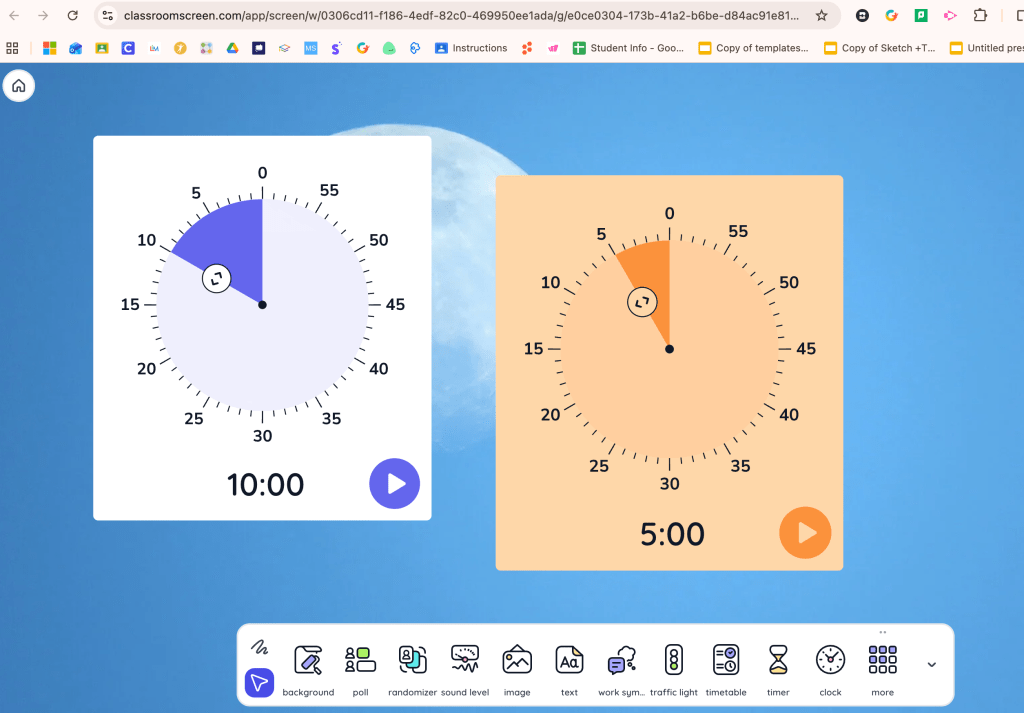
I time everything in my classroom. Fast and Curious. Thin Slides. Frayers. I live by the timer. I’ve always said it creates focus. Now I see that it supports simulation. When students can see time moving, they can adjust. They can feel urgency. They can check themselves at the midpoint.
That’s executive support, not just classroom structure.
Another simple shift she suggested was language. Instead of “Take notes,” say “Be a note taker.” Instead of “Do the reading,” say “Be a fact finder.” Add “er” to the task. Give them a role. When you give a role, you force a mental picture.
We give a lot of verbal directions in school. Too often we’re the ones doing the mental rehearsal. We’re picturing the steps. We’re anticipating the problems. Students aren’t.
Executive functioning is the ability to run the movie in your head before you press play.
Simulation.
That was the word missing from our cloud.
It’s the one I’m carrying back into my classroom.

 Moler's Musings