I feel like I am starting to hit a rhythm. There are still days when I wonder if I am just doing random things, trying to find consistency and purpose. But slowly, I can feel the stride taking shape. The protocols are giving me structure, and the students are responding with genuine engagement.
This week showed how much can happen when we stack the right activities. We kicked things off with 8Parts to sharpen map analysis, leaned on CyberSandwich to process readings and build understanding, worked through Map and Tell to strengthen geography skills, and dug into vocabulary with the Frayer Model. Later in the week, Archetype 4 Square pushed students into some of the best discussions we have had so far.
Each activity invited students to do more than just take in information. They were noticing details, making inferences, debating ideas, and connecting evidence to bigger themes. That engagement is what tells me I am slowly finding my stride.
Monday – Rack and Stack (Factors Exploration)
Tuesday – Reading and Organizer (Motivations), EMC2Learning
Wednesday – Divide the Pie
Thursday – Rack and Stack (Spain in America)
Friday – Organizer and Reading, EMC2Learning
Monday
We kicked off the week by looking at how the Age of Exploration did not simply appear out of thin air. It was the result of many forces building over centuries. I wanted students to see that explorers like Columbus and da Gama were not just bold individuals, but products of their time and the larger changes shaping Europe.
Setting the Stage with Maps
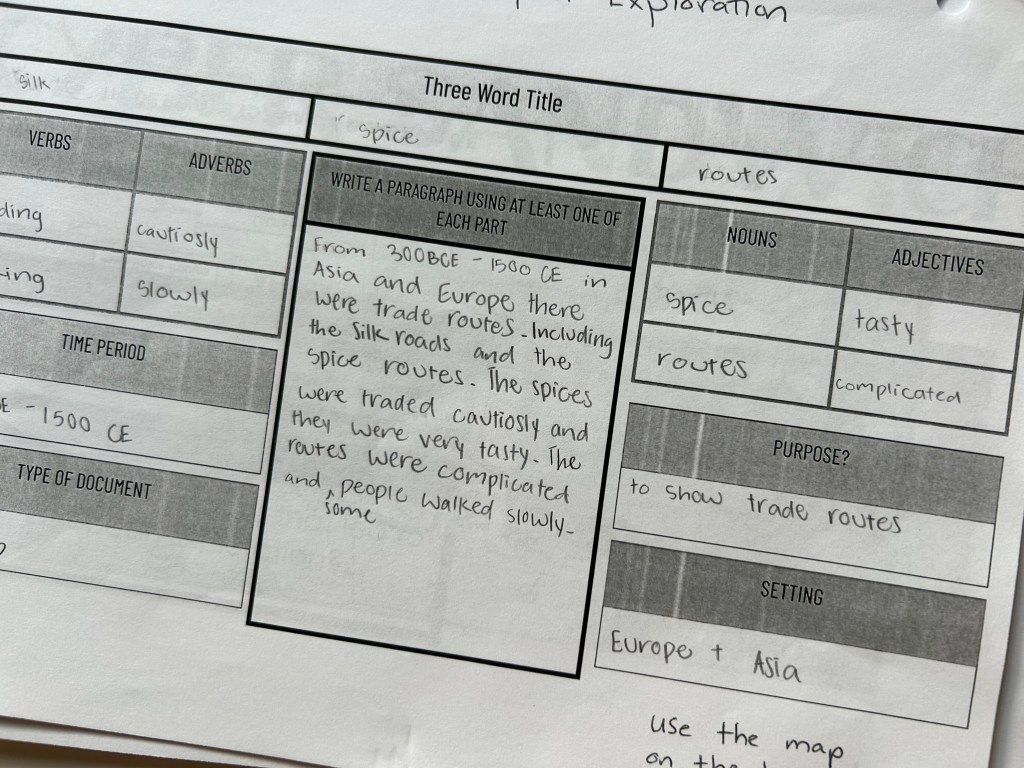
We started with an 8Parts activity, analyzing a historical map. This gave students practice with geography and map analysis skills, which are areas we will keep building throughout the year. Students had to break the map down into its pieces: nouns, verbs, adjectives, time period, setting, and purpose. Then they put it back together to tell the story it revealed. Many quickly realized how much information a map can communicate if you look closely.
Reading with Purpose
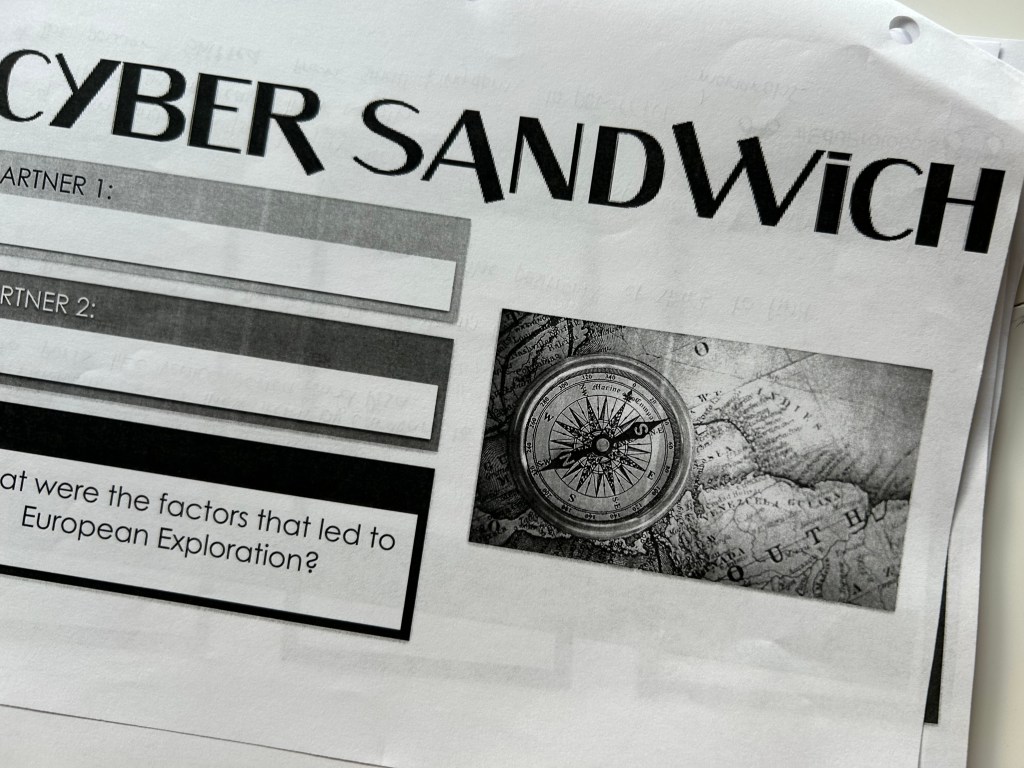
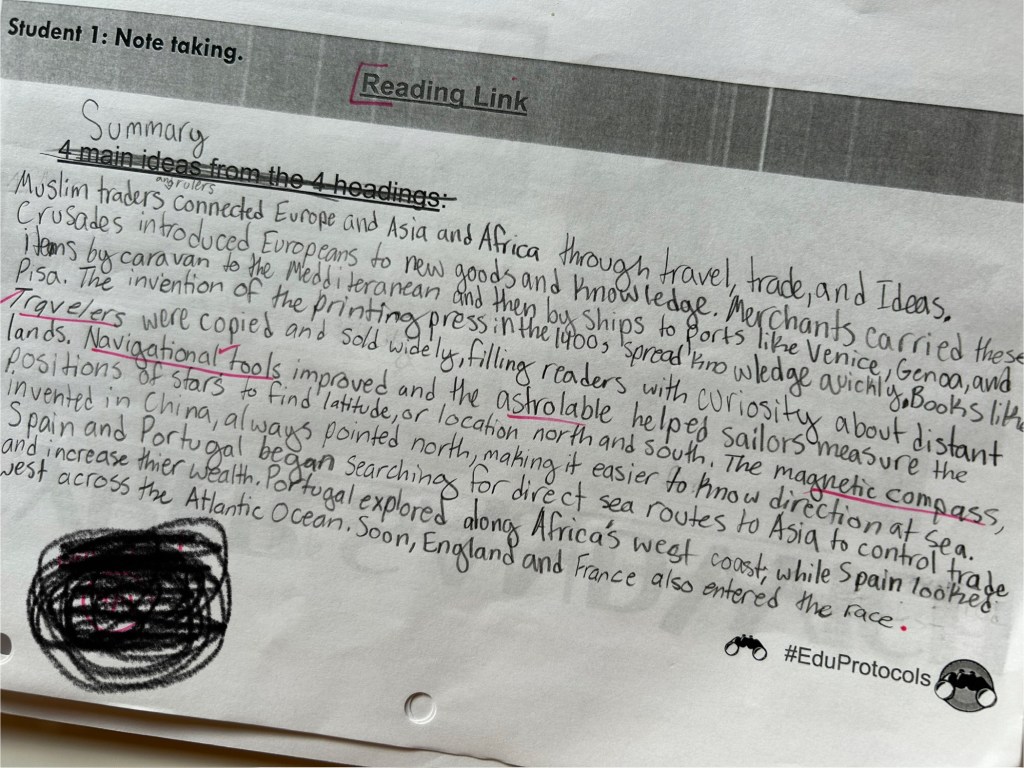
Next, we dug into the big question: What were the factors that led to European exploration? Using a reading that explored trade and the Crusades, the Renaissance, new technology, and competition among nations, students paired up for a CyberSandwich. Each partner summarized half of the text, then came together to share and compare notes. This structure helped them both process the content and hear the same ideas from another voice, making it more likely the information would stick.
Why It Mattered
By the end of class, students had built a clear picture: exploration was not random. It was fueled by curiosity sparked during the Renaissance, stronger nations looking for power, better ships and navigation tools, and the race to control trade routes to Asia.
For me, the highlight was seeing students make the leap from isolated facts to connected causes. They were not just learning “what happened” but beginning to think about why it happened, and that is the kind of historical thinking we will keep returning to all year.

Tuesday
Tuesday’s lesson brought strategy, problem-solving, and a little competition into our exploration unit. While Monday gave us the big picture, today we zoomed in on the motivations of Spain and Portugal and how those motives shaped the impacts of exploration on both Europe and the Americas.
Cracking the Code with EMC² Learning
We used a Code Breakers activity from EMC² Learning to tackle the Age of Exploration reading. Students began by gathering notes across several categories: Spain, Portugal, motives, impacts, and even England and France. The challenge came when I revealed the secret code: 2232.
This meant students had to decide which categories each number would represent, then trim their notes to fit. For example, if they placed a “2” under the Spain target, they could only keep two of their Spain notes and had to cut the rest. Every decision mattered, and not all categories were going to be used. That forced them to weigh the quality of their notes, decide what truly answered the driving question, and sacrifice details that did not carry as much weight.
Summaries and a Battle Royale
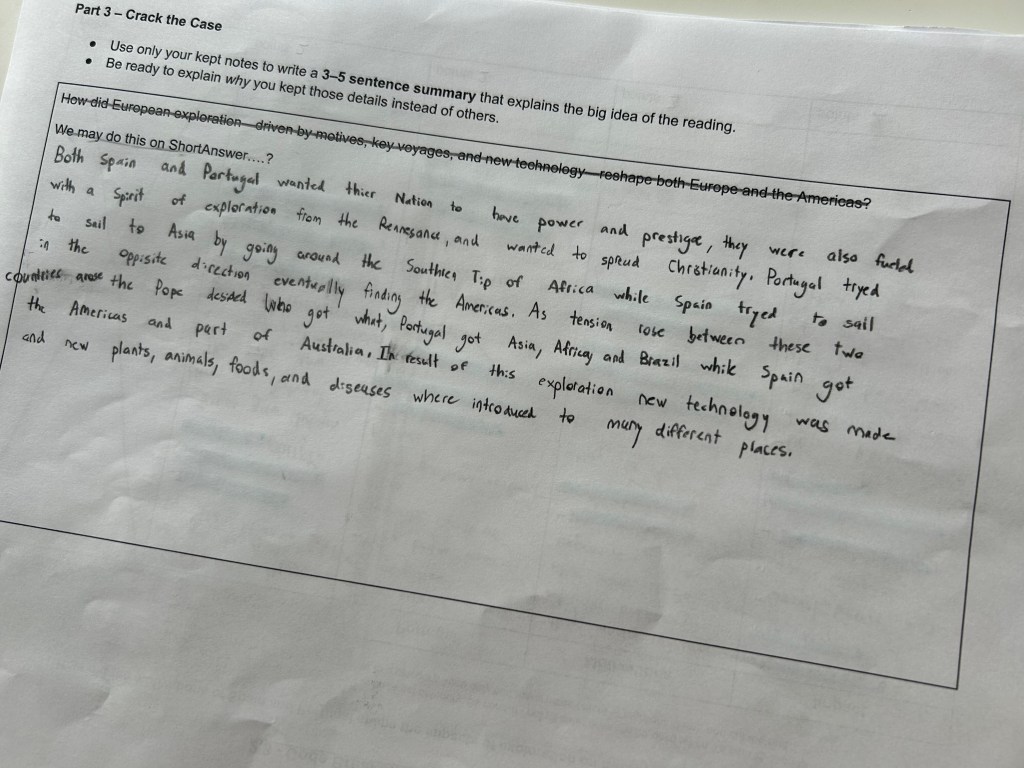
Once their notes were locked in, groups used them to write 3–5 sentence summaries answering the big question: How did the motives of Spain and Portugal shape the impacts of exploration? Some leaned on Portugal’s focus on trade routes along Africa and India, while others emphasized Spain’s westward voyages that opened the Americas.
To raise the stakes, groups submitted their summaries into ShortAnswer, which set up a full class Battle Royale. Students got to see each group’s choices play out, compare strategies, and reflect on how the placement of numbers shaped the strength of their arguments.
Why I Loved This Lesson
This lesson was full of twists and turns. Students had to wrestle with which notes fit which targets, defend their choices, and accept that not every detail could survive. They were doing more than memorizing explorers and dates. They were thinking like historians, prioritizing evidence, trimming down to essentials, and connecting their choices to the bigger idea.
By the end of class, the theme was clear: motives drive impact. And watching students battle through the decisions reminded me why I love mixing content with game based strategies.

Wednesday
By Wednesday, students were ready to take ownership of the big motivations driving Spain and Portugal’s push to explore. Instead of simply listing them, we dug deeper into the classic categories of God, Gold, Glory, and Colonies.
Dividing the Pie
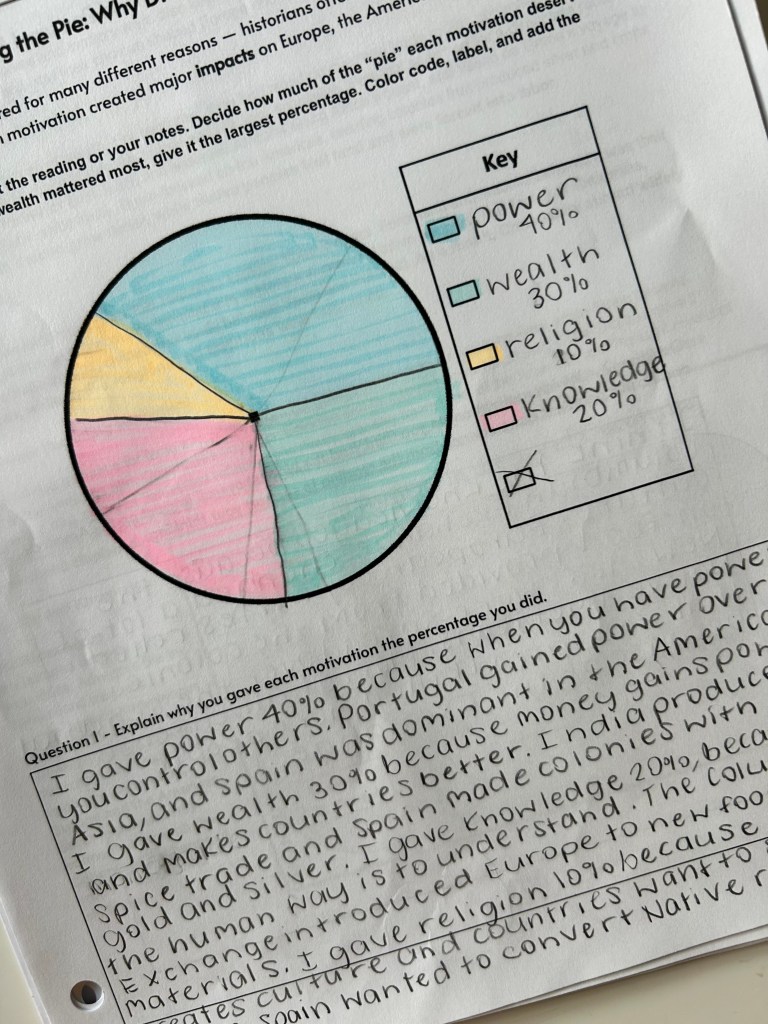
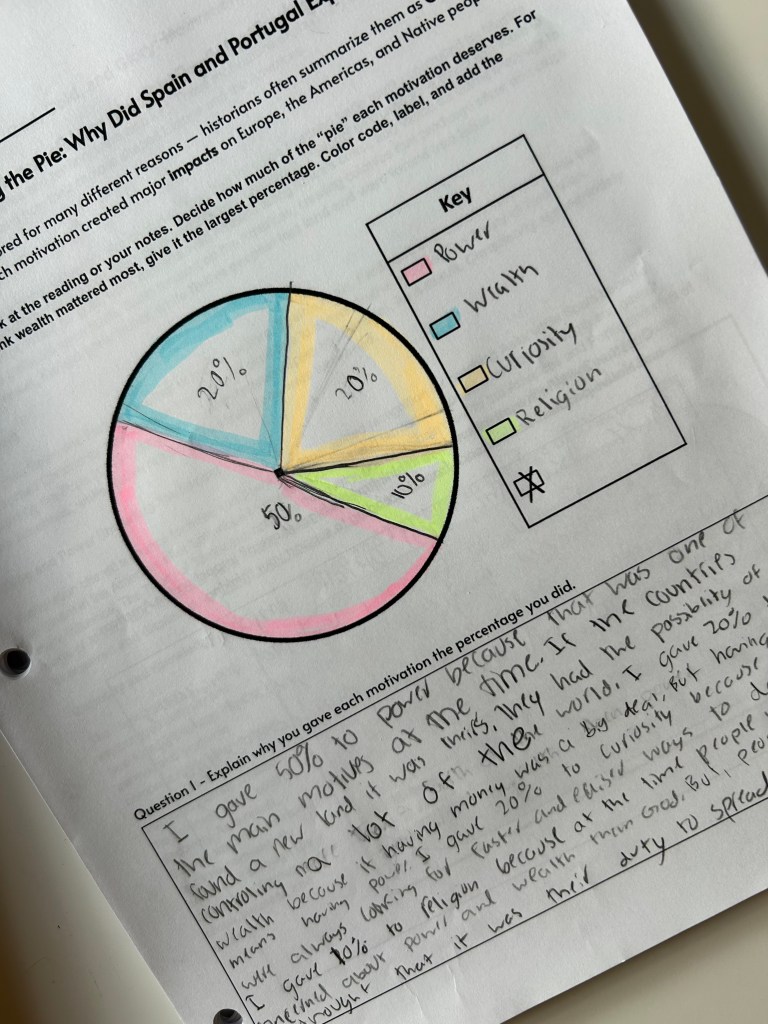
Students completed a Dividing the Pie activity, where they had to assign percentages to each motivation. If they thought wealth was the main driver, then Gold would take the largest slice of the pie. If spreading Christianity mattered most, then God would get more space. Their task was not just to color and label, but to defend why they divided the pie the way they did.
Evidence-Based Reasoning
To back up their choices, students used details from the reading. For example, Portugal’s search for a direct sea route to Asia and Spain’s colonies in the Americas showed how wealth and trade were powerful motivators. On the other hand, the Treaty of Tordesillas and missionary work revealed the strong role of religion. Some students even argued for curiosity and knowledge, pointing out how new technology and the spirit of discovery fueled exploration.
Making It Personal
The highlight of the activity was Question 2: Which motivation had the biggest impact on the Americas and Native peoples? Students had to wrestle with tough realities like how gold and colonies led to forced labor and land loss, or how the spread of Christianity weakened Native traditions. This question helped move their thinking from Europe’s perspective to the experiences of the Americas.
Why It Mattered
This lesson was not just about memorizing God, Gold, and Glory. It was about evaluating priorities, weighing evidence, and making claims. Every pie looked a little different, which sparked great conversations about how historians debate the very same question.
By the end, students saw that while all the motivations mattered, the balance you choose says a lot about what you think shaped history most.

Thursday
Thursday’s lesson was all about layering different EduProtocols to build toward Friday’s deeper dive into the impact of Spanish colonization in the Americas. This day was packed with discovery, vocabulary, and some of the best student-led discussions of the week.
Spot the Differences: Scrubbed Map
We started with a twist. Before our Map and Tell, I displayed the same map on my TV board but with certain pieces scrubbed out using Cleanup.pictures. I removed four key details: the word “North” from North America, Cortés, and two of Columbus’s voyages. Students’ first task was to find the differences.
This quick activity sparked curiosity right away and set up the focus points for the lesson. It gave students a reason to look closely at the map and notice details that connected directly to what we would later analyze.
Map and Tell and Vocabulary Work
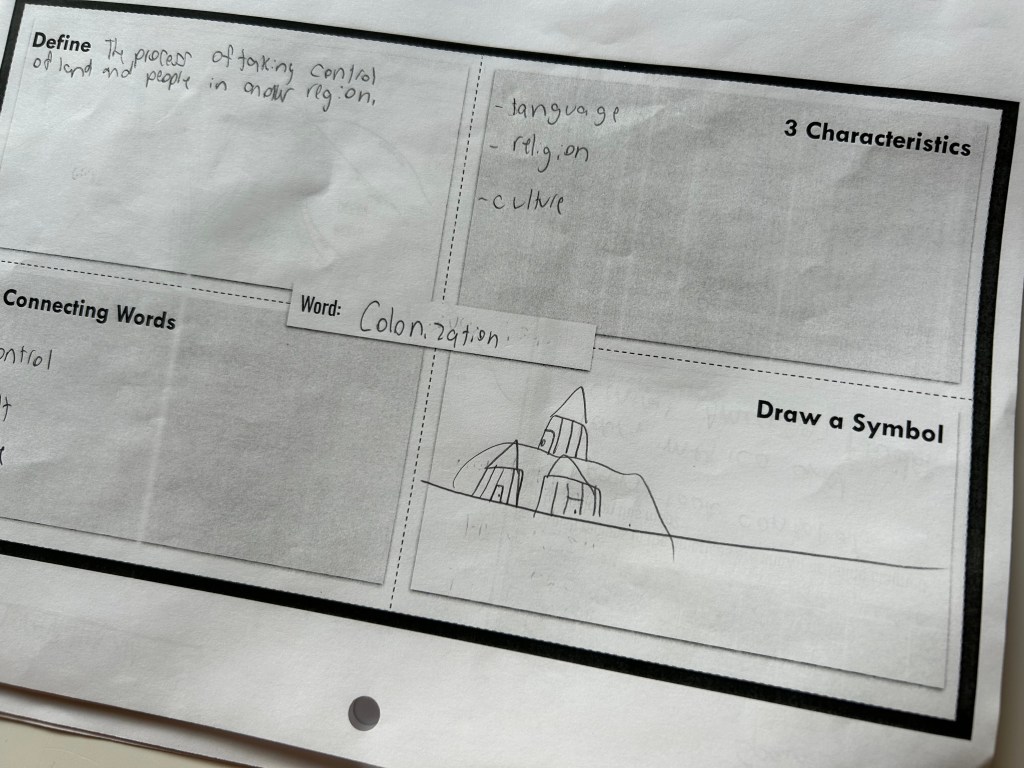
After the warm up, we moved into the Map and Tell where students shared insights and built their geography analysis skills. From there, they chose two vocabulary words to break down using a Frayer Model. The options: conquistador, encomienda system, colonization, and Columbian Exchange; gave them ownership over which concepts to dive into while still ensuring the class as a whole explored all four.
Archetype 4 Square with Queen Isabella
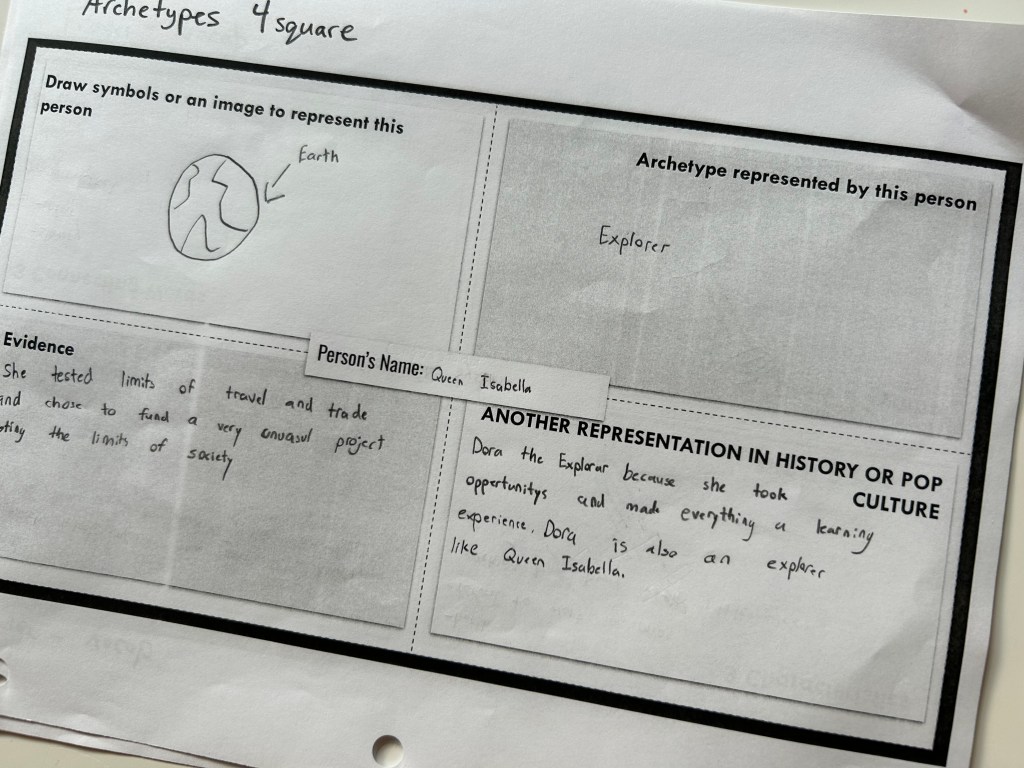
The highlight of the day came with the Archetype 4 Square. Students read a short piece about Queen Isabella and then explored which archetypes best fit her. Even though they had no background knowledge of archetypes, I gave them a list and asked, What do you think an archetype is? Many quickly noticed that they looked like personality traits or roles that show up in stories, movies, or TV shows.
What followed were some of the richest conversations of the week. Students selected multiple archetypes for Queen Isabella and then partnered up to defend their choices and reach a shared conclusion. One standout moment was when several students identified Isabella as the Innocent archetype. They justified it by explaining that she seemed to believe she was helping her country, trusted that natives were being treated well, and placed a great deal of faith in Columbus to explore and claim land. These ideas were not spelled out in the text, but students picked up on them through inference and discussion. That was awesome to see.
Why It Mattered
This lesson had so many layers—visual analysis, vocabulary practice, and character exploration—but what tied it all together was the level of student thinking. They were not just learning facts about maps, words, or Isabella. They were building arguments, questioning assumptions, and collaborating to refine their ideas.
Thursday felt like the perfect setup for Friday’s lesson, with students now primed to wrestle with the larger impacts of Spain’s colonization in the Americas.



Friday
Friday wrapped up our week on exploration and colonization with retrieval practice and a high-energy EMC² Learning lesson that challenged students to separate truth from half-truths.
Retrieval Practice First
All week we had been using a Gimkit review game with key questions, but Friday I pulled a few of those questions into a different format. Students answered three multiple choice questions, one fill in the blank, and one short answer on paper.
Answering without clicking forced them to recall and explain knowledge in a deeper way. It felt different from the fast-paced Gimkit and gave me a clear window into what they were actually remembering. Students did great with it, which reassures me that building retrieval practice into our regular routine is the right move, even if some days I doubt myself.
Breaking the Curse with Deja Voodoo
With retrieval practice done, we jumped into Deja Voodoo from EMC² Learning. I set the stage by asking, “Can you break the curse?”
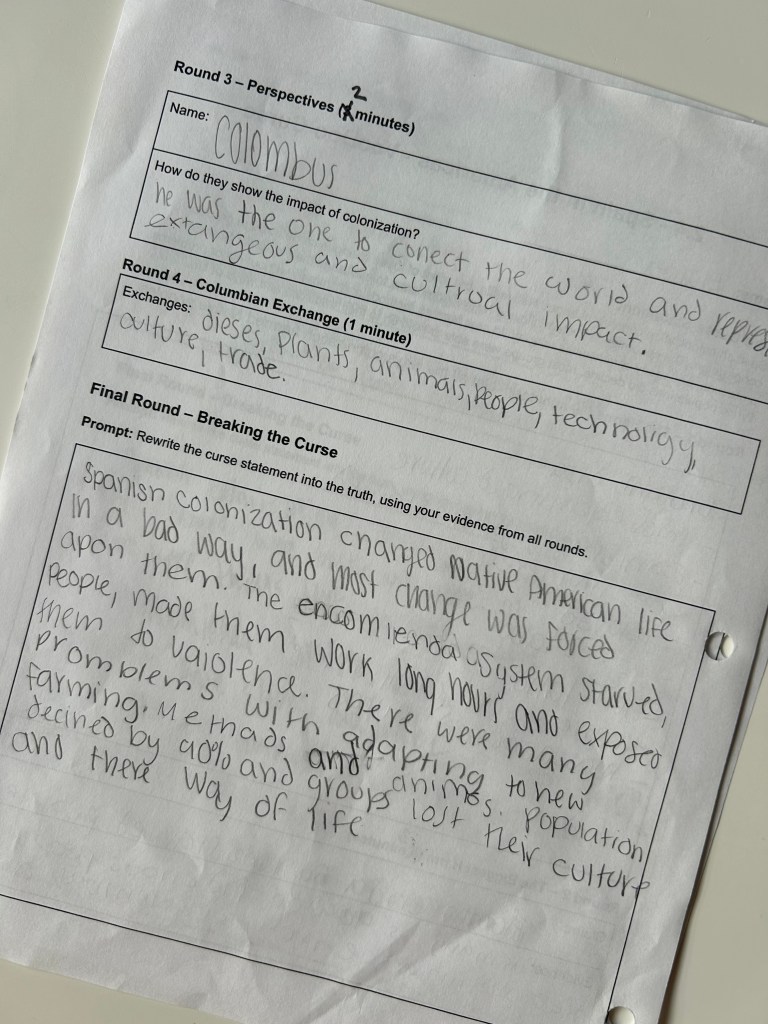
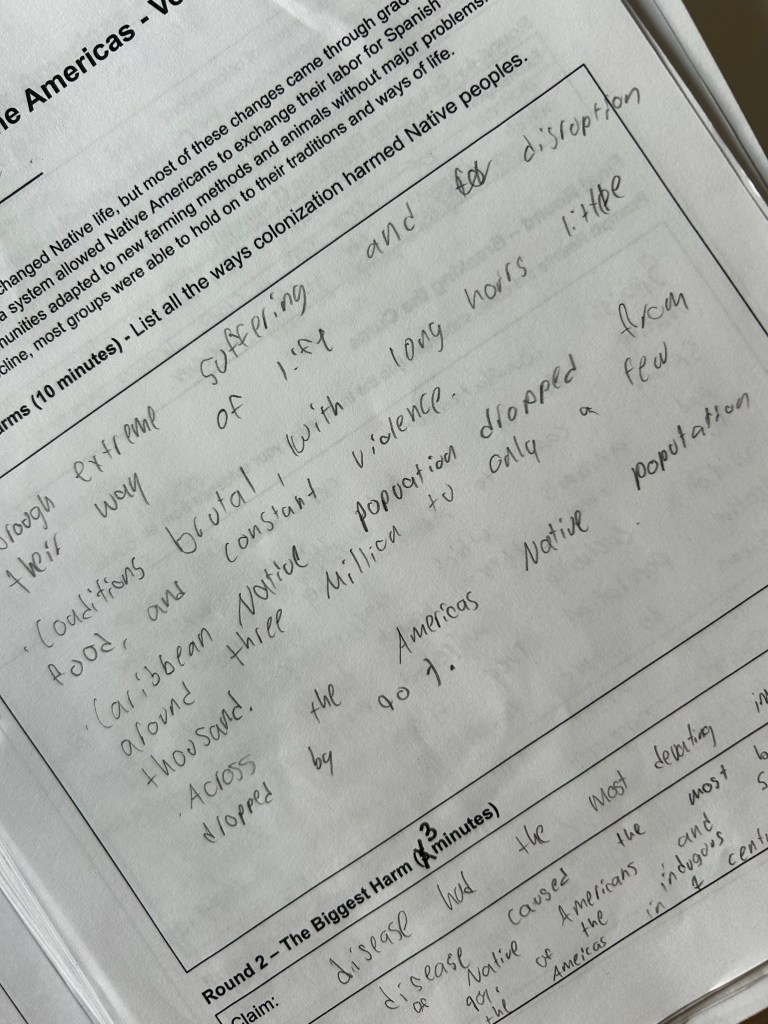
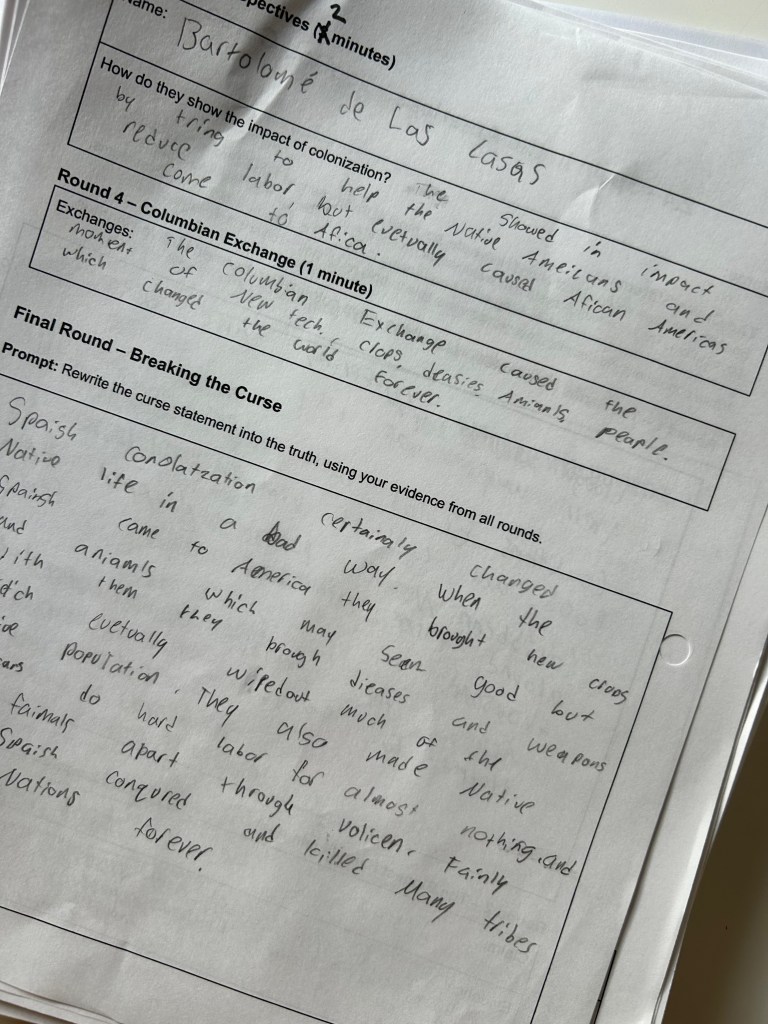
At the top of their organizer, students saw the Curse Statement I had written: “Spanish colonization certainly changed Native life, but most of these changes came through gradual cooperation. The encomienda system allowed Native Americans to exchange their labor for Spanish protection, and many communities adapted to new farming methods and animals without major problems. While populations did decline, most groups were able to hold on to their traditions and ways of life.”
The goal was to break the curse by exposing the lies, half-truths, and downplaying of colonization’s impact.
The lesson unfolded in five rounds, each one getting shorter.
- Gather initial evidence from the text.
- Look closer for examples of harm caused by colonization such as disease, forced labor, population decline, and cultural loss.
- Identify the most devastating impact and explain why it mattered most.
- Connect one person or group such as Columbus, Cortes, Las Casas, or Natives to the larger story.
- Rewrite the Curse Statement by replacing half-truths with accurate evidence.
After each round, groups quickly shared responses, and I awarded random points with the reminder that “everything is made up and the points don’t matter.” The mix of humor, urgency, and layered analysis kept the energy high. Before we knew it, class was over and students had successfully broken the curse.
Why I’ll Do It Again
I loved this lesson because it gave students multiple chances to revisit the same text, spot what they had missed, and sharpen their thinking. By the final round, they were confidently correcting distortions and explaining the real consequences of colonization.
I will definitely be bringing Deja Voodoo back. It struck the right balance of engagement, critical thinking, and fun, exactly the kind of learning I want Fridays to feel like.



 Moler's Musings