This week was all about keeping the momentum going—connecting reform movements, industrialization, and women’s rights in ways that actually made sense to students. Some lessons flowed just like I hoped. Others forced me to think on the fly (shoutout to the surprise Wi-Fi outage). But through it all, I leaned on purpose-driven protocols, reframing simple tasks to get kids thinking deeper, and using tools—whether AI or no-tech—intentionally.
Monday – Bento Box
Wednesday – Reform Movements, Readings (Stations)
Thursday – Women’s Rights
Monday
I’ve really grown to love the way a well-structured Rack and Stack can turn a test review into something way more meaningful than just a study guide. The trick is keeping it fast, focused, and rooted in retrieval. Monday’s review hit all of those.
Each protocol I used was capped at 5 to 8 minutes. That time limit keeps the pace quick and the energy up. Shoutout to Dominic Helmstetter—this structure is 100% something I borrowed from him, and it just works.
Here’s how we ran it:
- Annotate and Tell: A quick dive into industrialization sources. Students highlighted key sentences and had to explain what they meant in their own words.
- Sketch and Tell: We processed key events and concepts visually—simple drawings, one-sentence blurbs. It forced kids to make connections and explain big ideas fast.
- Frayer Model (Labor Unions): We broke down this concept in four parts—definition, facts, examples, and why it mattered. Took no more than 8 minutes.
- Cause and Effect (Cotton Gin): Straightforward but powerful. Students made the link between inventions and unintended consequences. This also worked as a setup for Tuesday’s writing.
- Parafly (Immigration): Students had three paragraphs and rewrote it using clearer language, and discussed how it could be improved. We did it fast, but it stuck.
We ended the day with a Quizizz practice test, and I threw in a little extra credit for any student who scored 100% on their first try. Four students pulled it off. That’s big.
To wrap up the period, I had students begin the Bento Box final—a creative, visual summary showing key differences between life in the North and South. The Bento Box is an Amanda Sandoval creation. They had to use symbols, captions, and organization to demonstrate understanding, not just spit out facts.


Tuesday
Tuesday was test day. No frills. No extras. Just students showing what they’ve learned—and the numbers speak for themselves.
When this unit started, my first-period class had a 35% average on the pretest. By the final test? 85%.
Second period? From 34% to 77%.
Fifth period? 35% to 81%.
Sixth period? 35% to 79%.
You can’t fake that kind of growth. It doesn’t happen by accident. That’s the result of layering protocols, keeping the tasks meaningful, and giving students multiple ways to engage with the content.
After the test, students finished up their Bento Boxes comparing life in the North and South. These were creative, visual, and packed with insight. It’s always a great way to reinforce what we’ve learned without just regurgitating facts.
And if there was still time? We rolled right into the next unit—the Second Great Awakening and Reform Movements. I had an Edpuzzle ready to go as a soft launch into that next wave of content. No wasted minutes.
The transitions were smooth, the growth was real, and the learning kept moving.
Wednesday
Wednesday kicked off the second half of our unit. The first part was focused on life in the North and South—slavery, the cotton gin, immigration, all of it. Now we’re pivoting into reform movements, and based on how heavy the content can feel, I knew I needed to chunk it.
Thin Slide: The Second Great Awakening and Reform
We started class with a Thin Slide about the Second Great Awakening. I gave students a couple paragraphs with the keywords “religion” and “reform” highlighted, and asked them to think about how a religious revival could lead to social change. I also made a local connection to Utopia, Ohio—a small town just down the road from us that people literally named “Utopia” while trying to build a perfect society in the 1840s. That little story gave the kids something to anchor to and brought the big ideas a bit closer to home.
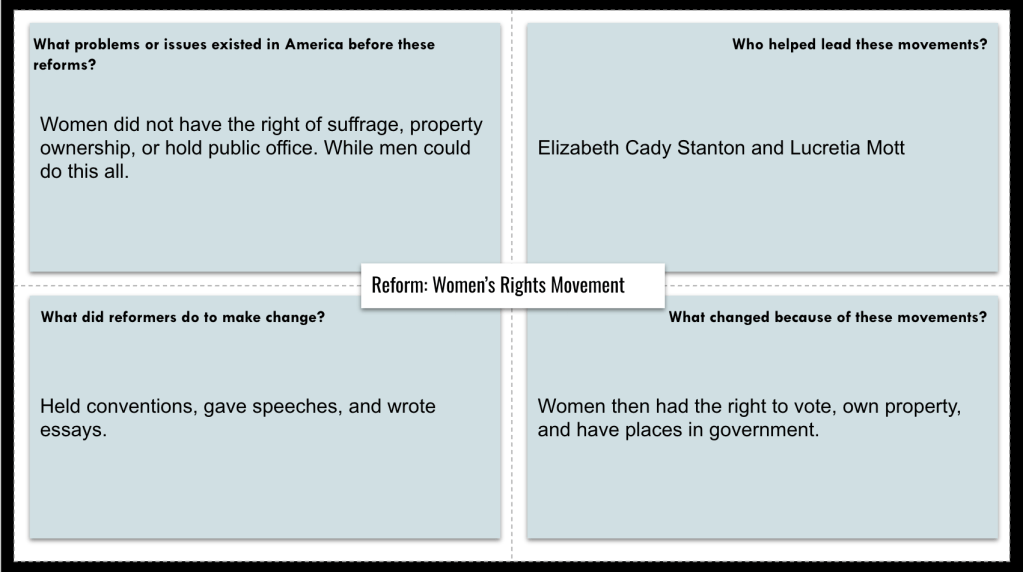
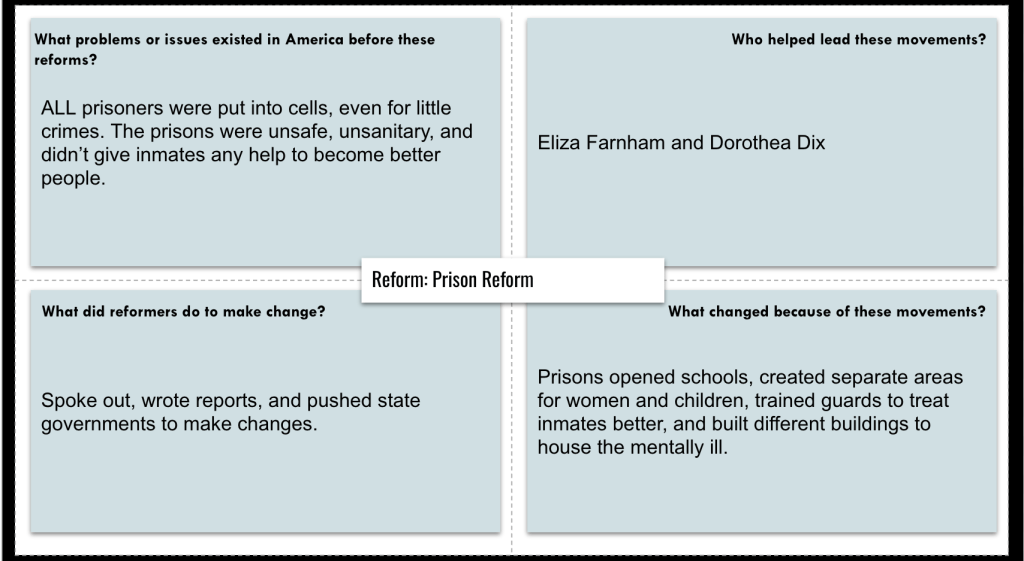
Reform Movement Frayers
Then we jumped into four reform movements: education, prison, temperance, and women’s rights. I gave them one-page readings for each. They had to pick two and fill out a Frayer Model—with prompts like:
- What were the problems before the reform?
- Who was involved?
- How did people push for change?
- What changed?
It was all about giving them enough structure to make sense of what they read without overwhelming them.
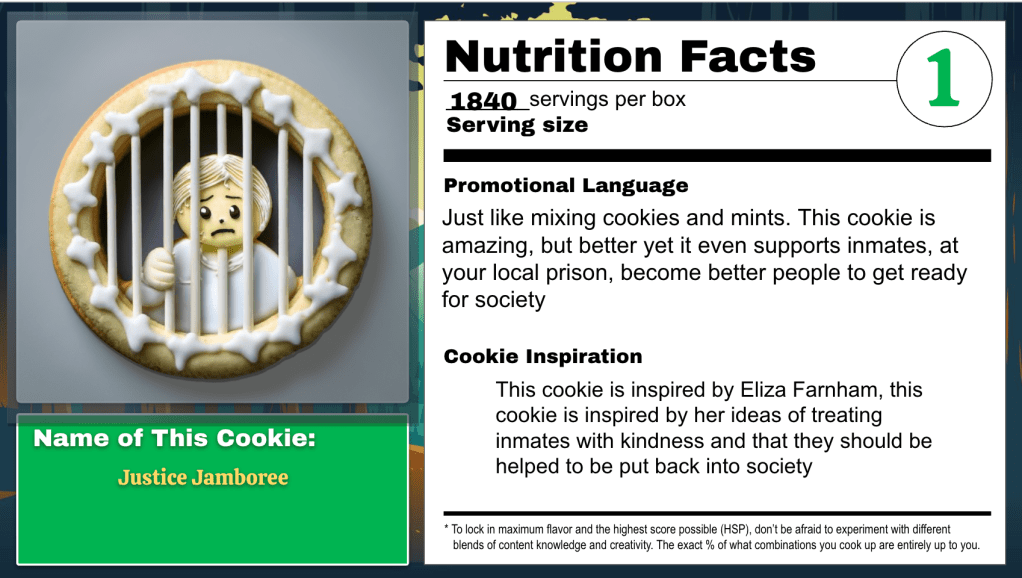
Designing a Reform Movement Cookie
The fun part came next. I had each student pick one reform movement and design a cookie that symbolized it—name, promotional language, and inspiration. Not because I think students should go into advertising, but because it gives them a creative outlet to synthesize what they’ve learned. I didn’t use a fancy template. I just gave them space and a task: connect what you learned to something that feels new and fun.
But I knew this would be a challenge. So I built a MagicSchool Idea Generator for them to use. That’s where the AI came in.
Some kids got it immediately. Others just hit “enter” and copied the first thing that popped up. That led to some awesome conversations about how to prompt AI and how to be more intentional with your thinking. One student said, “It said it couldn’t help me… then gave me a list anyway?” Welcome to AI. That’s how it works sometimes.
We talked about AI literacy without even planning to. We talked about responsible use. About editing. About pushing your thinking. It all came up naturally just by giving students a space to explore and test things out.
Why This Mattered
Some people might ask, “Why let kids use AI for something like this?” And honestly, this is exactly the kind of task where they should.
Because it’s not about copying. It’s about prompting, refining, questioning, and thinking through ideas in real time. These students are growing up in a world where AI isn’t going away. They need practice using it—not just to get an answer, but to develop a thought, build on it, and decide if it’s even worth using.
Watching students try to get the right response from the AI was the best part. Some had to reword their question three or four times before they got something useful. That’s the kind of persistence we want. That’s literacy—not just reading and writing, but digital reasoning, critical thinking, and adaptability.
It wasn’t perfect. But it was meaningful. And it was real.


Thursday
Thursday morning started with one of those classic curveballs—no Wi-Fi. Not ideal, but it forced me to think fast and strip things back to what mattered. I still wanted to build off the reform movement lesson from the day before, but I needed something fully offline that still had purpose.
I knew I wanted the lesson to focus on women’s rights—more specifically, the role suffrage played within that movement. So I kept it simple: what do I want students to understand by the end of class? I wrote that down—“Explain why suffrage was important to the women’s rights movement.”
First, I pulled a section from the textbook about the Seneca Falls Convention and the demands women were fighting for. Then I found a short, 4-minute History Channel video that gave the movement some faces and energy. I was able to play that from my desktop—no internet needed on the student end.
To process all of this, I created a Sketch and Tell-o with three textbook questions and a fourth space that asked:
“Why was suffrage important to the women’s rights movement?”
But even as I was making the copies, I thought to myself—this feels basic. It felt like a worksheet. So I reframed the whole lesson with a challenge.
I started class with this statement:
“Suffrage wasn’t that important to the women’s rights movement—it was just one of many demands.” Change my mind.
That one sentence shifted the tone. Suddenly they weren’t just answering questions—they were preparing a rebuttal. They watched the video, read the section, answered questions, and sketched visuals of what women were fighting for. And at the end, they had to change my mind.
It took some time to click. Some students didn’t totally get what I meant by “change my mind.” I ended up clarifying—I’m asking you to explain why voting was important. Convince me it wasn’t just another demand—it was the demand.
Once I shared an ideal response and modeled what a strong one might look like, the gears started turning. And honestly, the thinking that came out of it was way better than I expected for a no-tech day. The reframing really mattered.
We closed class with a quick Quizizz to check understanding of reform movements, suffrage, and the Seneca Falls Convention. Results were solid—and the engagement? Way better than if I’d just handed them a worksheet.

 Moler's Musings