
This week was all about using EduProtocols to deepen understanding and get students thinking critically about history. From Parafly for paraphrasing complex texts to Thick Slides for sequencing and comparing key events, we focused on meaningful engagement. ShortAnswer’s Quick Write gave students real-time AI feedback on their writing, while Map & Tell helped visualize territorial disputes. Sketch & Tell-O and Annotate & Tell made sure students weren’t just memorizing but actually processing history. Layering these protocols together made for a strong week of learning!
Monday – Test Review
Wednesday – Utopia, OH Rack and Stack
Thursday – Margaret Garner Rack and Stack
Friday – US Early Economy Rack and Stack
Monday and Tuesday
Monday was all about preparing for the Westward Expansion test. I originally planned a standard review, but a Sunday afternoon phone call with my friend Dominic Helmstetter changed that. He wanted to share with me what his understanding was of the the Great American Race. His idea—the Great American Race was a rapid-fire series of EduProtocols with Five-minute bursts of Parafly, Thin Slides, Annotate and Tell, and more, followed by a Quizizz mastery check where students had to get 100%. My response? That’s not how I’ve done the Great American Race before… but I love it.
So, I ran with it. I lined up five different EduProtocols, each tied to a major concept in the unit:
- Parafly → Mormon migration
- Annotate and Tell → Texas independence
- Sketch and Tell-O → Oregon Trail
- Frayer Model → Manifest Destiny
- Cause & Effect Organizer → Mexican-American War
Each round lasted 6-8 minutes. I encouraged students to complete as much as they could from memory before checking resources. To support them, I had AI generate concise readings summarizing key points from our lessons. We wrapped up the period with a Quizizz practice test, and the class averages landed between 44% and 65%. Not great.
At first, it felt discouraging. But my friend Corbin Moore reminded me—it’s not about achievement, it’s about growth. That shifted my mindset.
Test Day
Tuesday was test day, and I kept my usual grading system:
- Multiple-choice (content knowledge) → Taken on McGraw Hill’s site
- Short answer/extended response (writing/critical thinking) → Completed on Class Companion
The results?
- Multiple-choice averages: 89%, 74%, 85%, and 89%
- Short answer growth: Huge improvement from the pre-test
It’s easy to get caught up in numbers, but seeing how much my students progressed from struggling with the concepts on Monday to confidently tackling the test on Tuesday was a win.
This version of the Great American Race might not have been the original, but it was an exciting, high-energy way to cycle through multiple ways of processing information—and it’s something I’ll definitely refine and try again.
Wednesday
Wednesday, I wanted to mix things up and bring in local history. There’s a tiny town in Clermont County called Utopia, OH—a place I’ve been fascinated with since I was a kid. It’s right on the river, barely noticeable, but packed with history. Why was it called Utopia? What made people think they could build a perfect society there?
I connected this lesson to westward expansion by framing it around the Panic of 1837. Many Americans were financially struggling and had to make tough choices—head west for a new start, scrape by where they were, or try to create a utopia, a so-called perfect society. That’s exactly what happened in Utopia, OH, where three different groups attempted (and failed) to build their ideal communities.
Thin Slides: Creating a Utopia
We kicked things off with a Thin Slide on Padlet, where I asked students:
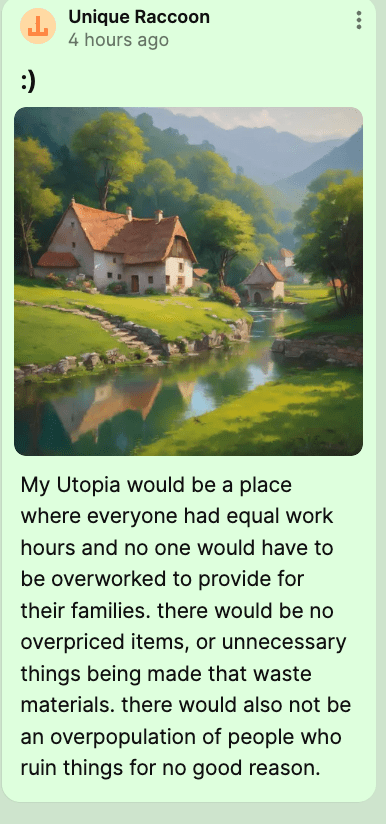
What would your ideal utopia or perfect society look like?
They had to describe it and generate an AI image to represent their vision. The responses were fantastic—some created futuristic cities, others imagined peaceful rural communities, and of course, some just wanted an unlimited pizza society.
Video & Frayer Models: Learning the History of Utopia, OH
Next, we watched a video about Utopia, OH, which connected the town’s origins to the Declaration of Independence and the pursuit of happiness. The video broke down the three groups who tried (and failed) to build a perfect society in Utopia:
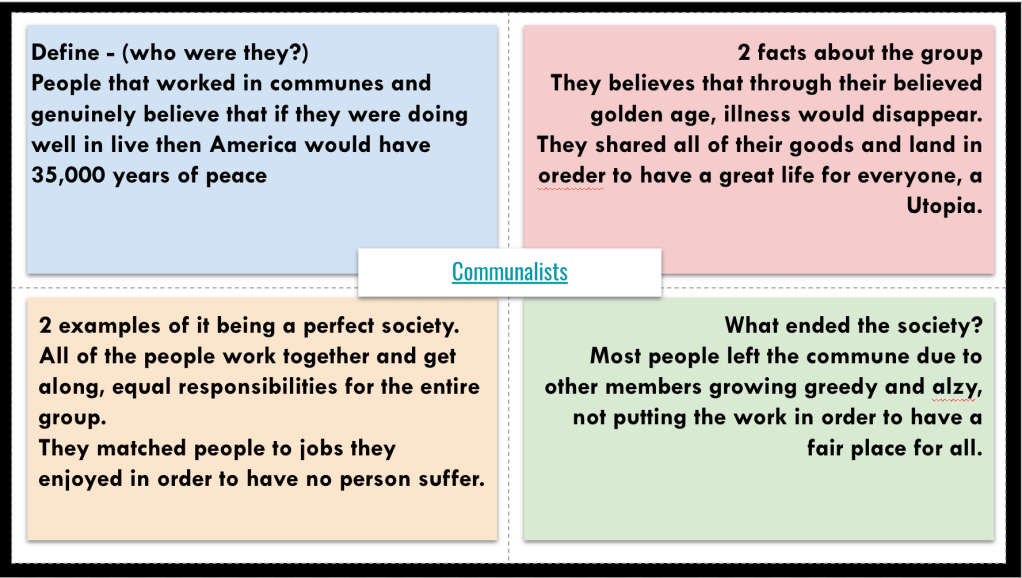
- Communalists – A group who shared everything but fell apart due to financial struggles.
- Spiritualists – Believed in connecting with spirits but were wiped out in a flood.
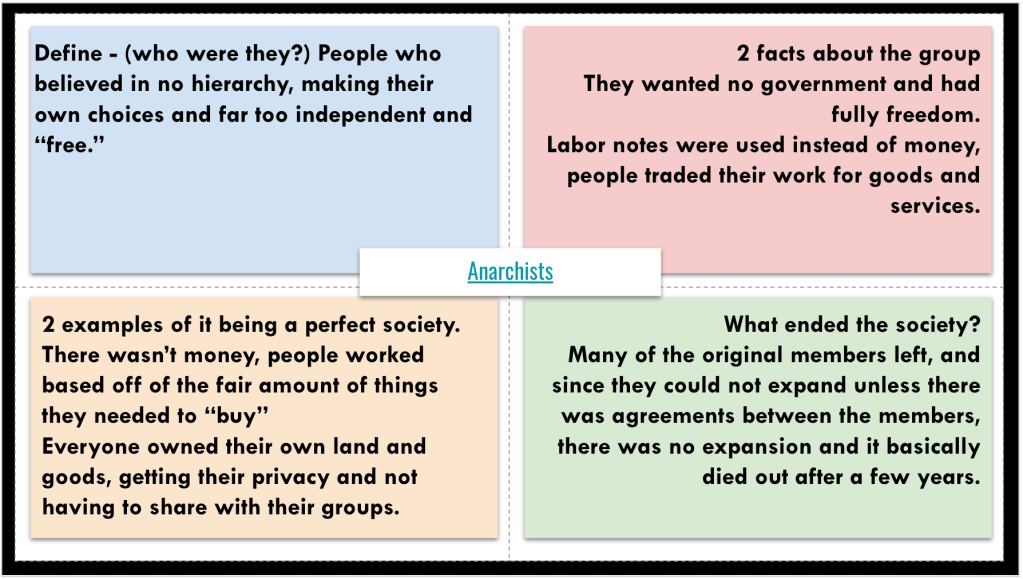
- Anarchists – Tried to live without rules, but well… that didn’t work.
Students then read about these groups and took notes using a Frayer Model, categorizing each society’s beliefs, goals, struggles, and ultimate failure.
ShortAnswer Quick Write: Can a Perfect Society Exist?
To wrap up the lesson, I had students respond to the question:
Can a perfect society ever exist?
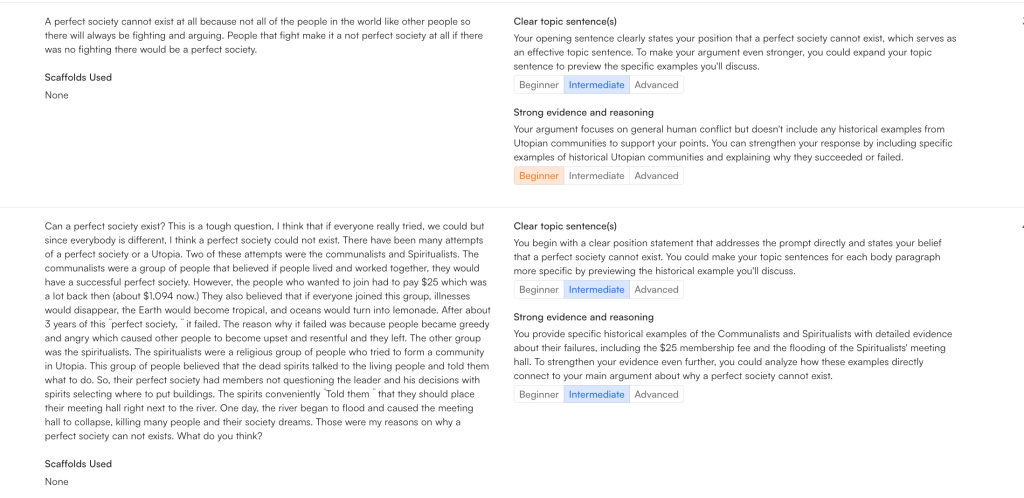
We used ShortAnswer’s Quick Write feature, which is currently in beta. This tool gives AI-generated feedback based on selected writing components—in this case, I chose “use of clear evidence and reasoning.”
- Students submitted their responses.
- AI provided instant feedback and a score (1 = Beginner, 2 = Intermediate, 3 = Advanced).
- The class saw their combined goal score (though I still wish I knew how it was calculated or if I could set it myself).
- At the end, students reflected on their feedback, making it a true learning experience rather than just another assignment.
I loved seeing how engaged students were with creating their own utopias, analyzing failed ones, and debating whether perfection is even possible. This lesson combined local history, critical thinking, and writing practice in a way that made students care about a little town they had never even heard of before.





Thursday
On Thursday, we kicked off our new unit on the differences between the North and South. I wanted to start with a local history story that powerfully illustrates these divisions—one that is both shocking and deeply revealing. That story was the case of Margaret Garner, an enslaved woman who escaped across the Ohio River to Cincinnati with her family in 1856. When slave catchers arrived to capture them, Margaret made the heartbreaking decision to end her daughter’s life rather than see her forced back into slavery.
This case wasn’t just about one woman—it reflected the moral and legal conflicts between the North and South. Abolitionists argued she should be put on trial for murder, as this would acknowledge her personhood, while pro-slavery forces demanded her return as property. In the end, the Ohio courts ruled in favor of the South, reinforcing how fragile “freedom” really was in free states.
Framing the Lesson
To get students thinking about the significance of this case, I opened with a quote from the story, prompting them to reflect on the thin line between freedom and slavery. I asked: What does Margaret Garner’s story tell us about the differences between North and South?
From there, we moved into a series of activities designed to break down this historical event in ways that encouraged deep thinking.
Thick Slide: Mapping the Story
Students read the Margaret Garner story and summarized the sequence of events using a Thick Slide with the Somebody, Wanted, But, So, Then format. They added:
- A title summarizing the event
- Two images representing key aspects of the story
- A comparison chart between the North and South, based on what they learned
This helped students visualize the story and understand how it reflected broader sectional tensions.
Annotate & Tell: Comparing Perspectives
We then examined two primary sources—one from an abolitionist newspaper and the other from a pro-slavery newspaper. Both presented vastly different takes on Margaret Garner’s actions.
Students highlighted:
- Abolitionist Source: Phrases that framed Margaret as a victim of slavery, reinforcing how Northern abolitionists viewed her as proof of slavery’s horrors.
- Pro-Slavery Source: Language that depicted her as a criminal, showing how Southerners justified slavery and the Fugitive Slave Act.
They answered the question: How does this case show that the North and South were no longer just two regions but two completely different societies?
Archetype Four Square: Margaret Garner’s Legacy
To wrap up, students engaged in an Archetype Four Square, deciding how Margaret Garner should be remembered. They had to choose an archetype—Martyr or Murderer—and justify their decision with historical evidence.
Short Answer: Bringing It All Together
Since we had time, students processed their thoughts using ShortAnswer’s Quick Write feature. The AI gave feedback on their use of conventions and explanation of content. This tool allowed students to refine their responses and see how small improvements could strengthen their arguments.
Friday
For Friday’s lesson, we focused on the economic, technological, and social differences that shaped the North and South before the Civil War.
EdPuzzle for Background Knowledge
We started with an EdPuzzle video on sectionalism to provide students with foundational knowledge. This helped set the stage for analyzing the growing divide between the two regions.
Close Read & Annotate and Tell
Students then moved into a Close Read & Annotate and Tell activity. They highlighted key words and phrases from the reading that helped answer questions about the U.S. economy, the expansion of slavery, and the Industrial Revolution. Using guiding questions, students made connections between economic changes and sectionalism.
Padlet Discussion
Next, we took the discussion to Padlet, where students answered the big question: How did economic growth, new technology, and slavery shape the early United States? This allowed them to see and build on each other’s responses, making their thinking more visible.

 Moler's Musings