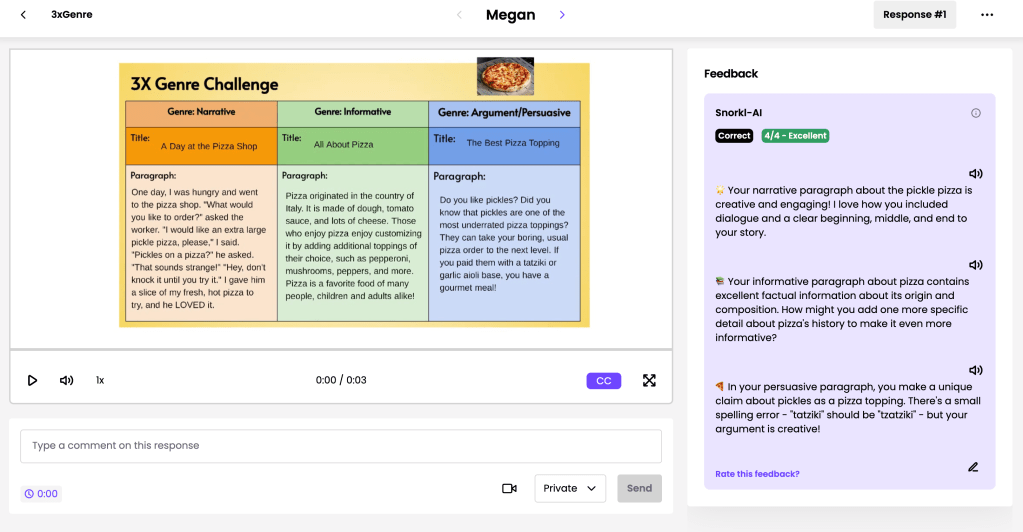
One of the biggest challenges in history education is engaging students in meaningful analysis while encouraging collaboration and critical thinking. Enter Snorkl, an AI-powered whiteboard tool that allows students to interact with historical content by annotating images, adding text, drawings, or even recording their voices. By integrating Snorkl with historical inquiry, EduProtocols, and depth and complexity strategies, we can create a dynamic space where students engage deeply with the past.
1. Image & Source Analysis (8 Parts)
A picture is worth a thousand words—but only if students know how to analyze it! Post a primary source image (painting, political cartoon, propaganda poster) on Snorkl and have students:
- Identify nouns, adjectives, and verbs within the image.
- Annotate details with text boxes explaining who, what, when, where, and why.
- Add speech bubbles or thought bubbles from different perspectives within the image.
- Record a voice memo explaining their interpretation and the historical significance.
This works perfectly with the 8 Parts EduProtocol, where students systematically break down the visual to gain a deeper understanding.
Depth & Complexity:
- Multiple Perspectives: Consider how different groups would interpret the image.
- Patterns Over Time: Compare similar images from different eras (e.g., Revolutionary War vs. Civil War propaganda).
2. Think Slide Expansion (Thin Slides to Thick Slides)
Think Slides are a great way to introduce a topic, but what if we took them a step further? Post a Thin Slide prompt (one image, one word) on Snorkl, then challenge students to expand it into a Thick Slide by:
- Adding three key facts about the topic.
- Sourcing where their information comes from.
- Comparing their topic to a related historical event or figure.
- Leaving voice comments on peers’ slides to encourage discussion.
EduProtocol Tie-In: This follows the Thin Slides method but adds a deeper research component with the Thick Slide approach.
Depth & Complexity:
- Ethics: Was the event just or unjust?
- Big Idea: What lasting impact did this have on history?
3. Timeline Construction
History is all about connections. Instead of giving students a pre-made timeline, post randomized images and descriptions of historical events and have students:
- Drag and arrange them in chronological order.
- Draw arrows showing cause-and-effect relationships.
- Add text boxes explaining why some events were turning points.
- Compare two different events and their outcomes.
Depth & Complexity:
- Cause & Effect: What led to this event? What were its consequences?
- Big Idea: How does this event connect to larger themes in history?
4. Historical Debate Board
Engage students in historical argumentation by posting a controversial historical question (e.g., “Was Andrew Jackson a hero or a villain?”). Have students:
- Add arguments on both sides of the debate.
- Use Snorkl’s drawing tools to connect related ideas.
- Record an audio response defending their position.
- Engage in peer review by responding to others’ claims.
Depth & Complexity:
- Different Perspectives: How might different groups view this event?
- Unanswered Questions: What evidence is missing from this debate?
5. Document-Based Investigation
Primary sources can be intimidating, but Snorkl makes them interactive. Upload a primary source document excerpt and ask students to:
- Highlight key phrases and annotate their meanings.
- Add images or drawings to represent key ideas.
- Answer sourcing questions (Who wrote this? When? Why?).
- Summarize the document in one sentence.
Depth & Complexity:
- Point of View: What bias does the author have?
- Trends: How does this document compare to other sources from the same period?
6. Westward Expansion Map Activity (Sketch & Tell)
When studying Westward Expansion, post a blank map of the U.S. on Snorkl and have students:
- Label newly acquired territories.
- Use arrows to indicate migration patterns.
- Draw icons or add images to represent key events (e.g., the Gold Rush, Trail of Tears).
- Compare the perspective of settlers vs. Native Americans by adding speech bubbles or text boxes.
Using Sketch & Tell, students can create quick illustrations with short written explanations to reinforce their understanding.
Depth & Complexity:
- Different Perspectives: What were the benefits and consequences of expansion?
- Across Disciplines: How did technology and economics impact migration?
7. Empathy Map for Historical Figures (Frayer Model Adaptation)
History is filled with complex figures. Post an image of a historical person and have students create an empathy map with four sections:
- What they see (their environment)
- What they think (their beliefs)
- What they feel (emotions, struggles)
- What they say (quotes or imagined dialogue)
Adapt this using a Frayer Model, where students also add vocabulary and contextual information.
Depth & Complexity:
- Ethics: Were their actions justified?
- Big Idea: How does this figure’s story connect to historical trends?
Final Thoughts
By using Snorkl’s interactive whiteboard tools, combined with EduProtocols, we can transform the history classroom into a space where students actively analyze, compare, and collaborate on historical content. These activities not only help students develop historical thinking skills but also allow them to engage with the past in a way that fosters depth, complexity, and critical inquiry.
What are some ways you’ve used interactive tools like Snorkl in your history classroom? Let’s share and collaborate!


 Moler's Musings