
This past week, EduProtocols made Andrew Jackson’s presidency more interactive and engaging, helping students analyze his impact through Fast & Curious, Annotate & Tell, MiniReports, Somebody-Wanted-But-So-Then, Thin Slides, and Number Mania. We started each day with Gimkit vocabulary practice, reinforcing key terms before diving into content. The Nullification Crisis worked well with Somebody-Wanted-But-So-Then, helping students break down key perspectives, while the Bank War MiniReport with Class Companion pushed them to strengthen historical writing using AI feedback.
For Indian Removal, we layered Edpuzzle, Annotate & Tell, Thin Slides, and Number Mania, making connections between the Seminole Wars, Indian Removal Act, Worcester v. Georgia, and the Trail of Tears. In Number Mania, students had to justify a quote using numerical evidence, reinforcing cause-and-effect thinking. Some students were testing Class Companion to outsmart AI, while others were pushing themselves to write more, but either way, they were improving. Using EduProtocols helped students engage deeply with Jackson’s presidency, making complex historical topics more meaningful and accessible.
Tuesday – Jacksonian Democracy Rack and Stack, Jackson MiniReport
Wednesday – Nullification Rack and Stack
Thursday – Bank War Rack and Stack, Bank War MiniReport
Friday – Native Removal Rack and Stack
Tuesday: Kicking Off the Andrew Jackson Unit
We started our new unit on Andrew Jackson with the central guiding question:
Should Andrew Jackson be considered a good president or a bad president?
To establish a baseline understanding, students took a pre-assessment, and as expected, the class averages were low—ranging from 19% to 25%. These results weren’t surprising since many students had little prior knowledge of Jackson beyond his presence on the $20 bill.
From there, we jumped into Jacksonian Democracy, starting with a Gimkit Fast & Curious to introduce key vocabulary terms like Jacksonian Democracy, democracy, spoils system, suffrage, and nominating conventions. We ran one round for two minutes, reviewed the words, and ran it again for another two minutes. This strategy paid off—every class improved their average score by at least 35% after just two rounds.
Building Understanding Through Multiple Lenses
Frayer Model: Breaking Down Jacksonian Democracy
After locking in vocabulary, students created Frayer Models for Jacksonian Democracy, helping them explore:
✔ Definition
✔ Characteristics
✔ Examples
✔ Non-examples
This was crucial because Jacksonian Democracy is not just about Andrew Jackson—it’s about a shift in political power and voting rights for the “common man.”

Map & Tell: Geography & Political Shifts
Next, we tied Jackson’s election to geographic and political changes through a Map & Tell activity. Students analyzed maps of voter participation in 1824 vs. 1828 to answer:
🔹 Where did voter turnout increase the most?
🔹 Which regions supported Jackson?
🔹 What does this suggest about democracy in the early 1800s?
Seeing how voting patterns shifted helped students visualize how Jackson’s presidency was fueled by an increase in voter participation among everyday Americans—one of the defining elements of Jacksonian Democracy.

MiniReport: Expanding Democracy vs. Controversy
Students then worked through a MiniReport to gather information from two sources:
1️⃣ The Election of 1828 – A Victory for the Common Man
2️⃣ The Spoils System
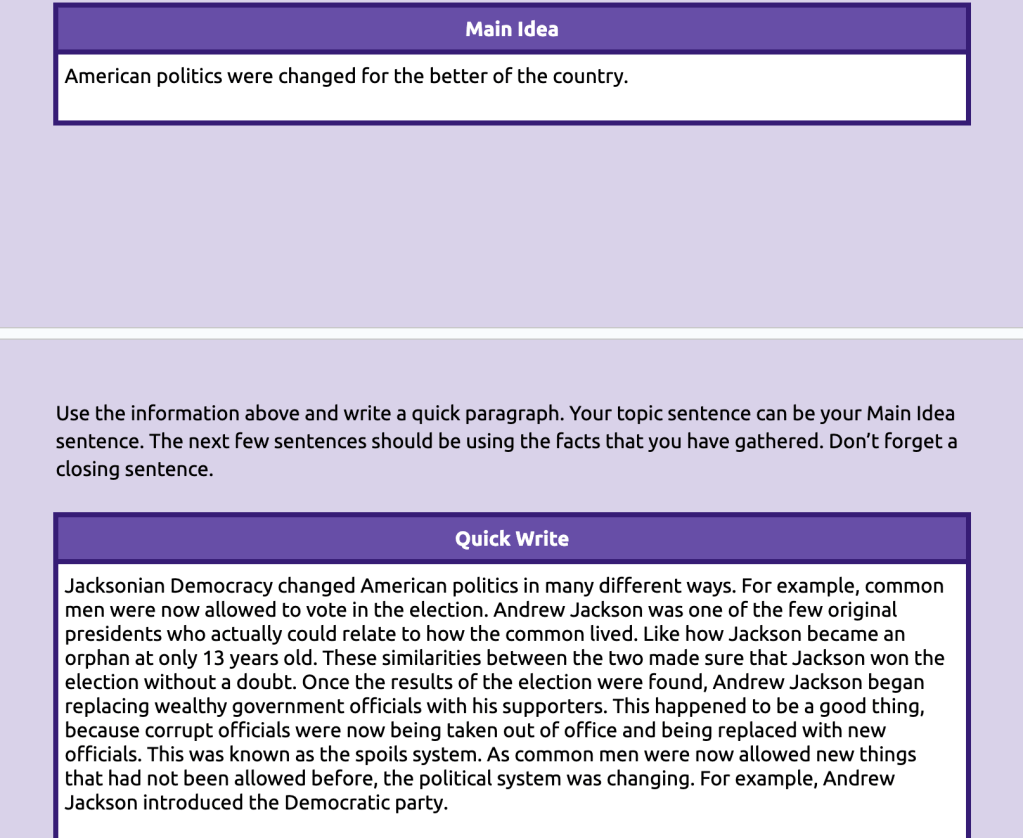
They had 8-10 minutes to collect key information on how Jacksonian Democracy expanded political participation while also bringing controversy through shifts in power. This helped them paraphrase key ideas and prepare for a structured quick write summarizing their findings.
After drafting their paragraphs, we used Class Companion to provide AI-generated feedback on their responses. I’m starting small with the MiniReport to help students build skills in comparing sources and developing structured paragraphs. The goal is to strengthen their ability to synthesize information, support their claims with evidence, and refine their writing with targeted feedback.

2xPOV: Seeing Jackson From Different Angles
To wrap up, students engaged in a 2xPOV activity where they analyzed Jackson’s impact from two perspectives:
1️⃣ A common man who benefited from his policies
2️⃣ A government official who saw issues with his leadership
This exercise helped students recognize how historical figures and policies aren’t just good or bad—they affect people differently based on their circumstances.
This structured approach ensures students aren’t just memorizing facts—they’re analyzing how Jacksonian Democracy shaped American politics, making it easier to answer our big guiding question in the weeks ahead:
➡️ Should Andrew Jackson be considered a good or bad president?

Wednesday – Continuing Our Exploration of Andrew Jackson
We continued exploring Andrew Jackson by focusing on the Tariff of Abominations and the Nullification Crisis. I started with some quick notes to provide background on tariffs and their impact, then we jumped into another Gimkit with new vocabulary words—tariff, abomination, nullification, and states’ rights.
Fast & Curious – Vocabulary Review
We ran a Gimkit for two minutes, paused for quick feedback, and then ran it again for another two minutes. Every class raised their average by 38% or higher, showing solid growth in understanding key terms. This quick retrieval practice helped students solidify their understanding before diving into deeper analysis.
Frayer Model – Clarifying Key Terms
I told students that if any question scored below 80% accuracy, we would Frayer it. The most commonly missed words were Union and secede, so we used the Frayer Model to break them down. Students worked together to define each term, provide examples, and illustrate their meaning, ensuring a stronger grasp of these key ideas before moving forward.

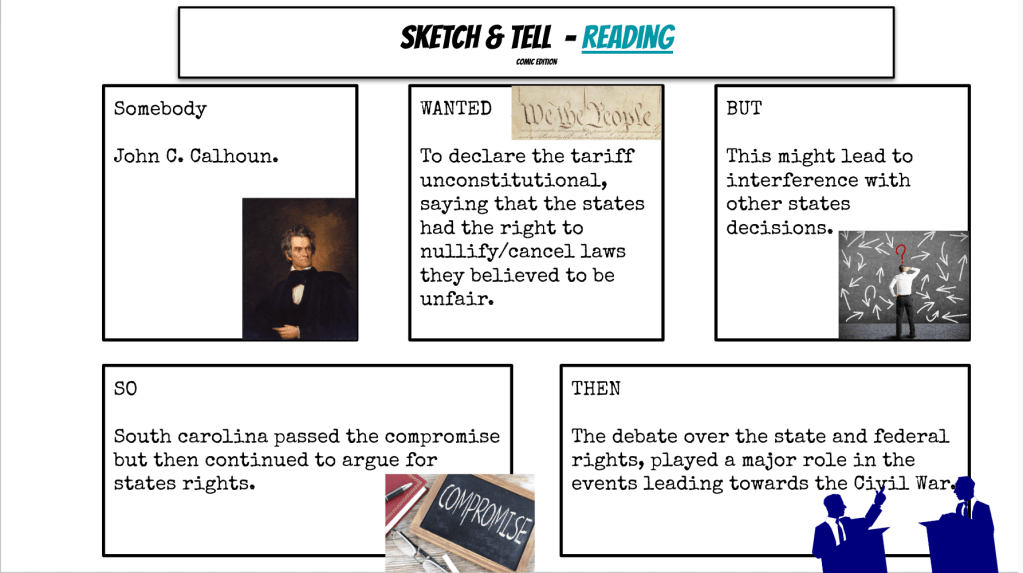
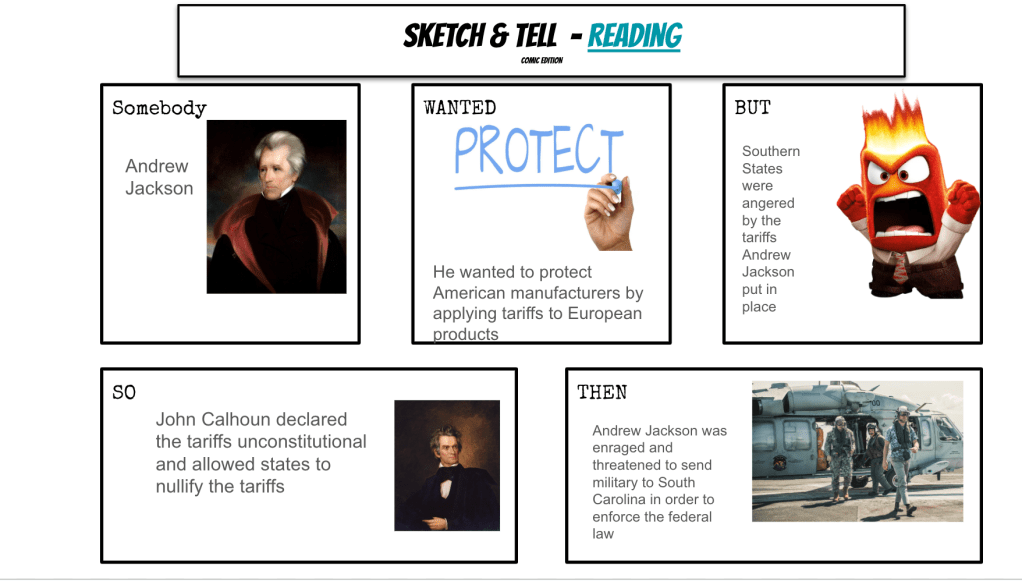
Somebody-Wanted-But-So-Then – Breaking Down the Crisis
We kept coming back to our main unit question, using it to frame our discussion on how tariffs and nullification created tension between the federal government and the states. To break things down, we used a Somebody-Wanted-But-So-Then chart to map out key players and their perspectives. This led us into a discussion about Andrew Jackson’s response to South Carolina’s threat to nullify the tariff and John C. Calhoun’s argument for states’ rights.

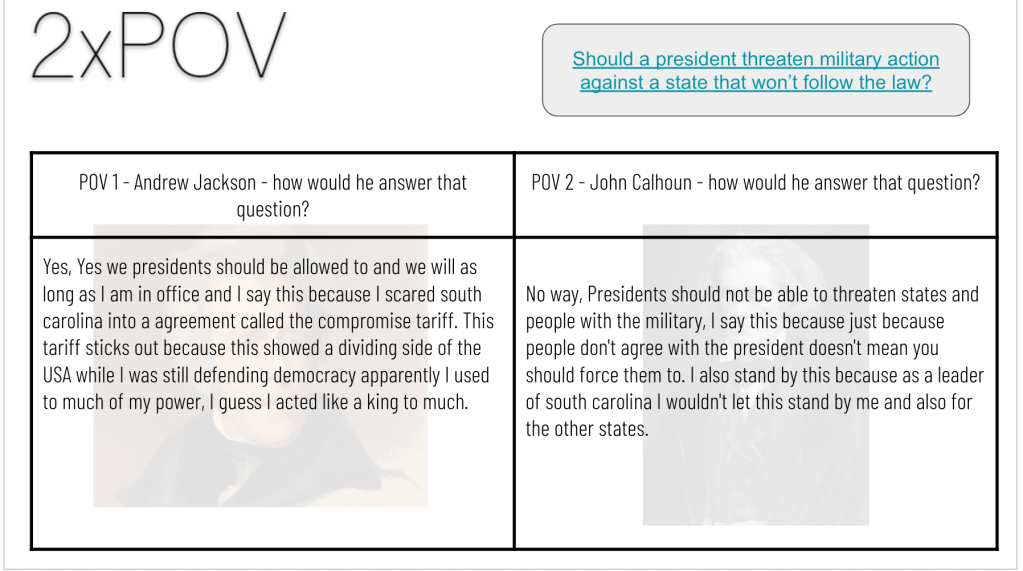
POV Analysis – Jackson vs. Calhoun
To take it a step further, students examined the point of view (POV) of both Jackson and Calhoun by answering:
“Should a president threaten military action against a state that refuses to follow federal law?”
This activity pushed students to think critically about federal vs. state power, a growing issue leading up to the Civil War.
🚀 By layering Fast & Curious, the Frayer Model, Somebody-Wanted-But-So-Then, POV Analysis, and Sketch & Tell, students engaged with history in multiple ways, making the complexities of the Nullification Crisis more accessible and meaningful!


Thursday – Jackson’s Bank War
We continued our exploration of Andrew Jackson by focusing on the Bank War and its effects on the U.S. economy. To kick things off, we ran a Gimkit with key vocabulary terms—inflation, depression, banknotes, economy, and others. The first round lasted two minutes, followed by quick feedback, and then another two-minute round. As with previous days, every class raised their average by 38% or higher, reinforcing key concepts before diving into the content.
Originally, I planned to incorporate a Frayer MiniReport and 2xPOV, but due to a two-hour delay, I adjusted the plan to focus on the MiniReport with Class Companion to make the best use of our time. With a test coming up on Tuesday, I wanted to keep things streamlined while still reinforcing key ideas.
MiniReport – Understanding the Bank War
Students worked through the Bank War MiniReport, using two sources—one primary and one secondary—to answer three key questions:
- Why did Jackson hate the bank?
- What were the intended consequences of his decision?
- What were the unintended consequences?
After gathering their information, students wrote a quick paragraph summary, ensuring they could explain Jackson’s motivations, the impact of his veto, and how closing the National Bank affected the economy.

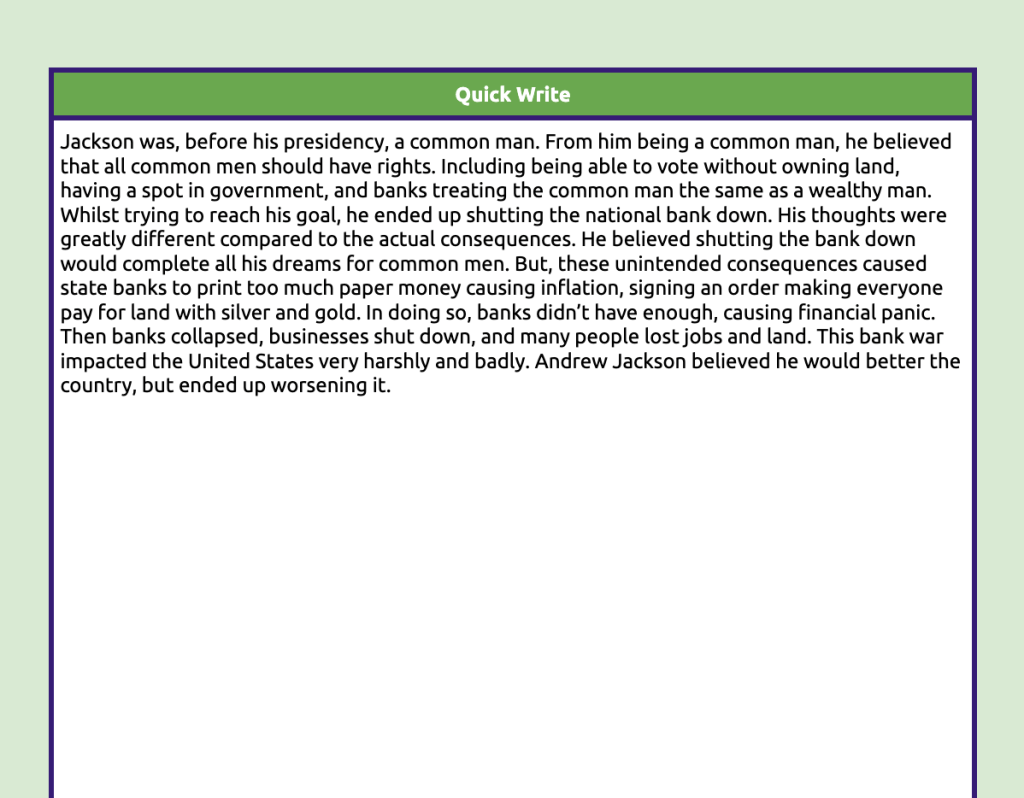
Class Companion – Writing Growth in Action
This is where things got interesting. Some students are writing more than they ever have, growing in confidence as they refine their responses with AI feedback. Others? They’re determined to outwit and outsmart the AI, testing how much they can push its limits. Either way, the result is the same—they’re writing more and getting better.
🚀 Even with the schedule adjustment, students engaged with the Bank War in a meaningful way, using historical sources and AI feedback to analyze Jackson’s choices and their lasting impact.
Friday – Native Removal
Friday was all about bringing together multiple aspects of Indian Removal—the Seminole Wars, Indian Removal Act, Worcester v. Georgia, and the Trail of Tears—and making them fit into one class period. With so many connected historical events, I had to be intentional about how each piece flowed together while keeping students engaged.
Fast & Curious – Vocabulary Review
We started with a Gimkit focused on key vocabulary—removal, treaty, sovereignty, resistance, forced migration—running the game in two two-minute rounds with quick feedback in between. This ensured students had a foundation before diving into content.
Edpuzzle – The Seminole Wars
To kick off our discussion on Native resistance, we watched an Edpuzzle covering Osceola and the Seminole Wars. As they watched, students answered embedded questions about why the Seminole resisted removal, how they fought back, and how their response was different from other tribes. This set up an early comparison between military resistance (Seminole) and legal resistance (Cherokee in Worcester v. Georgia).
Annotate & Tell – Indian Removal Act & Worcester v. Georgia
Next, we used Annotate & Tell to break down two key readings:
- The Indian Removal Act – Students highlighted government actions in yellow and Native American responses in green, analyzing how Jackson justified removal and how different tribes reacted.
- Worcester v. Georgia – Students did the same with this case, focusing on how the Cherokee used legal resistance and how Jackson refused to enforce the Supreme Court ruling.
After annotating, students paired up to explain one key takeaway before we discussed as a class.
Number Mania – Justifying a Quote with Data
For the activity, I gave students a quote:
“The Trail Where They Cried was not only a physical journey but also a moment that reshaped Cherokee history, causing loss, suffering, and ultimately resilience.”
Their task was to justify this quote using numerical evidence from the reading. They worked in pairs to pull at least four key numbers that supported the quote. Some of the most commonly cited numbers included:
- 1,200 miles – Representing the physical journey of forced removal.
- ¼ (25%) – The portion of the Cherokee population that died, proving suffering and loss.
- 2,000 died in camps – Highlighting the harsh conditions even before the journey began.
- 1839 – The Cherokee wrote a new constitution – Demonstrating their resilience and ability to rebuild.
Once they collected their numbers, students added them to a Number Mania poster, writing a brief explanation of how each number connected to the quote. A few students even challenged themselves by finding additional numbers beyond the reading to reinforce their argument.
Thin Slide
To bring everything together, students created a Thin Slide on the Trail of Tears, following the one word, one image format. They had three minutes to choose an image that captured the impact of the Trail of Tears and one word that summed up its historical significance (e.g., suffering, survival, injustice, displacement, resilience).
After creating their slides, students did a rapid-fire share, explaining why they chose their word and image in one sentence.
Quizizz Assessment
I ended class with a Quizizz assessment over everything we learned this week about Andrew Jackson. The class averages were as follows: 70%, 55%, 76%, and 55%.(87%). The last class of the day, I stopped part way through after looking at some of the scores and we had a heart to heart, life lesson talk and we tried again. I knew they could do better because they were rocking it this week – so they finished at an 87% class average. These scores were good considering we began with 19% to 25% pre-assessment averages.

 Moler's Musings
Hello to the gift to teachers! Thank you for sharing insight to your classroom and lessons using Eduprotocol. I am reaching out in hopes you would share your activity on Jackson and the bank wars. The link you provided takes me to the Monroe Doctrine. I’m so far behind in my pacing and your activities have allowed me to dig deeper in the content without sacrificing time. So, I would like your Venmo so I can buy you a cup of coffee or a beer. Thanks so much!
LikeLike