
This week was all about making learning meaningful, engaging, and interactive. We started with a retest—one that actually reflected what students had learned rather than tripping them up with ridiculous wording. Then, we dove into a Black History Month lesson that highlighted lesser-known historical figures using The Great American Race and Superlatives, leading to some of the best discussions we’ve had all year. We wrapped up the week with Game of Quotes, where students turned a Grimm’s fairy tale into a hilarious, text-based competition. This week was a reminder that when students are engaged, they learn—and they actually enjoy the process.
Thursday – Superlatives Template, 25 Stories for the Great American Race
Monday
On Tuesday, I sat down to rewrite the Early Republic unit test—not just to make it easier, but to make it make sense.
The original test was full of college-level questions that buried key concepts under overly complex wording. I want my students to be challenged, but I also want them to engage with history—not feel defeated by it.
So, I kept some of the previous test questions but reworded them to align with how 8th graders actually talk and think. I also added new questions focused on what we actually covered in class—things that reflected the way we analyzed history, not just the way the textbook framed it.
The biggest change was the short answer section. Instead of a vague prompt that left students unsure of where to start, I shifted to a clear, structured writing task:
- Choose from multiple prompts (giving students ownership)
- Construct a basic paragraph with a topic sentence, supporting details, and a conclusion
- Focus on historical thinking, not just memorization
And then came the results.
Before the unit, students took a pre-assessment to gauge what they knew coming in:
- 22%, 22%, 24%, 27%
No surprises there—most students walked in without much prior knowledge.
The first round of testing, using the original assessment, had some improvement:
- Multiple choice only: 63%, 57%, 60%, 65%
- With writing prompts included: 55%, 45%, 52%, 55%
That writing section killed their scores, but it wasn’t because they didn’t understand the content—it was because the original prompts didn’t give them the structure they needed.
Then, after using the revised test, which kept rigor while focusing on clarity and student success, here’s what happened:
- New test with structured writing prompts: 74%, 65%, 74%, 76%
That’s growth. That’s students showing what they actually learned. That’s a test that measures understanding instead of tricking them with wording gymnastics.
Thursday
With Black History Month underway, I wanted to do something different—something that highlighted Black Americans who don’t always make the history books but who played incredible roles in shaping the country.
The inspiration? My daughter’s book, Good Night Stories for Rebel Girls: 100 Tales of Extraordinary Women.
That book does an amazing job of telling engaging, digestible stories about historical figures. So, I took a screenshot of one story, dropped it into ChatGPT, and asked it to analyze the tone, wording, and style. Then, I had it generate a list of lesser-known Black Americans who made significant contributions to history.
The list was incredible—people like:
- Claudette Colvin – The teen who refused to give up her seat before Rosa Parks.
- Robert Smalls – An enslaved man who stole a Confederate ship and became a U.S. congressman.
- Bass Reeves – The first Black U.S. Marshal, believed to have inspired the Lone Ranger.
- Marie Bolden – The first Black national spelling bee champion in 1908.
- Henrietta Lacks – The woman whose cells were used for groundbreaking medical research.
Next, I had ChatGPT craft mini-biographies in the same tone and style as my daughter’s book—and it nailed it. These weren’t just fact dumps; they were narrative-driven, engaging, and built for middle schoolers.
The Great American Race: A Fast-Paced EduProtocol
Now, I had 25 powerful stories, and I wanted to make them interactive. So, I turned to one of my go-to EduProtocols—The Great American Race.
Here’s how it worked:
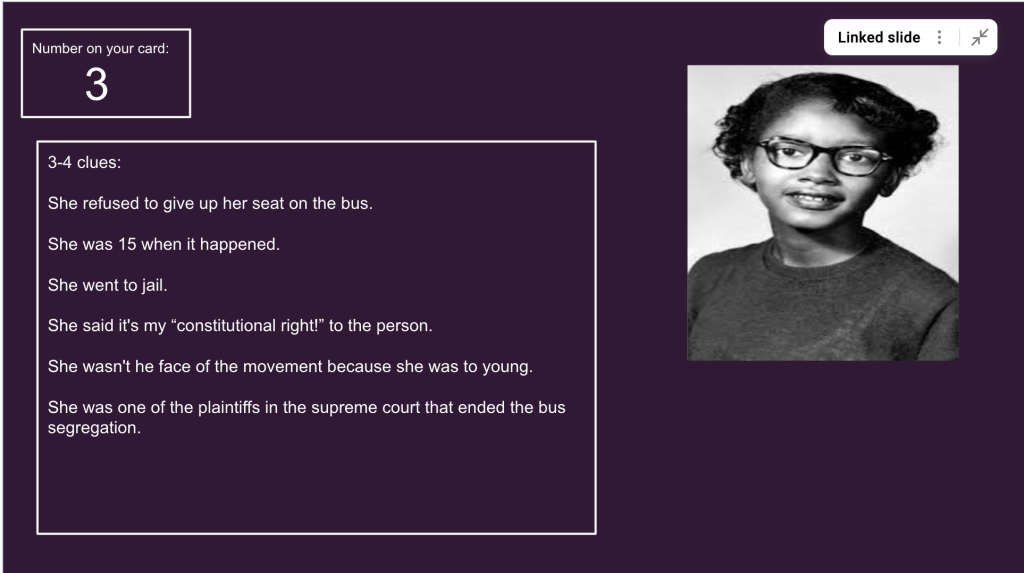
1️⃣ Each student received a numbered biography—a unique story about one of the Black historical figures.
2️⃣ They created a slide with 3-4 clues about their assigned person, but without revealing the name.
3️⃣ They had 10-12 minutes to create their slide.
4️⃣ Once all slides were arranged and shared, students paired up and raced to guess the correct historical figure based on the clues.
It was fast-paced, fun, and packed with learning. Students were highly engaged, trying to decipher the clues and connect historical achievements to the figures they might have never heard of before.


Superlatives EduProtocol: Evaluating Impact
After The Great American Race, I wanted to push students to think critically about these historical figures. That’s where the Superlatives EduProtocol, developed by Kim Voge, came in.
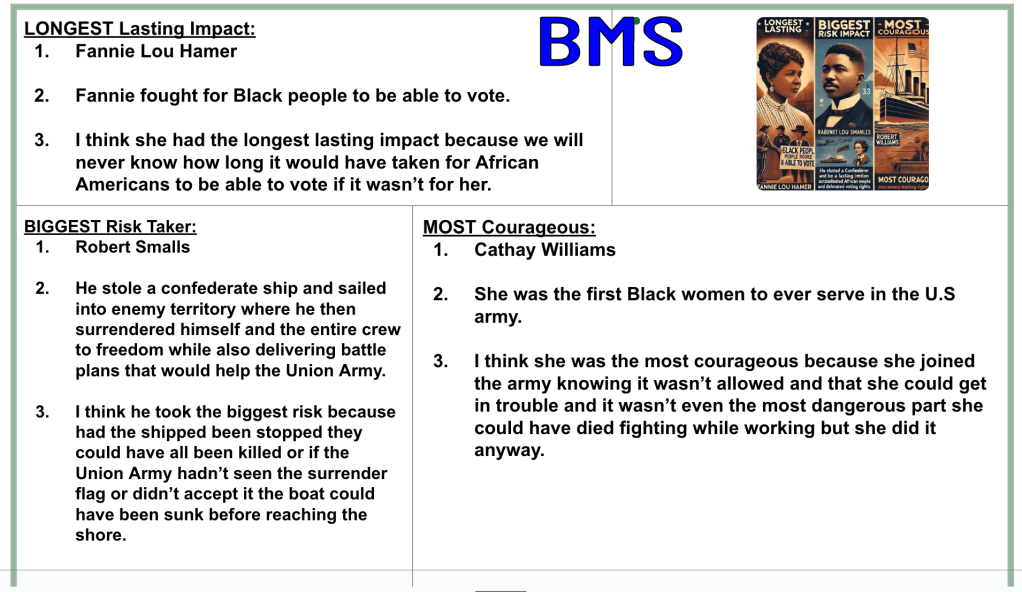
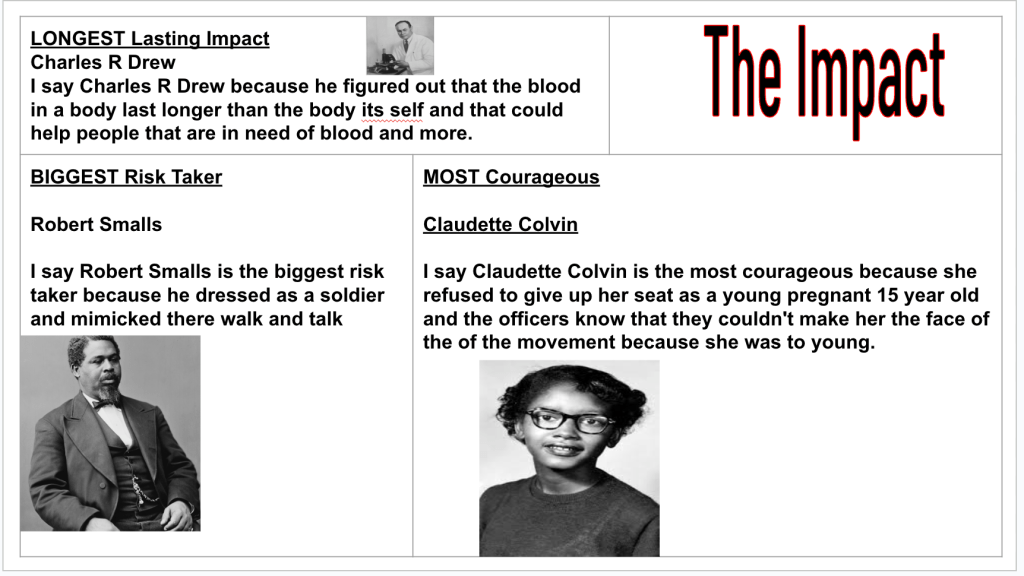
Students paired up and had to discuss, debate, and decide on the following categories:
🏆 Longest Lasting Impact – Which historical figure’s actions had effects that are still felt today?
💡 Biggest Risk Taker – Who made the boldest, most dangerous moves in pursuit of change?
🔥 Most Courageous – Who faced the biggest obstacles and showed the most bravery?
Once they made their choices, they:
✅ Created a title for their slide
✅ Added images to represent their chosen figures
✅ Wrote clear explanations justifying their selections
This was an awesome wrap-up activity. It wasn’t just about listing facts—students had to synthesize information, make comparisons, and justify their reasoning. The discussions were rich, with students arguing for their choices, challenging each other’s reasoning, and making real connections to history.



Why This Works
- Students drive the learning. Instead of me telling them the information, they explored it, synthesized it, and shared it in a collaborative and interactive way.
- It made Black history personal. By focusing on lesser-known figures, students realized history isn’t just about distant heroes—it’s full of overlooked individuals who changed the world.
- The EduProtocol structure made it stick. Instead of a worksheet or textbook reading, students built something, analyzed clues, and worked together—which means they’ll actually remember these figures.
- It deepened understanding. The Superlatives had students evaluate the impact and significance, not just memorize facts.
- It encouraged discussion and critical thinking. Students had to justify their choices with evidence, building argumentation skills.
Friday: Game of Quotes – Valentine’s Day Edition
Friday was one of those weird reward days, so I decided to try out the Game of Quotes EduProtocol with a Valentine’s twist. Since it was a more relaxed day, I wanted to keep students engaged while still working on reading, writing, and critical thinking.
Choosing the Right Story
I asked Claude AI for Grimm’s fairy tales that would work for 8th graders, and it suggested Clever Elsie. I skimmed through it, made a Google Doc, and shared it with students.
Before diving in, I gave students two minutes to skim the text. Then, I gave them a quick summary of Clever Elsie:
Clever Elsie is a character from a Grimm’s fairy tale also known as Clever Else or Clever Elisabeth. In the story, she is a young woman who overthinks everything to an absurd degree. The most famous part of the tale involves her becoming paralyzed with worry about a potential future scenario: while in her cellar, she sees a pickaxe hanging on the wall and becomes consumed with anxiety that if she marries and has a child, the pickaxe might fall and kill the child. This leads to a chain of events where others join her in crying over this hypothetical tragedy that hasn’t (and may never) happen.
The tale is often interpreted as a satire about overthinking and creating problems out of nothing.
Game of Quotes with Socrative
Once students had a basic understanding of the story, I introduced Game of Quotes—an EduProtocol where students find evidence from the text to match creative prompts.
We used Socrative to submit responses, and I used pre-made Valentine’s-related prompts from Martha Klein Conway (found in the EduProtocols Facebook Group).
Here’s how it worked:
- I posted a prompt in Socrative.
- As soon as one student submitted a response, everyone else had one minute to add their own.
- Once time was up, I hit “Start Vote,” and students voted on the best or funniest response.
- Laughter, discussion, and a whole lot of engagement followed.
This was awesome. Students were skimming the text, finding evidence, laughing, reading, and rereading—all while competing in a friendly, creative game.
Valentine’s Day Prompts We Used
- Something you never want your crush to say to you:
- “if she’s not actually clever, I won’t marry her.”
- “future child?”
- What Cupid said when his arrow missed the target:
- “…if only someone would want to marry her!”
- “take a nap”
- Title of a Valentine’s Day song
- “Possible Future Tragedy”
- “…future disaster.”
- A saying you would be surprised to see on a conversation candy heart (must be one or two words)
- “Watch out!”
- “…get away”
- “kill them!
- “Die”
Why This Works
Students had to engage with the text—even if they didn’t realize it. They had to think critically about how to connect a quote to a humorous, creative prompt. The competition element kept them invested. Laughter equals engagement. They weren’t just reading—they were enjoying the process.
This was a perfect way to wrap up the week—a low-stakes, high-engagement activity that still reinforced text analysis, comprehension, and creative thinking. I’ll definitely use Game of Quotes again.

 Moler's Musings