Last week, I kicked off my social studies unit with a pre-assessment using a citizenship test. The goal for my students was to answer six or more questions correctly. Out of the 89 students I teach across four periods, only six met that benchmark.
Faced with a tight timeline, I knew I had to make every lesson count. By the end of the week, after incorporating engaging EduProtocols, 70 out of 89 students achieved a score of six or higher on the same test. The growth was incredible and a testament to how these strategies support both understanding and retention.
Monday – Sketch and Tell-O Branches
Tuesday – Checks and Balances
Wednesday – Federalism
Thursday/Friday – Supreme Court Cases
Monday: Separation of Powers
Focusing on all seven principles of the Constitution is overwhelming for 8th graders, so I start by introducing separation of powers as the foundation of understanding how the government works. My goal is to connect the concept to the branches of government and their basic functions, creating a clear starting point for students.
Tug of War: Introducing Separation of Powers
When students entered the classroom, they were met with a tug of war rope stretched across the room. The curiosity was instant—”Are we playing tug of war?” they asked. Instead of answering directly, I invited them to imagine the floor surrounding the rope represented tyranny, greed, corruption, and despotism.
I asked, “Should a government be surrounded by these negative forces?” Of course, the answer was “no.”
- Round 1: One volunteer attempted to lift the rope out of the “corruption.” The catch? They couldn’t bunch it up or stretch it too far—it had to stay taut. Predictably, it didn’t work.
- Round 2: A second volunteer joined, but the rope still couldn’t be lifted properly.
- Round 3: With three volunteers, the rope was successfully lifted out of the corruption.
I explained that this is why we have separation of powers—no single branch can do it alone. By dividing power, we prevent tyranny and ensure the government operates effectively.
Quick Notes and Fast and Curious
Next, I introduced the three branches of government—executive, legislative, and judicial—through a brief set of notes. These quick notes provided an overview of the branches and their basic responsibilities.
We followed this up with a Fast and Curious Gimkit round, focusing on vocabulary and key concepts like the branches and their roles. Students played for 3 minutes, and I reviewed the most-missed questions afterward to clarify misunderstandings.
Sketch and Tell-O: Exploring the Branches
Using an article from iCivics, students explored each branch in more depth through a Sketch and Tell-O activity. For each branch, they:
- Sketched a visual representation of the branch’s role (e.g., a gavel for judicial).
- Wrote a brief description summarizing its main function.
This activity helped students connect abstract ideas to tangible visuals and concise explanations.
Fast and Curious: Reinforcing Understanding
After the Sketch and Tell-O, we returned to Gimkit for two more Fast and Curious rounds, each lasting 3 minutes. The goal was to reinforce what students had just learned about the branches of government. Scores improved noticeably, and the repetition solidified their understanding of the material.
Sneaker Sketch and Tell: Creative Connections
To wrap up the day, we used a Dominic Helmstetter Sketch and Tell Sneaker activity. Students designed a sneaker to represent one branch of government and wrote a brief summary explaining their design.
Tuesday: Checks and Balances
Continuing with the principles of the Constitution, Tuesday’s focus was checks and balances. This lesson aimed to go beyond the basics and help students connect vocabulary, real-world applications, and creative thinking to demonstrate their understanding.
Quick Notes: Setting the Stage
To begin class, I gave a brief lecture introducing checks and balances, focusing on key terms like impeach, override, and veto. I also provided basic examples:
- The president can veto a bill passed by Congress.
- Congress can override a veto with a two-thirds majority.
- The judiciary can rule laws unconstitutional.
These quick notes established foundational knowledge for the activities that followed.
Scenario-Based Analysis
Each student received a detailed checks and balances chart, categorizing the actions of each branch and how they could be checked by another branch. Students worked through three simple scenarios requiring them to infer how checks and balances worked in practice.
For example:
- “A potential bill was vetoed.”
- Students identified that the executive branch (president) has the power to veto a bill.
- Then, they determined that the legislative branch (Congress) could check this action by overriding the veto.
These scenarios required students to apply their understanding of the chart and start thinking critically about the system.
Annotate and Tell: Real-World Examples
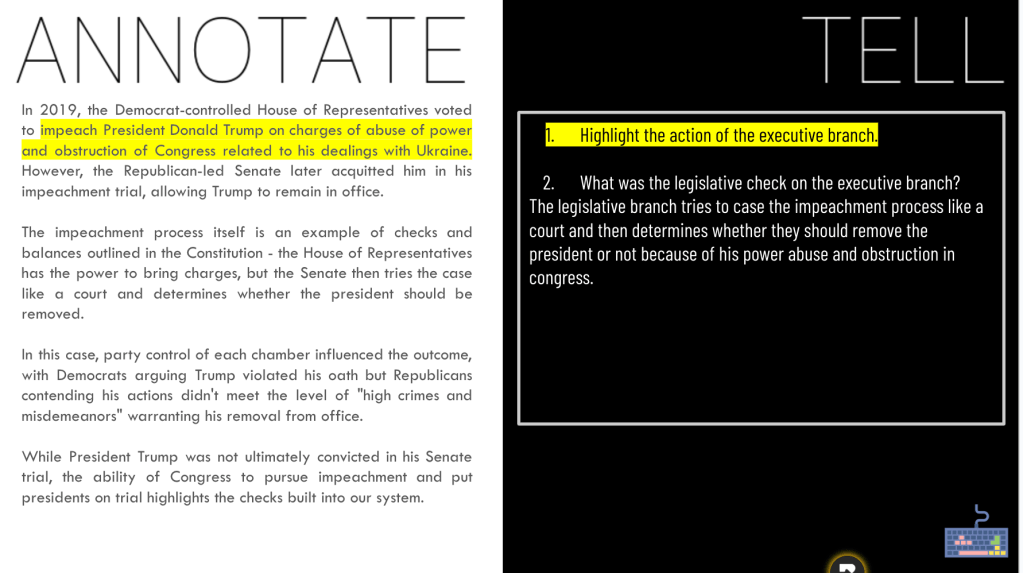
Next, students examined three AI-generated short stories based on recent events tied to checks and balances:
- Trump’s impeachment.
- Obama’s executive orders on gun control.
- Biden’s exploration of student debt cancellation.
For each story, students:
- Annotated key actions by the executive branch.
- Answered analysis questions, such as:
- How did the legislative branch check the president in this example?
- What role did the judiciary play (if any)?
This activity added context and relevance, showing students how checks and balances function in modern government.
Sketch and Tell Comic: Bringing Stories to Life
To wrap up, students used the Sketch and Tell comic format paired with the SWBST (Somebody, Wanted, But, So, Then) storyboarding technique. Students had two options:
- Create an original scenario that demonstrated checks and balances in action.
- Illustrate one of the AI-generated stories from earlier in class.
Each comic needed to show how multiple branches interacted, with annotations explaining the characters’ roles and the checks and balances applied.
As students shared their creations, they articulated detailed descriptions of the interactions between branches. For example, one student illustrated Congress overriding a veto with a vivid depiction of lawmakers “lifting” a veto stamp off a bill, while another highlighted a Supreme Court decision striking down an executive order.



Wednesday: Federalism
For my federalism lesson this year, I decided to switch things up while keeping the core elements that have worked well in the past. The focus was on making the concept of federalism relatable and interactive, while emphasizing key ideas like enumerated, reserved, and concurrent powers.
Thin Slides: Federalism in Context
The lesson began with Thin Slides, which provided a quick and creative way for students to process information.
- For the first slide, students read a brief description of federalism and chose:
- One word to represent federalism.
- One picture that symbolized the idea.
- They then explained their choices, sharing insights like “I chose ‘shared’ because both the state and national government share responsibilities.”
- The second Thin Slide focused on real-world examples of federalism. Students looked up the legal driving age in Ohio and compared it to other states. We discussed who sets these laws (state governments) and why they vary.
This activity transitioned into another research task: students looked up the minimum wage in Kentucky, Ohio, and California, noting how state laws differ and how federalism allows for this variation.
Sketch and Tell: Breaking Down Federalism
Students used a Sketch and Tell template to dive deeper into the structure of federalism.
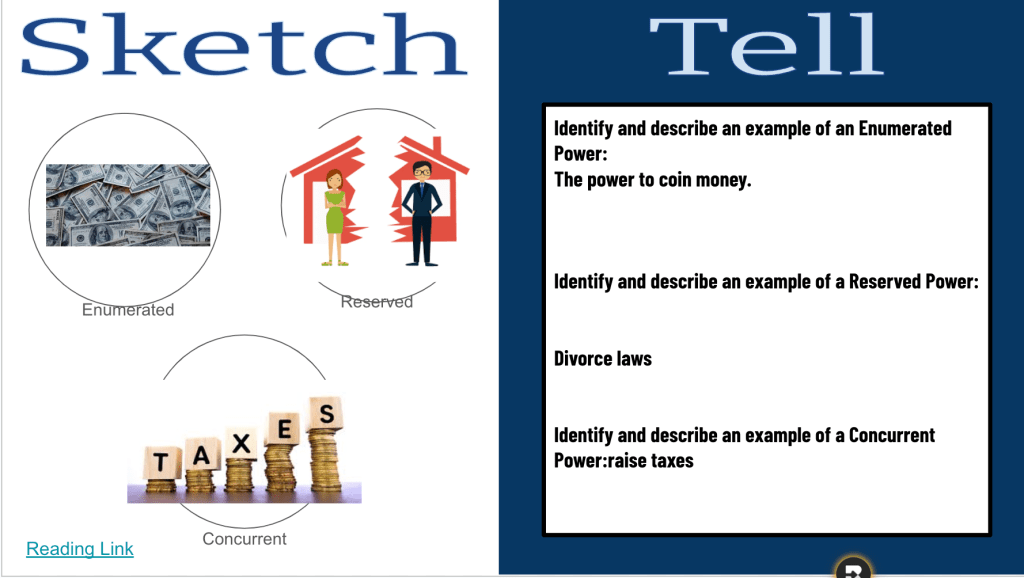
- Using an infographic or a modified textbook reading, students visualized expressed powers, state powers, and concurrent powers.
- They created drawings or used icons to represent examples, like a scale for concurrent powers (taxation) or a dollar sign for state powers (setting minimum wage).
This activity helped students connect abstract terms to concrete examples, reinforcing the distinctions between the different types of powers.
Thick Slide: Synthesizing Learning
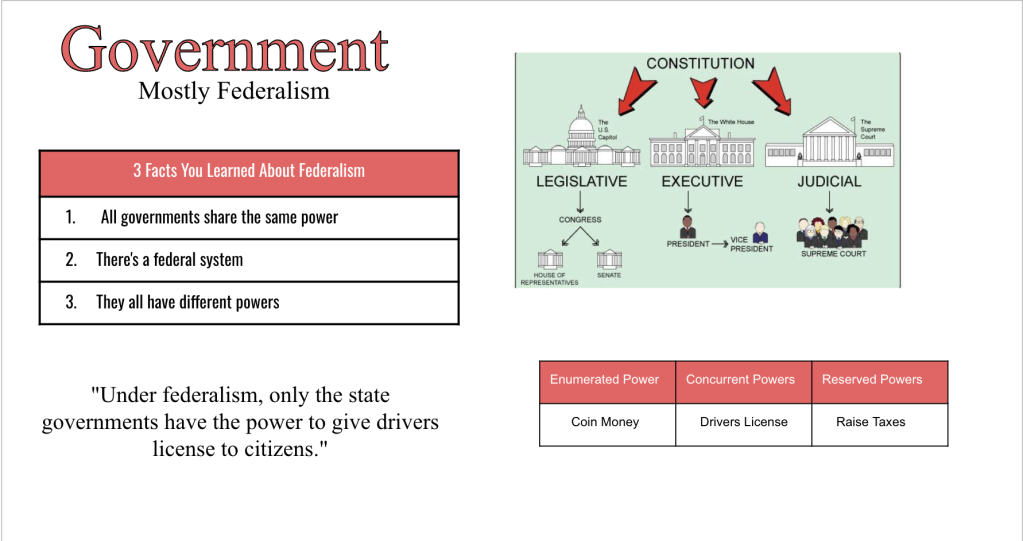
To wrap up the lesson, students completed a Thick Slide, which allowed them to reflect and synthesize their learning. On their slides, they included:
- Three things they learned about federalism.
- Examples of enumerated, reserved, and concurrent powers.
- A picture that represented federalism.
- A correction task, where they fixed an incorrect statement about federalism to make it true.



Thursday: Upgrading Bill of Rights Knowledge
The Bill of Rights can be tricky for 8th graders to memorize and understand, so Thursday was all about making the amendments memorable, engaging, and accessible. I kicked off class with a 10-question Quizizz to assess students’ baseline knowledge. As expected, most students remembered the 1st and 2nd Amendments but struggled with the rest. Class averages reflected this, coming in at 34%, 33%, 41%, and 34%. It was clear we needed a creative strategy to make these amendments stick.
Sketch and Tell-O: Prepping for Memory Aids
I handed out a Sketch and Tell-O template with 10 empty circles, one for each amendment. Students would use this to jot down sketches or notes based on the memory aids I shared during the lesson.
Memorable Mnemonics: Learning from Dave Burgess
For each amendment, I used a fun, engaging strategy inspired by Dave Burgess to help students connect the concept to something they could easily recall.
- 3rd Amendment: I told the story of Goldilocks making herself at home in the Three Bears’ house, linking it to the prohibition of soldiers being “quartered” in homes without consent.
- 6th Amendment: I showed a clip of an NFL player’s quick “pick six” interception to emphasize the idea of a speedy trial.
The students were laughing, engaged, and eagerly sketching the memory aids into their templates. They loved the zany connections and seemed to absorb the material effortlessly.
Assessing Growth with Quizizz
After finishing the activity, I had students tuck away their sketches and notes. Then we launched the same Quizizz again to check for growth. The results were encouraging:
- Class averages jumped to 74%, 77%, 68%, and 77%.
While the scores were slightly lower than last year’s averages, the improvement from the first round showed the power of these memory tricks. I’ll tweak a few things next time to fine-tune the approach, but overall, this was a win.
Friday: Applying the Bill of Rights
With the foundational knowledge of the Bill of Rights in place, Friday was all about applying that learning to real-world Supreme Court cases. The goal was to help students see how the amendments are interpreted and used in real-life scenarios—especially those that resonate with their own experiences as 8th graders.
Starting with EdPuzzle
Class began with an EdPuzzle video explaining the Supreme Court and how cases make their way to the highest court in the land. This gave students a framework to understand the cases they’d be analyzing later in the lesson.
Landmark Supreme Court Cases: An Interactive Experience
I curated a selection of Supreme Court cases that focused on issues students could relate to, such as:
- The Pledge of Allegiance in schools.
- Social media speech.
- School punishment policies.
- Prayer in schools.
Each case summary was printed onto cards and placed in envelopes around the room. To add an extra layer of engagement, one envelope included a bonus Bill of Rights Quizizz (which the students were now averaging 75–80% on—a huge improvement!).
The Activity
Students were divided into small groups and given 25 minutes to circulate through the envelopes and analyze as many cases as possible. For each case, their tasks were to:
- Guess which Constitutional amendment was in question.
- Predict how the Supreme Court ruled on the case.
The students did a great job identifying the relevant amendments, but the real excitement came when I shared the actual rulings. Many of the decisions surprised them or conflicted with their personal opinions, sparking lively discussions about how amendments are interpreted and applied.
Citizenship Test: Wrapping Up the Week
To end class, we returned to the same citizenship test we started with earlier in the week. The results were remarkable:
- At the beginning of the week, only six out of 89 students scored six or higher.
- By Friday, after incorporating engaging lessons and EduProtocols, 70 out of 89 students achieved that benchmark.

 Moler's Musings