
Coming back from winter break, we hit the ground running with the principles of the Constitution. The transition wasn’t easy—snow delays and uneven class times on Wednesday threw off our rhythm, and the textbook’s overwhelming vocabulary and dense content didn’t help. After some reflection and collaboration with a trusted colleague, I decided to adjust my approach.
This week, I focused on balancing structured teaching with interactive activities. By combining brief lectures, discussions, and EduProtocols, I aimed to make the principles of the Constitution accessible, engaging, and meaningful for my students. Here’s how the first two days unfolded.
Wednesday
After a snow-filled delay, Wednesday marked our first day back from winter break—and what a chaotic return it was. With a 2-hour delay, my classes were unevenly shortened to 30–46 minutes, and the pressure to cram an entire week’s worth of lessons into a limited timeframe only added to the frustration.
Teaching the principles of the Constitution is one of my favorite units, but the constraints of the textbook and deadlines imposed by common assessments make it hard to teach the way I know my students need. The textbook oversimplifies and overcomplicates at the same time—cramming seven principles into one chapter, with little focus on building foundational knowledge like understanding the branches of government or their roles. Cognitive load theory is completely ignored, and it’s clear the materials weren’t designed with middle school learners in mind.
Despite the challenges, I’m determined to make this unit engaging and meaningful for my students. Teaching shouldn’t feel like a race against a textbook or an arbitrary deadline—it should be about meeting students where they are and guiding them to where they need to be.
Starting with a Pre-Assessment
Given the shortened day and the need for a strong foundation, I kicked off the unit with a pre-assessment using questions from the U.S. citizenship test. I chose 10–11 questions that were directly tied to the principles of the Constitution. To keep the focus on critical thinking, I didn’t include answer choices—students had to come up with their responses based on their prior knowledge.
Here’s how the activity worked:
- Read Aloud: I read each question aloud, giving students time to think and respond.
- Trade and Grade: Students swapped papers with a partner to grade each other’s responses.
- Discussion: We went over each question as a class, discussing the correct answers and why they mattered.
Why It Worked
This activity served as both a pre-assessment and an opportunity to spark curiosity. Students were engaged in the discussion, and it gave me a sense of where they stood in terms of their knowledge of the Constitution’s principles. It also set the stage for deeper dives into each principle later in the week.
Reflection
It wasn’t the most exciting day, but it was an important one. The citizenship test questions provided a low-stakes way to ease back into learning while laying the groundwork for the unit. With the time crunch and external pressures, it’s not the start I wanted, but I’m determined to make the most of the days I have.
This week will be about finding ways to engage my students, break down complex ideas, and show them why the principles of the Constitution still matter today—despite the challenges of the snow, the textbook, and the ticking clock.
Thursday
After reflecting on Wednesday and discussing with my colleague Drew Skeeler, I decided to adjust my approach to teaching the principles of the Constitution. While I typically avoid lecturing, it became clear that short, focused direct instruction was what my students needed to build foundational knowledge. The plan was simple: 5–10 minutes of direct teaching, followed by turn-and-talks, and then an activity that built on the lecture using EduProtocols.
This shift felt necessary. Even though it’s not my preferred teaching style, it aligns with what will help my students engage with and understand the content right now.
The Lesson Plan
1. Lecture and Turn-and-Talks
I started with a 10-minute lecture introducing the seven principles of the Constitution:
- Popular Sovereignty
- Limited Government
- Separation of Powers
- Checks and Balances
- Federalism
- Republicanism
- Individual Rights
The goal was to provide a high-level overview with examples to make each principle relatable. For example, I explained checks and balances by describing how the president can veto a law passed by Congress, but Congress can override that veto.
After the lecture, students turned to a partner to discuss two questions:
- Which principle seems the most straightforward to you?
- Which principle do you think will be the hardest to understand?
These quick discussions helped students process the information and gave them a chance to voice initial thoughts or questions.
2. Fast and Curious Gimkit
Next, we jumped into a Fast and Curious Gimkit to reinforce the principles. The game included vocabulary and short explanations related to each principle.
- Students played for 3 minutes.
- I provided feedback on commonly missed questions.
- We ran the Gimkit again to improve accuracy.
3. Worksheet and Activity
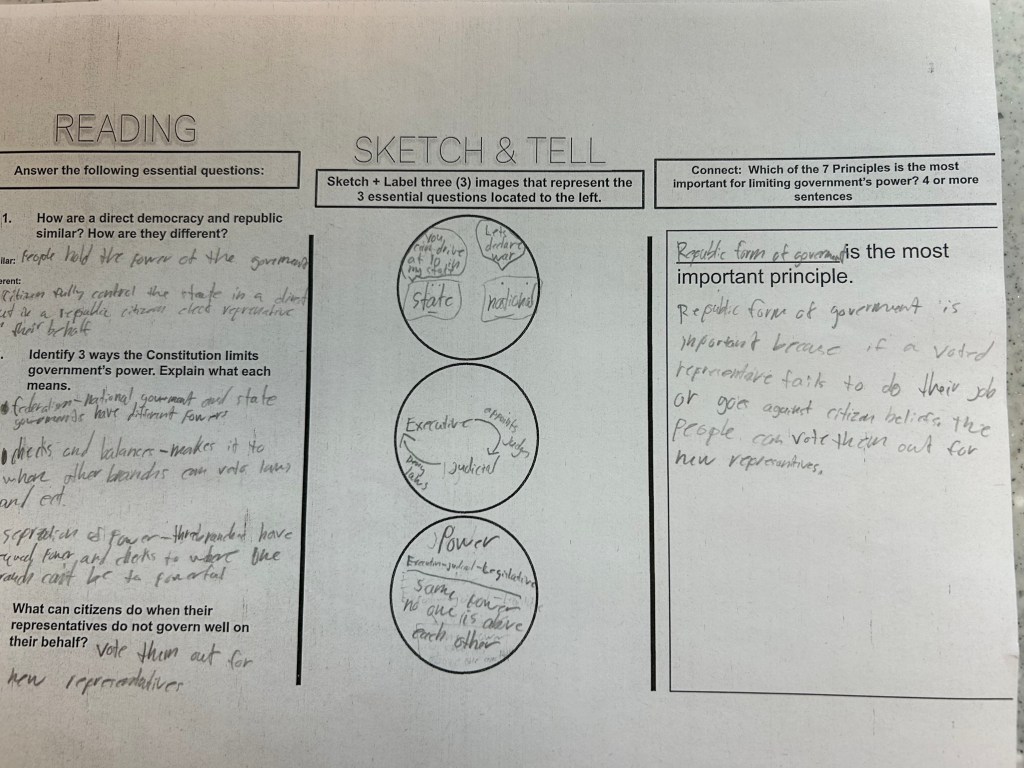
I pulled a worksheet from the textbook, but as usual, the vocabulary and phrasing were too complex for my 8th graders. To make it accessible:
- I simplified the questions to focus on key ideas like Why is separation of powers important?
- On the back, I added a Sketch and Tell-O activity where students drew a symbol for one of the principles and explained their choice.
- I also included a reflection question: Which principle do you think is the most important? Why?
4. Closing with Fast and Curious
We ended the lesson with one more round of the Gimkit to lock in what they’d learned. By the third round, scores were improving, and I could see the growth in their confidence.
Reflection
This lesson was a blend of compromise and creativity. The short lecture laid a clear foundation, the turn-and-talks helped students process the information, and the combination of EduProtocols and a modified worksheet gave them multiple ways to engage with the content.
While lecturing isn’t my favorite approach, it felt like the right choice today. Pairing it with interactive and creative activities made the lesson balanced and effective. Watching my students improve through the Fast and Curious Gimkit rounds and seeing their creativity in the Sketch and Tell-O reminded me that sometimes, adapting is the best way to meet students where they are.


 Moler's Musings