
Introduction
The past few weeks have been challenging—probably some of the toughest I’ve faced as a teacher. Being sick on and off for nearly a month has left me drained, both physically and mentally. Adjusting to a new school setting, new students, and trying to figure out what works has added to the weight. This year has forced me to stray from some of my core teaching philosophies. I’ve had to rely on strategies like extra credit, guided notes, and even the textbook more than I’d like.
I’m not relying on the textbook entirely, but it’s jam-packed with far too much information for 8th graders to process effectively. Pair that with vocabulary that feels overwhelming—words like negotiate, stimulate trade, inland, and emerged—and it’s clear the textbook isn’t a practical tool for building understanding. The challenge of teaching Tier 1 and Tier 2 vocabulary alongside complex historical concepts often feels insurmountable. When a student recently asked me, “What’s a stencil?” (I’m serious), I realized just how wide the gap can be.
The workload is also a challenge. There’s so much material to cover, and balancing meaningful activities with manageable workloads has been a constant juggling act. It’s hard not to feel like everything is just too much—for my students and for me.
I love writing in this blog; it’s a space to reflect and process. But lately, it’s felt like one more thing I can’t always keep up with. From here on, I’ll write when I can and focus on sharing what feels meaningful.
This week, though, I had three big wins. These are moments where my students were engaged, excited, and learning—and that’s what keeps me going.
1. Gimanji: Gamified Review
What It Is:
Gimanji is a competitive review activity created by Alexis Turnbull that combines Gimkit, Blooket, Quizizz, Kahoot, or any mix of platforms. It’s a hit with students because it’s fast-paced, fun, and team-based.
How to Run It:
- Start with a Gimkit
- Create a short, themed quiz. For example, I made a holiday-themed Gimkit with 12 questions about winter holidays.
- Run the game for about 5 minutes and let the top 4 or 5 finishers choose their teams.
- Switch to a Blooket
- Pick a mode that keeps the energy high. For our holiday version, I chose Santa’s Workshop, which is based on speed and luck.
- Award points to the top 5 finishers—5 points each worked well for us.
- Add a Kahoot
- Create a Kahoot quiz based on a fun theme. Ours was holiday songs represented by emojis. Students earn points based on accuracy and speed.
- Keep it short—5 to 8 minutes is perfect.
- End with Quizizz
- Finish with another short quiz. We did a round on holiday cookies.
- Again, the top 5 finishers earned points for their team.
Why It Worked:
The variety of platforms kept students engaged, and the team-based competition added an extra layer of excitement. By rotating through different tools, you can cater to a range of learning styles and keep the activity fresh. Gimanji is flexible—you can adapt it to any subject or theme.
2. WeWillWrite: Gamified Writing
What It Is:
WeWillWrite is a platform that turns writing into a gamified activity. Students respond to creative prompts in secret teams, assess their peers’ writing, and compete for points.
How to Run It:
- Sign Up and Create a Session
- Log in to WeWillWrite and create a session. The platform has premade prompts for all grade levels.
- Introduce the Activity
- Students join with a code, similar to Gimkit or Blooket.
- The platform automatically places them into secret teams.
- Write and Assess
- Display the first prompt (e.g., “Convince your grandma her cringe gift is perfect”).
- Students write for 3 minutes—there’s no submit button, so they’re encouraged to write the entire time.
- After writing, students self-assess and read the work of their teammates.
- Vote and Award Points
- Teams vote on the best, funniest, or most thoughtful piece.
- Winning entries are displayed, and AI highlights literary elements like metaphors, adjectives, and personification.
- Repeat for Additional Rounds
- Continue with new prompts, tracking team scores along the way.
Why It Worked:
The prompts were fun and accessible, encouraging even reluctant writers to participate. The anonymity of secret teams removed the fear of judgment, and the AI feedback added a layer of validation and learning. It was exciting to see students so invested in writing, and the self-assessment piece encouraged reflection on their work.
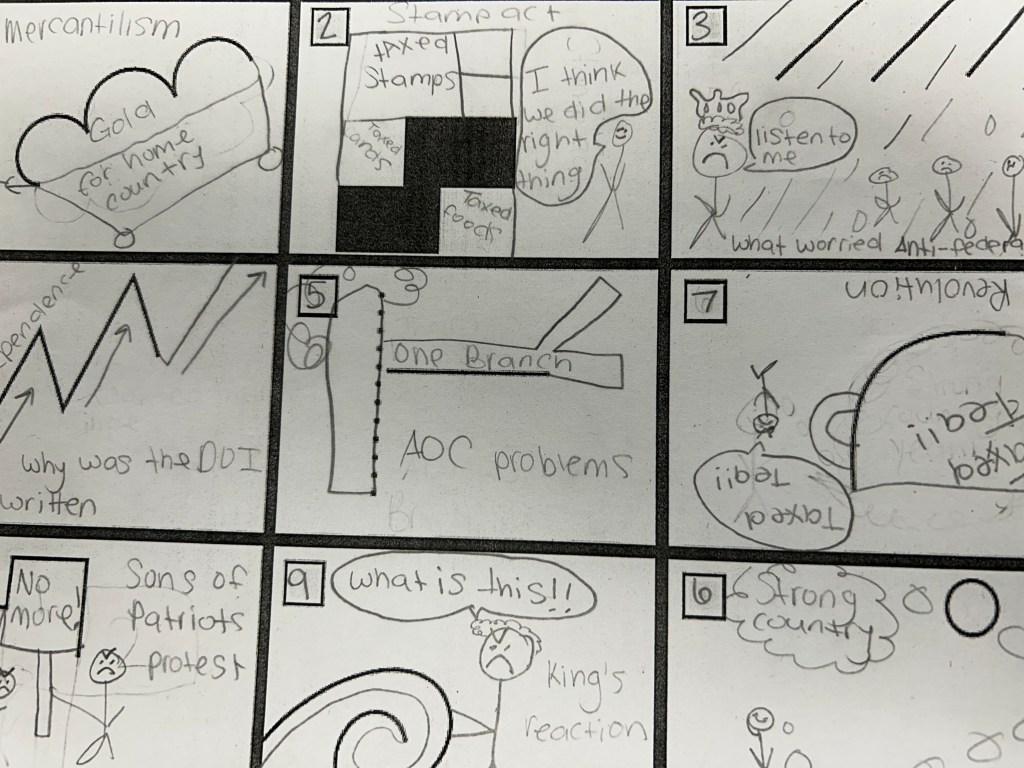
3. Finish the Drawing
What It Is:
This activity, inspired by Howson History, combines creativity with content. Students complete partially drawn images based on prompts tied to your curriculum.
How to Run It:
- Prepare the Drawings
- Create a sheet with 9 unfinished drawings—simple shapes or partial designs that students can build upon.
- Provide space under each box for labels.
- Randomize and Assign Prompts
- Have students randomly number the boxes on their sheet.
- Call out prompts one at a time. For example:
- “How would King George react to the Declaration of Independence?”
- “Illustrate mercantilism in action.”
- “What worried Anti-Federalists about the Constitution?”
- Drawing and Labeling
- Give students 3 minutes to complete their drawing and label it with key terms or ideas.
- Repeat and Discuss
- Continue with new prompts, encouraging students to share and explain their drawings as time allows.
Why It Worked:
This activity made abstract concepts more tangible. Students who might struggle with writing or vocabulary could still demonstrate understanding through visuals. It sparked great discussions and could easily transition into a Sketch and Tell or Sketch and Tell-O.

Final Thoughts
This week reminded me why I love teaching, even during tough seasons. These activities—Gimanji, WeWillWrite, and Finish the Drawing—brought energy and engagement back into my classroom. They provided ways to work around vocabulary gaps while keeping students focused and excited.
If you’re looking for ways to shake up your lessons and get your students excited, I highly recommend trying these strategies. They’re flexible, fun, and effective—proving that a little creativity can make a big difference!

 Moler's Musings
comment
LikeLiked by 1 person
Hang in there! Sometimes all we can do is take one day at a time. Although I’m disappointed you won’t be posting your daily/weekly thoughts & plans, I completely understand! I hope you can find time to relax & rejuvenate this Christmas break. I almost threw in the towel a year and a half ago, but you helped me change the way I do things in my classroom. For that, I am forever grateful…..thank you for always sharing. Praying for healing.
Tammy Sparks
LikeLike