This week focused on building a strong base for our Revolutionary War unit through EduProtocols and engaging activities. We used Gimkit rounds to reinforce key vocabulary, Thick Slides to explore foundational ideas like government’s role, and Brain-Book-Buddy-Boss for structured retrieval practice. Midweek, students independently analyzed the Declaration of Independence, paraphrasing and summarizing key passages.
By Friday, we launched into the war itself, pairing Sketch and Tell-O with a Choose Your Own Adventure as Continental soldiers and a creative Funko Pop project. These varied protocols helped make complex history accessible and memorable, laying the groundwork for deeper exploration of the Revolutionary era.
Monday
DOI Parafly Link, Thick Slide Link
This week, we continued our journey into the Declaration of Independence, working to break down complex ideas and bring clarity to an iconic but challenging text. The goal was to keep the Declaration manageable, balancing cognitive load with targeted analysis. I aimed to help students connect with the key concepts through consistency, vocabulary focus, and engaging paraphrasing work. Here’s a look at how it unfolded.
Breaking Down the Declaration
We picked up with the Declaration, focusing on why it was created, who was involved, and what it outlined for the future of governance. Knowing the text can be overwhelming, I broke it down into digestible sections—five key excerpts, starting with its description of government’s role. This approach allowed students to work with smaller, manageable parts and helped me pace the class to keep focus high.
We kicked off with a Gimkit review of core vocabulary from the Declaration—terms like political bands, unalienable, endowed, self-evident, usurpations, and tyranny. Running Gimkit in short rounds gave students a fast-paced vocabulary review; after three minutes, I provided quick feedback and immediately launched another round to reinforce retention.
Parafly: Paraphrasing with Scaffolding
Moving into the Parafly activity, I used Socrative to facilitate the paraphrasing practice. To get students warmed up, we started with random trivia and fun animal facts, adding some lighthearted engagement before diving into the Declaration’s text. I then introduced the five excerpts, inviting students to either paraphrase the original or work from a simpler translation if needed—an approach inspired by my special education background to support all learners. I pointed out the relevant vocab terms as we went along, helping to connect meaning and context in real time.
The Parafly took a bit longer than expected, with students getting involved in the layers of meaning within each excerpt. Although I aimed for a fast pace, I found it rewarding to see their focus as they grappled with language and intent.
Wrapping Up with Vocabulary Reinforcement
With time running out, we returned to Gimkit for a third and final round. It reinforced our vocabulary in a quick and dynamic way, although we didn’t quite make it to the Thick Slide summary I’d planned to close with. Still, seeing their engagement and progress with the Declaration was a win.
The week’s start has been a balance of repetition and exploration, and the students are beginning to see the Declaration not just as words but as ideas that shaped history. EduProtocols like Gimkit and Parafly have helped make the content accessible, and I’m looking forward to building on this foundation in the days ahead.
Tuesday
While I presented at an AI conference, my students worked independently on two key areas: wrapping up our exploration of the Declaration of Independence and diving into a basic introduction to the Electoral College for Election Day. With both activities, my focus was on reinforcing their understanding of purpose and process in government while also beginning the slow shift away from traditional worksheets.
Thick Slide: Synthesis and Locke’s Influence
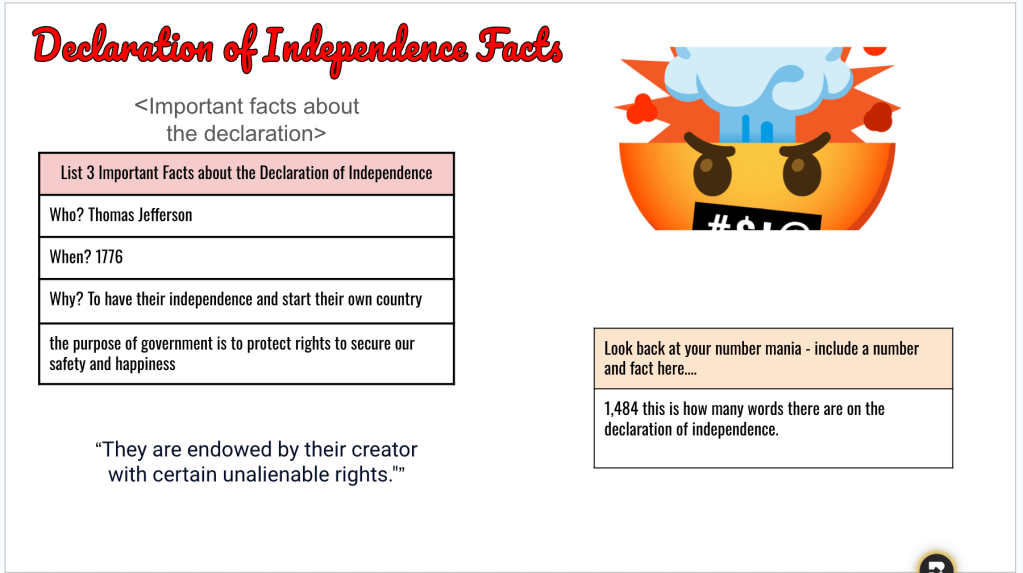
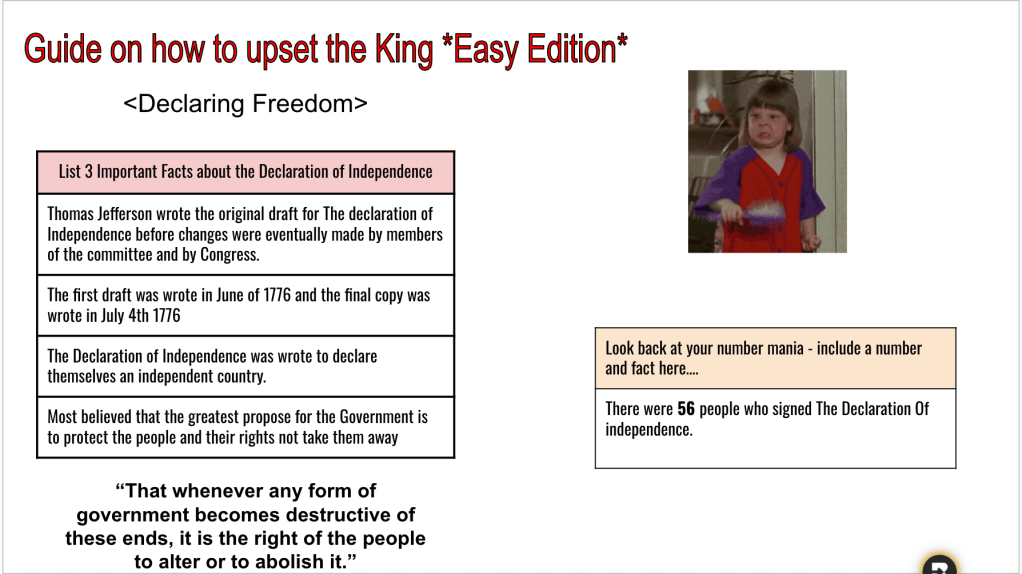
For the Declaration, I left a Thick Slide assignment designed to help students synthesize what they’ve learned. They were tasked with listing three facts about the Declaration, explaining why it was written, and defining the purpose of government. To add a layer of historical analysis, I had them find a quote reflecting John Locke’s influence and select an image that could show King George’s reaction to the Declaration. It was an opportunity for them to connect the ideas we’ve been exploring and to bring a bit of creativity into the mix.
Election Day Connection: Electoral College Intro
Given the significance of Election Day, I added a brief lesson on the Electoral College. I provided a simple reading, a set of questions, and an Edpuzzle video to introduce the basics. While I’m gradually moving away from basic worksheets, I recognize that some students are accustomed to this format and often gravitate toward it. The goal is to phase out these simpler resources without overwhelming them—a gradual balance of cognitive load and new skills.
Most students completed the Electoral College worksheet, but the Thick Slide remained unfinished for many. I’d hoped they’d prioritize the slide, but I understand that their inclination toward worksheets is simply a comfort zone I’m working to expand. Since the Thick Slide is key to consolidating their learning on the Declaration, we’ll wrap it up together on Wednesday.
The day was a reminder that gradual shifts in learning habits take time. As we move forward, I’ll keep guiding students toward deeper reflection and away from surface-level tasks. It’s a process, but it’s encouraging to see their growing confidence with more complex activities like the Thick Slide.
Wednesday
With the end of our unit in sight, Wednesday was dedicated to solidifying knowledge and preparing for what’s next. We began with a Gimkit review covering British taxes, colonial protests, and the Declaration of Independence—an all-in-one refresher to activate students’ memory of the unit’s main ideas. Following that, students completed the Thick Slide they’d started on Tuesday, giving them 12 focused minutes to synthesize their understanding before moving into our big review activity: Brain-Book-Buddy-Boss.
Brain-Book-Buddy-Boss: A Layered Approach to Review
This review approach remains one of my favorites because it gives students multiple ways to retrieve information, collaborate, and clarify. Each part of the protocol has a unique focus:
- Brain: Students started with 10 minutes of solo retrieval, jotting down everything they could remember from the unit. It’s a powerful way to see what truly “stuck” from the lessons.
- Book: Using the EduProtocols we completed, students had 12-15 minutes to revisit their notes and review resources. This stage encourages them to reflect on what we covered together and reinforces their recall with structured material.
- Buddy: Partnering up, students spent 8-10 minutes discussing and cross-checking their answers. This peer support helps bridge gaps in understanding and often leads to those “Aha!” moments.
- Boss: Finally, students could ask me questions for eight minutes. I set a timer and told them that when the timer was up, so was the Q&A—creating a sense of urgency and encouraging focused, meaningful questions.
Reflections on Class Differences
It’s always intriguing to see how each class performs during Brain-Book-Buddy-Boss. Some groups had extensive recall during the Brain phase, while others needed more time with their notes. These variations make me think critically about my own teaching—was something presented differently, or did attendance play a role? Each class brings its own dynamic, and this reflection helps me adapt and refine my approach for next time.
Overall, today’s review reminded me of the power of structured retrieval and peer collaboration. By giving students a framework to recall, reflect, and refine, I saw their confidence grow as they connected the dots across the unit. It’s a gratifying way to close a chapter and prepare for what’s ahead.
Thursday
Today, I was out of the classroom, but I set up a dual assessment to gauge students’ understanding of our unit on colonial unrest and independence. Knowing that my students were well-prepared after multiple reviews and practice with the material, I felt confident leaving them with activities that encouraged both quick recall and deeper analysis.
Self-Paced Gimkit Review
I kicked off their assessment with a Gimkit assignment set to complete when students answered 20 questions correctly. I like this self-paced approach because it adapts to students’ mastery levels—those who know the content can finish quickly, while others get more repetitions to reinforce their learning. The class averages came in at 83%, 80%, 74%, and 86%. The 74% average in one class stood out to me, given the number of review sessions we’ve done. It’s something I’ll need to revisit to ensure we’re addressing any lingering gaps.
Thick Slide: Independent Analysis
For the second part of the assessment, I left a Thick Slide assignment designed to capture various levels of understanding (DOK 1, DOK 2, and DOK 3). On the Thick Slide, students had to:
- Create a title and subtitle.
- Find an image illustrating the colonists’ desire for independence and explain it in a caption.
- Compare Loyalists to the Sons of Liberty.
- Identify and describe two British taxes.
- Select a quote from the Declaration of Independence that reflects Enlightenment influence.
This mix of tasks allowed them to showcase both foundational knowledge and analytical skills. Despite my absence, 83% of students were able to complete the Thick Slide, which was encouraging. It’s rewarding to see them synthesize information independently and apply key concepts we’ve covered.
Today’s self-paced setup allowed for some great insight into both their grasp of the material and areas where we might need to focus more in future lessons. The combination of Gimkit for quick recall and the Thick Slide for deeper analysis created a balanced assessment that catered to different learning strengths.


Friday
Life As A Soldier Link, Sketch and Tell-O with Reading
Today marked the beginning of our Revolutionary War unit, and I used a blend of strategies to introduce core vocabulary, guide focused reading, and foster creative engagement with historical content. From targeted vocabulary practice to a Choose Your Own Adventure activity, each step was designed to give students multiple entry points into understanding the complexities of the Continental and British armies.
Gimkit Vocabulary Practice and Strategic Reading
We started with a Gimkit focused on essential terms like minutemen, Continental Army, and Redcoats—words they’ll see repeatedly as we dive deeper into this period. After running through the questions, I reviewed the most commonly missed terms, helping to solidify their understanding. I then had students skim the reading to locate these terms in context, connecting vocabulary to real content.
For the reading, I handed out a streamlined, one-page document that highlighted the strengths and weaknesses of both armies. (Our textbook dedicated three pages to this, but I find that a more concise approach keeps students focused and reduces cognitive load.) I prompted them with, “How long should it take to read this?” Responses varied from 5 to 10 minutes, so I set a 4-minute timer to add a sense of urgency and purpose. Their goal: highlight one strength and one weakness under each heading, keeping their focus clear and purposeful. By giving them a structured task with a set time frame, I aimed to improve both their reading efficiency and comprehension.
Sketch and Tell-O: Visualizing Key Points
With their highlights in hand, students moved on to a Sketch and Tell-O, where they created four quick sketches representing the key points they’d just highlighted—one for each strength and weakness. Importantly, they did this without looking back at the reading, challenging them to recall and process the information in a new way. After sketching, they discussed their drawings with a partner, building verbal communication skills and reinforcing the content through peer-to-peer explanation. This was followed by a summary writing task, helping them consolidate their understanding in their own words.
Immersive Learning with Choose Your Own Adventure & Funko Pop Creation
To cap off the day, we turned to an engaging, interactive Choose Your Own Adventure experience inspired by Mike Meehan (@MrMeehanHistory). Students stepped into the shoes of a Continental or minuteman soldier, making choices to navigate the realities and hardships of Revolutionary War life. This approach gave students a more personal connection to the material, encouraging empathy and a deeper grasp of the soldiers’ experiences.
As a creative wrap-up, students crafted their own Funko Pop soldier. They incorporated the strengths, weaknesses, and lifestyle aspects they’d learned throughout the lesson, transforming the facts into a personalized, imaginative artifact. This final activity allowed them to express their understanding in a tangible, visual way and capped off the lesson with a memorable project.
Each part of the lesson was carefully structured to balance cognitive load and engagement. The use of concise readings, strategic highlights, timed tasks, peer discussion, and hands-on creativity gave students multiple modes to interact with the content, making the start of our Revolutionary War unit both educational and memorable.

 Moler's Musings