Sometimes, the demands of teaching and life outside the classroom can be overwhelming. This week, I felt the weight of it all. Trying to balance lesson planning, teaching, and taking care of my own well-being hasn’t been easy, but I’m doing my best to carve out moments for myself to stay sane. Still, Tuesday’s lesson reminded me that, despite all the challenges, we’re making progress—one step at a time.
Tuesday
Our focus for the day was colonial government, diving into how the colonies were left to create their own systems under England’s “salutary neglect.” It was a great opportunity to make connections between historical events and the structures the colonies built, giving students a look at the roots of American government.
We kicked things off with a Gimkit review to get the students’ minds engaged. The scores were rough—class averages came in at 49%, 60%, 65%, and 68%. Not exactly the strong start I was hoping for, but it set the tone for what we needed to work on. It’s all about growth, and sometimes seeing those lower numbers is the push we need to make improvements.
Map and Tell: Visualizing Space and Context
Next, we did a Map and Tell activity. I wanted students to make the observation that England was far away from the colonies. This helped us place the lesson in the context of distance and the impact of England’s hands-off approach, leading to salutary neglect. It’s one thing to tell them the colonies were left to manage themselves; it’s another to show them the physical distance on a map and let them connect the dots themselves.

Pyramid of Power: Visualizing Colonial Structure
To reinforce the concepts, we filled out a pyramid showing the power structure in England versus the colonies. The top half of the pyramid was England, with the king and Parliament. The bottom half showed the 13 colonies with their elected assemblies and town meetings. This was my attempt to help them visualize how the government was structured differently on either side of the Atlantic. We also tied this back to mercantilism, which we covered last week, emphasizing how England’s focus on economic gain allowed the colonies to develop their own political systems.
Thin Slides: Chunking Colonial Government
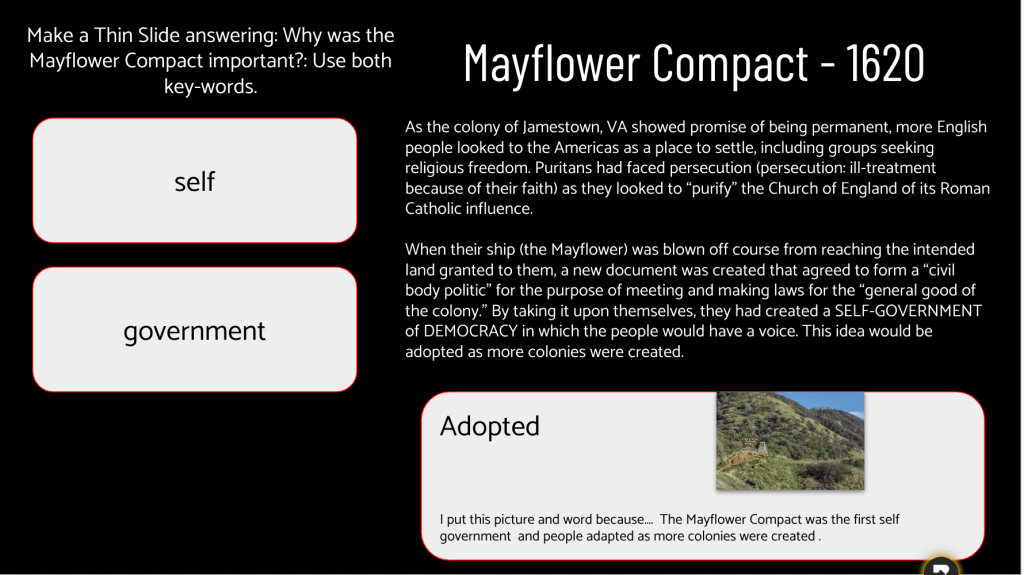
After the pyramid, I had the students use a Justin Unruh Thin Slide to work through chunked readings about the different foundations of colonial government, like the Magna Carta, Mayflower Compact, House of Burgesses, English Bill of Rights, and Fundamental Orders. The goal was to have them engage with keywords and summarize these concepts visually.
But this is where things got tricky. The kids seemed overwhelmed by the task. I chunked the material into five slides, thinking it would make the information manageable, but even this proved daunting for them. I timed each slide at 5-6 minutes, but it felt like I was pushing a boulder uphill—students were struggling to keep up, and engagement was low. I tried to step in, reading the content aloud and shifting to an “I do, we do, you do” model, hoping to guide them through it.
By the time I got to the second half of the day, I realized I needed to adjust. I switched the Thin Slide activity to paper. It was a simple move, but it made a huge difference. With the material in front of them and fewer distractions, the kids seemed more settled, and the pace was smoother. It’s a reminder that sometimes we have to adjust and find what works best for our students, even if it means veering from the plan.




Wrapping Up: Finishing with Gimkit
To close out the lesson, we went back to Gimkit for a final review. This time, the class averages were better—70%, 80%, 74%, and 72%. It wasn’t a dramatic jump, but it showed progress, and that’s what I’ll take away from this day.
Reflections: Learning and Adjusting
It wasn’t the most productive day, and that’s okay. Some lessons flow smoothly, and others remind us that teaching is a constant process of trial, error, and adjustment. Switching from digital to paper was the right call, and it’s something I’ll keep in mind moving forward. If a strategy isn’t working, I have to be flexible enough to try something new in the moment.
It’s all about finding the balance—both for my students and for myself. Whether it’s adjusting lessons on the fly or taking a deep breath to center myself before the next class, I’ll keep moving forward. Sometimes, it’s about embracing the small wins—like those incremental Gimkit score improvements—and using them as building blocks for the next day.
Here’s to figuring it all out, one lesson (and one adjustment) at a time.
Wednesday
We started the lesson with the “Brain” phase—classic retrieval practice. Students closed their Chromebooks and used their memories to answer a series of questions about the English Colonies. I set the timer for 10 minutes and challenged them to pull as much as they could from their own knowledge. The purpose was to emphasize thinking without relying on tech. As they worked, I could see some were really digging deep, and the effort was there. It was a great warm-up and laid the groundwork for the rest of the lesson.
Next, I had students highlight the questions they couldn’t fully answer, and that’s when we moved into the “Book” phase. Chromebooks came back out, but I was strict—no Googling! Instead, they had to rely on their notes and materials from previous lessons. I made sure to walk around, keeping everyone focused on using their resources the right way. This was all about reinforcing the importance of their own notes as tools and encouraging them to build solid study habits. The class was quiet but engaged, as students dove into their resources.
Once they had gathered their answers, it was time for “Buddy.” Students paired up and compared their responses, filling in any gaps or clarifying details they missed. This was the most interactive part of the lesson, and it was great to see them teach and learn from each other. I could tell that some students found confidence in what they knew, while others appreciated the chance to ask questions and catch up.
Finally, we wrapped up with “Boss” mode—that’s where I stepped in. Students brought their remaining questions or uncertainties to me. I loved this part because it gave me insight into areas where they needed more support and gave them the opportunity to check their understanding. I made it a point to answer their questions directly, clearing up any misconceptions they had about the material. It was a great way to wrap up the review while ensuring that everyone walked away with a clearer understanding.
The Results: A Big Improvement
I didn’t reveal the Brain-Book-Buddy-Boss framework upfront—I introduced each step as we went along, keeping the students curious and engaged. By the time we got through all four phases, they were fully on board and energized. We ended the lesson with another Gimkit assessment. This time, the class averages jumped significantly: 92%, 88%, 87%, and 86%. It was a major improvement from the 60%-70% range we had last week.
And the best part? I had them put away their notes and Chromebooks for the Gimkit—just their brains, again. The progress showed me that the strategy worked, reinforcing not only content knowledge but the value of retrieving information from memory.
Final Takeaway: Why I’ll Be Using This Again
The Brain-Book-Buddy-Boss approach hits all the right notes for an effective review session. It builds on retrieval practice, collaboration, and direct feedback—all while keeping students actively engaged. The step-by-step method allows them to build confidence, reflect on what they know, and fill in gaps—all in one lesson.
I’ll definitely be using this strategy again. It’s a win for the students and a win for the teacher, and it’s exactly the kind of structure we need to keep moving forward in our learning journey.
Thursday
Thursday was a turning point in the classroom as we launched into a new unit: the Causes of the American Revolution. The focus was all about understanding the shifting relationship between the colonists and England, and how things went from cooperation under Salutary Neglect to conflict. I knew I needed a hook that would be engaging, relevant, and just disruptive enough to get their attention—so I turned to PBIS.
Hooking Them with the PBIS Bathroom Trick
Let’s be honest—classic hooks like pretending to tax pencils or papers just don’t cut it anymore. Kids see right through it. So, I pulled out a move that was a little more realistic. I went into our PBIS rewards system and created a store item—a bathroom pass—for a steep price: 150 PBIS points. When I announced this to the class, they were outraged, and that’s exactly what I was going for.
We launched into a discussion about why they were so mad. The students had a lot to say, calling out the fairness of it all and pointing out that I had never cared about bathroom usage before—so why was I making it a big deal now? That’s when I pulled out my “Aha!” moment. I explained that this frustration they felt was exactly what the colonists experienced. England had ignored them for years under Salutary Neglect, and then suddenly, it started enforcing policies and making them pay their “fair share.” The students connected instantly—it wasn’t just a random history lesson; it was a situation they could feel.
This hook worked because it was something they genuinely cared about, and it was believable. It’s way better than the cheesy, outdated “tax” tricks. When you tap into something realistic like PBIS rewards, they buy in because it’s their world.
Retrieval Practice and Review: WordWall and Gimkit
After we had our discussion, I wanted to keep the momentum going with some retrieval practice. I’ve been making a conscious effort to build retrieval practice into the routine so it becomes second nature. We started with a WordWall activity where I posted a 13 Colonies map and had students, from memory, drag and drop to match the colonies. They got one shot to do it. Most students nailed 13 to 14 colonies correctly, which was awesome to see—proof that the practice is starting to pay off.
Next, we switched gears to a Gimkit focused on the French and Indian War. I prompted them with the question: “Think about what changed the relationship between the colonists and England?” This helped frame the conversation about how England’s policies started shifting after the war, leading to the tensions we’d see later.
Thin Slides and Sourcing Parts: Making Connections
To dig a little deeper, we did a quick Thin Slide on Padlet. I asked the students to find the European country that controlled Clermont County, Ohio, in 1754. Their task was simple: one word (the country) and one picture (a map) to support their answer. It took about 5 minutes, which was longer than I usually like for Thin Slides, but they needed that time to explore and find the info. I’m okay with a little extra time if it means they’re engaging with the material.
We moved on to Sourcing Parts using the famous Join or Die cartoon. The goal was to pick apart the cartoon and write a summary of its message. This activity took about 10 minutes, but I was impressed. The students noticed details like the letters and abbreviations representing the colonies, which was exactly why I had started with the WordWall retrieval practice earlier. It set the foundation for them to make the connection to the colonies depicted in the cartoon.
Experiment Time: Guided Notes vs. Sketch and Tell-o
Here’s where the day got interesting. I tried an experiment with my classes: for the first three, I used guided notes while I talked about the French and Indian War. For the last class, I switched it up and used a Sketch and Tell-o, letting them read about the French and Indian War on their own and create their own notes. I wanted to see if one approach would yield better engagement or retention.
We ended with another round of Gimkit. The scores were all over the place:
- First class: 45% to 69%
- Second class: 39% to 76%
- Third class: 31% to 66%
- Fourth class: 43% to 74%
So, what did I learn? Well, honestly, it’s hard to draw any clear conclusions. There were so many variables at play—behaviors, levels of engagement, and just plain old classroom dynamics. In the last bell, where I tried the Sketch and Tell-o, I had a couple of my usual top scorers out of the room during the second Gimkit round. They usually rank in the top 5, so there’s no doubt their absence impacted the final percentage. That 74% could’ve easily pushed up closer to 80% if they’d been there.
Final Thoughts
Was it the guided notes or the Sketch and Tell-o that made the difference? I don’t have a definitive answer yet. What I do know is that mixing things up and testing out different methods helps me see where my students are at and what they respond to. Sometimes, it’s not about the perfect strategy; it’s about being willing to pivot and try new things, even if the results aren’t crystal clear. At the end of the day, any progress—whether it’s small jumps in Gimkit scores or students making connections to content—means we’re moving in the right direction.
The PBIS bathroom hook will definitely make a return in future lessons—it’s the kind of realistic hook that gets them thinking and feeling like they’re in the colonists’ shoes. And I’ll keep experimenting with different approaches to see what sticks and what doesn’t. It’s all part of the process, and every day, we’re building something better.
Friday
Taxes and “No Taxation Without Representation”
I kicked off the class with a quick overview of why we have taxes in the first place—what they pay for and why they’re necessary. This laid the groundwork for our discussion about taxation without representation, so the students could start seeing things from the colonists’ perspective. I used a map to show the distance between England and the colonies, highlighting how disconnected the colonists felt from the laws being imposed on them.
I didn’t want to overwhelm the kids with too much information at once, so I decided to focus on just three key acts: the Stamp Act, the Sugar Act, and the Quartering Act. Breaking it down into manageable chunks felt like the right move, especially for a Friday when everyone’s attention span is hanging by a thread!
Iron Chef on Padlet: Act by Act
Once I set the stage, I gave each student a half-page of reading about one of the acts. They had 10 minutes to read and then jump into an Iron Chef activity on Padlet. The goal was to share key facts from their reading and use Padlet’s “I Can’t Draw” feature to create an AI-generated image that visually represented the act they were assigned. It was fun watching them explore the AI tool, and it definitely kept the energy up in the room.
Sketch and Tell with Emoji Kitchen
After we built out the Padlet, students reviewed each other’s work. Their task was to choose an act they didn’t study initially and create a Sketch and Tell using the Emoji Kitchen. They had 10 minutes to pair an emoji with a visual representation of the act and explain its significance. This approach was all about helping them synthesize information from their peers and think critically about how to represent historical concepts visually. The Emoji Kitchen adds a playful twist that keeps them engaged—some of the creations were spot-on and hilarious!

Wrapping Up with a Thick Slide
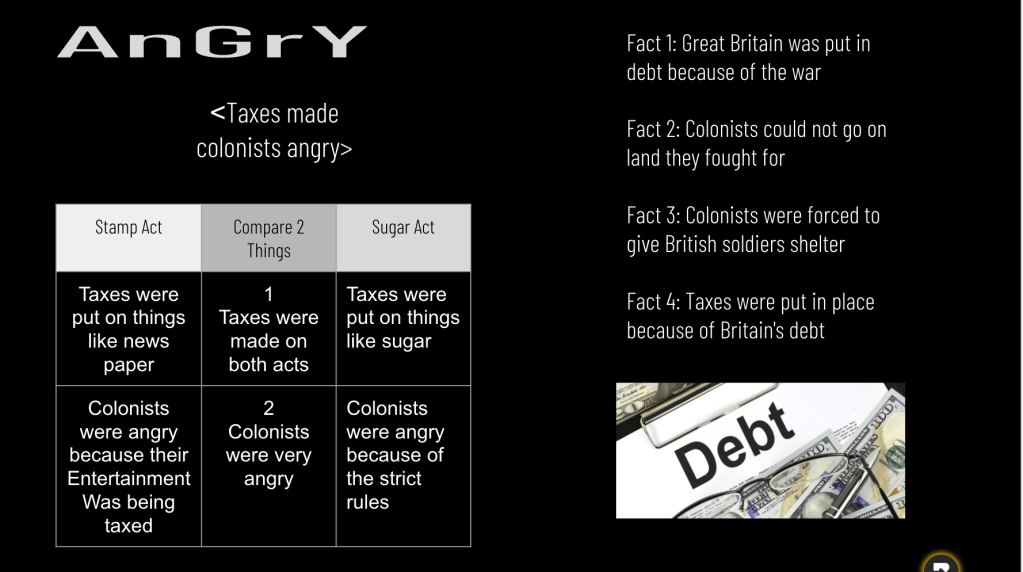
To pull everything together, we moved into a Thick Slide activity. I asked the students to create a slide that included the following:
- A title and subtitle for context
- Four key facts about the acts they learned
- A comparison between the Stamp Act and the Sugar Act
- An image that tied their points together
The Thick Slide gave them a chance to consolidate their knowledge and show what they’d absorbed in a structured way. It also allowed me to assess their understanding at a glance. I love how Thick Slides force students to think critically about what they’ve learned and distill it into a concise, visual summary.
Ending Strong with Gimkit
We wrapped up class with a Gimkit session to reinforce what we covered. The students always get competitive with Gimkit, and it’s the perfect way to review and end the week on a high note. I could see that focusing on just three acts kept things clear and manageable for them, and the structured activities made it easier for them to retain and recall information.
Final Thoughts
Friday felt like a win. By focusing on a few key acts and using a variety of EduProtocols like Iron Chef, Sketch and Tell, and Thick Slides, the lesson flowed smoothly. The balance of reading, visual work, and interactive review hit all the right notes. It’s all about finding ways to keep the students engaged while ensuring they walk away with a solid grasp of the content.
I’m looking forward to building on this foundation next week as we dive into more of the acts and continue exploring the buildup to the Revolution. The goal is to keep it fresh and interactive so that the students stay invested in the story of how these events shaped America.

 Moler's Musings