This week was all about leveraging EduProtocols to simplify learning, foster creativity, and reinforce key concepts. From using Thin Slides and Cybersandwich to explore complex topics like Bacon’s Rebellion and race-based slavery, to engaging students with retrieval-based activities like Graph and Tell and Thick Slides, the focus was on making learning more accessible and engaging. Whether students were interacting with AI chatbots or diving into historical data, these protocols helped break down challenging content into manageable, meaningful tasks. Here’s a breakdown of how we used EduProtocols to keep the momentum going this week:
Monday
On Monday, I decided to try out something new and set up a free trial with Magic School. In the past, it seemed like a promising one-stop shop for classroom tools, though my previous experiences were inconsistent. But with a new school email, I created a fresh account and set up a chatbot for the 13 colonies.
My vision was to have a chatbot that would take on the persona of one of the founders of the 13 colonies. All students had to do was type, “Who founded <enter colony name>?” A few people have already asked how I set up the chatbot, so here’s how I did it: Instead of app smashing, I was AI smashing. I went to Claude AI and asked for a set of instructions for a chatbot that would take on the persona of one of the founders of the 13 colonies—geared for 8th graders. It even provided a knowledge base for each founder!
For this lesson, I didn’t think it was important for students to memorize every detail about every colony. Instead, I wanted them to understand the colony’s region, its geography, and its economy.
Starting with Gimkit: Colonial Regions Review
We kicked off with a quick Gimkit on colonial regions, a review of Friday’s lesson. The class averages ranged from 82% to 90%—pretty solid, especially for a Monday.
Frayer Model Activity
Next, I handed out paper Frayer models where students wrote a colony name in the middle and added information about its government, geography, economy, and religion. Looking back, I should’ve just aligned it with the PEGS acronym we used on Friday, but live and learn.
Introducing Magic School
I showed students how to use Magic School, where I had set up a classroom that allowed me to add AI tools. I added both the chatbot and an image generator, then shared the Magic School link with the students—super easy!
I loved this activity because it got kids asking good questions, which is such an important life skill. They could ask the chatbot about their colony and get personalized answers. For example, they could ask the founder to use simpler language or even to relate the colony’s geography to basketball! It was cool, and the students were hooked—many didn’t know AI could do this kind of stuff.
Students wrote down notes from the chatbot on their Frayer models.
Airbnb Advertisement Activity
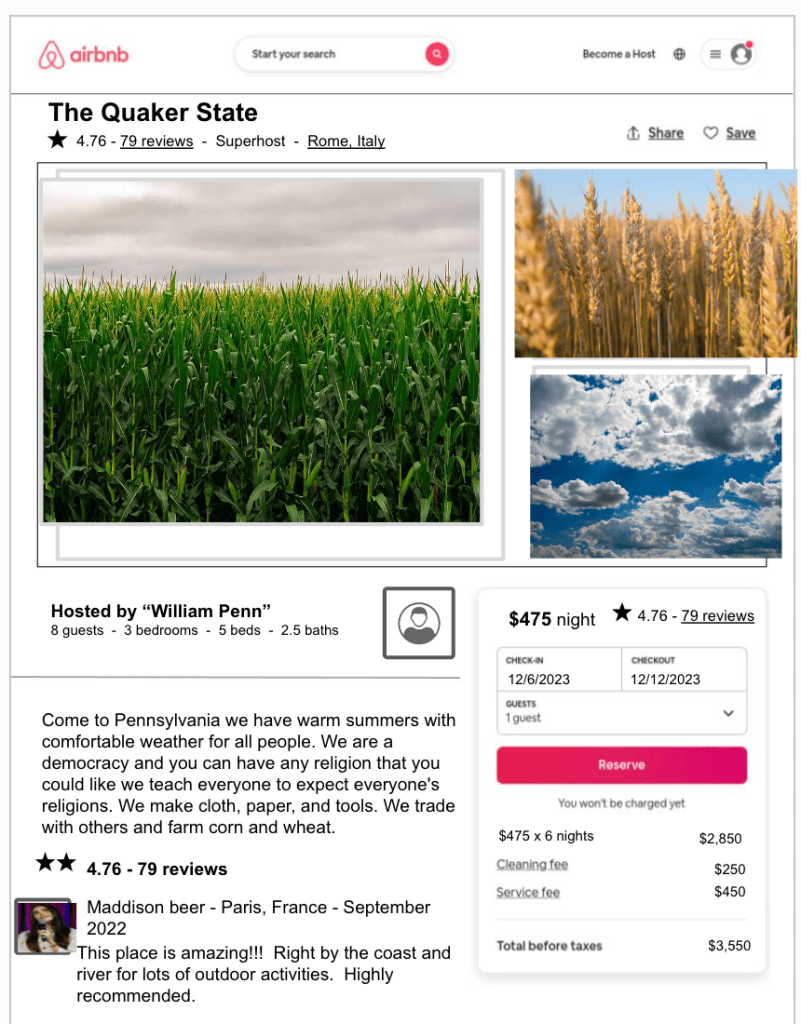
The next step was to use those notes to create an Airbnb advertisement for their colony. I got this idea from Ditch That Textbook, and it was super easy to adapt. However, the students struggled a bit with this task. Getting them to think creatively and step outside the box is still a work in progress, but I see improvement.
Takeaway
The chatbot was a win—it allowed students to engage in inquiry-based learning and step away from the textbook. The creative thinking piece is still a challenge, but I’m confident that with practice, we’ll get there. The biggest takeaway? Learning how to ask good questions and use AI to personalize that learning was a game changer for my students.
Tuesday
Tuesday, I needed a bit of an easy day, but still wanted to create a meaningful learning experience. We started the lesson by emphasizing the importance of using person-first language when discussing slavery. Instead of using terms like “slave,” we replaced them with “enslaved person,” and “master” or “owner” with “enslaver.” It’s a small shift but a crucial one, and I’ve learned it requires explicit teaching for students to fully grasp its significance.
Station Rotation Activity: The Triangular Trade and Middle Passage
The core of today’s lesson was a station rotation activity centered on the essential question: “How did Europeans exploring North America for trade, religious reasons, and competition with each other affect the history of the continent and the people who lived there?” This question has been guiding our exploration of European colonization’s impact on North America.
Students rotated through four stations, each engaging with a different aspect of the Triangular Trade and the Middle Passage:
Station 1: EdPuzzle Video
We kicked off with a 5-minute EdPuzzle video—a Ted-Ed lesson on the Middle Passage. The video was followed by questions to ensure comprehension and introduce students to the topic. The video laid the foundation for the rest of the activity.
Station 2: SlaveVoyages.org Interactive Map
At this station, students used the SlaveVoyages.org database, an incredible resource featuring a timelapse map of ships departing West Africa for the New World. The interactive map allowed students to explore individual ships, their cargo, and survival rates. It was a powerful, visual way to understand the horrific journeys endured by enslaved people. The database, built through collaborative efforts, was an invaluable resource for our class.
Station 3: Slavery Statistics
In this station, we focused on statistics related to slavery. Tying back to our previous Number Mania lesson, students saw how statistics have real historical context. They used data from the Slave Voyages database and connected it to the numbers we’ve been exploring.
Station 4: Slavery in the Northern and Southern Colonies
At the final station, students read about slavery’s presence in both the Northern and Southern colonies and how enslaved people managed to build their own culture despite their circumstances. A map illustrating the Triangular Trade routes accompanied the reading, helping students visualize the geographic connections.
Students worked in pairs at each station, discussing and answering questions. The stations ended up taking longer than expected, but seeing the students engaged and actively learning was more important than sticking to a rigid timeline.
Thick Slide Assessment
To wrap up the lesson, I posted a Thick Slide task. Students condensed the information from their station rotations into essential facts, answering the question, “How did the triangular trade and the Middle Passage transform North America?” They also used the Slave Voyages database to find a ship that traveled to North America and gather relevant statistics. As a final touch, they included a quote from Olaudah Equiano and an image with a caption.
Takeaway
This was a more laid-back day, but it was packed with meaningful content and reflection. The stations allowed for deep engagement, and the students rose to the challenge of condensing complex ideas into manageable pieces of information. Even though we didn’t stick to the exact schedule, the engagement and learning made it all worth it.
Wednesday
On Wednesday, I wanted to introduce how race-based slavery came to be in North America. I started with a picture of Anthony Johnson on the board. Johnson was a Black man and former indentured servant in Jamestown who earned his freedom, owned land, and even enslaved people to work on his tobacco farm. This example illustrated that slavery wasn’t originally race-based in the colonies. But then came Bacon’s Rebellion, and things began to shift.
Graph and Tell: Analyzing Slavery Census Data
We began with a Graph and Tell activity where students analyzed census data about slavery. They made inferences based on the data, which served as a review of the colonial regions and their economies. This exercise helped students make connections between the regions and how slavery impacted their development.
Introducing Bacon’s Rebellion
Next, I introduced Bacon’s Rebellion. The textbook mentioned that the rebellion showed how the Virginia government couldn’t ignore its citizens, but I thought, “Bacon’s Rebellion goes way beyond that!” To help students understand, I used a Somebody, Wanted, But, So, Then activity, giving them more practice with sequencing and comprehension. This scaffolded their understanding of the rebellion’s role in the shift toward race-based slavery.
Cybersandwich: The Start of Race-Based Slavery
After introducing Bacon’s Rebellion, we read about how race-based slavery began in Virginia as a consequence of the rebellion. I had students work through a Cybersandwich activity for this reading. They wrote down five important facts, condensed their notes, and then compared and discussed with a partner. This paired learning helped students process the material more deeply.
Struggling with Summary Writing
To wrap up, I wanted students to write a quick summary of what they had learned about the shift to race-based slavery. Oh boy—the summary writing was a struggle. I’m not sure if it was the content itself or just the act of writing, but many students found it challenging to condense their thoughts into a clear, concise summary.
Takeaway
Wednesday’s lesson introduced some complex ideas, and while the Cybersandwich activity helped students grasp the content, the summary writing showed me that we still have some work to do. I’ll need to continue working on breaking down writing skills and building confidence in expressing complex ideas in shorter formats.
Thursday
Thursday was a special reward day for the students since it was the end of the quarter. With limited time and a more relaxed atmosphere, I decided to do something simple but beneficial: a Retrieval Practice Grid activity that doubled as an opportunity for extra credit.
The Retrieval Practice Grid
I created a grid of questions that covered topics from 7th grade, Unit 1, Unit 2, and our current unit. Each question on the grid was worth a different amount of points based on its difficulty. Students could work through the questions, and depending on how many points they earned, they could unlock different levels of extra credit.
To ensure this was true retrieval practice, I didn’t allow Chromebooks—it was all about what they could recall from memory. The goal was to reward students for what they’ve learned over time, and it was a great way to wrap up the quarter while still reinforcing key content.
Takeaway
This activity worked perfectly for the day’s time constraints while still keeping students engaged and focused. It also showed me how much they’ve retained from not just this year, but even last year’s content. A win for both students and teacher!
As the week comes to a close, I’m impressed with how the EduProtocols have streamlined our lessons while keeping students engaged and thinking critically. The combination of Thin Slides, Cybersandwich, and Graph and Tell not only made complex topics like race-based slavery more approachable, but also fostered deeper understanding and retention. The students are gradually getting more comfortable with creative tasks, and I can see their confidence growing as they interact with both the content and each other. Moving forward, I’m excited to keep building on this momentum with even more dynamic and student-centered activities.


 Moler's Musings