Introduction
This week in the classroom was packed with diverse activities and learning experiences. Here’s a quick overview of what we covered:
- Concluded our unit on Native Americans in Ohio
- Held a commemorative lesson on 9/11
- Began a new unit on European exploration
- Utilized various EduProtocols and tech tools including Gimkit, Blooket, and Storyfile
Each day brought its own set of challenges and opportunities as we worked through these topics and experimented with different teaching methods. The following daily breakdowns detail our activities, student responses, and the ongoing process of adapting lessons to meet learning objectives.
Monday – Resistance and Resilience, Stories
Tuesday – Assessment
Wednesday – Storyfile
Thursday – Blooket – Exploration Vocab
Friday – Before 1492 Exploration, Gimkit Countries/Continents
Monday
On Monday, we continued our unit on Native Americans within Clermont County and around Ohio. I started off with a Gimkit Fast and Furious as a review of the content from last week. I ran the Gimkit for about 5 minutes, challenging the students to achieve a higher class average than we did on Friday. Most classes were at or slightly below where we finished on Friday, which is normal.
Next, we finished the Thin Story from Friday’s lesson. The Gimkit served as a review before completing the Thin Story on the effects of colonization on Native Americans within Ohio. I simply wanted the students to include one picture, one word, and explain why they chose that picture and word to represent how natives were affected by Europeans. It was a quick and easy wrap-up of that lesson.
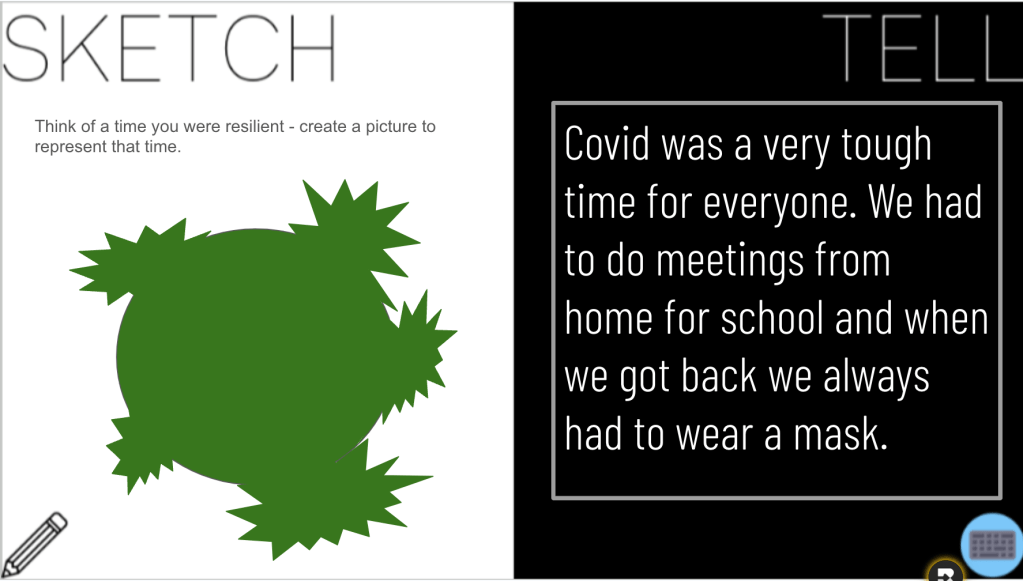
With marginalized groups, I think one thing that often gets overlooked is the resistance and resilience these groups displayed against their oppressors. So, I always try to focus on resistance and resilience when I can. For this lesson, I put together some Justin Unruh templates. I began with a Sketch and Tell as a preview activity, asking the students, “Think of a time you were resilient – create a picture to represent that time.” I wanted the kids to connect resilience from their lives to what we were studying.
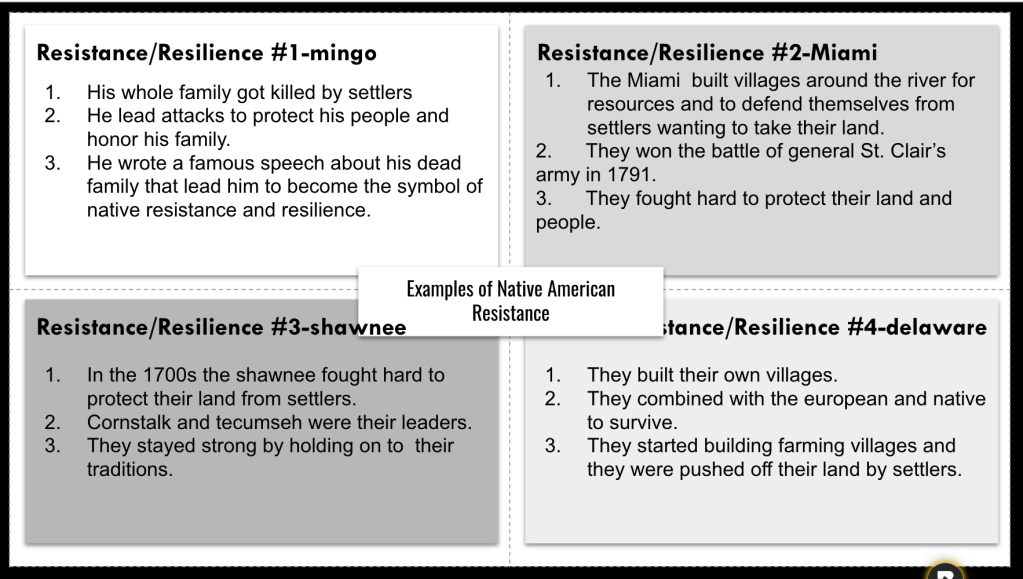
To prepare for the lesson, I had ChatGPT create 14 different stories of Native American resilience and resistance, pulled from a 38-page document on Native Americans of Ohio. I had ChatGPT adjust the stories to a 7th-grade level and provide context for each one. I then numbered the stories one through seven, cut them up, and placed them in envelopes around my classroom.
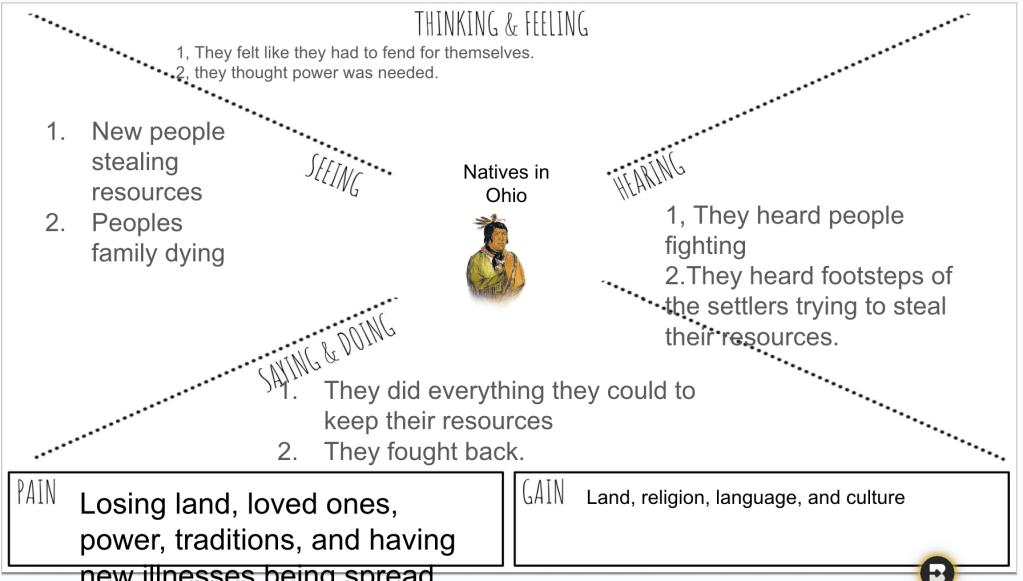
Students walked around the classroom, finding four different stories of resilience and resistance. They filled out a Frayer Model where they had to list three to four details from each story. At the conclusion of this activity, students completed an empathy map with details from their stories, putting themselves in the shoes of the Native Americans to understand what was causing them pain, what they were trying to gain, and what they were seeing, thinking, and feeling. Overall, I liked how this lesson shaped up, especially with the empathy map at the end.
Tuesday
On Tuesday, we reached the final portion of our unit on Native Americans from Ohio. So far this school year, I’ve been dealing with many student absences and trying to figure out how to work around that. It’s challenging when I’m still teaching students how to use some of the EduProtocols and they miss days.
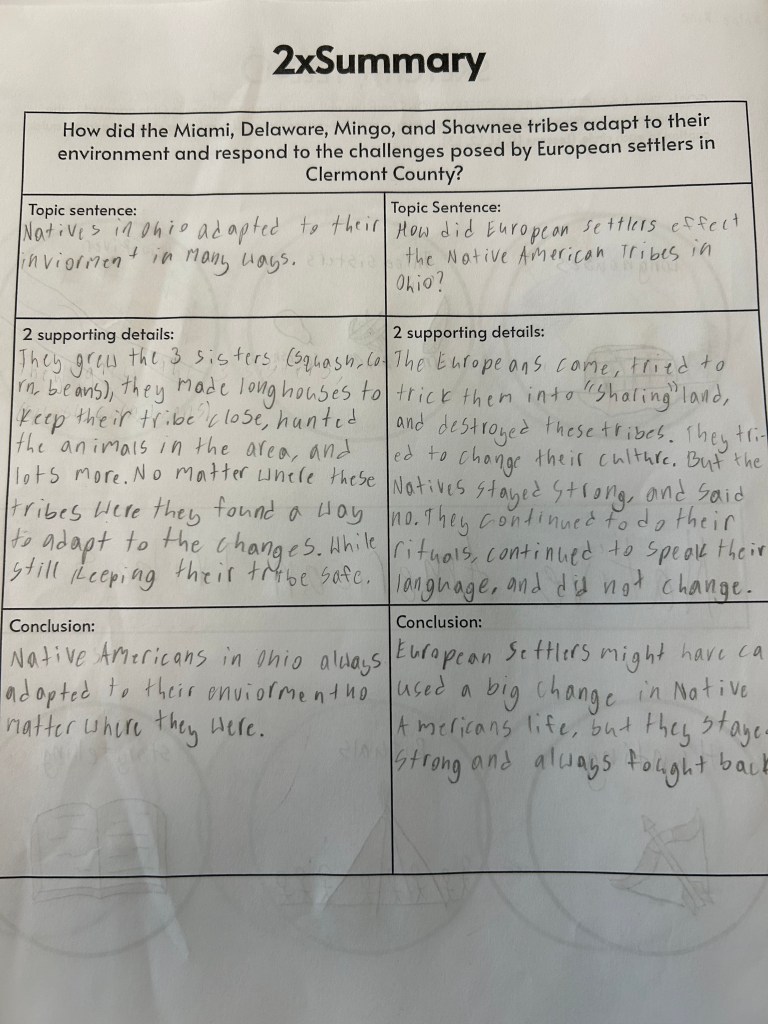
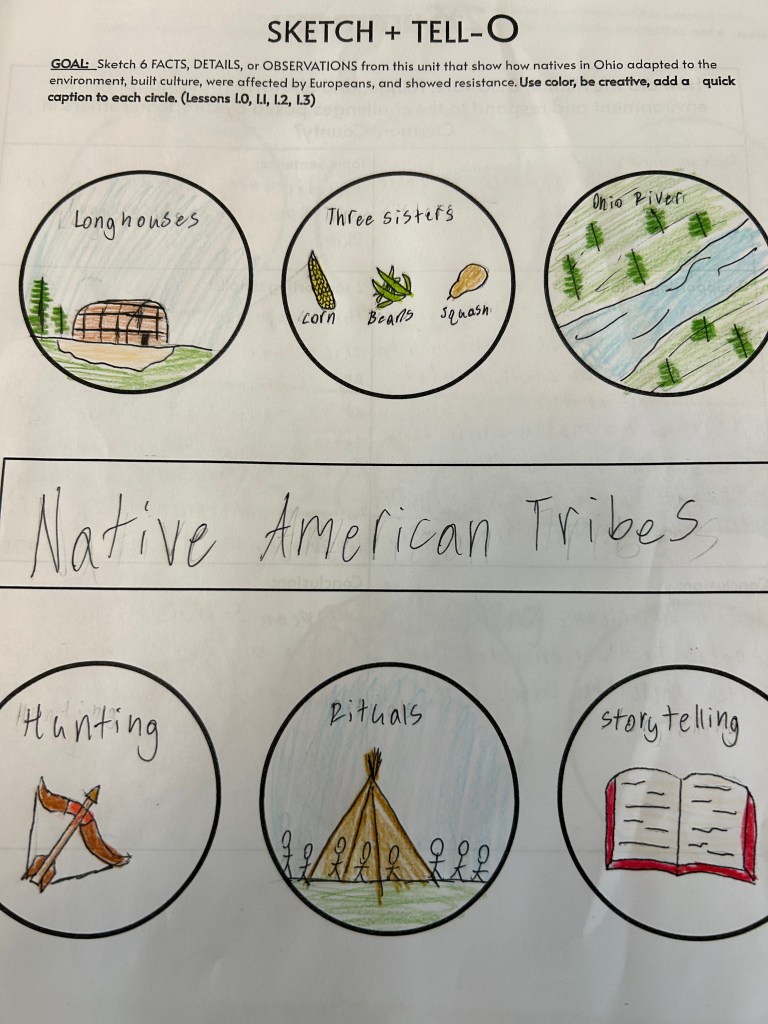
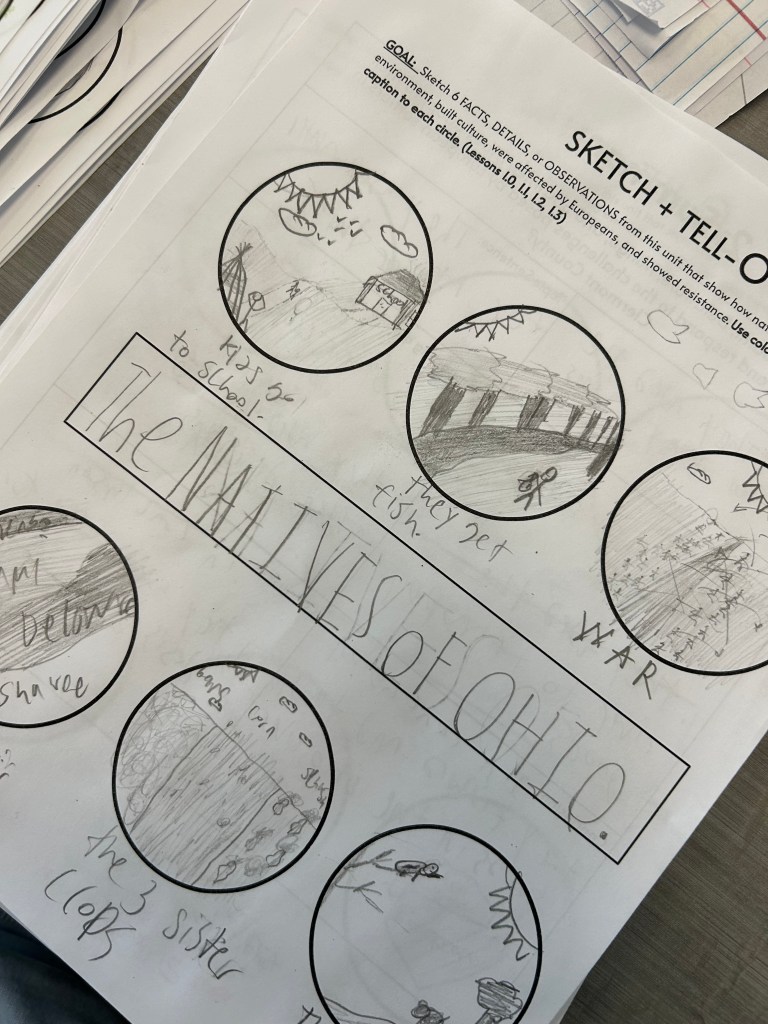
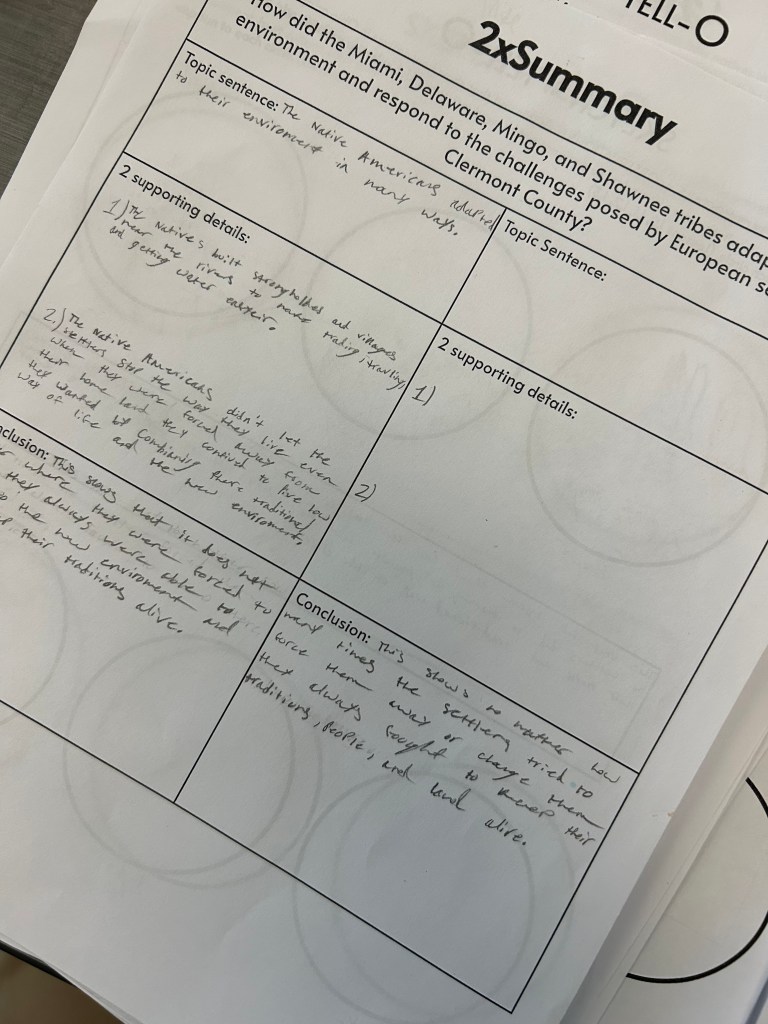
I needed to create an assessment that would allow all students to demonstrate what they learned, whether they were present in school or not. I settled on doing a Sketch and Tell where students would share six images and captions of anything they learned in this unit. In the middle of the paper, I wanted them to list out the main idea of the entire unit as well.
To make the assessment more comprehensive, I added a 2xSummary on the back of the Sketch and Tell. This graphic organizer had students think about a topic sentence that addressed our compelling question for the unit. Then, they had to include two details to support their topic sentence and write a concluding sentence twice.
Part of this assessment also included doing the Gimkit Fast and Curious that we had been doing since last week. I offered a deal to all my classes: if everyone answered 18 or more questions individually and the class average rose above 90%, I would give everyone a 100%. Out of my four Social Studies classes, two classes were able to meet that expectation.
Wednesday
On Wednesday, we needed 15 minutes to finish up the assessment from Tuesday, which was the Sketch and Tell and the 2xSummary. Considering this day was 9/11, I had a 9/11 lesson planned using Storyfile.
To begin my lesson on 9/11, I showed a news clip about a survivor from that day. I prefaced it by asking students to think about the survivor and consider what questions they could ask if they had the chance. The news clip was about 2 minutes long.
Following the news clip, we did a Wicked Hydra activity. I had the students pair up in groups of three to four people and write “9/11 Survivor” in the middle of a big piece of paper. From there, I wanted the students to start writing questions they would ask a survivor from 9/11. I gave them 8 minutes to come up with questions as a group, then had them pass the papers around the room to new groups who added more questions after 3 minutes. This process was repeated once more before the papers returned to the original group.
Next, I gave them a Frayer Model and asked them to choose the four best questions from their paper. Each quadrant of the Frayer Model contained one chosen question. Then, I had the students access Storyfile, a website where historical figures, famous people, and everyday individuals can be recorded giving responses to different questions. It’s a way to preserve history and create an interactive experience with historical figures.
In this case, Storyfile featured a 9/11 survivor, and the students could now ask their questions, to which the survivor may or may not respond. I explained to the students that an important life skill is being able to ask good questions, and if the survivor wasn’t responding to their question, it might not have been a good one.
At first, the students were a little freaked out because it seemed like the person was live on video. However, I explained that it’s just a collection of recorded videos spliced together, using AI to identify keywords from their questions and determine whether to answer or not. This was an engaging lesson and a way for students to understand the impact of 9/11 on those who lived through it.
Thursday
On Thursday, I started a new unit on exploration. I’m approaching it differently this year, focusing solely on Spain, France, the Netherlands, and Portugal, and how these countries explored around the world and eventually into the Americas. There’s also an emphasis on the things students learned in 7th grade and how they impacted European exploration, such as the Renaissance, the Crusades, Muslim explorers, and Rome.
I began the unit with vocabulary words such as Renaissance, caravel, astrolabe, colony, and mercantilism. I wanted to focus on students using context clues to create definitions for these words. To achieve this, I had ChatGPT use every vocabulary word in a sentence so students could use context clues to create their own definitions.
I printed all of these sentences, numbered them, and put them in envelopes around my room. Students worked together to fill out an organizer where they wrote down the word, read the sentence, came up with their own definition, and drew a symbol for the definition and word. When they finished each word, they would bring it to me for feedback. If it was good, they rolled a 20-sided die to determine how much that envelope was worth. At the end of the lesson, the group with the highest point total got to pick from my unimpressive prize box.
Following this game, we played two rounds of Fast and Curious on Blooket. This activity completed the class, and I really enjoyed the idea of students using context clues to create their own definitions.
Friday
On Friday, we did one quick round of Fast and Curious on Blooket with our vocabulary words from the previous day. We immediately followed this up with Gimkit, where I had 10 questions on continents and countries related to all the continents and countries we would be discussing with exploration. We did a quick 4-minute round on Gimkit, I gave some quick feedback, and then we did a quick 3-minute round just to become familiar with our continents and countries. The Gimkit included topics like Europe, Asia, Africa, North America, South America, France, Spain, the Netherlands, the United Kingdom, and Portugal.
Following this, I put together some Justin Unruh templates, and we started off with a Frayer Model with the term “CE” or Common Era. Students wrote a definition, used examples, non-examples, and used Common Era within a sentence. I started this lesson by building geographical knowledge of continents and countries, and I included CE because these concepts were used heavily in the reading we would be using for the Iron Chef activity.
Next, we did a Map and Tell where I had a map of the Crusades. We talked about sourcing the map, and I had a few questions such as “How do the routes on the map differ?” and “Here is a statement: ‘The Crusades stimulated European exploration.’ How does the map prove this statement true?” I also wanted the students to move stars to label Spain, France, and the United Kingdom as they looked at the map on a more global scale.
Next, I handed out the reading from our textbook. I’ve been doing a lot of reading aloud to the students because that’s what’s necessary right now in my classroom. It’s been a lot of hand-holding and walking them through it, but I’ve got to do what’s necessary at this point. The reading focused on Rome trading with China, Muslim explorers, and the Crusades.
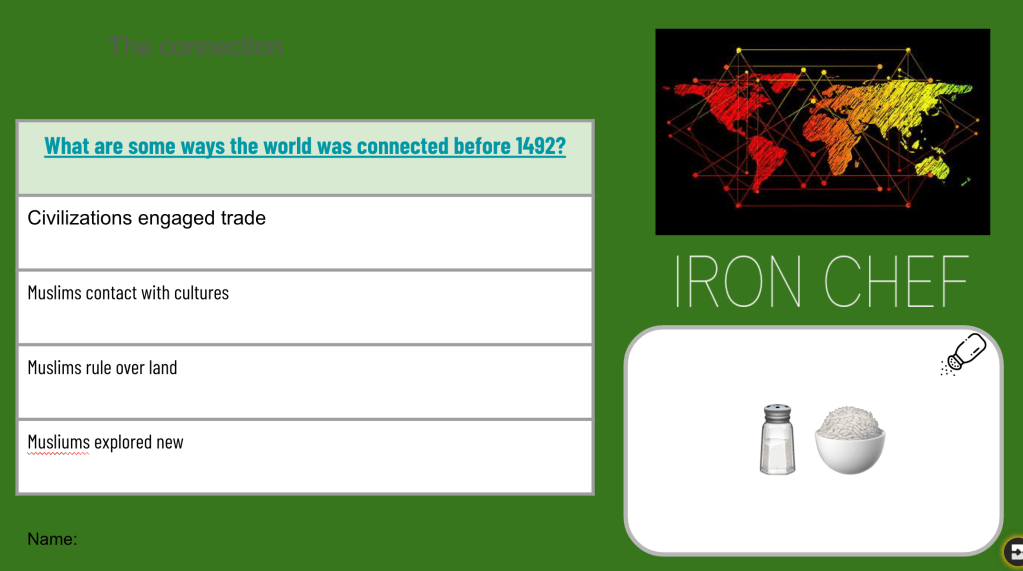
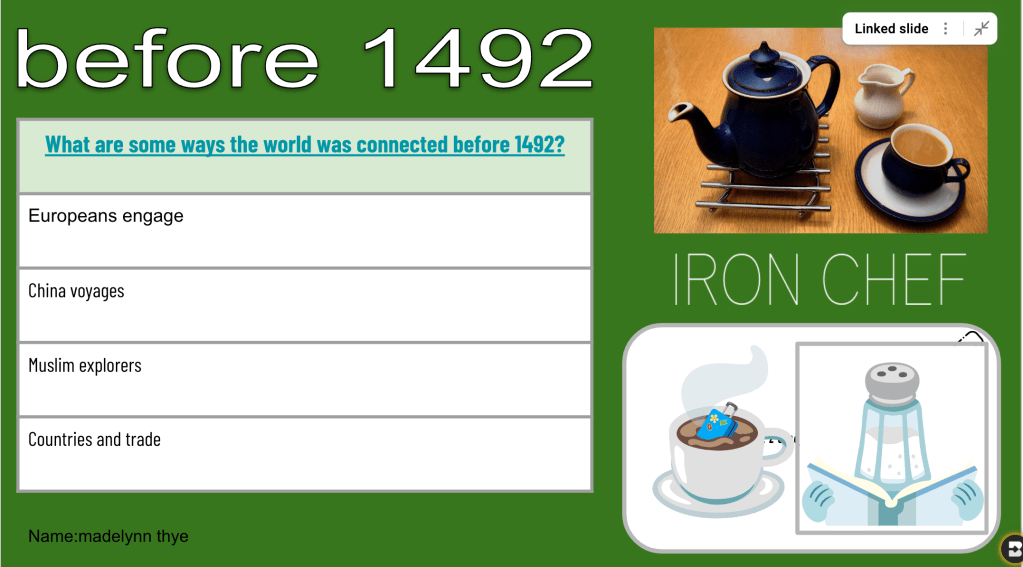
For the reading on the Iron Chef, I asked the question, “What are some ways the world was connected before 1492?” As I read, I had the students think about highlighting four ways the world was connected. At the conclusion of the reading, they had to transfer their information to the Iron Chef template. They also had to change the title to fit the main idea (as we’re still focused on that skill), add a picture, and include two emojis to show things that were traded in the world at this time.
Here’s the twist: I rolled dice to determine how many words they had to use when transferring and typing their highlighted information. One particular class had to choose the most important information because the dice roll came up as two. Another class had a dice roll of three, so they had to choose important words. I love this because they have to determine what’s important and paraphrase.
As they were building their Iron Chef slides, which took 10 minutes, I copied and pasted their slides into one slide deck. What’s nice about Google Slides is that I can link the copied slide back to their original slide, and it updates on mine in real time. At the conclusion of 10 minutes, I put the new slide deck of their Iron Chef slides on the classroom screen. I had them close their Chromebooks, and right from their desks, they had four seconds to present one thing that connected the world that they learned about. I use the word “share” because it’s less threatening than “presentation,” and these kids did awesome. That’s how we ended class today – it was a great day!

 Moler's Musings