Introduction
As a social studies teacher, I’m always looking for ways to make history relevant and engaging for my 8th-grade students. Recently, I leveraged AI to design a comprehensive lesson about Native Americans in Clermont County, Ohio. While our textbook covers Native Americans in North America broadly, I wanted to create a unit that would help students understand how their local area played a significant role in American history.
I began this process by uploading Ohio state standards and relevant textbook chapters to ChatGPT. After analyzing the standards related to Native Americans (or American Indians, as they’re sometimes referred to), ChatGPT helped determine what 8th-grade students should know about this topic. It then created and aligned questions for a 5 to 6-day unit, including a compelling question and supporting questions. This approach ensured that our lessons would meet state requirements while providing a localized, meaningful context for our students.
To maintain consistency with our existing curriculum, I had ChatGPT analyze the style and tone of the textbook readings. I then sourced local Native American history documents and had ChatGPT align them with the supporting questions, matching the textbook’s style. This step was crucial in creating a seamless integration between our standard materials and the new, localized content. ChatGPT also created a list of unit vocabulary words, ensuring we covered all necessary terminology.
With this solid framework in place, I selected EduProtocols based on data I had collected on my students’ needs and the specific literacy skills we needed to work on as a class. These protocols, developed by educators for educators, provide engaging, repeatable instructional strategies that can be used across various subjects and grade levels.
Finally, I used ChatGPT to create Gimkit multiple-choice questions aligned with the readings and standards. Gimkit, a gamified learning platform, would serve as both a formative assessment tool and an engaging way for students to interact with the material.
Throughout this process, I utilized EduProtocol templates created by Justin Unruh to plug into my unit framework. I tried to use EduProtocols we have been using to build in reps. I also tried to build in literacy skills my class needs to work on – identifying main idea, summarizing, and understanding perspectives.
Tuesday – EduProtocol Rack and Stack (Iron Chef, Frayer, Map and Tell), Gimkit Link
Wednesday – EduProtocols Rack and Stack (Frayer, CyberSandwich)
Thursday and Friday – EduProtocols Rack and Stack (Map and Tell, Iron Chef, Thin Story)
Tuesday
We kicked off the unit with our compelling question: “How did the Miami, Delaware, Mingo, and Shawnee tribes adapt to their environment and respond to the challenges posed by European settlers in Clermont County?” This overarching question would guide our exploration throughout the week. Our supporting question for Tuesday was more specific: “How did the Miami, Delaware, Mingo, and Shawnee tribes use their environment to meet their basic needs?”
I began class with a simple yet revealing question: “Who can name a Native American group that inhabited Clermont County?” Surprisingly, only three students across all my classes could name one – the Miami. This highlighted the importance of our upcoming lessons in building local historical knowledge.
We then moved to Gimkit, using the questions I had prepared. Initial class averages ranged between 59% and 68%, which was lower than I’d hoped. I quickly realized that students were often choosing the longest answers, assuming they were correct. This led me to refine the questions, ensuring all options were of similar length – a valuable lesson in question design!
Transitioning to our main activity, we engaged in a Map and Tell exercise exploring prehistoric migration to the Americas. We examined maps showing ancient land routes from Asia to North America, which sparked lively discussions. Students debated factors like climate change, food availability, and population pressures that might have influenced these epic journeys.
To connect this broader history to our local area, we located Ohio on the continental map and then zoomed in on a detailed, illustrated map of Clermont County. Students played detective, hypothesizing about Native American settlement locations based on geographical features like rivers, forests, and natural resources.
Following this, I implemented the Iron Chef EduProtocol, a strategy designed to help students engage deeply with content while practicing essential skills. Students created individual slides with a title (representing the main idea) and five facts about how specific Native American groups adapted to their environment. They had 15 minutes for this task, encouraging focused work.
Next, students reviewed each other’s slides, listing four key facts for each group in a Frayer model. This peer review process not only reinforced learning but also exposed students to multiple perspectives on the same information.
We concluded with the Emoji Kitchen concept, where students combined emojis to represent how Native Americans adapted to Ohio’s environment. This creative element allowed students to synthesize their learning visually, appealing to different learning styles and encouraging out-of-the-box thinking.


Wednesday
We continued our exploration of Native American tribes in Clermont County, shifting our focus to the supporting question: “How did the culture of the Miami, Delaware, Mingo, and Shawnee tribes shape their daily lives and help them thrive?”
The class began with a rolling recap using a 20-sided die, a strategy that combines retrieval practice with an element of chance. I posed questions about the previous day’s material, and students had to craft responses using the exact number of words as their die roll. This exercise not only reviewed key concepts but also challenged students to be concise and precise in their communication – valuable skills for any subject.
Next, we delved into defining culture using a Frayer model. This visual organizer helped students break down the complex concept of culture into its definition, characteristics, examples, and non-examples. It was particularly effective in helping students understand the multifaceted nature of Native American cultures.
Building on this foundation, we transitioned into a CyberSandwich activity. This structured approach, another EduProtocol strategy, allowed students to engage deeply with the content while developing their writing skills. The activity consisted of three parts:
- A 10-minute reading and note-taking session, where students gathered information about how the tribes’ culture influenced their daily lives.
- A 5-minute discussion period, allowing students to share insights and clarify understanding with their peers.
- A 10-minute writing exercise, where students crafted a paragraph with a clear topic sentence, two supporting details, and a concluding sentence.
This writing sample gave me valuable insight into their comprehension and writing abilities, allowing me to identify areas for further instruction.
To round off the class, we revisited our Gimkit questions. I was pleased to see improvement, with class averages rising to 70-75%. This progress indicated that students were solidifying their understanding of the material and becoming more comfortable with the content.
Thursday
I began Thursday’s lesson by leveraging AI to enhance our writing process. I created a Claude AI artifact designed to provide feedback on students’ CyberSandwich paragraphs from the previous day. The artifact was primed with the article we had read and a custom rubric featuring potential topic sentences, supporting details, and concluding sentence keywords.
While the results were still somewhat variable, it was a noticeable improvement from the previous week’s thick slide link submissions. Students seemed to appreciate the AI-generated feedback and made substantial revisions based on the suggestions. They submitted their revised paragraphs through a Google Form for further assessment.
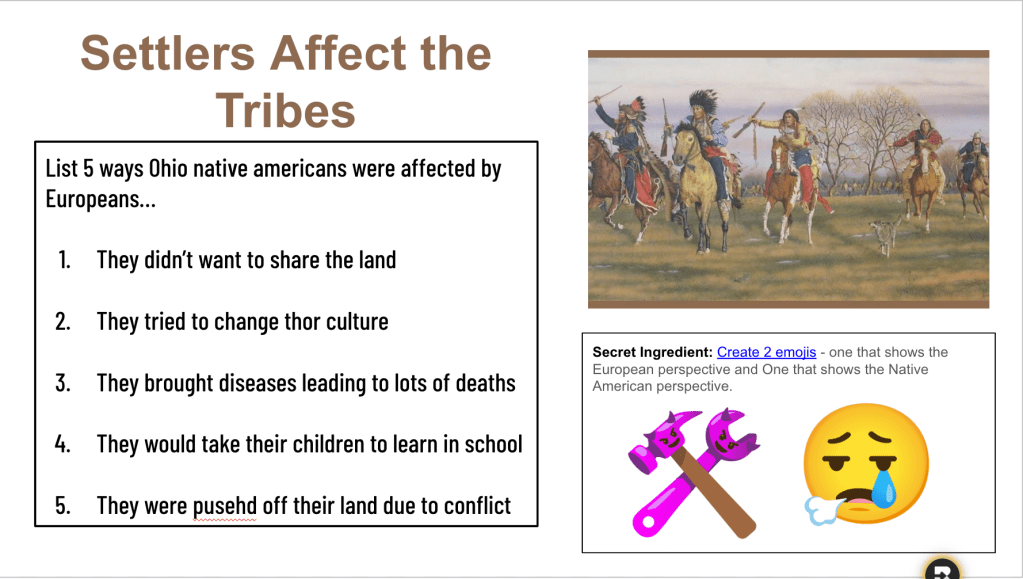
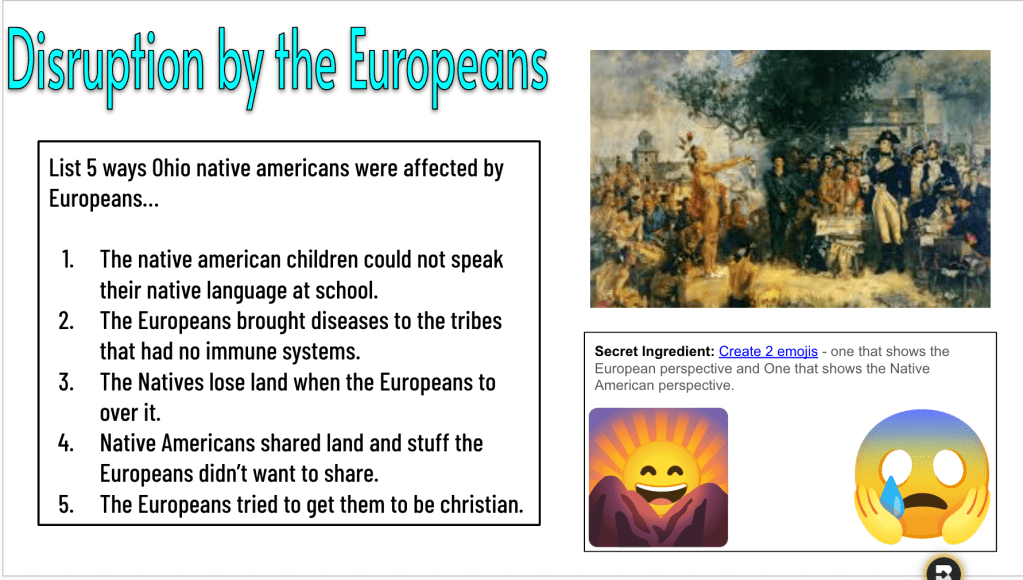
We then transitioned to our lesson on how European settlers disrupted the culture and way of life of Native American tribes in Ohio. I introduced an Iron Chef activity, challenging students to identify five ways Native Americans were affected by European arrival. To model effective main idea identification, I read an article aloud, deliberately connecting it to our previous lessons on Native American culture.
Students then had 10 minutes to create their Iron Chef slides, which included:
- A title representing the main idea
- A relevant picture
- Five key facts about European impact on Native Americans
- A “secret ingredient” section with an Emoji Kitchen creation to visually represent a perspective
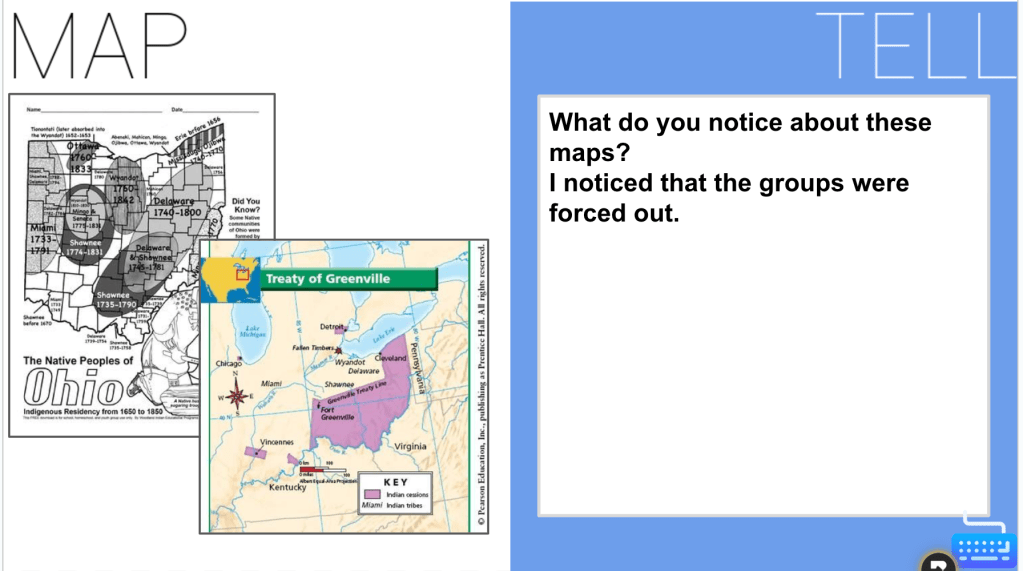
Next, we engaged in a Map and Tell exercise, comparing two maps: one showing Native American territories throughout Ohio, and another illustrating the effects of the Treaty of Greenville. This visual comparison helped students grasp the dramatic shift in Native American land holdings and the profound impact of settlement.
We concluded the class with another round of Gimkit. I was pleased to see a significant improvement in performance, with class averages rising from 75% to 90%. This progress indicated that students were consolidating their understanding of the complex relationships between Native Americans and European settlers in Ohio.

Friday
On our final day of the unit, we began with an engaging activity called “Doubling Details.” The initial prompt was “How were natives in Ohio affected by Europeans?” Students had to respond in exactly 8 words, encouraging concise, focused thinking. Next, they paired up to combine their ideas into a 16-word response. Finally, groups of four created a 32-word summary. Each round lasted 3 minutes, keeping the energy high and ideas flowing.
To prepare for our deep dive into the Treaty of Greenville, I introduced key vocabulary through a Blooket game. We played two quick rounds with words like “boundary,” “hindrance,” and “cede” to ensure students were prepared for the treaty excerpts.
For the main activity, I employed an EMC2Learning content compactor to explore sections of the Treaty of Greenville. Here’s an example of one excerpt we examined:
“The general boundary line between the lands of the United States and the lands of the said Indian tribes, shall begin at the mouth of Cayahoga river… thence southwesterly in a direct line to the Ohio River….”
I modeled the process of analyzing these excerpts using an “I do, we do, you do” approach. We summarized each excerpt, distilled it to a single word, and then added a picture for dual coding. However, when it came time for independent work, many students struggled. I allowed this struggle to continue until it verged on chaos, as I’m committed to building their confidence and resilience. While progress feels slow, I’m confident we’ll get there.
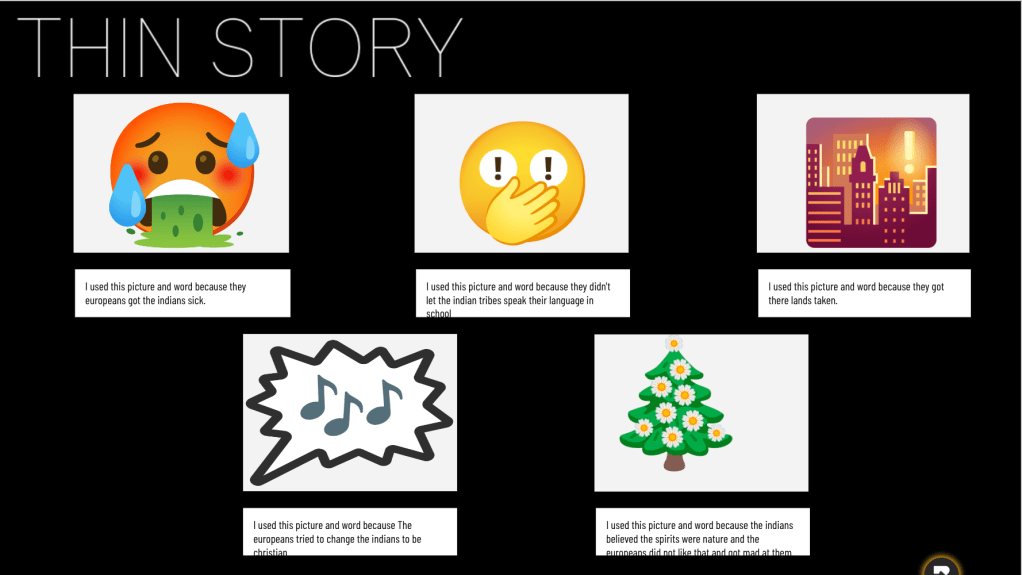
We concluded the lesson with a Thin Story activity. Students created a single image and word to represent how Native Americans were affected by Europeans, synthesizing all we had learned throughout the week.


Reflection
Throughout the week, these lessons combined various skills including vocabulary building, historical analysis, summarization, and visual representation. By using a variety of EduProtocols and technology-enhanced strategies, we were able to engage students in deep, meaningful learning about a complex historical topic.
The use of AI in lesson planning and feedback proved to be a valuable tool, allowing for more personalized and efficient instruction. However, it’s clear that the human element – the ability to adapt in real-time, to push students just the right amount, and to create a supportive classroom environment – remains crucial.
As we move forward, I’m excited to continue refining these strategies, always with the goal of making history come alive for my students and helping them see their place in the ongoing story of our community and nation.

 Moler's Musings