Introduction
So far this school year is flying by. I’m really enjoying my new schedule. My day begins with teaching two 65-minute social studies periods, followed by a plan period, co-teaching a reading workshop with an ELA teacher, and ending the day with two more 65-minute social studies classes. It makes for a nice day, allowing for in-depth lessons and sufficient time to transition between subjects.
At the beginning of the year, the name of the game is teaching the process and procedures of EduProtocols. I like to begin the year smart by starting with the following EduProtocols: Wicked Hydra, Frayers, 3xCER, 8Parts, Thin Slides, and Sketch and Tell. These are pretty basic, and I use them throughout the entire school year. They provide a solid foundation for critical thinking and engagement. I will introduce more in-depth protocols as the year progresses, such as CyberSandwich and Thick Slides, which build upon these basic skills.
Monday – Resource Rumble
Tuesday – Fast and Curious on Gimkit
Wednesday – Practice, Sketch and Tell-o
Thursday – Why We Study History
Monday
We began the day with no Chromebooks, so I needed a new plan. I had to introduce the syllabus. Last year, I used an escape room, but without Chromebooks, I needed something different. Enter the Resource Rumble from EMC2Learning. I used AI to create some puzzles and questions based on my syllabus related to the rules and procedures. I took the questions created by AI and placed them in 8 “treasure chests” around the room. The students had 25 minutes to complete all the treasure chests and have me check their work. This activity not only introduced the syllabus content but also encouraged teamwork and problem-solving.
A true Resource Rumble involves Jenga blocks, but mine were on the Amazon truck. I switched to a new plan and used dice instead. I have several different styles of dice, including one that has numbers one through twelve. After each group brought up their answer, I had them roll the dice to determine how many points the chest was worth. At the end, I had them add up their points. The winning group got to choose from my Unimpressive Prize Box, which contains small, quirky items that surprisingly delight the students.
Following this activity, we did a quick overview of the syllabus, ensuring everyone understood the key points. We then moved on to some Frayer a Friend, to make more connections. By the end of the day, the students finally received their Chromebooks, setting us up for more tech-integrated lessons in the coming days.
Tuesday
Now that we had Chromebooks, it was great to finally introduce the Fast and Curious. I was surprised at the number of students who had never played Gimkit. Since so many students were unfamiliar with it, I found a 4th-grade trivia Gimkit to introduce the game. I set the time limit for 8 minutes to let them explore, but I didn’t tell them anything – I wanted them to figure it out on their own.
Next, I ran another 4th grade trivia Gimkit round with less time, but challenged them to answer more questions and raise the class average. Following this, we did another round where I introduced the states – 50 questions, 50 states. My goal is to have the students know their states with 90% accuracy. It’s a work in progress, but Gimkit’s game-like structure makes this typically dry subject more engaging.
For another round of Gimkit, I had half the class close their Chromebooks and partner up to work together to answer questions. This variation promotes collaboration and peer teaching. If we had any time left, I had students complete another Frayer a Friend continuing to make more connections and learn the process of using a Frayer model.
Wednesday
We began class with a Dominic Helmstetter special – a great Smart Start for the Sketch and Tell-o with gold medals. I had students choose an Olympic event they would gold medal in and one non-Olympic event they would gold medal in. They had to draw a symbol and provide an explanation for why they would win a gold medal. This took about 20-25 minutes and served as a fun warm-up activity that also encouraged creativity and self-reflection. It also agve me a chance to understand the interests of the students.
We followed this up with another Gimkit on states, continuing to build their geography knowledge. I was ready to move into content and the question of “Why do we study history?” However, I realized I had a problem: we hadn’t really practiced much on Chromebooks. We had done Sketch and Tell and Thin Slides on paper, but not much with Chromebooks. This needed to change to ensure students were comfortable with the digital tools we’d be using throughout the year.
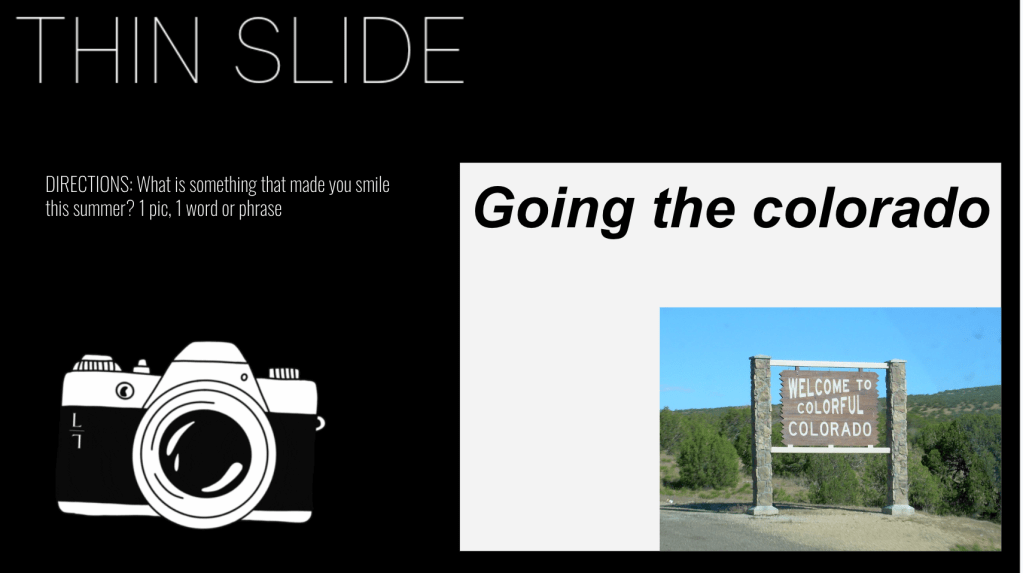
I stopped the lesson and created some practice slides using Justin Unruh templates. I put together a Thin Slide utilizing Google Slides, a Thin Slide utilizing Padlet, and two Sketch and Tells. I wanted to show how Padlet could be utilized for the “I can’t draw” feature, as it uses AI to generate images that can be used for Thin Slides. This introduction to various digital tools will prove valuable as we incorporate more tech-based activities.
For the Smart Start question, I asked, “What is a food no one should eat?” I gave students 3 minutes to create their responses. They put their name as the “subject” and wrote their one word or phrase in the body of the post. After 3 minutes, I selected “freeze Padlet” and then hit the play button, which turned it into a slide presentation. By using Padlet, students can’t mess with each other’s slides, ensuring a smooth presentation process.
Following our Thin Slides, we used a regular Sketch and Tell. The prompt was, “What is a food you can eat every day for the rest of your life?” It became apparent that I had to show them where Google Shapes was located on the toolbar and how to change colors and duplicate shapes. We clearly have some Google tech learning that needs to be done! I chose these specific EduProtocols because I would be using them in the near future, and this practice session helped identify areas where students needed more support.


Thursday
I began class with a Literacy Skills Entry exam from our McGraw Hill book. I noticed two exams – Historical Thinking Skills and a Literacy Skills exam. I decided the Literacy Skills entry exam was what I was going to use. I have every student with an IEP this year, and I wanted an idea of our ability to understand main ideas, inferences, context clues, and perspectives. This baseline assessment will help me tailor future lessons to meet the specific needs of this year’s class.
The original exam was 20 questions, which seemed like overkill. I had AI analyze the entire exam and every question for the skills being assessed. From there, I reduced the 20 questions to 8. This exam took 20 minutes. At the end of the day, I had AI create a rubric for the exam, and then I took all the students’ responses and correlated them with the rubric. The data I received provided good baseline information that will inform my teaching strategies moving forward.
For my original lesson on “Why do we study history?” I had a CyberSandwich ready to go. However, after some thought and knowing the students I had in front of me, I realized a new protocol would be too much. Instead, I put together a Thin Slide with the prompt, “What is an event that families would try to record and retell?” I gave them 3 minutes and stuck to my timer. This activity helped students connect historical thinking to their personal experiences.
Next, I included a Frayer with the word “continuity.” Under the “define” heading, I had AI create a sentence that could be used to help students use context clues to create a definition. The sentence was: “The movie series kept the same main character and story from one film to the next, providing continuity that helped viewers follow along easily.” For the other boxes, students had to find examples, non-examples, and a picture. I was hoping the Frayer would take 5 minutes, but it took about 8 to 10 minutes. This extra time was well-spent as students grappled with this important historical concept.
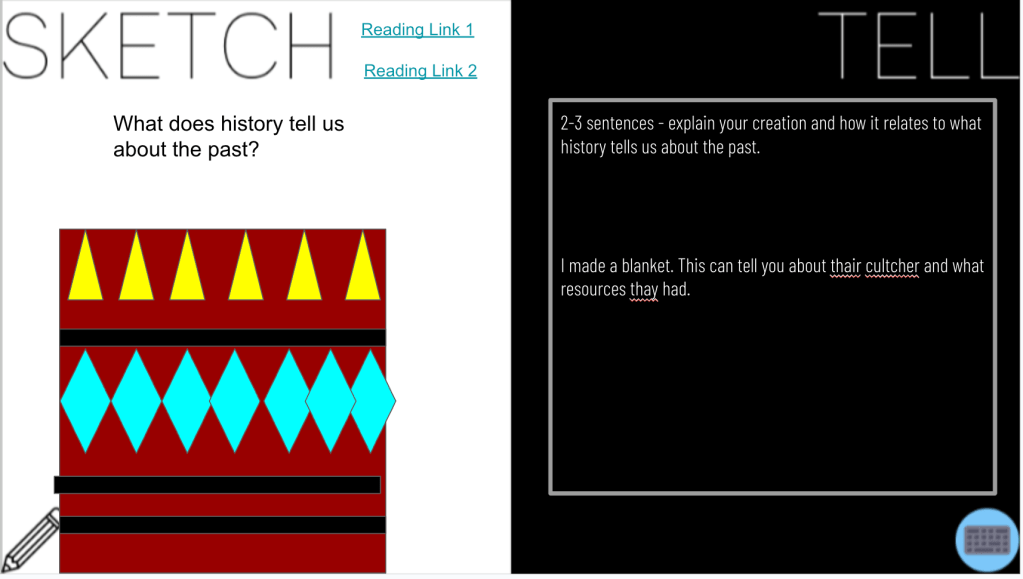
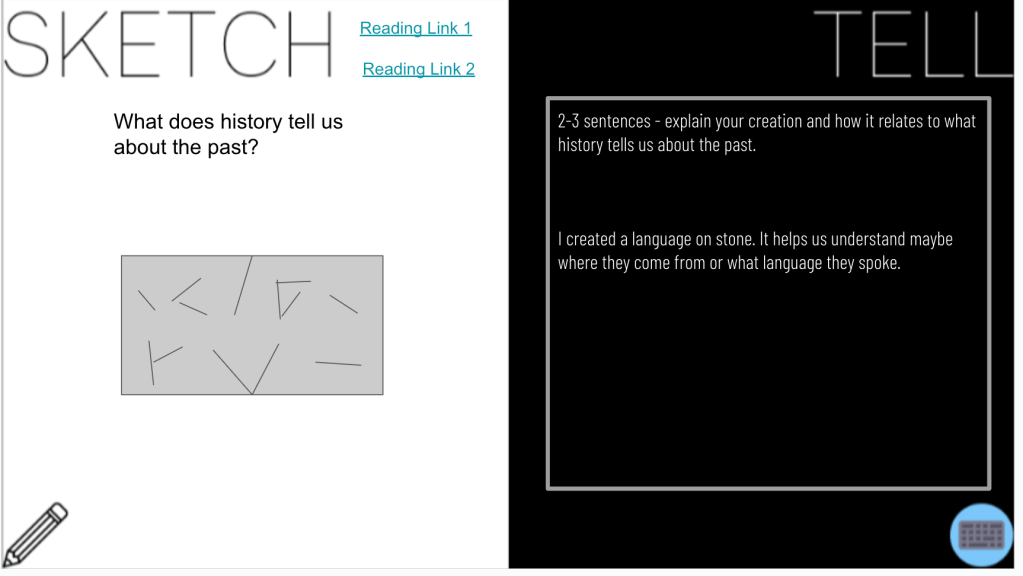
Following the Frayer, I had two Sketch and Tells ready to go. I linked the section from the textbook and asked, “Why do we study history?” The goal was to create a sketch with Google Shapes based on the reading and explain it with 2 to 3 sentences. Students had 10 minutes to complete both Sketch and Tells. That was a bit of a struggle, but I still had them turn it in. I’m learning I have my work cut out for me this year – I’m trying to help the students own their learning through protocols and timers. This process of productive struggle is essential for developing their historical thinking skills.



Friday
On Friday, I continued our historical thinking skills unit. This new book has a lot to it. It’s overwhelming and, like most textbooks, restricting, but I’m trying to analyze the teacher edition and think about which skills they’re trying to get the students to use. This helps direct my use of EduProtocols and ensures that I’m meeting curriculum standards while using engaging teaching methods.
The new topic today was, “How do historians use primary and secondary sources?” I felt like I had overwhelmed the students yesterday with too much, so I decided to simplify it and stick to a Frayer about primary and secondary sources. I provided a sentence created by AI to help them use context clues to create a definition. This approach allowed us to focus deeply on these fundamental concepts in historical research.
We began class with a Gimkit of 10 questions related to why we study history and primary and secondary sources. The class averages were between 72% and 79%, showing a decent grasp of the concepts but room for improvement. We followed this up with a Frayer on primary and secondary sources, reinforcing the ideas through a different learning modality.
Instead of using the textbook section on historians using various sources, I used a Dan Lewer “History for Humans” lesson. It provides a scenario set in the year 3240, where students are historians looking back on the lives of teenagers from 2024. I provided students with a graphic organizer, and they had to select artifacts or sources from their backpacks, write down observations, make inferences, and ask questions. Students used Chromebooks, phones, Stanley water bottles, pencils, and books as their artifacts. They did an excellent job with this activity, really getting into the role of future historians and understanding how everyday objects can become historical sources.
I also reminded them that they had started thinking like historians last week with a Wicked Hydra, asking questions about pictures related to me. They had also begun this process with the 8Parts activity, analyzing a historical photo. We didn’t finish this historical thinking activity and will continue on Monday, allowing for a deeper exploration of these skills.
We finished class with a Gimkit challenge: get above a 90% class average, and everyone receives 3 PBIS points. The class averages ranged from 82% to 92% – every class raised their average. This friendly competition helped reinforce the concepts we’d been learning all week while adding an element of fun to end the week.
Closing
As I reflect on this week, I’m pleased with the progress we’ve made in introducing various EduProtocols and historical thinking skills. The students are gradually adapting to the new technologies and methodologies, even if there’s still a learning curve. It’s clear that flexibility is key – whether it’s dealing with unexpected Chromebook delays or adjusting lesson plans on the fly. I’m particularly encouraged by the students’ engagement with activities like the Resource Rumble, Gimkit challenges, and the futuristic historian exercise. These activities not only make learning more interactive but also help develop critical thinking skills essential for studying history.
Looking ahead, I plan to continue refining my approach, balancing between introducing new concepts and reinforcing the basics. The baseline data from our literacy skills assessment will be invaluable in tailoring future lessons. As we delve deeper into our curriculum, I’m excited to see how the students will grow in their ability to analyze sources, make connections, and think like historians. It’s been a challenging but rewarding start to the year, and I’m looking forward to what the coming weeks will bring. Onward to another week of discovery in 8th grade social studies!

 Moler's Musings