This week was our last testing week, so we had two shortened class periods. I was continuing the causes of the Civil War and my essential question, “Which conflicts over slavery led to the Civil War?”
Last week, our focus was on compromises such as the Missouri Compromise, Compromise of 1850, and the Fugitive Slave Act. This week we focused on finishing up the Kansas Nebraska Act, learning about Uncle Tom’s Cabin, Dred Scott, and the Election of 1860. I have never really focused on the Election of 1860, so I wrapped some EduProtocols around a lesson from the Retro Report.
Monday – Sketch and Tell-o Analogies
Tuesday – Uncle Tom’s Cabin
Wednesday – Dred Scott, Amendments Sketch and Tell
Friday – Election of 1860
Monday
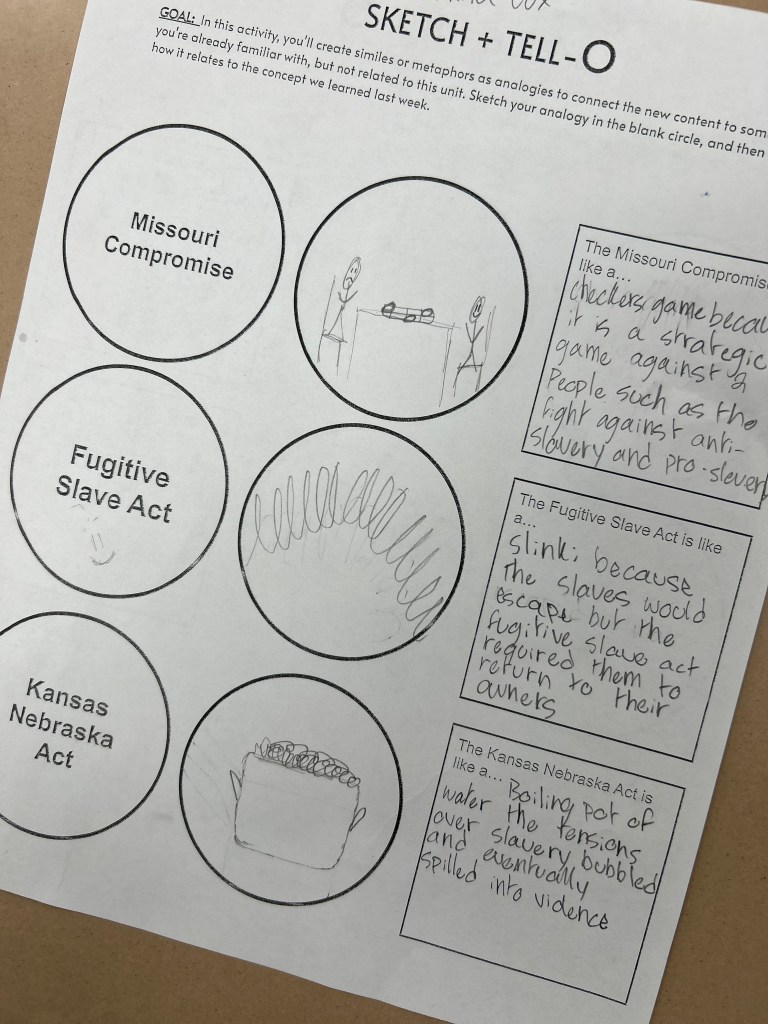
On Monday, I began class with a Sketch and Tell-o that had students thinking about analogies. I wanted them to review what they learned last week (Missouri Compromise, Fugitive Slave Act, Kansas Nebraska Act) by creating similes. For example, they would sketch and object for the simile connection and then write how the Missouri Compromise is like that object. We did this for 25 minutes and then moved onto the start of a new lesson.
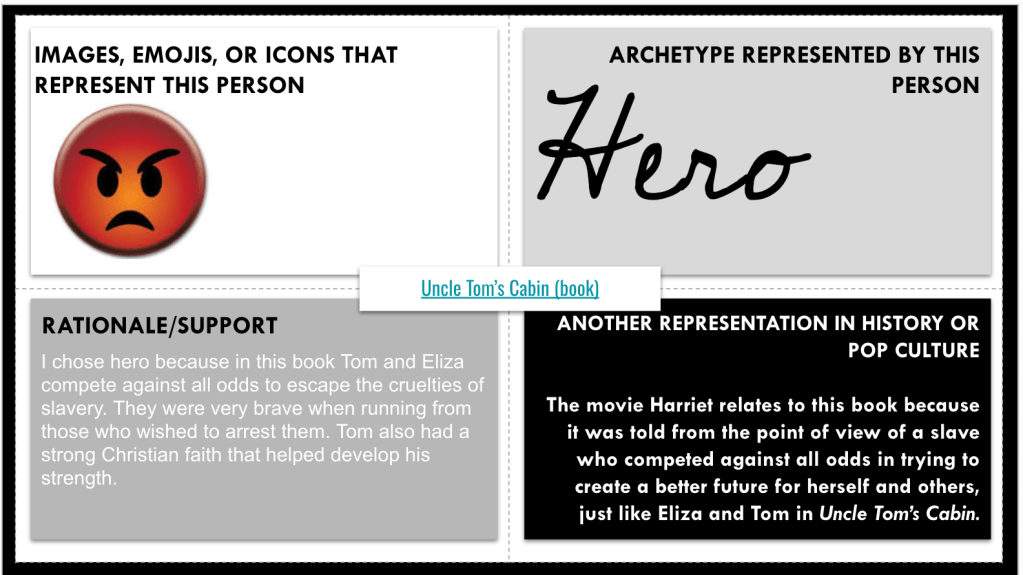
To introduce Uncle Tom’s Cabin, I used an Archetype Foursquare. In the middle of the archetype template, I linked an article about the background, plot, and impact of the novel. Students read through the information and decided which archetype they would apply to the novel and use supporting evidence. At the conclusion, I had students discuss why they chose a certain archetype to describe Uncle Tom’s Cabin.
We ended class with a Fast and Curious EduProtocol. I added some questions to the Gimkit about Uncle Tom’s Cabin. The class averages were down a bit because I added three new questions.
Tuesday
On Tuesday, we dove into a lesson on Uncle Tom’s Cabin. I adapted this lesson from from a textbook that my co-author, Dr. Scott Petri, contributed to – a resource written for schools in Texas that incorporates background information and primary sources to help students learn history.
Monday we had explored the background and significance of Uncle Tom’s Cabin. Tuesday, we focused on three chapters: Chapter 7 – A Mother’s Struggle, Chapter 30 – A Slave Warehouse, and Chapter 33 – Cassy. Students selected a chapter and designed a slide that featured a quote that would anger abolitionists. We then analyzed the quote together and considered how it reflected the harsh realities of slavery.
I was pleased with how engaged and motivated the students were throughout the lesson. By focusing on storytelling techniques and emotional language, Harriet Beecher Stowe created empathy and awareness about the devastating impact of slavery. I added an Annotate and Tell to the lesson with three excerpts from the ending of the book. On the slide, I had students focus on the arguments Stowe put forth against slavery, the audience she was appealing to, and why she would appeal to mothers.


Wednesday and Thursday
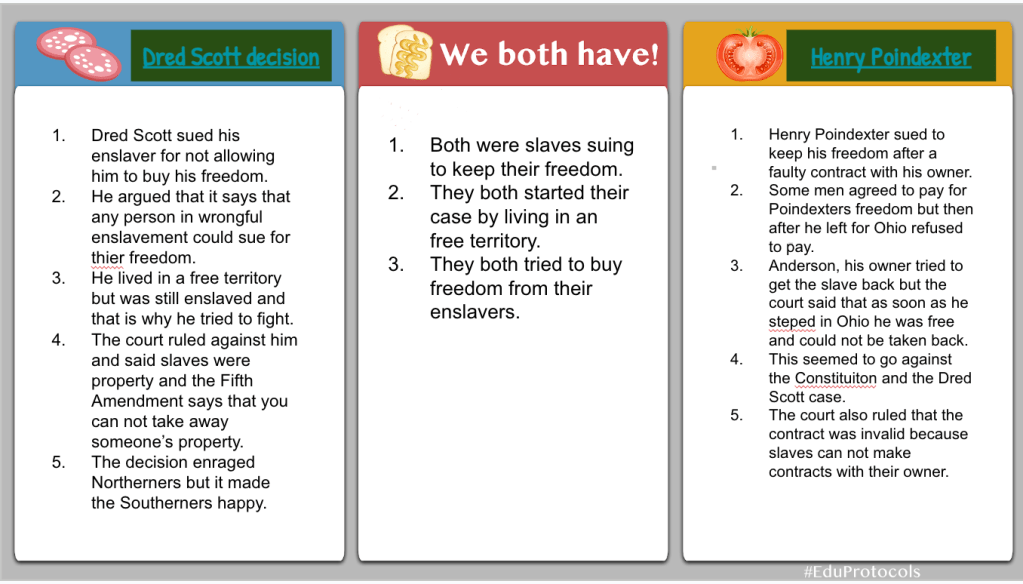
On Wednesday, we began learning about the Dred Scott case. I also use this as an opportunity to tie in some local history about Henry Poindexter who had a similar case in Ohio. As an educator, I always strive to connect historical events to the local context, making them more relatable and meaningful for my students. In this particular lesson, we discovered a remarkable similarity between the Dred Scott case of 1857 and a case involving Henry Poindexter in 1856.
Henry Poindexter signed a promissory note committing to pay $1,000 for his freedom. When his enslaver allowed him to cross the river into Ohio, specifically in New Richmond and Cincinnati, Henry decided not to honor the agreement, arguing that he was now in the free state of Ohio. Subsequently, his enslaver sued him, leading to a legal battle that reached the Ohio Supreme Court. Ultimately, the court ruled in Henry’s favor, declaring him free. This local connection offered a unique opportunity to understand the complexities of the time through a relatable lens.
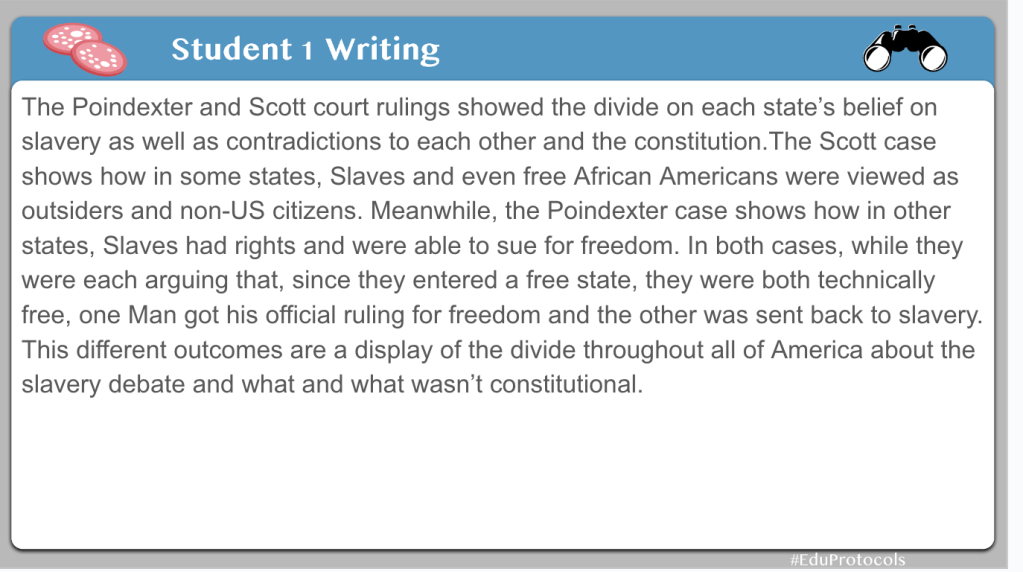
To deepen our understanding, we engaged in a Cybersandwich activity, comparing the Dred Scott case with Henry Poindexter’s legal battle. Students filled out a Venn diagram, identifying similarities and differences between the two cases. This exercise encouraged critical thinking, analysis, and reflection on the legal implications and consequences of each situation.
Following the Venn diagram, students composed a compare/contrast text structure to summarize their findings. This exercise not only reinforced their understanding of the cases but also developed their writing skills and ability to articulate complex ideas effectively.
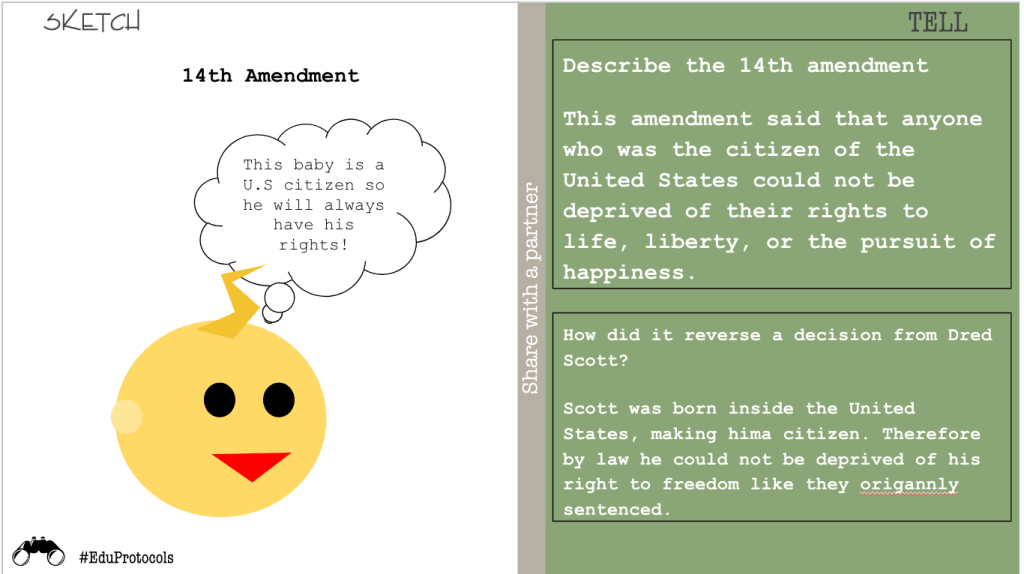
To further our exploration, we connected the Dred Scott case to the 13th and 14th Amendments, which had profound implications for civil rights and the overturning of the infamous decision. Employing a Sketch and Tell activity, students utilized Google Shapes to create visual representations of the 13th and 14th Amendments.
Accompanied by their sketches, students “told” the story of the amendments in their own words, explaining how each amendment played a significant role in nullifying the Dred Scott case decision. This exercise fostered creativity, critical thinking, and a deeper comprehension of the amendments’ impact on the course of history.
Thursday’s lesson was a cool exploration of local history intertwined with national events. By connecting the Dred Scott case to the story of Henry Poindexter, we provided students with a personal connection to a pivotal moment in our nation’s past. Moreover, examining the 13th and 14th Amendments enabled students to comprehend how the legal landscape evolved and how these amendments transformed the rights of individuals.



Friday
Friday I wasn’t at school and had a decision to make – do I post a summative assessment for my unit on the causes of the Civil War? Or, do I add one more lesson on the Election of 1860? The Election of 1860 lesson would be easy to put together and cause less problems – I went with this idea.
For this lesson, I adapted it from Retro Report. I started with this question, “How did the results of the 1860 presidential election show that the United States was becoming more and more divided?”
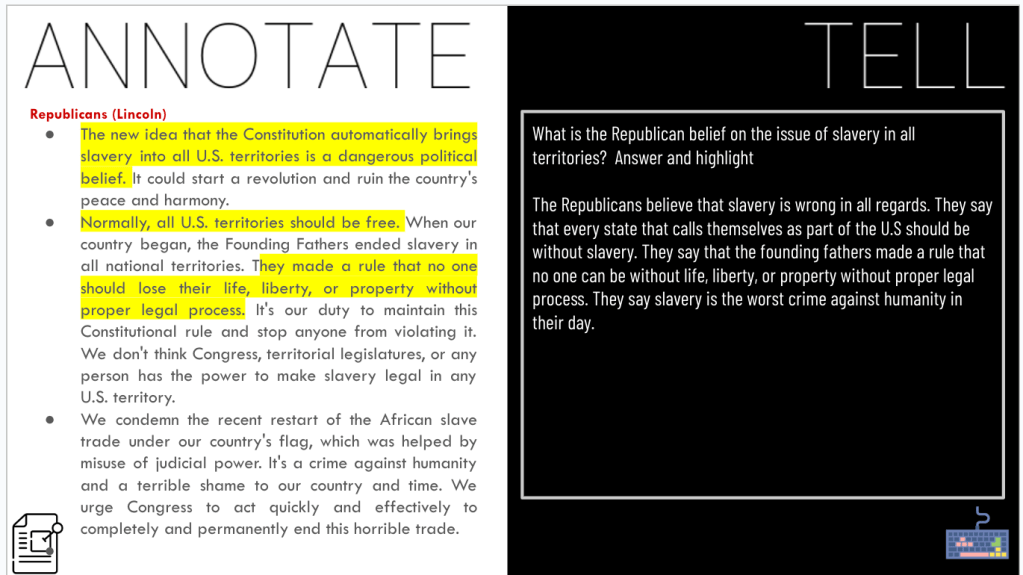
At the end of the lesson, I wanted students to write from the POV of 3 candidates from the Election of 1860. So, I created a 3xPOV template for this lesson. At the beginning of the lesson, I put together a Map and Tell and jhad students analyze a ,ap from the Election of 1860. Next, they watched a video from Retro Report on the election. The they analyzed the platforms of the Northern Democrats, Southern Democrats, and Republicans regarding their stance on slavery. Finally, students ended with the 3xPOV. This was meant to be a one day and they did an awesome job considering I wasn’t present.




 Moler's Musings