This week we started state testing. We always begin with the ELA test. As a result, our schedule was a bit weird. Also, I don’t really do anything on class on ELA testing days. Staring at screen, reading, and writing for 2 1/2 hours is daunting. I’m not going to have students come into social studies only to do it all again.
This week we focused on social studies for Monday, Tuesday, and Friday. We began the week by finishing our lesson on abolitionists. Students could choose between 3 options to show their learning about abolitionists – Dinner Party (Amanda Sandoval template), Sketch and Tell, or an Instastory (Amanda Sandoval template).
Then we wrapped up our unit on Revolution and Reform with a Summative Assessment of creating a virtual museum exhibit sharing the things they learned. I gave students one class period to complete this museum exhibit.
To end the week, we began a new unit on the Civil War. I began with a Geography Challenge from TCI. WE have spent the last two weeks learning about slavery and abolitionism and this served as a nice transition to the cause of the Civil War – slavery. The geography challenge served as a nice transitioning piece from abolitionism to showing how the Union struggled over the issues of slavery and statehood.
Monday – Abolitionist Lesson, Assessment
Tuesday – Virtual Museum Exhibit
Friday – Geography Challenge, Class Companion
Monday
Last Thursday we began a lesson on abolitionism. I like this lesson because I can incorporate lots of local history with abolitionists like: James G. Birney, John Rankin, and Harriet Beecher Stowe. It helps students see how their community played an important role in the ending of slavery. Here is the layout of the lesson:
- Students choose an abolitionist and create a Thick Slide about their methods and motivations.
- Students share their Thick Slide through a Google Form. The Google Form collects the slide links into a Google Sheet. I share the sheet.
- Students choose 4 other abolitionists, read through the slides, and collect notes about them using a Frayer Model.
- Students use their information to create something – Dinner Party, Sketch and Tell, or Instastory.
Students like having the choice of to show what they know about abolitionism. I tried to pick choices that varied in complexity. To me the Dinner Party was the most complex because students had to think about where toplace the abolitionists at a dinner party and think about their conversations. It’s very outside of the box thinking.
The sketch and tell is an option that students are familiar with. I selected this because I wanted students to apply a visual to the methods and motivations for abolitionists.
The Instastory template is familiar to students because it looks like an Instagram posting. Even though I haven’t used this template all year, I wanted to throw it out there and see what would happen. Here are some student samples:

Tuesday
On Tuesday, I wanted to wrap up my unit on Revolution and Reform. I wanted students to be able to answer two questions:
- How was life different in the North from life in the South?
- What motivated abolitionists to risk their lives to end slavery?
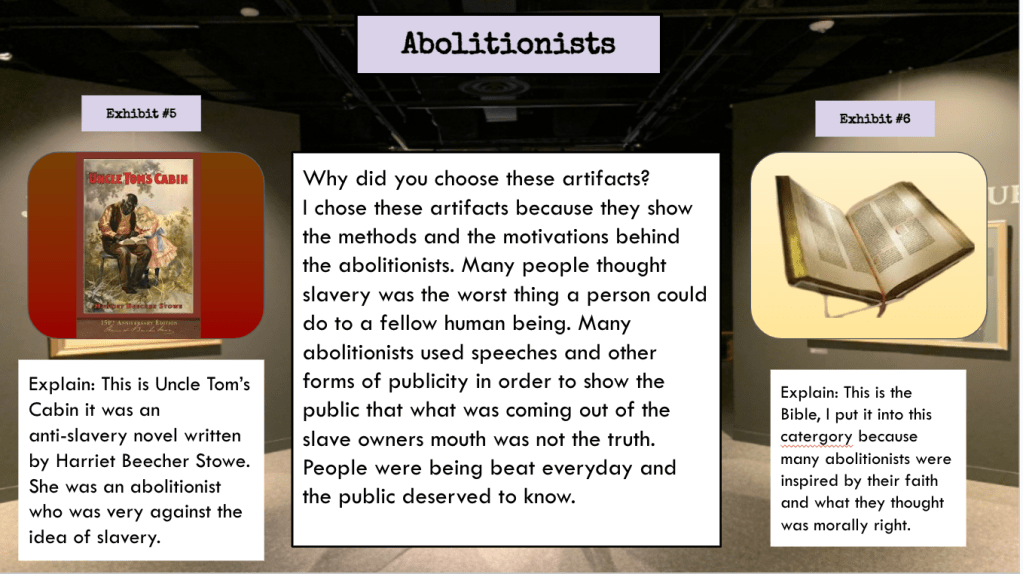
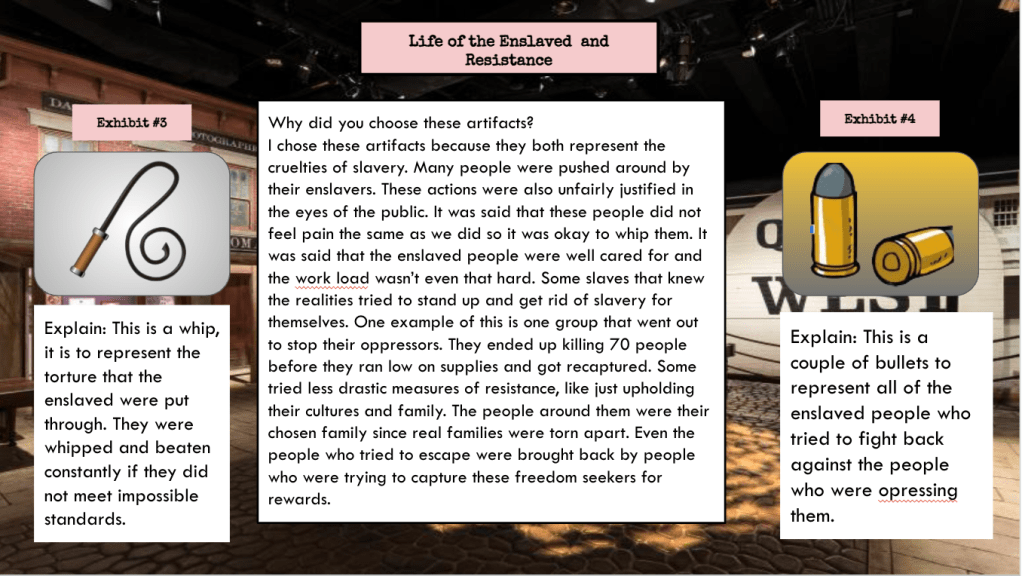
I needed an assessment to tie those things together. Te perfect option was a virtual museum exhibit. A few years ago, I created a template for a virtual museum, but I have never used it……until now.
When I put together the assessment, I wanted students to create an exhibits showing differences between North and South, an exhibit on slavery and resistance, and an exhibit on abolitionism. Because this is a summative assessment, I gave students the entire class period to get it done. It had to be turned in by the end of class. No working on it at home. A one shot deal.
I was pretty impressed with the exhibits:


Friday
On Friday, I introduced a new unit question, “What were the conflicts over slavery that led to the Civil War?” I began with a Geography Challenge from TCI because it was a simple way to begin the lesson. Plus, it wasn’t a daunting task that involved much reading or writing considering students spent the last 2 days doing that with testing.
I introduced the lesson by reminding students we have been learning about slavery and abolitionists. Now it was time to see how al, of these ideas played into arguments over statehood and sectionalism between North and South. We were building on previous knowledge to set up new knowledge.
We began the lesson by reading some background knowledge paired with the maps. Next, I had the students go through the steps to complete the Geography Challenge map.
During this lesson, I tried Class Companion – an self-contained AI tool that offers immediate feedback with student writing responses. Here is a brief summary about it:
Class Companion is an innovative educational app that integrates artificial intelligence to provide personalized feedback on writing assignments for students. In subjects like AP World History, teachers can assign writing prompts for students to practice answering repeatedly until they achieve an acceptable response.
The AI acts as a virtual teacher, offering instant critiques on what students did well and areas for improvement, allowing them to learn from mistakes at their own pace outside the classroom. Teachers can customize assignments, rubrics, and the type of feedback given, making it versatile across subjects requiring written responses like social studies, English, science, and languages.
The app includes anti-cheating features like detecting pasted text, tracking response times, and enabling teachers to override the AI’s grading if disputed. Students appreciate the rigorous practice and autonomy Class Companion provides in mastering structured essay writing for classes like AP History.
In summary, Class Companion harnesses AI to deliver tailored writing guidance, practice opportunities, and engagement for students while giving teachers powerful customization and oversight capabilities. Its unique blend of technology and pedagogy enhances the learning experience.

 Moler's Musings