December, so far, has been the longest month ever. In my past 11 years of teaching, I can count on one hand how many times I’ve missed school. This year, this semester, I have missed 15 days, A combination of sick, personal, and professional.
Since Thanksgiving it’s been a multitude of issues – flu, covid, pink eye, other random viruses, the axle broke on my car during rush hour, and a death in the family. I finally got around to getting a Christmas tree – the $2.99, tabletop special from Kroger.
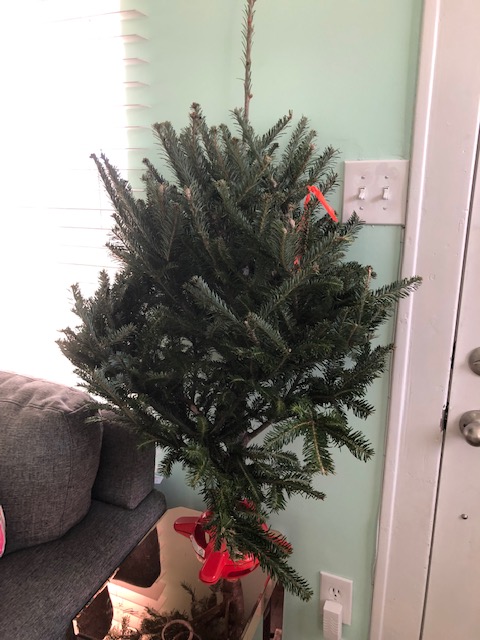
Chances are it will go without lights, but we’ll put some ornaments on it. However, that tree seems pretty symbolic of my December…so far.
Now, back to school. This week my goal was to finish the Constitution unit. I had two more remaining items – popular sovereignty and federalism. I was hoping to try some new things with these topics, but that wasn’t the case. I decided to stick with what I knew, and what I had available. As a result, we go through popular sovereignty, federalism, and did a review for the Constitution unit.
By the end of the week, I gave my Constitution citizenship test again. I asked the same 10 questions I asked three week ago. I like to take the first results and compare them to the second, or last, results after the students learned basic principles of government within the Constitution.
Due to some of my absences, I offered different challenges for students with the Citizenship test. I made a fil in the blank version with Quizizz and a multiple choice version. The results were great considering I felt like I did a poor job with this unit.
Monday – Popular Sovereignty CyberSandwich, Fast and Curious
Tuesday – Federalism Mystery Box Sketch and Tell, Federalism Notes
Wednesday – Resource Rumble Review
Thursday – Branches of Government Breakout, Citizenship Test (version 1, version 2)
Friday – Gimkit Reviews
Monday
Popular sovereignty was up first this week. The goal for this lesson is to have students understand the idea of popular sovereignty, and to have students identify the idea of popular sovereignty in the words of founding documents. I began class with a Quizizz that had students show their understanding of the definition for popular sovereignty and examples of popular sovereignty. The class averages were as follows: 45%, 50%, 55%, 47%, 65%. After the quiz finished, I asked all my classes, “What is the commonality among all the questions?” Each class was quick to understand the word ‘people’ in all the questions.
Next, I had a reading about popular sovereignty. I chose to read this article because I like to read to the class. Plus, Story Time with Moler is a crowd favorite. Some students also had the opportunity to watch a video about popular sovereignty. I scaffolded the CyberSandwich with these questions:
- What is popular sovereignty?
- List 3 ways popular sovereignty is expressed in a democracy.
- Include 1 quote from a founding document that shows popular sovereignty.
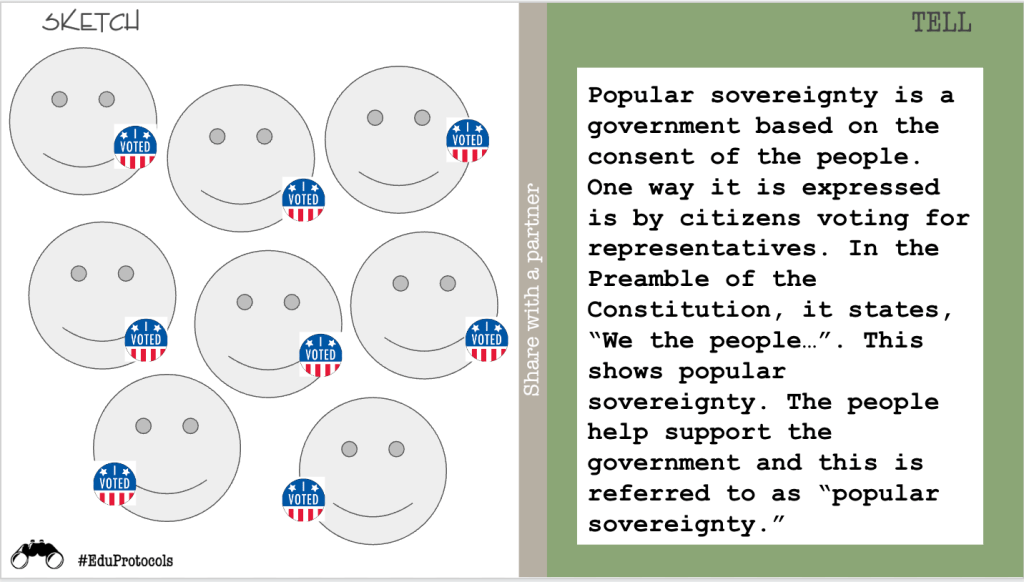
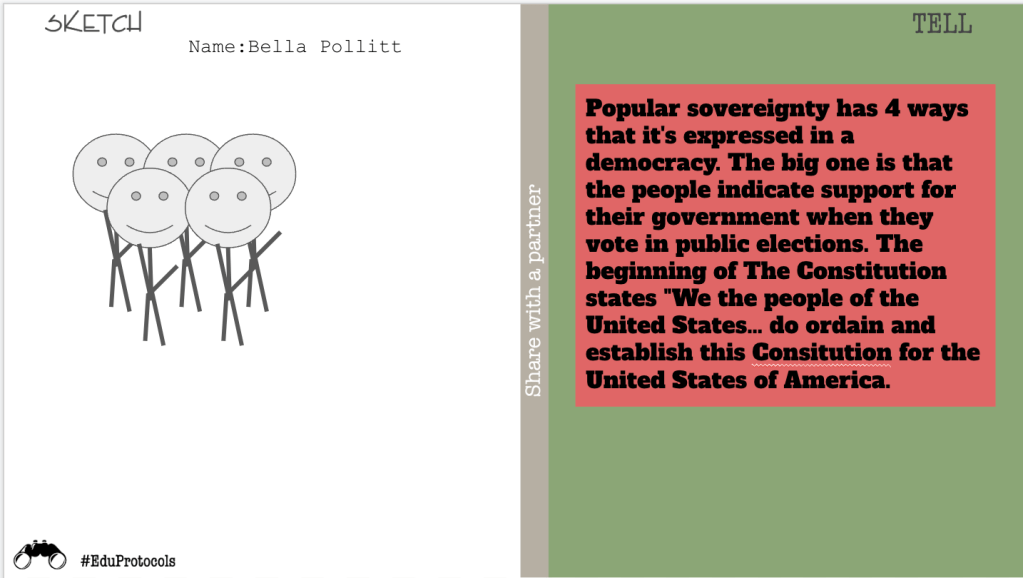
At the conclusion of the reading, I had students complete a Sketch and Tell for their summary. I think it’s important for them to take this abstract idea and construct it with an image. With their summary writing, I offered these four things to focus on:
- Define popular sovereignty.
- One way in which it is expressed today.
- A quote from a founding document.
- Concluding sentence
Here are some students examples:

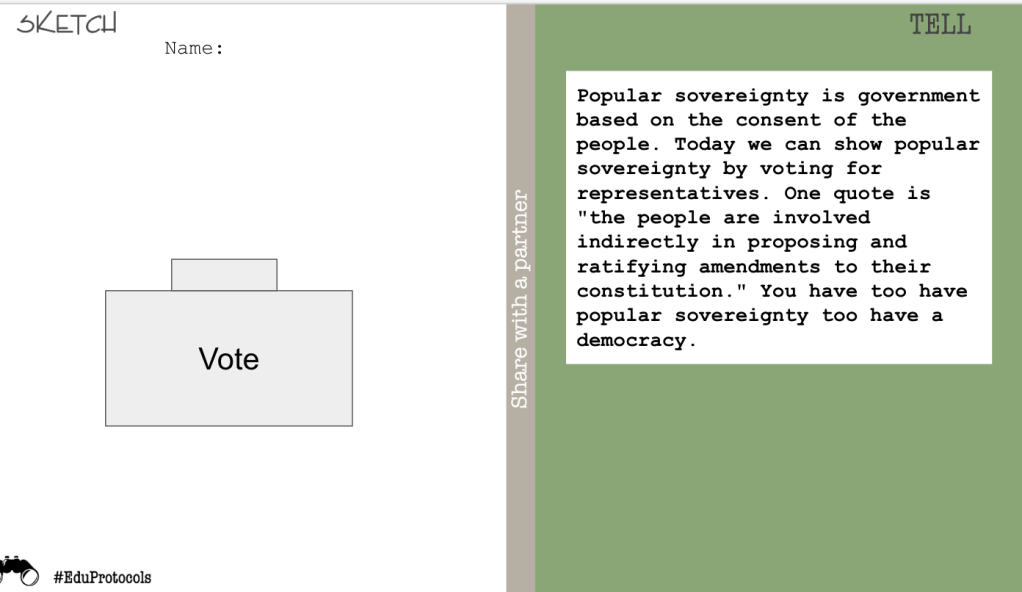
After the CyberSandwich, we took the Quizizz again and the class averages were as follows: 80%, 88%, 93%, 95%, and 98%. This lesson is what I consider to be simple and basic, but it’s pretty powerful and produces consistent results.
Tuesday
The lesson on Federalism is one of my favorites. I set up this lesson as a mystery box lesson. I was hoping to combine the mystery box with a CyberSandwich, but I didn’t have time to set it up this year. In years’ past, however, I have run out of time for the Sketch and Tell portion. As a result, I cut out the Quizizz this year.
Here is the set up:
- Students come in and I have Oreo’s hidden in a mystery box.
- I have a guided notes sheet and I go through notes on Federalism.
- I start off the lesson with a hint to the mystery box: the number 3
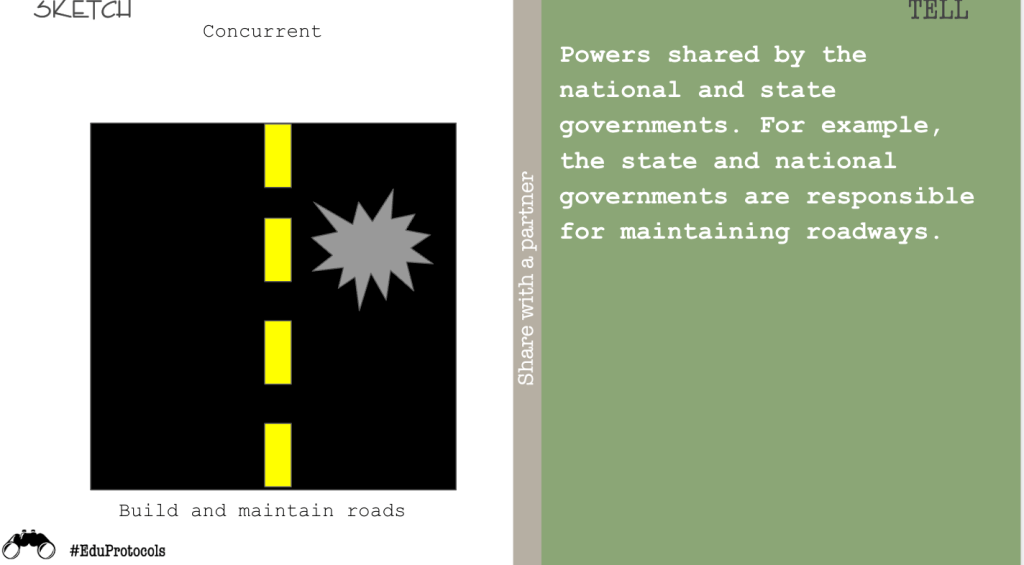
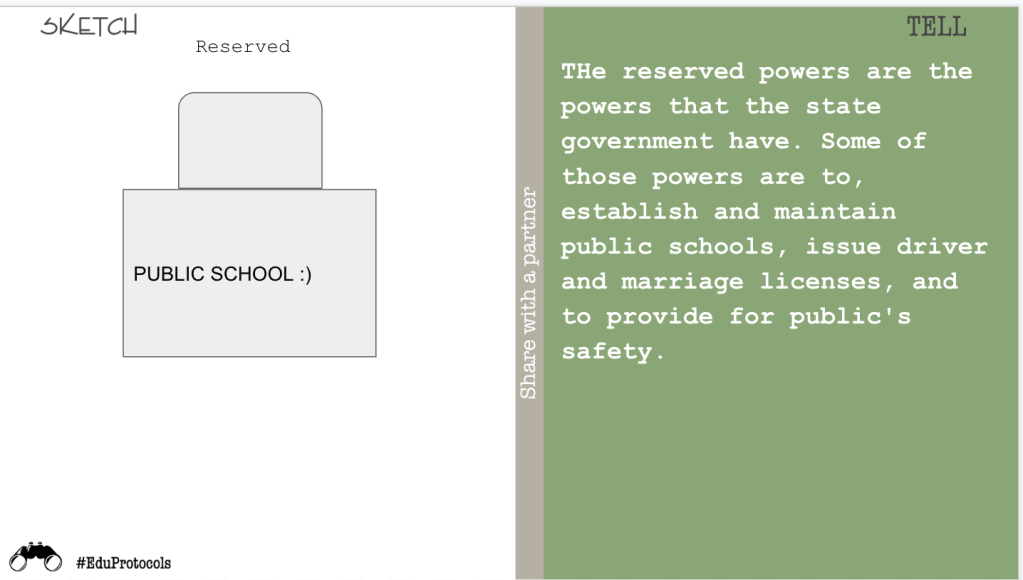
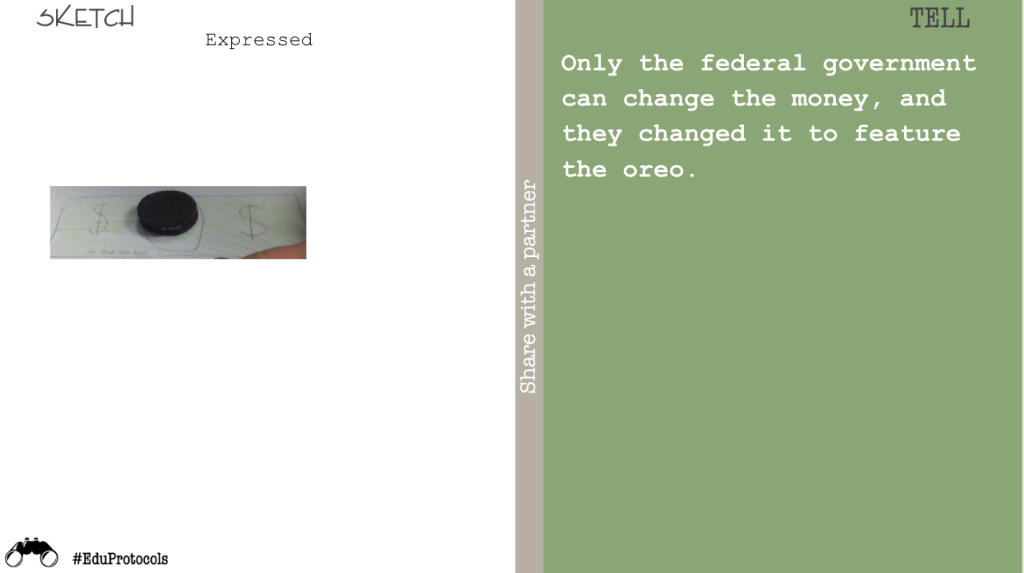
- I go through expressed, concurrent, and reserved powers.
- At the end of the lesson, I give more hints to the mystery box – stuff, milk, filling, and Sam Porcello.
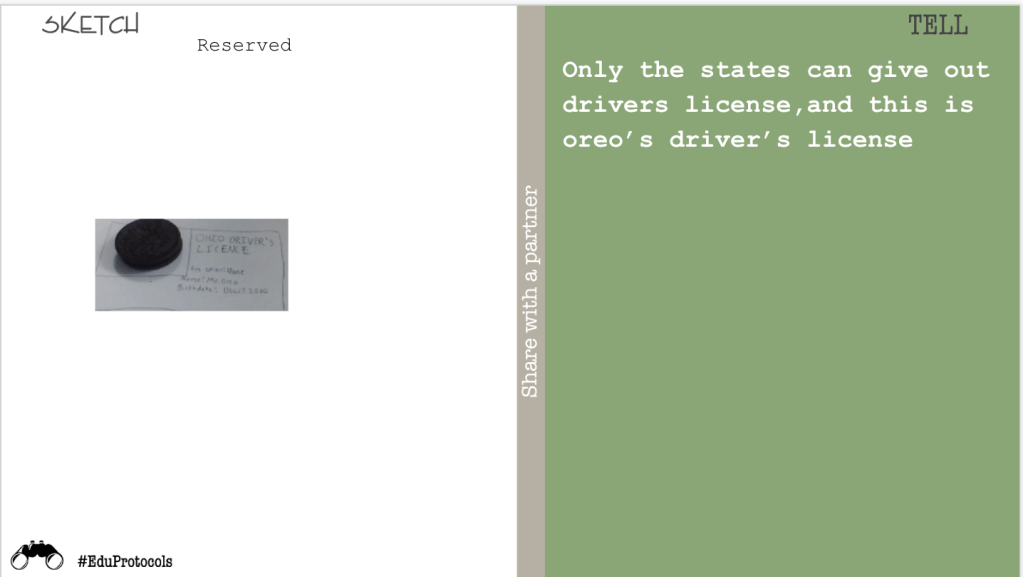
By the end of the lesson, students usually guess what’s in the box. They completely understand why the Oreo relates to Federalism. Last year, I had students create a picture with the Oreo. This year, some of my classes created pictures with Oreos representing expressed, concurrent, and reserved powers. Other classes I had them use Google shapes. Some classes I trust, some I don’t – it’s that kind of year. Here are some students samples:




Wednesday
Wednesday began with a student asking me, “Moler, can we do something where we get up and move?” I replied, “Yep.” Then I changed my entire lesson plan. I asked the class to give me five minutes as I wrote down eight review questions for a resource rumble.
All of the questions related to branches of government, checks and balances, popular sovereignty, and federalism. Basically, anything on the Citizenship test I was going to give to them again.
I can’t dive into the details, and set up of a resource rumble, but it was a fun time. The students love that review game and I’m glad a students spoke up.
Thursday
Thursday I was away from school for a funeral. So, I left the Citizenship test and a branches of government break out. (The branches of government breakout was a file I purchased on TPT about 7 years ago – therefore I can’t share it. I’m ashamed I admitted that 🤦♂️).
When I gave the citizenship test 3 weeks ago, I told the students the goal was to get six or more questions correct. Here are the results from the first time:
1st – 2/18 got six or more correct, 26% class average.
3rd – 0/29 got six or more correct, 24% class average.
5th – 2/24 got six or more correct, 25% class average.
7th – 2/20 got six or more correct, 27% class average.
8th – 3/14 got six or more correct, 34% class average.
After three weeks of lessons involving oreos, sketch and tells, choice boards, CyberSandwiches, and other EduProtocols, here are the final results:
1st – 18/18 got six or more correct, 89% class average.
3rd – 25/29 got six or more correct, 83% class average.
5th – 20/20 got six or more correct, 92% class average.
7th – 16/20 got six or more correct, 81% class average.
8th – 13/14 got six or more correct, 96% class average.
The caveat to this is it’s a combination of fill in the blank and multiple choice quizzes. However, I set up the Quizzes like this:
- Fill in the blank – students could take this quiz up to two times.
- Multiple Choice – students could take this quiz once.
- They could not take both quizzes. I encouraged them to challenge themselves and go for the fill in the blank.
Most students, however, chose the multiple choice test. In fact, 65% of my students chose the multiple choice, while 35% chose to do the fill in the blank.
Friday
Friday, I was out for the funeral again. Last day before winter break – I didn’t know what to do. I created a Friday Check In and put together a Gimkit of all first semester material. A very last minute, cliche thing to do, but I was making this in the hotel lobby at 10:30 PM. Story of my life – constantly finding ways to get things done, barely keeping my head above water. However, I usually manage to find a way.
With that – happy holidays!

 Moler's Musings