
This week was all about building depth and complexity while keeping students engaged with a variety of EduProtocols. We wrapped up Westward Expansion with strategies that helped students compare perspectives, analyze sources, and refine their writing skills.
We used Annotate & Tell to break down Texas independence and the Mexican-American War, Map & Tell to visualize territorial disputes, and Thick Slides to connect primary and secondary sources on the Mormon migration. Parafly helped students paraphrase historical texts, while MiniReports with Class Companion pushed them to synthesize information and improve their writing with AI feedback. We even tied in local history by exploring Clermont County’s own Gold Rush in 1868.
Each of these protocols ensured that students weren’t just memorizing facts—they were actively engaging, thinking, and making connections across history.
Tuesday – Texas Independence Rack and Stack
Wednesday – Mexican American War Rack and Stack
Thursday – Mormon Migration Rack and Stack
Friday – Gold Rush Mini Report
Tuesday
Tuesday’s lesson wasn’t just about reviewing Texas Independence—it was about digging deeper into how Texas annexation shaped American expansion and government policies. Instead of running through surface-level review questions, I stacked Annotate and Tell and Archetype Four Square to help students analyze the political and social consequences of annexation, make connections across history, and examine the perspectives of different groups.
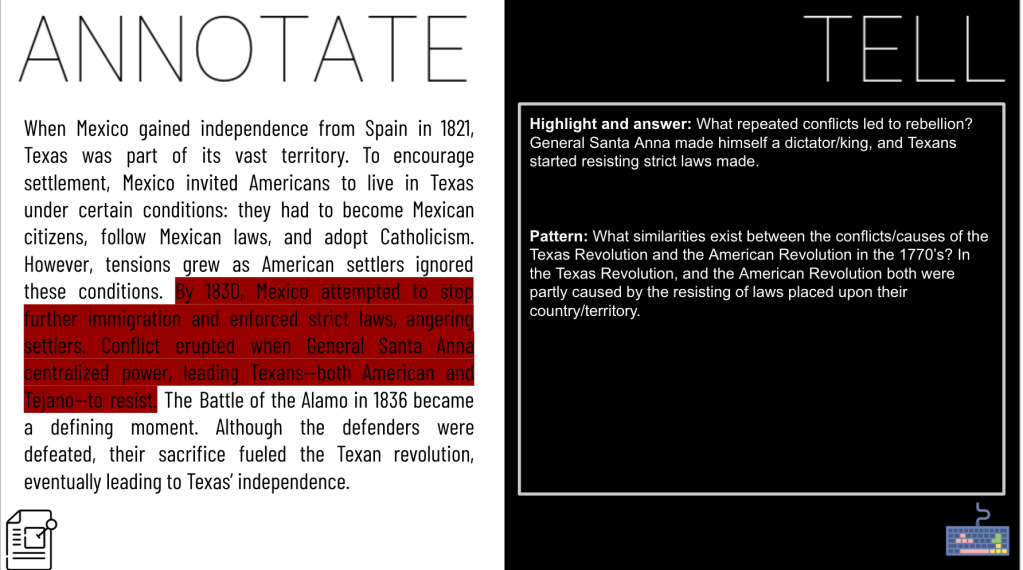
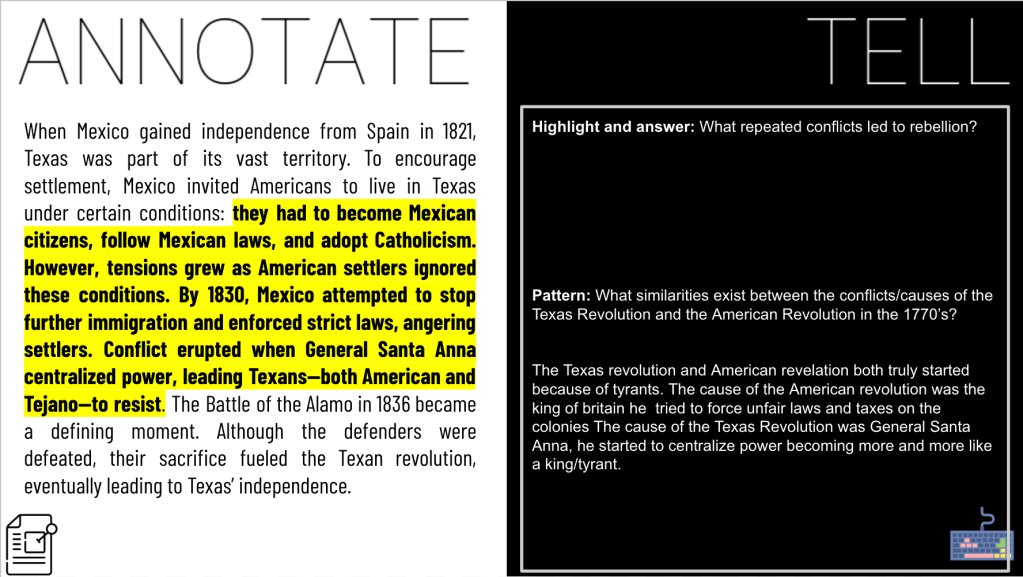
Annotate and Tell: Breaking Down Texas Independence
We started with Annotate and Tell, where students worked through a reading on Texas Independence, highlighting key points and responding to Depth and Complexity-aligned questions. What major conflicts led to rebellion? How did tensions between Texas and Mexico mirror other revolutions in history?
Students identified patterns in why revolutions happen, comparing Texas’s fight for independence to the American Revolution and other independence movements. After annotating, we had a discussion about how perspective shapes historical narratives, particularly in how Texas Independence is viewed by Americans versus how it was seen by Mexico.
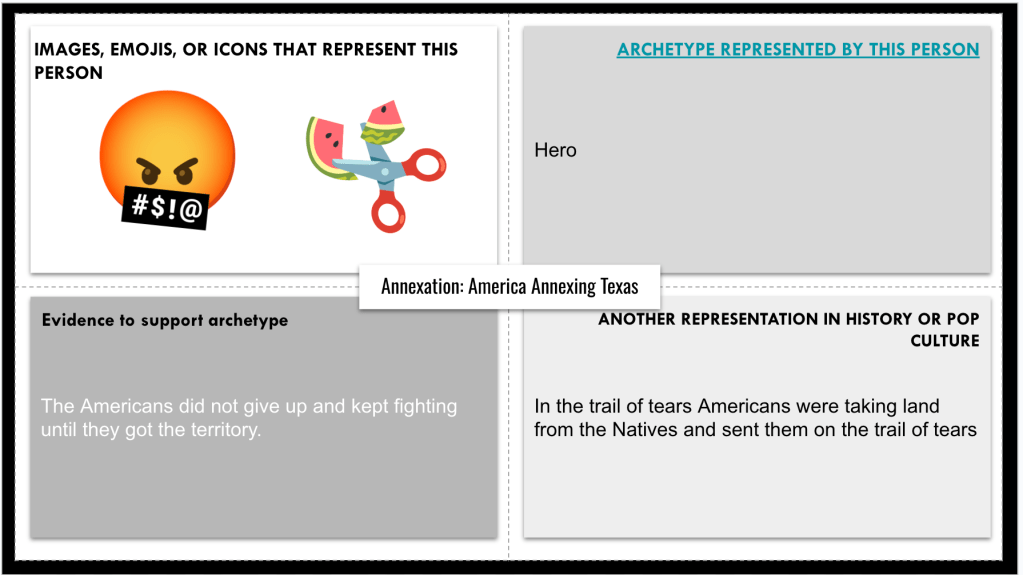
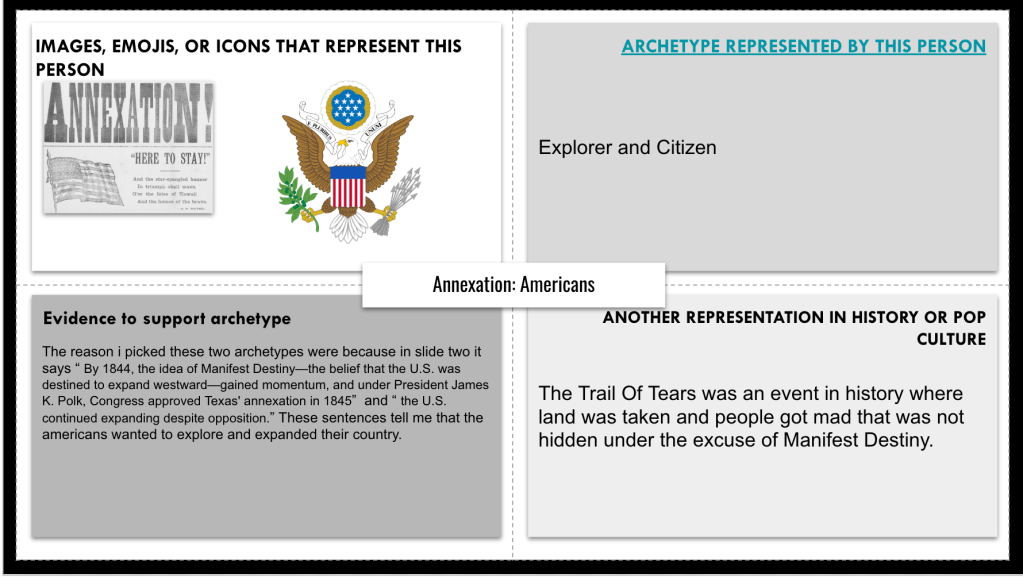
Archetype Four Square: Analyzing Government Post-Texas Annexation
Once students had a solid foundation on Texas Independence, we shifted focus to the role of the U.S. government in Texas annexation. Using Archetype Four Square, students analyzed the U.S. government’s actions through different archetypes. Was the U.S. acting as a Protector, an Opportunist, or an Aggressor in annexing Texas?
The connect piece was built into this activity as well. Students had to relate Texas annexation to another historical event. Many connected it to the Trail of Tears, recognizing that U.S. expansion often came with the displacement of Native American groups. Others linked it to the Louisiana Purchase, seeing it as another example of the U.S. growing its territory at the expense of others. This led to a discussion on whether Manifest Destiny justified these actions or simply provided an excuse for expansion.



Wednesday
Wednesday’s lesson was all about analyzing the causes and outcomes of the U.S.-Mexican War through layered activities that encouraged critical thinking. Using Map & Tell, Annotate & Tell, and Sketch & Tell-O, students built a deeper understanding of how territorial disputes, political decisions, and war shaped the history of the United States and Mexico.
Map & Tell: Setting the Stage
To start, we used Map & Tell to provide a visual representation of the territorial dispute between the U.S. and Mexico. Students labeled key locations, including the Nueces River, Rio Grande, and disputed land. We discussed why both countries claimed the land and how this disagreement escalated tensions.
Annotate & Tell: Analyzing Justifications for War
Next, students examined primary and secondary sources through Annotate & Tell to break down the events that led to war. Using depth and complexity prompts, they highlighted key parts of the text and answered questions that pushed them to think critically:
- Why did Mexican leaders refuse to discuss John Slidell’s offer, and how did their response influence Polk’s decision to go to war?
Students highlighted the sentence explaining Mexico’s refusal and discussed how it reinforced Polk’s belief that military action was necessary. - Perspective: How might Mexico’s refusal to sell land be viewed differently by American expansionists and Mexican leaders?
Many students noted that expansionists saw it as an opportunity to fulfill Manifest Destiny, while Mexican leaders saw it as an unjust attempt to take their land.
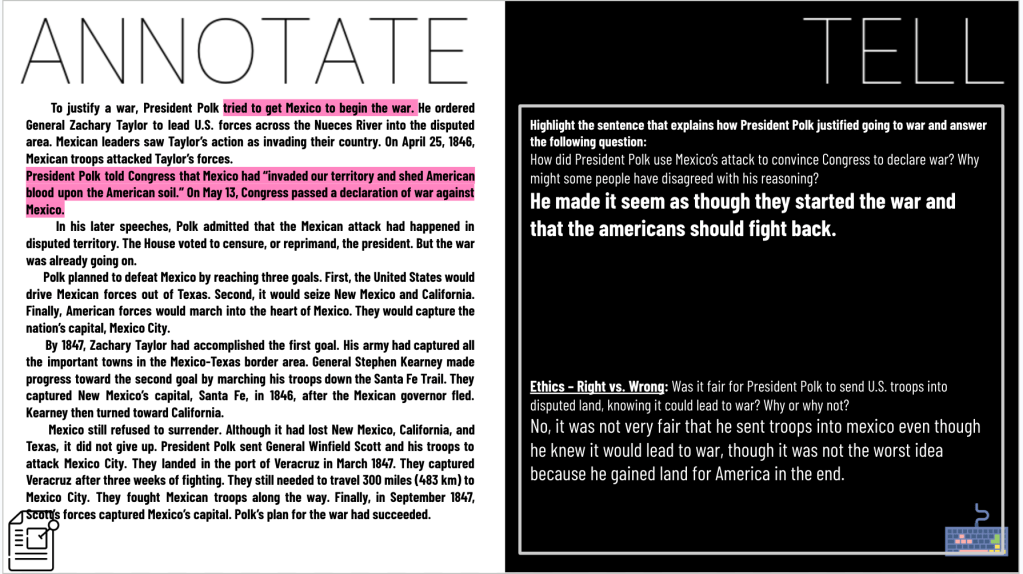
Annotate & Tell: Justifying War
The second Annotate & Tell focused on how President Polk framed the conflict:
- Highlight the sentence that explains how Polk justified going to war. How did he use Mexico’s attack to convince Congress? Why might some people have disagreed?
Students highlighted Polk’s statement about “American blood on American soil” and debated whether this was a valid reason for war or a strategic move to gain support for expansion. - Ethics – Right vs. Wrong: Was it fair for President Polk to send U.S. troops into disputed land, knowing it could lead to war? Why or why not?
This question sparked discussions about whether Polk provoked Mexico into war and whether the conflict was avoidable.
Sketch & Tell-O: Understanding the Treaty of Guadalupe Hidalgo
To close out the lesson, students completed a Sketch & Tell-O focused on the Treaty of Guadalupe Hidalgo. Each student created a visual representation of:
- The land acquired by the U.S.
- The impact of the treaty on Mexico
- How the treaty shaped future territorial expansion
They also wrote a short explanation connecting the treaty to previous historical events, with many linking it to the Trail of Tears, recognizing the continued displacement of people as the U.S. expanded westward.




Thursday
Thursday’s lesson focused on the Mormon migration and the challenges they faced during westward expansion. To make the content engaging and meaningful, I used a mix of EduProtocols, incorporating depth and complexity elements to push students’ thinking beyond just recalling facts.
Wicked Hydra: Generating Inquiry from Primary Sources
We started with a Wicked Hydra, where students analyzed Executive Order 44, also known as the “Extermination Order” issued by Missouri’s governor in 1838. The document stated that Mormons must be treated as enemies and either exterminated or removed from the state.
Students generated questions such as:
- Who were the Mormons?
- Why were they hated?
- What did they do to provoke this response?
- How could a state issue an extermination order?
These questions helped frame the lesson, setting up historical context and encouraging students to think about discrimination, religious freedom, and government authority.
Number Mania: Proving the Statement with Evidence
Next, we ran a Number Mania to reinforce the scale of the Mormon migration. The statement to prove was:
“The Mormon migration was one of the largest and most significant westward movements in U.S. history, involving thousands of people traveling thousands of miles to settle in Utah, where they established a thriving community despite early challenges.”
Students had to:
- Find four numbers that proved the statement true.
- Paraphrase facts from the textbook reading.
- Add four icons or pictures to visually represent key details.
- Title their Number Mania creatively to reflect the historical significance.
This protocol pushed students to analyze the numbers behind historical events and justify the migration’s impact with data.
Thick Slide: Memory, Complexity, and Comparison
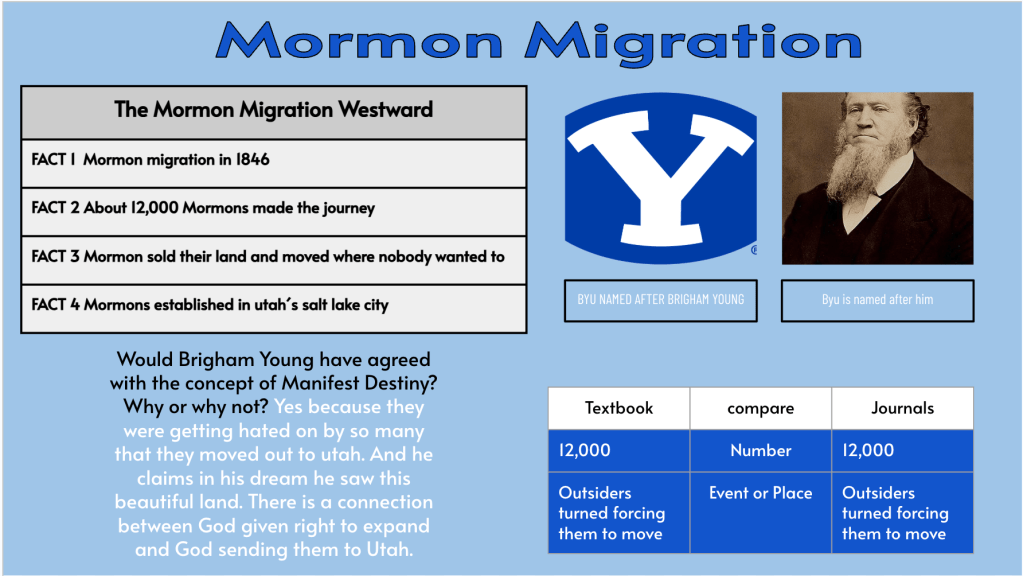
Students then created a Thick Slide, recalling four important facts about the Mormon migration from memory. But instead of stopping at just listing information, I added a depth and complexity twist:
“Would Brigham Young have agreed with Manifest Destiny? Why or why not?”
This question encouraged students to think critically about how religious groups viewed expansion differently than the U.S. government. Some argued that Young supported expansion for the survival of his people, while others pointed out that Mormons weren’t interested in spreading democracy or territorial claims in the same way as the federal government.
To deepen analysis, students then compared secondary source facts from the textbook with primary source excerpts from Mormon journals. They looked for corroborating details between historical records and personal accounts of migration hardships. This activity helped reinforce sourcing skills and historical interpretation.



Friday
We started the day with a Friday check-in: What seemed like an exciting experience but ended up being a complete letdown or genuinely difficult once you were actually there? I wanted students to connect with the experience of prospectors who traveled west expecting instant riches but faced harsh realities. This helped students build a personal connection to the topic before diving into the content.
MiniReport: Analyzing the Gold Rush from Multiple Perspectives
To examine the impact of the Gold Rush, we structured our lesson around a MiniReport paired with Class Companion for writing and feedback. The central question for this activity was:
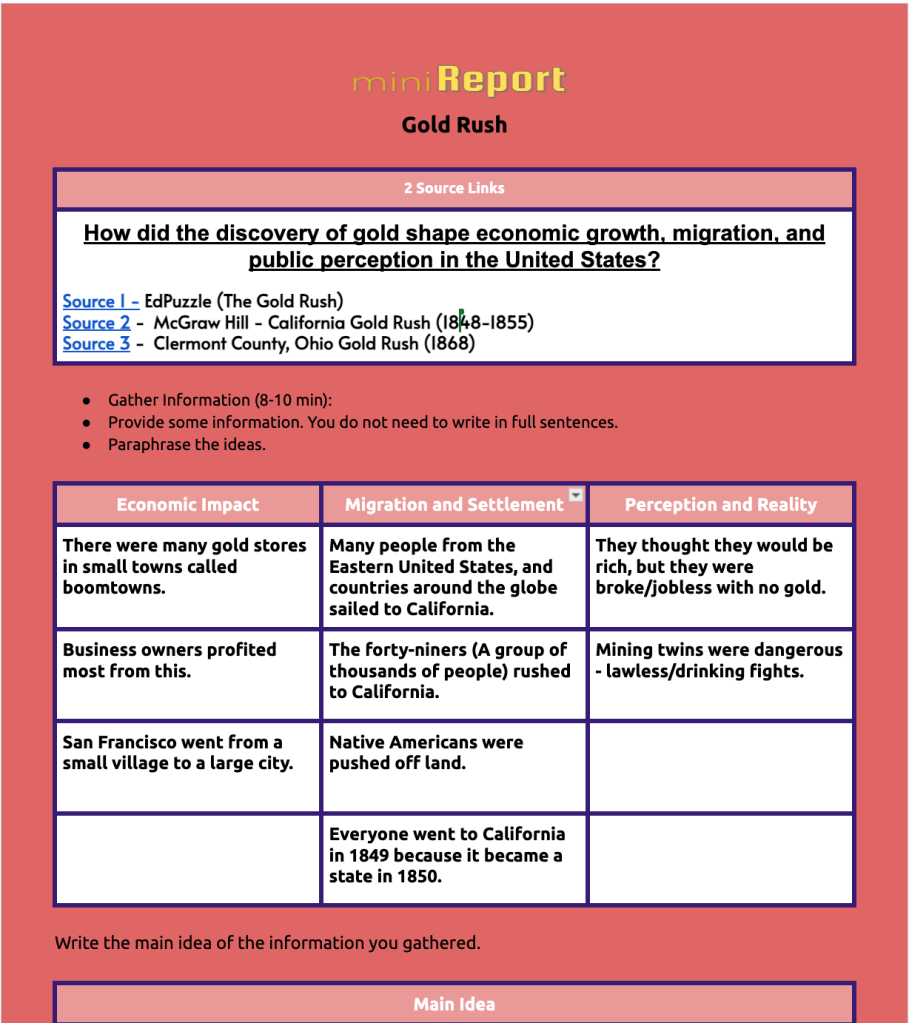
How did the discovery of gold shape economic growth, migration, and public perception in the United States?
Step 1: Gathering Information from Multiple Sources
Students worked with three sources:
- An EdPuzzle video on the California Gold Rush, which provided an engaging, visual introduction.
- A McGraw Hill textbook reading on the economic and social effects of the Gold Rush.
- A local history connection—the 1868 gold rush in Clermont County, Ohio.
Students organized their findings into three categories:
- Economic Impact: How the rush transformed industries, trade, and the economy.
- Migration and Settlement: How it spurred mass movement westward.
- Perception vs. Reality: The myths versus the actual struggles of prospectors.
Step 2: Writing & Feedback with Class Companion
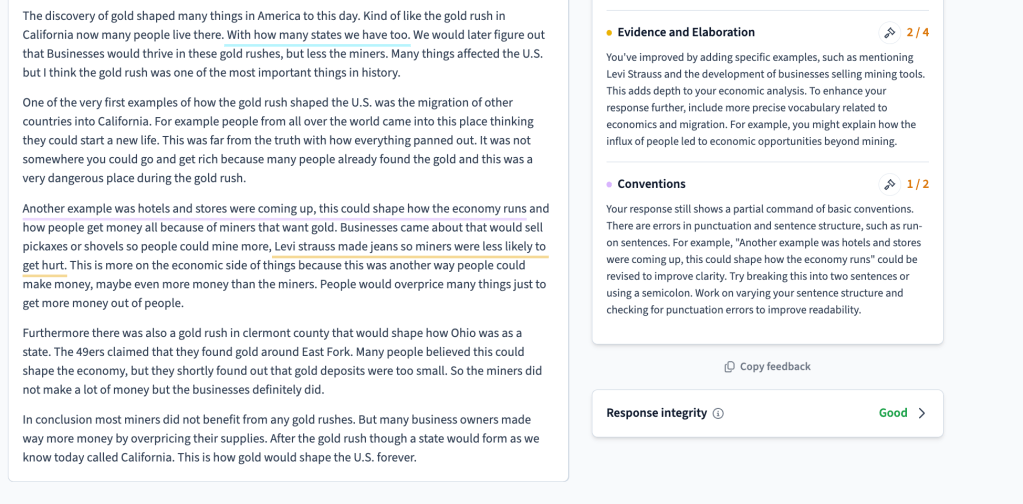
After gathering their evidence, students wrote a structured paragraph in Class Companion, where they received instant AI-driven feedback. I linked the Ohio State Test informative/expository rubric to the assignment, reinforcing the writing expectations they will face on standardized tests.
Students focused on:
- A clear topic sentence.
- Supporting details from their sources.
- A strong concluding statement.
I also used this opportunity to discuss how AI scoring systems on state tests look for specific key phrases, transitions, and evidence-based reasoning—helping students understand how to write for their audience.

 Moler's Musings