The Week That Was in 103

Week two felt like a reset button. Last week I tried to do too much too fast with Chromebooks, logins, and codes. It was overwhelming. This week, I went back to the basics. Paper, pencils, and simpler routines gave students (and me) the space to breathe. We still pulled out the tech: Quizizz for Fast and Curious, Google Slides for Thin and Thick slide, but we balanced it with Frayers, CyberSandwich, and Sketch & Tell-o on paper. That rhythm worked.

I also had a big curriculum shift confirmed. Originally, 6th grade was set for 7th grade content (ancient Rome and Greece), 7th grade for 8th grade content (early American history), and 8th grade for 10th grade content (modern American history). But over the weekend, it hit me my 8th graders had never learned early American history. How could they possibly jump straight into the modern era? I brought it up to my principal, and he agreed. So this year, both 7th and 8th grade are studying early America. Next year, 7th grade will move forward into modern America, and everything will be aligned again. It’s the right move, and it gives me time to prep for a brand-new course I’ll be teaching down the road.

Monday – Sources Rack and Stack

Wednesday – Lunchroom Fight 2

Thursday – Historical Thinking with Molly Pitcher Painting

Friday – John Brown Bias

Monday – Sources and Sourcing

We kicked off our new theme this week: Sources and Sourcing. The goal is simple but essential: help students recognize the difference between primary and secondary sources and begin applying that understanding.

We started with a Quizizz check in, and the results told me all I needed to know: most students had no clue. That changed my plan immediately. I scrapped my original idea and built a Rack and Stack that gave them multiple reps with the concept.

Here’s how it broke down:

  • Thin Slide – Students picked a source, labeled it primary or secondary, and shared with a partner. A quick, low-stakes way to get them thinking.
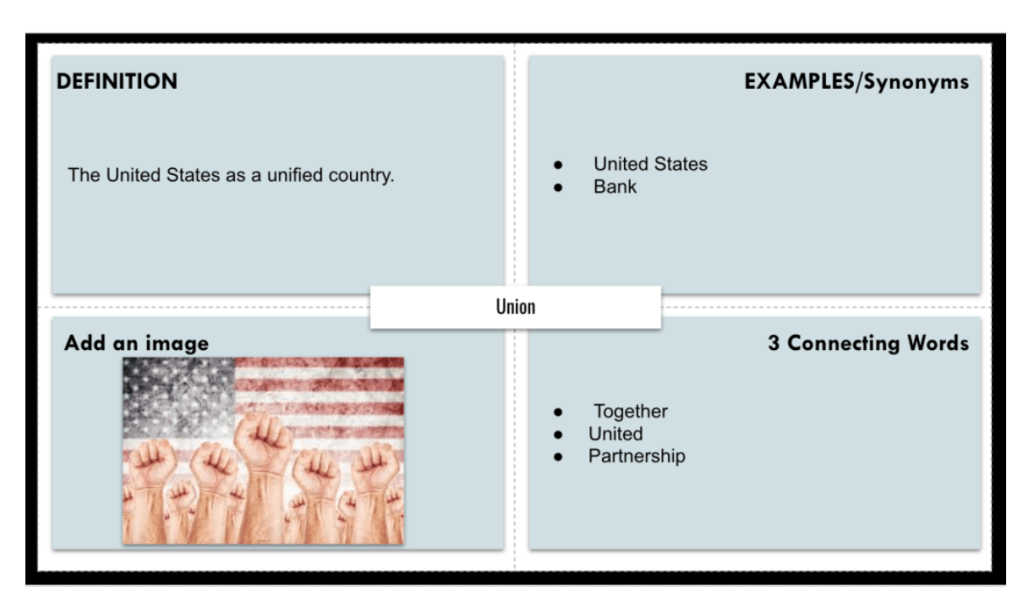
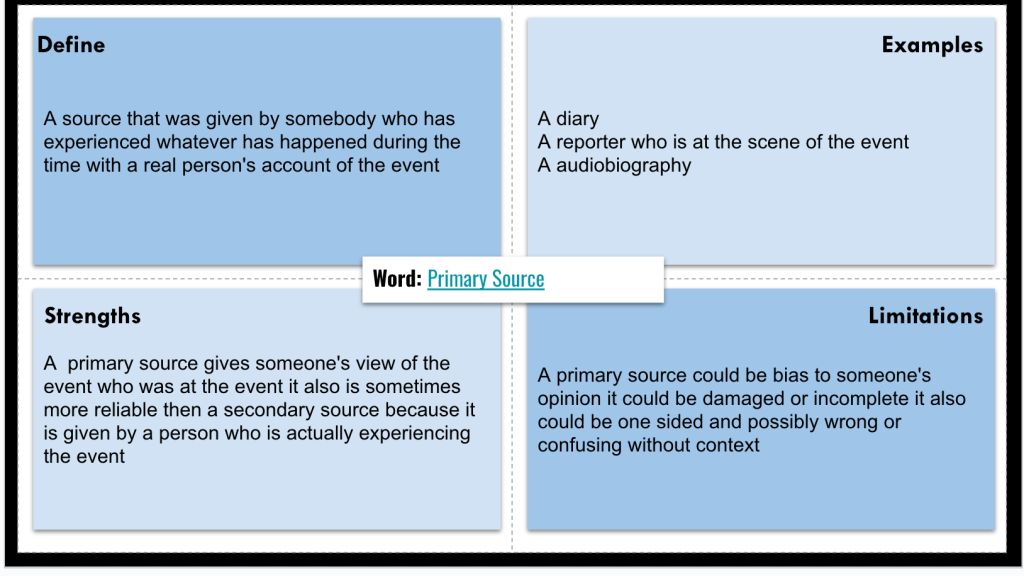
  • Frayers – Two total: one for primary, one for secondary. Students added definitions, examples, and nonexamples to deepen their understanding.
  • Word Wall – They sorted sources on their own. No scaffolds, no hints. Just a test of what they knew after the Frayers.
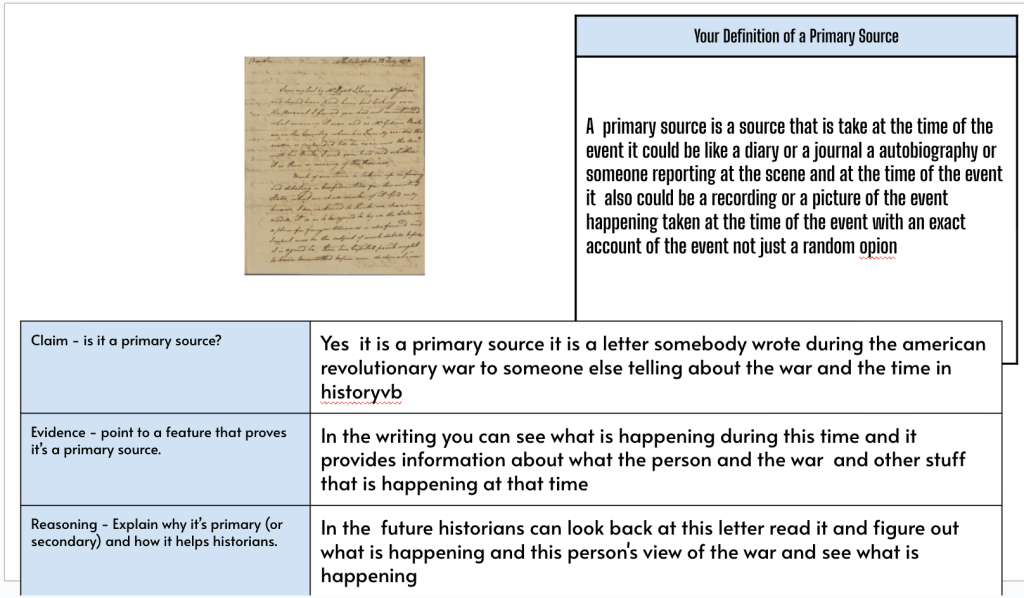
  • Thick Slide – The application task: If you were researching the American Revolution, what primary source could you use? Students added a picture, used their Frayer definition, and proved they found a true primary source with claim, evidence, and reasoning.

By the end, students weren’t just identifying sources; they were already starting to source them in their writing. That’s the kind of win that makes me feel good about slowing down, scaling back, and laying a strong foundation for what’s coming next.
Tuesday – Digging into Historical Thinking Skills

Tuesday’s focus was on the four historical thinking skills we’ll be leaning on all year: sourcing, contextualizing, corroborating, and close reading. I built a Quizizz Fast and Curious that mixed straight definitions with application-style questions. The first run was rough, class averages came in at 39%, 32%, 38%, 40%, and 52%. What fascinates me is how consistent those numbers always are across classes when students haven’t actually been taught the content yet. It shows me we’re all starting from the same baseline.

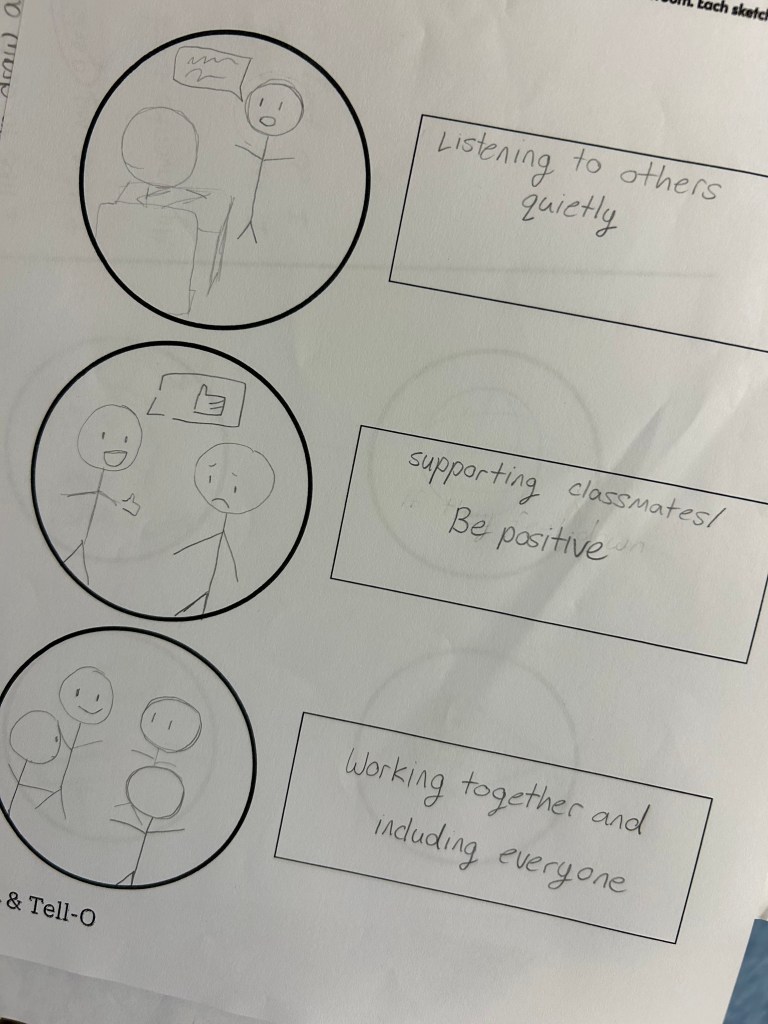
From there, I introduced notes on the four terms. To make it stick, I had students complete a Sketch & Tell-o for each drawing a quick sketch to capture the meaning and writing a one-sentence explanation. But I didn’t want it to just stay on paper. As we worked through the notes, I kept tying it back to Monday’s lesson.

I asked a student to look around the room and pick a primary source if they wanted to learn more about me. Some chose the student letters on my wall, others pointed to my Teacher of the Year plaque, and a few grabbed onto classroom photos. With each object, we practiced:

  • Sourcing – Who created it? When? Why?
  • Contextualizing – What was happening at the time it was made?
  • Corroborating – What other source in the room could support or challenge it?

For example, if a student chose my Teacher of the Year plaque, they often paired it with one of the letters from students that helped me earn it. That connection helped them see how sources work together to tell a fuller story.

We wrapped by running the Quizizz again. This time the class averages jumped to 47%, 58%, 59%, 48%, and 74%. It wasn’t perfect, but the growth was clear. Students saw the payoff of practice, and it gave us a strong foundation to keep building on the rest of the week.

Wednesday – Practicing Skills with the Lunchroom Fight

By midweek, I wanted a low-cognitive way for students to actually practice the historical thinking skills we had been building. The Lunchroom Fight 2 activity from the Digital Inquiry Group was the perfect fit.

In years past, I’ve never found this activity to be all that engaging. But this group is different. Being in a small private school, my students know each other well and have strong rapport. They listen to one another. They actually discuss instead of talking over one another.

We started class with another Quizizz for retrieval. Then we jumped into the Lunchroom Fight. A couple of students even asked, “When are we going to learn history?” They were eager to dive into content, but I wanted them to see how skills work in practice.

Students paired up, read through the eyewitness statements, and organized the information. The conversations were good: who seemed reliable, who didn’t, and what evidence actually held up. The end goal was a simple Claim-Evidence-Reasoning:

  • Claim – Who was at fault for the fight?
  • Evidence – Which statements supported that claim?
  • Reasoning – Why does that evidence matter for deciding suspension?

What impressed me most was the independence. Some students even took their papers down the hall into the common area to work, and I could trust them to get it done. That’s a gift as a teacher—watching students take ownership of the task, collaborate authentically, and actually enjoy practicing skills.

Thursday – Jumping Into History

Thursday was the first day we really shifted from skill-building to applying those skills with actual history. We started class the same way, with a Quizizz Fast and Curious. The averages told the story: 86%, 81%, 44%, 80%, and 88%. The growth was there, and the quick retrieval gave students confidence heading into the lesson.

From there, we moved into a sourcing activity from the Digital Inquiry Group. The prompt was tied to a famous image: Is this painting of the First Thanksgiving a reliable source to understand the relationship between the Wampanoags and the Pilgrims? Most students confidently said yes. But the reveal that the painting was created 311 years after the actual event surprised them. Once they thought about it, they understood why it was not reliable. That “aha” moment was powerful.

We used that as a bridge into another historical painting, Percy Moran’s Molly Pitcher Firing Cannon at the Battle of Monmouth (1911). Students leaned on the four skills of sourcing, contextualizing, corroborating, and lateral reading to break down the image. The conversations were sharp. They questioned the reliability, discussed how memory and myth can reshape events, and pulled connections to what we had been practicing all week.

We closed with a writing task:

Prompt: After analyzing Percy Moran’s painting Molly Pitcher Firing Cannon at the Battle of Monmouth (1911) using sourcing, contextualization, corroboration, and lateral reading, write a short response using the Claim–Evidence–Reasoning framework.

Instead of collecting responses on paper, I had students type their CERs into ShortAnswer. Then we ran a Battle Royale. Students voted responses up and down, debated which claims were strongest, and saw firsthand what made evidence and reasoning effective. It was a blast. The energy in the room was exactly what I want, with students engaged, competitive, and thinking critically about history.

Friday – Exploring Bias

Friday’s focus was on bias, which is always a tricky concept to teach middle schoolers. I adapted a lesson from Mr. Roughton and shaped it for my classes. We began with one final Quizizz Fast and Curious, and the results were strong: 86%, 80%, 83%, 83%, and 91%. That showed me they were ready for a challenge.

To introduce bias, I showed a recut trailer of Finding Nemo. Someone had spliced together lines and clips from the movie but paired it with horror film music. Every student had seen Finding Nemo, so they were shocked and confused by what they saw. That was the hook. I explained that nothing in the trailer was a lie, but the way the clips were cut and the music that was added changed the perspective completely. Bias works the same way. It is not always about telling falsehoods. Sometimes it is about presenting information in a way that leaves out parts of the story or makes it feel different than it really is. That clicked for them.

Next, we moved into a CyberSandwich on John Brown. I gave each student an article that ChatGPT had created for me. One came from the perspective of a northerner, the other from the perspective of a southerner. The students did not know that they were reading different accounts. Each article contained the same facts but used loaded language to create very different impressions. To scaffold, I gave them guiding questions:

  • List as many words or phrases as you can find that make John Brown look positive.
  • List as many words or phrases as you can find that make John Brown look negative.
  • Sourcing – Who might have written this account? How could that influence the way John Brown is described?
  • Contextualization – What was happening in the United States in the 1850s that might explain why people described John Brown this way?
  • Corroboration – Do you think this reading gives you enough information to make a good decision about who John Brown really was? Why or why not?
  • Based on what you read, who was John Brown?

As students worked, most had no idea they were reading different articles. In one class, someone raised their hand and said, “I can’t find anything positive.” Another student responded, “What? How can you not?” That sparked immediate comparisons and conversations. The realization that they had been given different accounts blew their minds. They begged to read the other version. That was the moment bias became real.

We closed with a CER: Was John Brown a hero or a villain? Students pulled from their notes, their comparisons, and their discussions to make a claim, back it with evidence, and explain their reasoning. The engagement was high, the conversations were thoughtful, and the lesson tied right back to the Finding Nemo trailer. It was the perfect way to end the week.
The Week That Was in 103

This week was my first full stretch as the new 6th, 7th, and 8th grade social studies teacher at St. Ursula Villa. With only three days on the books, I do not have the time or space to reflect on every class and every moment. Instead, I am going to highlight some lessons that stood out. Not because it was the best, but because it captured what I want this year to feel like.

Building More Than Community

On the very first day, I leaned on a few familiar tools: Sketch and Tell-o, Thin Slides, and Frayers to build community and get to know my students. The funny thing is, Villa already has an incredibly strong community. Many of these kids have been together for years, and each grade only has 30 to 40 students. So yes, the “Frayer a Friend” activity was a little redundant, but I wanted to give them practice with these frames we will use all year.

The next day, I put those same tools to work for something bigger: creating a class mission statement.

From Sketches to Statements

We started with a Sketch and Tell-o. I asked students to visualize what they feel is most important in a classroom environment. Four minutes to sketch, a quick explanation, then each student narrowed their ideas to a single word. They shared those words with a partner, and together we pulled out the common threads.

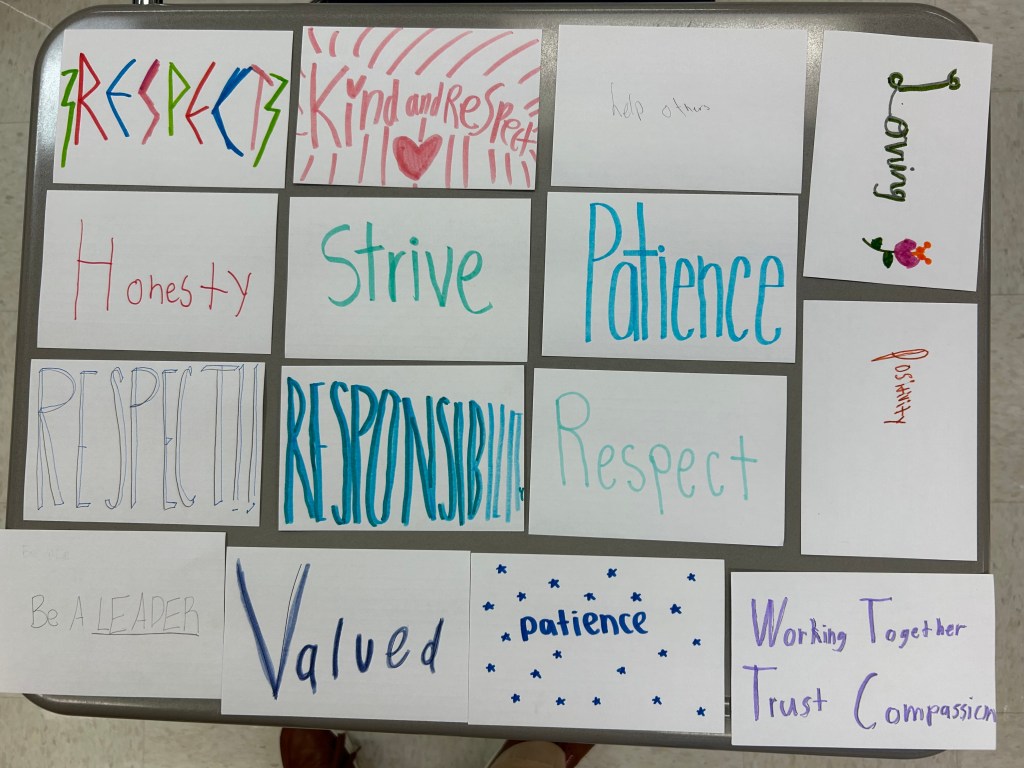
Next came the index card Thin Slide. On one side, students wrote three to four words that felt essential. On the back, they drafted a personal mission statement using those words. I modeled what that might look like first. Many students had already written personal mission statements before, so the leap to classroom mission came naturally.

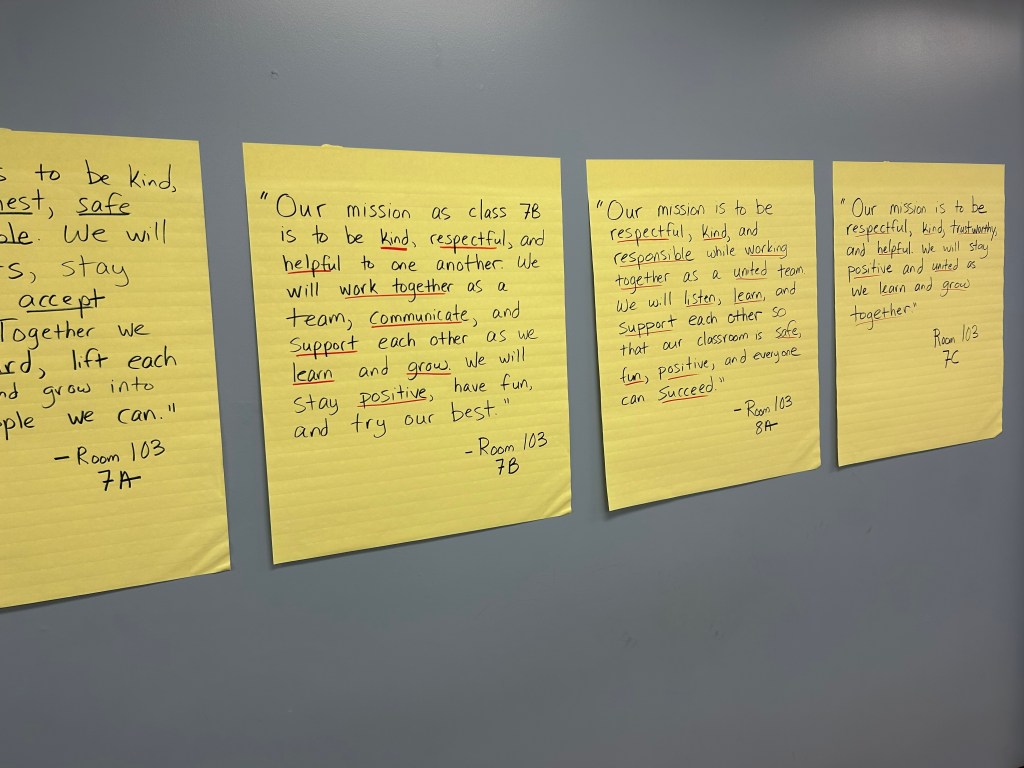
Then came my favorite part. We took those mission statements into ShortAnswer. Students typed them in, and we ran a battle royale. They read, debated, and narrowed them down round by round until one statement stood at the top. That collective ownership mattered.

We closed with a Frayer Model of the chosen mission statement, thinking through what it looks like student to student, teacher to student, student to teacher, and student to classroom. By the end, the words were theirs, the mission was theirs, and the expectations were theirs.

Why It Mattered

Was the lesson perfect? No. But it checked the box I care about most right now: students shaping the environment they want to learn in. The protocols gave them structure, and the process gave them voice.

That is a pretty good way to start a year.

What Stuck With Me: Lessons That Still Shape My Teaching

There are some people you can learn something from every time you talk to them. That was Scott Petri for me. Whether it was during a presentation, a text thread, or a chat about lesson design, he had a way of dropping a sentence or two that would make me rethink what I was doing in my classroom.

He helped me see Social Studies through a different lens. Less about just covering content, more about treating it like literacy instruction. That idea that we’re not just teaching history but also building background knowledge, academic vocabulary, and real writing skills, still shapes how I teach today.

Here are some of the biggest things that stuck with me….

Social Studies is English

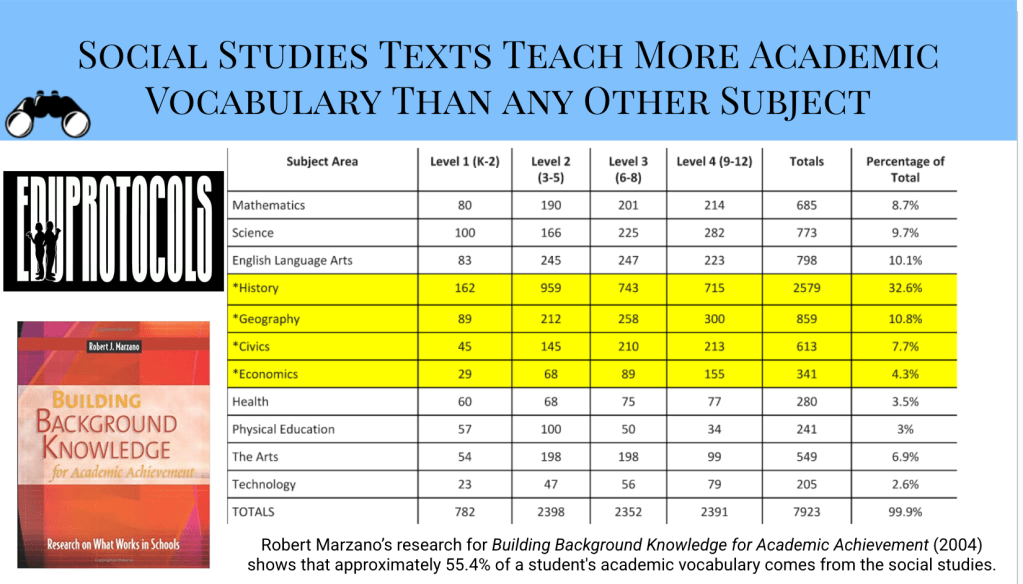
Scott used to say he was a “closeted English teacher.” He wasn’t just throwing that line out, he meant that if we’re teaching history well, we’re also teaching kids to read better, write better, and talk about complex ideas. One stat he shared really changed how I viewed my role: 55% of a student’s academic vocabulary comes from Social Studies. That’s massive. It made me way more intentional about teaching words and concepts instead of assuming kids would just “pick them up.” When I treat Social Studies like an English class, my students grow more in both.

Listening Is Learning

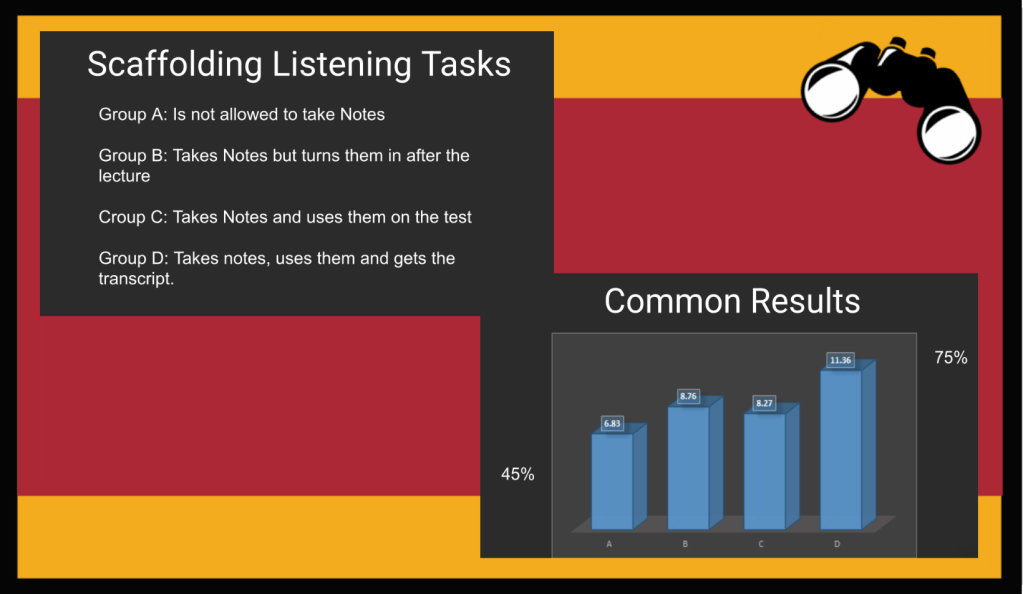
Scott taught me that students can listen and understand two to three grade levels above where they can read. That fact gave me a huge mindset shift. I used to feel a little guilty when I read texts aloud or used podcasts or narrated videos. It felt like I was doing too much of the work. But this past year, when I was doing a lot of reading aloud to my class, I remembered what he said. I wasn’t just talking at them, I was helping them access content they wouldn’t be able to get on their own.

Letting students listen, follow along with a transcript, and take notes isn’t cutting corners, it’s smart scaffolding. It helps them build confidence and fluency without feeling lost. Multimodal input: reading, listening, writing works better than just throwing a hard article at a struggling reader. That’s something I leaned into more this year, and it paid off.

Connections Are Where the Learning Happens

Scott shared a stat in most of his presentations that came from the 2021 AP U.S. History exam: only 15% of students could successfully make historical connections. We’re pretty good at helping students recall facts. But making connections? That takes practice—and modeling.

Scott was always pushing us to slow down and help students ask questions like, “How does this relate to what we’ve already learned?” or “What’s the bigger theme here?” And this is exactly why he created the Archetype Four Square: a powerful tool that helps kids organize historical events into meaningful patterns and themes. It’s a simple structure that forces them to think about how ideas evolve, connect, and repeat across time. It’s one of the most practical ways I’ve seen to build true historical thinking skills.

Reflection Isn’t a Side Dish—It’s the Main Course

Another big takeaway from Scott was the way he used student reflection and exemplars. Not as an extra. As a core part of the learning. Whether it was a Cybersandwich or a Number Mania or a Retell in Rhyme, he modeled how to show students what good looks like, and then helped them figure out how to get there.

After a Cybersandwich, I’d show students the notes I wish they had written. After a Number Mania, we’d reflect: “Did these numbers tell a story or just fill a slide?” That kind of thinking has changed how I run my classroom. It’s not just about doing the activity. It’s about growing through the feedback loop……..

Final

I still catch myself quoting things I heard Scott say in a Zoom call or presentation. Little ideas that stuck with me and ended up changing how I teach. He helped me raise the bar, not by making things harder, but by helping me teach smarter.

If you’ve ever wondered if those small moments of professional learning matter trust me, they do. They ripple. They stay with you. And sometimes they become the foundation of how you teach moving forward.

An Email at 1:40AM

“Not sure if I should say good morning or good night as it is 1:40am. We were talking about school and you came up in the conversation. I wanted to thank you for making learning easier and enjoyable.”

That was the email. No subject line. No assignment attached. Just a student, up late, thinking, and choosing to send a thank you. I didn’t need anything more.

These kinds of messages hit different. They’re not about test scores. They’re not about grades. They’re about how the learning felt.

And let’s be honest: that phrase: ‘easier and enjoyable’ didn’t come from thin air. It came from structure. From intentional repetition. From low cognitive load with high cognitive payoff. It came from EduProtocols.

I get messages like this often. Not every now and then. Often. Kids will tell me in class or write a note after the year ends. They’ll say things like:

  • “I actually liked coming to your class.”
  • “We learned but it wasn’t stressful.”
  • “It felt like we were doing something different every day, but I could always keep up.”
  • “We actually create things in your class.”

That’s not magic. That’s the outcome of running Fast & Curious consistently. That’s what happens when we build Thin Slides into weekly routines. That’s what Thick Slides and Sketch & Tell allow for talking, processing, seeing, and remembering.

Students feel the difference when we stop overloading them and start giving them rhythm. EduProtocols create a culture where thinking becomes normal. Where success doesn’t depend on who finished the worksheet, but who was brave enough to share a thought.

And because of that rhythm, because they know what to expect, students actually engage. They don’t need every direction reexplained. They don’t need to ask, “What are we doing today?” Every protocol becomes a stepping stone toward learning how to learn.

It’s easy to think EduProtocols are just about efficiency. About lesson planning made easier. But they’re also about connection. They shift the cognitive load to students without turning school into a grind. They open the door for late night thank you emails that aren’t about content, but about feeling seen and capable.

That email wasn’t just a thank you. It was proof. Proof that EduProtocols aren’t just changing the workflow – they’re changing how students experience school.

How I Rack and Stack: Inside My Lesson Planning Brain

In the past I have been asked, “How do you decide which EduProtocols to use, and how do you stack them together?”

On the surface, a rack and stacked lesson looks like it just works. Kids are engaged and the transitions are smooth. But there’s a lot of planning behind that flow. Decisions that start long before the first Gimkit or Frayer Model ever hits the board.

So I thought I’d pull back the curtain a bit and walk through how I build these lessons. I’ll use two real examples: one on Manifest Destiny (Mini Report too), and the other on Andrew Jackson and the Nullification Crisis. Different months, different topics, but the same planning approach.

It’s not just about which EduProtocols I like. It’s about what kind of thinking the content demands, and what kind of thinking I want students to practice.

Start with the End in Mind

Every lesson starts with one question: What should students know or be able to do by the end of this?

  1. For Manifest Destiny, I wanted students to understand the concept and controversy of the idea—why people believed in it, what it looked like, and how it’s viewed today. They needed to analyze both visual and written sources and make comparisons between historical and modern perspectives.
  2. For the Nullification Crisis, the goal was to understand how tariffs sparked tension between state and federal power, and to analyze Jackson’s leadership through that conflict. This wasn’t about memorizing dates—it was about understanding motivations, perspectives, and consequences.

The learning targets were content-specific, but they were rooted in bigger historical thinking skills: sourcing, analyzing POV, sequencing causes and effects, and making comparisons.

Build the Stack Around Thinking, Not Just Activities

Here’s where the rack and stack comes in. I don’t start with a random list of EduProtocols. I think about how the brain learns (I’ll fully admit, no clue if these terms are correct, but it’s how I think about them):

Retrieval, Fluency, Context, Synthesis, Expression

That learning arc helps me organize the protocols in a way that makes sense.

My coauthor Scott Petri would always stack (sequence) EduProtocols in a way to help students create something/express themselves at the end of a lesson. An example of this is his use of Fast and Curious and Thin Slides throughout a lesson that would build to the Thin Slides being used for an Ignite Talk.

Manifest Destiny Stack

  • Fast & Curious: Vocabulary primer to retrieve key terms
  • Wicked Hydra: Generate questions from a controversial headline to spark curiosity
  • Sourcing Parts: Analyze the “American Progress” painting to tackle symbolism and sourcing
  • MiniReport: Synthesize a textbook excerpt and a modern article into a structured comparison

Nullification Crisis Stack

  • Fast & Curious: Start again with vocabulary retrieval
  • Frayer Model: Use student data to target the most-missed terms for clarity and fluency
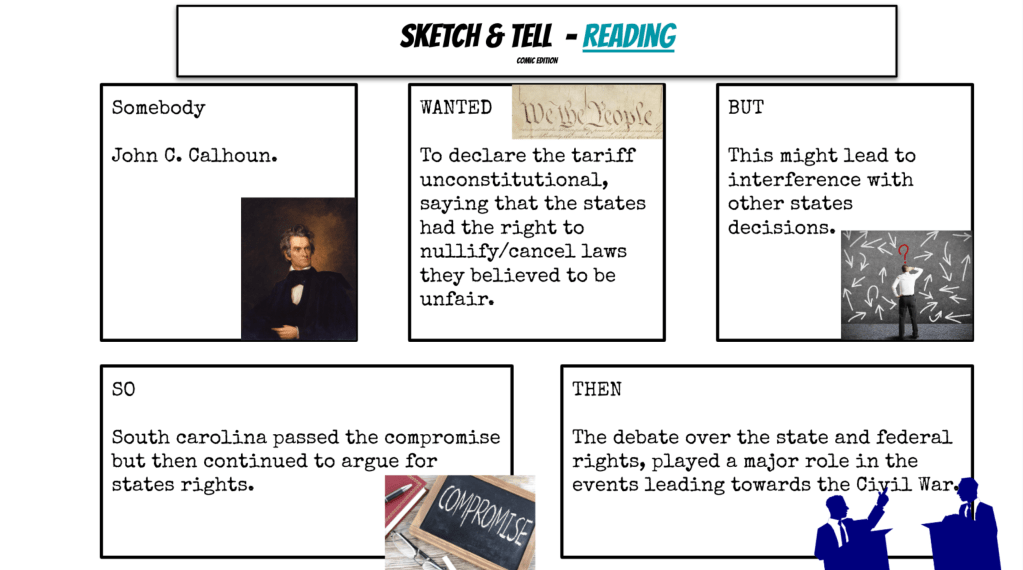
  • Somebody-Wanted-But-So-Then: Sequence the conflict with a narrative lens
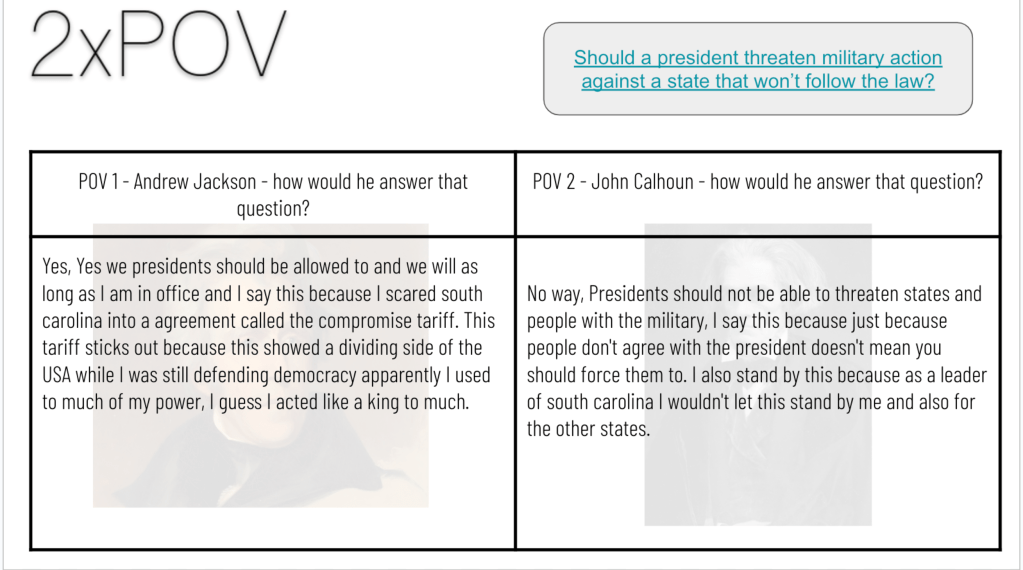
  • 2xPOV: Explore Jackson vs. Calhoun’s stances through primary source excerpts

The protocols change, but the pattern doesn’t. Start with retrieval, build into context and complexity, and finish with a chance for students to show their creativity/knowledge.

Let the Content Shape the Thinking

The thinking flow stays the same, but I adapt it based on what the content demands.

Manifest Destiny is full of imagery, myth, and legacy. It asks students to wrestle with beliefs, intentions, and consequences. I use EduProtocols that bring those pieced to life through visuals, structured writing, and modern-day connections.

The Nullification Crisis, on the other hand, is rooted in power dynamics and constitutional interpretation. It’s about understanding who wanted what, why they clashed, and how it played out. So I lean into story structure and POV work to help students break it down.

I’m not asking, “Which protocols do I like?” I’m asking, “What kind of thinking does this content require?”

Some Skills Go Beyond the Content

There’s another layer here, too. Sometimes it’s not just about history skills, it’s about cognitive skills that matter long after students leave the classroom. I’m trying to take care of the present while preparing kids for the future.

Here are three skills I intentionally built into these stacks:

  1. Adopting a Different Perspective: The POV Analysis protocol pushed students to consider two very different interpretations of the same conflict: Jackson and Calhoun’s views on states’ rights and federal authority. That’s more than a history lesson. That’s about being able to hold multiple perspectives in tension, something we all need more practice with in and out of school.
  2. Synthesizing Messages: In the Manifest Destiny lesson, the MiniReport asked students to combine ideas from a traditional textbook and a more critical, modern article. They had to make sense of competing viewpoints and turn it into a coherent written product. That’s the kind of synthesis skill that transfers to writing, speaking, and decision making.
  3. Asking the Right Questions: Wicked Hydra helped students generate their own questions from a provocative headline. We didn’t start with answers – we started with curiosity. That habit of inquiry matters. It helps students know what to ask when things get unclear or when they need to dig deeper, whether it’s in history or real life.
Final Thoughts

When I rack and stack, I’m not just filling time or tossing in a protocol because it’s fun. I’m designing a flow. A lesson that moves students from buiulding background knowledge/retrieval to confident creation – without burning them out along the way.

Even though the topics change, the thinking stays consistent:

  • Start with the goal
  • Build the sequence that supports the right kind of thinking
  • Keep the cognitive load manageable
  • Let students do the heavy lifting, at the right time, with the right support

If you’re just getting into racking and stacking, here’s my best advice:

Start small. Pay attention to the thinking each step requires. And when in doubt, ask: What do I want students to do with their brain next? That’s the question that drives everything I build.

The Week That Was in 234

This week was about layering, connecting, and getting students to own the content—not just memorize it. Every protocol, every sequence was designed to move students from basic retrieval to deeper understanding without overwhelming them.

Nothing fancy. Nothing over the top. Just intentional teaching.

Monday – Abolitionist Reformers Thick Slide

Tuesday/Wednesday – Superlatives

Thursday – Abolitionists/Women’s Suffrage Reading and AI Evaluation

Friday – Reform Movements Solo Iron Chef

Monday: Contributive Learning With Abolitionists

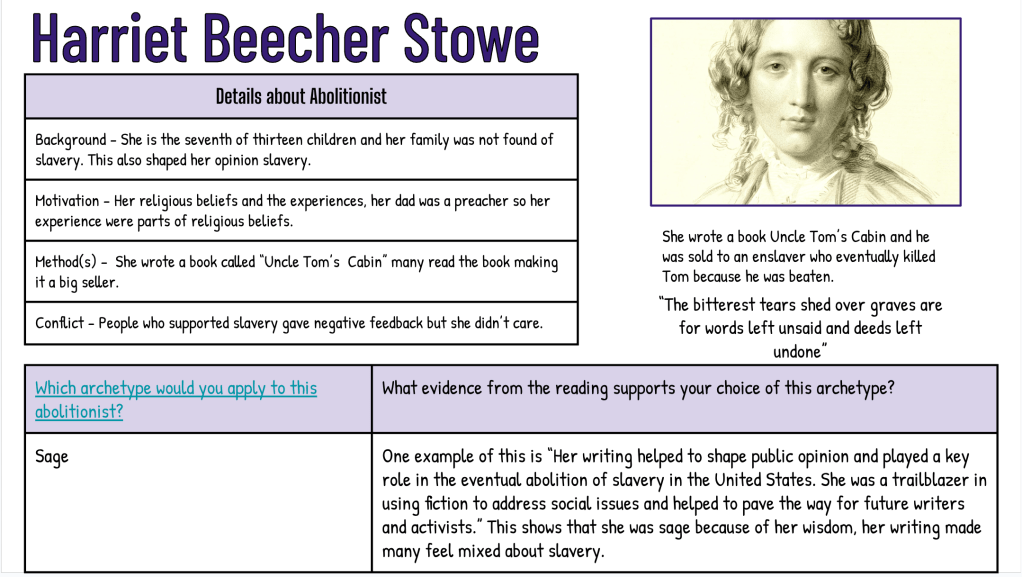
Monday kicked off our Abolitionist Movement work. I always try to bring in local figures like Harriet Beecher Stowe, John Rankin, and James G. Birney alongside Frederick Douglass, Sarah Grimké, and William Lloyd Garrison. Students need to see the local connection—that history didn’t just happen “out there.”

We started with a Thin Slide: “Change begins when someone refuses to stay silent.”
One picture. One word or phrase. Fast. Immediate. It set the tone for the day—thinking about voice, action, and courage.

Then we jumped into a short EdPuzzle. It wasn’t to “teach” the content—it was just to jog memories and fill in some quick context before they picked an abolitionist to dive deeper into.

The Thick Slide was the real meat of the day:
Each student chose one abolitionist and built a slide that included:

  • A short background
  • Their motivations for ending slavery
  • The methods they used (writings, speeches, helping people escape, etc.)
  • One powerful quote or moment that showed who they were

This wasn’t just copying facts—it was asking students to curate what mattered.

After they shared, classmates used a Frayer Model to capture the background, methods, and motivations for four abolitionists.

Why I sequenced it this way:

  • Thin Slide to frame the emotional/critical thinking lens
  • EdPuzzle for quick retrieval
  • Thick Slide to produce and contribute
  • Frayer to actively listen, gather, and process others’ work

Every move had a purpose: students weren’t just learning about abolitionists—they were seeing patterns of activism.

Tuesday: Finishing Abolition With Superlatives

Tuesday was another strange day because of science OST testing.

We opened with a Fast and Curious on Quizizz. Nothing complicated—just another layer of retrieval on the same reform movement content:

  • Words like suffrage, reform, abolitionism, and goals of different movements

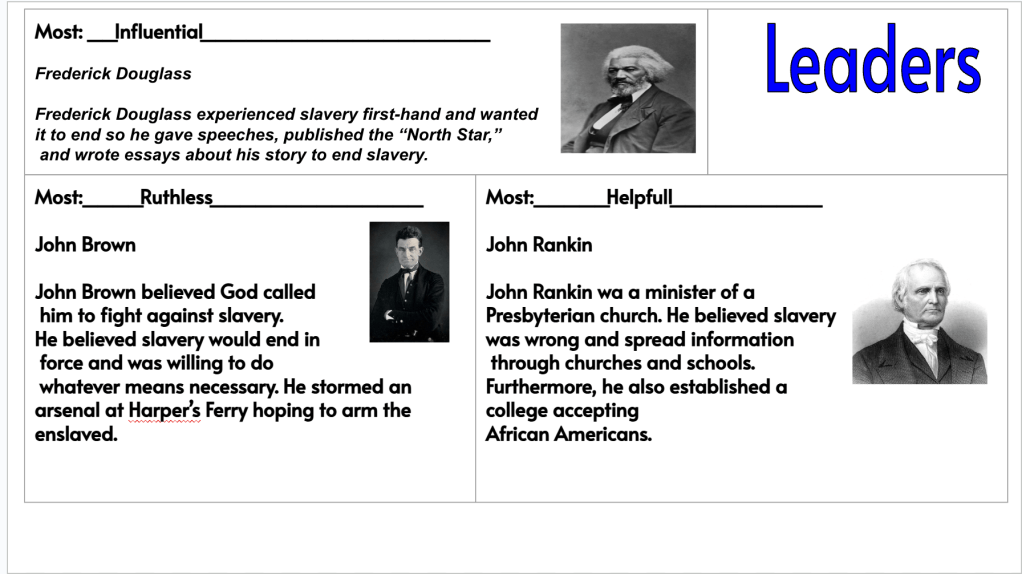
Then we finished Monday’s work with a Superlatives activity (shoutout to Kim Voge). Students had to pick 2–3 abolitionists and apply superlatives like Most Courageous, Most Determined, Most Visionary, etc.

At first, I had them tie it back to the Thin Slide quote from Monday…but after first period, I realized that overwhelmed them. So I pivoted and just let them focus on the superlatives.

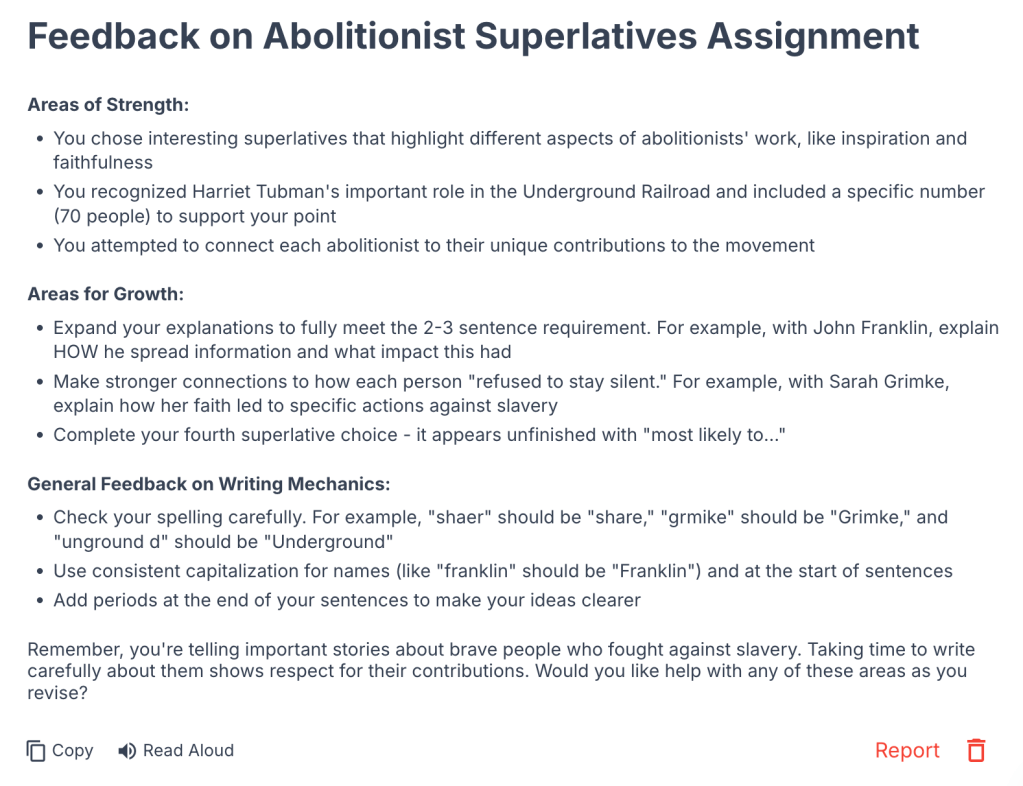
After students completed the Superlatives, they used Magic School’s writing feedback tool to add in ideas. They took a screenshot, attached the screenshot to the feedback tool, and generated feedback. It led to discussions of evaluating feedback and choosing to pay attention to the feedback that matters.

Why this worked:

  • Fast and Curious warmed them up with retrieval
  • Superlatives required them to compare, judge, and defend choices
  • It wasn’t just recalling facts—it was applying understanding

The pivot mattered. Sometimes you have to drop something mid-day when you realize it’s not helping kids think better.

Wednesday: Thinking on My Feet With Real-World Skills

Wednesday was a little chaotic—still on the weird science testing schedule. Some classes finished their superlatives and quizzes early, and I knew I needed something meaningful that wasn’t just busy work.

I thought back to a Friday Check-In I ran months ago:
“If I could teach you anything besides social studies, what would you want to learn?”

The most common answer? – Jobs. Taxes. How to get a job.

So I threw together a quick, no-internet-needed lesson:

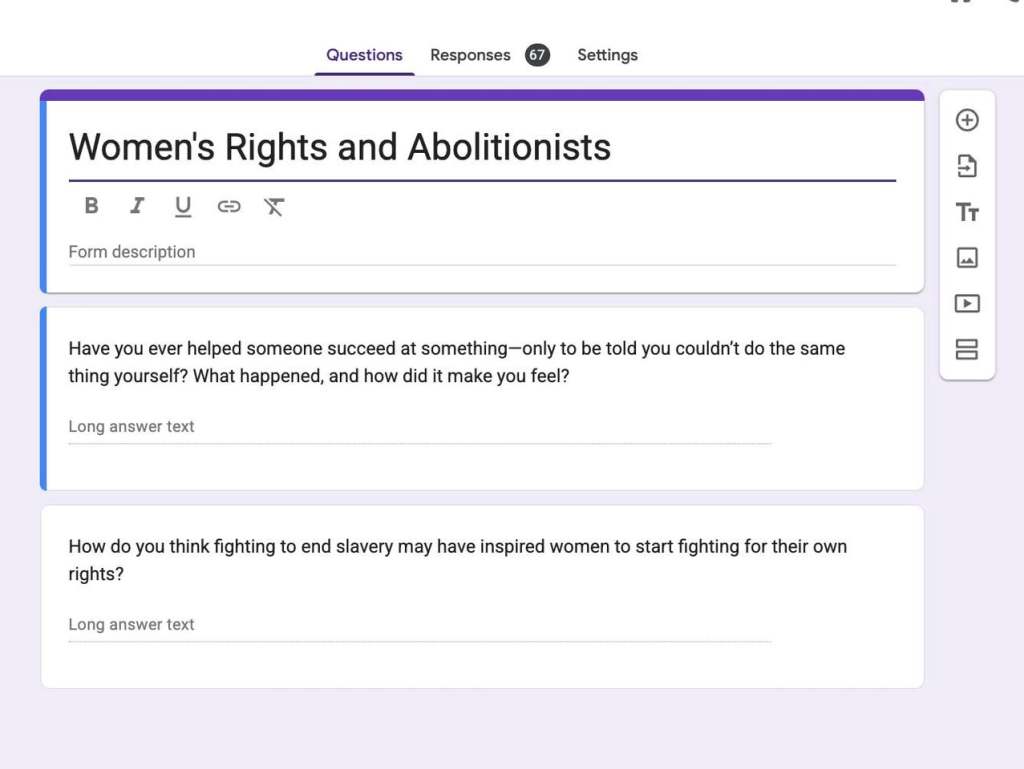
  • Started with a Google Form:
    • What’s more important—skills or attitude?
    • Would you hire yourself right now?
  • Number Mania on Padlet:
    • What are two labor laws that surprised you?

I shared a quick story about my first job working clay tennis courts—how doing the little things no one asked for got me better hours and more money.

Why this worked:

  • It was personal.
  • It was relevant.
  • It used EduProtocols (Number Mania + fast reflection) in a real-world context.

The best moments come when you connect content to what actually matters for students’ futures.

Thursday: Connecting Abolition and Women’s Rights (with Purposeful AI)

Thursday was all about tying movements together—and introducing AI not as a shortcut, but as a thinking partner.

Our goal:
Understand how the Abolitionist and Women’s Rights movements were connected—and why they eventually split apart.

The flow:

  • Opened with a Google Form to prime thinking: Where do you see connections? Where could you see division?
  • Annotate & Tell: Students read a short article and answered four guiding questions that helped them think about motivations, conflicts, and context.

Then came the AI part—and this was intentional:

  • Students used MagicSchool ChatBot Raina to ask a question about the reading. I did not preload the ChatBot with any extra information.
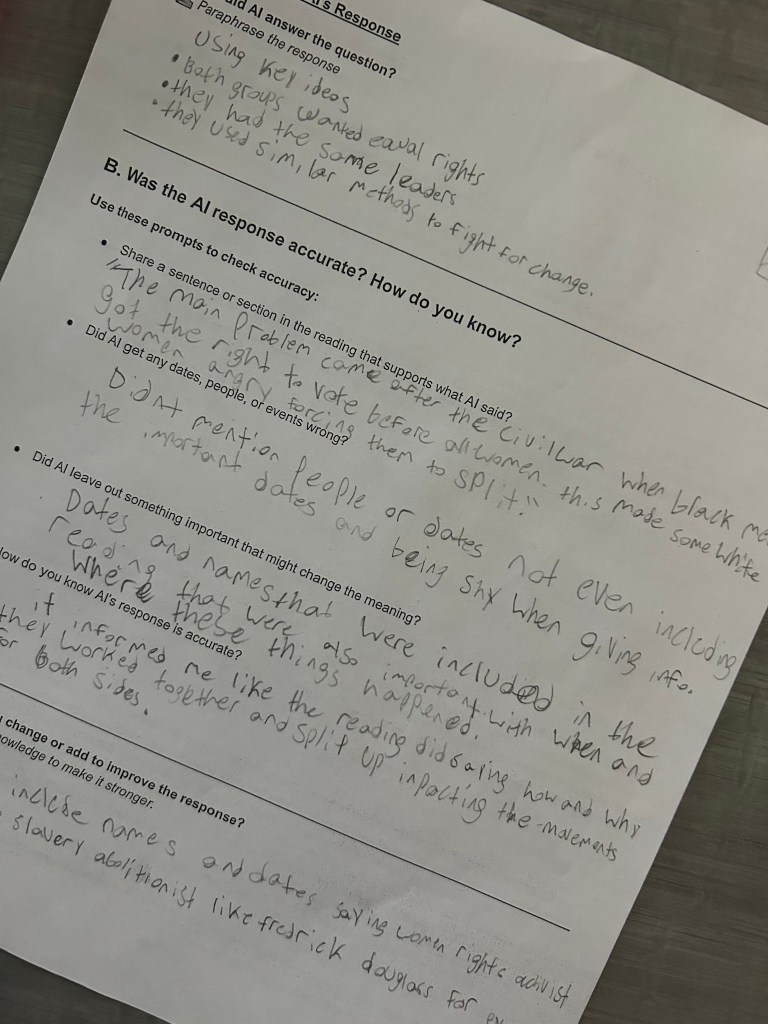
  • They had to paraphrase the AI response
  • Then they had to evaluate it:
    • Was it accurate?
    • Was anything missing?
    • How could it have been better?

This wasn’t just “use AI.” This wasn’t generate ideas and copy. It was: engage with AI, challenge it, think critically about it.

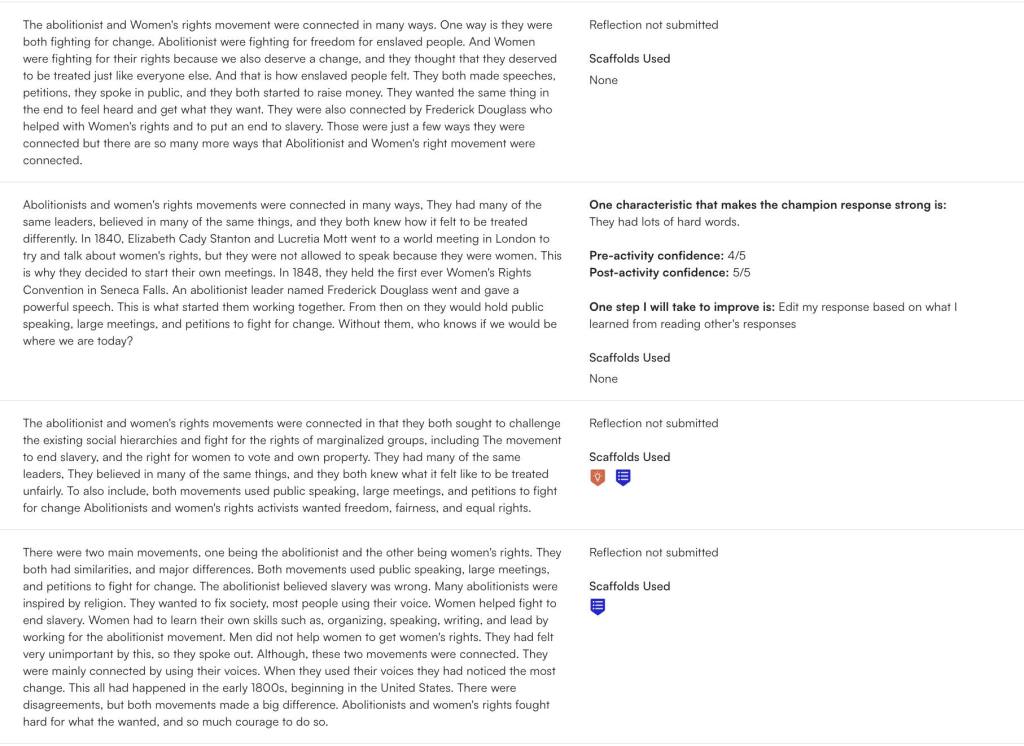
We closed it all with a Short Answer Battle Royale: Explain how the two movements were connected.

Why this worked:

  • The Google Form opened thinking.
  • Annotate & Tell slowed down reading.
  • AI added reflection, metacognition, and sourcing conversations.
  • Short Answer forced a full-sentence, evidence-based response.

AI wasn’t a crutch. It was a springboard for better thinking.

Friday: Wrapping Reform With Solo Iron Chef

Friday was about pulling everything together.

We started with a Fast and Curious on Quizizz (class averages were solid: 83%–90%) to hit key reform concepts one last time.

Then, students completed two Solo Iron Chef slides:

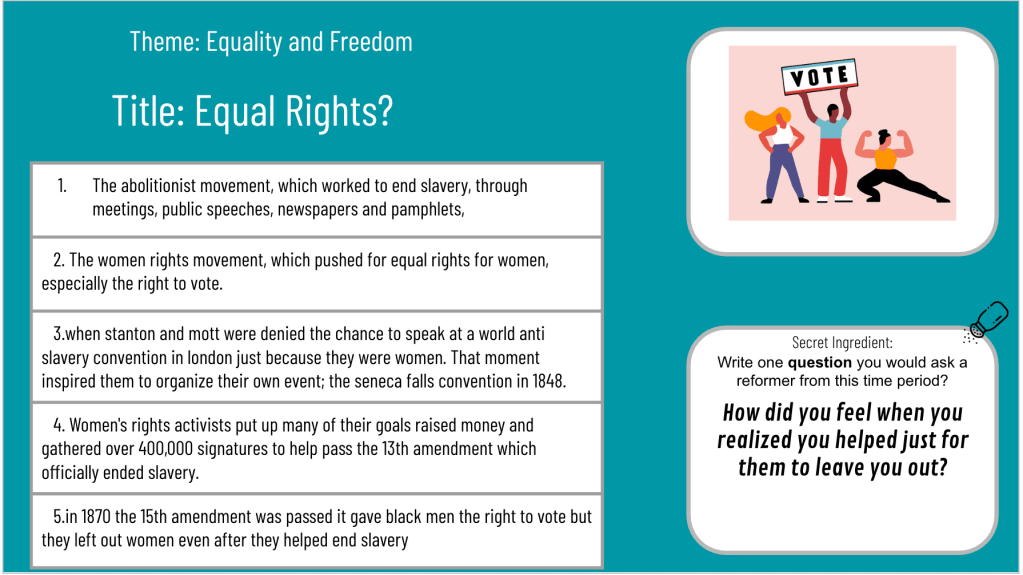
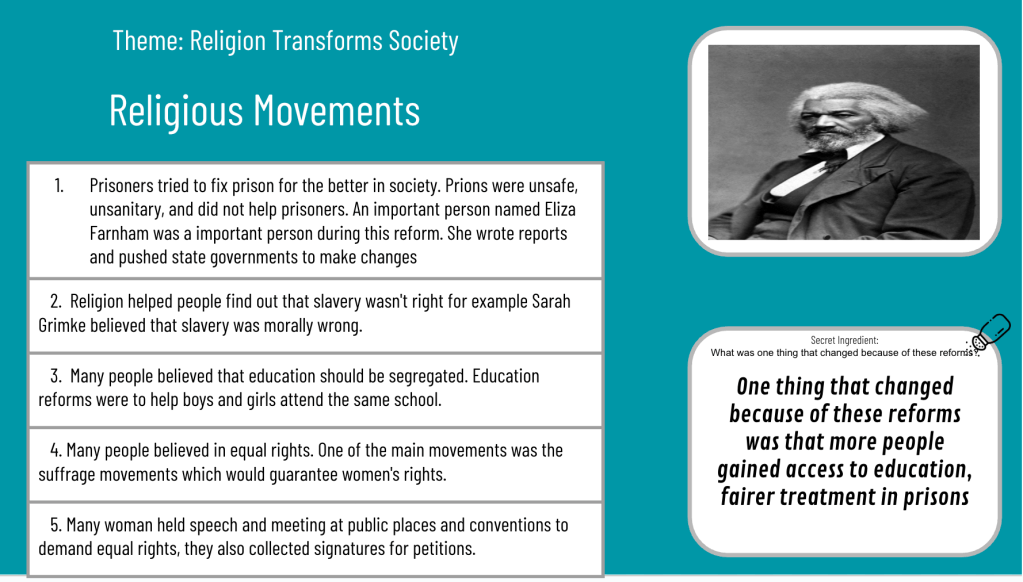
  • Slide 1: Religion Transforms Society (5 details + image + secret ingredient reflection)
  • Slide 2: Equality and Freedom (5 details + image + secret ingredient question)

I set the timer for 15 minutes per slide. Students had to screenshot their work and use MagicSchool to get AI feedback on it. And again—the feedback conversations were the best part. A student said, “The AI said to change my title but I made mine rhyme and I like it.” I said, “Then why listen to it? It’s a tool—not the truth. You know your purpose better than the AI does.”

Why this worked:

  • Retrieval + creative processing + purposeful reflection
  • AI wasn’t giving answers—it was helping students think about their choices

That’s the mindset we’re trying to build.

Why It All Worked

This week wasn’t about “doing EduProtocols” or “using AI” just because.
It was about intentional layering:

  • Start fast and low-stakes (Quizizz, Thin Slide)
  • Process and reflect (Annotate & Tell, Thick Slide, Frayer)
  • Compare and judge (Superlatives, Battle Royale)
  • Create and apply (Iron Chef, Superlatives)
  • Use AI for feedback, evaluate the answers

Every protocol had a purpose.
Every sequence moved students one step closer to owning their learning—not just memorizing for a test.

That’s how you build real growth. And that’s what made this week work.

Things That Shaped Me: The Game That Taught Me More Than Winning Ever Could

In my blog series, The Week That Was, I try to open up my classroom and my mind—how I plan, how I teach, what I try, what works, what doesn’t. But the more I think about it, the more I realize that maybe I need to open up more about myself. Not just what I do in the classroom, but who I am, and the things that have shaped me into the teacher I am today.

One of the biggest things that shaped me is tennis.

I’ve played my whole life—through elementray, middle school, and high school. I was my high school’s only state qualifier in tennis, and my old racquet is still in the glass case at the school. But here’s the funny thing: I’m not a naturally competitive person. Not in the loud, intense kind of way. But tennis taught me how to compete. And not just with other people—with myself.

Tennis is a game of integrity. You make your own line calls. You call the score out loud. If the ball double bounces on your side, you’re the one who’s supposed to admit it. There’s no ref on the court. You and your opponent are the refs. It’s a game of sportsmanship, honesty, and respect. No matter how tough the match is—whether you win or get your ass kicked—you shake your opponent’s hand and say “nice match.”

I’ve had moments where I’ve wanted to lose it. One time, a guy intentionally pegged me with a ball between points—not during the play, just straight up drilled me. I was heated. Had a few choice words. But I still walked to the net and shook his hand. Because that’s the game.

There’s no game clock in tennis. No buzzer. You play until someone wins the last point. It’s just you and your opponet, figuring each other out. It’s physical, mental, emotional. You have to get creative. You gotta adjust. You have to find a way.

Tennis didn’t just teach me how to play. It taught me how to carry myself, how to bounce back, how to keep my head, how to quietly prove people wrong. It’s shaped how I teach, how I coach, how I reflect, and how I grow.

That’s what this new series, Things That Shaped Me, is about. The moments and experiences behind the lesson plans. The stuff that built me. Because teaching isn’t just about what you do. It’s about who you are. And if I’m going to open up my classroom, I might as well open up a little more of myself too.

Things Are Getting Expensive…Here’s Some Useful Free Versions Of AI Tools

Things are getting expensive. Teachers don’t wanna pay for stuff. Free versions are usually watered down or full of ads. I’m just here to share some tools that have useful free versions. These are ones I’ve been using and they’ve helped me plan better, save time, and still give students solid feedback and learning experiences.

I’ll keep it simple: what it is, why I like it, and how I use it (with a solid teaching idea thrown in—usually paired with EduProtocols that make sense).

Class Companion

Even with the free version, Class Companion gives your students feedback like a champ. It tracks writing progress over time, breaks feedback down into categories like organization and evidence, and gives consistent scoring. You can assign short-answer questions or extended responses, turn off copy/paste (huge during state testing season), and export their progress.

Why I like it: I don’t have to manually grade everything and I still get useful data. Feedback is fast and targeted. It’s perfect for helping kids write better without burning myself out.

Teaching Idea: Pair with Nacho Paragraph. After doing a Number Mania, reading, or Frayer-based content build, have students write a one-paragraph response that argues a claim. Class Companion gives AI feedback on the claim, evidence, and reasoning. It’s also great after a MiniReport—combine two sources, write a response, and let AI provide revision tips. Great test prep without being test prep.

Brisk

Brisk is like having an AI sidekick built right into Google Docs and Slides. You can highlight text and ask it to simplify or raise the reading level, turn a website into a quick Google Slide presentation, or even generate questions. You can use it to leave AI-generated feedback on student work, but I mostly use it for materials prep.

Why I like it: It’s fast, doesn’t take me to a new platform, and it helps me tailor materials for students at different levels in seconds.

Teaching Idea: Use Brisk to level a source before a Cyber Sandwich. Take a tough article, simplify it for one group of students, and leave the original for another. Have them annotate, partner-share, and write a summary. You can even ask Brisk to generate questions for a thin slide or fast and curious warm-up.

Curipod

This is my go-to when I want a fast, interactive lesson that looks good but doesn’t take hours to make. Curipod lets you create engaging, Nearpod-style lessons. You can add open-ended questions, quick polls, drag-and-drop, even AI-generated reflections or historical figure Q&A simulations. The drawing and writing feedback features are a huge bonus.

Why I like it: I can turn a warmup into a 20-minute meaningful discussion with a couple clicks. Students actually enjoy the format and get to respond anonymously or collaboratively.

Teaching Idea: One way you could try using Curipod is by adding a few Sketch and Tell prompts throughout the lesson. Students draw and write a quick response, and the platform gives them feedback right away. After the Curipod, you might follow it up with a Thick Slide—have students share four important facts, two visuals, and a comparison. It’s a simple way to turn the lesson into something more student-centered and reflective.

Final Thoughts

These three AI tools won’t replace your teaching—but they do make it faster, easier, and more manageable. You don’t need 12 tools, and you definitely don’t need to drop $25/month to get value.

Try one this week. Layer it into an EduProtocol you already use. Let the AI handle some of the prep or feedback so you can focus more on the conversations and connections that matter.

The Week That Was In 234

When I think of teaching the Early Republic, I think about political parties, presidential decisions, and how those decisions shaped the federal government. I think about how the first five presidents kept us out of wars, expanded federal power, and navigated political tensions. I think about how political parties influenced those choices and how the nation evolved under their leadership. But this damn textbook has other plans.

Instead of keeping the focus on political parties, foreign policy, and domestic growth, it randomly throws in sectionalism, the Missouri Compromise, the Industrial Revolution, and some random westward expansion facts—all jammed into two weeks. It’s way too much, and it makes no sense. This is the Early Republic, not a scattershot of everything that happened between 1800 and 1825.

Then Friday rolled around, and we hit the common assessment from the textbook—a test that somehow completely ignores the Monroe Doctrine but includes a question asking students to identify three battles from the War of 1812. Who cares?! It’s not even an important part of the unit.

But I digress.

So, with all that, we kicked off Monday learning about growing sectionalism after the War of 1812. SMH.

Monday – War of 1812 Rack and Stack

Tuesday – Industrial Revolution

Monday

We kicked off Monday with a Content Compactor that acted as a quick review of the causes of the War of 1812. This got students thinking about the political, economic, and regional tensions that led to the war while allowing them to summarize key ideas concisely—an essential skill as we transitioned into the concept of sectionalism.

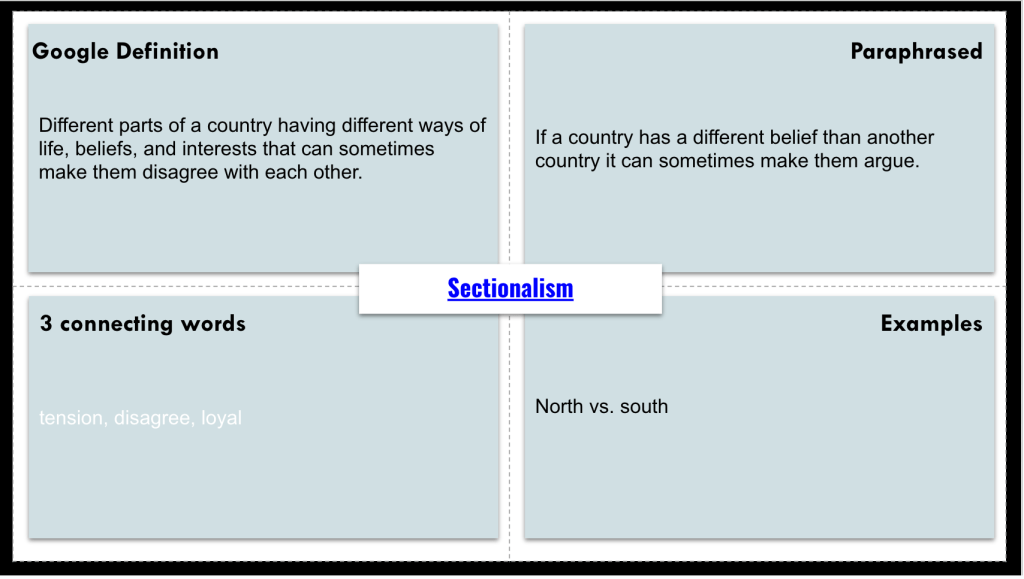
Frayer Model: Defining Sectionalism

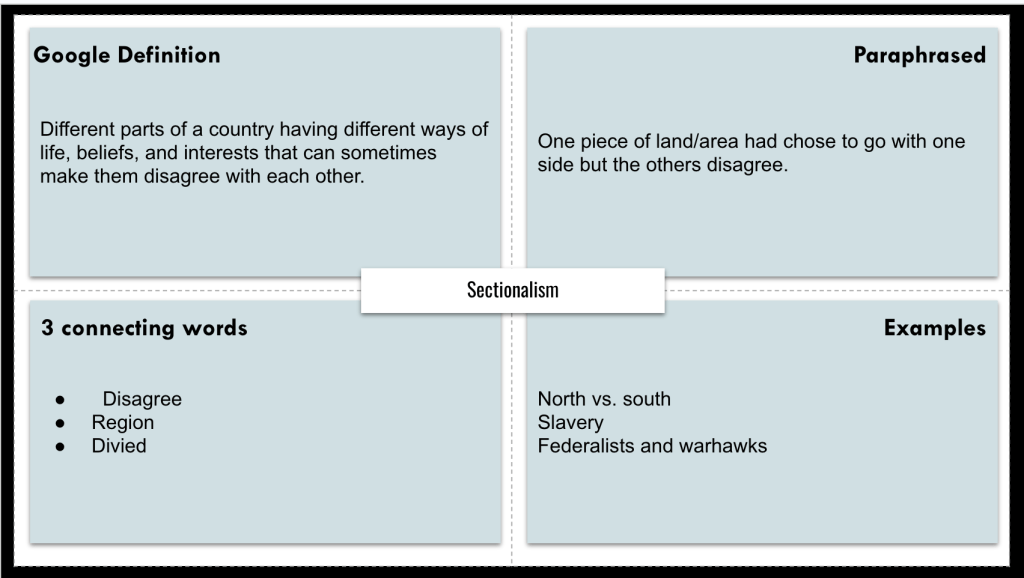
Next, we tackled sectionalism with a Frayer Model. Students defined the term, provided examples and non-examples, and listed key characteristics. The goal was to help students see sectionalism not just as a word, but as a major force that would shape U.S. history for decades. This activity ensured that students grasped the economic, political, and social divisions developing between regions of the country.

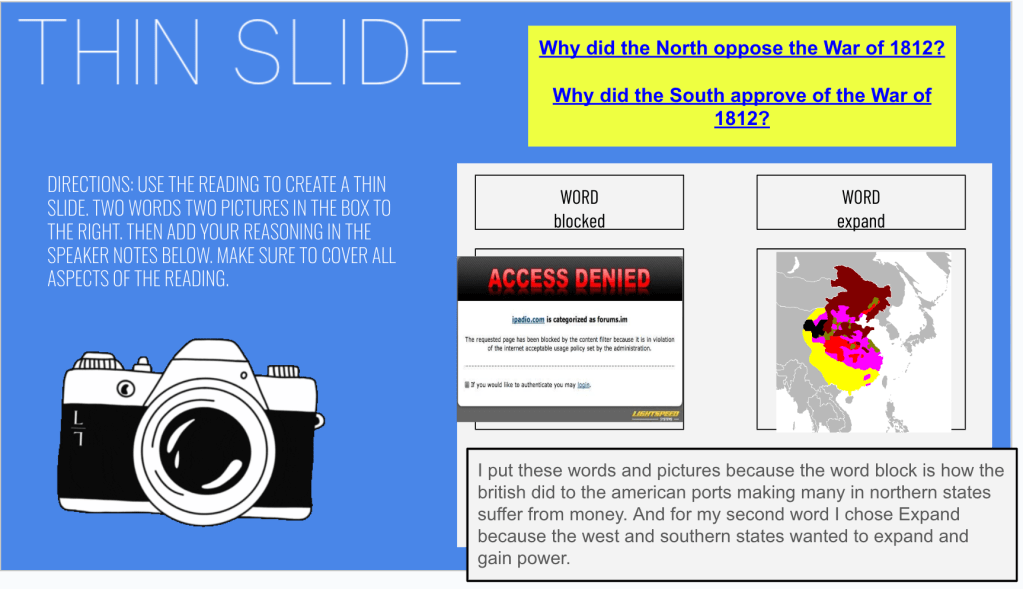
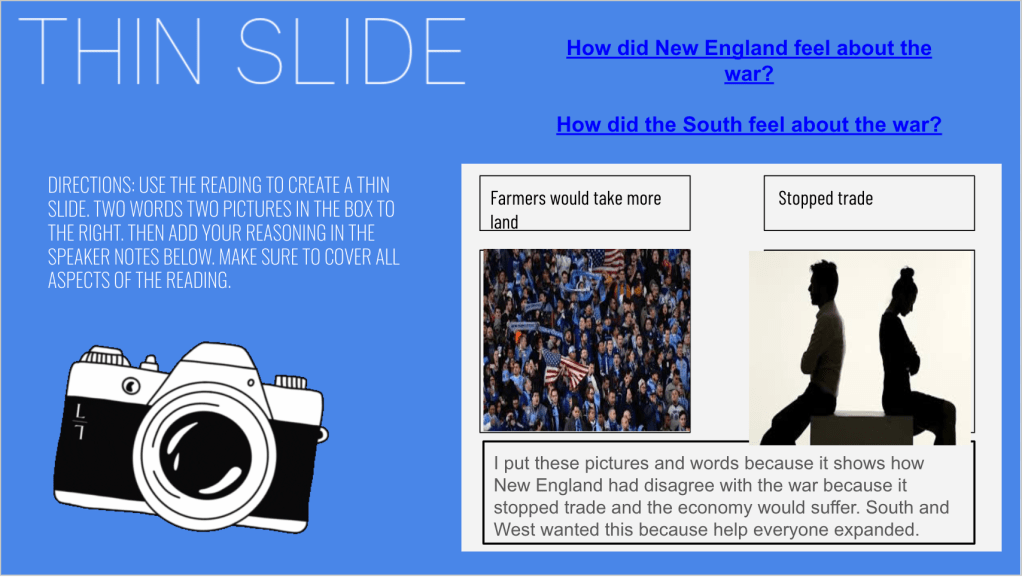
Thin Slides: Visualizing Sectionalism

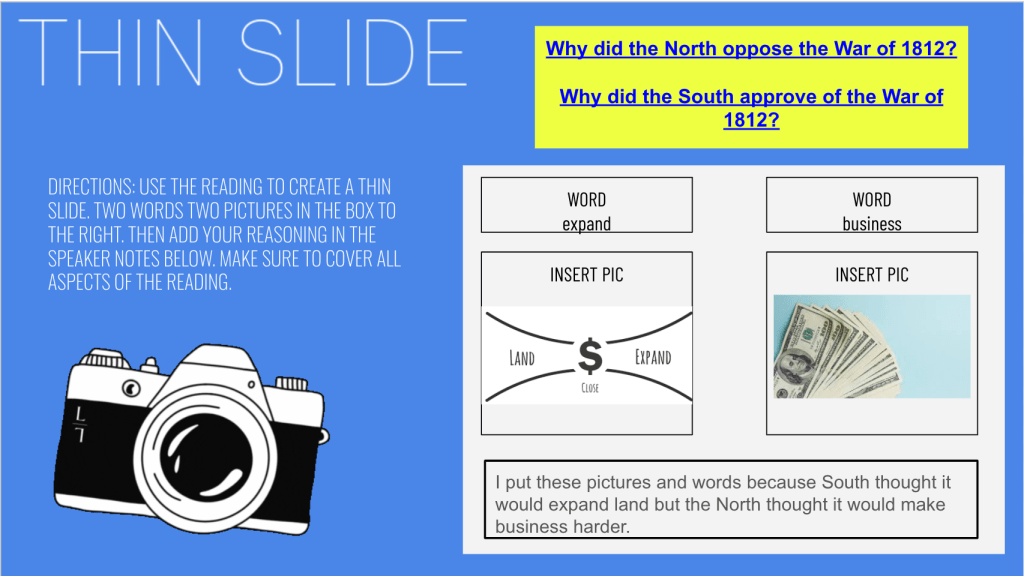
Once students had a working definition, they moved into a Thin Slides activity. Using a short reading on sectionalism, they selected two words and two images that best represented how sectionalism grew after the War of 1812. In the speaker notes, they explained their choices, addressing:

  • Why did the North oppose the war?
  • Why did the South support it?
  • How did economic and political differences lead to sectionalism?

This was a quick, low-stakes way for students to process how sectional tensions formed and why they mattered.

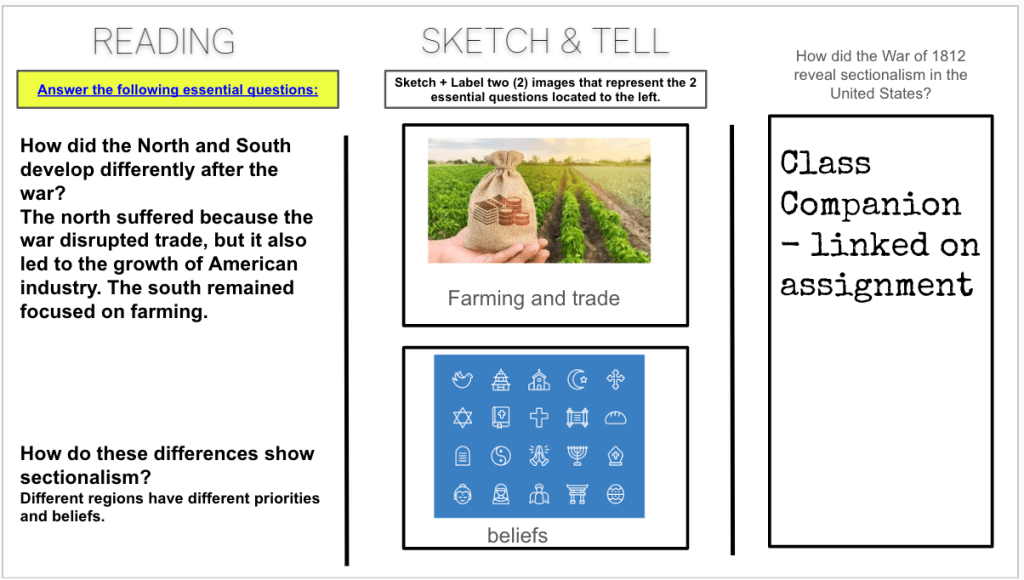
Sketch & Tell: Answering Essential Questions

Students then tackled three essential questions through a Sketch & Tell activity:
1️⃣ How did the North and South develop differently after the war?
2️⃣ How did these differences contribute to sectionalism?
3️⃣ How did the War of 1812 reveal sectionalism in the U.S.?

They created two labeled sketches that visually represented their answers, reinforcing how regional differences in economy, industry, and policy contributed to rising sectional tensions.

Class Companion: Writing About Sectionalism

To wrap it up, students used Class Companion to answer the question:
💡 How did the War of 1812 reveal sectionalism after the war?

This allowed students to take their thoughts from their sketches and turn them into a structured response with real-time AI feedback. Since some students needed more time to refine their writing, we carried this over into Tuesday, giving them an opportunity to perfect their responses and ensure they fully understood sectionalism’s impact.
Why This Works
  • Content Compactor helped students refresh prior knowledge in a concise, engaging way.
  • Frayer Model ensured students developed a strong conceptual foundation before moving forward.
  • Thin Slides encouraged visual learning and synthesis of ideas.
  • Sketch & Tell helped students explain complex historical trends in a creative, student-centered way.
  • Class Companion allowed students to organize their thoughts in writing with immediate, personalized feedback.

Instead of just reading about sectionalism, students were building their understanding step by step, using visual, discussion-based, and writing activities to make the concept stick.

Tuesday & Wednesday

We started Tuesday by finishing up Class Companion responses from Monday on how the War of 1812 revealed sectionalism. Once students submitted their final responses, we pivoted to the Industrial Revolution—a topic that the unit test oddly prioritizes with fill-in-the-blank questions on patents, corporations, and capitalism, but barely acknowledges the Monroe Doctrine or foreign policy under the early presidents. Because that makes total sense.

Gimkit Fast & Curious: Industrial Revolution Vocab

Since the test focuses so much on random economic terms, we ran a Gimkit Fast & Curious with key Industrial Revolution vocabulary—words like patent, corporation, free enterprise, and capitalism. First round: class averages were pretty bad. After giving a quick mini-lesson on the most-missed words, we ran the Gimkit again, and scores jumped up significantly.

To lock in the most commonly missed terms, we followed up with Frayer Models for:
🔹 Patent
🔹 Corporation
🔹 Free Enterprise

Reading, Videos & Thick Slides

After breaking down the vocabulary, students read about key innovations of the Industrial Revolution—factories, mechanization, interchangeable parts, and yes, the cotton gin (because clearly, that fits into an Early Republic unit 🤦‍♂️).

To help process the reading, students worked on Thick Slides focused on four ways the Industrial Revolution transformed America. They had to:
✅ List four key impacts
✅ Find an image to represent industrialization
✅ Compare the North and South’s role in industrialization

Why This Works
  • Gimkit Fast & Curious ensured students got multiple reps with essential vocabulary.
  • Thick Slides helped synthesize and apply learning, rather than just memorizing random terms.
  • Multiple formats (reading, videos, notes, discussion, and visuals) ensured everyone had a way to engage with the content.

Even though this topic was awkwardly shoved into the unit, we made it work in a way that actually helped students understand and retain the material—instead of just cramming information for a test.

Thursday

With the unit test coming up, I wanted to make sure students had multiple opportunities to review key concepts in an engaging and structured way. Enter Brain, Book, Buddy, Boss—one of my favorite review strategies because it reinforces retrieval practice, collaboration, and teacher-guided clarification all in one lesson.

Step 1: Brain (Independent Recall)

Students received the review sheet (matching terms, short answer questions, and key concepts from The Early Republic). Before looking at any resources, they went through the entire review sheet independently, answering as many questions as they could from memory.

The goal? Get a sense of what they already know.

Some students flew through it, while others stared blankly at the paper. That’s the beauty of this step—it exposes strengths and gaps immediately.

Step 2: Book (Reference-Based Learning)

Next, students used their notes, textbooks, and classwork to fill in missing answers and correct any mistakes. This phase is where light bulbs start going off as students piece together information they’ve seen throughout the unit.

Of course, this is also where they discover just how terribly worded some of these test questions are.

For example, here’s an actual test question:
“What were some effects of the Alien and Sedition Acts?”

A. The policy of nullification became largely discredited.
B. The French stopped attacking U.S. ships.
C. Fewer people immigrated to the United States from Europe.
D. The principle of states’ rights gained public support.

This question assumes a level of vocabulary knowledge that most 8th graders simply don’t have. The wording is vague enough to confuse even students who understand the Alien and Sedition Acts. What 8th grader uses discredited in conversation?

Step 3: Buddy (Peer Discussion & Comparison)

After self-correcting with their books, students paired up to compare answers and discuss any remaining gaps. If they disagreed on an answer, they had to explain their reasoning to each other.

These conversations were gold—students challenging each other, correcting mistakes, and realizing where they were off-track. They got into heated debates over Federalist vs. Republican beliefs and the importance of Marbury v. Madison. This step solidified a lot of key concepts.

Step 4: Boss (Teacher Q&A)

For the final step, I opened the floor for questions. Students could ask me about anything still unclear—but with a catch:

They only had 8 minutes.

Once the timer hit zero, I was done answering. This forces students to prioritize their questions and keeps the review focused and efficient.

Why This Works
  • Brain (independent recall) activates retrieval practice.
  • Book helps reinforce accuracy and self-correction.
  • Buddy provides peer discussion and clarification.
  • Boss allows for focused teacher intervention in a structured way.

By the end of class, students had worked through misconceptions, clarified their understanding, and felt more confident about the material. It was one of the best review strategies for this test, and it reinforced just how flawed some of the test’s wording really was.

Friday: Test Day

Friday was test day, and I had everything set up on Class Companion for the short answer questions, while using McGraw Hill’s testing program for the multiple-choice and fill-in-the-blank sections.

One of the fill-in-the-blank questions asked about the beliefs of Democratic-Republicans. Most students simply typed “Republicans”, which is a reasonable answer considering the textbook even calls them that at times.

But McGraw Hill marked it wrong because they didn’t type the answer exactly as programmed: “Democratic-Republicans, Republicans”. I wish I were making this up.

So now, instead of assessing whether students actually understood the beliefs of the party, we were stuck in a battle of formatting.

Class Companion: At Least It Scored Correctly

For the short answer responses, Class Companion scored and provided feedback, but students only had one attempt—no revisions, just one shot. At least it evaluated their responses based on content rather than formatting nonsense.

I need a damn drink.

The Week That Was In 234

This week in 8th-grade social studies, we brought history to life with engaging EduProtocols that helped students dive deep into the Early Republic and key moments like the Whiskey Rebellion. From Sketch and Tell-O activities that broke down complex ideas to Progressive Sketch and Tell timelines that visualized historical events, we kept creativity at the forefront. Class Companion added an exciting layer of AI-driven writing feedback, while Fast and Curious Gimkits and CyberSandwiches reinforced foundational knowledge and sparked meaningful discussions. These protocols not only engaged students but also helped them build connections, improve comprehension, and master essential skills.

Tuesday – Lesson Intro CyberSandwich

Wednesday – Cabinet and Neutrality

Thursday and Friday – Hamilton and Whiskey Rebellion, Whiskey Story

Class Companion – AI Writing Feedback

Tuesday: Kicking Off the Early Republic

This week, we dove into a new unit on the Early Republic, which will culminate in a common assessment. Starting with a pre-assessment right out of the textbook, I had students tackle 20 of the most challenging, oddly worded questions filled with difficult vocabulary. The pre-assessment was designed to gauge their baseline knowledge and took about 10–15 minutes. Predictably, it was tough, but it gave me a sense of where they stood as we started the unit.

Introducing the Unit with a CyberSandwich

One thing I like about the textbook’s first lesson in this unit is how it revisits key foundational topics that lead into the Early Republic. It highlights the weaknesses and problems in America before the Constitution—like taxation without representation, the Articles of Confederation, Shays’ Rebellion, and foreign and domestic disputes—and positions the Constitution as the solution.

The irony? The textbook doesn’t explicitly connect these issues to the Early Republic or explain how the first five presidents put the Constitution to work and expanded federal power. So, I decided to bridge the gap myself using a CyberSandwich EduProtocol.

Here’s how it went:

  1. Simplified Reading: Instead of fumbling with the textbook or logging into the website, I printed out the reading directly from the online textbook. Paper copies are quick, easy, and let students highlight and annotate as they read.
  2. Guiding Questions: Students spent 12 minutes reading and answering five guiding questions that I generated with AI to focus their attention on key details.
  3. Partner Discussion: After reading, students listed two problems and one solution from the text and discussed their findings with a partner, comparing ideas.
  4. Fixing a Paragraph: To practice critical thinking and writing, I gave them a poorly written paragraph (also AI-generated) about the topic and gave them 10 minutes to improve it.

Wrapping Up with Gimkit

We ended the class with a Gimkit featuring nine questions I pulled from the summative assessment for this unit. The scores showed where we have room to grow:

  • 57%, 47%, 39%, and 42%.

While the scores were low, it was a good baseline and a chance to familiarize students with the material they’ll need to master.

Wednesday: George Washington Takes Office

We jumped into Lesson 2: George Washington Takes Office, diving into how Washington and Congress worked to strengthen the federal government. While the textbook suggests this lesson could take two days, I find that assumption wildly unrealistic. It’s packed with readings, activities, writing tasks, and reviews that assume students have extensive social studies background knowledge—something many students simply don’t have due to the limited time spent on the subject in earlier grades. The disconnect between textbook expectations and real classroom realities is frustrating.

Quick Notes: Setting the Stage

To start the lesson, I introduced key topics through a short lecture. These quick notes laid out the big ideas students would encounter in the lesson:

  • Washington’s leadership style.
  • The establishment of key government structures.
  • The significance of neutrality and Jay’s Treaty.

The goal was to give students a foundation before diving into deeper activities.

Archetype Foursquare: Connecting History to Stories

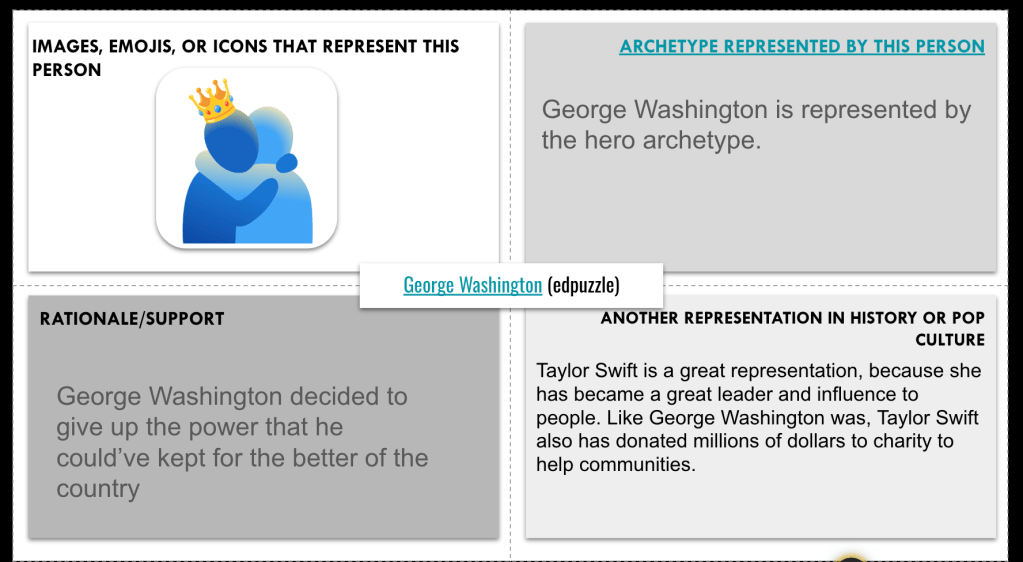
Next, I introduced archetypes—a fun and engaging way to connect historical figures to familiar characters. Students brainstormed archetypes in their favorite movies, TV shows, or books and discussed how every character fits an archetype (e.g., hero, mentor, trickster).

We followed this with an EdPuzzle on George Washington, a 4-minute video highlighting his leadership and challenges. While watching, students thought about which archetype best described Washington.

Afterward, students spent 8 minutes completing an Archetype Foursquare for Washington. They:

  • Identified an archetype for him (e.g., “hero” or “sage”).
  • Provided evidence from the video to support their choice.
  • Connected George Washington to someone else.
  • Compared their archetype ideas with a partner in a quick discussion.

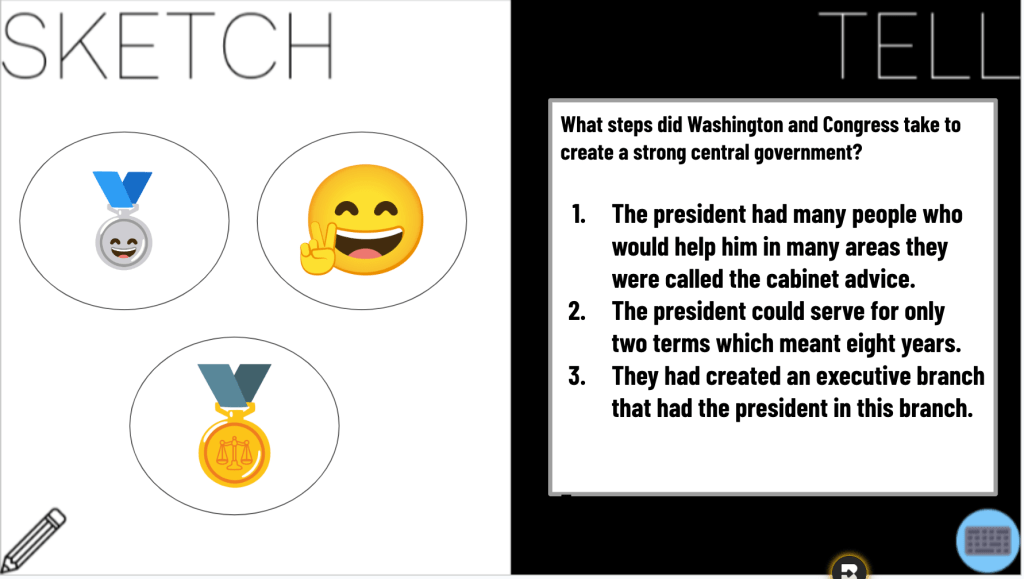
Sketch and Tell-O: Strengthening the Federal Government

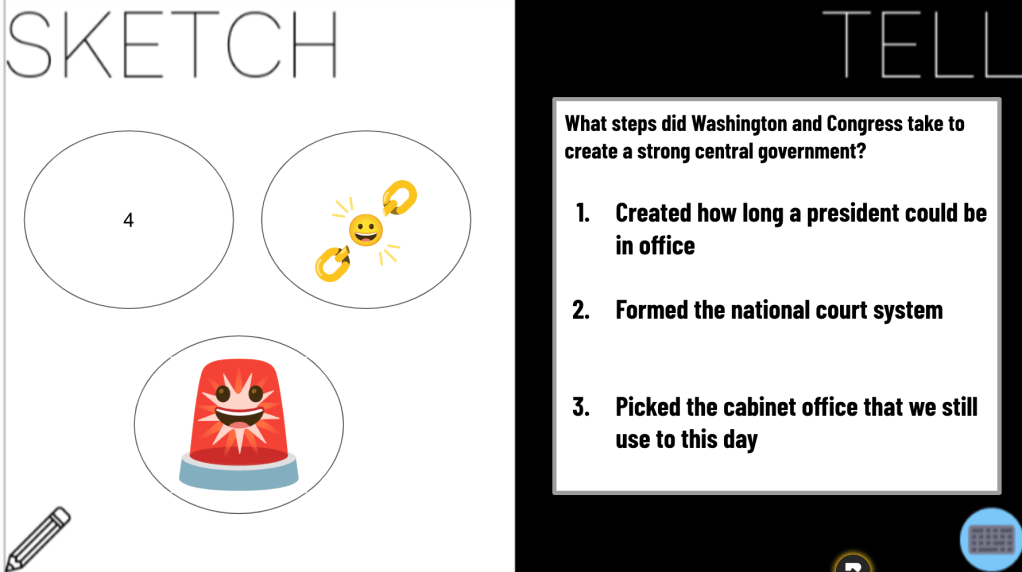
We then transitioned into the textbook’s reading on how Washington and Congress strengthened the federal government. Using a Sketch and Tell-O template, students sketched visuals to represent key ideas, such as:

  • The creation of executive departments.
  • The establishment of the federal court system.

This visual and creative approach helped break down the dense content into manageable chunks.

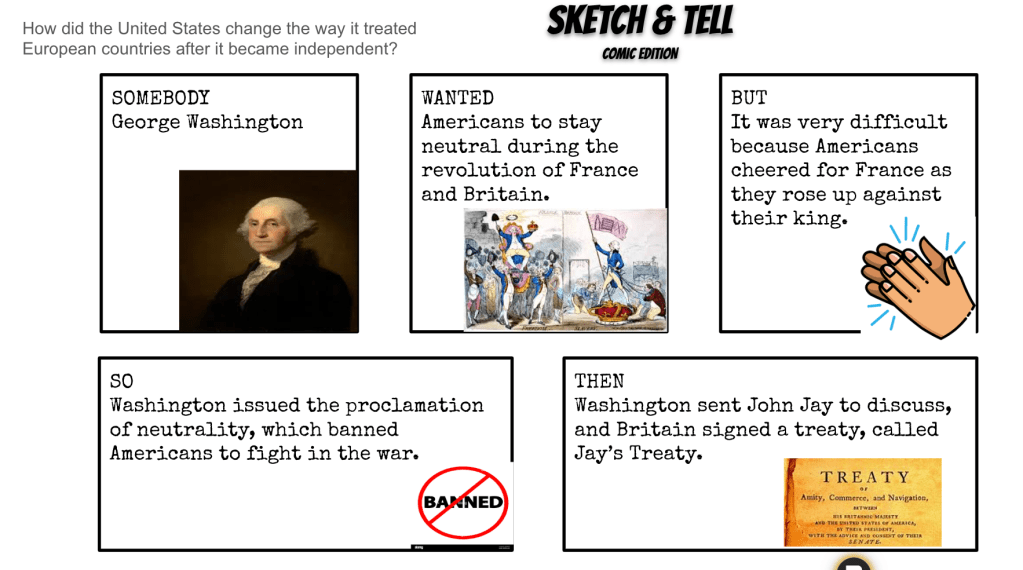
SWBST Sketch and Tell: Neutrality and Jay’s Treaty

Next, we tackled Washington’s foreign policy and Jay’s Treaty using a Somebody, Wanted, But, So, Then (SWBST) Sketch and Tell template. Students read about the challenges of maintaining neutrality during international conflicts and how Jay’s Treaty attempted to resolve tensions with Britain.

The SWBST activity allowed students to:

  • Summarize the main ideas.
  • Use both words and pictures to represent what they learned.
    This strategy is always a hit because it combines comprehension with creativity, making abstract concepts more concrete.

Wrapping Up with Fast and Curious

To close out the lesson, we ran a Fast and Curious Gimkit round focused on key vocabulary and ideas from the day.

  • Students played for 3 minutes.
  • I provided immediate feedback on commonly missed questions, reinforcing learning.

Thursday: Hamilton’s Plan

Thursday was all about diving into Hamilton’s financial plan, though I initially hoped to also cover Washington’s domestic issues like the Whiskey Rebellion. My ambition outpaced reality, and we only made it through Hamilton’s plan. That said, the day was packed with meaningful activities that helped students grasp these foundational concepts.

Quick Notes: The Foundation of Hamilton’s Plan

We began class with quick notes to outline Hamilton’s financial plan, focusing on:

  • Assuming state debts to strengthen the national government.
  • Establishing a national bank to regulate finances.
  • Implementing tariffs to protect American industry.

These notes took about 10 minutes and provided the background knowledge students needed for the activities that followed.

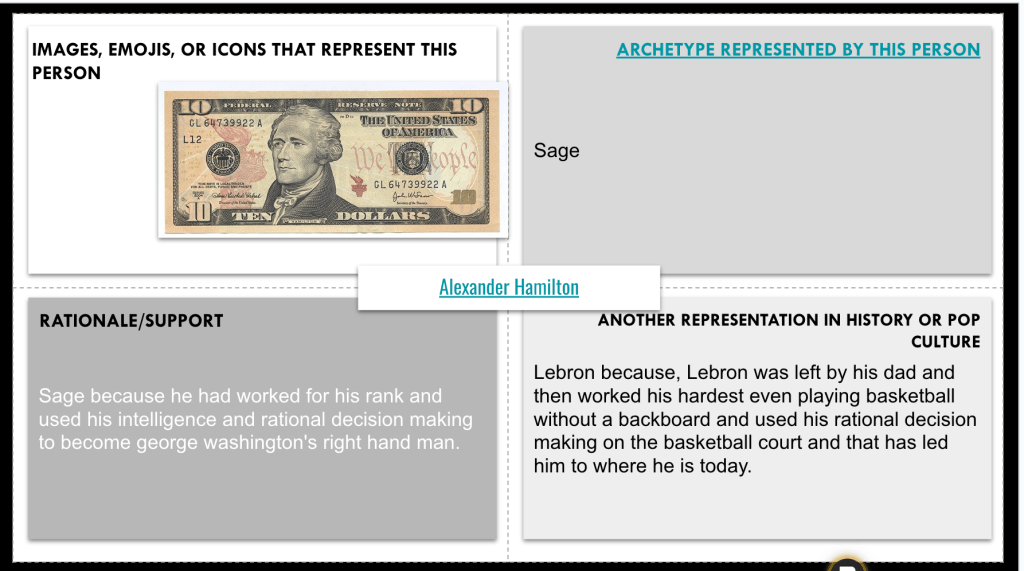
Archetype Activity: Understanding Hamilton

To make Hamilton more relatable, I used the brief biography from the textbook to introduce him as a historical figure. Then, we revisited the archetype activity from Wednesday, applying it to Hamilton. Students identified archetypes like “visionary,” “strategist,” or even “rebel,” depending on their interpretations.

This activity was quicker than Wednesday’s, but still sparked great discussion as students shared their archetype choices with partners and justified their reasoning.

Reading, Questions, and Sketch and Tell-O

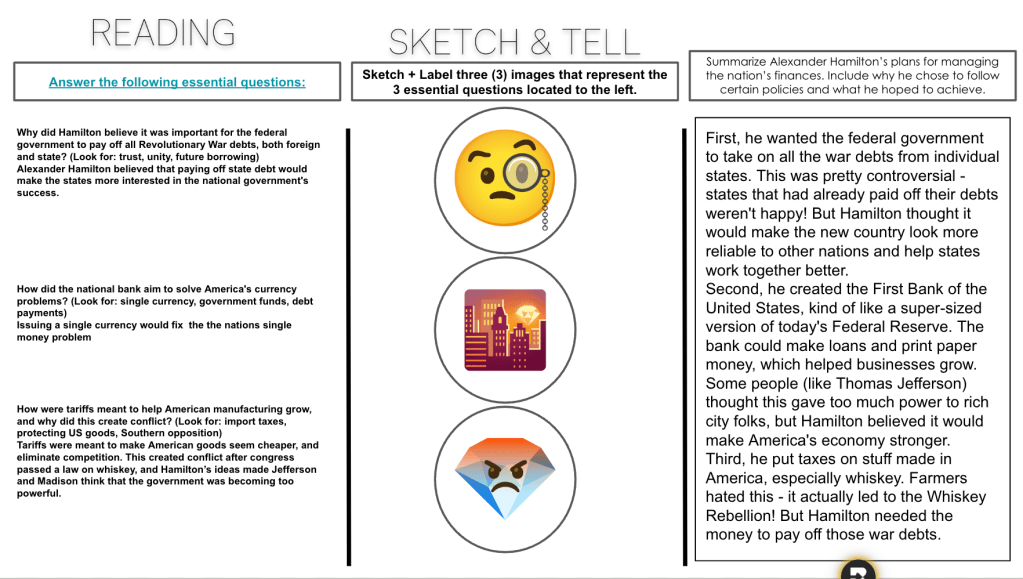
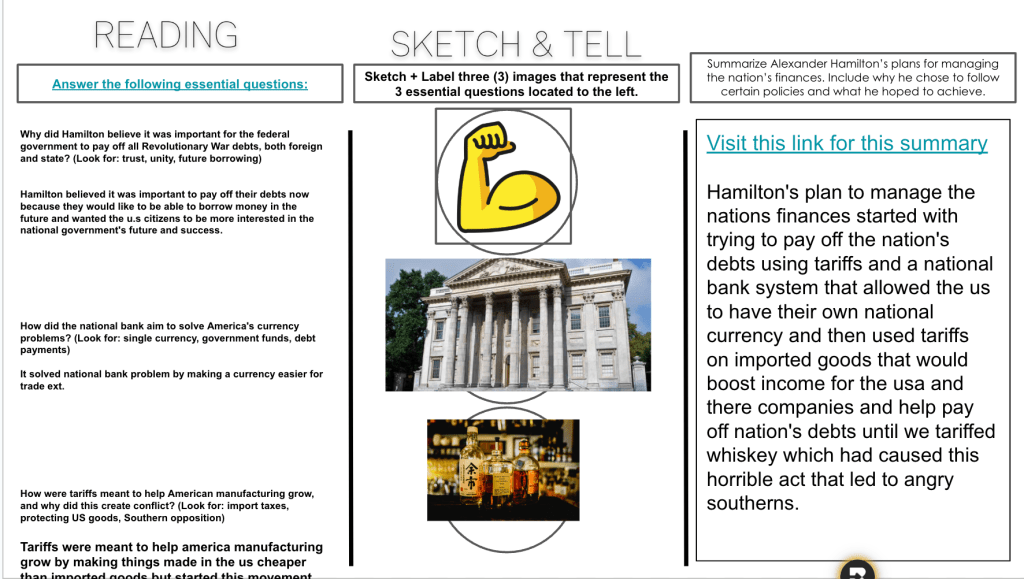
We transitioned to a reading about Hamilton’s financial plan, using a combination of structured questions, creative visualizations, and a connections summary. Here’s how it worked:

  1. Read and Respond: Students answered comprehension questions about Hamilton’s plan, focusing on why he wanted to assume state debts, how the national bank would work, and the purpose of tariffs.
  2. Sketch and Tell-O: Students used a Sketch and Tell-O template to represent key ideas from Hamilton’s plan. For example:
    • A chain symbolizing the unification of state debts under the federal government.
    • A vault or dollar sign representing the national bank.
  3. Connections Summary: To wrap up, students found an emoji or picture that connected with their answers and explained why they chose it.

I originally planned to use Class Companion, an AI feedback tool, to give students immediate feedback on their summaries. Unfortunately, it was blocked! I emailed the IT department to get it unblocked, but for now, we relied on peer discussions and my feedback instead.

Wrapping Up with Gimkit

We ended class with another Gimkit to reinforce the material. This time, the averages showed improvement:

  • 80%, 74%, 68%, and 70%.

Friday: The Whiskey Rebellion and Government Strength

On Friday, I wrestled with whether to skip the Whiskey Rebellion and dive straight into political parties, but I decided against it. The Whiskey Rebellion perfectly ties back to our first lesson: the Constitution made the government stronger, and putting down the rebellion proved that strength. This connection was too important to pass up, so we dedicated the day to exploring the Whiskey Rebellion in-depth.

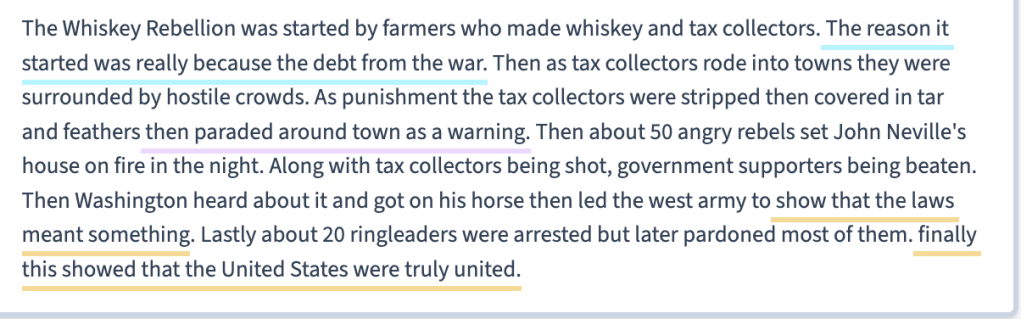
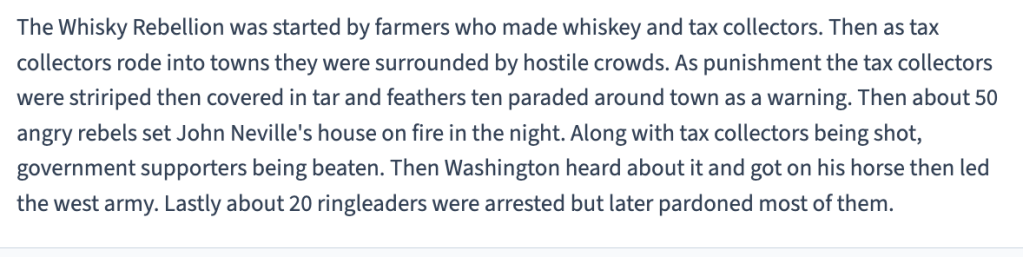
Progressive Sketch and Tell: Unpacking the Story

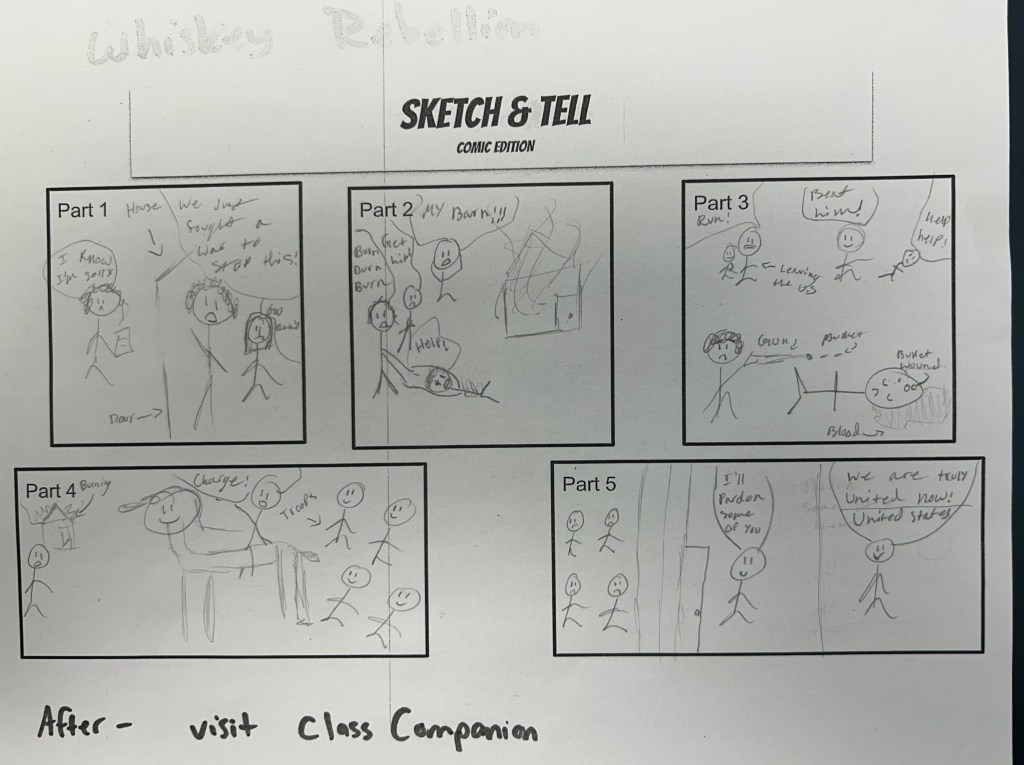
Inspired by Jake Carr and Justin Unruh, we used a Progressive Sketch and Tell to break the rebellion into digestible chunks. I used AI to divide the Whiskey Rebellion story into five parts, making it manageable and engaging for students.

  1. Setup: Each student received a paper with five Sketch and Tell boxes.
  2. Round 1: I handed out the first part of the story, giving students 3 minutes to read and sketch a visual representation of what they’d read. They then discussed their sketches with a partner.
  3. Rounds 2–5: For each subsequent part, students repeated the process—read, sketch, discuss. This structure kept the class moving while building a deeper understanding of the rebellion.

By the end, students had created a complete visual timeline of the Whiskey Rebellion.

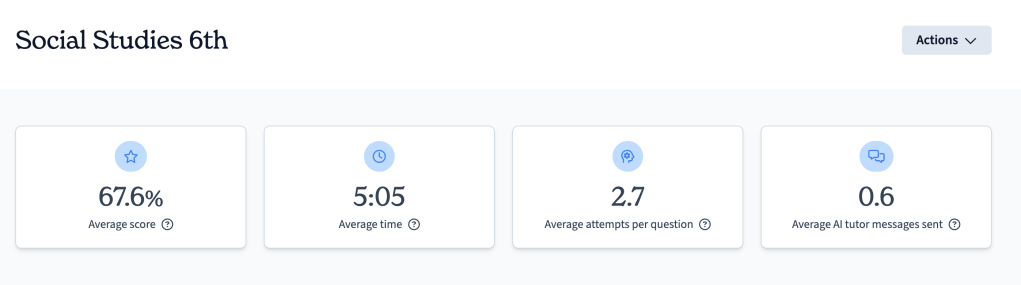
Introducing Class Companion for Writing Feedback

After completing their comics, students used Class Companion, an AI feedback tool, to summarize their Whiskey Rebellion comics in writing. This was my first time successfully using Class Companion after IT unblocked it, and it was a game-changer.

Here’s how it worked:

  • I set up the assignment by feeding information about the Whiskey Rebellion from our reading into Class Companion.
  • Students typed their summaries into the platform, receiving real-time feedback and scores on their writing.
  • They had three attempts to improve their summaries, with each attempt allowing them to act on AI-generated suggestions.

The feedback was eye-opening for many students. It pointed out areas for improvement in clarity, structure, and grammar, and the rubric generated by the AI made expectations crystal clear. Some students became competitive, determined to get the highest score possible by their third attempt.

The results were amazing. Students were engaged in improving their writing and motivated by the detailed feedback. The data Class Companion provided was also incredibly helpful for me to track progress.

Wrapping Up with Gimkit

We ended the day with a Gimkit review on Lesson 2. The class averages were impressive:

  • 91%, 80%, 88%, and 85%.

And just like that – a suggested 2 day lesson took 3 days and probably could have taken another day to do the lesson justice.