This week, we dug into the foundations of the United States government and explored how early laws shaped the country’s growth. EduProtocols were front and center as we kept students engaged and active in their learning:
📊 Monday: Introduced The Tier List to rank government systems and used Iron Chef with Padlet to analyze types of governments.
🍬 Tuesday: Gummy bears turned abstract government concepts into tangible representations, followed by another Tier List ranking activity.
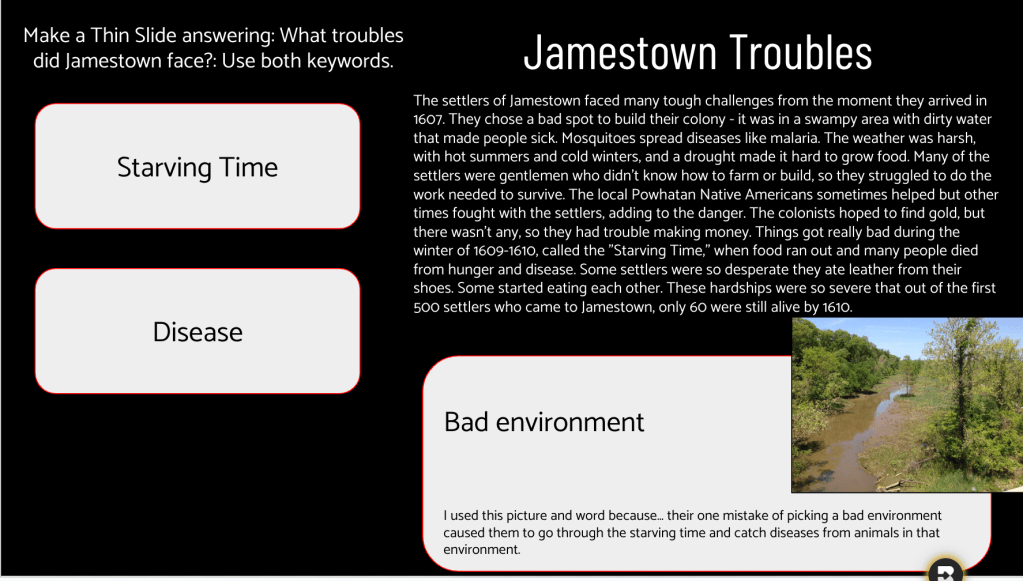
📖 Wednesday: Students tackled the Articles of Confederation with a Frayer Model, Justin Unruh’s template for Cause and Effect with Shays’ Rebellion, and a Sketch and Tell Comic.
🖥️ Thursday: Used Curipod to clarify the Articles and Shays’ Rebellion, helping students refine their Frayers and comics.
📜 Friday: Explored the Land Ordinance of 1785 and Northwest Ordinance of 1787 with Number Mania, connecting details to a key statement.
EduProtocols made this week dynamic and interactive, helping students dive deeper into complex topics while keeping them engaged and excited to learn!
Monday
Today, we began our new unit on the Constitutional Convention, which will cover topics like the Articles of Confederation, Shays’ Rebellion, the Northwest Ordinance, key compromises, and Federalists vs. Anti-Federalists. To set the stage, I introduced the concept of different government systems—some familiar, some new—and used a mix of EduProtocols to keep students engaged and thinking critically.
Starting with Gimkit: Activating Prior Knowledge
We started class with a quick 2-minute Gimkit on types of governments, focusing on basic terms and concepts. After the first round, I gave immediate feedback, clarifying any misunderstandings, and then we jumped into a second round. Repetition and feedback in short bursts like this are a great way to activate prior knowledge and boost confidence, especially as we dive into new material.
Introducing the Tier List: A Fun New Protocol
Next, I introduced a new EduProtocol: The Tier List (created by Eric Curts). Many students were already familiar with it, which made for a seamless introduction. We began by ranking fast food chains using the S-F ranking system. Students had three minutes to place their rankings, with the flexibility to leave tiers blank or include multiple restaurants in the same tier.
The real value of the Tier List came in the next steps:
- Partner Discussions: Students paired up to compare rankings and explain their reasoning, fostering meaningful discussions about personal preferences and decision-making.
- Live Class Results: As students submitted their rankings through a Google Form, the live results appeared on the board. This led to a fun, interactive class discussion about trends and outliers in the rankings.
This warm-up not only got students talking but also built their familiarity with the Tier List format, which we’ll use again for academic topics later in the unit.
Diving into Government Systems with Iron Chef
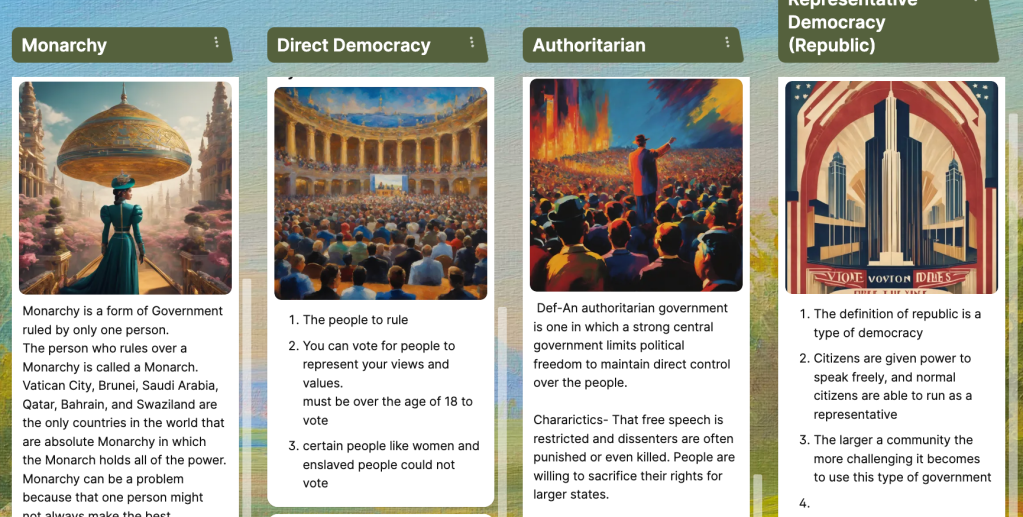
For the main activity, we used an Iron Chef format paired with Padlet to explore six government systems: direct democracy, monarchy, republic, authoritarian, anarchy, and confederation (I left out theocracy this time). Here’s how it went:
- Distributing Readings: Students received a half-page reading about their assigned government system.
- Padlet Contributions: Each group shared:
- A definition of their government system
- Two characteristics of that system
- Potential problems or limitations
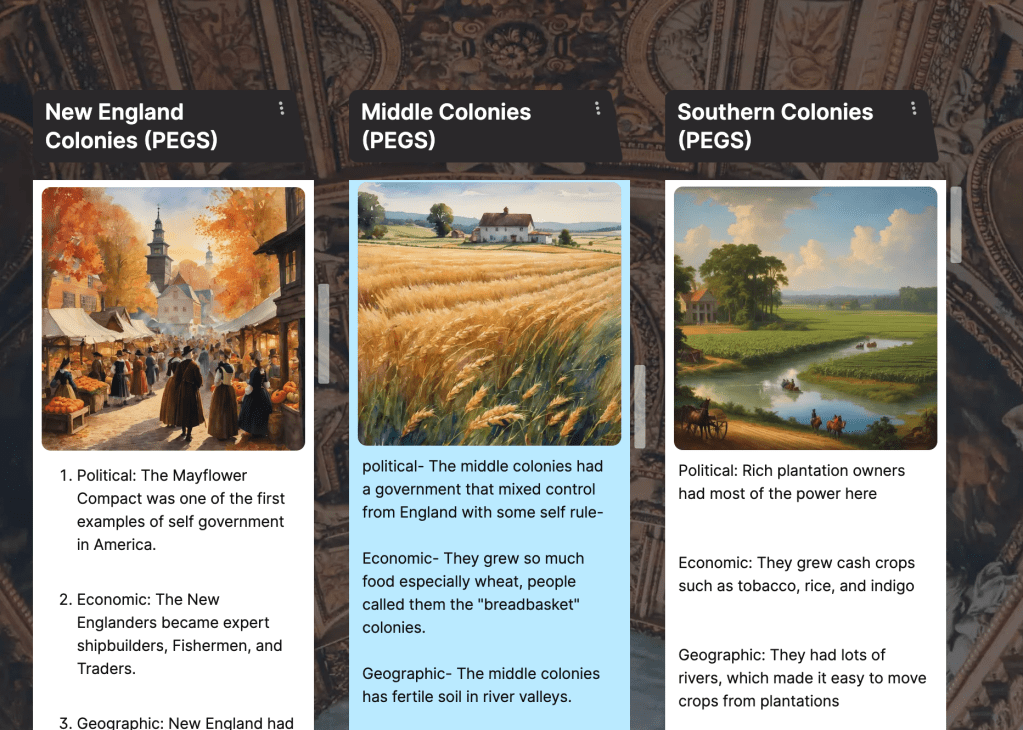
- An AI-generated symbolic image to represent it
This collaborative activity gave students ownership over their topic and ensured a wide range of perspectives for the class to learn from.
Sketch and Tell-O: Processing and Synthesizing
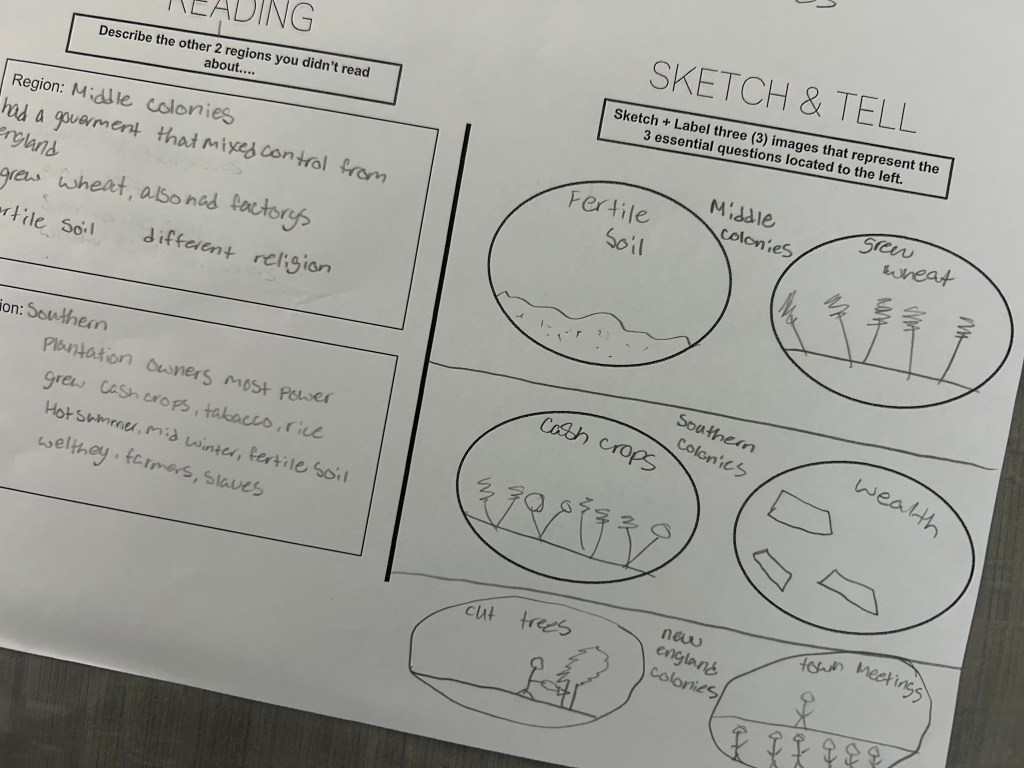
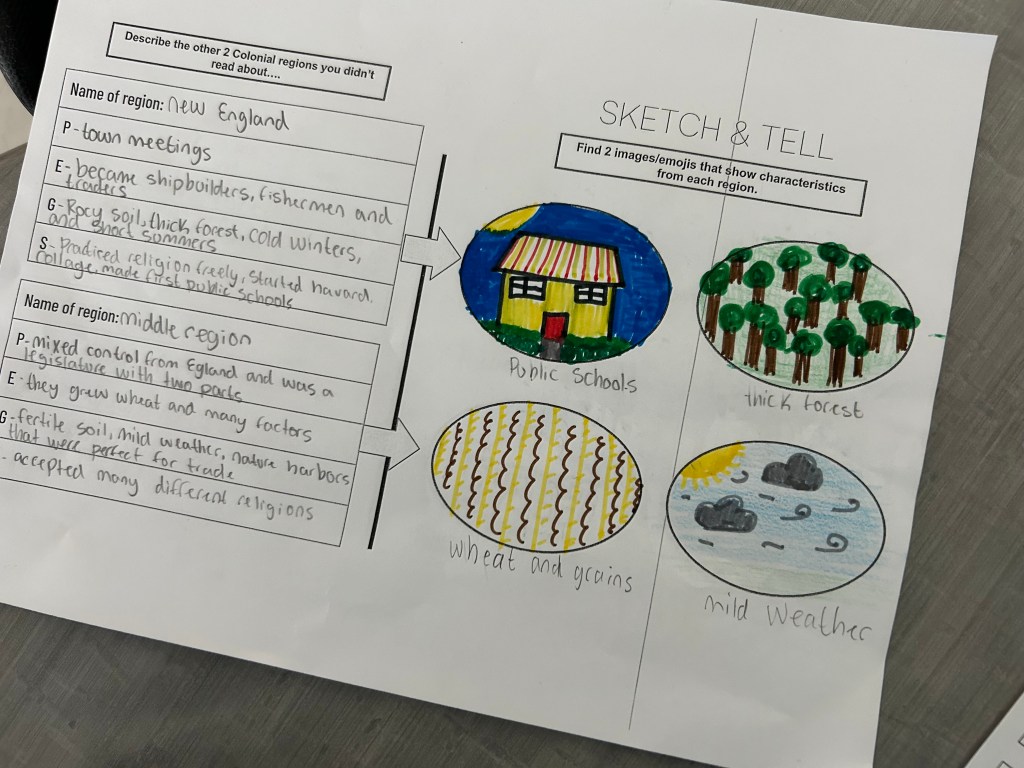
To reinforce what they learned, students moved into a Sketch and Tell-O Notes activity. As they reviewed each Padlet post, they sketched a quick picture, wrote a definition, and jotted down key facts for each government style. This protocol helps students process information visually and create a set of notes they can reference throughout the unit.
Wrapping Up with Gimkit
We ran out of time, but I squeezed in a final 3-minute Gimkit to reinforce what we’d covered. Quick reviews like this are an excellent way to close a packed lesson and leave students feeling confident in their understanding.
Reflection
Today’s mix of protocols and activities was all about building foundational knowledge in an engaging and interactive way. The Tier List added a fun twist to class discussions, while Iron Chef and Sketch and Tell-O helped students dive deeper into the nuances of different government systems. Although we ran out of time, the energy and focus in the room made for a strong start to this new unit.
Tuesday
Today, I realized we needed to shake things up. After starting class with a Gimkit on government systems, I noticed the results were still stagnant—students weren’t making the progress I’d hoped for. If they were struggling with basic questions, how could they effectively rank and discuss the systems on a Tier List? Time to try something different.
Gummy Bear Representations
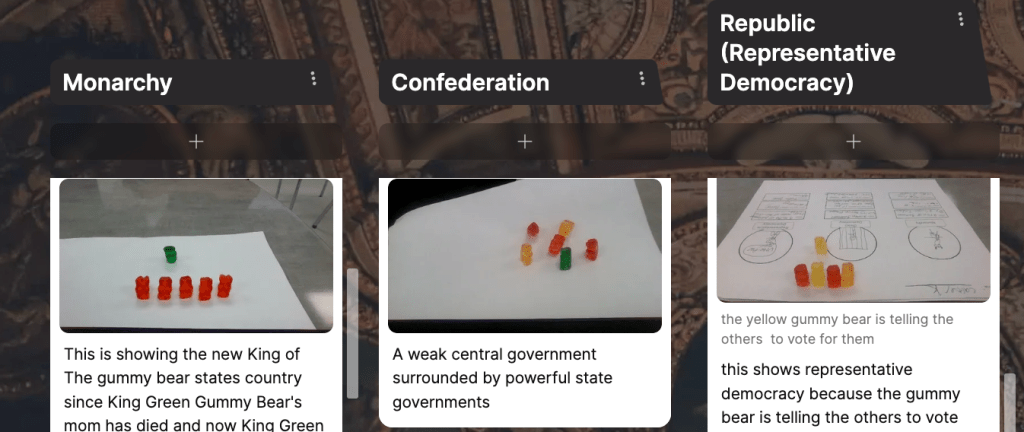
Enter the gummy bears. I handed each student a pack of individually wrapped Haribo gummy bears and set up a Padlet. Their task: review monarchy, confederation, and republic styles of government by creating gummy bear representations of each system.
Students got creative:
- For monarchy, some built a single gummy bear “king” surrounded by loyal “subjects.”
- For confederation, students grouped bears into loose alliances, showing independence but some cooperation.
- For republic, gummy bears voted or worked together as equals.
They took pictures of their creations, uploaded them to Padlet, and explained how their setups represented each government style. The energy in the room was fantastic, and students were highly engaged. This hands-on approach turned what could’ve been a dry review into something fun and memorable.
Revisiting Gimkit
After 20 minutes of gummy bear creations, we revisited the Gimkit. The results were much better this time—students had a clearer grasp of the government systems and were able to apply what they’d just reviewed in a meaningful way.
Ranking Governments with the Tier List
Next, we transitioned into the Tier List EduProtocol. This time, students ranked the styles of government we’ve studied so far. After completing their Tier List rankings, they paired up to discuss their choices and submitted their final results through a Google Form.
Wrapping Up with Class Discussion
We ended with a class discussion based on the live Google Form results, comparing trends and outliers. Students defended their rankings, debated the merits of each system, and reflected on what makes some systems more effective than others.
Reflection
Today’s gummy bear activity was a game-changer. It transformed abstract concepts into something tangible, making it easier for students to connect with and understand the material. The improved Gimkit scores showed that this hands-on, creative approach worked, and the Tier List discussion added depth to their understanding. Sometimes, all you need to reinvigorate learning is a little creativity—and a pack of gummy bears. 🍬
Wednesday
While I wasn’t in class today, I left a structured, engaging set of activities to introduce the Articles of Confederation and its connection to Shays’ Rebellion. The plan aimed to build foundational knowledge through vocabulary, visuals, and synthesis tasks, though I anticipated needing Thursday to review and reinforce some of the concepts.
Vocabulary Practice with Gimkit
The lesson began with a Gimkit focused on vocabulary terms related to the Articles of Confederation. This provided a quick, interactive way for students to familiarize themselves with key terms they’d encounter in the reading and activities.
Edpuzzle: Visual and Audio Support
Next, students watched a six-minute Edpuzzle video on the Articles of Confederation. The video served as a concise visual and auditory primer, helping students understand the context and purpose of the Articles while highlighting its strengths and weaknesses.
Frayer Model: Breaking Down the Articles
Students then completed a Frayer model on the Articles of Confederation, paired with a reading. The prompts encouraged them to:
- Define the Articles of Confederation.
- Explain one reason why the government was intentionally made weak.
- List three powers Congress had under the Articles.
- Identify four weaknesses of the government.
This activity pushed students to engage with the text critically and organize their understanding in a structured way.
Exploring Shays’ Rebellion
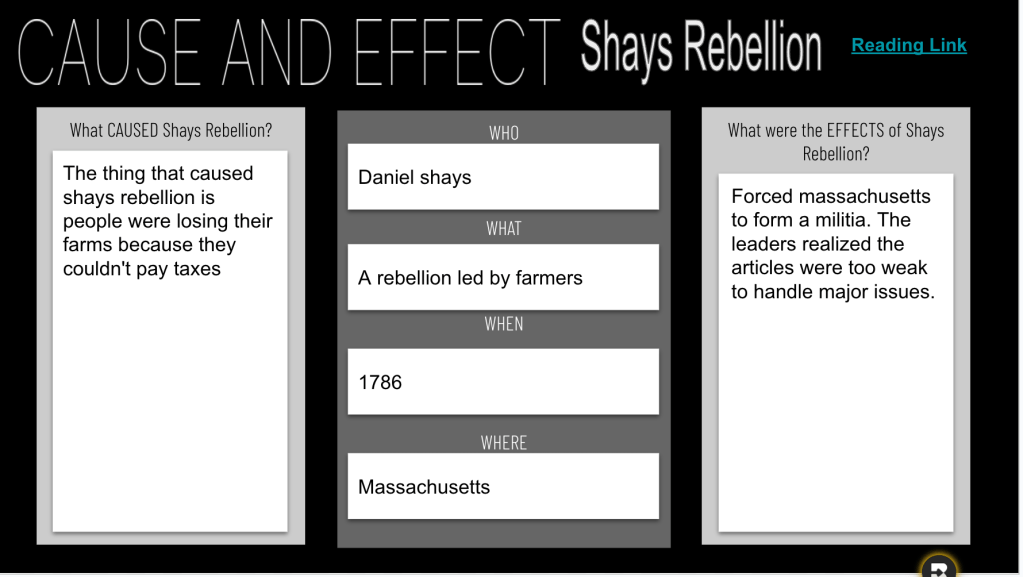
To connect the Articles to its historical impact, I included a Justin Unruh template focused on Shays’ Rebellion. Students identified:
- The cause of the rebellion.
- The who, what, when, and where of the event.
- The effect Shays’ Rebellion had on the call for a stronger federal government.
This task linked abstract governmental weaknesses to a real-world crisis, helping students see how the Articles’ limitations played out in history.
Sketch and Tell Comic: Synthesis
The final activity was a Sketch and Tell comic. Students were tasked with synthesizing the day’s learning by illustrating:
- What the Articles of Confederation were.
- Two weaknesses of the Articles.
- Shays’ Rebellion.
- One success under the Articles.
This activity combined creativity and critical thinking, but as expected, many students didn’t finish this part. We’ll use Thursday to revisit and complete it.




Reflection
Today’s plan blended a variety of tools—Gimkit, Edpuzzle, Frayer models, and a Sketch and Tell comic—to help students engage with foundational ideas about early American government. While I wasn’t there to guide them, the scaffolding allowed for independent exploration. Still, Thursday will be key for addressing gaps and ensuring everyone synthesizes these concepts fully. Sometimes, lessons like these are reminders of the importance of follow-up, especially when tackling big, interconnected topics like these.
Thursday
Today was all about getting everyone on the same page with the Articles of Confederation and Shays’ Rebellion. After Wednesday’s independent work, I decided that a more guided and interactive approach was needed to fill gaps and ensure everyone had a clear understanding. Enter Curipod, an AI-powered tool similar to Pear Deck and Nearpod, which helped make today’s lesson engaging and collaborative.
Using Curipod to Guide the Lesson
If you haven’t tried Curipod, let me just say—it’s a game changer! I asked Curipod to generate a lesson for 8th graders about the Articles of Confederation and Shays’ Rebellion. It created a structured lesson with key topics like:
- Successes and Weaknesses of the Articles
- The Structure of Government
- Cause and Effect
- Shays’ Rebellion
What makes Curipod especially great are the interactive pieces. For example, it included prompts like:
- “Why do you think the founding fathers didn’t create an executive branch with a president?”
- “Why do you think they created a central government that couldn’t levy taxes?”
Students had three minutes to respond, thanks to the built-in timer (adjustable if needed). Once time was up, students could read and vote on the most relevant responses—anonymously! This feature is a huge win because it encourages honest, thoughtful answers without turning into a popularity contest.
Curipod also lets you add, edit, or delete information on the slides, making it highly adaptable to fit your classroom needs. The free version alone is incredibly robust, and I loved how it seamlessly tied into today’s goals.
Revisiting and Fixing Frayers and Comics
To start, students opened the Frayer models they had worked on Wednesday. Using the Curipod lesson as a guide, they reviewed and updated their definitions, weaknesses, successes, and other key details about the Articles of Confederation. This ensured they had accurate, complete information while reinforcing what we’d already covered.
Next, we transitioned to their Sketch and Tell comic slides, where students synthesized:
- The Articles of Confederation
- Two weaknesses of the Articles
- Shays’ Rebellion
- One success under the Articles
With time to refine their work, the students made meaningful improvements to their comics, bringing together everything they’d learned so far.
Wrapping Up with Gimkit
We ended class with a quick round of Gimkit to reinforce the key terms and ideas. By now, students’ scores were improving steadily, showing their growing confidence with the material.
Reflection
Curipod was the perfect tool for today’s lesson—it brought clarity, engagement, and interactivity to topics that could otherwise feel dry or overwhelming. The anonymous response feature encouraged thoughtful participation, while the guided format helped students fix any misunderstandings from Wednesday’s lesson. Tying everything together with the Frayers, comics, and Gimkit made for a well-rounded day of learning and reflection. If you haven’t tried Curipod yet, I highly recommend it—it’s an absolute game changer for collaborative lessons!
Friday
Today’s focus was on two key pieces of legislation: the Land Ordinance of 1785 and the Northwest Ordinance of 1787. These laws laid the groundwork for organizing and settling the Northwest Territory, so our lesson emphasized understanding how land was divided and states were established.
Starting with Gimkit
We kicked off with a 10-question Gimkit that combined review from Thursday’s lesson with new questions about today’s content. This mix kept students on their toes while reinforcing prior learning and previewing key ideas.
Reading and Proving a Statement
Next, we read an article on the Land Ordinance and Northwest Ordinance. I explained how townships were set up, breaking down the system of squares, sections, and their purposes. To apply their learning, I gave students the statement:
“The United States created an organized system to divide land and establish new states in the Northwest Territory.”
Their task was to prove the statement true using four numbers from the readings. This Number Mania activity helped them connect specific details to a broader understanding, encouraging them to think critically and organize evidence to support a claim.


Wrapping Up Early
I originally planned to include more activities, but by the time we finished the Number Mania and ran a second round of Gimkit, I decided that was enough for the day. It’s Friday, Thanksgiving break is around the corner, and the students had been working hard all week. Sometimes, it’s just as important to recognize when they need a break as it is to keep pushing forward.
Reflection
Today’s lesson was a perfect balance of review, new content, and synthesis. The Number Mania helped students focus on key details, while the Gimkit kept them engaged and reinforced their learning. Wrapping up a bit early felt like the right call—it gave students a breather after a week of hard work and set a positive tone heading into the weekend. Sometimes less really is more.




 Moler's Musings