You see them everywhere. Someone declares that a certain strategy is the only way to teach. Another says something should never be done in a classroom again. A thread blows up online about how one practice is terrible and another is the future of education.
The problem is that most of these takes ignore something really simple.
Teaching is a human thing.
Every classroom is a mix of personalities, relationships, moods, and dynamics that are impossible to copy somewhere else. The teacher matters. The students matter. The culture of the room matters. Even the time of day matters. What works beautifully in one classroom might completely flop in another.
And that’s not because someone is doing it wrong.
It’s because teaching isn’t a formula.
Sometimes a strategy works because it fits the personality of the teacher. Sometimes it works because the students respond to that teacher in a certain way. Sometimes it works because the relationships in that room allow it to work.
But when that same strategy gets turned into a universal rule or a bold declaration about “good teaching,” it starts to fall apart.
Just because something works in one classroom doesn’t mean it will work everywhere.
That doesn’t make it a bad idea. It just means it’s one idea among many.
The best teachers I know don’t live off hot takes. They experiment. They adjust. They pay attention to the humans in front of them and make decisions based on what those students need.
Last Friday I presented EduProtocols at Springer School and Center in Cincinnati. Springer is known for its work with students who have ADHD and executive functioning challenges. I went to share ideas. I left rethinking some of my own.
Early in her keynote, Sarah Ward had us build a word cloud around executive functioning. The room filled it fast. Words like….
Organization.
Planning.
Time management.
Routines.
Focus.
It looked right. But the word she was looking for wasn’t there. By the end, she gave it to us……….”Simulation.” That was the word.
Executive functioning isn’t first about binders or planners. It starts with nonverbal working memory. In simple terms, can a student picture what “done” looks like? Can they see themselves doing the task before they start?
If they can’t picture it, they can’t plan it. If they can’t plan it, they can’t execute it. These are things that I don’t think twice about, they just happen. But, for many kids, and some adults, this is the struggle.
Nonverbal memory leads to if–then thinking. If–then thinking drives self-talk. When the image isn’t there, the whole chain breaks.
She talked about how screens are impacting imagery. Kids can read the words, but they struggle to imagine the scene. They don’t see it play out in their heads. That matters more than we think. When everything is pre-visualized for you on a screen, your brain doesn’t have to generate the picture. It just consumes it. Then we hand students a paragraph in a textbook and assume they’re building a mental movie. Many aren’t. They’re decoding, not visualizing. And if there’s no image, there’s no anchor for memory. No anchor for planning. No anchor for executive function.
Then she layered in situational awareness. Space. Time. Objects. People. Stop and read the room. Many kids struggle with this. They’re physically present but mentally somewhere else. They don’t notice how much time has passed. They don’t notice that others have already started. They don’t notice the materials they need sitting right in front of them. Situational awareness is the ability to take in the environment and adjust. If you can’t “see” the room, you can’t respond to the room. And when students lack that awareness, we often interpret it as not caring, when in reality it’s a processing gap.
Nonverbal memory plus situational awareness equals what she called mimetic ideation. In plain language: mime it in your head. Don’t talk it through. Picture yourself acting it out. It’s a mental dress rehearsal. She called it “mime it.” Run the movie in your head before you hit play in real life. Here’s what that looks like in a classroom:
Make an image. What does “done” look like? For example, if we’re doing a Thin Slide, picture the finished slide. One clear image. One strong phrase. Clean. Simple. Not cluttered.
Image yourself in it. What do I look like doing this? Am I sitting upright, Chromebook open, reading closely? Am I highlighting key words? See yourself actually working, not just thinking about working.
Move through the space. How am I physically going to do this? I take out my notebook. I open Google Classroom. I scroll to the assignment. I start typing. Walk yourself through the steps before you begin.
Feel the energy. What’s my tone? Calm and focused? Rushed and frantic? If I’m revising a Nacho Paragraph, I’m steady and intentional, not just clicking submit.
Think if–then. If I get stuck, then I reread. If I finish early, then I add a second piece of evidence. If the timer is at halfway, then I should be halfway done.
Account for time and task. How long do I have? What exactly is the job? Eight minutes to be a “fact finder.” Ten minutes to be a “slide designer.” Not just “work on it,” but a clear task inside a visible block of time.
That’s executive functioning. Not just planning. Simulation.
The part that hit me hardest was time and task. Some students often struggle to visualize time. If you say, “You have 10 minutes,” that’s abstract. They may spend five minutes just getting organized and suddenly they’re behind. Add anxiety and their executive functioning drops even more.
That explains a lot of what we see.
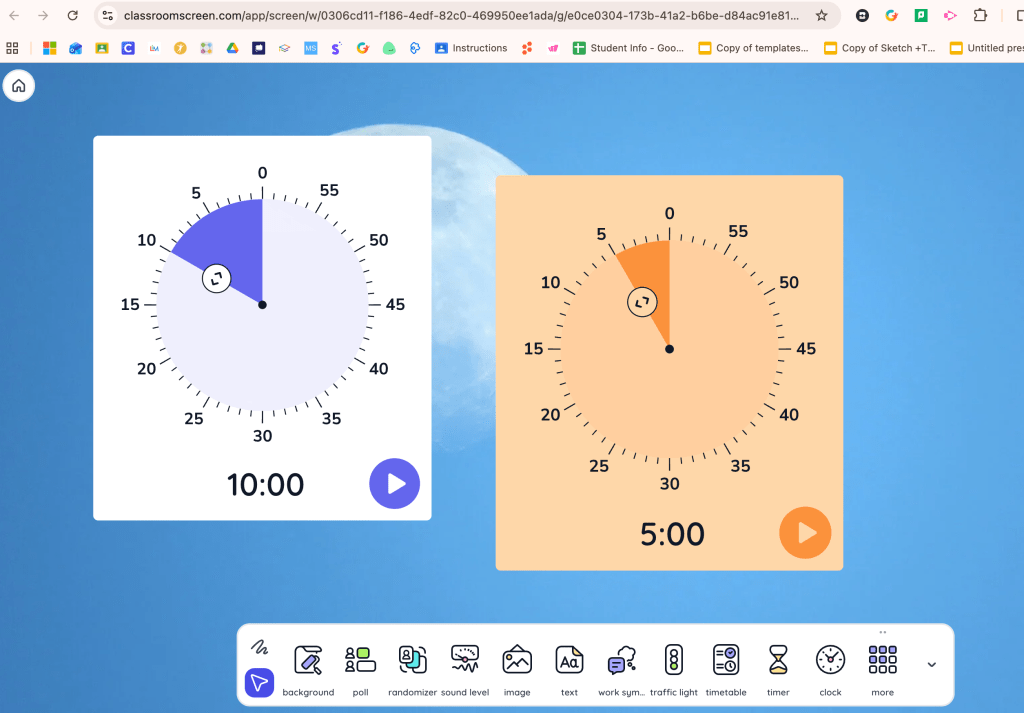
It also reinforced something I already believe in. Make time visible. Classroom Screens is a great site with visual timers. Kids can actually see how much time should be sepnt doing something.
I time everything in my classroom. Fast and Curious. Thin Slides. Frayers. I live by the timer. I’ve always said it creates focus. Now I see that it supports simulation. When students can see time moving, they can adjust. They can feel urgency. They can check themselves at the midpoint.
That’s executive support, not just classroom structure.
Another simple shift she suggested was language. Instead of “Take notes,” say “Be a note taker.” Instead of “Do the reading,” say “Be a fact finder.” Add “er” to the task. Give them a role. When you give a role, you force a mental picture.
We give a lot of verbal directions in school. Too often we’re the ones doing the mental rehearsal. We’re picturing the steps. We’re anticipating the problems. Students aren’t.
Executive functioning is the ability to run the movie in your head before you press play.
I was scrolling through my own blog the other day, looking back at what I did at this time last year, and it hit me. I am four full weeks behind where I was. Last year I had 65 minute classes. I had 180 school days. I had far fewer interruptions and almost zero strange schedules. This year I’m teaching 40 to 45 minute classes. At least once a week one of them gets chopped to 30 minutes. Some days I don’t see certain groups at all. And I’m working with a 173 day schedule.
I’m sharing this for any teacher who feels that pressure creeping in. I refuse to water down what I teach just to say I “covered it.” If I’m going to teach something, I’m going to do a good job and give kids an experience they actually learn from. Eighth grade social studies is important. It shapes how students understand this country and the ideas that built it. I’m proud to teach it and I refuse to cheapen it just because the clock is tight.
So if you feel behind, you’re fine. We all are in some way. Do what you can and don’t shortchange students. Bring the stories to life. Connect the past to their community and their world. You can’t do that by rushing through a textbook and obsessing over a pacing guide. Quality matters more than speed, and the kids will remember the difference.
I never really thought about this until I had a brief conversation with two parents this afternoon. They were touring the school, thinking about sending their child here next year, and they stopped by my room. My students were working on their summative assessment for our Road to the Revolution unit. It is an argumentative one pager answering the question, “Why did loyal colonists begin fighting against their own government?”
I mentioned that the one pager was their test for the unit, and one of the parents looked a little surprised. So I followed up with, “I am not a traditional teacher. To me, there is more to learning than circling A, B, or C. Learning should feel different. It should be ongoing. We always talk about wanting lifelong learners, and assessments like this actually allow for that. The best part is the conversations I get to have with kids while they work. They ask how to word things, how one idea connects to another, and why certain events mattered. Those moments are meaningful. That is real learning.”
She paused, thought about it, and said she agreed. It honestly felt like I opened her mind to something she had not considered before.
The funny part is that I had not really thought about it that way until the words came out of my mouth.
These one pagers, and any nontraditional assessment we have done this year whether the Netflix summaries, hexagonal webs, or annotated maps, naturally create conversations and questions. Kids stop, think, ask, revise, and explain. I love that. When I gave a traditional test at the start of the year, none of that happened.
I think we often view a summative assessment as the finish line. Here is what you should know, show it, and then we move on. But what if the assessment pushed back on that idea? What if it became part of the learning instead of the end of it?
I’ve been watching Ken Burns’ new documentary, The American Revolution, and it hit me just how much is packed into this era. Abstract ideas. Complicated politics. Dozens of events. And honestly, the way I used to teach it wasn’t doing anyone any favors.
My old approach was pretty typical: start with some vocab, squeeze in the French and Indian War, sprint through every tax over 2–3 days, toss in salutary neglect somewhere, then protests, then the Boston Massacre as a one-off, then the Tea Party and Intolerable Acts, and finally the Declaration and natural rights. It worked… but there was no flow. Too many disconnected parts. The cognitive load was just too much.
This year, I decided to take a completely different path.
I treated the French and Indian War as the ending to my 13 Colonies unit, framing it as a rivalry gone bad. Then, instead of opening the Road to Revolution with new content, I started with review of the consequences of that war and the breakdown of salutary neglect. I still taught vocabulary up front, but this time I wanted the unit to feel like a story told through the voices of the people who lived it.
We kicked things off with the Stamp Act by reading the actual wording. Kids debated fairness using the colonists’ own language. I even taught the difference between a pence, a shilling, and a pound because if you want them to understand the argument, you have to let them stand inside it.
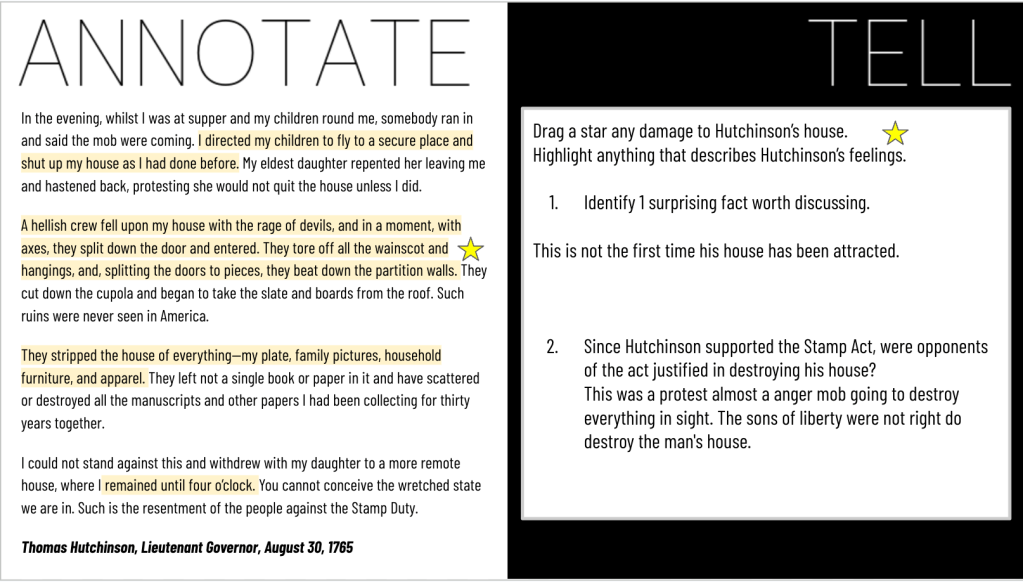
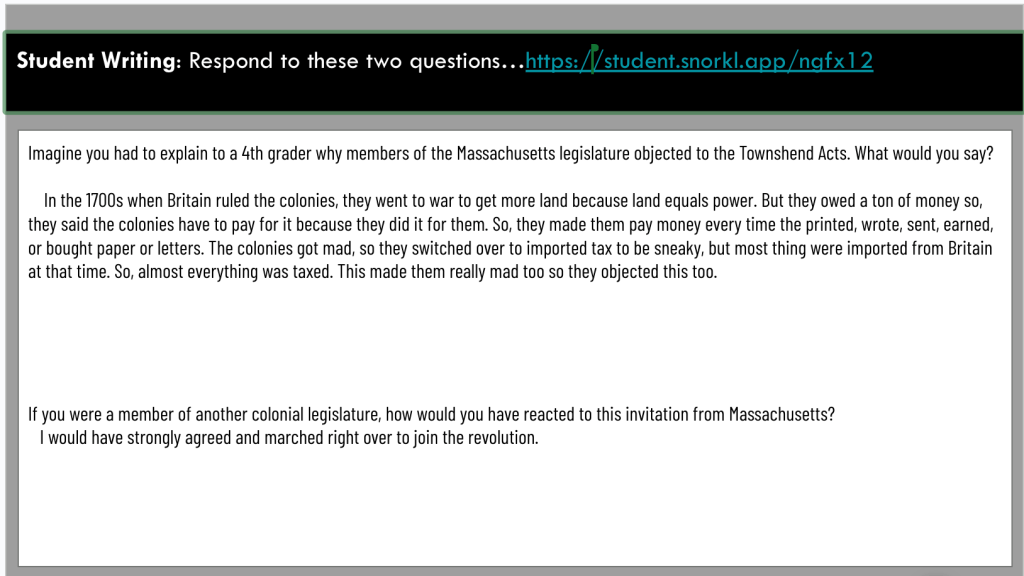
From there, we looked at protests and reactions through the eyes of Samuel Adams and Thomas Hutchinson. Same people, same thread, same narrative. Then we moved into the Townshend Acts and Adams’ Massachusetts Circular Letter. That’s also when I introduced natural rights, not waiting until the Declaration of Independence. Life, liberty, and property were already shaping colonial arguments long before 1776.
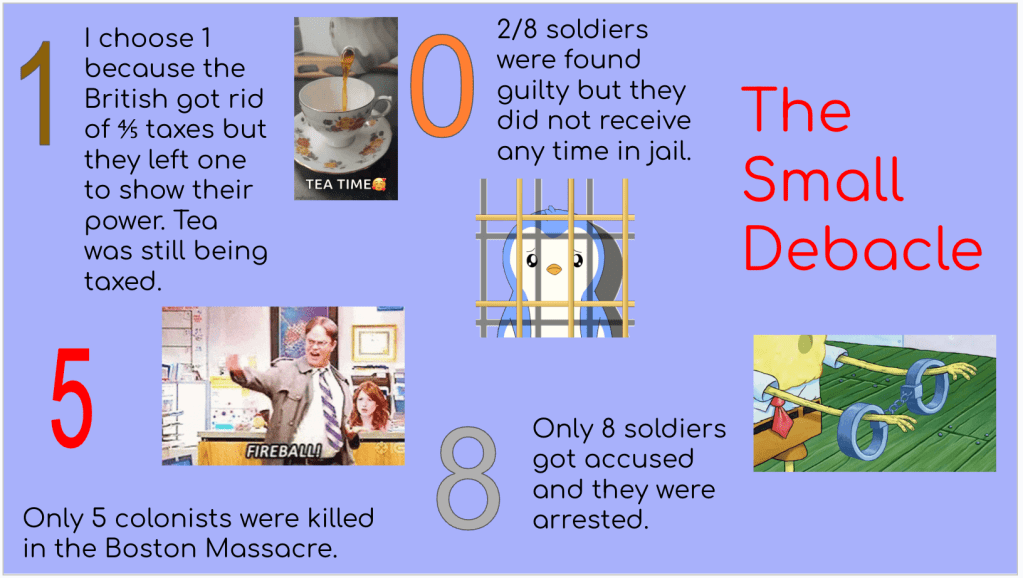
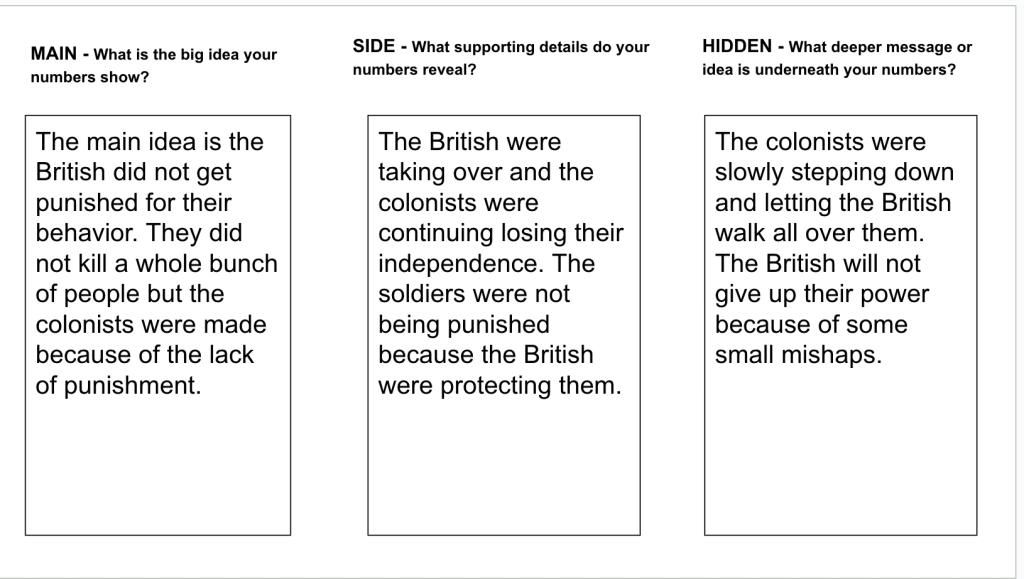
When we got to the Boston Massacre, it finally clicked for them: “If natural rights include life… what happens when government ordered, British soldiers fire into a crowd?” The story built itself.
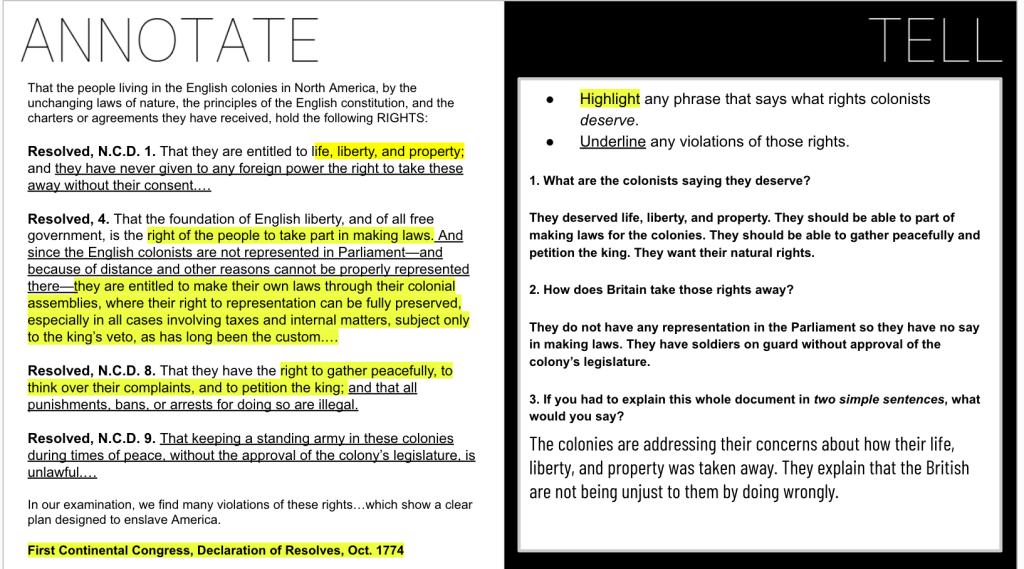
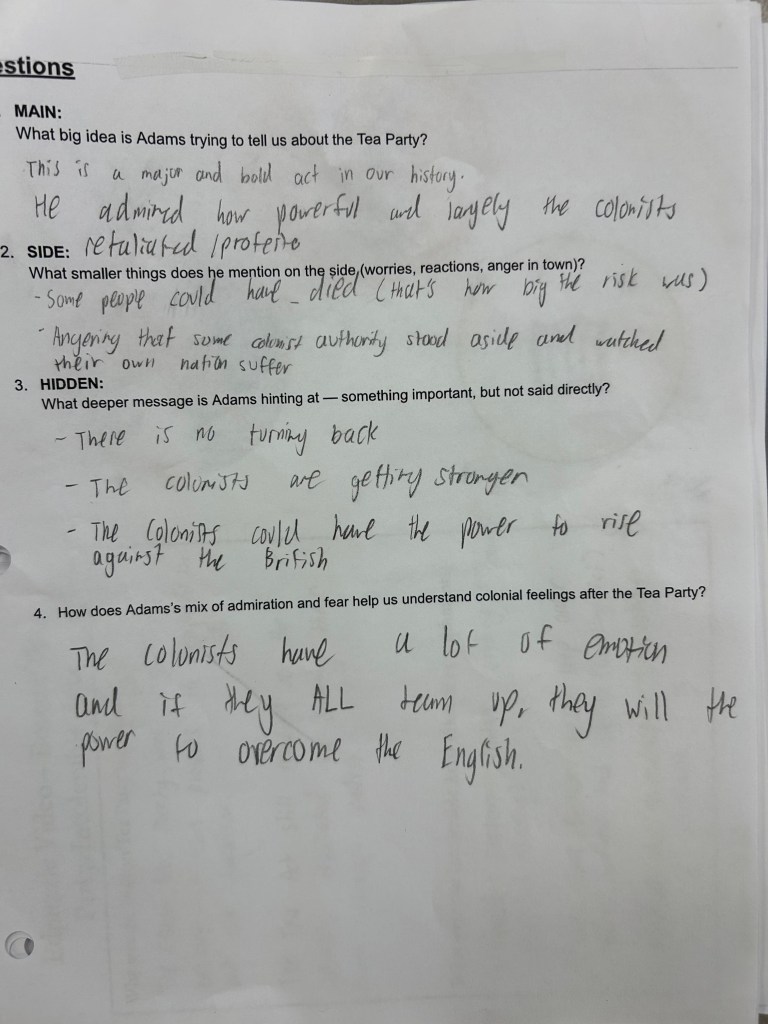
Then we hit the Tea Party and Intolerable Acts using a diary entry from John Adams where he basically predicts the crackdown and knows war is on the horizon. Finally, we closed the chapter with the First Continental Congress and their Declaration of Resolves. Background reading to primary source to short, purposeful chunks. As my friend and co-author Scott Petri always said: “Don’t make your class death by 1,000 primary sources.”
In the end, the kids didn’t just remember events, they followed a coherent story told by the people living it. And that made the culminating question feel earned:
Why did British subjects go from being loyal to fighting their own government?
This new approach felt clearer, more human, and honestly… more teachable. And watching students connect the dots on their own reminded me why I love this job.
I’ve had students complain. I’ve had students defy. I’ve had students look me straight in the eye and say, “I’m not doing this.” I’ve even had kids tell me, “I hate school.”
That last one always sticks with me. Because hating school hasn’t always been a thing. Somewhere along the line, it starts.
For years, I’ve asked my 7th and 8th graders a simple question: “When did you start hating school?” And you know what? About 95% of them say 4th or 5th grade. That’s not a coincidence.
Now that my daughter is in 4th grade, I’m starting to see why.
Take her latest assignment, a two-page book report. She loves reading. She reads in the car, before bed, pretty much anywhere. She got to pick her book, which should have been awesome. But instead, it came with a mountain of a writing project. She’s never done anything like this before, and the directions weren’t chunked or scaffolded. It was just: “Choose a book and write this big report.”
So now, the kid who loves reading doesn’t. She’s not thinking about the story anymore.
And to top it off, the two-page report template (from TPT) was emailed to me, and I had to print it because she lost her copy. So now, it’s not just her stress. It’s ours.
Here’s what I keep thinking:
Just have a few extra copies ready. Battling over a lost paper doesn’t teach responsibility. It just builds resentment.
Don’t hand a 4th grader a giant project with no warm-up. Start small. Build confidence.
What if instead of the classic book report, we tried something like BookaKucha?
Students create three slides about their book and talk for 20 seconds per slide. That’s it. One minute of presenting. It’s quick, creative, and authentic. They get to share what they love about a book, not just prove they read it.
When students recommend books to each other, it creates a reading culture. And culture beats compliance every time.
Because maybe the goal isn’t to make kids “do” reading. Maybe it’s to make sure they don’t stop loving it.
This has been on my mind lately. Teachers (myself included) often say we’re doing certain practices like retrieval, inquiry, student choice, feedback cycles, or collaboration. We believe we are. We even tell others we are.
But when you really stop and look at the day-to-day flow of your classroom, sometimes the truth is we’re not. Not in the way we imagine. Maybe we’ve done it once or twice, or a version of it, but not with purpose or consistency.
I’ve made a point to pause and ask myself: Why am I doing this? Am I doing it regularly? Does it actually make sense for my students? Those questions have helped me see what’s real versus what’s routine.
It’s easy to fall into the comfort of saying we “do” something because it feels right or sounds good. The harder part is being honest enough to admit when we’re not and then making the small adjustments that bring our intentions and actions back in line.
Teaching social studies in 2025 is not the same as it was even five years ago. My middle schoolers live in a world where AI can spit out an answer in less time than it takes them to find the question mark on the keyboard. That changes things.
But here is the key: it does not change why we teach social studies. It just changes how we help kids wrestle with information. If anything, AI has made the skills of questioning, sourcing, and perspective even more important.
Here are five things I want my students to get if they are going to actually learn social studies in an AI world:
1. Be the historian, not the robot
AI is good at telling kids what happened. Historians do the harder work of weighing evidence, building arguments, and arguing over perspective. I remind my students that the chatbot is not the historian, they are.
2. Sources are still the anchor
AI does not always make clear where its information comes from and sometimes it just makes things up. That is why my students keep coming back to the question: What is the source? If they cannot answer that, the information does not carry much weight.
3. Bias never goes away
This one is easy for kids to grasp. We have always shown them that newspapers, diaries, and speeches carry bias. Now we add AI to the list. Whose voice do you hear? Whose voice is missing? Once they see bias in one place, they start spotting it everywhere.
4. Question before you accept
This is where I have found AI to be the best teaching tool. It gives kids a polished looking answer that is not always perfect. Instead of saying “do not use it,” I give them my Fray-I template.
Students take an AI response and then “fray it apart”:
What is the main point?
Did it use evidence or just sound nice?
What is missing?
Would you trust this for an assignment?
The beauty of Fray-I is that it forces kids to do what historians do: summarize, critique, evaluate, and revise. AI is not a shortcut. It is raw material for real thinking. You can copy a Fray-I template here!
5. History is still human
At the end of the day, AI can generate timelines and definitions, but it cannot teach empathy or perspective. That is still our job. My students need to see the choices, struggles, and connections that make history matter. That is where the learning lives.
Final Thought
AI is here, and our students are going to use it. We can either fight it or teach with it. For me, the answer is clear: use it as a spark, then give students tools like Fray-I to push deeper. That is how they learn to think like historians in an AI world.
This year brings something new. After a long run in public education, I have made the switch to a small private school, St. Ursula Villa. I will be teaching 6th, 7th, and 8th grade social studies. The change already feels right. The school is close to everything I do, where I live, where I coach tennis, where life actually happens. If I need to run up to school, it will not feel like an all-day event. That alone is a big deal.
More than that, I will be able to be involved with school activities in a way that makes sense for me. Smaller class sizes, a supportive staff, and students who are eager to learn. It is a refreshing combination.
Why the Switch?
Honestly, it was time. I found myself saying things I never thought I would say. I was stressed out, going through the motions, just trying to survive the day. My great friend and co-author, Dr. Scott Petri, once told me, “Moler, your worst day of teaching is someone’s best day.” The problem? I was having way too many of those worst days.
When I interviewed for this position, the principal asked me why I applied. My answer came out without hesitation: “Because I miss teaching.” I was tired of babysitting. That pretty much sums up where I was at and why I needed a reset.
Leaving public education is not something I ever imagined doing, but the reality was clear. I needed a break. I needed to find joy in teaching again.
Looking Ahead
I am excited to start fresh. A new environment. Smaller classes. Great colleagues. Great kids. I can feel myself wanting to be more creative again, not just checking boxes.
That brings me to this blog. For years, I have written The Week That Was to reflect on my teaching. But writing about three different grade levels every week? That might be too much, both for me and for anyone reading. So I am rethinking the format.
Right now, I am leaning toward something like this:
My top 3 lessons of the week
Or maybe 3 wins and 1 that needs work
It keeps things tight, focused, and honest. Because the truth is, no week is perfect, and that is the point.
A new school. A new rhythm. A chance to get back to the kind of teacher I want to be. That is what this year is about.
Every so often, I go back and reread a blog post called Is Your Lesson a Grecian Urn? (It’s a great post from th Cult of Pedagogy). I’ve shared it in PD sessions, sent it to colleagues, and maybe most importantly, used it to check myself when I start planning something that’s more “fun” than it is valuable.
The first time I read it, it hit me like a well-placed serve in the ribs. Not all hands on learning is actually learning. We can wrap balloons in papier-mâché, make the prettiest PowerPoints, and check all the “engagement” boxes, but if it doesn’t move students forward in skills and understanding, it’s not much more than a time filler.
Why This Sticks With Me
I’ve been guilty of the Grecian Urn approach before. We all have. It’s so easy to fall into the trap of thinking, If they’re busy and smiling, they’re learning. But the truth is, smiles and productivity don’t always equal mastery. A “creative” project can still live in the lowest levels of Bloom’s Taxonomy if the thinking stops at remembering and regurgitating.
That’s why I like the Grecian Urn metaphor. It’s not anti-fun or anti-creative. It’s a gut check: Is the time spent on this task proportional to the learning it produces?
How I Use the Lesson
When I read the original post, I started doing a little mental math while lesson planning:
If students spend 3 days making something, what exactly will they be able to do with that knowledge after?
Could we hit the same learning target in a day with a tighter, more purposeful activity?
Am I grading for content, or for how “cute” or “neat” the final product looks?
This isn’t about stripping away every bit of creativity. It’s about making sure the creativity supports the learning, not overshadows it.
My Takeaway for Teachers
Here’s where I’ve landed:
If it’s for learning, make sure the heavy lift is in the thinking, not the decorating.
If it’s for fun or sanity, own that and don’t pretend it’s something it’s not.
If it’s a Grecian Urn, you can either cut it or tweak it until it’s doing real academic work.
The reason I keep going back to this blog post is because it reminds me that time is my most valuable classroom currency. Every minute students spend should have a clear connection to what I want them to know or be able to do. And if we can make it meaningful and enjoyable, that’s the sweet spot.








 Moler's Musings