History teacher at New Richmond Middle School. Tennis coach at SUA, Beechmont Racquet and Fitness, Lunken Playfield, and KCC. Striving to learn, create, and innovate one day at a time.
This has been on my mind lately. Teachers (myself included) often say we’re doing certain practices like retrieval, inquiry, student choice, feedback cycles, or collaboration. We believe we are. We even tell others we are.
But when you really stop and look at the day-to-day flow of your classroom, sometimes the truth is we’re not. Not in the way we imagine. Maybe we’ve done it once or twice, or a version of it, but not with purpose or consistency.
I’ve made a point to pause and ask myself: Why am I doing this? Am I doing it regularly? Does it actually make sense for my students? Those questions have helped me see what’s real versus what’s routine.
It’s easy to fall into the comfort of saying we “do” something because it feels right or sounds good. The harder part is being honest enough to admit when we’re not and then making the small adjustments that bring our intentions and actions back in line.
I’m going to frame this week’s post around the beginning, middle, and end of the week. Once again, our rhythm was shaped by shortened schedules and shadow days, which meant adjusting plans and finding ways to keep learning moving forward. To work around the interruptions, I started the week with a take-home test, then rolled out a new unit built around a compelling question: “Would you have risked everything and left England during the 1600s for a chance at a better life?” We staged the question with a round of Number Mania and some key vocabulary, giving students both the facts and the language to start thinking about the risks and rewards of leaving home. By the end of the week, we shifted gears into the mystery of Roanoke, weighing different theories and examining evidence to see how stories about the past are pieced together.
Early in the Week
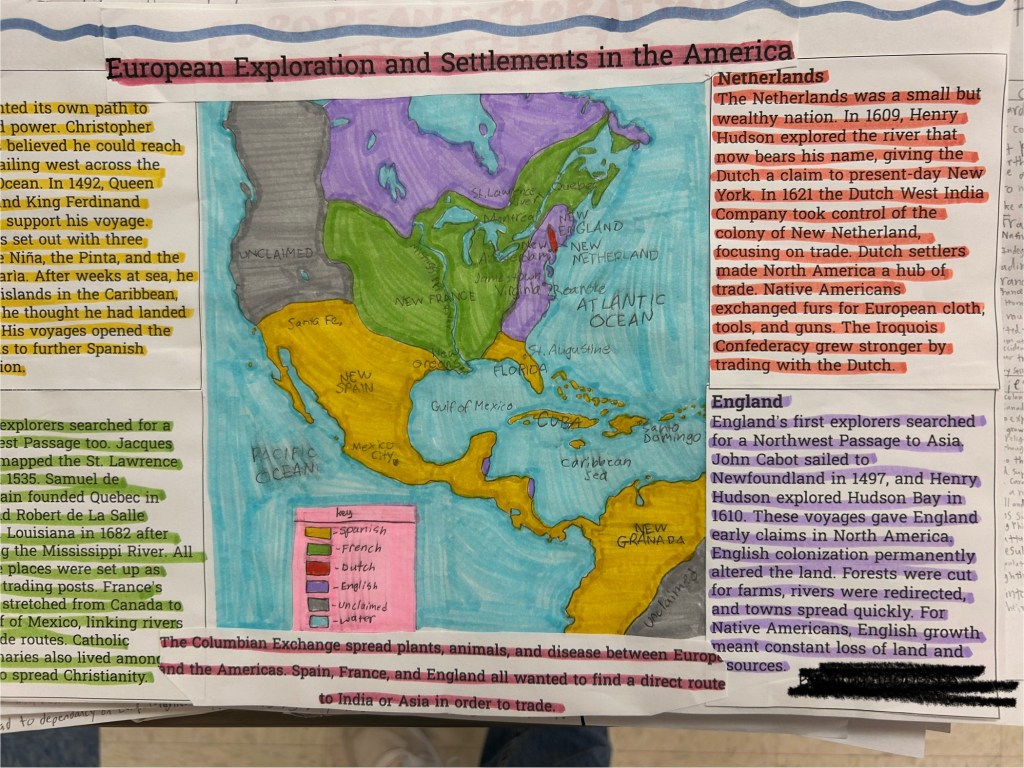
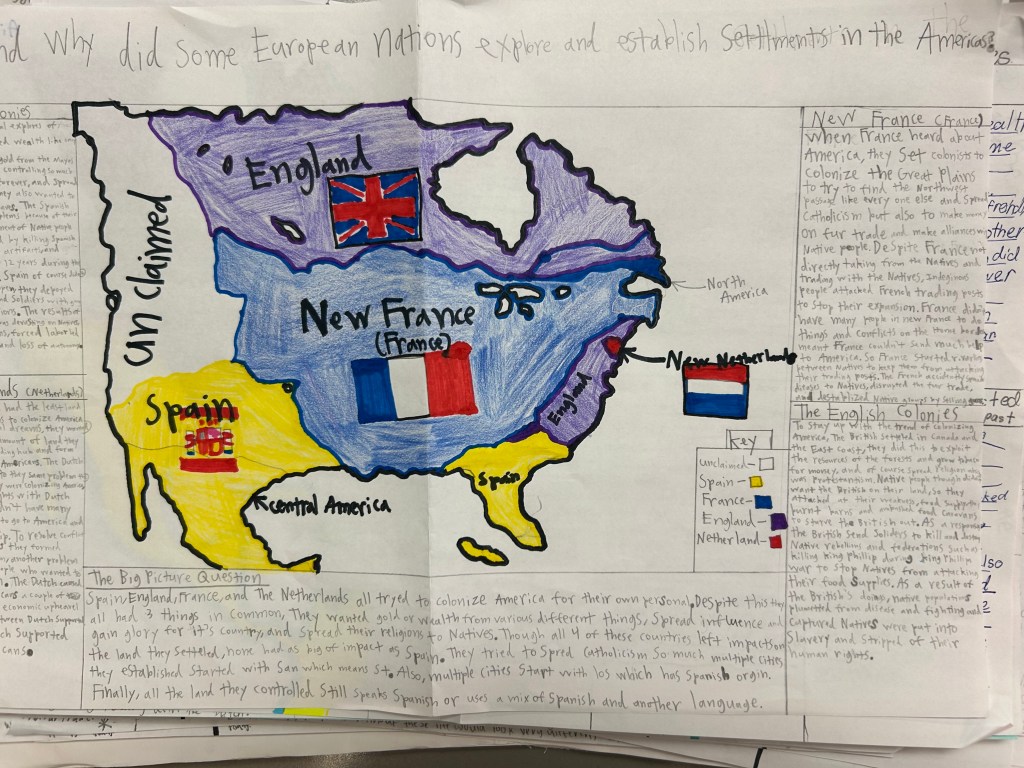
Early in the week, I gave students a take-home test and let them use the entire class period to work on it. When I first mentioned “take-home test,” they got excited and thought it would be an easy multiple-choice packet. I laughed and told them, “Do you really think I’m going to give you a multiple-choice test to take home? No way.” Instead, the assignment was an annotated map. Students outlined North and Central America, colored and labeled the territories of Spain, France, England, and the Netherlands, and created a title and key. Around the map, they wrote Somebody–Wanted–But–So–Then stories for each country, explaining motives, challenges, actions, and effects. Finally, they answered a big-picture question about which country left the biggest long-term impact on North America and why.
Working Through the Assignment
I set it up this way because our schedule has been unpredictable. Some days we have 40–45 minutes, others just 30, and sometimes classes disappear altogether because of shadow days or shortened schedules. The constant stopping and starting makes it hard to keep a steady flow. This format let me keep the class moving forward while also giving students a creative way to show what they had learned.
Why It Mattered
The take-home test worked because it balanced structure with freedom. Students weren’t just filling in blanks or circling answers. They had to demonstrate knowledge by connecting maps, stories, and big-picture ideas. For me, the best part was seeing how they tied geography and narrative together to make sense of the bigger patterns of exploration.
Midweek
By Tuesday and Wednesday, we shifted into a new unit framed around the compelling question: “Would you have risked everything and left England during the 1600s for a chance at a better life?” So far, the overwhelming answer from students has been “no,” and not just in one class—it was a pretty consistent “no” across the board. I am already thinking ahead to the summative assessment and considering a twist. Students might roll dice to generate a scenario for their “made-up life” in England, which could force them to think differently about the risks and rewards of leaving.
Staging the Question
To stage the question, we started with vocabulary through Gimkit and a TIP chart. TIP stands for term, information, and picture. We opened with a Fast and Curious Gimkit round that ran for three minutes. Class averages fell between 60 and 75 percent. After reviewing results, any word where the class scored below 90 percent had to be added to their TIP chart. To make sure students were not just copying definitions, I added another layer. I pulled out a triangular dice, and the number rolled determined how many words their definition could be. This forced students to underline and extract the most important words, then rewrite the definition in their own terms. After filling in their TIP charts, we played another round of Gimkit. This time, class averages jumped to 85 to 91 percent.
Building Context
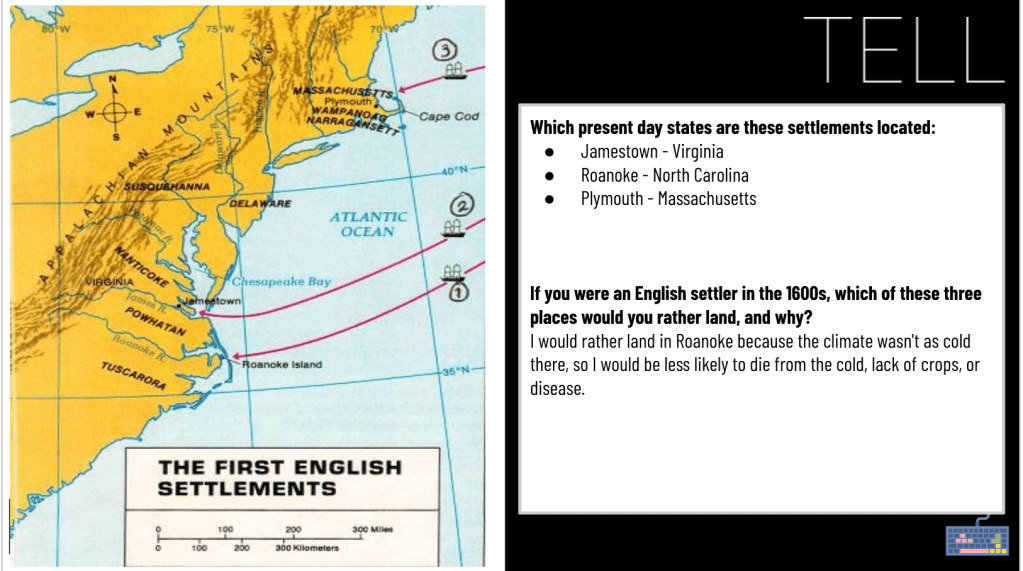
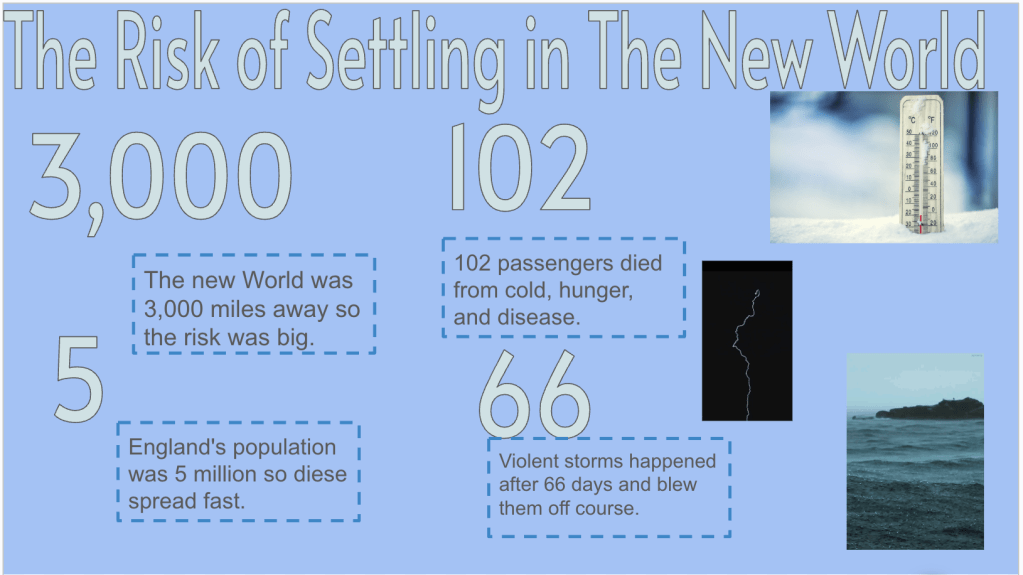
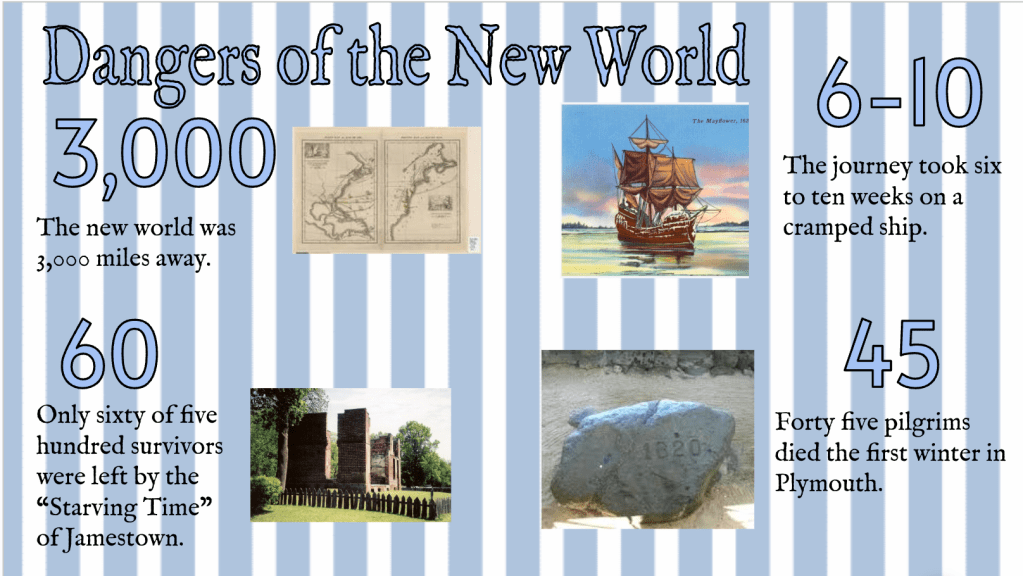
Once students had the language down, we moved into activities that helped them ground the question in time and place. With the Map and Tell, students had to figure out which modern-day states Jamestown, Roanoke, and Plymouth are located in. Then they discussed with a partner which settlement they would rather land at if they were an English settler in the 1600s, and why. For Number Mania, the goal was to prove the statement that leaving England and settling in the New World was risky and dangerous. Students picked four numbers from the reading, connected each to a fact, and organized their findings with a title and at least three pictures.
Why It Mattered
This sequence staged the big question with layers of vocabulary, geography, and data. Instead of simply asking students for an opinion, it gave them tools and context to support their reasoning. The dice added just enough unpredictability to make definitions more thoughtful, while the Gimkit runs gave immediate feedback on progress. By the time we finished, students had already begun to weigh whether leaving England in the 1600s was worth the risk, and most were firmly convinced it was not.
End of the Week
On Thursday, the 8th graders were out of the building visiting high schools for shadow days, so I gave the 7th graders time to continue working on their annotated maps. We also ran one more round of Gimkit with our vocabulary words, and this time the class averages all climbed above 90 percent. It was a good sign that the combination of TIP charts and repeated Gimkit play was paying off.
Roanoke Theories
On Friday, we dove into one of history’s mysteries with the supporting question: “What happened to the settlers at Roanoke?” I used a premade history lesson on Roanoke theories but trimmed it down to four main possibilities: the settlers went to Croatoan Island, they were killed, the Spanish attacked them, or they starved to death and were lost at sea. Then I added one more theory of my own—that John White knew the colonists were dead, discovered skeletal remains, but returned to England and lied about it to avoid scaring people away from the New World. Since these colonies were money-making ventures, it made sense that leaders would want to cover up failure and keep the dream alive.
Working Through the Evidence
I created a set of guiding questions for each theory to push students to consider evidence, reliability, and plausibility. After working through the theories, students summed it all up with a Thick Slide. They had to choose which theory they believed was true, explain their reasoning with evidence, compare reasons to go to the New World versus reasons to stay in England, draw a picture with a caption, and give their slide a title and subtitle
Why It Mattered
Friday was also the due date for their annotated maps, and 95 percent of students turned them in. What struck me most was the quality. These weren’t quick, surface-level assignments. Students had put care and detail into their work, showing that even in a week full of interruptions, they take the learning seriously and rise to the challenge.
I’m learning quickly that my school has a rhythm all its own—one filled with odd schedules, unexpected interruptions, and lots of moving parts. Some days it feels like just when I find my teaching groove, the bell schedule changes or half the class disappears for a shadow day. Other days, Mass, assemblies, or leadership experiences shift the tempo in ways that make planning a clean, flowing lesson nearly impossible. It’s a challenge, but I’m adjusting.
At the same time, I keep reminding myself that these “interruptions” are actually experiences that matter. Students are getting chances to lead, to serve, to worship, to see other schools, and to grow in ways that reach far beyond my classroom walls. So while it can make teaching messy and sometimes frustrating, the bigger picture is that it’s giving kids experiences they’ll carry with them. This week was one of those jumbled weeks, and instead of a day-by-day recap, I’m sharing the themes and highlights of what we managed to pull off in between it all.
Early in the week, we took on a classic history question: Did Columbus die believing he had reached Asia? I used a packet from Mr. Roughton’s site as the backbone, but I also added in a secondary source I thought was interesting. It suggested Columbus probably knew he wasn’t in Asia at all but kept fudging numbers and stretching the truth so the ships, money, and prestige would keep coming his way.
Working Through the Sources
Students analyzed a mix of evidence: a textbook passage that claimed Columbus never realized he had found a new land, letters where he signed himself as “Governor of Asia,” writings from his later voyages describing a “new heavens and new earth,” and even a map drawn under his direction that labeled South America as the “New World.” Adding in the secondary source about him lying for funding gave students a new angle to wrestle with.
Why It Mattered
By the end, the room was buzzing with debate. Was Columbus simply mistaken all the way to his death in 1506, or did he know he had discovered something new but lied to protect his reputation and keep the support rolling? For me, the highlight was seeing students not just memorize a textbook claim but weigh conflicting pieces of evidence, argue their case, and realize that even “famous facts” from history are not always so simple.
Mid Week
By the middle of the week, we shifted focus to how other European powers followed Spain into the Americas. I kicked things off with a map showing land claims from Spain, England, the Netherlands, and France. But I had some fun with it first. I scrubbed off five key details using the cleanup.pictures site, including “1682” from the title, the word “New,” and even Jamestown. What was funny is that in every class, students noticed “1682” last, even though the year was sitting right there in the title. It was a good reminder that sometimes students need to be pushed to read titles and pay attention to the little things.
Big Picture Pinpoint with a Twist
Next, we dove into an EMC2Learning lesson called Big Picture Pinpoint. I broke the reading into four sections, placed our lesson question in the center of a bullseye, and set up four surrounding boxes. Each round, two students rolled dice. The first roll determined how many bullet points they could write, the second determined how many words per bullet point. The dice added an element of pressure and fun, but the real goal was to force students to boil down the text to its most important details. After four rounds, they had a tight set of notes ready to go.
Processing and Comparing
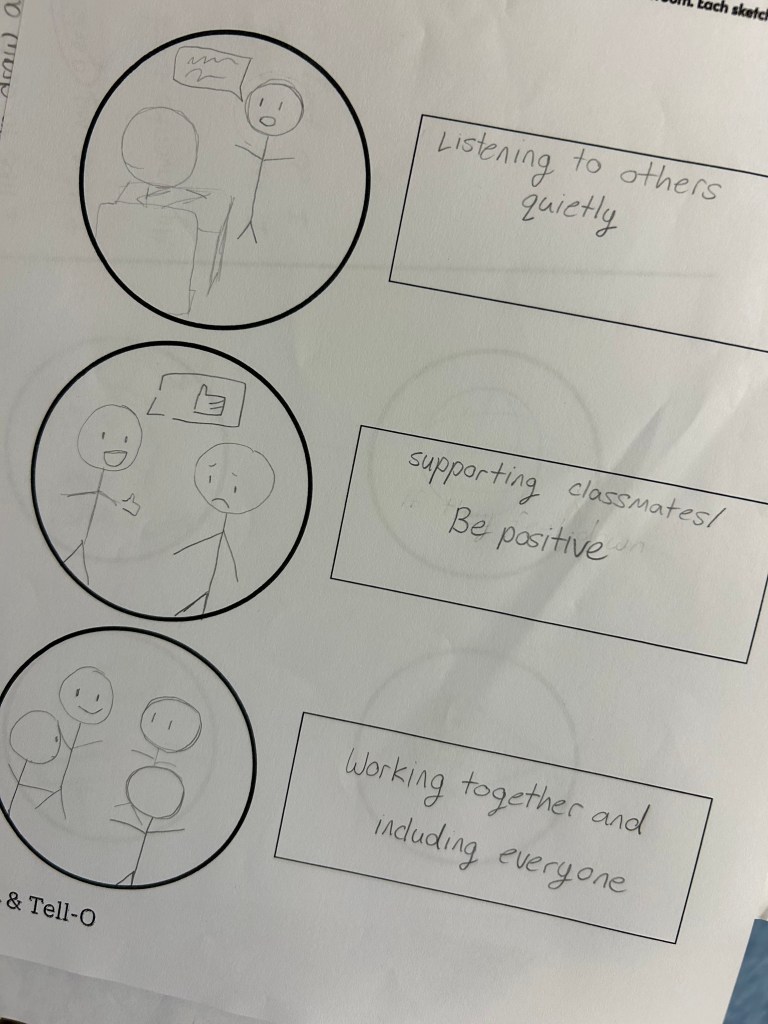
To make sense of the information, students then created a Sketch and Tell-o. Each circle represented one of the four reading sections, and they had to sketch an image tied to the content. After sketching, they circled back to answer the lesson question. The next day, we built on that foundation with a triple Venn diagram. Students compared and analyzed why Spain, France, and the Netherlands colonized North America, identifying both similarities and differences in motives and impacts.
Why It Mattered
This sequence worked because it layered skills: map analysis, summarizing under constraints, visual processing, and finally comparison. The dice game kept things light, but the students still had to think carefully about what mattered most in the text. By the time they hit the Venn diagram, they weren’t just recalling facts. They were analyzing patterns across different nations and weighing how those choices affected Native Americans and the landscape of North America.
Late Week
I think it is important for students to understand and learn how marginalized groups fight back. Too often textbooks gloss over this or only mention resistance in passing. I wanted students to see that Native peoples were not passive victims of colonization, but active defenders of their communities and ways of life.
Doubling Details
We began class with a Doubling Details warm up using the lesson question from 2.6: Why did England, France, and the Netherlands follow Spain into the Americas, and what effects did they have on Native Americans and North America? Students had one minute to respond in exactly eight words. Then they had two minutes to find a partner and build their response into sixteen words. Finally, I gave them four minutes to find two other partners and expand it into thirty-two words. Each group shared, and I picked the best one. This quick routine gave students practice in stretching their thinking and refining their ideas before we dug into new content.
Reading and Questions
We worked through a reading that traced Native resistance from the Taíno in the Caribbean to the Pueblo Revolt in New Mexico, the Powhatan at Jamestown, and Metacom’s coalition in New England. Students saw how different groups used different strategies: revolts, cutting off food supplies, burning towns, building alliances, and even blocking trade routes. The questions in the packet pushed them to think not only about what happened, but why these strategies mattered and how different groups chose different paths of resistance.
Empathy Map
To process what they read, students used an empathy map. At the center of the map was the same North America map we began the unit with, showing the many Native groups that had built their own cultures across the continent. Now students were adding the layer of how those groups fought and resisted when Europeans arrived. Around the edges of the empathy map, students considered what Native peoples might have seen, felt, thought, and done. This activity helped them shift from memorizing events to stepping into the perspective of the people living through them.
Why It Mattered
By the end, students recognized that resistance was a natural human response to being threatened, exploited, or pushed off land. They also started to connect that resistance to larger patterns in history, realizing that marginalized groups have always found creative ways to fight back. For me, the highlight was seeing students connect the map they started the unit with to this empathy exercise, tying together culture, conflict, and agency in a way that made the history feel more alive.
I feel like I am starting to hit a rhythm. There are still days when I wonder if I am just doing random things, trying to find consistency and purpose. But slowly, I can feel the stride taking shape. The protocols are giving me structure, and the students are responding with genuine engagement.
This week showed how much can happen when we stack the right activities. We kicked things off with 8Parts to sharpen map analysis, leaned on CyberSandwich to process readings and build understanding, worked through Map and Tell to strengthen geography skills, and dug into vocabulary with the Frayer Model. Later in the week, Archetype 4 Square pushed students into some of the best discussions we have had so far.
Each activity invited students to do more than just take in information. They were noticing details, making inferences, debating ideas, and connecting evidence to bigger themes. That engagement is what tells me I am slowly finding my stride.
We kicked off the week by looking at how the Age of Exploration did not simply appear out of thin air. It was the result of many forces building over centuries. I wanted students to see that explorers like Columbus and da Gama were not just bold individuals, but products of their time and the larger changes shaping Europe.
Setting the Stage with Maps
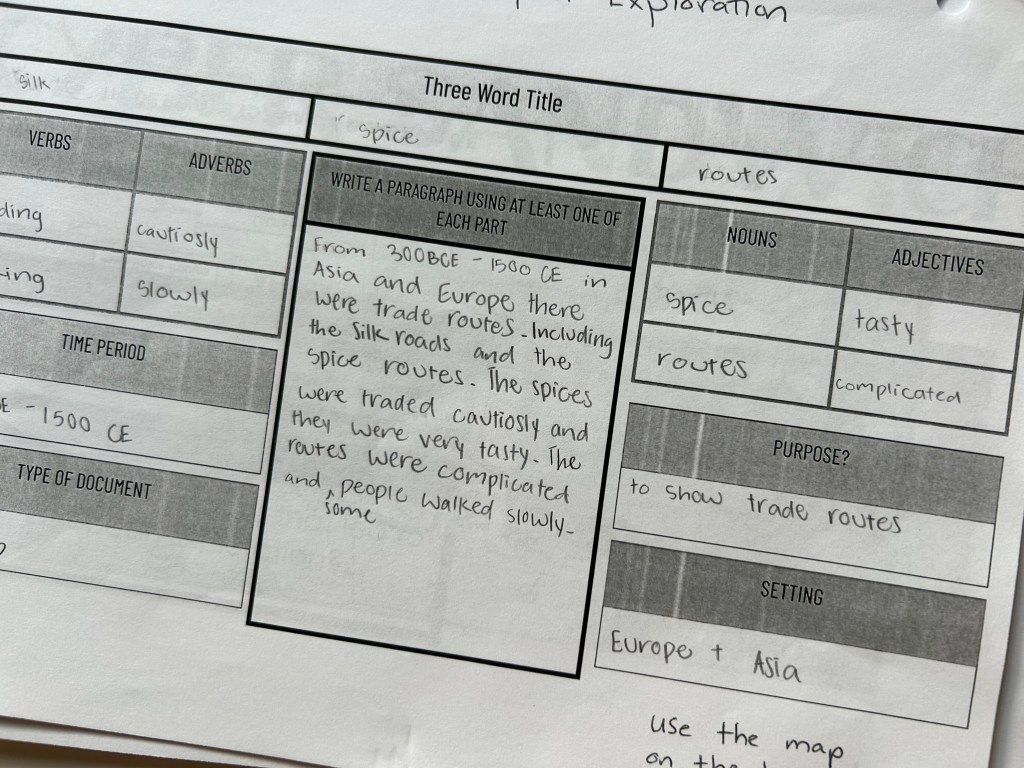
We started with an 8Parts activity, analyzing a historical map. This gave students practice with geography and map analysis skills, which are areas we will keep building throughout the year. Students had to break the map down into its pieces: nouns, verbs, adjectives, time period, setting, and purpose. Then they put it back together to tell the story it revealed. Many quickly realized how much information a map can communicate if you look closely.
Reading with Purpose
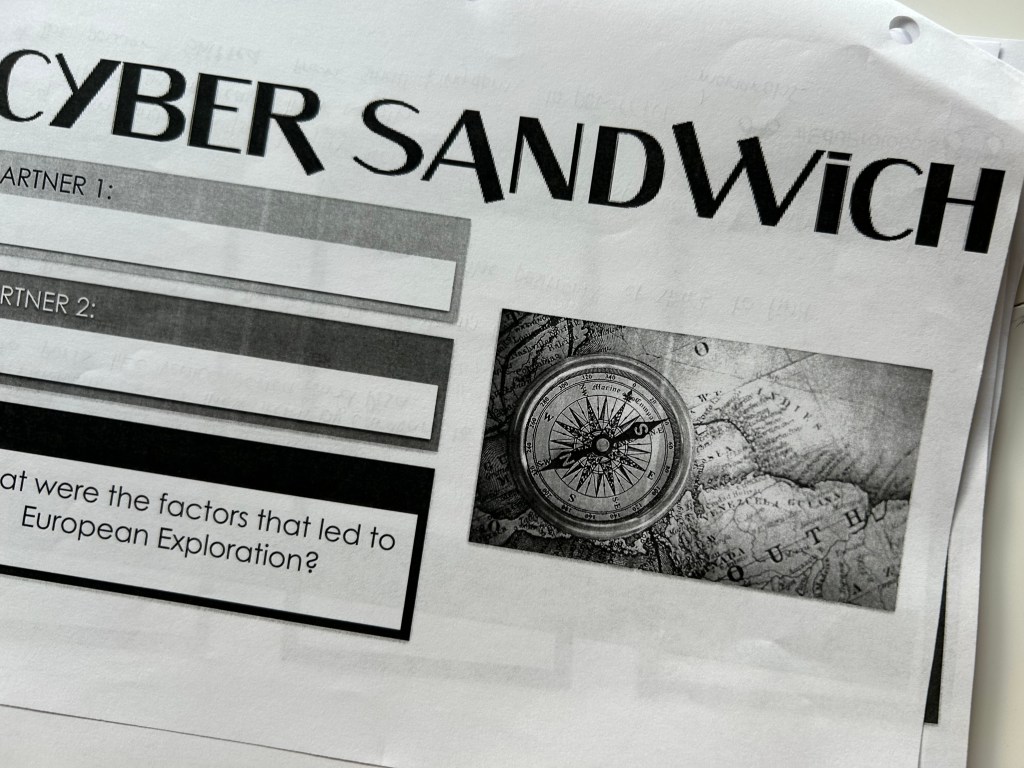
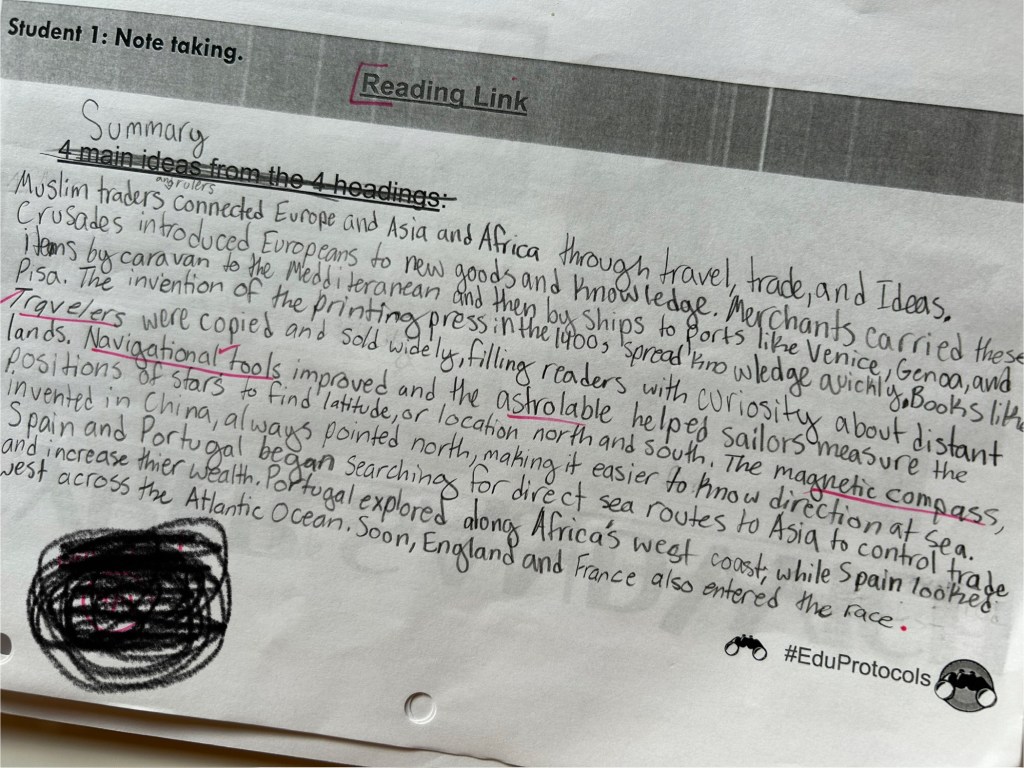
Next, we dug into the big question: What were the factors that led to European exploration? Using a reading that explored trade and the Crusades, the Renaissance, new technology, and competition among nations, students paired up for a CyberSandwich. Each partner summarized half of the text, then came together to share and compare notes. This structure helped them both process the content and hear the same ideas from another voice, making it more likely the information would stick.
Why It Mattered
By the end of class, students had built a clear picture: exploration was not random. It was fueled by curiosity sparked during the Renaissance, stronger nations looking for power, better ships and navigation tools, and the race to control trade routes to Asia.
For me, the highlight was seeing students make the leap from isolated facts to connected causes. They were not just learning “what happened” but beginning to think about why it happened, and that is the kind of historical thinking we will keep returning to all year.
Tuesday
Tuesday’s lesson brought strategy, problem-solving, and a little competition into our exploration unit. While Monday gave us the big picture, today we zoomed in on the motivations of Spain and Portugal and how those motives shaped the impacts of exploration on both Europe and the Americas.
Cracking the Code with EMC² Learning
We used a Code Breakers activity from EMC² Learning to tackle the Age of Exploration reading. Students began by gathering notes across several categories: Spain, Portugal, motives, impacts, and even England and France. The challenge came when I revealed the secret code: 2232.
This meant students had to decide which categories each number would represent, then trim their notes to fit. For example, if they placed a “2” under the Spain target, they could only keep two of their Spain notes and had to cut the rest. Every decision mattered, and not all categories were going to be used. That forced them to weigh the quality of their notes, decide what truly answered the driving question, and sacrifice details that did not carry as much weight.
Summaries and a Battle Royale
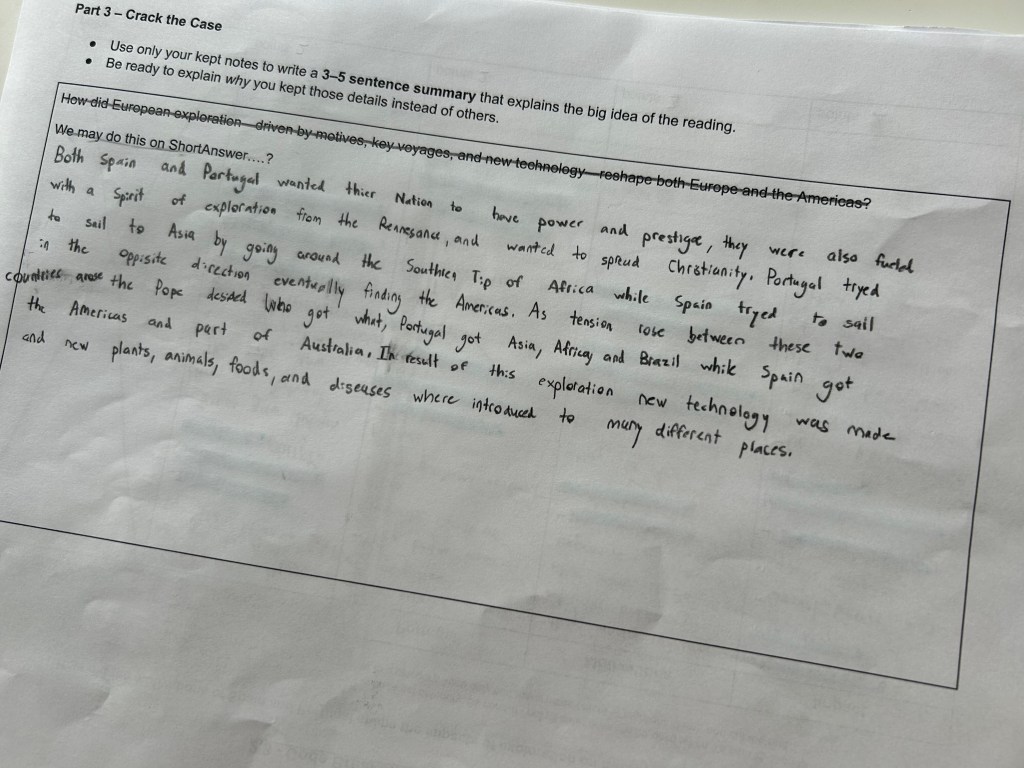
Once their notes were locked in, groups used them to write 3–5 sentence summaries answering the big question: How did the motives of Spain and Portugal shape the impacts of exploration? Some leaned on Portugal’s focus on trade routes along Africa and India, while others emphasized Spain’s westward voyages that opened the Americas.
To raise the stakes, groups submitted their summaries into ShortAnswer, which set up a full class Battle Royale. Students got to see each group’s choices play out, compare strategies, and reflect on how the placement of numbers shaped the strength of their arguments.
Why I Loved This Lesson
This lesson was full of twists and turns. Students had to wrestle with which notes fit which targets, defend their choices, and accept that not every detail could survive. They were doing more than memorizing explorers and dates. They were thinking like historians, prioritizing evidence, trimming down to essentials, and connecting their choices to the bigger idea.
By the end of class, the theme was clear: motives drive impact. And watching students battle through the decisions reminded me why I love mixing content with game based strategies.
Wednesday
By Wednesday, students were ready to take ownership of the big motivations driving Spain and Portugal’s push to explore. Instead of simply listing them, we dug deeper into the classic categories of God, Gold, Glory, and Colonies.
Dividing the Pie
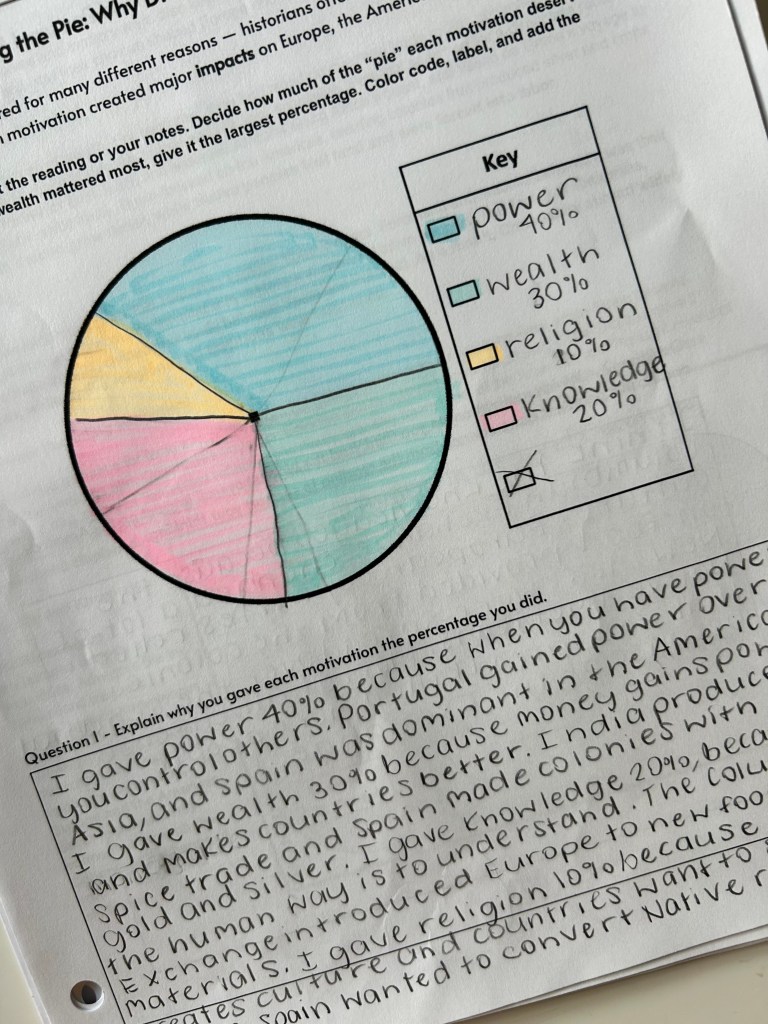
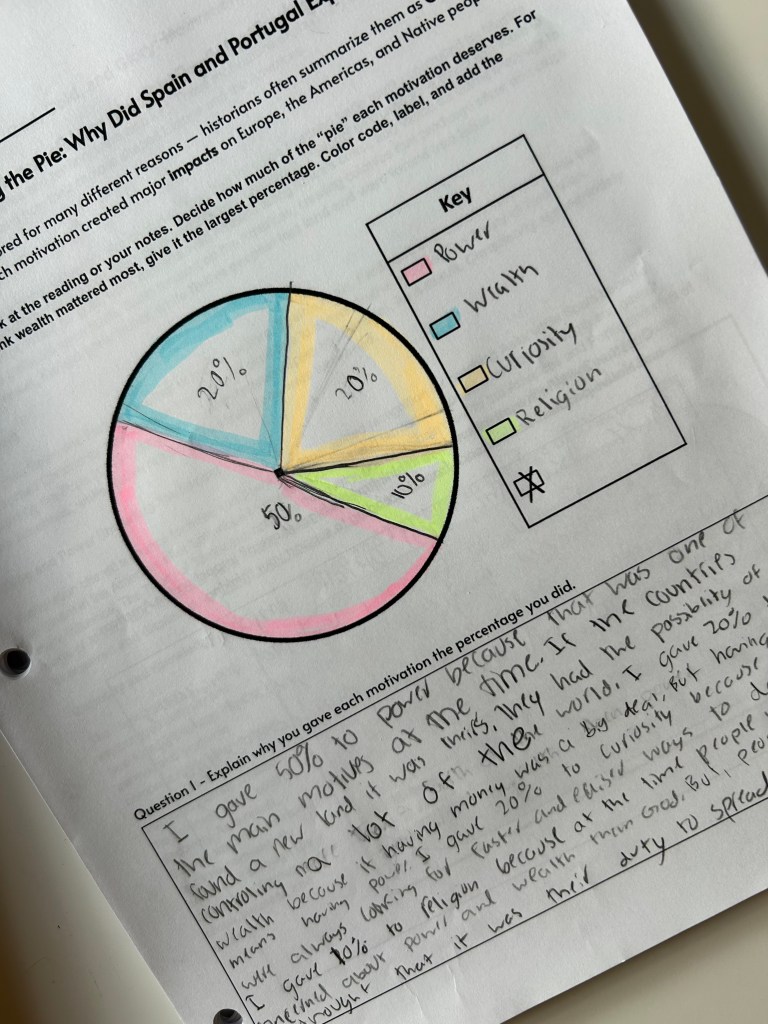
Students completed a Dividing the Pie activity, where they had to assign percentages to each motivation. If they thought wealth was the main driver, then Gold would take the largest slice of the pie. If spreading Christianity mattered most, then God would get more space. Their task was not just to color and label, but to defend why they divided the pie the way they did.
Evidence-Based Reasoning
To back up their choices, students used details from the reading. For example, Portugal’s search for a direct sea route to Asia and Spain’s colonies in the Americas showed how wealth and trade were powerful motivators. On the other hand, the Treaty of Tordesillas and missionary work revealed the strong role of religion. Some students even argued for curiosity and knowledge, pointing out how new technology and the spirit of discovery fueled exploration.
Making It Personal
The highlight of the activity was Question 2: Which motivation had the biggest impact on the Americas and Native peoples? Students had to wrestle with tough realities like how gold and colonies led to forced labor and land loss, or how the spread of Christianity weakened Native traditions. This question helped move their thinking from Europe’s perspective to the experiences of the Americas.
Why It Mattered
This lesson was not just about memorizing God, Gold, and Glory. It was about evaluating priorities, weighing evidence, and making claims. Every pie looked a little different, which sparked great conversations about how historians debate the very same question.
By the end, students saw that while all the motivations mattered, the balance you choose says a lot about what you think shaped history most.
Thursday
Thursday’s lesson was all about layering different EduProtocols to build toward Friday’s deeper dive into the impact of Spanish colonization in the Americas. This day was packed with discovery, vocabulary, and some of the best student-led discussions of the week.
Spot the Differences: Scrubbed Map
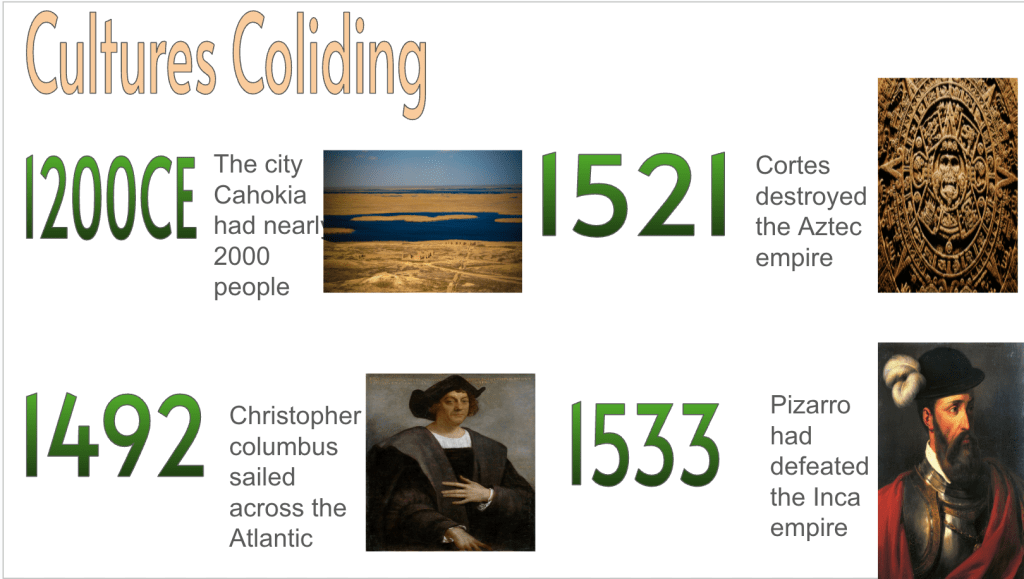
We started with a twist. Before our Map and Tell, I displayed the same map on my TV board but with certain pieces scrubbed out using Cleanup.pictures. I removed four key details: the word “North” from North America, Cortés, and two of Columbus’s voyages. Students’ first task was to find the differences.
This quick activity sparked curiosity right away and set up the focus points for the lesson. It gave students a reason to look closely at the map and notice details that connected directly to what we would later analyze.
Map and Tell and Vocabulary Work
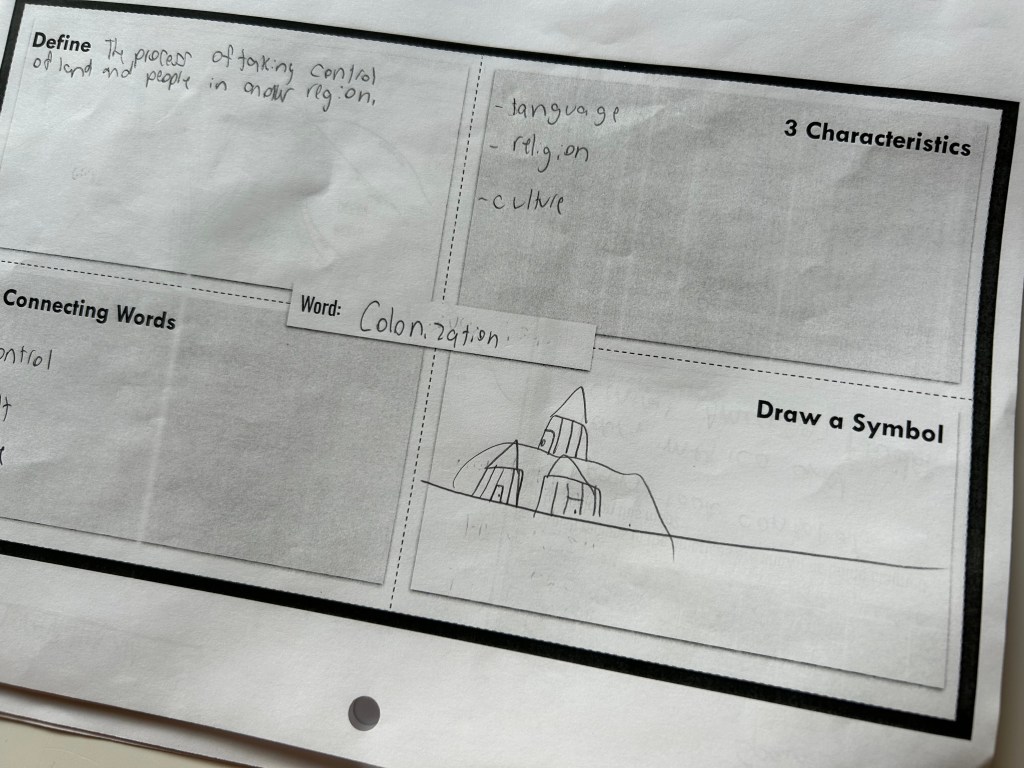
After the warm up, we moved into the Map and Tell where students shared insights and built their geography analysis skills. From there, they chose two vocabulary words to break down using a Frayer Model. The options: conquistador, encomienda system, colonization, and Columbian Exchange; gave them ownership over which concepts to dive into while still ensuring the class as a whole explored all four.
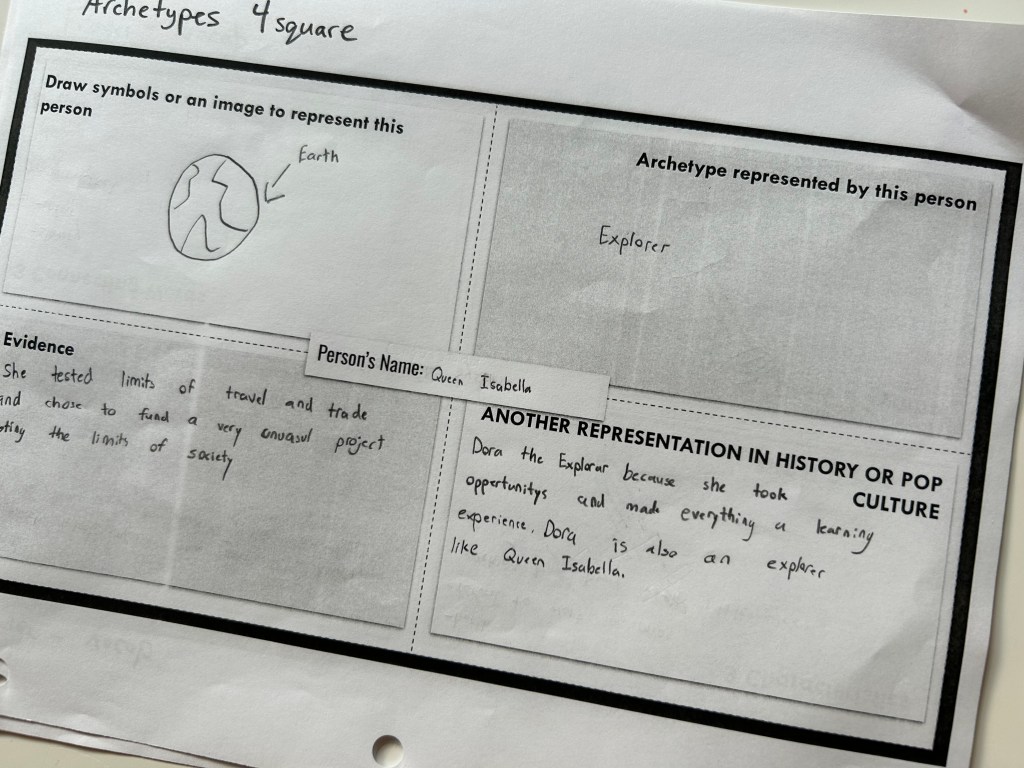
Archetype 4 Square with Queen Isabella
The highlight of the day came with the Archetype 4 Square. Students read a short piece about Queen Isabella and then explored which archetypes best fit her. Even though they had no background knowledge of archetypes, I gave them a list and asked, What do you think an archetype is? Many quickly noticed that they looked like personality traits or roles that show up in stories, movies, or TV shows.
What followed were some of the richest conversations of the week. Students selected multiple archetypes for Queen Isabella and then partnered up to defend their choices and reach a shared conclusion. One standout moment was when several students identified Isabella as the Innocent archetype. They justified it by explaining that she seemed to believe she was helping her country, trusted that natives were being treated well, and placed a great deal of faith in Columbus to explore and claim land. These ideas were not spelled out in the text, but students picked up on them through inference and discussion. That was awesome to see.
Why It Mattered
This lesson had so many layers—visual analysis, vocabulary practice, and character exploration—but what tied it all together was the level of student thinking. They were not just learning facts about maps, words, or Isabella. They were building arguments, questioning assumptions, and collaborating to refine their ideas.
Thursday felt like the perfect setup for Friday’s lesson, with students now primed to wrestle with the larger impacts of Spain’s colonization in the Americas.
Friday
Friday wrapped up our week on exploration and colonization with retrieval practice and a high-energy EMC² Learning lesson that challenged students to separate truth from half-truths.
Retrieval Practice First
All week we had been using a Gimkit review game with key questions, but Friday I pulled a few of those questions into a different format. Students answered three multiple choice questions, one fill in the blank, and one short answer on paper.
Answering without clicking forced them to recall and explain knowledge in a deeper way. It felt different from the fast-paced Gimkit and gave me a clear window into what they were actually remembering. Students did great with it, which reassures me that building retrieval practice into our regular routine is the right move, even if some days I doubt myself.
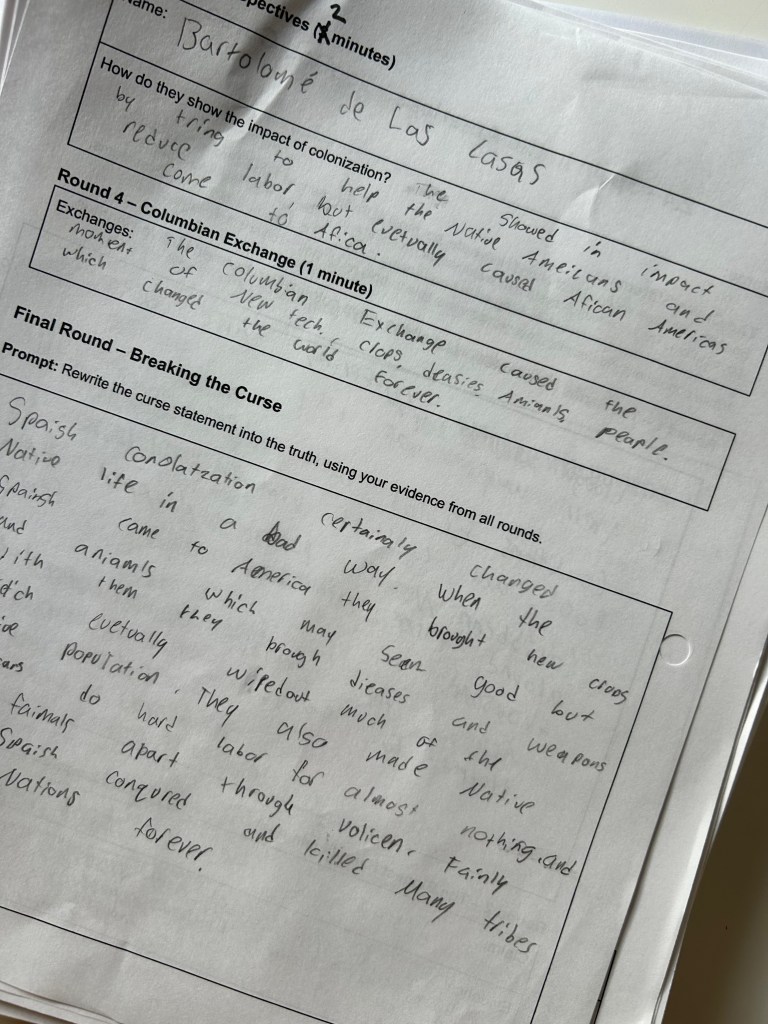
Breaking the Curse with Deja Voodoo
With retrieval practice done, we jumped into Deja Voodoo from EMC² Learning. I set the stage by asking, “Can you break the curse?”
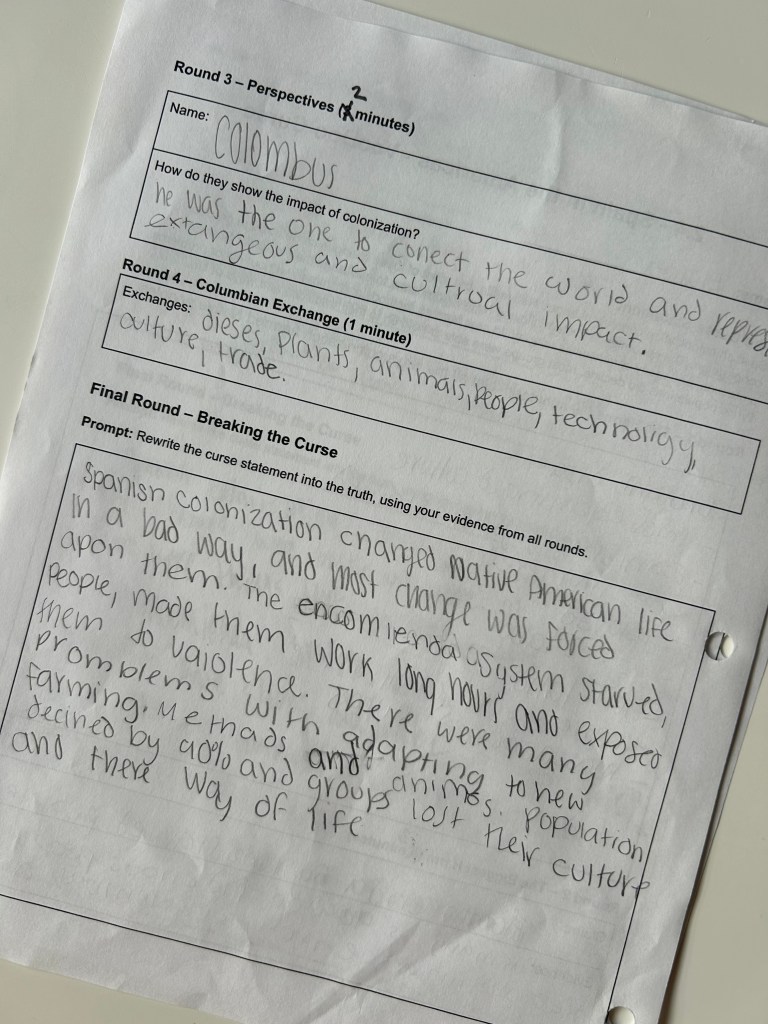
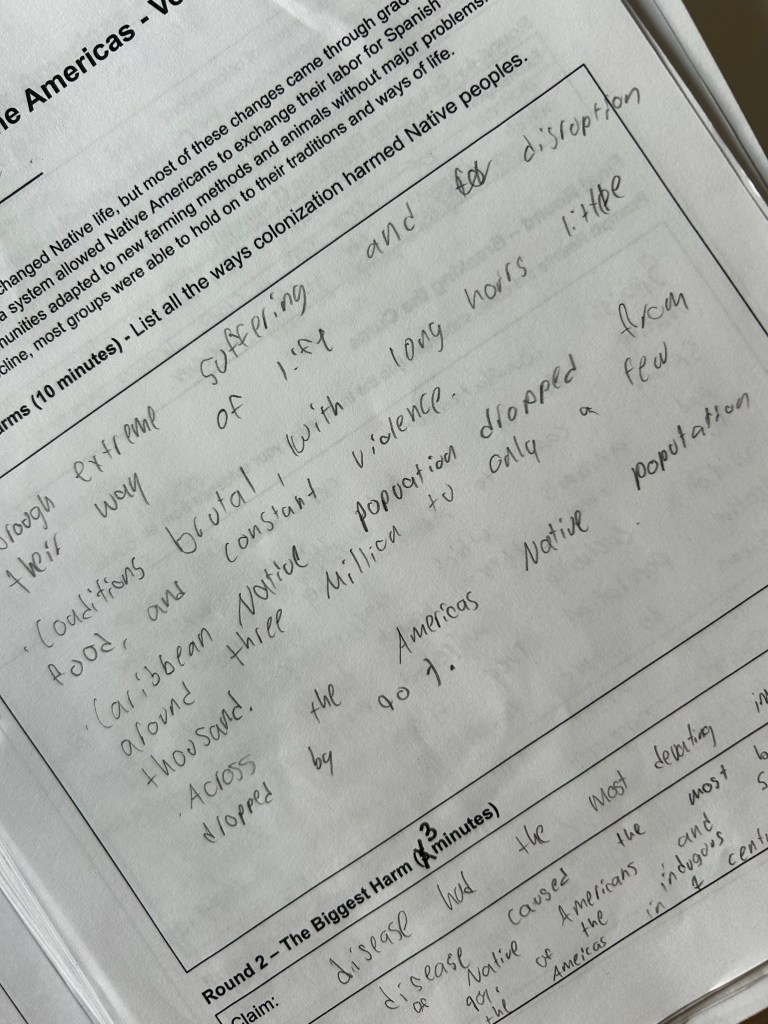
At the top of their organizer, students saw the Curse Statement I had written: “Spanish colonization certainly changed Native life, but most of these changes came through gradual cooperation. The encomienda system allowed Native Americans to exchange their labor for Spanish protection, and many communities adapted to new farming methods and animals without major problems. While populations did decline, most groups were able to hold on to their traditions and ways of life.”
The goal was to break the curse by exposing the lies, half-truths, and downplaying of colonization’s impact.
The lesson unfolded in five rounds, each one getting shorter.
Gather initial evidence from the text.
Look closer for examples of harm caused by colonization such as disease, forced labor, population decline, and cultural loss.
Identify the most devastating impact and explain why it mattered most.
Connect one person or group such as Columbus, Cortes, Las Casas, or Natives to the larger story.
Rewrite the Curse Statement by replacing half-truths with accurate evidence.
After each round, groups quickly shared responses, and I awarded random points with the reminder that “everything is made up and the points don’t matter.” The mix of humor, urgency, and layered analysis kept the energy high. Before we knew it, class was over and students had successfully broken the curse.
Why I’ll Do It Again
I loved this lesson because it gave students multiple chances to revisit the same text, spot what they had missed, and sharpen their thinking. By the final round, they were confidently correcting distortions and explaining the real consequences of colonization.
I will definitely be bringing Deja Voodoo back. It struck the right balance of engagement, critical thinking, and fun, exactly the kind of learning I want Fridays to feel like.
I’ve been coaching tennis for a long time, and I can still hear the echoes from courts all over: “Bend your knees.” “Finish your swing.” “Low to high.” Those lines are so common they almost fade into the background. But I never really bought into that approach. To me, coaching was never just about repeating mechanical reminders.
What shaped me as a coach is the belief that tennis is a game of awareness. Watch your opponent. Notice how they carry themselves. If they are frustrated and slamming balls into the net, that matters. If they miss every third forehand, that is a pattern you can work with. If they thrive on consistency, then you take it away, high, low, short, deep, anything to break their rhythm. Tennis is a puzzle, and the best players are the ones who learn to see it piece by piece.
That way of seeing the game shaped how I see the classroom too. Worksheets and lectures? Those are the “bend your knees” of teaching. They can check a box, but they don’t create awareness. Real learning happens when students start noticing connections, when they see patterns in history, when they recognize how an idea links to something in their own lives. My job is not to hand them instructions but to create conditions where they learn to think, to notice, to respond.
What shaped me is this simple idea: whether on the court or in the classroom, growth is about presence. If you dwell on the point you lost, you’re living in the past. If you only think about the final score, you’re living in the future. Awareness lives in the present. And that’s where learning and growth truly happen.
Tennis shaped my teaching. Teaching shaped my tennis. Both shaped me into someone who believes that success is not about doing more, it’s about seeing more.
I’m discovering as the year moves along that life at the Villa comes with a steady stream of interruptions to the normal school rhythm. Practice high school placement tests, walk-a-thons, shadow visits, pep rallies, and more. Honestly, it feels like way more than I ever experienced in public schools. But here’s the thing, it’s all good. These moments create a climate and culture that is unlike any place I’ve been, and I’m learning to embrace them as part of what makes this community special.
At the same time, I’m not getting as much done in class as I would like. This is a process and these kids are not used to my style or the tech usage I bring. Eventually, I want to get back to where I was getting three to five protocols accomplished in a class period.
Even with the curveballs, we kicked off Unit 2 on exploration and colonization this week. We started with a Number Mania preview to frame the big picture, then dug into how Native Americans arrived, adapted, survived, and thrived. We took a pause to step into a one-day lesson on 9/11, and then the week closed with two days of unusual schedules that didn’t leave much time for momentum.
We started the week by previewing Unit 2 and setting the tone with a Fast and Curious. I introduced our guiding question for the unit: How did European colonization and exploration impact Native peoples and North America? Scores on the quiz ranged from 60 to 74 percent, which gave us a good baseline for where we’re starting.
From there, I passed out a one-page reading that matches the flow and structure of the unit. It began with Beringia, moved through Native peoples growing, adapting, and thriving, and then shifted to the arrival of Europeans and the impact that followed. We paired this reading with a Number Mania. I have found that opening units with a Number Mania gives students a ton of data points to help frame the big picture in space and time. For this one, students had to find four numbers that proved Europeans impacted and disrupted Native life.
Something that stood out was how students reacted to this activity compared to Friday. When we first did a low-cognitive, smart start Number Mania, many of them rolled their eyes and wondered why we were doing it. Some even thought it was cheesy. I get it. These kids have been together since preschool, and with grade levels of only 30 to 40 students, they know each other well. Icebreakers feel strange. But today was different. Several admitted that the smart start practice actually made today’s Number Mania super easy. It was a small win.
Tuesday and Wednesday
We spent two days on a lesson that simplified what the textbook made overwhelming. The text mentioned around 14 Native tribes, which is too much to meaningfully process, so I narrowed it down to five regions: Eastern Woodlands, Mesoamerica, Southwest, Northwest, and Plains. The goal was for students to understand how Native peoples adapted, survived, and thrived within their regions based on geography
I structured the lesson to move from DOK 1 to DOK 2 to DOK 3. Many of these students are used to recall and rote memorization, but I want to push their critical and creative thinking. We started with stations where students read about the different regions and tribes, then categorized information into location, religion, environment, food, and housing. As they worked, I explained the learning process. I told them that transferring information from a reading to an organizer is DOK 1.
The next step was choosing three of the five regions and comparing them with a triple Venn diagram. At first, many students filled the middle space with answers like “they were in North America.” I kept coming back with the question, “If I asked you how they adapted and survived, would saying they were all in North America answer that question?” That pushed them to think deeper, and many went back and improved their comparisons.
For the last part, I used a strategy from EMC2Learning and had students write three six word memoirs about the three regions from their Venn diagram. The focus was on adaptation and survival. I explained that comparing information with a Venn diagram is DOK 2, while writing six word memoirs that capture the essence and most important information is DOK 3. I chose this activity because it is creative, simple, and gave them practice on Google Slides again. Students added text boxes, pictures, and changed word art, while also working part of the lesson on paper for balance and familiarity.
We wrapped up both days with a Fast and Curious, which raised class averages into the 80 to 94 percent range. That growth showed them that practice and persistence are paying off.
Thursday and Friday
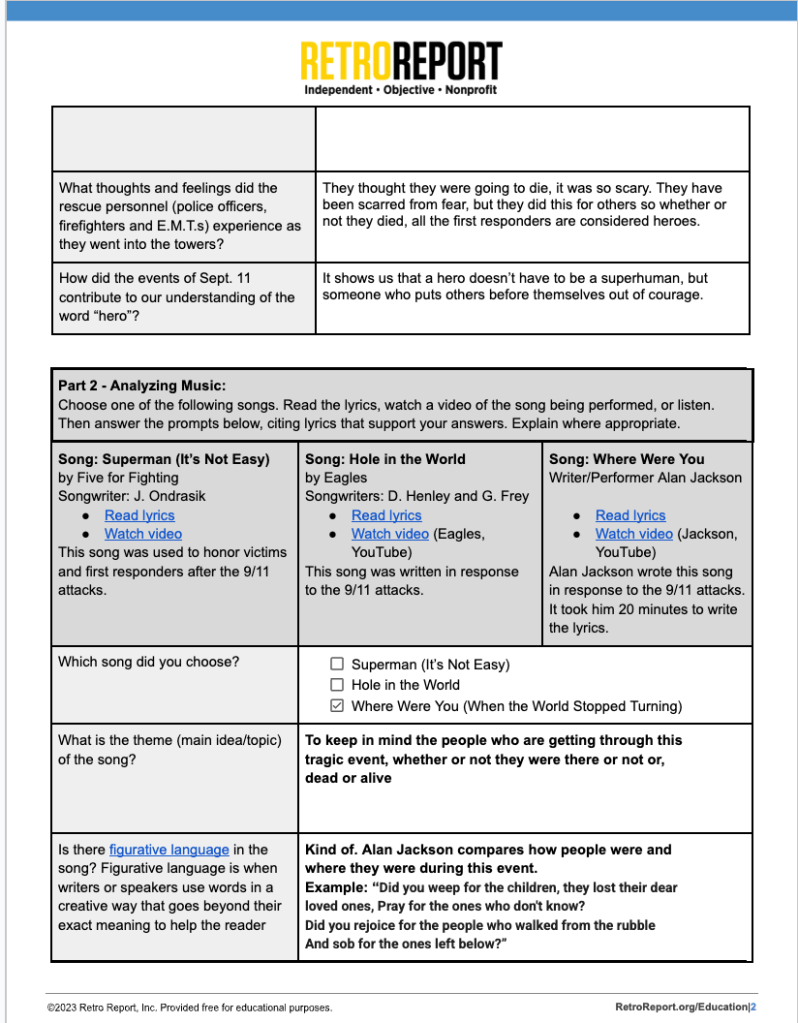
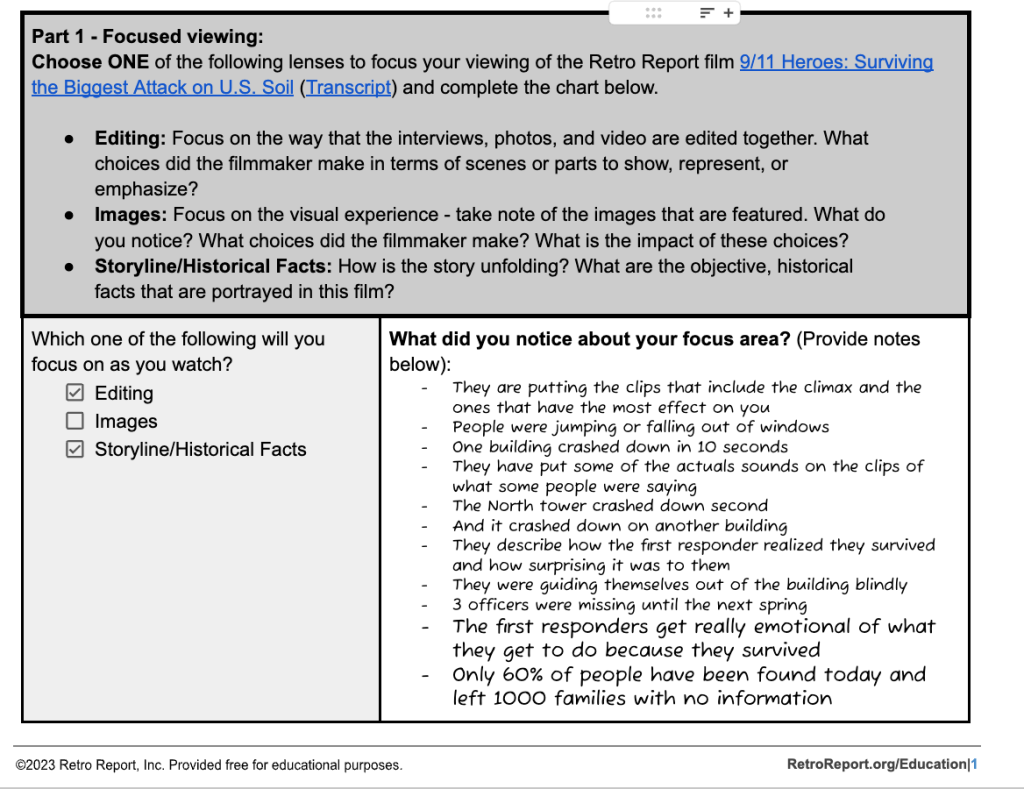
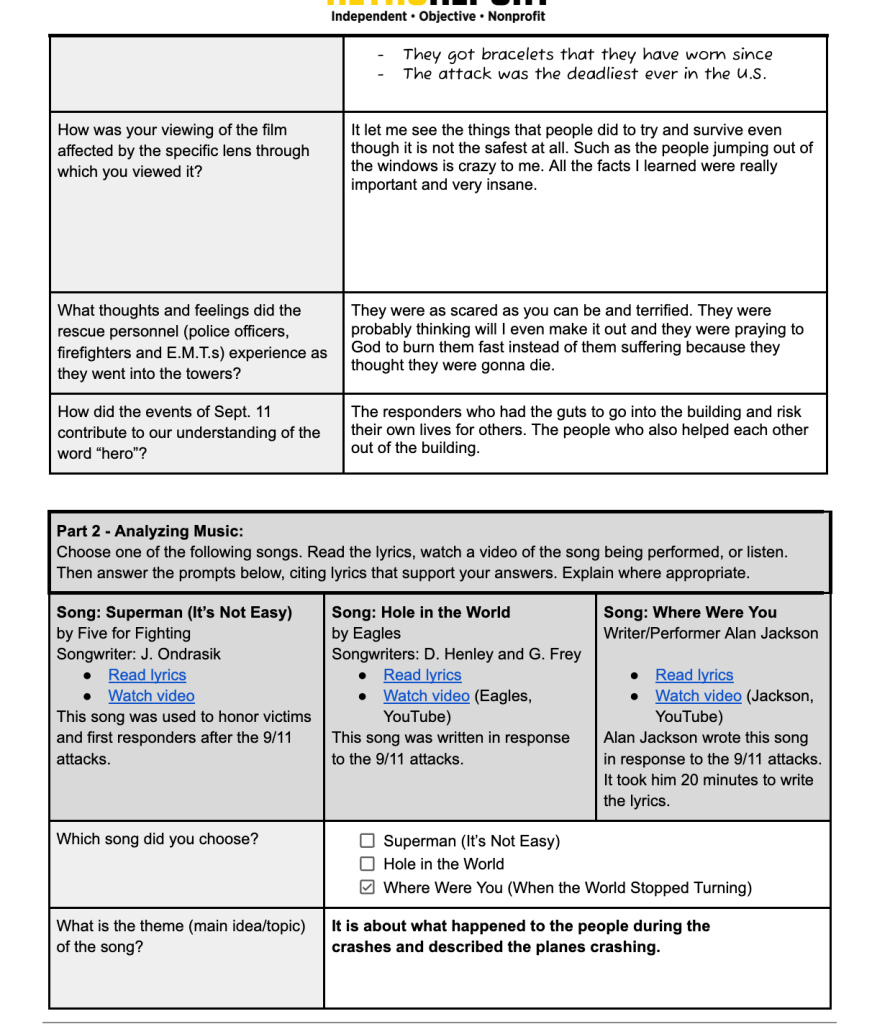
Thursday I set aside Thursday to focus on 9/11. I found a powerful Retro Report lesson with the objective: Analyze the impact of the terrorist attacks of Sept. 11, 2001 through different media sources. What I appreciated about this lesson is that it focused less on the events themselves and more on the heroes of 9/11 and the impact felt by the country afterwards. The main thread was exploring how Americans coped and grieved in the aftermath.
This one hit home for me. At 42 years old, I lived through that day, and I could share my perspective with students. For example, there was a song analysis portion where students chose one of three songs: Superman by Five for Fighting, Hole in the World by the Eagles, or Where Were You (When the World Stopped Turning) by Alan Jackson. I told them how Jackson’s song was one I leaned on at the time to help process what happened. I was able to connect with them in a way that felt authentic and personal.
Another part of the lesson had students analyze Mike Piazza’s iconic home run or President Bush’s first pitch at the Yankees game. There was also an introductory video created by Retro Report that students could view from one of three lenses: editing, imagery, or stories. I did cut a few activities to fit our schedule, which in hindsight I probably should have left in, but even with that the lesson was meaningful. I had thought about layering EduProtocols into it but decided to keep the original structure, and it worked.
What struck me most was how engaged the students were. Many admitted they had never studied 9/11 in depth before. They were curious, asking thoughtful questions, and processing the material in ways that impressed me. Instead of the blackout poetry originally suggested, I had them create a six word story about how Americans coped and grieved. Their responses showed just how much they were thinking and feeling. It was one of those lessons where the kids carried the learning, and I was just guiding them along.
Being at a new school means I’m living inside a learning curve. One is the learning curve of new procedures, figuring out how things run in a building that isn’t second nature to me yet. The other is learning about my students, how they learn, what they know, and what still feels brand new.
Technology has been the most eye-opening part. I’ve had to scale back some of my tech usage because I’ve noticed things I didn’t expect: students struggle when switching from tab to tab, they freeze when asked to transfer information from paper to a Chromebook slide, and some are still working hard at typing itself. Even something as simple as highlighting text in a slide became a full-class tutorial. But here’s the thing, they give everything they have. They want to be right, to be thorough, to do it well. So when a “simple” Map & Tell or Annotate & Tell takes longer than I planned, it isn’t because of disengagement, it’s because they are pouring themselves into it. That’s a learning curve I’ll gladly navigate.
Tuesday: Audience, Purpose, and Bias
This week we continued our historical thinking skills with a focus on audience and purpose and how those shape bias. I kicked things off with Paul Revere’s famous engraving of the Boston Massacre. I just put it up on the screen and asked, “What do you notice?” Students jumped in with their observations, and then I followed with a question that caught them off guard: “Since this was known as the Boston Massacre, how many people do you think died?”
The guesses rolled in, 15, 213, 500, 30. When I told them the real number was 5, their jaws dropped. Suddenly, the engraving looked different. That one moment opened the door for a deeper conversation about perspective and purpose.
Annotate & Tell
From there, we moved into an Annotate & Tell activity using two primary source newspaper accounts (thanks to the Gazette and the Chronicle). Students highlighted key words and answered guiding questions:
Who is the intended audience for this source?
What is the author’s purpose?
How does the description work to support that purpose?
It was a challenge at first, some students even asked, “Where do I type my answer?” But once we got rolling, they dug into the language, spotting words and phrases that revealed bias and purpose. The more they looked, the more the accounts felt less like “the truth” and more like arguments meant to persuade.
Final Reflection
We wrapped with a reflection that asked students to think about which version was more convincing to its audience and to use evidence from the text to support their reasoning. Some sided with the Gazette, some with the Chronicle, but what mattered most was that they were weighing sources against each other, not just accepting them at face value…….
This week reminded me that learning curves aren’t setbacks, they’re signposts. They show me where my students are, what tools they need, and how much they care about getting it right. If that means slowing down a bit on tech or taking extra time to show how to highlight, then so be it. The payoff is worth it, students not only practicing historical thinking, but also realizing that history isn’t about memorizing, it’s about perspective, audience, and purpose. Room 103 is learning. And so am I.
Wednesday: Resource Rumble Review
Midweek was all about review. To get ready for the test, I set up a Resource Rumble. Around the room I had seven envelopes, each tied to a different historical thinking skill. One had primary sources, another secondary, another sourcing, another contextualizing, and so on. Students worked in groups, pulling tasks from each envelope and building their study guide as they went.
Once they thought they had an answer, they brought it to me for approval and feedback. If it was solid, they got to roll dice and collect that many Jenga blocks. The twist was that their blocks weren’t just points, they had to build the tallest freestanding tower by the end. The room buzzed with movement, laughter, and some serious strategy as groups tried to balance accuracy with architecture. They loved it. I think part of the appeal was that it felt new, they got out of their seats, and for once it didn’t involve technology. By the end, they were smiling, competing, and most importantly, ready for Thursday’s test.
Thursday: Putting Skills to the Test
The test itself was designed to be straightforward but intentional. I built it in three parts: multiple choice, think alouds, and performance tasks that practiced the skills we had been building. The multiple choice section mixed DOK 1 and DOK 2 questions focused on primary and secondary sources, sourcing, contextualizing, corroborating, close reading, audience, purpose, and bias.
The think alouds were something different. Students read quotes like, “John Smith wrote about himself saving Jamestown. But I’m stopping to wonder… was he bragging to make himself look good? Which skill am I using when I question his reason for writing?” These items pushed students to recognize the historical thinking skills in action, not just definitions on a page.
For the performance tasks, I wanted them to work with sources, write, and apply what they knew. They sourced and questioned the reliability of the Boston Massacre engraving, contextualized a painting of Plymouth Rock, and compared sources on John Brown to analyze audience, purpose, and bias. I leaned on ChatGPT to help me design the framework, then revised and added the touches I knew my students needed. It ended up being a clean, balanced test that gave me a true look at how they’re progressing.
Friday: A Stumble into Number Mania
Friday I tried to roll out our new unit on Native Americans and European exploration and colonization with two Map & Tells and a Number Mania. The problem was we had never done a Number Mania before, and I ignored my own advice about starting small. What I got instead was a front row seat to how much my students still struggle with basic Chromebook and Google Slides skills. Adding pictures, changing word art, duplicating shapes—things I thought were second nature—turned into major roadblocks. At one point I was even being asked what the title should be. Good grief.
It was frustrating for them, so I pivoted. For my next three classes, I had them create a Number Mania about themselves, picking four numbers that told a story about who they are. I walked them through step by step: how to insert and format pictures, what word art is, how to change it, and even the magic of Control+D to duplicate. It wasn’t what I originally planned, but it gave me a better picture of their tech readiness and let them practice in a low-stakes, personal way.
Week two felt like a reset button. Last week I tried to do too much too fast with Chromebooks, logins, and codes. It was overwhelming. This week, I went back to the basics. Paper, pencils, and simpler routines gave students (and me) the space to breathe. We still pulled out the tech: Quizizz for Fast and Curious, Google Slides for Thin and Thick slide, but we balanced it with Frayers, CyberSandwich, and Sketch & Tell-o on paper. That rhythm worked.
I also had a big curriculum shift confirmed. Originally, 6th grade was set for 7th grade content (ancient Rome and Greece), 7th grade for 8th grade content (early American history), and 8th grade for 10th grade content (modern American history). But over the weekend, it hit me my 8th graders had never learned early American history. How could they possibly jump straight into the modern era? I brought it up to my principal, and he agreed. So this year, both 7th and 8th grade are studying early America. Next year, 7th grade will move forward into modern America, and everything will be aligned again. It’s the right move, and it gives me time to prep for a brand-new course I’ll be teaching down the road.
We kicked off our new theme this week: Sources and Sourcing. The goal is simple but essential: help students recognize the difference between primary and secondary sources and begin applying that understanding.
We started with a Quizizz check in, and the results told me all I needed to know: most students had no clue. That changed my plan immediately. I scrapped my original idea and built a Rack and Stack that gave them multiple reps with the concept.
Here’s how it broke down:
Thin Slide – Students picked a source, labeled it primary or secondary, and shared with a partner. A quick, low-stakes way to get them thinking.
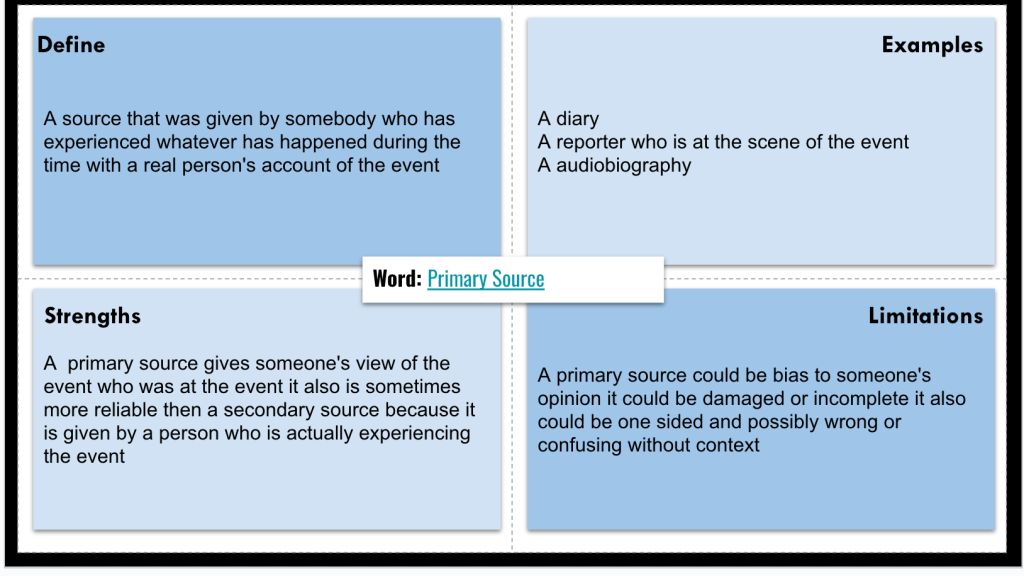
Frayers – Two total: one for primary, one for secondary. Students added definitions, examples, and nonexamples to deepen their understanding.
Word Wall – They sorted sources on their own. No scaffolds, no hints. Just a test of what they knew after the Frayers.
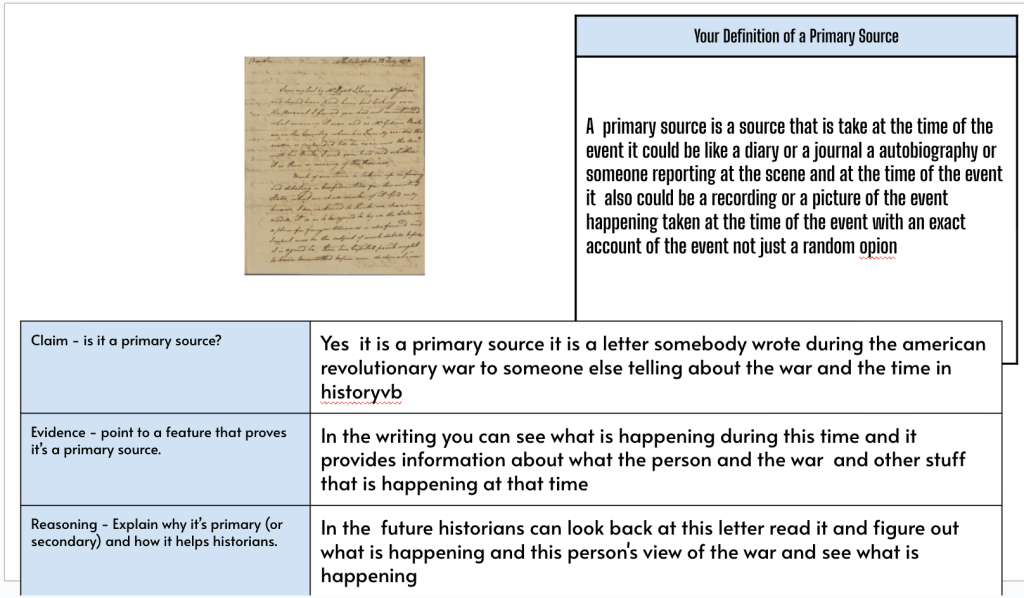
Thick Slide – The application task: If you were researching the American Revolution, what primary source could you use? Students added a picture, used their Frayer definition, and proved they found a true primary source with claim, evidence, and reasoning.
By the end, students weren’t just identifying sources; they were already starting to source them in their writing. That’s the kind of win that makes me feel good about slowing down, scaling back, and laying a strong foundation for what’s coming next.
Tuesday – Digging into Historical Thinking Skills
Tuesday’s focus was on the four historical thinking skills we’ll be leaning on all year: sourcing, contextualizing, corroborating, and close reading. I built a Quizizz Fast and Curious that mixed straight definitions with application-style questions. The first run was rough, class averages came in at 39%, 32%, 38%, 40%, and 52%. What fascinates me is how consistent those numbers always are across classes when students haven’t actually been taught the content yet. It shows me we’re all starting from the same baseline.
From there, I introduced notes on the four terms. To make it stick, I had students complete a Sketch & Tell-o for each drawing a quick sketch to capture the meaning and writing a one-sentence explanation. But I didn’t want it to just stay on paper. As we worked through the notes, I kept tying it back to Monday’s lesson.
I asked a student to look around the room and pick a primary source if they wanted to learn more about me. Some chose the student letters on my wall, others pointed to my Teacher of the Year plaque, and a few grabbed onto classroom photos. With each object, we practiced:
Sourcing – Who created it? When? Why?
Contextualizing – What was happening at the time it was made?
Corroborating – What other source in the room could support or challenge it?
For example, if a student chose my Teacher of the Year plaque, they often paired it with one of the letters from students that helped me earn it. That connection helped them see how sources work together to tell a fuller story.
We wrapped by running the Quizizz again. This time the class averages jumped to 47%, 58%, 59%, 48%, and 74%. It wasn’t perfect, but the growth was clear. Students saw the payoff of practice, and it gave us a strong foundation to keep building on the rest of the week.
Wednesday – Practicing Skills with the Lunchroom Fight
By midweek, I wanted a low-cognitive way for students to actually practice the historical thinking skills we had been building. The Lunchroom Fight 2 activity from the Digital Inquiry Group was the perfect fit.
In years past, I’ve never found this activity to be all that engaging. But this group is different. Being in a small private school, my students know each other well and have strong rapport. They listen to one another. They actually discuss instead of talking over one another.
We started class with another Quizizz for retrieval. Then we jumped into the Lunchroom Fight. A couple of students even asked, “When are we going to learn history?” They were eager to dive into content, but I wanted them to see how skills work in practice.
Students paired up, read through the eyewitness statements, and organized the information. The conversations were good: who seemed reliable, who didn’t, and what evidence actually held up. The end goal was a simple Claim-Evidence-Reasoning:
Claim – Who was at fault for the fight?
Evidence – Which statements supported that claim?
Reasoning – Why does that evidence matter for deciding suspension?
What impressed me most was the independence. Some students even took their papers down the hall into the common area to work, and I could trust them to get it done. That’s a gift as a teacher—watching students take ownership of the task, collaborate authentically, and actually enjoy practicing skills.
Thursday – Jumping Into History
Thursday was the first day we really shifted from skill-building to applying those skills with actual history. We started class the same way, with a Quizizz Fast and Curious. The averages told the story: 86%, 81%, 44%, 80%, and 88%. The growth was there, and the quick retrieval gave students confidence heading into the lesson.
From there, we moved into a sourcing activity from the Digital Inquiry Group. The prompt was tied to a famous image: Is this painting of the First Thanksgiving a reliable source to understand the relationship between the Wampanoags and the Pilgrims? Most students confidently said yes. But the reveal that the painting was created 311 years after the actual event surprised them. Once they thought about it, they understood why it was not reliable. That “aha” moment was powerful.
We used that as a bridge into another historical painting, Percy Moran’s Molly Pitcher Firing Cannon at the Battle of Monmouth (1911). Students leaned on the four skills of sourcing, contextualizing, corroborating, and lateral reading to break down the image. The conversations were sharp. They questioned the reliability, discussed how memory and myth can reshape events, and pulled connections to what we had been practicing all week.
We closed with a writing task:
Prompt: After analyzing Percy Moran’s painting Molly Pitcher Firing Cannon at the Battle of Monmouth (1911) using sourcing, contextualization, corroboration, and lateral reading, write a short response using the Claim–Evidence–Reasoning framework.
Instead of collecting responses on paper, I had students type their CERs into ShortAnswer. Then we ran a Battle Royale. Students voted responses up and down, debated which claims were strongest, and saw firsthand what made evidence and reasoning effective. It was a blast. The energy in the room was exactly what I want, with students engaged, competitive, and thinking critically about history.
Friday – Exploring Bias
Friday’s focus was on bias, which is always a tricky concept to teach middle schoolers. I adapted a lesson from Mr. Roughton and shaped it for my classes. We began with one final Quizizz Fast and Curious, and the results were strong: 86%, 80%, 83%, 83%, and 91%. That showed me they were ready for a challenge.
To introduce bias, I showed a recut trailer of Finding Nemo. Someone had spliced together lines and clips from the movie but paired it with horror film music. Every student had seen Finding Nemo, so they were shocked and confused by what they saw. That was the hook. I explained that nothing in the trailer was a lie, but the way the clips were cut and the music that was added changed the perspective completely. Bias works the same way. It is not always about telling falsehoods. Sometimes it is about presenting information in a way that leaves out parts of the story or makes it feel different than it really is. That clicked for them.
Next, we moved into a CyberSandwich on John Brown. I gave each student an article that ChatGPT had created for me. One came from the perspective of a northerner, the other from the perspective of a southerner. The students did not know that they were reading different accounts. Each article contained the same facts but used loaded language to create very different impressions. To scaffold, I gave them guiding questions:
List as many words or phrases as you can find that make John Brown look positive.
List as many words or phrases as you can find that make John Brown look negative.
Sourcing – Who might have written this account? How could that influence the way John Brown is described?
Contextualization – What was happening in the United States in the 1850s that might explain why people described John Brown this way?
Corroboration – Do you think this reading gives you enough information to make a good decision about who John Brown really was? Why or why not?
Based on what you read, who was John Brown?
As students worked, most had no idea they were reading different articles. In one class, someone raised their hand and said, “I can’t find anything positive.” Another student responded, “What? How can you not?” That sparked immediate comparisons and conversations. The realization that they had been given different accounts blew their minds. They begged to read the other version. That was the moment bias became real.
We closed with a CER: Was John Brown a hero or a villain? Students pulled from their notes, their comparisons, and their discussions to make a claim, back it with evidence, and explain their reasoning. The engagement was high, the conversations were thoughtful, and the lesson tied right back to the Finding Nemo trailer. It was the perfect way to end the week.
This week was my first full stretch as the new 6th, 7th, and 8th grade social studies teacher at St. Ursula Villa. With only three days on the books, I do not have the time or space to reflect on every class and every moment. Instead, I am going to highlight some lessons that stood out. Not because it was the best, but because it captured what I want this year to feel like.
Building More Than Community
On the very first day, I leaned on a few familiar tools: Sketch and Tell-o, Thin Slides, and Frayers to build community and get to know my students. The funny thing is, Villa already has an incredibly strong community. Many of these kids have been together for years, and each grade only has 30 to 40 students. So yes, the “Frayer a Friend” activity was a little redundant, but I wanted to give them practice with these frames we will use all year.
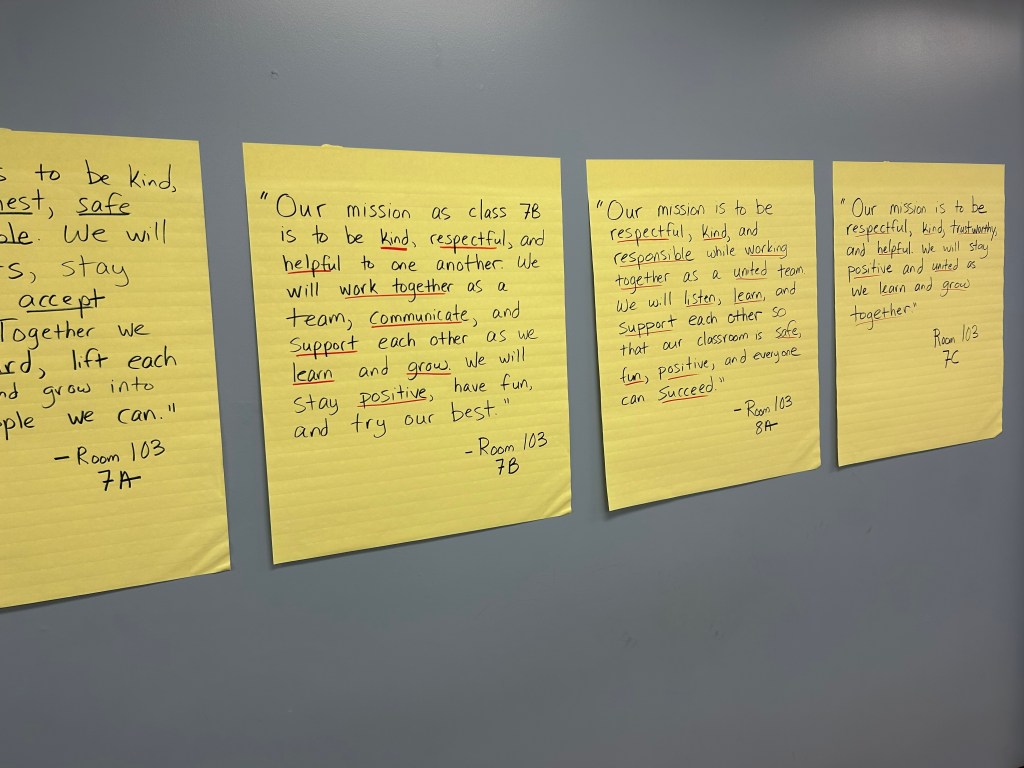
The next day, I put those same tools to work for something bigger: creating a class mission statement.
From Sketches to Statements
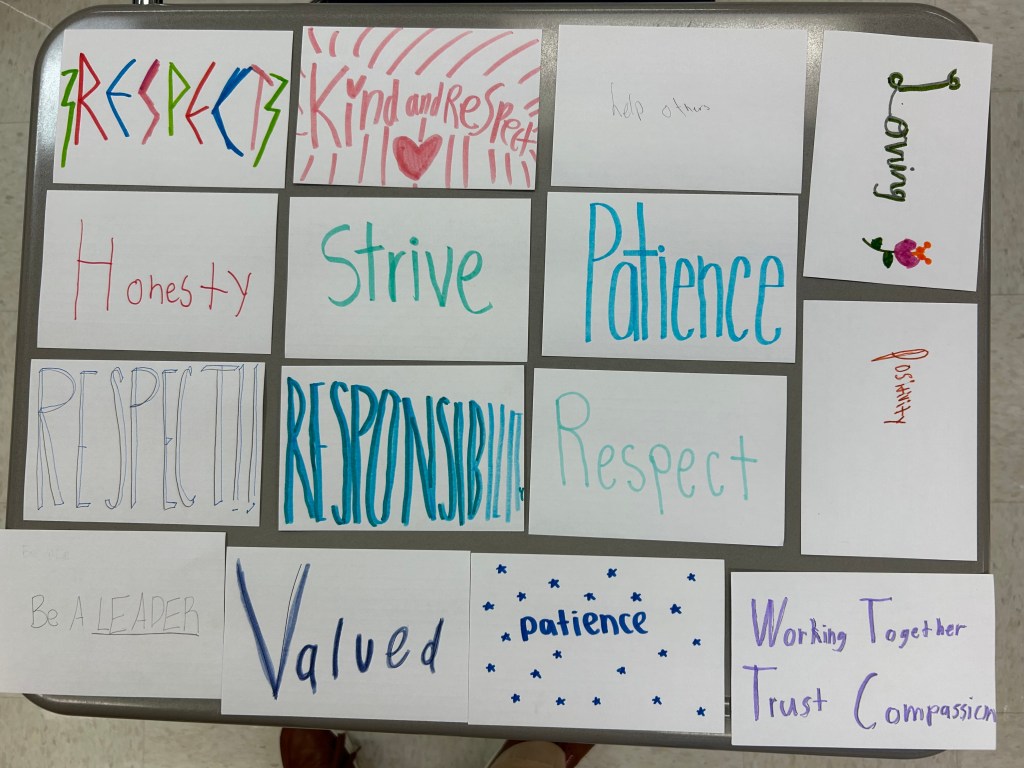
We started with a Sketch and Tell-o. I asked students to visualize what they feel is most important in a classroom environment. Four minutes to sketch, a quick explanation, then each student narrowed their ideas to a single word. They shared those words with a partner, and together we pulled out the common threads.
Next came the index card Thin Slide. On one side, students wrote three to four words that felt essential. On the back, they drafted a personal mission statement using those words. I modeled what that might look like first. Many students had already written personal mission statements before, so the leap to classroom mission came naturally.
Then came my favorite part. We took those mission statements into ShortAnswer. Students typed them in, and we ran a battle royale. They read, debated, and narrowed them down round by round until one statement stood at the top. That collective ownership mattered.
We closed with a Frayer Model of the chosen mission statement, thinking through what it looks like student to student, teacher to student, student to teacher, and student to classroom. By the end, the words were theirs, the mission was theirs, and the expectations were theirs.
Why It Mattered
Was the lesson perfect? No. But it checked the box I care about most right now: students shaping the environment they want to learn in. The protocols gave them structure, and the process gave them voice.
Teaching social studies in 2025 is not the same as it was even five years ago. My middle schoolers live in a world where AI can spit out an answer in less time than it takes them to find the question mark on the keyboard. That changes things.
But here is the key: it does not change why we teach social studies. It just changes how we help kids wrestle with information. If anything, AI has made the skills of questioning, sourcing, and perspective even more important.
Here are five things I want my students to get if they are going to actually learn social studies in an AI world:
1. Be the historian, not the robot
AI is good at telling kids what happened. Historians do the harder work of weighing evidence, building arguments, and arguing over perspective. I remind my students that the chatbot is not the historian, they are.
2. Sources are still the anchor
AI does not always make clear where its information comes from and sometimes it just makes things up. That is why my students keep coming back to the question: What is the source? If they cannot answer that, the information does not carry much weight.
3. Bias never goes away
This one is easy for kids to grasp. We have always shown them that newspapers, diaries, and speeches carry bias. Now we add AI to the list. Whose voice do you hear? Whose voice is missing? Once they see bias in one place, they start spotting it everywhere.
4. Question before you accept
This is where I have found AI to be the best teaching tool. It gives kids a polished looking answer that is not always perfect. Instead of saying “do not use it,” I give them my Fray-I template.
Students take an AI response and then “fray it apart”:
What is the main point?
Did it use evidence or just sound nice?
What is missing?
Would you trust this for an assignment?
The beauty of Fray-I is that it forces kids to do what historians do: summarize, critique, evaluate, and revise. AI is not a shortcut. It is raw material for real thinking. You can copy a Fray-I template here!
5. History is still human
At the end of the day, AI can generate timelines and definitions, but it cannot teach empathy or perspective. That is still our job. My students need to see the choices, struggles, and connections that make history matter. That is where the learning lives.
Final Thought
AI is here, and our students are going to use it. We can either fight it or teach with it. For me, the answer is clear: use it as a spark, then give students tools like Fray-I to push deeper. That is how they learn to think like historians in an AI world.


























 Moler's Musings