
This week was all about putting learning into action. Instead of just moving through content, we focused on activities that helped students think, discuss, and make sense of ideas. From analyzing perspectives on the War of 1812, to building an understanding of sectionalism, to predicting the Monroe Doctrine through images, and finally connecting everything through hexagonal thinking, each activity pushed students to do something with what they were learning. By the end of the week, the goal was not just to know the content, but to organize it, talk through it, and make meaning of it together.
Monday – Was the War of 1812 Worth It?
We picked right back up where we left off on Friday, but this time students had to do something with what they learned.
Building on Friday
Friday’s work set the foundation. Students looked at different perspectives and started building an understanding of why the United States might go to war with Britain and why it might not. The goal was not to memorize reasons. It was to sit in the tension of the decision. Monday was about pushing that thinking further.
Reality Check
We started by having students rank the strength of the U.S. Navy versus the British Navy. This seems simple, but it forced a reality check. Once students saw the massive gap between the two, you could feel the shift in the room. Some started questioning whether war even made sense at all.
Primary Source Work
From there, we moved into a primary source, James Madison’s speech to Congress. Instead of just summarizing it, students had to think about what Madison was really doing. Was he convincing? Was he leaving things out? Was this enough to justify war?
Putting It Together
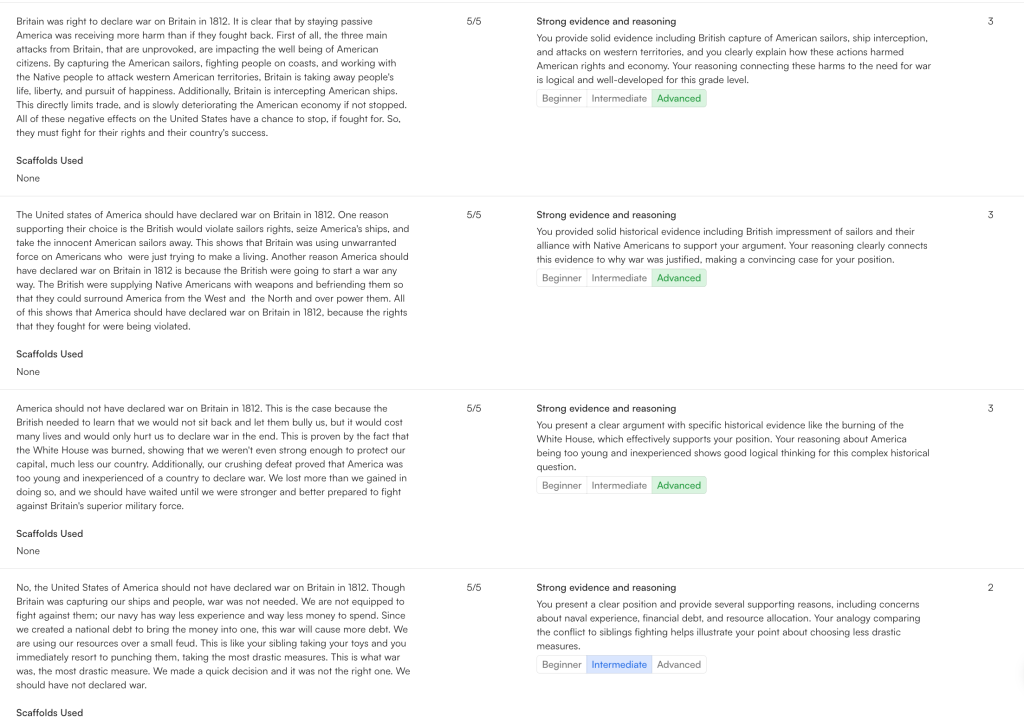
Then we brought everything together. Students went into MyShortAnswer and used the Quick Write feature to respond to the question: Should the United States have gone to war with Britain? They were not just typing an answer. They were making a claim, backing it up, and then getting immediate AI feedback on their thinking. Not grammar. Not spelling. Their thinking. Some students realized their evidence did not actually support their claim. Others saw they only used one idea when they needed more. A few went back and revised right away.
Why It Matters
That is the part I keep coming back to. Instead of waiting days to see if their thinking made sense, students were able to adjust in real time. It turned writing into a process, not a one shot assignment. By the end of class, students were not just answering a question about the War of 1812. They were starting to understand something bigger. Sometimes in history, leaders make decisions knowing the odds are not in their favor. The real question becomes, was it worth it?
Tuesday – From War to Sectionalism
Tuesday was a shortened class period, but we kept the focus tight and intentional. I did not want to rush past the causes of the War of 1812 and jump straight into effects without helping students make a meaningful connection.
Introducing Sectionalism
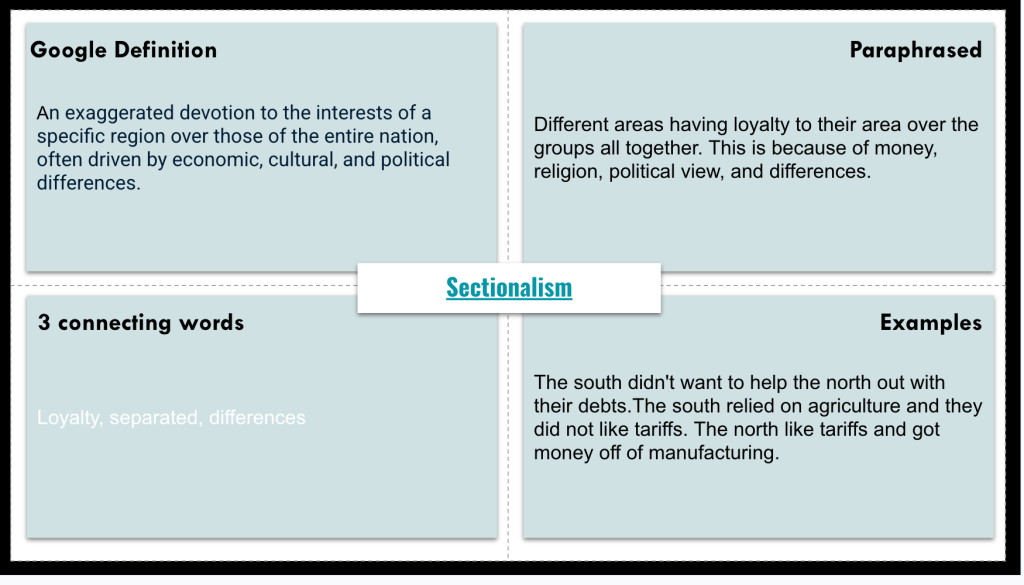
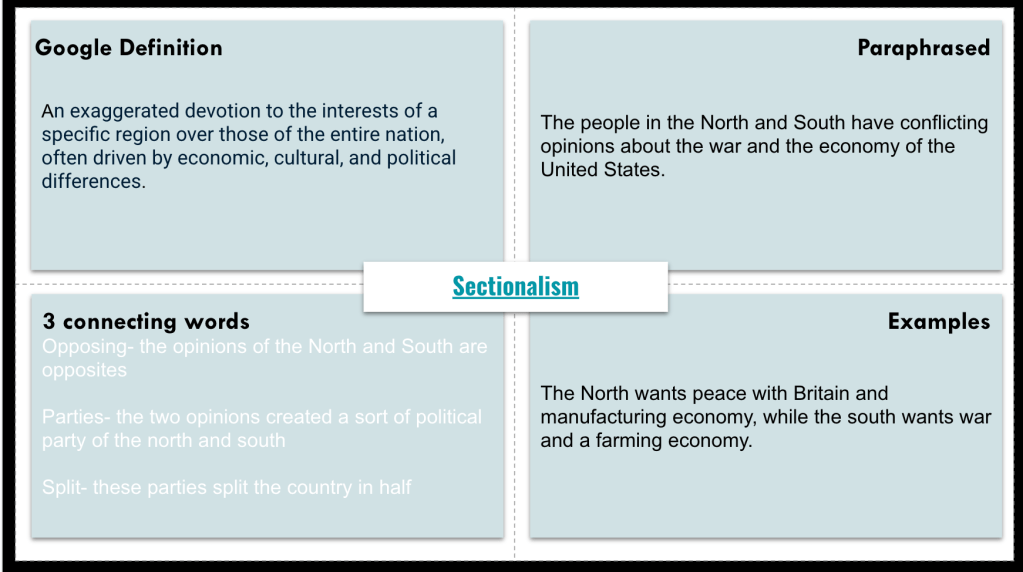
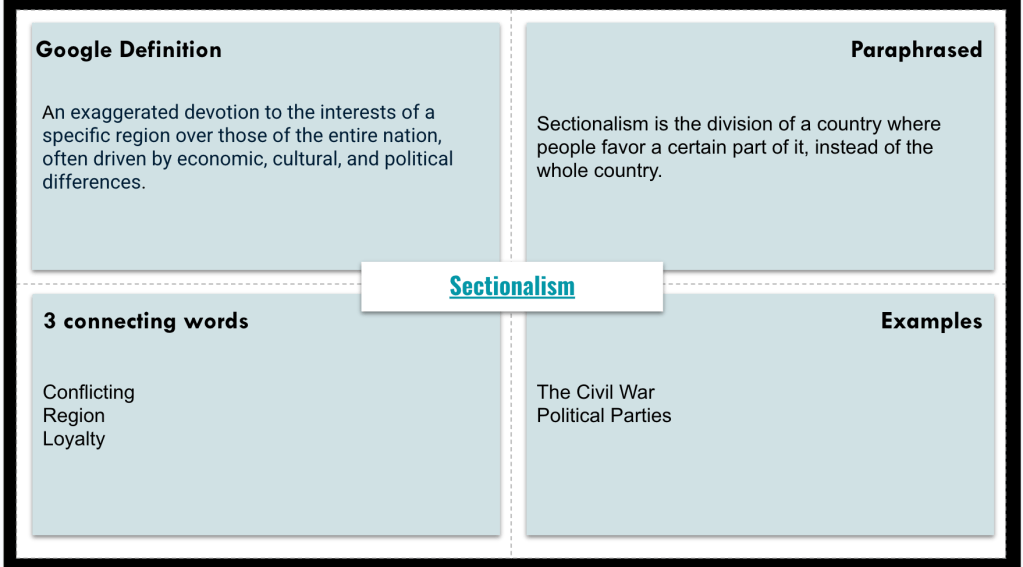
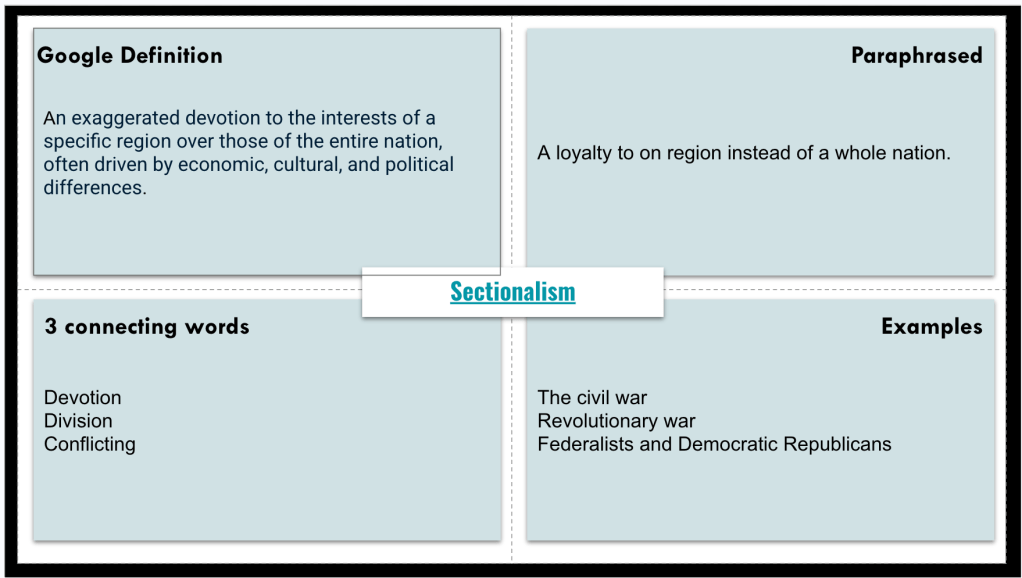
We started with a Frayer model on the word sectionalism.
Students had to:
- Find three connecting words
- Paraphrase the definition
- Share examples
The definition we worked from described sectionalism as an exaggerated loyalty to one region over the nation, often tied to economic, cultural, and political differences .
This gave students a foundation, but more importantly, it gave them language they could actually use moving forward.
Making the Connection
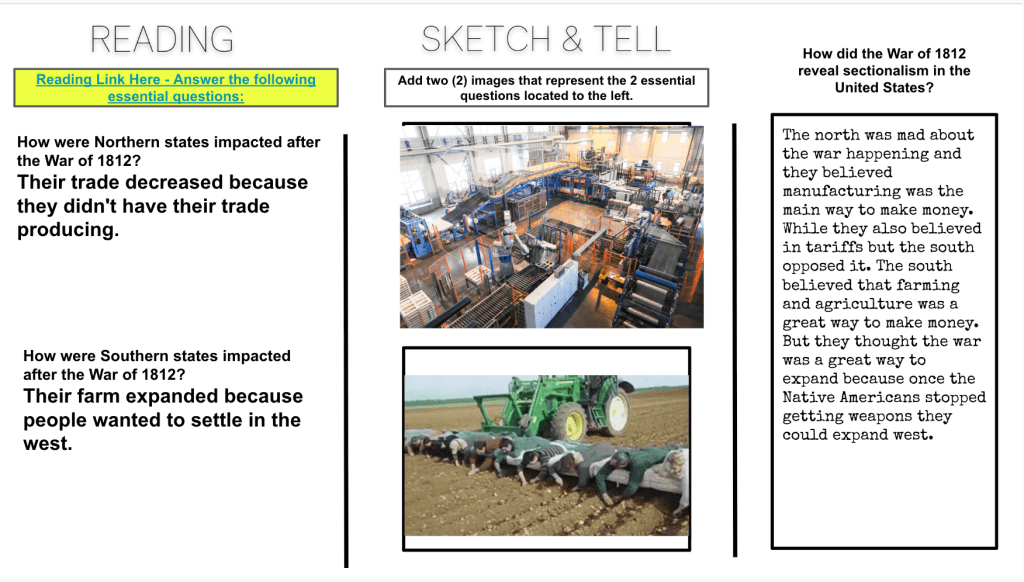
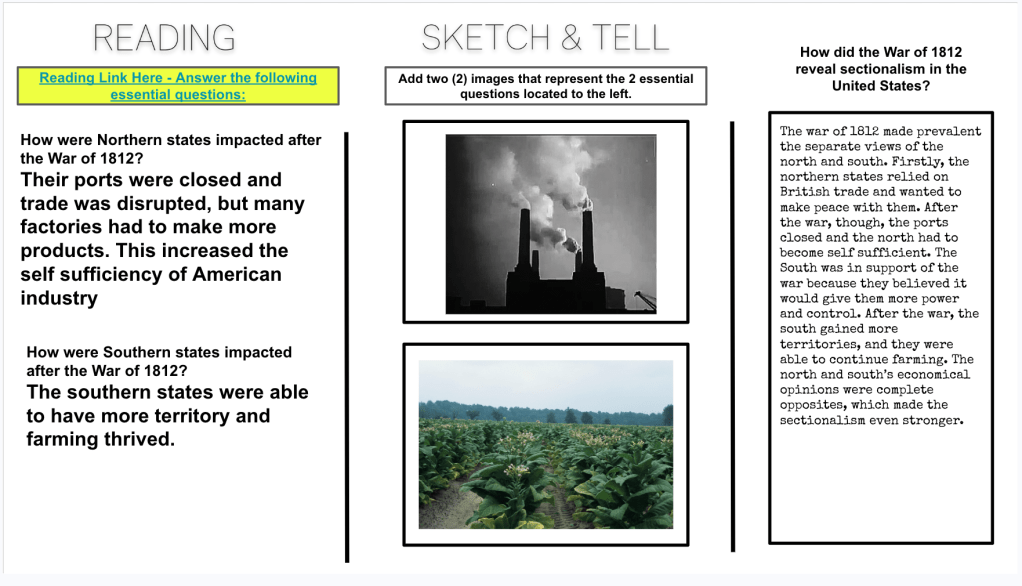
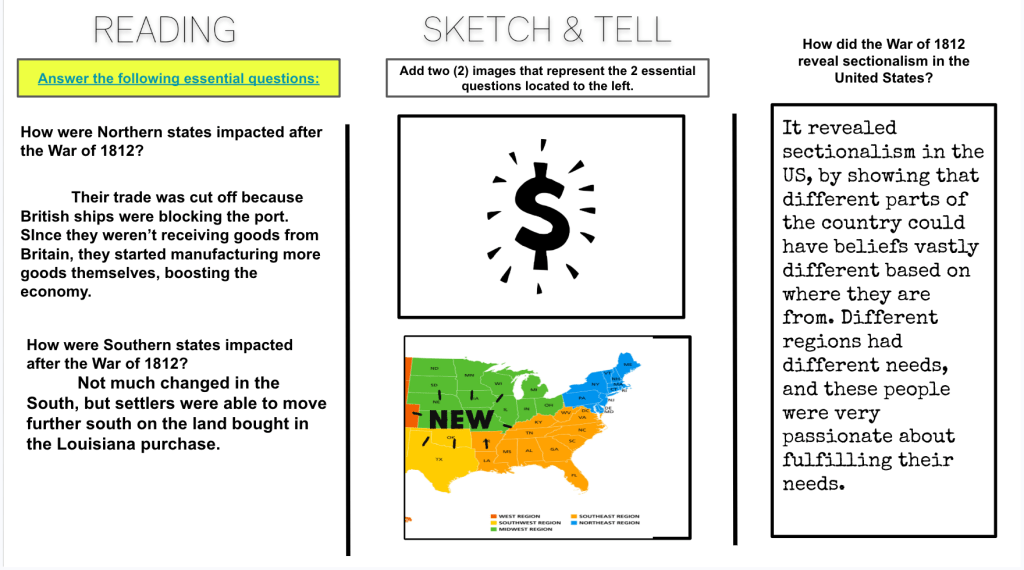
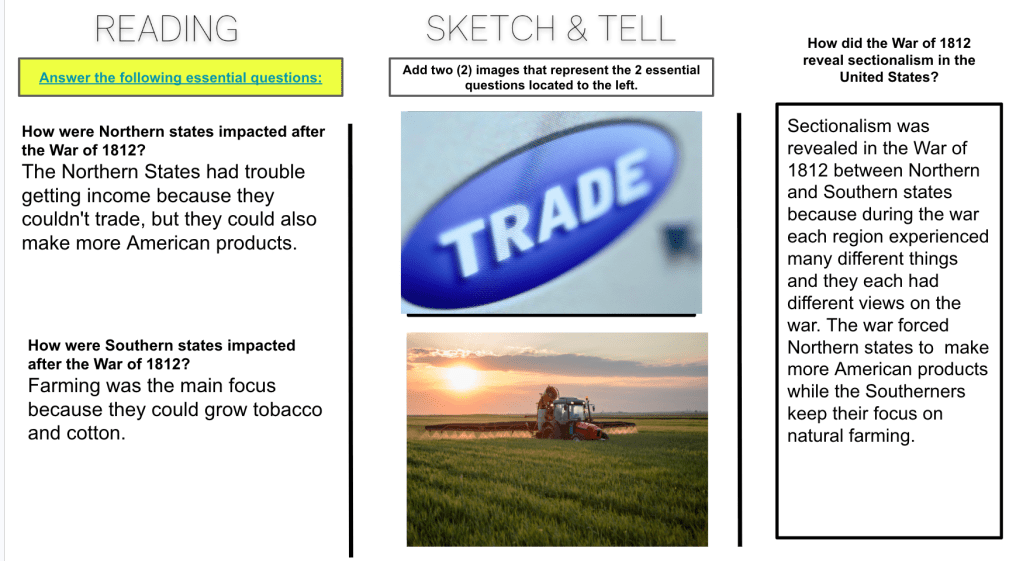
From there, we moved into a Sketch and Tell combined with a CER response.
Students focused on how the War of 1812 affected the North and the South differently. Instead of just listing effects, they had to:
- Show it visually
- Explain it with a claim
- Support it with evidence
This is where things started to click.
Students began to see that the war did not impact everyone the same way. The North and South had different economies, different priorities, and different reactions. That difference is where sectionalism starts to take shape.
Why This Matters
This lesson was not about mastering sectionalism in one day. It was about introducing an idea we will keep building on. Students are starting to see a shift:
The country is no longer just dealing with outside threats. Now, the tension is starting to come from within. And that is a thread we are going to keep pulling on as we move forward.
Wednesday & Thursday – From Tested to Powerful
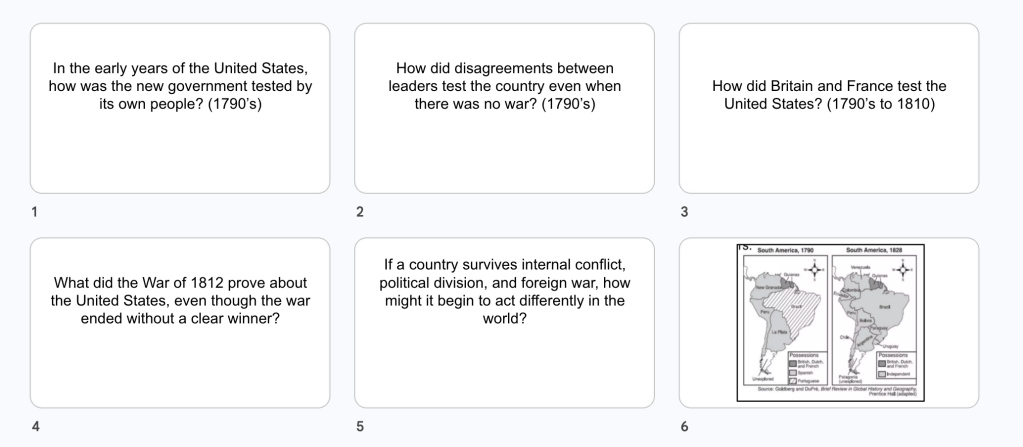
We went back to our unit question: how was the Constitution tested in the early republic? Instead of just reviewing, I wanted students to see the progression of the entire unit. We used a line of questions that walked them through that story, starting with how the government was tested by its own people, then how political disagreements created tension, how Britain and France challenged the United States, what the War of 1812 proved, and finally what a country might do after surviving all of those challenges.
Rolling Recaps
We turned those questions into a Rolling Recap. I rolled the dice, and students had to answer using that exact number of words. This forced them to be precise and focus on what mattered most. It was quick, but it pushed them to revisit everything we had learned and organize it clearly in their heads.
Expanding the World
From there, we shifted outward. Students looked at what was happening in South America by comparing maps from the late 1700s to the 1820s, noticing the shift from European control to independence movements. Using Map and Tell, they explained what they saw and why it mattered. At this point, the story was no longer just about the United States. It was about the Western Hemisphere.
Introducing Monroe and Uncle Sam
Next, we introduced James Monroe and connected him to Uncle Sam, a symbol students recognize. We talked about how Uncle Sam came out of the War of 1812 and began to represent the identity and power of the United States. This helped students start thinking about how the country saw itself and how it wanted to be seen by others.
Predicting the Monroe Doctrine
Before giving them the actual doctrine, we had students try to figure it out on their own. They analyzed political cartoons around the room, made observations, and developed predictions. Many noticed Uncle Sam taking a strong stance in North and South America, often blocking or warning European powers. Some pointed out clear boundaries or messages like “keep out” or “off limits.” Without being told directly, they were already building an understanding of what the Monroe Doctrine might mean.
Checking Our Thinking
To finish, students read a short passage and answered questions to confirm or revise their predictions. They learned that the Monroe Doctrine established that the United States would stay out of European conflicts, that European nations could not create new colonies in the Americas, and that any interference in the Western Hemisphere would be seen as a threat.
The Big Shift
This was the point of the lesson. At the beginning of the unit, the United States was being tested by its own people, by political parties, and by foreign nations. Now students are seeing something different. The United States is no longer just reacting. It is setting expectations and drawing boundaries.
The country moved from trying to survive to showing confidence and control, and that shift is what makes the Monroe Doctrine matter.
Friday – Making the Connections
Friday was the start of our end of unit assessment, and everything shifted from learning to putting it all together.
Quizizz Check-In
Before we jumped into the assessment, I ran a Quizizz Mastery Peak to see where students were at. The first attempt percentages on a 25-question set were 85%, 83%, 75%, 84%, and 84%, which is exactly what you hope to see going into an assessment. It showed that students were not just participating throughout the week, they were actually retaining and understanding the content.
Hexagonal Thinking Begins
From there, we moved into hexagonal thinking as our summative assessment. Students were given a set of key concepts from the unit, including ideas like strict vs. loose interpretation, presidential power, sectionalism, the National Bank, the War of 1812, and the Monroe Doctrine.
Their task was not to define them, but to make sense of them by choosing 10 hexagons that best answered the unit question, connecting them into one complete group, and explaining how each connection made sense. The driving question remained the same: how was the Constitution and government tested in the early republic?
Thinking Through Conversation
This is the part I keep coming back to. I love the questions and discussions hexagonal thinking brings because students were constantly talking, debating, and adjusting their thinking as they built their connections. It was not quiet or isolated. It was active, messy, and meaningful.
In my opinion, assessments should be collaborative between students and between students and the teacher. The conversations happening during this activity were far more meaningful than circling A, B, C, or D on a test because students were justifying their thinking, challenging each other, and refining their ideas in real time.
The last part of the task pushed them even further as students answered what was the biggest test of the Constitution in the early republic. They had to make a claim, support it with evidence, and explain their reasoning, which brought everything from the unit together.
Why It Worked
This felt like a true ending to the unit because instead of returning to a traditional test, students were organizing everything we had learned and making their own meaning out of it. It gave them ownership of the content and showed how they were thinking, not just what they could recall. After seeing the Quizizz data and listening to the conversations during the activity, it was clear they were ready.
Lessons for the Week
Monday – Mr. Roughton’s Site (War of 1812)
Tuesday – Sectionalism/War of 1812
Wednesday and Thursday – a lesson I purchased a long time ago so I can’t share it (sorry)
Friday – Hexagonal Thinking

 Moler's Musings