
Tuesday
After a long weekend, we jumped back into our Text Quest and focused on the Three-fifths Compromise and the compromise over the Atlantic slave trade. To check what stuck from last week, we opened with a Quizizz. Class averages came in at 75%, 80%, 85%, 90%, and 94%. I will take that. We are trending up and holding onto content.
Next, I handed out a short reading on compromises over slavery. It was written in a clear cause and effect structure, so I paired it with a cause and effect organizer: problem in the middle with four causes and four effects. It always surprises me how challenging this is for students because there are no multiple-choice answers or fill-in-the-blanks. Many of these students are used to circling A, B, C, or D, filling in pre-made notes, or copying from a slideshow. When the task shifts to deciding what matters, some of them freeze. The good news is that they are getting used to my style and slowly learning how to figure out what is important. My goal is not just to get them through the content. I want them thinking about history and how it relates to them.
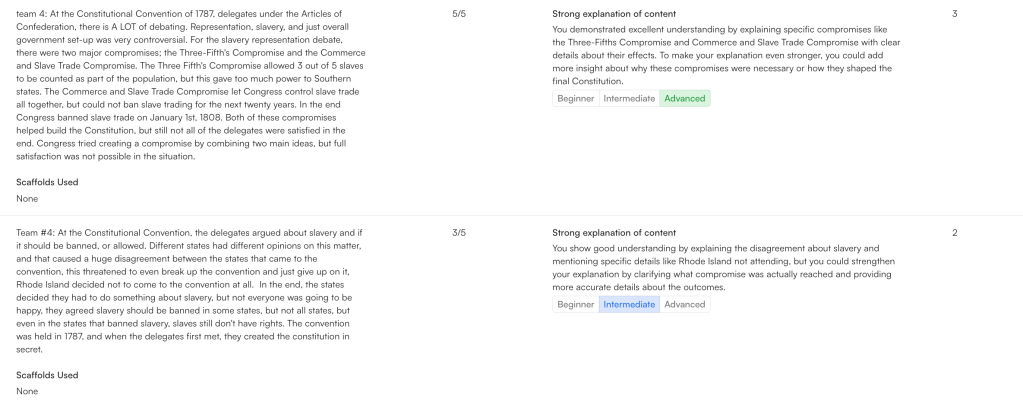
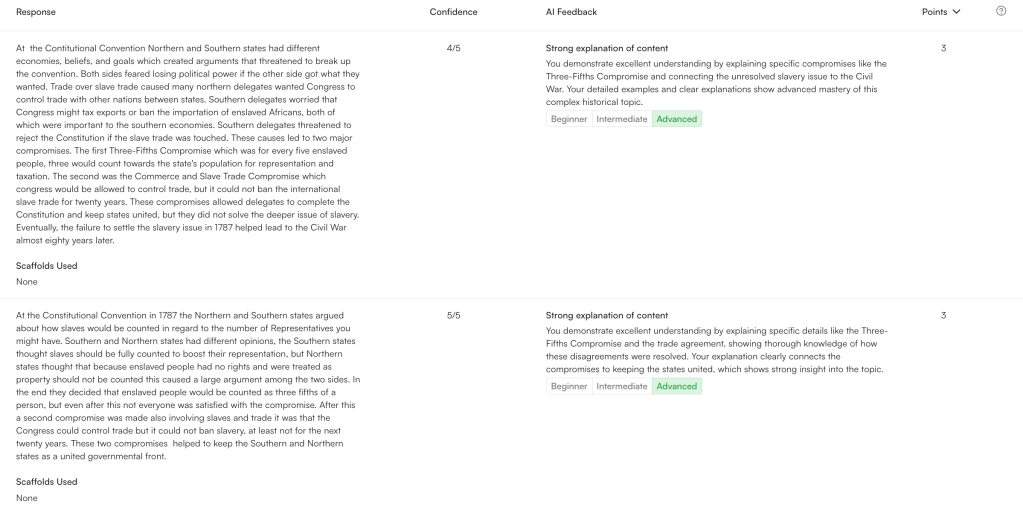
After about ten minutes, we shifted into My Short Answer using the Quick Write feature. I gave everyone a poorly written paragraph and asked them to fix it with better information. The only criteria I set in the AI feedback tool was “clear explanation of content.” Since this was our Bonus Battle for the Text Quest, I created a scoring system based on the feedback ratings: beginner earns 1 point, intermediate earns 2 points, and advanced earns 4 points because advanced is actually hard to achieve.
The motivation was real. Students genuinely wanted to earn points for their teams, so they slowed down and wrote with purpose. The improvement from the original paragraph to the revised version was noticeable, and the teamwork energy was exactly what I hoped for. Overall, it was a strong day.
Wednesday and Thursday
Daily Debate: How Should We Choose a President?
To close out our Text Quest, I shifted into how the United States chooses a president and the compromises behind that decision. For our final daily debate, students had five minutes to work with their groups and write a claim with evidence and reasoning about how the president should be chosen. I framed it as the 1790s. There are no phones, no television, people are disconnected from each other, and news travels slowly. The three choices were direct popular vote, Congress chooses, or state legislatures choose. Five minutes went quick, but students debated, wrote, and defended their arguments. I collected their cards, read them aloud, and ranked first through fourth place finishers.
Pre-Simulation Scenario and Discussion
For our final Bonus Battle, I needed something lively. The students have been buzzing all week because a big snowstorm is on the way. I try to match student energy and adjust lessons instead of forcing something that will not land. Before the simulation, I put a scenario on the board:
Two presidential candidates run. Candidate 1 gets 66 million votes. Candidate 2 gets 63 million votes. Who wins?
Most students made faces at the question and at me. I told them it was not a trick. Almost everyone agreed Candidate 1 should win because they had more votes. That is how most games work in their world. Score more points and you win. Then I revealed that the scenario was Clinton vs Trump in 2016. Confusion followed, which was perfect. I explained that the founders essentially blended all three options from the daily debate into the Electoral College system. Citizens cast votes, states hold certain numbers of votes based on representation, and electors officially cast votes on behalf of the people.
Electoral College Simulation (I cannot share this file)
Then we ran the simulation. Students paired up with someone from another team. Each pair received dice and a sheet with twenty-six rounds. A slide told them to roll the dice. The highest roll won the round. The next slide showed two unlabeled state outlines. The highest roller chose left or right or named the state. The other state went to the lower roller. Then I revealed the electoral votes. The race to 270 was loud, competitive, and fun. When we reached California, which everyone wanted, there was a twist. The highest roller thought they secured it, but then I required a reroll to simulate a recount. Sometimes they kept it, sometimes they lost it. The reactions were priceless. After the final state, I totaled all electoral votes and averaged them by team to determine first through fourth place.
Reading and Frayer Model
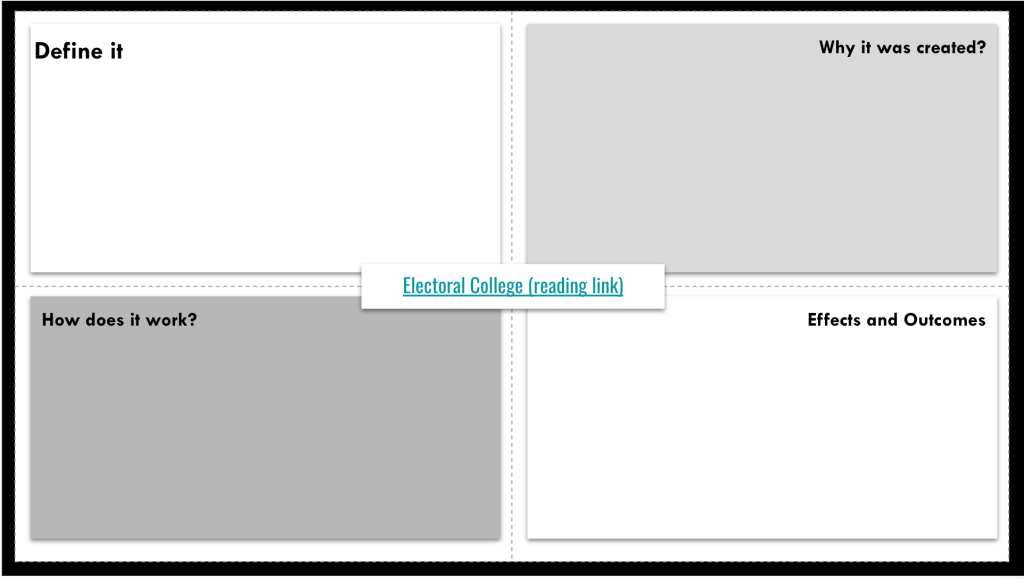
I rarely assign homework because I understand how middle school homework actually plays out. This time I sent home a reading on the history of the Electoral College. I attached a Frayer model with four prompts: Define, Why was it created, How does it work, and Effects and outcomes.
Annotate and Tell with Hamilton
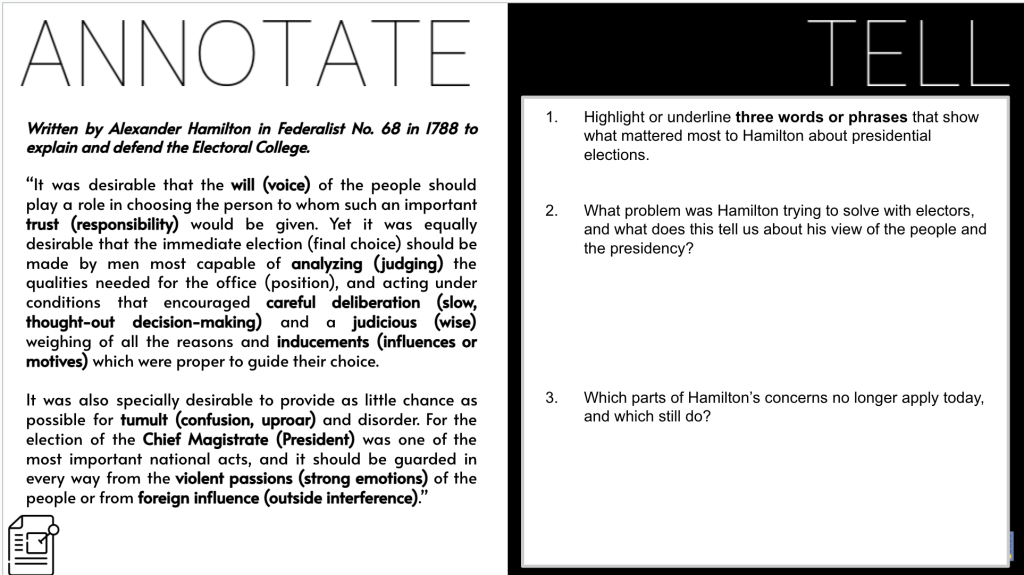
To close the loop, I assigned an Annotate and Tell with Hamilton’s Federalist 68 in support of the Electoral College. I included two guiding questions to anchor their thinking:
• What problem was Hamilton trying to solve with electors, and what does this tell us about his view of the people and the presidency?
• Which parts of Hamilton’s concerns no longer apply today, and which still do?
Overall, these two days mixed debate, simulation, reading, annotation, and writing. The students handled the shifts well and it was a strong finish to our Text Quest.
Friday
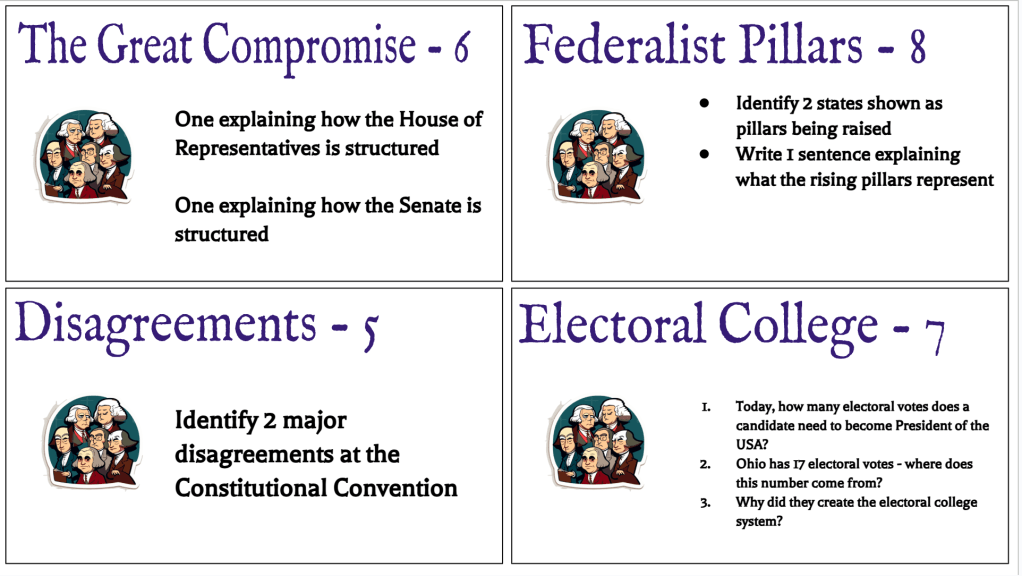
Friday was all about getting students up and moving again. The energy level has been high all week because everyone is watching the weather and talking about the snow, so I needed something physical and fast that still hit content. I set up a Resource Rumble by placing eight envelopes around the room and giving each group a recording sheet. Each envelope had a different task connected to what we have been learning. Students moved to an envelope, completed the task, and then brought their sheet to me for feedback. If their answer was good enough, they earned a dice roll.
The dice roll let groups collect that many Jenga blocks. The goal was simple: build the tallest tower in the room. It created a fun mix of academic checking, instant feedback, fast movement, and problem solving. Groups had to talk through their answers, agree on what to write, and then sprint back to build before another group passed them. There was zero down time and everyone was involved.
This matched the energy of the day perfectly. Students were lively but focused, and it gave them a productive outlet for all the snow day excitement. It was a great way to end the week.
Lessons for the Week
Tuesday – Three-Fifths Compromise Reading
Wednesday and Thursday – Electoral College Reading, Frayer and Annotate

 Moler's Musings