
Monday
Monday was one of those keep the storyline going days. We are still building the Road to the Revolution, but instead of dumping vocab or giving kids a list of causes, I am trying to tell it like an actual unfolding story through the people who lived it.
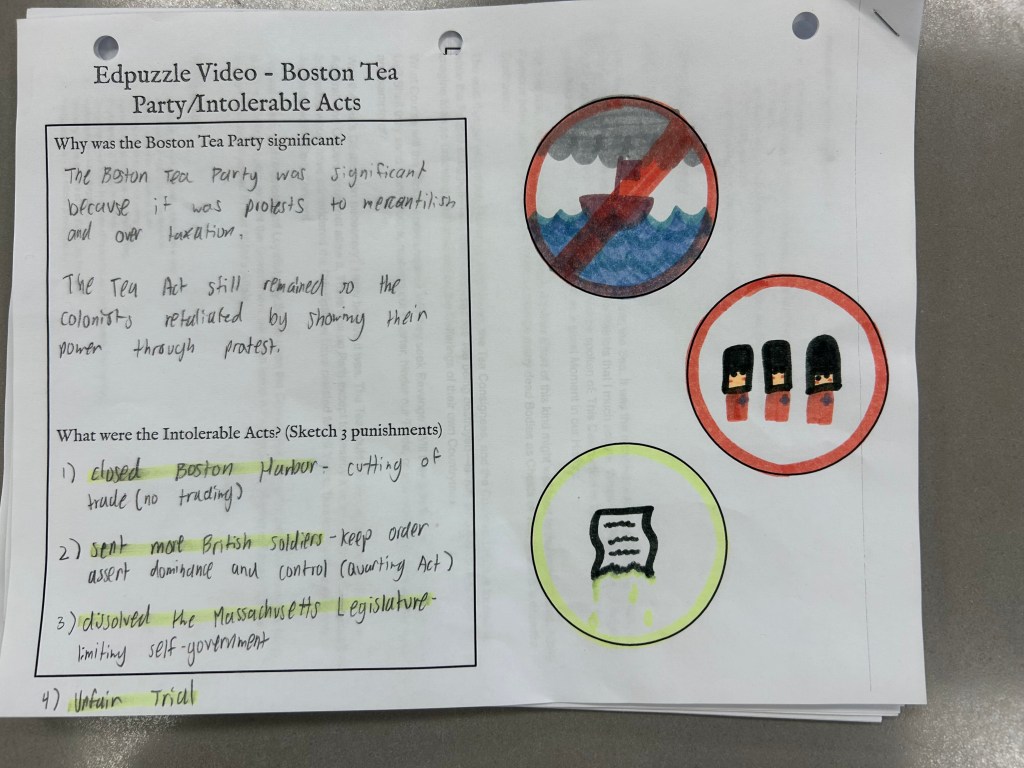
I pulled a short video from the American Battlefield Trust that covered the Boston Tea Party and the punishments that followed. I had a moment where I thought, “We could totally Number Mania this.” Looking back, I probably should have done it with a new twist. My brain was foggy and I did not have the creative energy to reinvent the wheel on a Monday morning.
Instead we kept it simple. Students answered the question: What was the significance of the Boston Tea Party? It was straightforward, but it pushed them to think beyond “they dumped tea.”
Then we moved into a Sketch and Tell O on the punishments from the Intolerable Acts. It was quick, visual, and it worked for our shortened 30 minute classes.
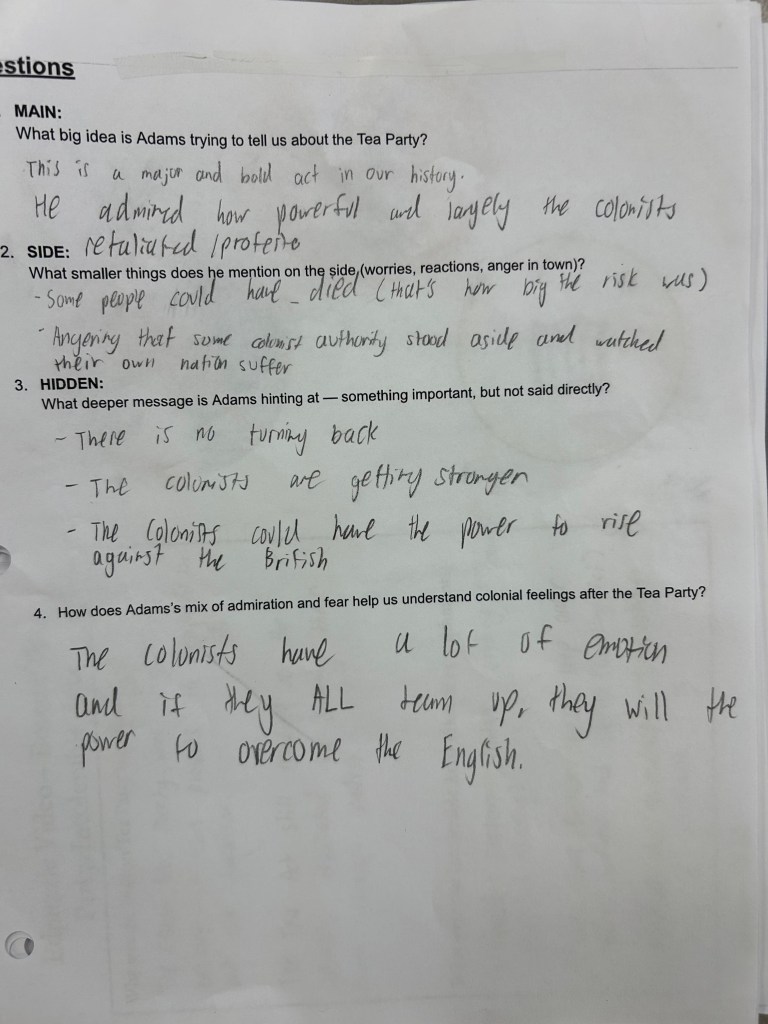
The highlight of the day was bringing in a diary entry from John Adams. He admired the boldness of the Tea Party but also feared what might come next. He predicted the Intolerable Acts before they happened. That got the kids attention.
I paired the letter with the Main, Side, Hidden strategy we have been using:
• The main idea of Adams reflection
• The side ideas he mentions
• The hidden message sitting underneath his words
Even in a short class period, they pulled out solid thinking. For a shortened schedule day, that felt like a win.
Tuesday
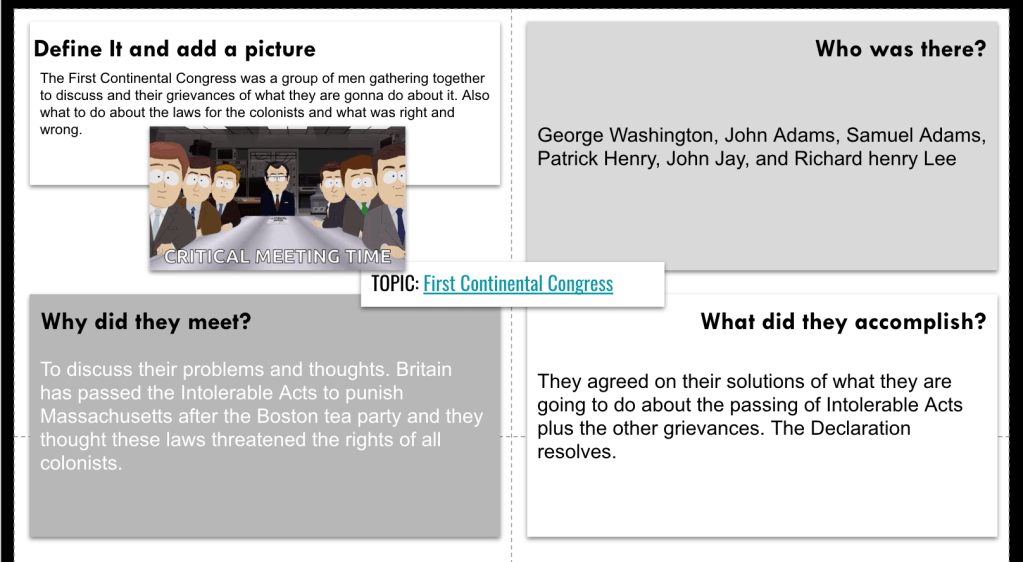
Tuesday kept the story moving. We shifted into the First Continental Congress and started with a Frayer. I linked a short reading in the middle of it so they had context before filling it out. Students had to define the First Continental Congress, list people who were there, list characteristics, and include a picture. It was simple and structured, and it helped them see this meeting as an actual event with real people, not just a vocabulary term.
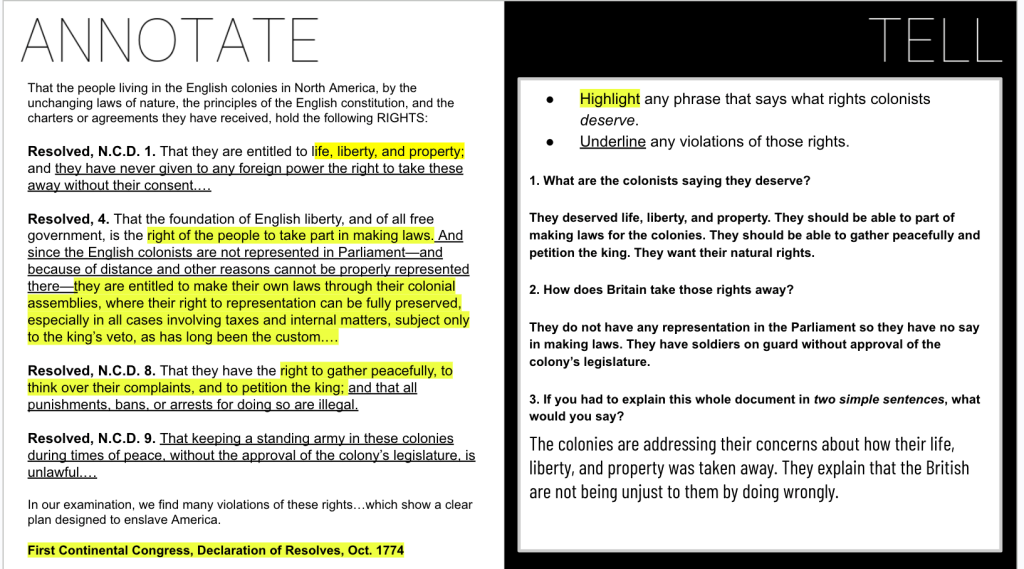
Next we moved into an Annotate and Tell with the Declaration of Resolves. I had to explain two things right away. First, resolves are agreements. Second, the abbreviation N C D is Latin for nobody disagreed. Kids get tripped up by things like that, so clearing it upfront helped them focus on the meaning.
For annotation I gave them these prompts:
• Highlight any phrase that says what rights colonists deserve.
• Underline any violations of those rights.
And they answered:
- What are the colonists saying they deserve
- How does Britain take those rights away
- If you had to explain this whole document in two simple sentences, what would you say
To close out the lesson, I had students write a haiku. It worked perfectly because it connected to what they have been doing in language arts. This is the second time I have overlapped with language arts. The first time was when they wrote a summary using the somebody wanted but so then format. It was awesome to see them use a skill from one class and apply it in another.




Wednesday and Thursday
By midweek it was time to wrap up the unit, and I decided the summative assessment would be a one pager. Not a decorative one. An argumentative one. Students had to explain the reasons loyal colonists began fighting against their own government, and they also had to explain why some colonists would have chosen to stay loyal. It asked them to balance perspective, make a claim, and show their thinking.
Setting it up felt good, and I did not fully realize why until later in the afternoon. Two parents were touring the school and stopped by my room. My students were scattered around the room working, thinking, revising, and asking me questions about their ideas. One parent asked what they were doing, so I explained the one pager and mentioned that this was their test for the unit. She looked surprised, so I explained it a little more.
I said something like, “I am not a traditional teacher. I do not think learning is circling A, B, or C. Learning should feel different. It should keep going. We always talk about wanting lifelong learners. Assessments like this actually support that. The best part is the conversations I get to have while they work. They ask how to word ideas, how one event connects to another, and why certain actions mattered. Those moments are real learning.”
She paused for a second and then said she agreed. It felt like she had not considered that idea before. The truth is, I had not really considered it in that way either until I heard myself say it out loud.
These one pagers, and really any nontraditional assessment we have done this year, whether a Netflix summary, a hexagonal web, or an annotated map, naturally create conversation. Kids stop and think. They ask questions. They revise. They explain. When I gave a traditional test at the start of the year, none of that happened.
I think we often treat a summative assessment like a finish line. You know it or you do not, and then we move on. This assessment pushed back on that idea. It became part of the learning, not the end of it. And it reminded me that when we design assessments that invite curiosity instead of shutting it down, students rise to it.
Friday
Friday was exactly what we needed. We played Gimanji, an Alexis Turnbull classic, and it was the perfect way to head into a long break. We mixed Kahoot, Gimkit, Quizizz, and Blooket into one big review of everything we have learned this year. The kids were into it, the energy was high, and the room felt light after a heavy unit.
I like Gimanji because it does not feel like a test review. It feels like a celebration of what they know. They laugh, they compete, and they surprise themselves with how much they remember. It is the kind of day that ends a week on a high note and sends everyone out the door in a good mood.
Lessons This Week
Monday – Sketch and Tell-o, John Adams Diary
Tuesday – 1st Continental Congress Rack and Stack
Wednesday/Thursday – One Pager Directions

 Moler's Musings