Sometimes, teaching history means peeling back the layers. Literally.
It was late in the year, and I just wanted to mix things up. We’d been hitting heavy content, and I needed something different—not easier, just… different.
So I asked AI to help.
We were covering the Lincoln-Douglas debates—a pivotal moment tied to the expansion of slavery and the rise of the Republican Party. I pasted a section of our textbook into ChatGPT and gave it a twist: “Rewrite this reading. Keep all the key facts. But embed five subtle clues to an object: an orange. Don’t name it. Just hide it.”
The clues?
- wedge
- sections
- bitter
- peel
- squeeze
But here’s the thing—I didn’t tell the students that.
I left the rewritten passage with the sub, followed by the usual reading questions. No mention of any mystery. No hint that something fun was coming.
Only after they answered the questions did I drop the surprise:
A Padlet link with the challenge.
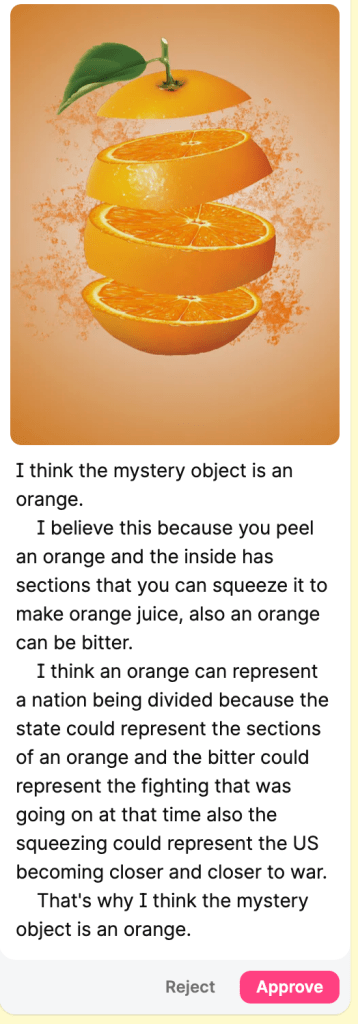
“Based on the clues in the reading, what mystery object do you think I was thinking of? Add your guess. Then explain how it connects to a country being pulled apart by the issue of slavery.”
To make it more interesting—and to avoid copycat answers—I changed the Padlet settings to manual approval. No one could see each other’s guesses.
And just like that, reading became a puzzle.
The guesses poured in: a violin? a broken flag? a lemon zest?
And then came the ones that nailed it: an orange.
Their follow-up explanations were exactly what I hoped for:
- “The country was in wedges, pulling away from the center.”
- “There were different sections that couldn’t stay together.”
- “Once you peel it, you can’t undo it.”
- “Everyone was getting squeezed from both sides.”
That day, the students didn’t just complete another textbook reading.
They investigated. They connected. They created a metaphor.
Why This Works:
This isn’t fluff. It’s curiosity-driven, metaphor-based reading that builds real skills.
Here’s the breakdown:
- Choose a reading worth understanding deeply.
- Pick an everyday object that metaphorically fits the moment.
- Use AI to embed 4–6 subtle clues.
- Let students read and respond as usual.
- Then drop the mystery object twist: guess and explain the metaphor.
It turns reading into a mystery.
It turns metaphor into meaning.
It turns a late-year lesson into something different because we all need that during this time of year.



 Moler's Musings