This week in 234, we stacked a lot of learning into five days—Fast & Curious, Frayer Models, Mini Reports, Short Answer Battle Royales, and even a Netflix-themed summative. We used Thin Slides and AI tools like MagicSchool to keep thinking sharp and feedback immediate. Students worked through compromises, created empathy maps, asked hard questions, and wrapped it all up with creative final products. Every day had a clear task, a familiar structure, and a chance to show what they knew in a new way.
Tuesday/Wednesday – Missouri Compromise Rack and Stack
Thursday – MiniReport Compromises Rack and Stack
Friday – Netflix Template
Monday: New Unit
I wasn’t at school Monday, but I still wanted the lesson to move thinking forward. This was the day to bridge the gap between our work on reform—especially abolitionism—and the new unit on the causes of the Civil War. I didn’t want it to feel like two separate things. I wanted students to start seeing the threads.
I started them with an EdPuzzle on the causes of the Civil War. This was more of a primer than anything—just to introduce key ideas like sectionalism, states’ rights, and slavery as a cause, not a side detail. From there, they jumped into a vocabulary Quizizz to build some retrieval around terms like secession, abolitionist, compromise, and conflict. The goal was to give them some anchors before diving deeper later in the week.
Next, students read a short piece on the Abolitionist Movement. The reading focused on how individuals and laws pushed against slavery in different ways—through writing, escape networks, and protest. They answered four questions in complete sentences, which gave structure without overloading them. This is always a key decision I think about when I’m not there: clarity over complexity.
Finally, they went to a Padlet where they shared two things they learned and responded to the big question: “What was the cause of the Civil War?” That question, in one form or another, is going to guide us the next couple weeks. And I wanted them thinking about it early—even if their answer was rough.
None of it was flashy, but it had purpose. It helped me set up our three guiding themes for the unit:
- Compromises Can’t Solve Slavery
- A Nation Divides
- Getting Ready for War
The best part is it gave them space to revisit old knowledge and preview new ideas—and when I returned Tuesday, they were ready to build.
Tuesday/Wednesday: The Missouri Compromise
Our theme this week was “Compromises Can’t Solve Slavery,” and this lesson focused on the Missouri Compromise.
We opened with a Quizizz for vocabulary and retrieval—terms like “compromise,” “balance,” and “slave vs. free states.” I originally planned to use a Frayer Model for the word “compromise,” but students already demonstrated understanding on Quizizz, so I cut it. Real-time data helps guide what stays and what goes.
Then we jumped into Upside Down Learning (from EMC2Learning), scaffolded with three categories: Cause, Conflict, and Compromise. Above the line, students charted accurate info from the Missouri Compromise reading. Below the line, they created an alternate reality—what if Missouri hadn’t joined as a slave state? What if no compromise had happened? It’s a quick way to push thinking to higher levels of Bloom’s—synthesis and evaluation.
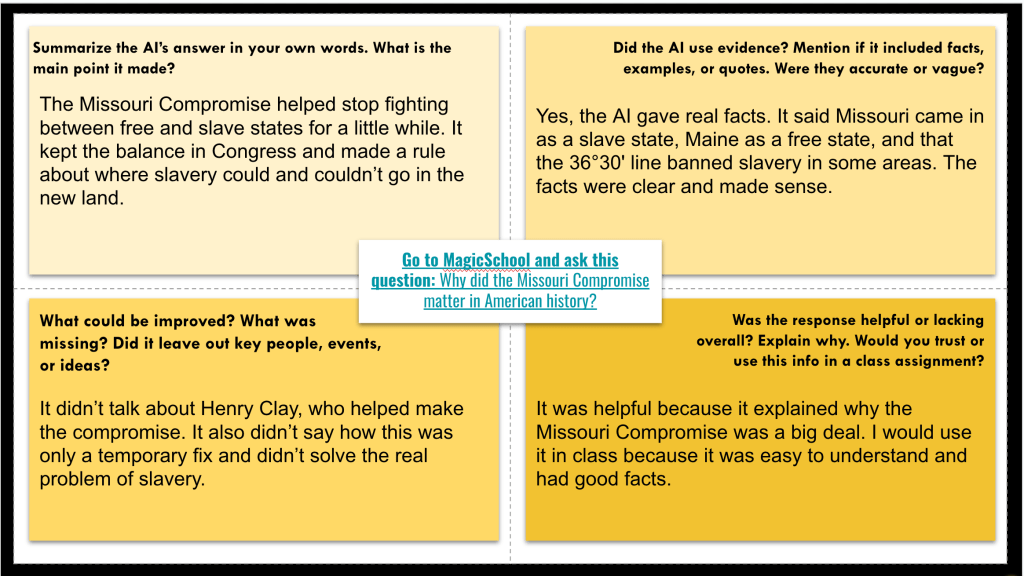
Next came a task I call Fray-I. I wanted students to ask a question that the reading didn’t answer. Then, using MagicSchool’s Raina AI, they typed in their question and completed a Frayer-style evaluation:
- What was the main idea of the AI’s response?
- Did it use evidence?
- Was anything missing?
- Would you trust this response?
We ended with an Empathy Map based on two primary sources—one from a Northerner and one from a Southerner debating slavery in the West. After reading, students chose one voice and filled out an empathy map to process their perspective.
Why this worked:
It hit different levels—retrieval, evaluation, synthesis. The tasks built on each other and helped students understand compromise not just as a definition, but as a broken fix in a broken system.
And AI wasn’t just an “add-on”—it was a skill. Ask. Analyze. Evaluate.


Thursday – Caption Crunch
Thursday was all about keeping the cognitive load low—but not the learning. I’m running out of days before testing hits, and I knew I had to get both the Compromise of 1850 and the Kansas-Nebraska Act into one lesson. Normally, I’d spread those out. But I’ve learned that reducing the number of tasks while still keeping the thinking high is one way to keep the load manageable. It’s not just about what content you include—it’s also about how you deliver it.
We started with a Fast and Curious on Quizizz. Same core theme questions we’ve been hitting: compromise, slavery, and failure. It got them thinking quickly and primed for the day’s work.
Then we jumped into our Mini-Report. The layout was intentional—students had to compare both compromises side-by-side, using two half-page readings. I’ve found that the Mini-Report structure helps students stay focused, especially when they’ve seen it before. Familiarity builds confidence, and confidence keeps engagement up.
Before we read, I ran an EdPuzzle—some classes did it live, others on their own. I had them write down just one detail from the video to get them warmed up. That’s it. Just one. No overkill, no worksheet—just purposeful priming.
After that, we read and filled in the Mini-Report. No full sentences. Just paraphrased notes to get them processing.
Once they had their facts, we jumped into Short Answer for a Battle Royale. The question: “How did the Compromise of 1850 and the Kansas-Nebraska Act try to solve the issue of slavery, and why didn’t they work?” Students competed for a donut. It sounds silly, but they wrote their asses off. Because there was structure. Because it mattered.

We wrapped up with something new I called Caption Crunch. I set up a Padlet with columns and gave students captions that connected to one of the three compromises we’ve studied. Their task: take the caption, add keywords, and plug it into Padlet’s AI image generator. Then, they posted their AI-generated image and explained in 2–3 sentences which compromise it represented and how the image reflected what happened. The captions were generated by AI, but the decisions and connections were all theirs.
I think Caption Crunch has potential to be an EduProtocol. It pushed students to think symbolically, creatively, and critically about each compromise. And it added another layer of retrieval and review without feeling like “just more reading.” It can be used across all grade levels and content areas.
It was one of those days that felt packed, but purposeful. Everything flowed. Everything clicked. And the kids were into it. That’s what matters.


Friday
Friday was all about wrapping up our first theme—“Compromises Can’t Solve Slavery”—and giving students a chance to pull everything together in a creative way. We kicked off with one final round of the same Quizizz we’d been using all week. And yes, I had to play the game. I told them: If your class average is below 80%, you’re creating more work for yourselves. If it’s above 90%, everyone gets a 100%. It’s ridiculous that I have to do that, but here we are.
One class came in at 70%. Honestly? Unbelievable. We’ve been doing this same Quizizz set every day. So that class had to do a three-way Venn diagram comparing the Missouri Compromise, Compromise of 1850, and Kansas-Nebraska Act. The other classes finished at 87%, 83%, and 80%—so they moved on to the main activity: the Netflix Template.
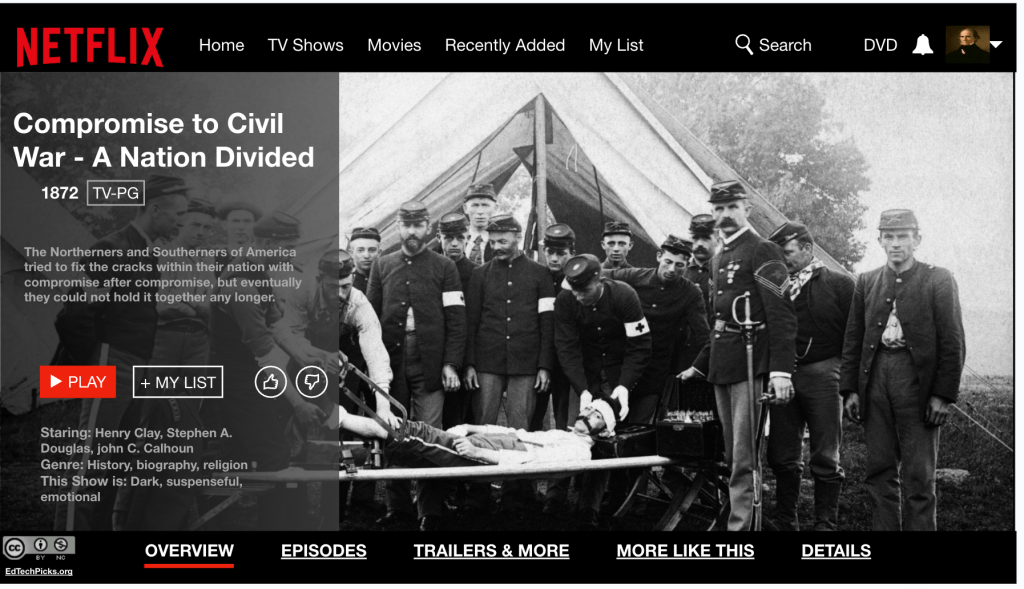
This is one of my favorite creative assessments. I’ve had this template forever—I can’t even remember where I got it—but it’s sharp. Looks like a real Netflix series and pushes students to synthesize in a unique way. Here was the success criteria:
Slide 1:
- Series Title
- A 3–4 sentence summary connecting the compromises and showing how they represent failure
Slide 2:
- Creative episode titles (one per compromise)
- A short summary that explains:
- What the compromise tried to fix
- What actually happened
- Any relevant key terms (Fugitive Slave Act, Bleeding Kansas, etc.)
- A thumbnail image, cast list (Henry Clay as “The Great Compromiser”), and a content warning
I also created a MagicSchool classroom where students could attach their Netflix slides and get writing feedback. I like that part because it’s easy to set up and it lets students take some ownership. Some kids were tweaking titles, some were improving explanations, and some were learning how to actually use Google Slides better.
That part is underrated. I had students asking, “How do I layer these images?” or “How do I crop this picture into a shape?” and I got to teach them real tech skills while they were working through content. So yeah, it wasn’t just about summarizing compromises—it was about learning how to design, write, and revise creatively.
That’s a win in my book.




 Moler's Musings